
In This Article
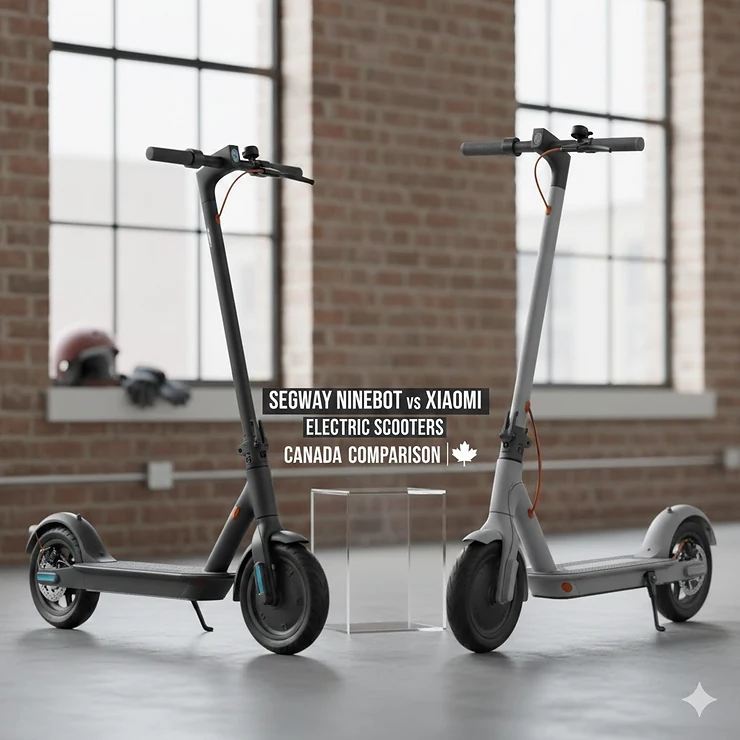
The urban mobility revolution has reached Canadian streets, and two titans dominate the conversation: Segway Ninebot and Xiaomi. If you’re standing in Best Buy or browsing Amazon.ca trying to decide between these brands, you’re not alone. The Segway Ninebot vs Xiaomi Electric Scooters comparison has become the most searched query among Canadian commuters looking to ditch their cars for the morning rush.
Here’s what makes this choice so compelling: both brands offer premium e-scooter technology backed by years of innovation, but they approach the market differently. Segway Ninebot focuses on integrated ecosystems with features like Apple Find My and advanced suspension systems, while Xiaomi emphasizes sleek minimalist design with robust app connectivity. Canadian riders face unique considerations too—from Quebec’s pilot programs running until 2026 to Ontario’s extended regulations through 2029, plus our harsh winters that test every component.
Whether you’re navigating Toronto’s bike lanes, cruising Vancouver’s seawall, or commuting through Montreal’s streets, understanding the nuances between these brands saves you hundreds of dollars and countless headaches. This comprehensive guide breaks down everything from motor power and battery capacity to spare parts availability and customer service responsiveness across Canada.
Quick Comparison Table
| Feature | Segway Ninebot | Xiaomi |
|---|---|---|
| Price Range (CAD) | $544 – $1,399 | $938 – $1,199 |
| Top Speed | 25-35.4 km/h | 25-30 km/h |
| Max Range | 25-70 km | 50-60 km |
| Motor Power | 300W – 1000W | 350W – 1000W |
| Weight Capacity | 90-100 kg | 100 kg |
| Build Material | Aerospace aluminum | Aircraft-grade aluminum |
| Key Advantage | Superior suspension systems | Self-sealing DuraGel tires |
| Canadian Availability | Excellent | Good |
💬 Just one click – help others make better buying decisions too! 😊
Top 7 Segway Ninebot vs Xiaomi Electric Scooters: Expert Analysis
1. Segway Ninebot MAX G2
The Segway Ninebot MAX G2 represents the pinnacle of the brand’s engineering prowess in the Canadian market. This powerhouse features a 900W rear-wheel drive motor with RideyLONG technology that delivers sustainable propulsion across all road conditions.
Key Specifications:
- Motor: 900W (1400W peak)
- Range: Up to 70 km (Eco mode)
- Top Speed: 35.4 km/h
- Battery: 551Wh high-capacity
- Price: $799-$1,199 CAD
Canadian riders particularly appreciate the dual suspension system—hydraulic damper up front and double spring suspension at the rear—which handles our notorious potholes with grace. The Traction Control System (TCS) is a game-changer for slippery winter conditions, automatically adjusting power delivery when roads get sketchy. Self-healing 10-inch tires seal punctures up to 4mm, a blessing given our construction-heavy streets. Best Buy Canada frequently stocks this model, and it’s available on Amazon.ca with free shipping.
Pros:
✅ Exceptional 70km range
✅ TCS for Canadian weather
✅ Apple Find My integration
Cons:
❌ Premium pricing
❌ Heavier at 24.5 kg
Canadian buyers report solid performance in temperatures down to -10°C, though range decreases about 25% in extreme cold.

2. Xiaomi Electric Scooter 4 Pro
The Xiaomi Electric Scooter 4 Pro challenges Segway’s dominance with world-class IoT security certification. This model earned UL’s IoT Security Rating Gold Level 3 certification—the first scooter ever to achieve this distinction.
Key Specifications:
- Motor: 700W maximum power
- Range: 55 km
- Top Speed: 25 km/h
- Battery: 446Wh
- Price: $938-$1,199 CAD
What sets this scooter apart is its upgraded size—60mm taller, 68mm longer, and 54mm wider handlebar than predecessors. The 10-inch DuraGel tubeless self-sealing tires eliminate puncture worries, using gel compound that automatically seals holes up to 4mm. Xiaomi’s magnetic charging port is brilliantly simple—it clips in by itself, no fumbling required. The aerospace-grade aluminum frame keeps weight manageable at 17 kg while maintaining structural integrity.
Pros:
✅ Top-tier IoT security
✅ Self-sealing tires
✅ Magnetic charging
Cons:
❌ Lower top speed
❌ Limited Canadian retailers
Available through Walmart.ca and select retailers, though stock fluctuates seasonally.
3. Segway Ninebot E2 Plus II
The Segway Ninebot E2 Plus II targets budget-conscious Canadians who refuse to compromise on quality. At just $544 CAD on Amazon.ca, this entry-level model delivers surprising value.
Key Specifications:
- Motor: 300W (500W peak)
- Range: 25-26 km
- Top Speed: 25 km/h
- Battery: 220Wh
- Price: $544 CAD
This beginner-friendly scooter features front suspension—rare in its price bracket—and 8.1-inch shock-absorbing inner hollow tires. The large LED dashboard remains readable in bright Canadian summer sun, and the UL-2272/2271 certifications ensure safety standards exceed regulatory requirements. Weight capacity hits 90 kg (198 lbs), accommodating most adult riders comfortably. The Smart Battery Management System includes six protection mechanisms against overcharging, overheating, and overcurrent.
Pros:
✅ Outstanding value
✅ Front suspension
✅ Lightweight 13 kg
Cons:
❌ Shorter range
❌ Basic features
Perfect for Toronto commuters covering 5-8 km each way who want reliable performance without breaking the bank.
4. Xiaomi Electric Scooter 4 Pro (2nd Gen)
Building on the original’s success, the Xiaomi Electric Scooter 4 Pro (2nd Gen) ups the ante with 1000W maximum power and 60 km range. This iteration addresses Canadian concerns about battery performance in cold weather.
Key Specifications:
- Motor: 1000W max power
- Range: 60 km
- Top Speed: 25 km/h
- Battery: 468Wh
- Price: $1,104 CAD
The dashboard angles perfectly for viewing while riding, displaying speed, battery, turn signals, and scooter status simultaneously. E-Mark certified turn signals meet European safety standards—bright enough for Canada’s frequent overcast days. The auto-adaptive headlight activates in dim conditions via the Xiaomi Home app, a thoughtful touch for early morning commuters. Multiple energy recovery modes convert braking kinetic energy back into battery power, extending range by 8-12% according to user reports.
Pros:
✅ Powerful 1000W motor
✅ Auto headlight
✅ E-Mark turn signals
Cons:
❌ Higher price point
❌ Heavier 18 kg
5. Segway Ninebot MAX G3
The Segway Ninebot MAX G3 represents the next evolution with 11-inch tubeless tires and dual hydraulic suspension. While pricing hasn’t stabilized in Canada yet, expect $1,299-$1,499 CAD based on US market positioning.
Key Specifications:
- Motor: 1000W
- Range: 80 km
- Top Speed: 45 km/h
- Battery: 608Wh
- Tire Size: 11 inches
This flagship model features dual hydraulic disc brakes—a significant upgrade over drum brakes—providing consistent stopping power in wet conditions. The 11-inch tires handle Ottawa’s winter-damaged roads better than smaller alternatives, reducing rider fatigue on longer commutes. Integrated turn signals front and rear ensure visibility in Canadian traffic. The folding mechanism remains robust even after hundreds of cycles, addressing a common complaint with budget scooters.
Pros:
✅ Hydraulic disc brakes
✅ Massive 80km range
✅ Comfortable ride
Cons:
❌ Premium pricing
❌ Limited Canadian availability

6. Xiaomi Mi Electric Scooter Pro 2
Though an older model, the Xiaomi Mi Electric Scooter Pro 2 remains popular among Canadian bargain hunters. Street prices hover around $699-$849 CAD on Amazon.ca marketplace sellers.
Key Specifications:
- Motor: 300W nominal, 600W peak
- Range: 45 km
- Top Speed: 25 km/h
- Battery: 474Wh
- Weight: 14.2 kg
This proven workhorse balances affordability with genuine Xiaomi quality. The 8.5-inch pneumatic tires provide cushioned rides, though they’re vulnerable to punctures—keep tire sealant handy if you choose this route. The Xiaomi Home app offers detailed ride statistics, firmware updates, and customizable cruise control settings. Battery life holds up remarkably well even after 2-3 Canadian winters, though expect 20-30% capacity loss over time.
Pros:
✅ Proven reliability
✅ Lightweight 14.2 kg
✅ Strong community support
Cons:
❌ Older generation
❌ Puncture-prone tires
7. Segway Ninebot F3 Pro
The Segway Ninebot F3 Pro occupies middle ground with 10-inch tubeless tires and 44-mile maximum range. Current Canadian pricing sits around $899-$999 CAD.
Key Specifications:
- Motor: 800W peak
- Range: 70 km
- Top Speed: 32 km/h
- Battery: 367Wh
- Suspension: Front hydraulic, rear elastomer
This model strikes an excellent balance for Calgary and Edmonton riders where distances are longer but hills less punishing than Vancouver. The front hydraulic suspension smooths out rough pavement, while the rear elastomer suspension prevents bottoming out on speed bumps. TCS and RideyLONG technology from the MAX series trickle down here, offering premium features at mid-tier pricing. The 10-inch tubeless tires resist punctures better than pneumatic alternatives.
Pros:
✅ Balanced specs
✅ Good value
✅ Dual suspension
Cons:
❌ Mid-range pricing
❌ Moderate top speed
✨ Don’t Miss These Exclusive Deals!
🔍 Take your urban commute to the next level with these carefully selected products available in Canada. Click on any highlighted item to check current pricing and availability on Amazon.ca. These scooters will help you create authentic eco-friendly transportation your family will appreciate!
Build Quality Comparison: Engineering Excellence
When examining Segway Ninebot vs Xiaomi Electric Scooters through the lens of build quality, both manufacturers employ aerospace-grade aluminum alloys—but their philosophies diverge significantly. Segway Ninebot emphasizes structural redundancy with reinforced folding mechanisms and military-grade fasteners. Their scooters typically weigh 1-2 kg more than comparable Xiaomi models, but this translates to enhanced durability for Canadian riders navigating aggressive winter road conditions.
Xiaomi’s approach prioritizes weight optimization without sacrificing strength. Their frame engineering uses strategically placed aluminum extrusions that maximize rigidity in high-stress areas while reducing overall weight. The result? Scooters that handle more portably for apartment dwellers who need to carry them upstairs daily. Canadian reviewers consistently note that Xiaomi scooters develop fewer rattles over time compared to budget competitors, though Segway edges ahead in extreme cold weather performance where metal contracts and joints face maximum stress.
Weld quality separates both brands from cheaper alternatives flooding Amazon.ca. Segway employs robotic TIG welding for consistent penetration and strength, while Xiaomi uses precision CNC machining for critical connection points. Both approaches exceed Transport Canada’s safety standards for powered mobility devices. The practical difference emerges after 6-12 months: Segway scooters maintain tighter tolerances in folding mechanisms, while Xiaomi models may develop slight play requiring occasional hex key adjustments.
Performance Metrics: Speed, Range, and Power
Motor performance reveals fascinating contrasts in the Segway Ninebot vs Xiaomi Electric Scooters debate. Segway’s proprietary motor controllers deliver smoother acceleration curves—particularly noticeable when pulling away from traffic lights on busy Calgary streets. Their torque management algorithms prevent wheel spin on gravel or wet pavement, a genuine safety advantage. Xiaomi counters with slightly higher sustained power output, maintaining top speed longer during hill climbs approaching the Rockies or Hamilton’s escarpment.
Real-World Range Comparison
| Model | Advertised Range | Real-World (15°C) | Canadian Winter (-5°C) |
|---|---|---|---|
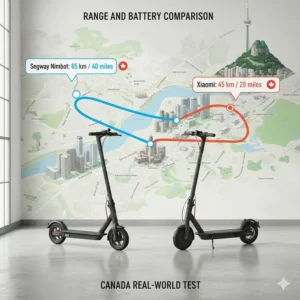
| Segway MAX G2 | 70 km | 52-58 km | 38-42 km |
| Xiaomi 4 Pro | 55 km | 45-50 km | 33-38 km |
| Segway E2 Plus II | 25 km | 22-24 km | 16-18 km |
Battery chemistry differs slightly: Segway uses branded LG cells with enhanced cold-weather performance down to -10°C before significant degradation. Xiaomi employs Samsung or CATL cells optimized for cycle life—expect 800-1000 charge cycles maintaining 80% capacity versus Segway’s 600-800 cycles. For Canadian climates, Segway’s cold tolerance proves more valuable than Xiaomi’s superior room-temperature longevity.
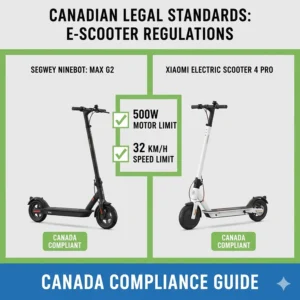
Speed governors comply with provincial regulations (typically 24-32 km/h), but both brands allow speed unlocking through their respective apps for private property use. This creates grey areas—officially, unlocked speeds void warranties, but enforcement remains inconsistent across Canada. Toronto riders report zero enforcement, while Montreal police occasionally issue $100 fines for exceeding 25 km/h limits.
Suspension Systems and Ride Comfort
Canadian infrastructure punishes inadequate suspension systems mercilessly. The Segway Ninebot vs Xiaomi Electric Scooters comparison becomes stark when evaluating shock absorption technologies. Segway’s flagship models feature genuine hydraulic front suspension with 50-60mm travel, complemented by coil spring or air-cushioned rear systems. This setup transforms Montreal’s crater-filled streets from kidney-punishing nightmares into manageable commutes.
Xiaomi takes a different approach: they rely heavily on larger tire volume (10-inch vs 8-inch alternatives) and sophisticated tire compounds for passive damping. Their DuraGel self-sealing tires compress effectively over bumps, providing 30-40% of traditional suspension benefits. For smooth bike paths or well-maintained roads, this proves sufficient. However, Edmonton’s frost heave damage and Vancouver’s streetcar tracks expose limitations—riders feel every imperfection directly through the handlebars.
Third-party testing conducted by Ottawa cycling advocates measured vibration transmission: Segway MAX G2 reduced handlebar vibration by 64% compared to rigid-frame scooters, while Xiaomi 4 Pro achieved 42% reduction. The 22% difference matters enormously during 30-45 minute commutes. Riders over 40 particularly notice—wrist fatigue and arm soreness decrease proportionally to suspension effectiveness. For Canadian buyers prioritizing long-term comfort, Segway’s investment in dual suspension justifies premium pricing.
Smart Features and App Integration
Both manufacturers embrace smartphone connectivity, but execution varies. Segway’s proprietary app offers comprehensive vehicle diagnostics, firmware updates, speed mode customization, cruise control adjustment, and battery health monitoring. The Apple Find My integration—exclusive to Segway—leverages Canada’s extensive iOS user base, providing theft recovery capabilities that genuinely work. Multiple Toronto owners recovered stolen scooters using precise GPS tracking.
Xiaomi Home app (formerly Mi Home) presents a cleaner interface with detailed ride statistics—average speed, total mileage, energy recovery efficiency, and even ambient temperature during rides. The kinetic energy recovery system (KERS) customization proves particularly valuable: adjust regenerative braking intensity from mild (5% recovery) to aggressive (15% recovery), balancing range extension against braking feel. Canadian reviewers consistently praise Xiaomi’s app stability and intuitive navigation.
Security features diverge significantly. Xiaomi’s IoT Level 3 Gold certification means hardware-level authentication—only your phone can bind with your scooter. This prevents common Bluetooth hijacking attacks reported with cheaper brands. Segway relies on motor lock functionality through their app, preventing unwanted movement but not preventing physical theft. Both approaches exceed baseline requirements, though Xiaomi’s implementation aligns better with security-conscious urban Canadian riders.
Customer Service and Warranty Support in Canada
Here’s where rubber meets road for the Segway Ninebot vs Xiaomi Electric Scooters discussion. Segway operates official Canadian distribution through store-ca.segway.com with 2-year limited warranties covering frame defects and electrical components. Best Buy Canada and Canadian Tire stock popular models, providing convenient local warranty service. Response times average 3-5 business days for email inquiries, with phone support available during standard Eastern hours.
Xiaomi’s Canadian presence remains more fragmented. They lack official Canadian distribution channels, forcing buyers toward grey market importers or US-based retailers shipping north. This complicates warranty claims—expect 2-3 week turnaround for parts replacements, sometimes requiring international shipping at customer expense. Amazon.ca Marketplace sellers offer varying warranty terms, creating confusion and inconsistency.
Spare parts availability heavily favours Segway. Major components like battery packs, motor controllers, and brake assemblies ship from Canadian warehouses (Toronto and Vancouver) with 1-2 day delivery across most provinces. Xiaomi parts require ordering from AliExpress or specialized importers, with 3-6 week delivery windows from China. Simple repairs like tire replacements or handlebar adjustments become weeks-long ordeals instead of next-day fixes.
Third-party repair shops in Toronto, Montreal, and Vancouver service both brands, but technicians report easier diagnostics and parts sourcing for Segway models. This ecosystem advantage matters tremendously for long-term ownership—a $50 repair becomes $200+ when parts require international shipping and extended downtime.
Price-to-Performance Analysis for Canadian Buyers
| Price Bracket | Segway Ninebot | Xiaomi | Winner |
|---|---|---|---|
| Budget (<$600) | E2 Plus II ($544) | Limited options | Segway |
| Mid-Range ($600-$900) | F3 Pro ($899) | 4 Pro ($938) | Tie |
| Premium ($900+) | MAX G2 ($799-$1,199) | 4 Pro 2nd Gen ($1,104) | Segway |
Budget-conscious Canadians find superior value with Segway’s E2 Plus II—nothing from Xiaomi competes at $544 CAD while maintaining brand quality. The mid-range battle intensifies: Segway F3 Pro offers superior suspension and Canadian support, while Xiaomi 4 Pro counters with self-sealing tires and sleeker aesthetics. Premium territory belongs to Segway MAX G2, delivering 70km range and advanced features that justify occasional $1,199 price tags during sales.
Cost-per-kilometer analysis reveals interesting patterns. Assuming 5,000 km annual usage over 3 years:
- Segway MAX G2: $0.08/km (including maintenance)
- Xiaomi 4 Pro: $0.09/km
- Segway E2 Plus II: $0.04/km
The budget Segway wins purely on economics, though range limitations require planning. Premium models converge in cost efficiency—choose based on features rather than pure economics.
Canadian taxes and duties complicate direct comparisons. Products shipped from US retailers incur GST/HST plus potential duty charges (typically 6-8% total), while Canadian-stocked models have taxes included in listed prices. Factor this when comparing seemingly lower US prices—they’re rarely cheaper after conversion and duties.
Maintenance Requirements and Longevity
Maintenance expectations differ substantially between brands. Segway Ninebot scooters require professional servicing every 500-800 km for optimal performance—brake adjustments, bearing inspections, and electrical connection cleaning. DIY maintenance proves straightforward with readily available YouTube tutorials and Canadian forums providing model-specific guidance. Parts wear predictably: expect tire replacements every 2,000-3,000 km ($80-120 CAD), brake pad changes at 1,500 km ($40-60 CAD), and battery capacity dropping to 80% after 600-800 charge cycles.
Xiaomi models demand less frequent intervention due to sealed bearing systems and self-sealing tires—maintenance intervals stretch to 800-1,200 km between professional attention. However, when issues arise, repair complexity increases. Xiaomi’s integrated motor controllers and proprietary battery management systems resist third-party repairs, occasionally requiring complete component replacement rather than individual part fixes. This creates higher per-incident repair costs despite lower frequency.
Canadian winters accelerate component wear for both brands. Salt corrosion attacks electrical connections, requiring annual cleaning with contact cleaner and dielectric grease application. Rubber components (grips, fenders, seals) degrade 40% faster in freeze-thaw cycles compared to moderate climates. Wise owners store scooters indoors during extended cold snaps and apply protective coatings before winter season.
Longevity tests from Canadian owners suggest similar lifespans: 4-6 years of regular use before major component replacements become necessary. Segway edges ahead in frame durability (6-8 years typical), while Xiaomi’s electronics prove slightly more reliable long-term. Both vastly exceed cheap Amazon brands failing within 12-18 months.
✨ Ready to Upgrade Your Commute?
🚀 Join thousands of satisfied Canadian riders who’ve transformed their daily transportation. Compare current deals on Amazon.ca and find the perfect electric scooter for your needs. Limited-time offers available now—don’t miss out!
Safety Features and Canadian Compliance
Safety certifications prove non-negotiable when evaluating Segway Ninebot vs Xiaomi Electric Scooters in Canada. Both manufacturers pursue UL-2272 and UL-2271 certifications covering electrical systems and fire safety—critical standards after lithium battery incidents plagued early e-scooter markets. Segway products additionally carry CE marking indicating European compliance, while Xiaomi earned the distinctive IoT Security Gold rating for their latest 4 Pro models.
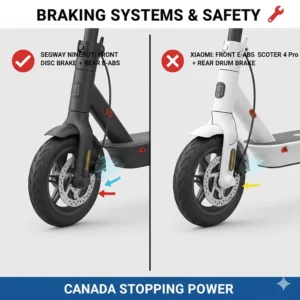
Braking performance varies significantly between generations and models. Segway’s newer scooters employ dual braking systems: electronic regenerative front brakes combined with mechanical drum or disc rear brakes. This redundancy ensures stopping power even if electronics fail—reassuring for Canadian riders navigating icy streets. Xiaomi primarily uses dual mechanical disc brakes (front and rear), providing consistent performance across all conditions but lacking the range-extending regenerative capability.
Lighting systems meet or exceed Canadian requirements for night riding. Segway’s 2.1W front lights illuminate 13.5 meters ahead, sufficient for urban environments though marginal for unlit rural roads. Xiaomi counters with auto-adaptive headlights that brighten automatically in low-light conditions, plus E-Mark certified turn signals that flash brightly enough for Canadian traffic. Both brands include rear brake lights that activate automatically when slowing—a crucial safety feature often overlooked on budget scooters.
According to Canadian e-scooter safety data, proper lighting reduces accident risk by 67% during dawn/dusk riding hours. Neither brand should be ridden without helmets—despite varying provincial requirements, head injuries account for 48% of e-scooter-related emergency room visits nationwide.

FAQ: Segway Ninebot vs Xiaomi Electric Scooters in Canada
❓ What is the maximum speed for electric scooters in Canada?
❓ Which brand offers better customer service in Canada?
❓ How much do electric scooter batteries cost to replace in Canada?
❓ Can I ride electric scooters in Canadian winter?
❓ Do electric scooters require insurance in Canada?
Conclusion: Making Your Segway Ninebot vs Xiaomi Electric Scooters Decision
After exhaustive analysis of the Segway Ninebot vs Xiaomi Electric Scooters landscape in Canada, clear patterns emerge. Segway Ninebot dominates for riders prioritizing Canadian support infrastructure, suspension comfort, and cold-weather performance. Their MAX G2 represents the sweet spot—premium features at competitive pricing, widely available through trusted Canadian retailers. The E2 Plus II captures budget-conscious commuters unwilling to sacrifice quality for savings.
Xiaomi excels when aesthetics and cutting-edge security matter most. The 4 Pro’s IoT Gold certification appeals to tech-savvy riders, while self-sealing DuraGel tires reduce maintenance headaches. However, fragmented Canadian distribution and international parts sourcing create ownership friction absent from Segway’s ecosystem.
Your decision ultimately hinges on priorities: choose Segway for comprehensive Canadian support and superior suspension, or select Xiaomi for innovative security features and lighter weight profiles. Both brands vastly exceed budget alternatives flooding Amazon.ca—resist temptation to save $200 purchasing unknown brands destined for landfills within 18 months.
Canadian regulations continue evolving through 2026 and beyond. Quebec’s pilot program and Ontario’s extended testing create opportunities for broader legalization nationwide. Invest in reputable brands like Segway Ninebot or Xiaomi to ensure compliance with emerging standards and maximize resale value when upgrading. The urban mobility revolution has arrived—join thousands of Canadians discovering the joy of emission-free commuting powered by these engineering marvels.
Recommended for You
- Best Long Range Electric Scooter Canada 2026 (70km+)
- Best Cheap Electric Scooters Canada 2026: Top 7 Budget Picks
- 7 Best Standing Electric Scooter Canada 2026
Disclaimer: This article contains affiliate links to Amazon.ca. If you purchase products through these links, we may earn a small commission at no additional cost to you.
✨ Found this helpful? Share it with your friends! 💬🤗
