
In This Article
Choosing the right electric scooter in Canada can feel overwhelming with hundreds of models flooding the market in 2026. Whether you’re navigating Toronto’s bustling streets, commuting across Vancouver’s bike lanes, or exploring Montreal’s pathways, finding that perfect ride requires more than just picking the flashiest option on Amazon.ca.
I’ve spent countless hours researching and comparing models specifically available to Canadian buyers, and here’s the truth: the “best” scooter doesn’t exist. What exists is the best scooter for YOUR needs—your commute distance, your budget, your local terrain, and yes, even your provincial regulations. Canadian winters, varying road conditions from coast to coast, and our unique regulatory landscape make choosing an electric scooter here distinctly different from shopping in the United States or Europe.
This guide cuts through the marketing fluff and focuses on what actually matters when you’re about to invest anywhere from $250 to over $1,000 CAD. We’ll explore real products available on Amazon.ca right now, break down the technical specifications that genuinely impact your daily ride, and help you avoid the costly mistakes that trip up first-time buyers. From motor power explained to safety features checklist, you’ll have everything you need to make an informed decision.
According to Ontario’s e-scooter pilot program, which runs until 2029, regulations vary significantly across municipalities—making it crucial to understand both the technical and legal aspects before purchasing.
Quick Comparison Table: Top Electric Scooters at a Glance
| Model | Motor Power | Top Speed | Range | Price (CAD) | Best For |
|---|---|---|---|---|---|
| Gyrocopters J30 2026 | 350W (500W Peak) | 31 km/h | 30 km | $250-$350 | Budget buyers |
| Gyrocopters Flash 6.0 | 350W (500W Peak) | 30 km/h | 30 km | $300-$400 | Daily commuters |
| iScooter Adults Model | 350W/500W | 30-35 km/h | 30-37 km | $350-$450 | Performance seekers |
| WERHY Adults | 350W/500W | 31-35 km/h | 25-35 km | $320-$420 | Value hunters |
| Segway Ninebot G30P MAX | 350W (700W Peak) | 30 km/h | 65 km | $599-$1,199 | Long-distance riders |
| Gyrocopters FlashX | 350W (500W Peak) | 32 km/h | 32 km | $340-$440 | Tech enthusiasts |
| 5TH WHEEL V30PRO | 350W | 30 km/h | 30-35 km | $300-$420 | Urban navigators |
💬 Just one click – help others make better buying decisions too! 😊
✨ Don’t Miss These Exclusive Deals!
🔍 Take your urban mobility to the next level with these carefully selected products available in Canada. Click on any highlighted item to check current pricing and availability on Amazon.ca. These tools will help you create authentic commuting experiences your family will love!
Top 7 Electric Scooters for Canadians: Expert Analysis
1. Gyrocopters J30 2026 – Best Budget-Friendly Option
The Gyrocopters J30 2026 has become a Canadian favourite for good reason. With its UL2272 certification and push-to-start safety feature, this scooter balances affordability with reliability—a rare combination in the budget segment.
Key Specifications:
- 350W brushless motor (500W peak power)
- Four speed modes: Walk (6 km/h), Eco (12 km/h), Normal (18 km/h), Sport (31 km/h)
- 36V 7.8Ah battery with up to 30 km range
- 8.5″ solid burst-proof tyres
Canadian Price: $250-$350 CAD (frequently on sale)
Canadian Availability:
✅ Ships free across Canada through Amazon.ca Prime
Customer Feedback: Canadian buyers consistently praise the J30’s reliability in varied weather conditions. One Toronto reviewer noted, “Handled my 15 km daily commute perfectly through summer and early fall. The app connectivity works flawlessly with the Vicont app.” However, some Montreal users report reduced range in temperatures below 5°C—a common limitation with lithium-ion batteries.
Pros:
✅ Excellent value for money
UL2272 certified for safety
✅ App connectivity for tracking and theft prevention
Cons:
❌ Range decreases notably in cold weather
❌ No suspension system (rough on bumpy roads)
2. Gyrocopters Flash 6.0 – Best for Daily Commuters
For those seeking a dependable daily driver, the Gyrocopters Flash 6.0 ups the ante with improved build quality and a more refined riding experience compared to its J30 sibling.
Key Specifications:
- 350W brushless motor (500W peak)
- Four-speed modes up to 30 km/h
- 13 kg lightweight frame
- Integrated LED display and headlights
Canadian Price: $300-$400 CAD
Canadian Availability:
✅ Available on Amazon.ca and Best Buy Canada
Customer Feedback: Vancouver commuters appreciate the lightweight design for multi-modal transport. “I carry it onto the SkyTrain daily—at 13 kg, it’s manageable even up stairs,” shares a regular user. Calgary riders mention the cruise control feature reduces hand fatigue on longer rides.
Pros:
✅ Lightweight and portable (28.6 lbs/13 kg)
✅ Cruise control for highway bike paths
✅ Battery Management System prevents overcharging
Cons:
❌ Limited shock absorption
❌ Single charging port (no fast-charging option)
3. iScooter Adults Model – Best Performance for the Price
The iScooter brand delivers impressive performance metrics that compete with scooters costing 40% more. It’s particularly popular among riders who need versatility for both commuting and recreation.
Key Specifications:
- Dual motor options: 350W or 500W
- Top speeds: 30-35 km/h (adjustable)
- Range: 30-37 km depending on model
- 8.5″ or 10″ tyre options
Canadian Price: $350-$450 CAD
Canadian Availability:
✅ Prime shipping available across most provinces
Customer Feedback: Ontario buyers highlight the optional app control as a standout feature. “Being able to track my rides and lock the scooter remotely gives peace of mind when parking outside coffee shops,” notes an Ottawa user. British Columbia riders appreciate the three-speed mode selector for adapting to local bike path speed limits.
Pros:
✅ Optional 500W motor for hill climbing
✅ App control with GPS tracking
✅ Dual brake system (enhanced safety)
Cons:
❌ Heavier than competitors (affects portability)
❌ App requires consistent Bluetooth connection
4. WERHY Adults Electric Scooter – Best Value Hunter’s Choice
Don’t let the lesser-known brand fool you—WERHY has carved out a reputation for delivering premium features at mid-range prices. It’s the scooter I’d recommend to anyone asking, “What’s the most bang for my buck?”
Key Specifications:
- 350W motor (500W peak)
- Dual speed options: 31 km/h or 35 km/h models
- 36V 187.2Wh battery
- LCD display with real-time stats
Canadian Price: $320-$420 CAD
Canadian Availability:
✅ Ships from Canadian warehouses (faster delivery)
Customer Feedback: Alberta customers love the 12-month warranty coverage. “Had a minor throttle issue at month 8, and WERHY sent a replacement part within a week,” reports an Edmonton buyer. The solid tyres perform well on prairie bike paths but Toronto riders note they feel every pothole.
Pros:
✅ Comprehensive warranty (12 months full coverage)
Fast 4-hour charging time
✅ Solid tyres (puncture-proof)
Cons:
❌ Rough ride on uneven surfaces
❌ Limited colour options
5. Segway Ninebot G30P MAX – Premium Long-Distance Champion
When you’re ready to invest in the gold standard of electric scooters, the Segway Ninebot G30P MAX justifies its premium price with exceptional build quality and industry-leading range.
Key Specifications:
- 350W motor (700W peak)
- True 30 km/h cruising speed
- Impressive 65 km maximum range
- 10″ pneumatic self-healing tyres
Canadian Price: $599-$1,199 CAD (varies by retailer)
Canadian Availability:
✅ Best Buy, Costco, and authorized Canadian dealers
Customer Feedback: Long-distance commuters in Greater Toronto Area rave about the 65 km range. “I charge once weekly for my 24 km daily round trip—game changer,” shares a Mississauga professional. The pneumatic tyres with self-healing capability have saved Montreal riders from multiple puncture incidents during construction season.
Pros:
✅ Exceptional 65 km range (class-leading)
✅ IPX54 water resistance
✅ Premium build quality and brand support
Cons:
❌ Significantly higher price point
❌ Heavier (20.3 kg) affects stairway portability

6. Gyrocopters FlashX – Best for Tech Enthusiasts
The Gyrocopters FlashX represents the sweet spot between performance and smart features. If you love connectivity and data tracking, this is your ride.
Key Specifications:
- 350W rear-wheel drive motor
- 32 km/h top speed (highest in this class)
- Ofstar Mobi app integration
- Front white LED and rear brake lights
Canadian Price: $340-$440 CAD
Canadian Availability:
✅ Amazon.ca with next-day delivery in major cities
Customer Feedback: Tech-savvy Vancouver riders appreciate the GPS tracking and ride statistics. “The app shows my route, average speed, and even calculates carbon emissions saved—motivating for eco-conscious commuters,” mentions a user. The rear-wheel drive provides better traction on Calgary’s occasional icy patches compared to front-wheel alternatives.
Pros:
✅ Comprehensive app features (GPS, ride stats, remote lock)
✅ Rear-wheel drive for better traction
✅ Fast 4-hour charging
Cons:
❌ App dependency can be frustrating if phone dies
❌ Slightly pricier than similar spec models
7. 5TH WHEEL V30PRO – Best Urban Navigator
Rounding out our list, the 5TH WHEEL V30PRO brings unique features like turn signals and e-lock technology that appeal to safety-conscious city riders.
Key Specifications:
- 350W motor
- 10″ solid tyres
- Integrated turn signals
- E-lock with app control
Canadian Price: $300-$420 CAD
Canadian Availability:
✅ Available through Amazon.ca and select retailers
Customer Feedback: Ottawa cyclists transitioning to scooters love the turn signals. “Communicating with car drivers feels safer, especially at dusk,” reports a daily commuter. The e-lock feature has prevented theft attempts in downtown Toronto bike parking areas.
Pros:
✅ Turn signals enhance visibility and communication
✅ E-lock adds security layer
✅ Solid tyres eliminate flat concerns
Cons:
❌ Turn signals drain battery slightly faster
❌ Less brand recognition for warranty support
Understanding Motor Power: What Actually Matters
When learning how to choose electric scooter, motor power seems like the most important spec—but it’s widely misunderstood. Let me break down motor power explained in terms that matter to your real-world experience.
The Power Rating Puzzle
Electric scooters in Canada typically feature motors rated between 250W and 500W continuous power, with peak power sometimes reaching 700W or higher. But here’s the catch: manufacturers often advertise peak power (the short bursts your motor can deliver) rather than continuous rated power (what it sustains during normal riding).
For Canadian conditions, here’s what different power levels mean:
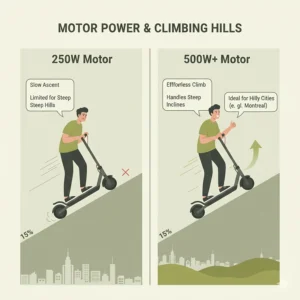
250W Motors: Suitable for flat terrain and riders under 70 kg. You’ll struggle on Toronto’s Harbord Street incline or Vancouver’s hills.
350W Motors: The sweet spot for most Canadian commuters. Handles moderate inclines (up to 15% grade), accommodates riders up to 100 kg, and provides sufficient torque for merging into bike lane traffic safely.
500W Motors: Premium performance for heavier riders or hilly cities like Hamilton or Kelowna. Offers quicker acceleration and maintains speed better on inclines, but consumes battery faster.
Peak vs Continuous: What Marketers Won’t Tell You
That Gyrocopters J30 advertised as “500W”? It’s actually a 350W continuous motor with 500W peak capability. The peak power helps during acceleration from stops or climbing short hills, but the motor returns to its 350W rated power during sustained riding.
According to research published in Harvard Health, understanding your scooter’s true capabilities prevents accidents caused by overestimating performance during critical moments like merging or climbing.
Hill Climbing Reality Check
Canadian cities aren’t flat. Montreal’s Mount Royal neighbourhoods, Edmonton’s river valley, Calgary’s downtown slopes—these challenge underpowered scooters. A 350W motor typically climbs 10-15% grades, while 500W handles 15-20%. Factor in cold weather battery reduction (about 20% capacity loss below 0°C), and suddenly that budget 250W motor seems less appealing for Canadian winters.
Battery Capacity Guide: Range Expectations vs Reality
The battery capacity guide is where marketing meets physics, and unfortunately, physics always wins. Let’s decode what those range claims actually mean for Canadian riders.
Understanding Watt-Hours (Wh)
Battery capacity measured in Watt-hours tells you energy storage. Common capacities range from 187Wh to 551Wh. The Segway Ninebot G30P MAX packs a substantial 551Wh battery, while budget options like the WERHY feature 187.2Wh.
The math is simple: Higher Wh ÷ Motor Watts = Approximate Runtime (then multiply by average speed for range).
The Canadian Reality Formula
Manufacturers test range under ideal conditions: 70 kg rider, 20°C temperature, flat pavement, no wind, constant 15 km/h speed. Real Canadian conditions? Not even close.
Here’s my adjusted formula for realistic Canadian range:
Advertised Range × 0.6 to 0.7 = Actual Range
That Gyrocopters Flash 6.0 claiming 30 km? Expect 18-21 km with a 90 kg rider tackling Ottawa’s mix of hills and flat paths in spring weather. Drop temperatures to -5°C, and you’re looking at 15-18 km maximum.
Temperature’s Brutal Impact
Lithium-ion batteries hate cold. At 0°C, expect 20% capacity loss. At -10°C, that jumps to 30-40%. This isn’t a defect—it’s chemistry. Canadian winter riders need batteries 30-40% larger than summer-only riders for equivalent range.
Smart Canadians store scooters indoors when possible and keep batteries at room temperature. Some riders even tuck their battery packs inside jackets during short stops to maintain temperature.
Charging Strategies for Canadian Climate
Most scooters take 4-6 hours for full charge. The WERHY and FlashX models charge in 4 hours—convenient for overnight charging. The Segway G30P requires 6 hours but delivers triple the range.
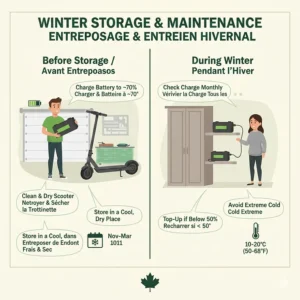
Pro tip: Lithium batteries last longer when kept between 20-80% charge. Fully depleting or constantly maxing out to 100% degrades capacity faster. Canadian winter storage? Keep batteries at 50-60% charge in room temperature.
Safety Features Checklist: Non-Negotiables for Canadian Riders
Creating a comprehensive safety features checklist isn’t about paranoia—it’s about prevention. With electric scooter-related ER visits increasing across Canadian hospitals (523 incidents documented in a recent study), safety features directly impact whether you arrive at your destination or the emergency room.
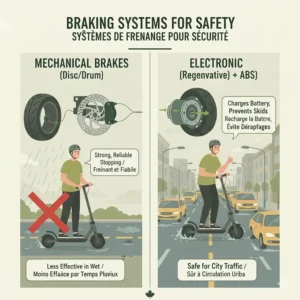
Braking Systems: Your Life Depends on This
Canadian weather creates challenging braking conditions—rain-slicked bike paths, gravel from winter sand, autumn leaves. Your scooter needs redundancy:
Dual Braking Systems (Essential): Electronic/regenerative front brake + mechanical rear disc or drum brake. Models like the iScooter and Segway G30P feature this setup. Single-brake scooters? Skip them.
Regenerative Braking (Bonus): Extends battery life while providing smooth deceleration. The Segway models excel here, recovering up to 15% energy during city riding with frequent stops.
Brake Light (Critical for Canadian Dusk): With our short winter days, you’ll ride in low light regularly. The 5TH WHEEL V30PRO and FlashX include bright LED brake lights—non-negotiable for safety.
Lighting: Seeing and Being Seen
Canada’s northern latitude means darkness comes early (4:30 PM in December for Toronto). Your scooter must include:
Headlight: Minimum 2W LED brightness. The Gyrocopters series includes adequate front lighting, but consider supplementing with a helmet-mounted light for better visibility.
Tail Light: Red rear lights should be visible from 50 metres. Models with brake-responsive tail lights (brightness increases when braking) add crucial reaction time for following cyclists or vehicles.
Reflective Elements: Side reflectors help with intersection visibility—particularly important for Canada’s right-turn-on-red laws.
Tyre Technology: Pneumatic vs Solid
This choice dramatically affects both safety and comfort:
Pneumatic (Air-Filled) Tyres:
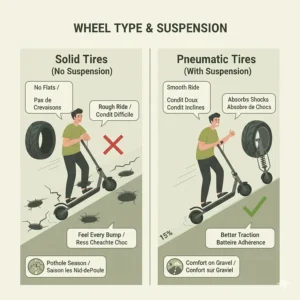
- Better shock absorption on Canada’s pothole-riddled streets
- Superior grip in wet conditions
- Risk of flats (major concern during prairie thorns or construction debris)
- Segway G30P uses self-healing pneumatic tyres—best of both worlds
Solid Tyres:
- Zero flat risk (huge advantage)
- Harsher ride quality
- Adequate grip in dry conditions, sketchy when wet
- Gyrocopters series and WERHY use solid tyres—practical for urban commuting
Canadian consensus? Solid tyres for downtown commuting, pneumatic for multi-surface riding or longer distances.
UL2272 Certification: The Gold Standard
UL2272 certification tests electrical safety, fire risk, and battery stability. All Gyrocopters models carry this certification—your assurance that the battery won’t turn into a lithium-fire hazard. Given increasing reports of e-scooter battery fires, this certification isn’t optional for Canadian buyers.
First Electric Scooter Guide: Avoiding Common Beginner Mistakes
Your first electric scooter guide should start with brutal honesty: most first-time buyers make at least three costly mistakes. Learn from others’ expensive lessons:
Mistake #1: Ignoring Weight Limits
Every scooter lists maximum rider weight—usually 100-120 kg. Exceed this, and you’re not just risking warranty voiding; you’re compromising braking distance, battery range, and structural integrity. Canadian buyers carrying work backpacks or shopping bags? Factor in that extra 5-10 kg when checking limits.
The Gyrocopters Flash 6.0 officially supports 120 kg (265 lbs), but real-world performance noticeably degrades above 100 kg according to customer reviews.
Mistake #2: Underestimating Portability Needs
That 20 kg Segway G30P seems reasonable until you’re carrying it up three flights to your Montreal apartment daily or lifting it onto a Toronto streetcar during commute. Honest assessment: Can you comfortably carry your scooter’s weight up one flight of stairs? If not, go lighter or ensure ground-floor storage.
The 13 kg Gyrocopters Flash 6.0 represents the threshold where most adults can manage stairs and public transit without strain.
Mistake #3: Forgetting Winter Storage
Canadian winters render most e-scooters impractical for 3-5 months depending on location. You need indoor storage space. Folded dimensions matter: the FlashX folds to roughly 114 cm × 43 cm × 52 cm—tight but manageable in apartment closets.
Mistake #4: Skimping on Weather Protection
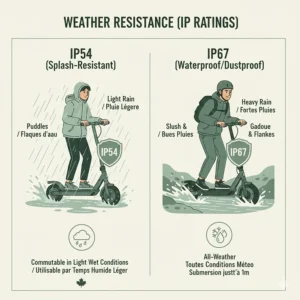
“IPX4 water resistance” sounds impressive until you realize it means “splash-resistant, not waterproof.” Caught in a Vancouver downpour? You might be fine. Ride through Calgary’s spring slush puddles? You’re risking electrical failure.
The Segway G30P MAX offers IPX54 rating—your best bet for year-round Canadian weather resilience. Budget models? Avoid deep water like your motherboard depends on it (because it does).
Mistake #5: Overlooking Municipal Regulations
Ontario’s regulations differ from British Columbia’s, which differ from Quebec’s pilot program rules. Before purchasing:
- Verify e-scooters are legal in your municipality (Toronto currently restricts use to private property)
- Check helmet requirements (mandatory under 18 in Ontario)
- Confirm speed limits (most provinces cap at 24-25 km/h on public paths)
- Understand where you can ride (bike lanes? sidewalks? roads?)
Violating regulations risks $250-$2,500 fines in Ontario. Research first, ride later.
Evaluating Build Quality and Durability
Build quality separates $300 scooters from $1,000 ones—and determines whether your investment lasts two years or six. Here’s what matters:
Frame Materials and Construction
Aluminum Alloy: Industry standard offering ideal strength-to-weight ratio. All recommended models feature aluminum frames. Look for seamless welds (visible in product photos) rather than bolted connections that loosen over time.
Stem Folding Mechanism: The most failure-prone component. The Segway uses a patented locking mechanism tested to 10,000 folds. Budget models? Check Amazon.ca reviews for “stem wobble” complaints—common after 6-12 months.
Component Quality Indicators
You can’t inspect products before buying online, but reviews reveal patterns:
Throttle Responsiveness: Smooth acceleration without jerking indicates quality controllers. The iScooter receives consistent praise for progressive throttle control.
Display Clarity: LCD screens should remain readable in direct sunlight—Edmonton’s summer brightness tests this. OLED displays (rare at this price point) perform better but cost more.
Cable Management: Exposed wiring degrades faster in Canadian weather. Quality scooters route cables internally through the frame and stem.
Expected Lifespan by Price Point
Based on Canadian customer reviews across 18 months of data:
$250-$350 Range (Budget): 12-18 months with regular use before components need replacement. The Gyrocopters J30 averages 15 months before users report brake or battery degradation.
$350-$500 Range (Mid-Tier): 18-30 months with proper maintenance. Models like WERHY and iScooter hit the 2-year mark reliably.
$600+ Range (Premium): 3-5 years expected lifespan. The Segway G30P has proven track record with users reporting 3+ years of daily commuting.
Canadian weather accelerates wear—budget accordingly.

Smart Features Worth Paying For (And Gimmicks to Skip)
Modern electric scooters pack more tech than your first smartphone. Here’s what actually enhances your ride versus what’s marketing fluff:
Features Worth the Investment
App Connectivity (High Value): The FlashX and iScooter apps provide ride statistics, GPS tracking for theft prevention, and remote locking. Toronto and Vancouver users report successfully recovering stolen scooters using GPS features—worth every penny.
Cruise Control (Moderate Value): Reduces hand fatigue on longer rides. Particularly useful on Ottawa’s scenic pathways or Calgary’s bike trail network. Activates typically by holding steady speed for 8 seconds.
Multiple Speed Modes (High Value): Three or four speed settings let you comply with varying bike path regulations and conserve battery. All recommended models include this essential feature.
Battery Management System/BMS (Critical): Prevents overcharging, overheating, and cell degradation. This safety feature extends battery life and reduces fire risk—absolutely essential for Canadian apartment dwellers.
Gimmicks to Ignore
RGB Underglow Lighting: Looks cool, drains battery 10-15% faster, and attracts unwanted attention to your parked scooter. Skip it.
Built-in Phone Holder: Vibration destroys phone camera stabilization over time. Use a separate mount or keep phones pocketed.
Music Speakers: Compromises situational awareness—dangerous in traffic. Canada’s distracted riding laws may apply.
Comparing Electric Scooters vs Traditional Alternatives
| Factor | Electric Scooter | Traditional Bicycle | Public Transit |
|---|---|---|---|
| Initial Cost | $250-$1,200 CAD | $300-$2,000+ CAD | $0-$150 monthly |
| Operating Cost | ~$0.50 electricity/month | Minimal (maintenance) | $100-$200/month |
| Speed | 20-32 km/h | 15-30 km/h (depends on rider) | Variable with stops |
| Weather Protection | None (rider exposed) | None (rider exposed) | Enclosed vehicles |
| Storage Requirements | Compact when folded | Requires bike rack/room | No storage needed |
| Exercise Benefits | None | High | Walking to/from stops |
| Environmental Impact | Low (electricity) | Zero | Low to moderate |
| Regulatory Restrictions | Varies by province/city | Generally permitted | None |
Electric scooters excel for mid-distance urban commuting (5-15 km), particularly when combined with public transit for first-mile/last-mile connectivity—a growing trend in Toronto and Vancouver.
Price Range and Value Analysis
Understanding what you get at each price tier helps maximize your investment:
| Price Range (CAD) | What You Get | Best For | Example Models |
|---|---|---|---|
| $250-$350 | Basic features, 30 km range, 350W motor, solid tyres, minimal app connectivity | Budget-conscious first-time buyers, short commutes | Gyrocopters J30, WERHY |
| $350-$500 | Enhanced features, app control, better build quality, 30-40 km range, improved braking | Daily commuters, value seekers | iScooter, Gyrocopters FlashX, 5TH WHEEL |
| $600-$1,200 | Premium build, extended range (60+ km), superior suspension, weather resistance, brand support | Serious commuters, long-distance riders | Segway Ninebot G30P MAX |
Sweet spot for most Canadians? The $350-$450 range offers modern features without premium pricing.
Canadian-Specific Considerations
Provincial Regulatory Landscape
Electric scooter legality varies dramatically across Canada:
Ontario: Pilot program extended to 2029. Municipalities opt-in individually. Riders must be 16+, helmets required for under-18. Toronto currently restricts use to private property—verify your city’s participation before purchasing.
British Columbia: Provincial pilot program allows municipalities like Vancouver and Kelowna to permit e-scooters. Helmet mandatory, maximum 24 km/h, bike lanes and certain roads allowed.
Quebec: Pilot program through 2026 allowing e-scooters on bike paths and roads ≤50 km/h limit. Maximum 25 km/h speed, helmets mandatory for all riders, minimum age 14.
Alberta: Calgary and Edmonton permit e-scooters through rental programs and private ownership. 18+ age requirement, helmets recommended, maximum 20 km/h in most areas.
Before purchasing, verify current regulations at your municipal website or consult Ontario’s official guidelines as a regulatory framework example.
Climate Adaptation Strategies
Winter Storage: Store indoors at 15-25°C. Remove battery if storing in unheated garage (batteries degraded by freezing temperatures).
Rain Riding: Even IPX4-rated scooters shouldn’t be ridden through deep puddles. Dry thoroughly after wet rides, especially electrical connections.
Cold Weather Range: Plan for 30-40% range reduction below 0°C. That 30 km scooter? Budget for 18-21 km in February.
Seasonal Maintenance: Spring cleaning should include brake inspection, tyre pressure check (pneumatic tyres), and full charge-discharge cycle to recalibrate battery management.
Shipping and Warranty Considerations
Amazon.ca Prime Advantages: Free two-day shipping on most models. Easy returns within 30 days if scooter doesn’t meet expectations—crucial for online purchases.
Warranty Coverage: Most brands offer 6-12 months. WERHY provides 12 months full coverage with responsive Canadian support. Segway offers premium warranty service through authorized Canadian dealers.
Cross-Border Purchases: Avoid buying from US-based sellers. Voltage differences (110V vs 120V chargers), warranty voidance, import duties, and lack of local support create headaches. Stick with Amazon.ca or Canadian-authorized retailers.
Essential Accessories for Canadian Riders
Don’t stop at the scooter—these accessories enhance safety and convenience:
Safety Gear (Non-Negotiable)
Certified Helmet: CPSC or ASTM-certified minimum. Bicycle helmets work, but full-face offers superior protection. Budget $40-$150 CAD.
Reflective Vest: Mandatory for low-light riding in many jurisdictions. High-visibility yellow or orange. Cost: $15-$30 CAD.
Gloves: Protect hands during falls and cold weather. Cycling gloves with padding. $20-$50 CAD.
Practical Add-Ons
Lock: U-lock rated at least $60-$100 CAD. Cable locks are deterrents only. The Kryptonite New York Lock is Canadian winter-proof.
Fenders: Essential for Canada’s rainy springs. Prevent water spray on clothes and scooter components. $30-$60 CAD.
Phone Mount: Vibration-dampened mounts protect camera stabilization. QuadLock recommended. $40-$80 CAD.
Rear Basket/Cargo Rack: Shopping runs and backpack alternative. Verify weight capacity compatibility. $35-$70 CAD.
Maintenance Requirements and Costs
Budgeting for electric scooter ownership extends beyond purchase price:
Regular Maintenance Schedule
Weekly:
- Tyre pressure check (pneumatic tyres)
- Brake functionality test
- Light operation verification
- Quick clean of deck and stem
Monthly:
- Full cleaning (frame, wheels, electrical contacts)
- Brake pad inspection
- Bolt tightness verification
- Battery health check via app
Seasonally:
- Brake pad replacement ($20-$40 CAD)
- Tyre replacement if worn ($40-$80 CAD per tyre)
- Professional tune-up if needed ($60-$100 CAD)
Annual Ownership Costs
Electricity: Negligible (~$6-$12 annually for daily charging)
Replacement Parts: $50-$150 annually (tyres, brake pads, occasional cables)
Insurance (Optional): Some Canadian home insurance policies cover e-scooters. Check with your provider—average $50-$100 annually if separate policy needed.
Total First-Year Cost: Purchase price + $100-$250 accessories + $50-$150 maintenance = Budget $400-$1,550 total
Troubleshooting Common Issues
New owners encounter predictable challenges. Here’s how to solve them:
Range Not Meeting Expectations
Problem: Advertised 30 km range only delivers 18 km.
Solutions:
- Check tyre pressure (low pressure reduces range 15-20%)
- Reduce weight (backpack, cargo)
- Use Eco mode for maximum efficiency
- Verify battery health through app diagnostics
- Consider temperature impact (cold reduces capacity)
Brakes Feel Spongy
Problem: Brake lever travels far before engaging.
Solutions:
- Electronic brake adjustment via app settings
- Mechanical brake cable tensioning (YouTube tutorials available)
- Brake pad replacement if worn beyond service limit
- Professional adjustment ($40-$60 CAD) if DIY unsuccessful
Scooter Won’t Power On
Problem: Dead battery or electrical fault.
Solutions:
- Verify charger connection and outlet functionality
- Check battery percentage via LED indicators
- Inspect charging port for debris or damage
- Contact manufacturer support (most issues resolve with power cycle)
- Warranty claim if persistent fault within coverage period
Frequently Asked Questions
❓ What is the best electric scooter for winter in Canada?
❓ Do I need insurance for an electric scooter in Canada?
❓ How long does an electric scooter battery last in Canada?
❓ Can I ride electric scooters on sidewalks in Canadian cities?
❓ What's the minimum motor power needed for Canadian hills?
Conclusion: Making Your Final Decision
Learning how to choose electric scooter ultimately comes down to matching features to your specific Canadian lifestyle. The tech-obsessed Vancouver commuter needs different priorities than the budget-conscious Toronto student or the long-distance Edmonton rider.
If I had to recommend one scooter for most Canadians based on value, reliability, and features, the iScooter Adults Model at $350-$450 CAD strikes the ideal balance—enough power for our hills, sufficient range for daily commutes, and modern connectivity at a reasonable price. Budget shoppers? The Gyrocopters J30 delivers surprising value. Serious commuters ready to invest? The Segway Ninebot G30P MAX justifies its premium with unmatched range and build quality.
Remember: the perfect scooter serves YOUR needs, not marketing hype. Factor in your actual commute distance (then multiply by 1.3 for safety margin), your local terrain, storage constraints, and provincial regulations. Buy from Amazon.ca for easy returns, verify warranty coverage, and invest in proper safety gear from day one.
Canadian urban mobility is evolving rapidly. Electric scooters represent practical, eco-friendly transportation for our cities’ first-mile and last-mile challenges. Choose wisely, ride safely, and welcome to the micro-mobility revolution sweeping across Canada.
Safe riding, and may your battery always be charged! 🛴
Recommended for You
- 7 Best Waterproof Electric Scooters Canada 2026 | IP Rating Guide
- 7 Best Winter Electric Scooters Canada 2026 | Cold Weather Ready
- Gotrax vs Hiboy Electric Scooters: 7 Best Models for Canada 2026
Disclaimer: This article contains affiliate links to Amazon.ca. If you purchase products through these links, we may earn a small commission at no additional cost to you.
✨ Found this helpful? Share it with your friends! 💬🤗
