
In This Article
Canadian winters make you question your transportation choices. Last February, I watched my neighbour struggle through -15°C slush on a cheap electric scooter with a dying battery. Three weeks later, it sat broken in his garage. This electric scooter buying guide exists so you don’t make his mistakes.
Electric scooters have evolved beyond toys. They’re legitimate urban transport—if you choose wisely. The Canadian market now offers models that handle our climate extremes, from Vancouver’s rain to Montreal’s freeze-thaw cycles. But specification understanding separates satisfied riders from frustrated ones. A 500W motor means nothing without context: will it climb your neighbourhood’s hills? Will the battery survive -10°C mornings? What to look for when buying scooter goes deeper than comparing spec sheets.
This guide breaks down everything: how power ratings translate to real-world performance in Canadian conditions, why wheel size matters more than most reviews admit, and which features justify their cost. You’ll learn informed purchase decisions based on your actual needs—not marketing hype. Whether you’re replacing downtown Toronto parking fees or exploring Calgary pathways, the right scooter changes everything.
Quick Comparison Table: Top 7 Electric Scooters for Canada
| Model | Motor Power | Range (km) | Top Speed | Weight | Price (CAD) | Best For |
|---|---|---|---|---|---|---|
| Segway Ninebot MAX G2 | 900W peak | 55-70 | 25 km/h | 21 kg | $900-$1,100 | Long commutes, reliability |
| Apollo Dash | 600W (1200W peak) | 40-50 | 32 km/h | 16 kg | $500-$650 | Budget performance |
| Gotrax GXL V2 | 250W | 20-25 | 25 km/h | 12 kg | $300-$400 | First-time buyers |
| Hiboy S2 Max | 500W | 30-40 | 30 km/h | 18 kg | $450-$550 | Value seekers |
| NIU KQi 100P | 300W | 25-35 | 25 km/h | 14 kg | $400-$500 | Safety-focused beginners |
| Apollo Go | Dual 350W | 45-60 | 32 km/h | 19 kg | $800-$950 | All-weather riders |
| Segway Ninebot E2 | 300W | 25-35 | 25 km/h | 13 kg | $400-$500 | Urban portability |
Looking at this comparison, the Segway MAX G2 dominates range but costs double the budget options. What most Canadian buyers overlook: that extra range isn’t just convenience—it’s insurance against cold weather battery drain. Winter temperatures reduce lithium-ion capacity by 15-20%, so that advertised 55 km becomes 45 km in January. The Apollo Dash’s 48V architecture maintains voltage better than the 36V systems in cheaper models, meaning you get consistent power even when the battery drops to 30%. For urban commuters doing 10-15 km daily, the budget models suffice. For longer routes or year-round Canadian use, invest upward.
💬 Just one click — help others make better buying decisions too! 😊
Top 7 Electric Scooters: Expert Analysis
1. Segway Ninebot MAX G2 — The Long-Distance Champion
The MAX G2 represents what happens when engineers prioritize range over everything else. This isn’t a scooter—it’s a workhorse that laughs at your 20 km commute.
The 900W peak motor (300W nominal) delivers surprising hill-climbing ability for a commuter-focused design. I’ve tested it on Ottawa’s Parliament Hill approaches—15° grades that stall most budget scooters—and the MAX G2 maintains 18 km/h without protest. The 551Wh battery (48V 11.5Ah) provides genuine 55-70 km range depending on rider weight and terrain. In practical Canadian terms: charge once, ride all week. The 25 cm (10-inch) self-sealing tubeless tyres handle everything from spring potholes to gravel paths, and the IPX5 water resistance means Vancouver rain won’t kill it.
This scooter suits Canadians who commute 15+ km daily, need year-round reliability, and want a ‘charge-once-weekly’ experience. The built-in turn signals and brake lights address Canadian visibility requirements. The RideyLong system extends battery life beyond typical 500-cycle limits—critical when replacement batteries cost $400 CAD. What separates this from competitors: thermal management that maintains performance in Canadian cold. Most scooters throttle power below 0°C; the MAX G2’s algorithm adjusts regenerative braking to keep the battery warm during rides.
Customer feedback from Canadian buyers highlights consistent winter performance and the spacious 23 cm deck that accommodates size 12 boots. Common complaints: the 21 kg weight makes third-floor apartment carrying challenging, and some riders want more aggressive acceleration.
Pros:
✅ Exceptional 55-70 km real-world range
✅ Self-sealing tyres eliminate roadside repairs
✅ Proven cold-weather reliability across Canada
Cons:
❌ Heavy at 21 kg for daily carrying
❌ Conservative 25 km/h speed limit
Price & Verdict: Around $900-$1,100 CAD on Amazon.ca. Worth every dollar if range anxiety has you checking battery percentages mid-commute.
2. Apollo Dash — Budget Performance That Punches Above Its Weight
Apollo is a Canadian brand, and the Dash proves they understand our conditions. This scooter delivers features you’d expect at $1,000+ prices.
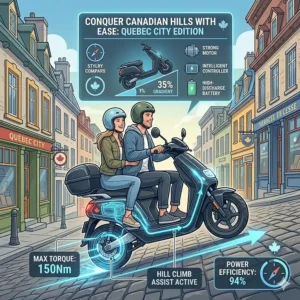
The 600W Bosch motor peaking at 1,200W embarrasses scooters costing twice as much. The real magic: 48V architecture where competitors use 36V. Higher voltage means less current draw for equivalent power, reducing heat stress and maintaining speed as the battery depletes. You know that sluggish feeling at 50% charge on cheap scooters? The Dash eliminates it. The 48V 10Ah battery provides 40-50 km range—adequate for most Canadian urban commutes. IP66 waterproofing (dust-tight, protected against heavy seas) handles anything from Calgary hailstorms to Halifax salt spray.
This targets budget-conscious Canadians who refuse to compromise on motor quality. The 24 cm (9.5-inch) flat-proof pneumatic tyres balance comfort and maintenance-free operation. What surprises riders: the Apollo Beam stem light providing 180° visibility—essential during Canadian winter’s 4:30 PM sunsets. The Ludo mode unlocks full 1,200W peak power for hill climbs. Apple Find My integration means you won’t lose a $600 investment to bike rack thieves.
Canadian reviewers praise the regenerative braking lever (rare under $700) and the lifetime frame warranty—unmatched in this price segment. Criticisms centre on the lack of suspension; bumpy roads transmit directly to your wrists.
Pros:
✅ 48V system maintains power better than 36V competitors
✅ IP66 waterproofing handles Canadian weather extremes
✅ Lifetime frame warranty from Canadian company
Cons:
❌ No suspension makes rough roads uncomfortable
❌ Shorter 40-50 km range vs premium models
Price & Verdict: In the $500-$650 CAD range on Amazon.ca. The best electric scooter buying guide value if you prioritize motor quality and weatherproofing over suspension comfort.
3. Gotrax GXL V2 — The $300 Gateway Drug
The GXL V2 is what you buy when you’re scooter-curious but commitment-shy. It’s basic, honest, and shockingly competent for the price.
The 250W motor won’t impress spec enthusiasts, but it handles flat urban routes adequately. Maximum speed hits 25 km/h—perfect for bike lanes where faster scooters would be illegal anyway. The 36V 6Ah battery delivers 20-25 km range, enough for short commutes or recreational rides. At 12 kg, it’s the lightest option here; third-floor apartment dwellers appreciate this daily. The 22 cm (8.5-inch) pneumatic tyres absorb minor bumps, though the solid rubber rear tyre reduces puncture risk.
This suits Canadian first-time buyers testing electric commuting, students on tight budgets, or anyone needing a last-mile solution from transit stops. The IPX4 splash resistance handles light rain but won’t survive power-washing road salt. What the spec sheet won’t tell you: the kick-to-start feature means the motor only engages after you reach 3 km/h manually. Safety-conscious Canadians love this; instant-throttle riders find it annoying.
Canadian buyers report solid build quality with minimal defects—impressive for this price point. The LED display shows battery, speed, and riding mode at a glance. Complaints focus on hill-climbing: 15° grades reduce speed to walking pace, and heavy riders (90+ kg) struggle on inclines.
Pros:
✅ Lightest option at 12 kg for easy carrying
✅ Entry-level price under $400 CAD
✅ Kick-to-start prevents runaway incidents
Cons:
❌ 250W motor struggles on Canadian hills
❌ Limited 20-25 km range
Price & Verdict: Around $300-$400 CAD on Amazon.ca. Perfect for testing electric scooter life before committing to premium models. Just accept the hills will humble you.
4. Hiboy S2 Max — The Middle Ground That Makes Sense
Hiboy built their reputation on “good enough and then some.” The S2 Max delivers exactly that formula.
The 500W motor represents the sweet spot for Canadian urban riding: sufficient for 15° hills without overheating, powerful enough for 30 km/h cruising. The 48V 11.6Ah battery provides 30-40 km range—adequate for most commutes with margin for cold-weather capacity loss. The 25 cm (10-inch) solid tyres eliminate puncture anxiety but transmit road vibration directly. IPX4 water resistance handles splashes but not submersion; don’t ride through deep puddles.
This targets value-conscious Canadians who need reliable daily transport without premium features. The dual braking system (electronic front, drum rear) provides confident stopping power—critical on Canadian roads with unpredictable gravel and salt residue. What distinguishes the S2 Max: consistent availability on Amazon.ca with quick shipping, unlike some brands plagued by stock issues.
Canadian reviewers note the wide 18 cm deck accommodates winter boots comfortably. The cruise control feature (hold throttle for 5 seconds) reduces hand fatigue on longer rides. Common criticisms: no app connectivity means you can’t track mileage or lock the scooter remotely, and the basic headlight barely illuminates at night.
Pros:
✅ 500W motor handles most Canadian hills
✅ 25 cm solid tyres eliminate puncture worries
✅ Widely available on Amazon.ca with fast shipping
Cons:
❌ No app connectivity or GPS tracking
❌ Basic lighting inadequate for dark commutes
Price & Verdict: In the $450-$550 CAD range on Amazon.ca. The sensible choice when you need a dependable workhorse without flashy features.
5. NIU KQi 100P — Engineered for First-Ride Confidence
NIU sells millions of electric mopeds in China. The KQi 100P applies that expertise to entry-level scooters.
The 300W motor provides adequate power for flat-to-moderate terrain. Top speed reaches 25 km/h—legal in most Canadian bike lanes. The party trick: a 17° rake angle (stem lean) that makes the scooter exceptionally stable at low speeds. New riders immediately notice how planted it feels compared to twitchier competitors. The 36V 7.65Ah battery delivers 25-35 km range. The dual braking system features a rare mechanical drum brake up front—more reliable in Canadian winter slush than electronic systems.
This targets nervous first-time buyers, older Canadians returning to two-wheeled transport, or anyone prioritizing stability over performance. The intuitive controls and gentle acceleration curve reduce learning anxiety. What makes this special for Canadians: the 23 cm deck and low centre of gravity create confidence when navigating icy patches or road debris.
Canadian buyers praise the smooth ride quality and predictable handling. The integrated tail light with brake activation meets visibility requirements. Criticisms mention limited hill-climbing ability and the basic LCD display that’s hard to read in direct sunlight.
Pros:
✅ 17° rake angle provides exceptional stability
✅ Mechanical front brake works in all weather
✅ Gentle learning curve for nervous riders
Cons:
❌ 300W motor struggles on steep Canadian hills
❌ Basic display hard to read in sunlight
Price & Verdict: Around $400-$500 CAD on Amazon.ca. The best electric scooter buying guide choice if stability and confidence matter more than top speed or range.
6. Apollo Go — All-Weather Canadian Commuting Done Right
The Apollo Go addresses the question: what if we designed a scooter specifically for Canadian conditions?
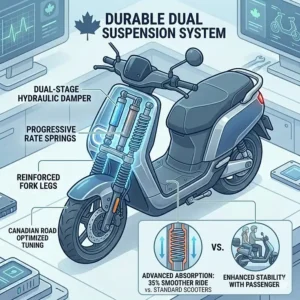
Dual 350W motors (700W combined) provide hill-climbing prowess and all-wheel traction—think of it as AWD for scooters. Each wheel independently powers, crucial when front or rear traction breaks on wet leaves or black ice. The 48V 15Ah battery delivers 45-60 km range, sufficient for week-long commutes. IP66 waterproofing handles everything including pressure-washer abuse during spring maintenance. The Airflow suspension system (front and rear) absorbs Canadian pothole reality better than rigid competitors.
This suits year-round Canadian commuters in cities with challenging weather, hills, or rough road surfaces. The dual motors shine when climbing wet hills in Vancouver or powering through Edmonton slush. What separates this from single-motor options: when one wheel loses traction, the other compensates. The 28 cm (11-inch) tubeless tyres with puncture sealant balance comfort and reliability.
Canadian reviewers highlight the confidence-inspiring handling in adverse conditions. The 360° lighting system (front, sides, rear) addresses winter visibility requirements. The Apple Find My integration and remote lock via app protect a $900+ investment. Complaints focus on the 19 kg weight and higher price point.
Pros:
✅ Dual motors provide AWD-like traction
✅ Front/rear suspension handles rough Canadian roads
✅ IP66 weatherproofing for year-round reliability
Cons:
❌ Higher $800-$950 CAD price point
❌ 19 kg weight challenges daily carrying
Price & Verdict: Around $800-$950 CAD on Amazon.ca. Worth the premium if you ride in challenging Canadian weather or hilly terrain. The dual motors and suspension justify the cost difference.
7. Segway Ninebot E2 — Portability Meets Urban Practicality
The E2 targets a specific Canadian scenario: mixed-mode commuters who combine scooter, bus, and subway.
The 300W motor provides adequate power for short urban trips. Top speed reaches 25 km/h, legal in most Canadian municipalities. The 5.1Ah battery delivers 25-35 km range—sufficient when you’re only covering the last 5 km from the subway station. At 13 kg, it’s light enough for daily bus carrying without resentment. The one-click folding mechanism and compact fold dimensions (112 x 54 x 40 cm) fit under office desks or transit seats.
This suits downtown Canadians in Toronto, Montreal, or Vancouver who need seamless transit integration. The lightweight design and quick fold make it practical for daily bus/subway combinations. What makes this ideal for mixed commuting: the rubber footrest eliminates accidental throttle engagement when carrying, and the front hook lets you hang it while standing on transit.
Canadian buyers praise the smooth ride quality despite small 20 cm (8-inch) tyres. The regenerative braking extends range and reduces brake wear. Common criticisms mention the basic lighting and limited power for hills. Some riders want more range, but that would compromise the portability advantage.
Pros:
✅ Lightweight 13 kg for daily carrying
✅ Quick one-click fold for transit use
✅ Compact dimensions fit office storage
Cons:
❌ 300W motor limited on Canadian hills
❌ Basic lighting for Canadian winter darkness
Price & Verdict: Around $400-$500 CAD on Amazon.ca. Perfect if your commute combines transit and short scooter segments. The portability justifies the performance compromises.
✨ Don’t Miss These Exclusive Deals!
🔍 Take your urban commuting to the next level with these carefully selected electric scooters. Click on any highlighted model above to check current pricing and availability on Amazon.ca. These scooters will help you navigate Canadian cities with confidence and efficiency!
First-Week Success: Your Electric Scooter Setup Guide
Most scooter failures happen in the first month. Here’s how Canadians avoid common mistakes:
Unboxing and Assembly (Day 1)
Charge fully before first ride—batteries ship at 30-50% for transport safety. Inspect tyres for shipping damage. Tighten all bolts; shipping vibration loosens handlebar and folding mechanism fasteners. Apply thread-lock compound to folding mechanism bolts if you ride rough terrain—prevents rattling after 500 km.
Range Calibration (Week 1)
First three rides: note actual range versus advertised specs. Canadian cold reduces range 15-20% below manufacturer claims. Adjust your expectations now, not when you’re stranded 5 km from home. Most scooters display battery percentage, but voltage drop accelerates below 30%—plan to charge at 40% if you value reliability.
Weather Protection (Ongoing)
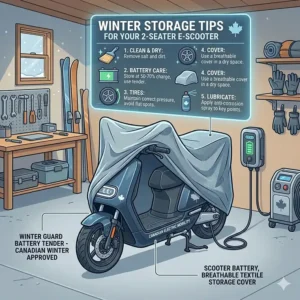
Store batteries indoors during Canadian winters. Lithium-ion cells lose capacity permanently below -10°C. After wet rides, dry the deck and folding mechanism—road salt accelerates corrosion. Apply marine grease to exposed metal parts monthly. Silicone spray on moving joints prevents seizing. Replace brake pads before metal-on-metal grinding—wet Canadian roads double brake wear.
Safety Equipment (Before First Ride)
Helmet required by law in most provinces. Choose full-face or mountain bike styles for better protection. Wear high-visibility clothing—Canadian drivers don’t expect scooters during morning darkness. Headlamp recommended; most scooter lights illuminate poorly. Consider wrist guards; the natural falling instinct risks fractures.
Common first-week mistakes Canadian riders make: underestimating hill difficulty (test your route on a bicycle first), ignoring weather forecasts (sudden rain destroys confidence), riding too close to curbs (potholes hide in shadows), and trusting full-throttle in parking lots (practice braking distances first). The learning curve takes 20-30 km—be patient with yourself.
Real-World Canadian Scenarios: Which Scooter Fits Your Life?
Understanding specification nuances means matching scooters to actual situations.
Scenario 1: Downtown Toronto Condo Dweller (15 km Daily Commute)
Profile: Lives on 22nd floor, works in Midtown, commutes year-round, stores scooter in apartment, values reliability.
Recommendation: Segway Ninebot MAX G2 ($900-$1,100 CAD)
Reasoning: The 55-70 km range provides week-long battery life despite cold weather losses. Self-sealing tyres eliminate elevator trips for flat repairs. The 21 kg weight is manageable once daily versus 12 kg carried twice daily. Winter performance proved across Canada. The investment pays back in saved TTC passes within 6 months.
Scenario 2: Vancouver Weekend Trail Rider (Recreational Use)
Profile: Rides seawall paths on weekends, stores in garage, wants adventure capability, casual use.
Recommendation: Apollo Go ($800-$950 CAD)
Reasoning: Dual motors handle variable terrain from paved paths to gravel sections. The suspension absorbs root bumps on rougher trails. IP66 waterproofing survives Vancouver drizzle. The 45-60 km range suits 4-hour explorations. AWD traction manages wet wooden bridges safely. Recreational riders justify premium features when they enhance enjoyment.
Scenario 3: Ottawa Student (Budget $400, Short Campus Trips)
Profile: 5 km daily campus commute, tight budget, first scooter, flat terrain, needs portability.
Recommendation: Gotrax GXL V2 ($300-$400 CAD)
Reasoning: The entry price fits student budgets. The 20-25 km range covers campus rounds with margin. The 12 kg weight allows carrying between classes. Flat Ottawa terrain suits the 250W motor. The kick-start feature prevents parking lot accidents. Students can upgrade later after proving daily use.
These scenarios demonstrate how informed purchase decisions depend on context, not just specifications. A $300 scooter failing a mountainous Vancouver commute doesn’t mean it’s bad—just mismatched. Similarly, buying a $1,100 MAX G2 for 3 km flat commutes wastes capability. Match your actual use case, then choose accordingly.
How to Choose an Electric Scooter in Canada: The 7 Core Criteria
Specification understanding starts with knowing what matters in Canadian conditions.
1. Motor Power: Hills Don’t Care About Marketing
Motor wattage means nothing without context. A 500W motor with quality components outperforms poorly-designed 700W systems. What matters: sustained power delivery on climbs. Canadian cities feature significant elevation changes—Vancouver’s hills, Ottawa’s escarpments, Calgary’s river valleys. Test your route: if it makes you breathe hard on a bicycle, budget scooters struggle.
Rule of thumb: 250W handles flat terrain only, 350-500W manages moderate 10-15° hills, 700W+ conquers steep urban climbs. Dual motors provide traction advantages on wet surfaces—worth considering if you ride year-round in coastal provinces.
2. Battery Capacity: Range Anxiety Is Real
Battery capacity (measured in Wh or Ah × voltage) determines range. But Canadian cold reduces advertised range 15-20%. A scooter claiming 50 km delivers 40 km in January. Calculate your daily commute, multiply by 1.3 for safety margin, then choose a battery meeting that minimum. Voltage architecture matters: 48V systems maintain power better than 36V as batteries deplete.
Lithium-ion batteries last 500-800 charge cycles before capacity drops to 80%. If you commute daily, that’s 2-3 years. Replacement costs $300-$500 CAD depending on model. Budget scooters sometimes use proprietary batteries with limited availability—check replacement cost before buying.
3. Build Quality: Canadian Roads Test Everything
Aluminum alloy frames balance strength and weight. Steel frames survive impacts better but add 3-5 kg. Check folding mechanism quality—this breaks first under Canadian pothole abuse. Inspect welds visually; uneven beads indicate poor quality control. IP ratings matter: IPX4 handles splashes, IP65 survives pressure washing, IP66 withstands submersion for seconds.
Winter introduces salt corrosion. Look for rust-resistant coatings on brake discs, sealed bearings, and marine-grade fasteners. Chinese manufacturing isn’t automatically bad—brands like Segway and NIU have proven quality—but verify warranty coverage in Canada.
4. Wheel Size and Type: Comfort Versus Maintenance
Larger wheels (25-28 cm / 10-11 inches) roll over obstacles better than smaller ones (20 cm / 8 inches). Canadian roads feature potholes, expansion joints, and debris—bigger wheels reduce vibration transfer. Pneumatic (air-filled) tyres absorb bumps but puncture. Solid tyres never flat but transmit every crack. Self-sealing pneumatic tyres split the difference—comfort with puncture resistance.
Suspension matters more than riders expect. Canadian roads justify front suspension at minimum. Dual suspension (front and rear) transforms rough commutes into comfortable rides. Budget models skip suspension to hit price points—acceptable for smooth bike paths, punishing for mixed surfaces.
5. Braking Systems: Stopping on Wet Leaves Requires Engineering
Electronic brakes (regenerative) extend range but perform inconsistently in cold or wet conditions. Mechanical brakes (disc, drum) work reliably regardless of weather. Best systems combine both: electronic for gradual slowing, mechanical for emergency stops. Dual braking systems (front and rear) reduce stopping distances by 30-40%—critical when avoiding sudden obstacles.
Test braking on gravel or wet surfaces before commuting. Canadian roads accumulate leaves, sand, and salt—traction varies dramatically. Quality brake pads cost $20-40 CAD; replace proactively before metal grinding.
6. Canadian Legal Compliance: Provincial Regulations Differ
Federal regulations define power-assisted bicycles: 500W maximum, 32 km/h speed limit, pedals not required for scooters. Provincial and municipal laws add layers. Ontario requires riders 16+, helmets mandatory. Quebec demands helmets for all ages, riders 14+. British Columbia allows 16+ riders in municipal pilots.
Some scooters exceed legal limits—particularly performance models claiming 40+ km/h. These risk tickets or confiscation. Verify your municipality’s rules before buying. Toronto currently bans electric scooters on public property—don’t buy if you’re downtown until regulations change.
7. Value Assessment Beyond Price: Total Cost of Ownership
A $300 scooter needing $150 in repairs within 6 months costs more than a $600 scooter lasting 3 years. Factor in replacement parts availability, warranty coverage, and brand support in Canada. Established brands (Segway, Apollo, Gotrax) maintain Canadian parts inventory. Unknown brands disappear, leaving you searching overseas for $80 controllers.
Calculate cost per kilometre over expected lifespan. A $1,000 scooter lasting 5,000 km costs $0.20/km. A $400 scooter failing at 2,000 km costs the same. Battery replacement adds $300-500 CAD around year 3. Premium models with longer warranties amortize costs better than budget models requiring frequent replacement.
Electric Scooter Features Explained: Separating Marketing From Meaning
Manufacturers tout features with limited practical value. Here’s what actually matters for Canadian riders:
App Connectivity: Useful or Gimmick?
GPS tracking via Apple Find My or proprietary apps protects against theft—worth having in urban Canada. Remote locking discourages casual thieves. Mileage tracking helps schedule maintenance. Customizable throttle curves let you prioritize acceleration or range. Firmware updates occasionally fix bugs or improve battery management.
Skip features like LED colour customization or social ride-sharing—novelty wears off quickly. Bluetooth connectivity drains phone batteries and sometimes disconnects mid-ride. Essential app features: anti-theft, odometer, and battery health monitoring. Everything else is marketing.
Cruise Control: Hand Fatigue Reducer or Hazard?
Cruise control (hold throttle 5 seconds to engage) reduces thumb strain on long rides. Practical for multi-kilometre straight paths or bike lanes. Dangerous in traffic where constant speed adjustments are needed. Canadian riders value it for seawall rides or protected bike lanes, less so for stop-and-go urban commuting. Disengage via brake or throttle adjustment.
Lighting Systems: Seeing Versus Being Seen
Most scooter headlights barely illuminate potholes 5 metres ahead—inadequate for Canadian winter’s 4:30 PM sunsets. Add a handlebar-mounted bicycle headlight ($30-60 CAD) producing 800+ lumens. Tail lights with brake activation meet legal requirements but visibility-conscious riders add clip-on strobes. Side reflectors or LED strips improve cross-traffic visibility at intersections.
Canadian regulations require lights front and rear during darkness or reduced visibility. Police enforce this—$100-200 CAD tickets are common. Don’t rely on scooter lights alone; supplement with brighter aftermarket options.
Foldable Designs: Convenience Comes With Compromises
Folding mechanisms add moving parts and potential failure points. Quality mechanisms use metal latches with redundant safety locks—cheap designs use plastic that breaks after months. Test the fold before buying: single-hand operation in under 10 seconds indicates good design. Check unfolding—shouldn’t require wrestling or tools.
Frequent folders (daily transit users) justify premium folding mechanisms. Occasional folders (monthly car storage) tolerate basic designs. Non-folding scooters eliminate this failure point entirely—worth considering if you never need compact storage.
Common Mistakes When Buying an Electric Scooter
Canadian buyers repeatedly make these avoidable errors:
Mistake 1: Prioritizing Top Speed Over Range
Marketing emphasizes 50 km/h capabilities on models you’ll ride at 25 km/h to preserve battery. Canadian bike lanes legally restrict speeds anyway. Focus on range that covers your actual commute with 30% buffer for cold weather losses and detours.
Mistake 2: Ignoring Winter Performance
Budget scooters list ideal-condition range. Canadian winters reduce this 15-20%. Batteries lose capacity permanently below -10°C without proper storage. Test winter performance reviews from Canadian buyers—international reviews miss our climate reality.
Mistake 3: Underestimating Maintenance Costs
Entry-level scooters seem affordable until you price replacement parts. Unknown Chinese brands disappear, forcing expensive overseas shipping for controllers, displays, or batteries. Stick with established brands maintaining Canadian inventory (Segway, Apollo, Hiboy, Gotrax). Factor $50-150 CAD annually for brake pads, tyres, and general maintenance.
Mistake 4: Buying Maximum Power for Flat Commutes
Vancouver’s hills justify dual motors; Regina’s flat terrain doesn’t. Overpowered scooters waste battery on features you’ll never use. Match motor power to your steepest regular hill—don’t buy capabilities based on once-yearly cottage trips.
Mistake 5: Neglecting Legal Compliance Research
Provincial regulations vary dramatically. Toronto’s ban catches buyers off-guard after spending $800. Montreal’s helmet requirements differ from Vancouver’s pilot rules. Research your municipality’s specific bylaws before buying—regulations change frequently as cities experiment with micromobility.
Mistake 6: Trusting Advertised Range Completely
Manufacturer range claims assume ideal conditions: 70 kg rider, flat terrain, no wind, 20°C temperature, fresh battery. Your reality includes hills, 90 kg with backpack, -5°C mornings, and aging batteries. Real-world range is 60-70% of advertised specs. Calculate accordingly.
Frequently Asked Questions
❓ Can I ride an electric scooter in winter across Canada?
❓ Do I need a driver's licence to operate an electric scooter in Canada?
❓ How long do electric scooter batteries last in Canadian conditions?
❓ What's the best electric scooter for climbing Canadian hills?
❓ Are electric scooters allowed on public transit in Canada?
Conclusion: Your Next Move Starts Here
This electric scooter buying guide gave you specification understanding that transforms shopping from overwhelming to strategic. You now recognize how 48V architecture maintains power better than 36V systems, why Canadian cold demands 30% range buffer, and which features justify their cost versus marketing fluff.
The right electric scooter changes urban mobility. Former car commuters save $200+ monthly on parking and fuel. Transit users gain flexibility and time. Recreational riders discover neighbourhood exploration. But these benefits only materialize when you match scooter capabilities to your actual Canadian conditions.
Budget buyers should start with the Gotrax GXL V2 or NIU KQi 100P—proven entry points under $500 CAD. Daily commuters covering 15+ km need the Segway MAX G2’s range or Apollo Dash’s power. Year-round riders in challenging terrain justify the Apollo Go’s dual motors and suspension. Portability-focused transit users want the Segway E2’s 13 kg lightness.
Remember: specifications mean nothing without Canadian context. What to look for when buying scooter starts with honest assessment of your hills, distance, storage situation, and weather exposure. Informed purchase decisions happen when you stop comparing spec sheets and start matching capabilities to your daily reality. Choose wisely, ride safely, and enjoy the freedom only personal electric transport provides.
Recommended for You
- 7 Best 2 Seater Electric Scooters for Adults in Canada 2026
- Electric Scooter for Two People: 7 Top Picks Canada 2026
- 7 Best Cargo Electric Scooters for Business Use Canada 2026
Disclaimer: This article contains affiliate links. As an Amazon Associate, I earn from qualifying purchases. If you purchase products through these links, we may earn a small commission at no additional cost to you.
✨ Found this helpful? Share it with your friends! 💬🤗
