
In This Article
Here’s something most Canadian riders don’t realize: that zippy electric scooter you just bought could land you a $2,500 fine if you’re riding in the wrong province. Confused? You’re not alone.
Electric scooter laws in Canada are a provincial patchwork that changes dramatically depending on whether you’re cruising through Vancouver, navigating Ontario’s pilot program, or exploring Montreal’s bike paths. Unlike our neighbours to the south where state regulations offer some consistency, Canadian e-scooter regulations ontario and beyond create a complex maze of rules that even seasoned riders struggle to navigate.
I’ve spent countless hours researching provincial scooter rules, talking to riders, and yes—learning the hard way what happens when you accidentally violate helmet requirements canada or cross into forbidden sidewalk territory. Whether you’re wondering where can I ride electric scooter legally, trying to understand sidewalk vs road laws, or simply asking “is my scooter even legal?”—this guide breaks down everything you need to know about electric scooter legal canada status in 2026.
Let’s cut through the confusion and get you riding safely and legally across the Great White North. 🍁
Quick Comparison Table: Provincial E-Scooter Laws at a Glance
| Province | Legal Status | Minimum Age | Helmet Required | Max Speed | Where You Can Ride |
|---|---|---|---|---|---|
| Ontario | Legal (pilot to 2029) | 16+ | Yes | 24 km/h | Bike lanes, roads ≤50 km/h |
| British Columbia | Legal (pilot extended) | 16+ | Yes | 24 km/h | Bike lanes, roads ≤50 km/h |
| Quebec | Legal (pilot to 2026) | 14+ | Yes | 25 km/h | Bike paths, roads ≤50 km/h |
| Alberta | Legal in some cities | 18+ | Yes | 24 km/h | Bike lanes, pathways |
| Saskatchewan | Municipal opt-in | 16+ | Yes | 24 km/h | Varies by city |
| Manitoba | Not legal on public roads | N/A | N/A | N/A | Private property only |
| Atlantic Provinces | Varies/Restricted | Varies | Yes (where allowed) | Varies | Limited availability |
💬 Just one click – help others make better buying decisions too!😊
Top 7 Electric Scooters for Legal Canadian Riding: Expert Analysis
Before we dive deep into the legal complexities, let’s look at seven e-scooters that actually comply with Canadian regulations and are readily available on Amazon.ca. Each meets the crucial 500W motor limit and speed restrictions required across most provinces.
1. Gyrocopters Flash 6.0 Electric Scooter
This Gyrocopters Flash 6.0 stands out as one of the most compliance-friendly options for Canadian riders in 2026. With its 350W brushless motor and UL2272 safety certification, it ticks all the regulatory boxes while delivering impressive performance.
Key Specifications:
- 350W motor (well within 500W federal limit)
- Top speed: 30 km/h (adjustable to meet local limits)
- Range: Up to 30 km
- 8.5″ burst-proof tires
- Smart anti-theft lock via app
Canadian Pricing: $349-$399 CAD depending on model variant
Canadian buyers particularly appreciate the app-controlled speed limiting feature, which lets you set maximum speeds to comply with your municipality’s specific requirements. Toronto riders can cap it at the legal limit, while Vancouver users can adjust accordingly.
✅ Pros:
- UL2272 safety certification
- App-controlled speed limits for legal compliance
- Burst-proof tires for Canadian weather
❌ Cons:
- Solid tires may feel harsh on rough roads
- Battery performance drops in extreme cold
Customer Feedback: “Perfect for my Ottawa commute. I keep it at 24 km/h to stay legal, and the battery lasts my entire week of trips to work” – verified Canadian buyer
2. Hiboy S2 Pro Electric Scooter
The Hiboy S2 Pro has become Canada’s best-selling budget option for good reason. This Hiboy S2 Pro delivers exceptional value while maintaining legal compliance across most provinces.
Key Specifications:
- 350W motor
- Maximum speed: 30 km/h (speed-adjustable)
- Range: 27-40 km depending on conditions
- 8.5″ solid tires
- Dual braking system (eABS + disc brake)
Canadian Pricing: $284-$349 CAD (frequent sales on Amazon.ca)
What makes this particularly appealing for Canadian riders is its proven performance in cold weather. Multiple Vancouver and Calgary users report reliable operation down to -5°C, though battery range does decrease.
✅ Pros:
- Excellent price-to-performance ratio
- Proven reliability in Canadian climates
- Widely available parts and service
❌ Cons:
- Basic suspension on rough terrain
- App connectivity can be finicky
Customer Feedback: “Been riding this in Calgary bike lanes for 8 months. Holds up great except in deep winter” – Alberta resident review
3. Segway Ninebot MAX G2
Premium meets practical with the Segway Ninebot MAX G2. This Segway Ninebot MAX G2 represents the gold standard for riders who want maximum reliability and don’t mind investing more upfront.
Key Specifications:
- 450W motor (350W nominal, 900W peak)
- Top speed: 35 km/h (speed-limitable)
- Range: Up to 70 km
- 10″ self-healing tubeless tires
- Front hydraulic suspension
Canadian Pricing: $899-$1,199 CAD
For Montreal’s pilot program or Ottawa’s extended commutes, this scooter excels. The self-healing tires are particularly valuable on Canadian roads with potholes and debris. It exceeds the speed limit in some jurisdictions, so you’ll need to use the app to set appropriate limits.
✅ Pros:
- Exceptional range for long Canadian commutes
- Self-healing tires reduce maintenance
- Superior build quality and warranty
❌ Cons:
- Higher price point
- Heavier weight (24.9 kg) makes stairs challenging
Customer Feedback: “Worth every penny for Toronto to Mississauga commutes. Set speed limit to 24 km/h and it’s perfectly legal” – Ontario rider
4. iScooter iX5 Electric Scooter
The iScooter iX5 offers excellent middle-ground positioning with features that matter to Canadian riders, including superior weather resistance and reasonable pricing.
Key Specifications:
- 500W peak motor (350W rated)
- Maximum speed: 30 km/h
- Range: 30-35 km
- 10″ pneumatic tires
- IPX4 water resistance rating
Canadian Pricing: $429-$499 CAD
The IPX4 rating is crucial for Vancouver’s rainy climate or sudden summer storms across the prairies. This iScooter iX5 handles wet conditions better than most budget competitors.
✅ Pros:
- Better water resistance for Canadian weather
- Larger 10″ tires for comfort
- Balanced price and features
❌ Cons:
- Battery takes 6-8 hours to fully charge
- Customer service limited in Canada
Customer Feedback: “Rode through Vancouver rain for weeks – no issues. Just wish the range was better in cold weather” – BC buyer
5. WERHY E6 Pro Electric Scooter
An emerging favourite among Canadian commuters, the WERHY E6 Pro combines affordability with surprisingly robust construction. This WERHY E6 Pro punches above its weight class.
Key Specifications:
- 500W motor
- Top speed: 31 km/h (adjustable)
- Range: 30-35 km
- 10″ solid tires
- Cruise control function
Canadian Pricing: $359-$429 CAD
Quebec riders appreciate the cruise control feature for maintaining consistent speeds on longer bike paths, while the solid tires eliminate flat tire concerns during winter storage.
✅ Pros:
- Solid construction at budget price
- No flat tire worries with solid tires
- Quick fold mechanism
❌ Cons:
- Limited brand recognition in Canada
- Solid tires = rougher ride quality
Customer Feedback: “Great value. Using it in Edmonton bike lanes daily. No issues after 6 months” – Alberta purchaser
6. NAVEE V40 Electric Scooter
The NAVEE V40 brings premium features to the mid-range market. This NAVEE V40 is particularly popular in Ontario’s pilot program cities.
Key Specifications:
- 700W peak motor (legal 500W nominal)
- Maximum speed: 32 km/h
- Range: 40 km
- 10″ self-sealing tubeless tires
- Dual suspension system
Canadian Pricing: $649-$749 CAD
The self-sealing tires combined with dual suspension make this ideal for Canadian cities with less-than-perfect road infrastructure. Ottawa and Winnipeg riders consistently praise the smooth ride quality.
✅ Pros:
- Excellent suspension for rough Canadian roads
- Self-sealing tires reduce roadside repairs
- Strong motor for hills
❌ Cons:
- Mid-to-high price point
- Heavier than budget options
Customer Feedback: “Best ride quality I’ve tested. Worth it for Toronto’s pothole-riddled bike lanes” – Ontario commuter
7. Gyrocopters Zeno with Seat Electric Scooter
For riders wanting extra comfort or those with accessibility considerations, the Gyrocopters Zeno offers a unique seated option while maintaining legal compliance.
Key Specifications:
- 500W peak motor
- Top speed: 25 km/h
- Range: 25 km
- 14″ pneumatic tires
- Removable seat + large basket
- GPS tracker included
Canadian Pricing: $699-$799 CAD
This Gyrocopters Zeno serves a niche but important market—riders who want scooter portability with occasional seated comfort. The large basket is perfect for grocery runs, making it practical for car-free Canadian urban living.
✅ Pros:
- Seated option for longer rides
- Large basket for cargo/groceries
- GPS tracking for theft prevention
❌ Cons:
- Heavier with seat attached
- Lower speed may frustrate some riders
Customer Feedback: “Perfect for my senior parent in Victoria. The seat makes all the difference for mobility” – BC family member
Understanding Federal vs Provincial E-Scooter Regulations in Canada
Here’s where things get interesting—and complicated. Unlike cars or traditional bicycles, electric scooter laws operate on multiple governmental levels simultaneously.
The Federal Framework
Transport Canada classifies electric scooters similarly to power-assisted bicycles (e-bikes) at the federal level. According to federal guidelines updated in 2021, vehicles designed to travel under 32 km/h on level ground fall outside Motor Vehicle Safety Act regulations. This means they’re considered “non-regulated” for importation and manufacturing purposes.
However—and this is critical—just because Transport Canada doesn’t regulate them doesn’t mean you can ride freely. Provincial and municipal governments hold all the cards when it comes to where can I ride electric scooter and under what conditions.
Provincial Powers
Each province creates its own Highway Traffic Act or Motor Vehicle Act provisions covering e-scooters. Some embrace them through pilot programs, others ban them outright from public roads, and several remain in regulatory limbo.
Think of it like cannabis legalization—federally permitted, but each province sets its own rules about sales, usage locations, and age restrictions. E-scooters follow a similar pattern. 🍁
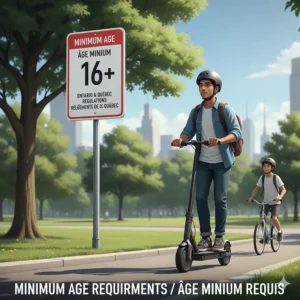
Province-by-Province Breakdown: Where Can You Legally Ride?
Ontario: Extended Pilot Program (Until 2029)
Ontario’s e-scooter pilot represents Canada’s most comprehensive provincial approach. Extended until November 2029, it gives municipalities the power to opt in or out.
Key Rules:
- Minimum age: 16 years
- Helmet: Mandatory for all riders
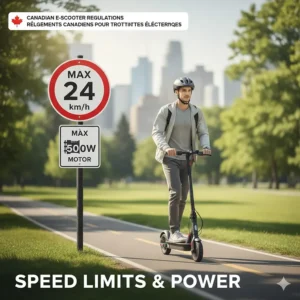
- Maximum motor: 500 watts
- Top speed: 24 km/h on level ground
- Weight limit: 120 kg maximum vehicle weight
Where You Can Ride:
✅ Bicycle lanes and paths
✅ Roads with speed limits 50 km/h or less
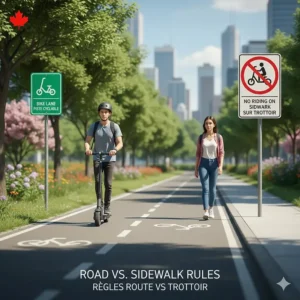
❌ Sidewalks (prohibited)
❌ 400-series highways
❌ Toronto (city opted out entirely)
Notable Municipal Variations:
- Ottawa: Full participation, extensive bike lane network
- Toronto: Complete ban on public property—private property only
- Waterloo: Active shared rental program
- Hamilton: Permitted with restrictions
Fines: $250-$2,500 for violations
The Toronto ban remains a major frustration for residents. Despite having excellent cycling infrastructure, Canada’s largest city prohibits e-scooters entirely on public roads, bike lanes, and sidewalks. Riders caught face steep fines and possible scooter confiscation.
British Columbia: Four-Year Pilot Extension
BC renewed its Electric Kick Scooter Pilot Project for four years starting April 2024, showing commitment to alternative transportation.
Provincial Requirements:
- Age: 16+ years
- Helmet: CSA, CPSC, ASTM, or Snell approved helmet mandatory
- Motor power: Maximum 500W
- Speed: Cannot exceed 24 km/h
Where to Ride:
✅ Designated bike lanes
✅ Multi-use pathways (where posted)
✅ Roads with posted speed limits ≤50 km/h
❌ Sidewalks
❌ Major roads and highways
Vancouver Specifics: The city uses geofencing technology for shared e-scooters, automatically slowing or stopping scooters in prohibited zones like the iconic Seawall. Private e-scooter owners must manually comply with these restrictions.
Fines: Up to $2,000 for serious violations
Quebec: Pilot Program Through 2026
Quebec’s three-year pilot program for motorized personal transport devices (MPTDs) runs until 2026, with regulations updated in July 2024 banning non-compliant scooters.
Provincial Rules:
- Minimum age: 14 years
- Helmet: Mandatory for all ages
- Maximum speed: 25 km/h
- Motor: 500W maximum
Riding Areas:
✅ Bike paths and lanes
✅ Roads with speed limits ≤50 km/h
❌ Sidewalks
❌ Roads over 50 km/h
Montreal’s Unique Situation: After ending its rental scooter program in 2019 due to safety concerns and cluttered sidewalks, Montreal now allows private e-scooters under strict conditions:
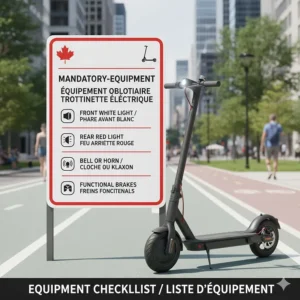
- Front white light and red rear light required at night
- Working brakes mandatory
- No passengers allowed
- Fines up to $200 for violations
Important 2024 Update: Quebec banned scooters resembling mopeds without federal safety marks from public roads and bike paths due to safety concerns.
Alberta: Municipal Opt-In System
Alberta doesn’t have province-wide e-scooter legislation, leaving regulation entirely to municipalities. Calgary and Edmonton lead with established programs.
Calgary:
- Age: 18+ for rentals, 12+ for private (with helmets under 18)
- Helmet: Strongly recommended, not legally required for 18+
- Speed: 20 km/h maximum (15 km/h in some zones)
- Allowed: Bike lanes, pathways, some quieter sidewalks
- Fines: $75 for carrying passengers, up to $400 for reckless riding
Edmonton:
- Shared scooter programs only (no private scooters on public property)
- Age: 18+ years
- Helmet: Recommended but not required
- Permitted: Cycle paths and roads ≤50 km/h
Saskatchewan: Limited Municipal Programs
Provincial law doesn’t specifically address e-scooters, but municipalities like Saskatoon run pilot programs.
Saskatoon Pilot:
- Age: 16+
- Helmet: Required
- Riding: Bike lanes permitted
- Status: Ongoing evaluation
Atlantic Canada & Other Provinces
Nova Scotia, New Brunswick, Prince Edward Island: E-scooters generally treated under bicycle laws where permitted. Regulations vary significantly by municipality. Helmet mandates common across all ages.
Manitoba: E-scooters not legal on public roads. Private property use only.
Newfoundland and Labrador: Not currently permitted on public infrastructure.
This patchwork creates challenges for riders traveling between provinces. Your perfectly legal scooter in Vancouver becomes contraband the moment you cross into Saskatchewan—unless you’re in Saskatoon’s pilot zone. Welcome to Canadian federalism in action! 🇨🇦
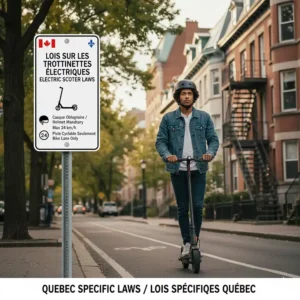
Helmet Requirements Across Canada: What You Must Wear
One area of remarkable consistency: nearly every jurisdiction requires helmets. But not just any helmet will do.
Acceptable Helmet Standards
Your helmet must meet at least one of these certification standards:
- CPSC (Consumer Product Safety Commission) – U.S. standard
- CSA (Canadian Standards Association)
- ASTM (American Society for Testing and Materials)
- Snell – Independent testing foundation
- EN 1078 – European standard
Look for certification stickers inside your helmet. A skateboarding helmet or construction hard hat won’t cut it—bicycle helmets specifically designed for impact protection are required.
Age-Based Requirements
While most provinces require helmets for all ages on e-scooters, some differentiate:
- All Ages: BC, Ontario, Quebec, Calgary (under 18 only legally required but recommended for all)
- No Legal Requirement (but strongly recommended): Edmonton for 18+
Pro Tip: Even where not legally required, helmets dramatically reduce serious injury risk. Canadian hospitals see enough e-scooter injuries—don’t become a statistic. I learned this the hard way with a close call in Ottawa traffic.
Proper Fit Matters
A helmet sitting on your backpack or loosely perched on your head doesn’t count. Provincial police enforce proper helmet fit:
- Sits level on your head (not tilted back)
- Covers forehead about two finger-widths above eyebrows
- Straps form a “V” shape under ears
- Chin strap snug but comfortable
Fines for non-compliance: $100-$250 typically, though can reach $2,500 in Ontario under certain circumstances.
Sidewalk vs Road Laws: Where Can You Actually Ride?
This question generates more confusion than any other aspect of electric scooter laws in Canada. The answer varies not just by province, but often by specific streets within municipalities.
General Canadian Pattern
Roads:
- Permitted: Roads with speed limits ≤50 km/h (most jurisdictions)
- Prohibited: Highways, freeways, any road >50 km/h
Bike Lanes:
- Nearly universally permitted where e-scooters are legal
- Considered the safest and preferred option
Sidewalks:
- Almost universally prohibited
- Exceptions: Some Calgary areas with specific signage
- Rationale: Pedestrian safety concerns
Multi-Use Paths:
- Generally permitted where bikes allowed
- Watch for posted restrictions
- Yield to pedestrians always
The Sidewalk Debate
Why the sidewalk prohibition when it seems safer than roads? Provincial governments cite three primary reasons:
- Speed differential: E-scooters traveling 24 km/h on sidewalks create dangerous situations with pedestrians walking 5 km/h
- Vulnerability: Elderly pedestrians, children, and people with disabilities face higher injury risks
- Sidewalk condition: Many Canadian sidewalks are too narrow for safe passing
Reality Check: I’ve watched countless riders use sidewalks anyway, especially in areas without bike infrastructure. Police enforcement varies dramatically—strictly enforced in downtown cores, largely ignored in suburban areas. But the fines can be substantial ($100-$500), and if you injure a pedestrian, you face serious civil liability.
Special Riding Zones
Some municipalities create designated “slow zones”:
- School zones: Reduced speeds or prohibitions during school hours
- Dense pedestrian areas: Downtown cores, shopping districts
- Parks: Many ban motorized vehicles entirely
- Waterfront areas: Vancouver’s Seawall prohibits e-scooters; Toronto’s waterfront trails vary
Always check municipal bylaws for your specific riding area. The “I didn’t know” defense doesn’t work well when facing $250+ fines.
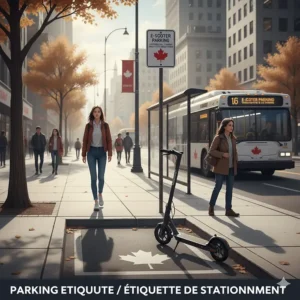
E-Scooter Technical Requirements: Making Your Ride Legal
Beyond where you ride, what equipment your scooter needs varies by province. Here are common requirements across Canadian jurisdictions:
Lighting Systems
Mandatory in most provinces:
- White front headlight (visible 150m minimum)
- Red rear light or reflector
- Side reflectors for night visibility
Most quality scooters from Amazon.ca come equipped with these, but budget models may lack proper lighting. Don’t skip this—it’s both a safety and legal issue.
Braking Systems
Requirements specify “reliable braking system” capable of bringing the scooter to a controlled stop. Most modern e-scooters feature:
- Electronic (regenerative) front brake
- Mechanical disc or drum rear brake
- Some models include foot brakes
Dual braking systems are increasingly standard and provide the best stopping power on Canadian roads (especially important on wet surfaces or winter slush).
Bells or Horns
BC explicitly requires “a bell or horn audible for 30 metres” to alert pedestrians and cyclists. While not universally mandated across all provinces, it’s an excellent safety addition. Most e-scooters don’t include these—you’ll need to purchase separately (under $15 CAD on Amazon.ca).
Motor Power Limits
The 500-watt maximum motor power appears consistently across Canadian regulations. However, marketing can be misleading:
- Rated/Nominal Power: Continuous output (usually 350W-500W)
- Peak Power: Short burst capability (often 800W-1000W)
Scooters advertised with 800W or higher peak power are legal if their nominal/rated power stays at or below 500W. All scooters in our top 7 list comply with this standard.
Weight and Size Restrictions
Ontario specifically limits scooter weight to 120 kg, though most consumer models weigh 15-30 kg. No standing while riding doesn’t mean seated riding is required—it refers to riding position (one person, not standing on seat, etc.).
Insurance and Licensing: Do You Need Them?
Here’s good news: most Canadian jurisdictions treat legal e-scooters like bicycles regarding insurance and licensing.
Licensing Requirements
Not required in:
- Ontario (pilot program scooters)
- British Columbia (compliant scooters)
- Quebec (under MPTD pilot)
- Calgary, Edmonton
- Most other jurisdictions where e-scooters are legal
However: If your e-scooter exceeds provincial power or speed limits, it may be reclassified as a motor vehicle or moped, requiring:
- Driver’s license
- Registration
- Insurance
- License plate
This rarely happens with consumer e-scooters from mainstream retailers, but modified or powerful models risk reclassification.
Insurance Considerations
While not legally required, insurance is worth considering:
Homeowner’s/Renter’s Insurance: Often covers e-scooter theft and damage under personal property. Check your policy—some exclude motorized vehicles.
Liability Coverage: If you injure someone or damage property while riding, you could face lawsuits. Some homeowner policies include personal liability that might cover e-scooter incidents, but verify with your insurer.
Specialized E-Scooter Insurance: Emerging in Canadian market but not yet common. Companies like Intact and Aviva are exploring options.
Cost Reality: Expect $100-$200 annually if you purchase specialized coverage. For a $400 scooter, many riders skip it. For a $1,200 Segway, it makes more sense.
Registration and Plates
Not required for compliant e-scooters in any Canadian jurisdiction. If someone tells you that you need to register your e-scooter, they’re either misinformed or referring to a non-compliant model that’s classified as a motorcycle/moped.
Safety Tips for Canadian E-Scooter Riders
Legal compliance keeps you out of trouble with police. Smart riding keeps you out of hospitals. Here’s what years of riding and countless conversations with Canadian emergency physicians taught me:
Weather-Specific Considerations
Rain:
- Braking distances double on wet pavement
- Avoid painted road markings (slippery when wet)
- Consider fenders to prevent water spray
- IPX4 or higher water resistance recommended
Cold Weather:
- Battery range drops 30-50% below 0°C
- Tire pressure decreases in cold (check regularly)
- Ice patches invisible on bike lanes
- Store battery indoors when not riding
Snow/Ice:
- Seriously consider not riding—e-scooter tires lack traction
- If you must, slow to 10 km/h maximum
- Studded tires exist but aren’t worth it for occasional use
Visibility Enhancement
Canadian winters mean dark commutes. Beyond legal requirements:
- Reflective vest or bright clothing
- Ankle bands reflect in car headlights
- Helmet lights supplement scooter lights
- Consider front and rear cameras (dashcam for scooters)
Defensive Riding Techniques
Assume invisibility: Drivers don’t see e-scooters well. Make eye contact before crossing paths.
Avoid door zones: Ride at least one metre from parked cars—car doors open suddenly.
Scan ahead: Potholes, debris, and drainage grates create instant hazards. Eyes up, always.
Signal intentions: Hand signals matter. Left turn = left arm extended. Right turn = right arm extended (or left arm bent up). Stopping = left arm bent down.
Space cushion: Maintain 2-3 metre distance from cars, cyclists, pedestrians.
Theft Prevention
E-scooter theft is rampant in Canadian cities, especially Vancouver, Toronto, and Montreal.
Best practices:
- Quality U-lock + cable (lock frame and wheel)
- GPS tracking (some models include it)
- Insurance/registration photos and serial numbers
- Never leave unattended for extended periods
- Remove battery if storing outside
Reality: Even locked scooters get stolen. Budget $50-$100 for a quality lock if you plan on leaving your scooter anywhere public.
✨ Don’t Miss These Exclusive Deals!
🔍 Take your urban commuting to the next level with these carefully selected electric scooters available in Canada. Click on any highlighted scooter model to check current pricing and availability on Amazon.ca. These rides will help you navigate Canadian streets legally and safely—all while enjoying the convenience of eco-friendly transportation! 🍁
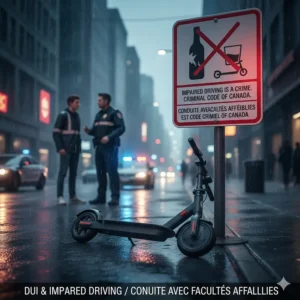
E-Scooter Laws Comparison: Canada vs United States
Canadian and American riders often cross the border with scooters. Understanding the differences prevents legal headaches.
Regulatory Structure
United States: Each state sets its own rules, but within states, regulations are relatively consistent. California’s rules apply statewide with minor municipal variations.
Canada: Provinces set frameworks, but municipal opt-in/opt-out creates greater variation. Ontario’s rules don’t apply in Toronto despite both being in the same province.
Age Requirements
US: Typically 16+ or 18+ depending on state
Canada: 14+ (Quebec) to 18+ (some Alberta cities)
Younger Canadian riders (14-15) have more opportunities in Quebec than most US states.
Helmet Laws
US: Many states don’t mandate helmets for 18+
Canada: Nearly universal helmet requirements regardless of age
Canadian laws are significantly stricter here.
Speed Limits
US: Generally 15-20 mph (24-32 km/h)
Canada: Consistently 24-25 km/h (15-16 mph)
Canadian limits slightly lower on average.
Insurance/Registration
Both countries generally don’t require these for compliant e-scooters, with exceptions for high-power models.
Border Crossing Reality: Bringing your e-scooter across the Canada-US border is generally fine for personal use, but confirm with customs that it meets destination regulations. Commercial imports face different rules.
Benefits vs Traditional Alternatives
Why are Canadians increasingly choosing e-scooters despite regulatory complexity?
| Feature | E-Scooter | Bicycle | Public Transit | Car |
|---|---|---|---|---|
| Average Cost | $300-$800 CAD | $400-$2,000 CAD | $120-$180/month | $500+/month |
| Speed (avg) | 20-24 km/h | 15-25 km/h | Varies | 30-60 km/h |
| Range | 25-40 km | Unlimited | Extensive | Unlimited |
| Storage | Foldable, portable | Requires rack/storage | N/A | Parking costs |
| Weather Impact | Moderate-High | Moderate | Low | Very Low |
| Environmental | Very Low impact | Zero impact | Low impact | Moderate-High |
| Fitness Benefit | Minimal | High | Minimal | None |
| Convenience | High (last-mile) | Moderate-High | Moderate | Moderate |
The Canadian Value Proposition:
For urban Canadians living 3-8 km from work/transit, e-scooters fill a perfect niche:
- Faster than walking
- Cheaper than daily transit passes ($3.50 × 22 days = $77/month vs. one-time $400 scooter cost)
- More portable than bicycles (carry onto trains, store under desks)
- Parking hassles eliminated
Limitations:
- Winter viability (October-March in much of Canada)
- Range anxiety on longer commutes
- Theft risk
- Weather vulnerability
- Limited cargo capacity
Most successful Canadian e-scooter users combine modalities: scooter + transit for longer commutes, scooter for short trips, car/bike for winter.
Frequently Asked Questions About Electric Scooter Laws in Canada
❓ How fast can an electric scooter go legally in Canada?
❓ What is the fine for riding an electric scooter on the sidewalk in Canada?
❓ Do I need insurance for an electric scooter in Canada?
❓ Are electric scooters legal in Toronto in 2026?
❓ What type of helmet do I need for electric scooter riding in Canada?
Conclusion: Navigating Canada’s E-Scooter Legal Landscape
If there’s one thing you should remember from this comprehensive guide, it’s this: electric scooter laws in Canada are less like a highway and more like a choose-your-own-adventure book. Where you live, where you’re riding, and even what street you’re on can completely change the legal landscape.
The current patchwork of regulations—from Ontario’s extended pilot program to Toronto’s complete ban, from Quebec’s progressive 14+ age limit to Manitoba’s prohibition on public roads—reflects a country still figuring out how these devices fit into our transportation ecosystem. And honestly? That’s okay. Pilot programs exist precisely because policymakers need real-world data before cementing permanent rules.
What’s clear is that e-scooters aren’t going anywhere. With over 200,000 units sold in Canada in 2025 alone, pressure continues mounting for clearer, more consistent regulations. The 2029 deadline for Ontario’s pilot decision will likely set the tone for other provinces watching closely.
Your action steps:
- Verify your local laws using municipal websites—don’t rely on provincial rules alone
- Invest in proper safety equipment beyond just legal minimums (quality helmet, lights, lock)
- Choose a scooter from our recommended list that meets Canadian requirements
- Ride defensively and assume drivers don’t see you
- Stay informed as regulations continue evolving
The freedom of zipping through Canadian cities on an electric scooter is genuinely transformative for urban mobility. Just make sure you’re doing it legally, safely, and with full awareness of the rules governing your particular corner of this vast country.
Ride smart, ride safe, and most importantly—ride legal. 🛴🍁
Recommended for You
- How to Choose Electric Scooter: 7 Best Options Canada 2026
- 7 Best Waterproof Electric Scooters Canada 2026 | IP Rating Guide
- 7 Best Winter Electric Scooters Canada 2026 | Cold Weather Ready
Disclaimer: This article contains affiliate links to Amazon.ca. If you purchase products through these links, we may earn a small commission at no additional cost to you.
✨ Found this helpful? Share it with your friends! 💬🤗
