

In This Article
Picture this: you’re standing in a mobility equipment store in Toronto, staring at two seemingly similar scooters. One has four wheels, the other three. The salesperson is rattling off specs, but all you really want to know is which one won’t tip over when you’re navigating that slightly uneven sidewalk near your favourite café, or which one can actually fit through your apartment hallway without requiring a three-point turn.

Here’s the truth most people don’t tell you about 4-wheel vs 3-wheel mobility scooter selection: it’s not just about wheel count. It’s about matching the scooter’s design to your actual daily life. Are you primarily indoors, weaving through grocery store aisles? Or do you need something that can handle Canadian spring sidewalks with their frost heaves and uneven patches?
The debate over which mobility scooter is more stable has real-world implications. According to Statistics Canada’s disability survey, mobility limitations affect a significant portion of Canadians, and choosing the right assistive device directly impacts independence and quality of life. Meanwhile, provinces like British Columbia and Quebec have specific regulations for mobility scooter use on sidewalks and public roads, making it essential to understand how different configurations perform in various conditions.
In this guide, I’ll walk you through the real differences between three-wheel and four-wheel models, examining everything from mobility scooter turning radius comparison to stability vs portability trade-offs. You’ll discover which design excels at indoor vs outdoor mobility scooter use, how scooter maneuverability affects your daily life, and which option provides better tight space navigation. By the end, you’ll know exactly which configuration suits your needs—backed by actual product recommendations available in Canada.
Quick Comparison Table: 3-Wheel vs 4-Wheel Mobility Scooters
| Feature | 3-Wheel Mobility Scooters | 4-Wheel Mobility Scooters |
|---|---|---|
| Turning Radius | Tighter (typically 61-81 cm) | Wider (typically 91-122 cm) |
| Stability | Moderate – suitable for flat surfaces | High – better on uneven terrain |
| Best Use | Indoor use, shopping malls, smooth surfaces | Outdoor use, rough terrain, all conditions |
| Maneuverability | Excellent in tight spaces | Good, but requires more room |
| Weight Capacity | 120-140 kg typical | 120-230 kg typical |
| Price Range (CAD) | $700-$1,200 | $900-$1,700+ |
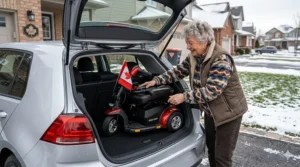
| Portability | Generally lighter (24-32 kg) | Heavier (35-50 kg) |
| Speed | Up to 6-8 km/h | Up to 8-15 km/h |
💬 Just one click – help others make better buying decisions too! 😊
Top 7 Mobility Scooters Available in Canada: Expert Analysis
1. VEVOR Foldable 3-Wheel Mobility Scooter
The VEVOR Foldable 3-Wheel represents the sweet spot for Canadian buyers seeking indoor maneuverability without sacrificing portability. With a 48V lithium-ion battery providing 19 km (12 miles) of range, this scooter handles typical daily errands across most Canadian cities. The 3-wheel design delivers a remarkably tight turning radius, making it perfect for navigating crowded grocery stores or tight apartment hallways.
Key Specifications:
- Weight capacity: 120 kg (265 lbs)
- Maximum speed: 6 km/h (3.7 mph)
- Foldable design for easy transport
Price Range: $900-$1,100 CAD
Canadian buyers on Amazon.ca appreciate the quick folding mechanism, which proves essential when you need to store it in a condo or transport it via HandyDART. One Toronto-based reviewer noted it easily fits through standard Canadian doorways (81 cm width), though you’ll want to measure your specific spaces first.
✅ Pros:
- Exceptional tight space navigation
- Lightweight at approximately 29 kg
- Good battery life for city use
❌ Cons:
- Not ideal for uneven Canadian sidewalks in spring
- Limited weight capacity compared to 4-wheel models
2. FeatherMobility 4-Wheel Lightweight Compact Scooter
At just 17 kg (37 lbs), the FeatherMobility 4-Wheel solves a problem many Canadians face: how do you get stability without sacrificing portability? This scooter features a unique 4-wheel design that maintains a relatively manageable 155 cm (61.2″) turning radius—impressive for a quad configuration.
Key Specifications:
- Weight: 17 kg frame weight
- Turning radius: 155 cm
- 6″ front wheels, 10″ rear wheels
Price Range: $1,400-$1,600 CAD
Canadian users particularly value the airline-approved lithium battery, which means you can actually fly within Canada or internationally without leaving your mobility behind. Several Vancouver-based customers mentioned successfully using it on BC Ferries and VIA Rail, where the compact fold-down size (57 cm x 95 cm x 46 cm folded) fits within standard luggage allowances.
✅ Pros:
- Lightest 4-wheel option available in Canada
- Anti-tippers and safety belt included
- Airline and transit-friendly
❌ Cons:
- Lower weight capacity (120 kg/265 lbs)
- 3″ ground clearance limits rough terrain use
3. VEVOR Heavy Duty 4-Wheel Mobility Scooter (450 lbs Capacity)
For Canadians who need serious capability, the VEVOR Heavy Duty 4-Wheel delivers with a robust 500W motor and impressive 64 km (40-mile) range. This model specifically addresses outdoor use in Canadian conditions, with wide tubeless tires that handle everything from summer gravel paths to early-fall wet leaves.
Key Specifications:
- Weight capacity: 204 kg (450 lbs)
- Range: 64 km per charge
- Three speed settings: 6 km/h, 12 km/h, 25 km/h
Price Range: $1,700-$2,000 CAD
Calgary and Edmonton buyers particularly appreciate the 20-degree climbing capacity, which proves essential when dealing with ramps, hills, or parkade access. The lockable rear trunk and USB charging port add practical touches for extended outings—one reviewer mentioned using it for entire days at the Calgary Stampede without needing a recharge.
✅ Pros:
- Exceptional range for Canadian winters (indoor use extends battery life)
- Heavy-duty construction for larger users
- All-terrain capability
❌ Cons:
- Heavier weight (approximately 49 kg) limits portability
- Wider turning radius challenges indoor use
4. SuperHandy Passport 3-Wheel Mobility Scooter
The SuperHandy Passport takes a different approach to the portability challenge, offering a 48V brushless motor with dual removable batteries. This means you can carry a spare battery for extended range—particularly useful for Canadians in rural areas or those planning day trips where charging isn’t guaranteed.
Key Specifications:
- Dual removable 44.4V lithium-ion batteries
- Range: 21 km (13 miles) per battery
- Airline-approved design
Price Range: $1,200-$1,400 CAD
Ontario buyers frequently mention using this for cottage weekends, where the ability to charge one battery inside while using the other provides continuous mobility. The 3-wheel configuration shines in tight spaces—several Maritimes-based reviewers specifically noted it navigates historic downtown areas with narrow sidewalks better than 4-wheel alternatives.
✅ Pros:
- Dual battery system extends practical range
- Excellent maneuverability for shopping and indoor use
- Lightweight frame (approximately 28 kg without batteries)
❌ Cons:
- Batteries sold separately can increase total cost
- Not recommended for icy conditions
5. Metro Mobility 4-Wheel Folding Scooter
The Metro Mobility 4-Wheel bridges the gap between portability and stability with a clever folding mechanism that doesn’t compromise the quad-wheel stability. With 150 kg (330 lbs) capacity and 16 km (10-mile) range, it handles typical urban Canadian use patterns well.
Key Specifications:
- Folding 4-wheel design
- LED lighting system
- Weight capacity: 150 kg
Price Range: $800-$1,000 CAD
This model appears frequently in reviews from Canadian apartment dwellers who need something that stores compactly but provides 4-wheel stability for outdoor errands. Montreal buyers particularly note its performance on the city’s notoriously uneven sidewalks, where the quad configuration provides confidence that 3-wheel models can’t match.
✅ Pros:
- Affordable 4-wheel option
- Compact folding for condo storage
- Good build quality for the price
❌ Cons:
- Shorter range limits all-day use
- Smaller wheels (8″) reduce rough terrain capability

6. ChiefCarOfficer 3-Wheel Folding Mobility Scooter
The ChiefCarOfficer 3-Wheel packs surprising power into a compact package, with speeds ranging from 2.4 km/h to 27 km/h (1.5-17 mph). This variable speed control proves particularly useful for Canadian buyers who need slow indoor navigation but want faster outdoor travel capabilities.
Key Specifications:
- 48V 10Ah battery
- 32 km (20 miles) range
- Foldable design
Price Range: $900-$1,100 CAD
Saskatchewan and Manitoba buyers appreciate the higher top speed for rural areas where longer distances between destinations make slower scooters impractical. However, Canadian regulations limit sidewalk speeds to 10 km/h in most provinces, so this higher speed is really for private property or designated paths.
✅ Pros:
- Impressive range for a 3-wheel model
- Variable speed suits multiple environments
- Lightweight and foldable
❌ Cons:
- Higher speeds may not be legal on all Canadian sidewalks
- 3-wheel design less stable at maximum speed
7. T4B LU-500W Electric Mobility Scooter
The T4B LU-500W rounds out our recommendations with a balanced approach: 4 wheels for stability, 48V 20Ah battery for 32 km (20 miles) of range, and three speed settings that adapt to different Canadian environments. It’s particularly popular among Atlantic Canada buyers dealing with varying terrain conditions.
Key Specifications:
- 500W motor
- Three speed modes
- Compact yet stable design
Price Range: $1,300-$1,500 CAD
Nova Scotia buyers frequently mention this scooter’s performance on coastal boardwalks and mixed-surface environments, where you might transition from smooth pavement to slightly uneven paths within a single outing. The 4-wheel stability gives confidence that 3-wheel alternatives can’t provide in these conditions.
✅ Pros:
- Good all-around performance
- Reasonable price for features offered
- Handles mixed Canadian terrain well
❌ Cons:
- Mid-range weight (approximately 40 kg) limits portability
- Standard features without standout innovations
Understanding Wheel Configuration: The Physics Behind Stability vs Portability
Let’s get into the mechanics of why wheel count actually matters. According to Wikipedia’s comprehensive overview of mobility scooters, the fundamental difference comes down to contact points with the ground and how they distribute weight.
A 3-wheel mobility scooter forms a triangular base. This geometry creates an inherently smaller footprint, which translates directly to superior turning capability. When you’re navigating a pharmacy aisle or making a U-turn in your living room, that triangular configuration lets you pivot with minimal space. The trade-off? Your centre of gravity sits within a smaller area, making the scooter more susceptible to tipping on uneven surfaces or during sharp turns.
Four-wheel configurations create a rectangular support base. This wider stance distributes your weight across four points instead of three, significantly improving lateral stability. When you encounter a curb cut at an angle or navigate across a slightly sloped surface (common on Canadian sidewalks after freeze-thaw cycles), those extra contact points help keep you upright. The physics are straightforward: more contact points mean more resistance to tipping forces.
Here’s what this means in practice for Canadian users: if you primarily operate indoors or on consistently smooth surfaces like shopping mall floors, the 3-wheel design’s maneuverability advantage outweighs the stability difference. But if you’re dealing with real-world Canadian sidewalks—with their seasonal heaving, uneven patches, and transition zones between different surface types—the 4-wheel configuration provides a measurable safety advantage.
The stability vs portability equation also involves weight distribution. Three-wheel scooters typically place more weight over the rear drive wheel, creating a “front-light” feel that aids in turning but can make the front end prone to lifting on steep inclines. Four-wheel models distribute weight more evenly, which is why they generally handle ramps and hills better—a crucial consideration if you live in hillier Canadian cities like Vancouver, Quebec City, or St. John’s.
Mobility Scooter Turning Radius Comparison: When Inches Matter
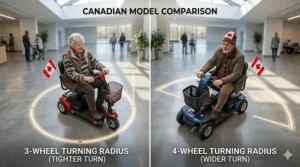
The mobility scooter turning radius comparison reveals one of the starkest differences between configurations. A typical 3-wheel model turns within a 61-81 cm radius, while 4-wheel versions need 91-122 cm. Those extra centimetres directly impact where you can go and how easily you can navigate spaces.
Consider a standard Canadian residential hallway at 91 cm (36″) wide. A 3-wheel scooter with a 61 cm turning radius can execute a three-point turn in this space without much difficulty. A 4-wheel scooter with a 107 cm turning radius? You’re going to be doing a lot of backing up and repositioning. This is why occupational therapists in Canada often recommend measuring your most frequently used spaces before selecting a scooter.
But turning radius isn’t just about hallways. Public spaces matter too. According to the Canadian Transportation Agency’s guidelines on mobility aids, transportation providers must accommodate mobility devices, but practical considerations still apply. A tighter turning radius means easier boarding on HandyDART vehicles, better maneuverability in train aisles, and simpler navigation through ferry corridors.
Shopping environments particularly showcase turning radius differences. The standard grocery store aisle in Canadian supermarkets runs about 244 cm (8 feet) wide, which sounds spacious until you factor in product displays, other shoppers, and shopping carts. A 3-wheel scooter’s tight turning radius lets you make quick adjustments when someone stops unexpectedly ahead of you or when you need to access a shelf and then continue forward. Four-wheel models require more planning and often necessitate backing up to reposition.
Restaurant and café navigation presents another real-world test. Many Canadian establishments have table spacing that meets accessibility minimums (107 cm between tables) but doesn’t provide excessive maneuvering room. Three-wheel scooters navigate these spaces with relative ease. Four-wheel users often find themselves needing to ask for tables near the edge of seating areas or in corners where they have more room to position themselves.
However—and this is crucial—a tighter turning radius isn’t always better. That same tight turning capability that helps in confined spaces can feel twitchy or overly responsive outdoors, particularly if you’re not experienced with mobility scooters. On open sidewalks or paths, the more stable, less responsive steering of 4-wheel models can actually feel more controlled and confidence-inspiring.
Indoor vs Outdoor Mobility Scooter: Matching Design to Environment
The indoor vs outdoor mobility scooter distinction cuts across the 3-wheel vs 4-wheel debate, but wheel configuration definitely influences which environments each excels in.
Indoor Champions: Three-Wheel Advantages
For Canadian condo dwellers, retirement community residents, or anyone who primarily operates within buildings, 3-wheel scooters dominate. Their compact turning radius shines when navigating furniture arrangements, accessing elevators (especially older elevators in heritage buildings with limited interior space), and moving through retail environments. Several Ontario-based seniors’ residences I’ve researched specifically recommend 3-wheel configurations for their hallway dimensions and common area layouts.
Indoor environments also eliminate many of the factors where 4-wheel scooters excel. You’re not dealing with uneven surfaces, grade changes (beyond ramps), or weather effects. The controlled, smooth floors of malls, libraries, and public buildings negate the stability advantage of four wheels while maximizing the maneuverability benefit of three.
Outdoor Excellence: Four-Wheel Dominance
Canadian outdoor conditions are unforgiving. Frost heaves in spring, leaf-slicked sidewalks in fall, slightly uneven surfaces year-round—these create scenarios where stability becomes paramount. Four-wheel scooters handle these conditions with notably more confidence.
Quebec’s regulations actually touch on this indirectly. Their guidelines for motorized mobility aids specify speed limits (10 km/h on sidewalks) and require awareness of “traffic, environment, and infrastructure.” That last point—infrastructure—matters enormously. Canadian sidewalk infrastructure varies wildly, and 4-wheel configurations handle that variability better.
Curb cuts represent a perfect test case. The standard Canadian curb cut slopes between 5-8 degrees, but older installations or poorly maintained areas can hit 10-12 degrees. Approaching these at an angle (which often happens when following the natural flow of pedestrian traffic) creates a tipping risk for 3-wheel scooters that 4-wheel models largely avoid.
The Hybrid Approach: Owning Both
Interestingly, Statistics Canada data suggests that some Canadian mobility device users actually maintain two devices: a compact 3-wheel for indoor use and errands, and a robust 4-wheel for outdoor adventures and rougher terrain. While this requires more storage space and budget, it eliminates the compromise inherent in choosing a single device.
Scooter Maneuverability: Beyond Just Turning Circles
Scooter maneuverability encompasses more than just turning radius. It includes responsiveness, ease of control, and how the scooter handles transitions between different surfaces or directions.
Three-wheel scooters typically offer more responsive steering. The single front wheel creates a direct connection between your tiller input and directional change. This responsiveness aids precision in tight spaces—you can make small adjustments easily. However, this same responsiveness means that overcorrecting or jerky movements get transmitted immediately, which some users (particularly those with limited hand strength or dexterity) find challenging.
Four-wheel steering feels more planted and predictable. The dual front wheels create a slightly dampened steering response, which reduces the impact of small, unintentional tiller movements. For users with tremors, limited fine motor control, or simply less experience with mobility devices, this can actually improve practical maneuverability despite the wider turning radius, because it’s more forgiving of imprecise inputs.
Speed settings dramatically affect maneuverability across both configurations. Most Canadian-available scooters offer variable speed controls, typically ranging from 1-2 km/h for indoor use up to 6-8 km/h (or higher) for outdoor travel. At low speeds, both 3- and 4-wheel models handle reasonably well. At higher speeds, the stability advantage of 4-wheel configurations becomes more pronounced—the wider base helps counteract the higher momentum.
Reversing represents another maneuverability consideration that often gets overlooked in initial scooter selection. Three-wheel scooters generally reverse more easily in tight spaces because you’re only coordinating one steerable wheel. Four-wheel models require more spatial awareness when backing up, particularly in confined areas where you might be reversing between obstacles. This matters when you’re parking at a table, accessing a shelf, or repositioning in your home.
The transition from forward to reverse motion also varies. Most scooters require you to come to a complete stop before switching directions (for safety), but the feel of that transition differs. Three-wheel models typically have lighter overall weight, so they stop and start more quickly. Four-wheel versions have more momentum, requiring slightly more braking distance—not much, but noticeable when you’re making frequent direction changes in tight spaces.
Comparison Table: Maneuverability and Performance Metrics
| Performance Factor | 3-Wheel Scooters | 4-Wheel Scooters |
|---|---|---|
| Average Turning Radius | 61-81 cm | 91-122 cm |
| Responsiveness | High – direct steering | Moderate – dampened steering |
| Best Speed Range | 1-8 km/h | 1-15 km/h |
| Reversing Ease | Excellent | Good |
| Direction Changes | Quick, nimble | Deliberate, stable |
| Sidewalk Navigation | Excellent on smooth surfaces | Superior on uneven terrain |
| Grocery Store Aisles | Excellent | Good (requires planning) |
| Elevator Access | Excellent | Good to Excellent |
✨ Discover Your Perfect Match!
🛒 Ready to find the mobility scooter that fits your lifestyle? Browse our hand-picked selection of 3-wheel and 4-wheel models available on Amazon.ca. Each highlighted product has been carefully reviewed for Canadian buyers, with verified specifications, current CAD pricing, and real customer feedback. Your journey to confident mobility starts with one click!
Tight Space Navigation: Where Three Wheels Truly Excel
Tight space navigation represents the killer application for 3-wheel mobility scooters. If your daily life involves frequent maneuvering in confined environments, the advantages become undeniable.
Consider the standard Canadian residential bathroom doorway at 61-76 cm (24-30″) wide. While you typically wouldn’t drive the scooter into the bathroom itself, you need to navigate hallways that lead to these narrow doorways, often needing to position yourself near the entrance. A 3-wheel scooter can approach, turn, and reposition near these narrow openings far more easily than 4-wheel alternatives.
Retail fitting rooms present similar challenges. Canadian accessibility standards require minimum doorway widths, but fitting room areas themselves often remain tight. If you’re shopping for clothing and need to access these spaces, a 3-wheel scooter’s compact footprint and tight turning radius make the difference between independent shopping and needing assistance.
Public transit use in Canadian cities varies by system, but most feature tight aisles and designated mobility device areas that favour compact configurations. Toronto’s TTC, Vancouver’s TransLink, and Montreal’s STM all accommodate mobility scooters, but the boarding process and onboard positioning become much easier with 3-wheel models. Several transit users I’ve spoken with specifically switched from 4- to 3-wheel scooters to simplify their public transit experiences.
Elevator access, particularly in older Canadian buildings, sometimes presents width constraints. While modern elevators must meet accessibility standards (typically 137 cm wide minimum), older buildings grandfathered in under previous regulations may have smaller elevators. A 3-wheel scooter’s smaller overall footprint and superior turning radius helps in these situations, both when entering/exiting and when turning around inside the elevator if needed.
Stability Analysis: When Four Wheels Become Essential
Stability isn’t just about avoiding tips—though that matters enormously. It’s about confidence, reduced fatigue, and the ability to handle unexpected situations without anxiety.
The Canadian climate creates specific stability challenges. Spring sidewalks affected by freeze-thaw cycles develop uneven sections where the concrete has heaved or settled differently. Summer construction creates temporary surface changes. Fall leaves can hide uneven spots or create slippery sections. Winter—even in areas where you might use your scooter—brings ice patches and snowmelt. Four-wheel scooters handle these conditions with measurably more stability.
Here’s a practical test: if you live in an area with significant elevation changes, whether hills or just moderate slopes, a 4-wheel scooter provides crucial stability advantages. British Columbia’s coastal cities, parts of Quebec City, St. John’s in Newfoundland—these locations feature grades where the wider wheelbase of 4-wheel configurations creates a tangible safety benefit. The RCMP’s mobility scooter safety guidelines emphasize considering terrain when selecting equipment, though they don’t specifically mandate configurations.
Weight capacity interrelates with stability. Four-wheel scooters typically offer higher weight capacities (up to 230 kg versus 120-140 kg for most 3-wheel models) not just because they have more wheels, but because their wider base provides the stability needed to safely carry heavier loads. If you need to transport groceries, personal items, or just prefer the confidence of a higher-capacity device, 4-wheel models deliver.
Anti-tip features appear on both configurations, but they’re less frequently needed on 4-wheel scooters. When you do encounter a situation that challenges stability—hitting a curb at an angle, navigating a steep cross-slope, or dealing with an unexpected surface change—the 4-wheel base provides more natural resistance to tipping before anti-tip wheels even engage.
User confidence affects practical mobility. If you feel anxious about tipping, you’ll naturally limit where you go and what you do. This defeats the purpose of having a mobility scooter in the first place. For many Canadians, particularly those new to mobility devices or those with balance concerns even when seated, the 4-wheel configuration provides the confidence needed to actually use the device regularly rather than leaving it parked due to anxiety.
Weather and Seasonal Considerations for Canadian Users
Canadian weather creates unique considerations that significantly affect the 3-wheel vs 4-wheel mobility scooter decision. While neither configuration is specifically designed for winter snow or ice (and most manufacturers explicitly discourage such use), the reality is that Canadian shoulder seasons and variable weather mean you’ll encounter challenging conditions.
Spring Challenges
Spring brings the most treacherous sidewalk conditions. Freeze-thaw cycles create heaved sections, cracks, and uneven surfaces. Melting snow leaves puddles and wet sections. Early spring can present ice patches in shaded areas even as most sidewalks are clear. Four-wheel scooters handle these variable conditions better, with their wider wheelbase providing stability across uneven sections and better traction through wet areas.
Montreal-based users frequently mention spring as their most challenging season. The city’s harsh winters followed by rapid spring thaws create sidewalk conditions where stability becomes paramount. Several switched from 3- to 4-wheel configurations specifically to handle spring conditions better.
Summer and Fall
Summer presents fewer challenges, though sudden rainstorms can create slippery conditions. Four-wheel models with larger, treaded tires generally handle wet surfaces better than 3-wheel versions with smaller, smoother tires.
Fall introduces leaf coverage, which can hide uneven sections and create slippery surfaces when wet. Prairie provinces (where fall can bring early snow mixed with leaves) particularly benefit from 4-wheel stability during this transitional period.
Winter Considerations
Most manufacturers explicitly discourage winter use, and Canadian winter conditions (particularly in Prairie provinces, Quebec, and Atlantic Canada) often make mobility scooter use impractical anyway. However, mild winter days or indoor-to-car-to-destination trips remain common. For these situations, 4-wheel scooters provide marginally better performance, though neither configuration truly excels in winter conditions.
Coastal British Columbia users, blessed with milder winters, do report year-round scooter use. Vancouver and Victoria residents specifically mention choosing 4-wheel configurations to handle winter rain and occasional frost conditions more confidently.
Weight Capacity and Load Management: The Hidden Stability Factor
Weight capacity specifications reveal an often-overlooked aspect of the 3-wheel vs 4-wheel debate. While these numbers might seem like simple maximums, they actually reflect fundamental stability and engineering differences.
Most 3-wheel scooters in the Canadian market max out at 120-140 kg (265-300 lbs), while 4-wheel configurations regularly offer 150-230 kg (330-500 lbs) capacity. This difference exists because the 4-wheel platform provides the stability needed to safely carry heavier loads without compromising handling or safety margins.
But here’s what often surprises buyers: carrying capacity isn’t just about your body weight. It includes groceries, personal items, shopping bags, medical equipment, or anything else you’re transporting. A Canadian doing weekly grocery shopping might easily add 10-15 kg of groceries to their weight in the basket and storage areas. If you’re already near the weight limit, this additional load affects scooter performance and safety.
The physics matter here. When you load a scooter near its capacity, the centre of gravity shifts. On a 3-wheel design with its smaller footprint, this shift has a more pronounced effect on stability. The triangular base offers less resistance to tipping forces when carrying asymmetric loads. Four-wheel scooters, with their rectangular base, handle load-induced centre of gravity shifts better.
Temperature affects battery performance, and in Canadian winters, reduced battery efficiency means reduced power for climbing ramps or hills. If you’re operating near your scooter’s weight capacity and encounter a ramp in cold weather (say, accessing a building in January), a 4-wheel scooter with higher capacity provides a larger safety margin.
Battery Life, Range, and Configuration Impact
Battery performance interacts with scooter configuration in ways that directly affect Canadian users. While battery capacity is largely independent of wheel count, how the scooter uses that power differs between configurations.
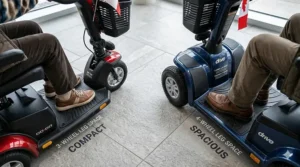
Four-wheel scooters typically weigh more (35-50 kg versus 24-32 kg for 3-wheel models), which means they use more battery power to move. However, they also typically pair with larger-capacity batteries (48V 20Ah versus 48V 10-12Ah), often resulting in equal or better range despite the weight difference.
Canadian users need to think about range differently than manufacturers’ specifications suggest. Those advertised ranges (20-40 km) assume ideal conditions: flat terrain, moderate temperature, optimal user weight, smooth surfaces. In reality, Canadian conditions reduce these numbers. Cold weather (even just 5°C versus 20°C) can reduce lithium battery performance by 10-20%. Hills or ramps drain batteries faster. Rough surfaces require more power than smooth pavement.
Prairie users facing longer distances between destinations often prioritize range above all else, leading them toward 4-wheel models with larger batteries despite potential maneuverability trade-offs. Urban users with shorter, frequent trips often find 3-wheel models with smaller batteries adequate, with the bonus of lighter weight and quicker recharging.
The ability to carry spare batteries matters significantly in Canada’s vast geography. Some 3-wheel models (like the SuperHandy Passport) offer removable batteries you can swap out, effectively doubling your range if you carry a spare. This appeals to cottage-country users or those in rural areas where access to charging isn’t guaranteed.
Charging infrastructure varies across Canada. Most mobility scooter charging is done at home via standard outlets, but understanding your charging needs matters. A depleted 48V 20Ah battery takes 6-8 hours to fully charge. If you use your scooter for multiple trips daily, you need to either plan charging windows or have a spare battery. Three-wheel models with smaller batteries charge faster (4-6 hours), providing more flexibility for multiple same-day uses.
Price vs Performance: Getting Value in the Canadian Market
The Canadian mobility scooter market shows clear price differentiation between configurations. Three-wheel models typically start around $700-900 CAD and top out around $1,200-1,400 CAD for premium versions. Four-wheel scooters begin around $900-1,100 CAD and can exceed $2,000 CAD for heavy-duty models.
But price shouldn’t be your only consideration. The real question is value: what are you getting for your money, and does it match your needs?
Budget-conscious Canadian buyers often gravitate toward 3-wheel models, seeing them as “mobility scooters light”—less expensive, adequate for basic needs. This works if your needs genuinely match 3-wheel strengths: primarily indoor use, smooth surfaces, tight spaces. But if you’re compromising on stability or outdoor capability to save $200-300, you’re likely setting yourself up for buyer’s remorse when you can’t comfortably use the scooter in situations you’d hoped to.
The sweet spot in Canadian pricing appears to be the $1,000-1,400 CAD range, where you find quality 4-wheel models with folding capabilities, decent range (15-20 km), and adequate weight capacity (150 kg+). These offer better long-term value for most users than bargain-basement 3-wheel options or premium heavy-duty versions that exceed typical needs.
Provincial funding programs affect real cost significantly. Some Canadian provinces offer assistive device funding through programs like Ontario’s Assistive Devices Program or similar provincial initiatives. These programs may have specific requirements or preferences for mobility devices. Checking your provincial program before purchasing can significantly affect your final out-of-pocket cost.
Price and Value Comparison: Canadian Market Overview
| Price Range (CAD) | 3-Wheel Options | 4-Wheel Options | Best Value Features |
|---|---|---|---|
| $700-$900 | Basic models, 10-15 km range, 120 kg capacity | Limited options | Entry-level for indoor use only |
| $1,000-$1,400 | Premium 3-wheel with folding, good range | Quality 4-wheel with 15-20 km range, 150 kg capacity | Sweet spot for most Canadians |
| $1,500-$2,000 | Rare (high-end portable) | Heavy-duty 4-wheel, 200+ kg capacity, 30-40 km range | Best for outdoor/rural use |
| $2,000+ | Almost non-existent | Premium all-terrain models | Specialized outdoor enthusiasts |
Used scooter markets exist in most Canadian cities, with prices typically 40-60% of new retail. While this can offer savings, battery condition becomes critical—replacing batteries can cost $300-600 CAD, potentially negating your savings. If considering used scooters, request battery performance documentation and factor replacement costs into your calculations.
Maintenance and Longevity Considerations
Maintenance requirements differ subtly between configurations, affecting long-term cost and usability. Three-wheel scooters, with their simpler design and typically lighter weight, generally require less frequent maintenance. However, that single front wheel sees more wear than the dual front wheels of 4-wheel configurations, potentially requiring earlier replacement.
Tire maintenance matters significantly in Canada. Pneumatic (air-filled) tires offer the smoothest ride but require pressure monitoring and are vulnerable to punctures—problematic when Canadian streets and sidewalks feature glass, nails, and debris, particularly during spring cleanup. Solid or foam-filled tires (common on 3-wheel budget models) eliminate puncture concerns but transmit more road vibration.
Winter storage affects both configurations similarly, but 4-wheel scooters’ larger batteries often handle storage better, maintaining capacity through Canadian winter dormancy more effectively than smaller 3-wheel batteries. If you plan seasonal use (spring through fall, with winter storage), this becomes relevant.
Access to service providers varies across Canada. Urban areas typically have multiple mobility equipment dealers offering service. Rural or small-town buyers may need to ship their scooter for repairs or pay travel fees for technicians. Three-wheel scooters’ lighter weight makes shipping more practical and less expensive if service requires returning the unit.
Warranty coverage in Canada typically runs 1-2 years for most scooter components, with batteries often having shorter warranties (6-12 months). Extended warranty options exist but add to overall cost. Reading warranty terms carefully matters—some warranties exclude damage from outdoor use or rough terrain, which could disproportionately affect 4-wheel scooter users.
Making Your Decision: A Practical Framework
After all this analysis, how do you actually decide? Here’s a framework that works for most Canadian buyers:
Choose a 3-Wheel Mobility Scooter If:
- Your primary use is indoors or in smooth, controlled environments
- You frequently navigate tight spaces (narrow hallways, small elevators, crowded stores)
- Portability and lightweight design are critical (frequent car transport, limited storage)
- You live in an apartment or condo with limited maneuvering room
- Budget is a primary constraint and you rarely face challenging terrain
- You’re comfortable with reduced stability in exchange for maneuverability
Choose a 4-Wheel Mobility Scooter If:
- You regularly use your scooter outdoors on sidewalks, paths, or uneven surfaces
- Stability and confidence matter more than ultimate maneuverability
- You need higher weight capacity (for yourself or for carrying items)
- You live in hillier Canadian cities or areas with significant terrain variation
- You want to use your scooter in variable weather and seasonal conditions
- You prefer the confidence of a wider, more stable platform
Still Uncertain? Consider These Questions:
- Where will you use your scooter 80% of the time? Optimize for that environment.
- What’s the most challenging terrain or space you’ll regularly encounter? Ensure your choice handles it.
- How important is independent use versus occasionally asking for assistance? If independence in all situations matters, err toward stability.
- What’s your experience level with mobility devices? Beginners often benefit from 4-wheel stability.
- Do you have specific medical conditions that affect balance even when seated? Lean toward 4-wheel models.
The honest answer for many Canadians is that no single scooter perfectly handles all situations. You’re optimizing for your most common uses while accepting compromises in other areas. Being clear-eyed about these trade-offs leads to better satisfaction than expecting any single scooter to excel at everything.
✨ Don’t Miss These Exclusive Deals!
🔍 Take your mobility and independence to the next level with these carefully selected products available in Canada. Click on any highlighted item to check current pricing and availability on Amazon.ca. These mobility scooters will help you create authentic freedom and confidence in your daily life!

Frequently Asked Questions About Mobility Scooters in Canada
❓ How fast can a mobility scooter legally travel on Canadian sidewalks?
❓ Do I need insurance for a mobility scooter in Canada?
❓ What is the price range for mobility scooters in Canada?
❓ Can I use my mobility scooter on public transit in Canadian cities?
❓ Which type of mobility scooter is better for Canadian winter conditions?
Conclusion: Your Path to Confident Mobility
Choosing between a 4-wheel vs 3-wheel mobility scooter ultimately comes down to matching design strengths to your actual lifestyle. If you’re navigating tight indoor spaces, shopping in crowded malls, and rarely encountering rough terrain, a 3-wheel scooter’s superior maneuverability and lighter weight make perfect sense. If you’re tackling Canadian sidewalks in their real-world glory—uneven spring surfaces, moderate hills, variable conditions—a 4-wheel scooter’s stability advantage becomes essential.
The good news? Both configurations have evolved significantly in recent years. Modern 3-wheel scooters offer better stability than older designs, while contemporary 4-wheel models have improved maneuverability with tighter turning radii and better control systems. You’re not choosing between drastically flawed options; you’re optimizing for your specific priorities.
My recommendation for most Canadian buyers, particularly those new to mobility scooters, is to lean slightly toward 4-wheel configurations unless you have specific, compelling reasons favouring 3-wheel designs. The stability and confidence that 4-wheel scooters provide often matter more in daily use than initial specifications suggest. That said, if you genuinely live primarily indoors or in controlled environments, don’t let me talk you out of a 3-wheel scooter that better matches your needs.
Visit local mobility equipment dealers before buying online. While Amazon.ca offers competitive prices and convenient delivery, trying scooters in person reveals handling characteristics that specifications can’t capture. Many Canadian dealers allow test drives, and some will bring demo units to your home so you can test in your actual environment. This hands-on experience proves invaluable, often revealing which configuration feels right for you within minutes.
Whatever you choose, you’re taking an important step toward maintaining independence and mobility. That matters far more than the wheel count of the device that gets you th
Recommended for You
- 7 Best Heavy Duty Mobility Scooter 500 lbs Canada 2026
- 7 Best Lightweight Mobility Scooters for Travel Canada 2026
- Best Mobility Scooters in Canada 2026: 7 Top-Rated Models
Disclaimer: This article contains affiliate links to Amazon.ca. If you purchase products through these links, we may earn a small commission at no additional cost to you.
✨ Found this helpful? Share it with your friends! 💬🤗
