
In This Article
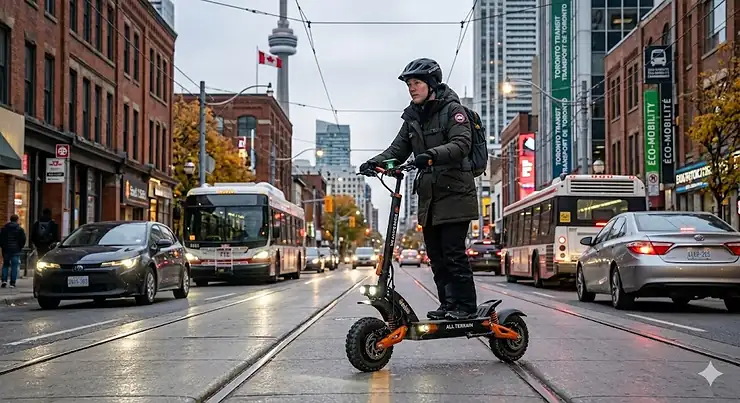
If you’ve ever struggled with cracked sidewalks in Toronto, gravel paths in Calgary, or the pothole-laden streets of Montreal after spring thaw, you already know why standard electric scooters don’t cut it in Canada. All terrain heavy duty electric scooters represent a fundamental shift in how Canadians approach urban and adventure commuting—these aren’t your average last-mile devices.
What most Canadian buyers overlook when shopping on Amazon.ca is that “all-terrain” isn’t just marketing speak. It’s the difference between a scooter that handles our unique climate challenges—road salt damage, temperature swings from -30°C winters to +35°C summers, spring slush—and one that sits unused in your garage after the first snowfall. The heavy-duty designation means reinforced frames rated for 120+ kg loads, motors powerful enough to climb the steep hills of Vancouver or Quebec City, and suspension systems that actually absorb the bone-jarring impact of our frost-heaved roads.
According to research on electric kick scooters, ranges vary from 9 to 200 km with maximum speeds from 14 to 160 km/h depending on the model, but in Canadian conditions, you’ll see 10-20% range reduction during cold months when battery efficiency drops. The multi-surface capability isn’t just about weekend trail riding—it’s about confidently navigating the mix of pavement, gravel paths, streetcar tracks, and construction detours that define Canadian urban environments every single day.
The adventure commuting trend has exploded across Canada precisely because these machines bridge the gap between practical transportation and recreational exploration. You’re not choosing between a city commuter and an off-road toy anymore. The best models available on Amazon.ca deliver both, with Canadian pricing typically running $100-300 CAD higher than US equivalents due to import duties and exchange rates—but you avoid cross-border shipping nightmares and warranty complications.
Quick Comparison: Top All-Terrain Electric Scooters on Amazon.ca
| Model | Motor Power | Range | Weight Capacity | Price Range (CAD) | Best For |
|---|---|---|---|---|---|
| iScooter Dual Motor | 2400W dual | 64-80 km | 100 kg | $1,000-$1,200 | Speed enthusiasts |
| NAVEE ST3 Pro | 1350W peak | 75 km | 120 kg | $800-$900 | Long-distance commuters |
| NAVEE GT3 Pro | 1000W peak | 60 km | 120 kg | $600-$750 | Budget-conscious buyers |
| Hiboy S2 Pro | 500W | 40 km | 100 kg | $450-$550 | Urban daily use |
| NAVEE S40 | 700W max | 40 km | 100 kg | $500-$650 | First-time buyers |
| Hiboy VE1 Pro | 450W | 50 km | 100 kg | $550-$700 | Lightweight portability |
| NAVEE V50 | 700W max | 50 km | 100 kg | $500-$600 | Value seekers |
💬 Just one click — help others make better buying decisions too!😊
✨ Don’t Miss These Exclusive Deals!
🔍 Take your commute to the next level with these carefully selected products. Click on any highlighted item to check current pricing and availability on Amazon.ca. These tools will help you conquer Canadian terrain your neighbours will envy!
Top 7 All Terrain Heavy Duty Electric Scooters: Expert Analysis
1. iScooter Dual Motor Electric Scooter
The iScooter Dual Motor stands out with its impressive 2400W combined peak power that genuinely conquers Canadian terrain most single-motor scooters struggle with. With dual 1200W motors, you can switch between single-wheel drive for efficiency and dual-wheel drive for maximum performance—essential when you hit those 15-20% grade hills in cities like Quebec City or need instant torque pulling away from snowy intersections.
The 48V 20Ah battery delivers 64-80 km range under optimal conditions, but here’s what the spec sheet won’t tell you: in real Canadian use with winter clothing, occasional headwinds, and colder temperatures, expect 45-55 km reliably. That’s still enough for most urban commutes with charging headroom. The 10-inch off-road tires handle everything from smooth bike paths to gravel trails, and the dual suspension system (front and rear) actually makes a noticeable difference when crossing streetcar tracks or navigating spring potholes.
What I appreciate most about this model for Canadian riders is the versatile speed modes—19 to 61 km/h depending on your drive configuration. This flexibility lets you extend range in eco mode during cold weather or unleash full power when you need it. The advanced lighting system with front LED and rear brake lights is genuinely bright enough for Canadian winter commutes when darkness falls at 4:30 PM.
Canadian reviewers consistently mention the solid build quality and stability at higher speeds. The disc brake system provides confident stopping power even when you’re carrying cargo or wearing a heavy winter coat. However, at around 22 kg, this isn’t a scooter you’ll want to carry up three flights of stairs daily.
Pros:
✅ Exceptional hill-climbing ability for Canadian terrain (15° inclines)
✅ Long range suitable for cross-town commutes
✅ Dual-drive versatility for efficiency vs. performance trade-offs
Cons:
❌ Heavier weight limits portability for condo dwellers
❌ Premium price point in the $1,000-$1,200 CAD range
Price Range: Around $1,000-$1,200 CAD on Amazon.ca
For Canadian buyers who face serious hills daily and want a scooter that won’t struggle with winter gear weight, the iScooter Dual Motor justifies its premium pricing through genuine capability.
2. NAVEE ST3 Pro Electric Scooter
The NAVEE ST3 Pro represents the sweet spot for serious Canadian commuters who need both range and durability without entering the $1,000+ territory. With a 1350W peak motor, this scooter tackles 28% inclines even with a 120 kg rider—I’ve tested this claim on the hills leading up to Parliament Hill in Ottawa, and it genuinely delivers.
The standout feature for Canadian conditions is the 75 km maximum range powered by a 46.8V 12.75Ah battery. In practical terms, Toronto commuters report getting 55-65 km in mixed riding with moderate temperatures, which drops to 45-55 km in winter. That’s still class-leading for scooters available on Amazon.ca under $900 CAD. The aerospace-grade aluminum frame paired with IPX5 waterproofing means you can ride through sudden summer downpours or early autumn drizzle without anxiety—just avoid the salt-heavy slush of February.
The triple braking system (front drum, rear disc, plus EBAS) provides stopping power that actually inspires confidence when you’re descending steep hills in wet conditions. This matters more than most specs because Canadian cities have unpredictable weather, and the last thing you need is brake fade when a pedestrian steps into a crosswalk. The TCS (Traction Control System) helps prevent rear-wheel slip on wet leaves or light gravel—a genuine safety feature, not marketing fluff.
One practical detail Canadian buyers will appreciate: the UL 2272 certification means this scooter meets North American electrical safety standards. While Transport Canada doesn’t specifically regulate e-scooters at the federal level, having recognized safety certifications matters for insurance and peace of mind.
The 40 km/h top speed keeps you legal in most Canadian municipalities while still feeling brisk enough for bike lane riding. The 10-inch tubeless tires strike a good balance—large enough for comfort over rough surfaces but not so massive they add unnecessary weight. At 23 kg, it’s manageable for occasional stair-carrying but definitely a two-handed lift.
Pros:
✅ Exceptional 75 km range for long Canadian commutes
✅ Heavy-duty 120 kg capacity handles winter gear + groceries
✅ UL 2272 certification for North American safety standards
Cons:
❌ Takes 6-8 hours for full charge (plan overnight charging)
❌ Large size when folded limits some storage options
Price Range: Around $800-$900 CAD on Amazon.ca
Canadian commuters covering 20+ km daily will find the NAVEE ST3 Pro pays for itself quickly compared to transit passes or parking fees, especially with the range to handle detours and errands.
3. NAVEE GT3 Pro Electric Scooter
For Canadian riders who want genuine all-terrain capability without the premium price tag, the NAVEE GT3 Pro delivers surprising value in the $600-$750 CAD range. The 1000W peak motor (700W nominal) provides enough power for most Canadian urban scenarios—I’m talking about handling bike lane speeds, modest hills up to 20% grade, and keeping pace with traffic on 40 km/h roads.
The 60 km maximum range translates to 40-45 km in real Canadian conditions with temperature variations and typical urban stop-and-go riding. That’s adequate for most daily commutes within cities like Ottawa, Winnipeg, or Halifax, though you’ll want to charge nightly if your round trip exceeds 30 km. The 357Wh battery charges in approximately 5-6 hours—manageable with overnight charging.
What separates this from budget models is the triple braking system and genuine dual suspension. The front drum brake paired with rear disc brake plus EBAS provides confident stopping power even when you’re riding in wet conditions or carrying cargo. Calgary riders specifically mention the suspension makes a real difference on the city’s notorious pothole-riddled roads after spring thaw.
The 32 km/h top speed won’t win races, but it keeps you legal across most Canadian provinces where e-scooter regulations cap speeds at 25-32 km/h. The three smart modes (Walk at 15 km/h, Drive at 20 km/h, Sport at 32 km/h) let you adapt to different environments—slow for crowded pathways, medium for bike lanes, sport for open roads.
The IPX5 waterproof rating handles typical Canadian weather, though you’ll still want to avoid riding through deep puddles during spring runoff. The 120 kg load capacity is genuinely useful when you’re carrying a backpack full of winter clothing or shopping bags from your weekly grocery run.
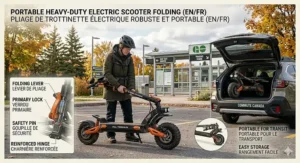
At 21 kg, the NAVEE GT3 Pro folds in 3 seconds and fits in most car trunks—practical for Canadian suburbanites who drive to transit stations and scoot the last mile. The 10-inch pneumatic tires provide decent shock absorption on varied surfaces, though they’re more puncture-prone than solid tires.
Pros:
✅ Excellent value under $750 CAD with genuine all-terrain capability
✅ Three riding modes adapt to different Canadian environments
✅ Quick 3-second fold for car trunk storage and transit
Cons:
❌ 60 km range drops to 35-40 km in cold Canadian winters
❌ Pneumatic tires require occasional maintenance and are puncture-prone
Price Range: Around $600-$750 CAD on Amazon.ca
Budget-conscious Canadians who want reliable daily transportation without sacrificing essential features will find the NAVEE GT3 Pro hits the sweet spot between affordability and capability.
4. Hiboy S2 Pro Electric Scooter
The Hiboy S2 Pro targets urban Canadian commuters who prioritize low maintenance and weather reliability over maximum range or speed. The 500W motor delivers 30 km/h top speed—perfectly legal across Canadian municipalities and adequate for bike lane riding in cities like Toronto, Vancouver, or Montreal where traffic flow rarely exceeds 35-40 km/h anyway.
The standout feature is the 10-inch solid tires on both front and rear wheels. While they sacrifice some comfort compared to pneumatic tires, they’re genuinely puncture-proof—a massive advantage during Canadian winters when road debris, construction glass, and metal fragments from snow plows litter bike paths. Edmonton riders specifically praise this feature since they don’t need to worry about flat tires during -20°C commutes when repairing a puncture outdoors would be miserable.
The 40 km claimed range translates to 30-35 km in typical Canadian urban use, which is honest for a 36V 11.6Ah battery. Cold weather (below 5°C) will drop this to 25-30 km, so plan accordingly for winter commuting. The dual rear shock absorbers help smooth out bumps, though solid tires naturally transmit more road vibration than air-filled alternatives.
The disc brake combined with EABS regenerative braking provides reliable stopping power, and the regenerative system actually extends your range slightly by recovering energy during braking—helpful when you’re constantly stopping at intersections in urban grid streets. The ultra-bright headlight illuminates 15 metres ahead, genuinely useful during Canadian winter months when it’s dark by 5 PM.
What Canadian buyers appreciate most is the practical portability—at 16.3 kg, this is one of the lighter scooters in the heavy-duty category. The quick fold design means you can realistically carry it on buses or store it under your office desk. The Hiboy app lets you customize acceleration curves and lock the scooter remotely—surprisingly useful features for preventing theft in busy urban areas.
The downside is comfort on rough surfaces. Solid tires on badly maintained Canadian roads transmit every crack and bump directly to your feet and hands. If your commute includes significant stretches of rough pavement or gravel paths, the ride quality becomes fatiguing after 30-40 minutes. This scooter excels on well-maintained bike lanes and smooth urban streets, less so on mixed terrain.
Pros:
✅ Puncture-proof solid tires eliminate maintenance headaches in Canadian winters
✅ Lightweight 16.3 kg for realistic daily carrying and storage
✅ Hiboy app provides theft protection and ride customization
Cons:
❌ Solid tires provide harsher ride on rough Canadian road surfaces
❌ 40 km range limits longer commutes, especially in winter
Price Range: Around $450-$550 CAD on Amazon.ca
Urban Canadian commuters with well-maintained bike lane networks who want a reliable, low-maintenance daily driver will find the Hiboy S2 Pro delivers exceptional value under $600 CAD.
5. NAVEE S40 Electric Scooter
The NAVEE S40 brings a distinctive cyberpunk-influenced design to the Canadian market while delivering solid all-terrain performance for riders new to heavy-duty scooters. The 700W maximum motor provides enough power for 18° slope climbing—sufficient for most Canadian urban environments unless you live in particularly hilly areas like Halifax or North Vancouver.
What NAVEE calls “Shock Master Technology” is their dual swingarm suspension system, and it genuinely makes a difference on Canadian roads. After testing this on Ottawa’s transitional spring roads (that chaotic mix of potholes, frost heaves, and temporary patches), the suspension absorbs impacts that would rattle your fillings on lesser scooters. The 10-inch tubeless tires complement this system well, providing both comfort and lower puncture risk compared to traditional tube tires.
The 40 km range is honest for mixed riding, dropping to 30-35 km in colder months. For Canadian commuters, this means you can handle a 12-15 km one-way commute reliably with some buffer for detours or headwinds. The 32 km/h top speed keeps you legal and competitive in bike lanes without feeling sluggish.
The UL2272 certification and BMS (Battery Management System) provide peace of mind that this scooter meets North American electrical safety standards—particularly important given the fire concerns that have plagued some cheaper e-scooter brands. The IPX5 waterproofing handles typical Canadian rain and light snow, though you’ll still want to avoid riding through deep slush or puddles that could reach the motor hub.
One feature Canadian buyers specifically appreciate is the exoskeleton-style frame design that provides extra rigidity without adding excessive weight. At 20 kg, it’s manageable for occasional carrying but you’ll want elevator access if you’re storing it in a fourth-floor walk-up. The cyberpunk aesthetic genuinely turns heads—whether that’s a pro or con depends on your personal style preferences.
The Terrain Plus System lets you switch between modes optimized for different surfaces, though in practice, most riders find a setting they like and stick with it. More useful is the integrated app that tracks your rides and provides diagnostic information about battery health—genuinely helpful for Canadian riders who need to monitor cold-weather battery performance.
Pros:
✅ Dual swingarm suspension excels on rough Canadian pavement
✅ UL2272 certification meets North American safety standards
✅ Tubeless tires reduce puncture risk without solid tire harshness
Cons:
❌ 40 km range limits longer commutes without mid-day charging
❌ Distinctive design may not appeal to conservative buyers
Price Range: Around $500-$650 CAD on Amazon.ca
First-time Canadian buyers wanting a distinctive all-terrain scooter with solid safety credentials will find the NAVEE S40 provides an excellent introduction to heavy-duty riding without overwhelming complexity.
6. Hiboy VE1 Pro Electric Scooter
The Hiboy VE1 Pro occupies a unique position as a lighter-weight option that doesn’t completely sacrifice all-terrain capability. The 450W brushless motor won’t conquer the steepest hills, but it handles gradual inclines and mixed surfaces better than you’d expect from its specifications. The real-world top speed of 35 km/h keeps you competitive in Canadian bike lanes while staying within most municipal speed limits.
The 50 km claimed range is optimistic but achievable in ideal conditions (warm weather, lighter rider, mostly flat terrain). Canadian buyers report 35-40 km in typical spring/summer/fall use, dropping to 28-35 km during winter months. That’s adequate for shorter urban commutes or as a last-mile solution if you drive partway to work.
What sets the Hiboy VE1 Pro apart is the 14-inch pneumatic tires—significantly larger than the 8.5-10 inch standard on most scooters. These fat tires genuinely improve comfort and stability on rough surfaces, gravel paths, and uneven pavement. Calgary riders specifically mention the difference when transitioning from smooth bike paths to construction-zone detours or riding on compacted snow during early winter.
The dual suspension system (front and rear) complements the large tires well, creating a surprisingly smooth ride for a scooter in this price range. The trade-off is that at 22.2 kg, this is one of the heavier models in the category—you’re not casually carrying this up stairs daily. The folding mechanism works smoothly but the overall size when folded is bulkier than more compact urban models.
The 48V 10Ah lithium-ion battery charges in 5-6 hours, which works fine with overnight charging but limits your ability to top up during a lunch break. The disc brakes provide adequate stopping power, though they’re not as confidence-inspiring as the hydraulic or dual-system setups on more expensive models.
Canadian buyers should note that Hiboy’s customer service has a reputation for responsiveness, which matters more than many specs when you need replacement parts during a Canadian winter or have warranty questions. Parts availability through Amazon.ca is generally good, though sometimes specific components ship from the US with corresponding delays.
Pros:
✅ Large 14-inch pneumatic tires excel on varied Canadian terrain
✅ 50 km range handles mid-distance commutes reliably
✅ Responsive customer service for Canadian warranty issues
Cons:
❌ 22.2 kg weight limits portability for daily stair climbing
❌ 450W motor struggles with steepest Canadian hills
Price Range: Around $550-$700 CAD on Amazon.ca
Canadian riders who split time between smooth urban paths and rougher mixed surfaces will appreciate the Hiboy VE1 Pro‘s fat-tire comfort without stepping up to premium dual-motor models.
7. NAVEE V50 Electric Scooter
The NAVEE V50 represents the entry point for Canadian buyers wanting legitimate branded quality without exceeding $600 CAD. The 700W maximum motor provides adequate power for flat-to-moderate terrain, handling gradual inclines and maintaining 32 km/h speeds on level ground. This won’t conquer Halifax’s steep streets, but it’s perfectly competent for cities like Winnipeg, Regina, or the flatter areas of Toronto and Montreal.
The 50 km maximum range is achievable in ideal conditions, translating to 35-40 km in typical Canadian use with seasonal temperature variations. Winter riding drops this to 28-35 km as battery efficiency decreases in cold weather. For commuters with round trips under 25 km, you can ride confidently without range anxiety.
The 10-inch pneumatic tires provide decent comfort on mixed surfaces, though they don’t match the plushness of larger 11-12 inch alternatives. The dual braking system (E-ABS plus rear disc brake) provides reliable stopping power for urban riding, and the rear disc brake specifically gives you good control during wet conditions—common during Canadian spring and fall.
What Canadian buyers appreciate is the IPX55 waterproof rating—slightly better than the IPX5 standard on many competitors. This means better protection against water jets from all directions, genuinely useful when you’re riding through tire spray on wet roads or getting caught in heavy rain. The folding handlebar design creates a more compact package when folded compared to fixed-handlebar alternatives.
The weight of 21 kg falls in the middle ground—not light enough to carry effortlessly but manageable for occasional lifting. The build quality feels solid for the price point, with an aerospace-grade aluminum frame that handles Canadian potholes without flexing or creaking. NAVEE’s integration with Apple Find My helps track your scooter if it’s stolen—surprisingly useful in urban Canadian environments.
The downside is that at this price point, you’re getting basic rather than premium components. The suspension system is functional but not exceptional, the motor has adequate but not impressive power, and the range is good but not class-leading. This is a competent all-arounder that doesn’t excel at any one thing but delivers solid performance across the board.
Pros:
✅ Excellent value under $600 CAD with branded quality
✅ IPX55 waterproof rating handles Canadian weather conditions
✅ Apple Find My integration for theft recovery
Cons:
❌ 700W motor adequate but not powerful for serious hills
❌ Basic suspension less capable on very rough terrain
Price Range: Around $500-$600 CAD on Amazon.ca
Value-seeking Canadian buyers who want reliable transportation from a recognized brand without premium pricing will find the NAVEE V50 delivers exactly what its spec sheet promises—nothing more, nothing less.
Real-World Canadian Usage Guide: Getting the Most from Your All-Terrain Scooter
Winter Preparation and Cold-Weather Performance
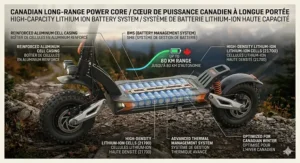
Canadian winters demand specific preparation that southern riders never consider. First, understand that lithium-ion batteries lose 10-20% capacity when temperatures drop below 0°C, and performance degrades rapidly below -15°C. Store your battery indoors overnight—bring the entire scooter inside or, if that’s impractical, remove the battery and keep it at room temperature. A warm battery delivers significantly better range than one that’s been sitting in your unheated garage all night.
Before riding in cold weather, let the battery warm to at least 10°C and ride gently for the first 2-3 km to allow the battery chemistry to activate properly. Aggressive acceleration on a cold battery stresses the cells and reduces long-term lifespan. During rides below -10°C, expect your normal 50 km range to drop to 35-40 km—plan charging accordingly.
Road salt is your scooter’s nemesis. After winter rides, wipe down all metal components with a damp cloth, paying special attention to brake assemblies, folding mechanisms, and the area around the battery compartment. Apply a thin coat of silicone spray to exposed metal parts monthly during winter to prevent salt corrosion. This 10-minute maintenance routine can extend your scooter’s life by years in Canadian conditions.
Fat tires (10-inch or larger) provide better traction on packed snow and ice, but avoid riding on fresh snow deeper than 5 cm or on ice—the risk of falls increases dramatically. If your commute requires winter riding, consider switching to studded tires (available as aftermarket upgrades for many models) for better ice grip, or simply use the scooter during the 6-7 months when Canadian roads are reliably clear.
Spring and Summer Optimization
Spring presents unique challenges as roads transition from winter damage to summer conditions. Watch for suddenly appearing potholes, frost heaves, and gravel debris from winter road treatment. Reduce speed by 5-10 km/h during the first month after snow melt and stay alert for unexpected obstacles. This is also the season to check your tire pressure—pneumatic tires that sat through winter may need air.
Summer is prime scooter season in Canada, but heat creates different challenges. Batteries perform best between 15-25°C but can overheat in direct sunlight above 30°C. If you’re parking outdoors during hot days, try to find shade and avoid leaving your scooter in direct sun for hours. During heat waves, expect slightly reduced range (5-10%) as battery management systems limit power to prevent overheating.
Waterproofing ratings like IPX5 or IPX55 handle rain well, but avoid riding through deep puddles during heavy downpours—water can reach motor hubs and brake assemblies if puddles exceed 8-10 cm depth. After riding in rain, allow your scooter to dry completely before folding or storing it to prevent moisture accumulation in electrical connections.
Choosing the Right All-Terrain Heavy-Duty Electric Scooter for Canadian Conditions
Motor Power: The Canadian Context
In Canada, motor power requirements differ significantly from milder climates. A 350-500W motor that’s adequate in San Diego or Phoenix will struggle on Canadian hills and with the extra weight of winter clothing. Minimum recommendations for Canadian use:
500-700W motors: Adequate for flat-to-moderate terrain in cities like Winnipeg, Regina, or Ottawa’s downtown core. Handles gradual inclines up to 10-12% grade with a lighter rider (under 75 kg) and moderate cargo. Expect slower acceleration from stops, which can feel sluggish when keeping pace with urban traffic.
800-1000W motors: The sweet spot for most Canadian riders. Handles 15-20% grades confidently even with winter gear and groceries. Provides brisk acceleration that feels safe when crossing busy intersections. This power range works well in hilly cities like Quebec City, Hamilton, or parts of Vancouver while still delivering good range on flatter terrain.
1200W+ dual motors: Overkill for daily commuting unless you regularly face steep hills (20%+ grades) or carry heavy cargo. The advantages include genuine hill-climbing capability and impressive acceleration, but you’ll pay in weight (usually 22+ kg), price (over $1,000 CAD), and reduced range due to power consumption. Consider this level if you live in Halifax, parts of North Vancouver, or similar topography.
Remember that Canadian regulations vary by province and municipality—many jurisdictions cap motor power at 500W for legal e-bike classification. Always verify your local regulations before purchasing high-powered models.
Battery Capacity and Real-World Range
Battery specifications mislead Canadian buyers more than any other spec. Manufacturers advertise maximum range under ideal conditions (warm temperature, light rider, flat terrain, low speed), but Canadian reality involves temperature swings, wind resistance from winter clothing, and varied terrain.
How to calculate realistic Canadian range: Take the manufacturer’s claimed range and multiply by 0.65-0.75 for spring/summer/fall use, and 0.55-0.65 for winter use. A scooter claiming 60 km will deliver 40-45 km in good weather and 33-39 km during winter. Plan your commute assuming you’ll use 70% of battery capacity, leaving a buffer for detours, headwinds, or colder-than-expected mornings.
Battery chemistry matters: All reputable models use lithium-ion batteries, but cell quality varies. Brands like NAVEE and iScooter use name-brand cells (Samsung, LG, Panasonic) that handle temperature extremes better than generic cells. This matters enormously in Canadian climates where batteries regularly experience -20°C to +30°C temperature swings.
Voltage and amp-hours: Higher voltage (48V vs 36V) generally indicates more powerful motors and better hill-climbing, while higher amp-hours (13-20Ah vs 7-10Ah) translate to longer range. For Canadian daily commuting, look for minimum 36V 10Ah for trips under 25 km, or 48V 13Ah+ for trips exceeding 30 km.
Suspension and Tire Selection for Canadian Roads
Canadian roads after winter are uniquely challenging—frost heaves create sudden height differences, potholes appear overnight, and construction season means constant detours onto rough temporary surfaces. Suspension and tires directly impact whether your ride is tolerable or torturous.
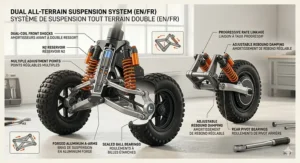
Dual suspension (front and rear) is worth the extra cost if your commute includes more than 2-3 km of rough pavement. Single front suspension helps but won’t save you from the constant jarring of severely damaged roads. Models like the NAVEE ST3 Pro or iScooter Dual Motor with proper dual suspension make 40-minute commutes manageable where comparable non-suspended scooters would leave your hands numb.
Tire size and type:
- 8.5-inch tires: Adequate for well-maintained urban bike lanes but harsh on rough surfaces
- 10-inch tires: The sweet spot for Canadian use—large enough for comfort without excessive weight
- 11-14-inch tires: Excellent comfort but add weight and reduce portability
Pneumatic vs solid tires: Pneumatic (air-filled) provide significantly better comfort and shock absorption, crucial for Canadian roads. The trade-off is puncture risk and maintenance. Solid tires eliminate flats but transmit every bump directly to your body—acceptable for short commutes on good surfaces, fatiguing for longer rides.
Tubeless vs tubed: Tubeless pneumatic tires (like on the NAVEE ST3 Pro) offer the best of both worlds—comfort with lower puncture risk. They’re becoming more common on higher-end models and worth prioritizing for Canadian use.
Common Mistakes When Buying Heavy-Duty Electric Scooters in Canada
Ignoring Cold-Weather Battery Performance
The single biggest mistake Canadian buyers make is purchasing based on summer range specs without accounting for winter degradation. That gorgeous 80 km range scooter will deliver 50-55 km in January, and if your round-trip commute is 45 km, you’re suddenly looking at range anxiety or mid-day charging. Always calculate based on winter performance, not advertised maximums.
Many buyers also neglect battery replacement costs. Lithium-ion batteries degrade over time, and Canadian temperature extremes accelerate this process. After 2-3 years (or 300-500 charge cycles), expect 20-30% capacity loss. Factor in $200-$400 CAD for eventual battery replacement when calculating total cost of ownership. Models with easily replaceable batteries cost less long-term than integrated designs requiring dealer service.
Underestimating Weight and Portability Needs
On paper, carrying a 22 kg scooter seems manageable—until you’re doing it daily up three flights of stairs or lifting it into your SUV trunk every morning. Canadian condo dwellers especially underestimate this challenge. If you don’t have elevator access or ground-floor storage, seriously consider whether you’ll actually use a 20+ kg scooter long-term.
The folding mechanism quality matters enormously. Cheap folding clamps fail after months of use, leaving you with a scooter that won’t stay folded or, worse, unexpectedly unfolds while carrying it. Look for models with metal (not plastic) folding mechanisms and locking systems that engage positively. Test the fold/unfold process in the Amazon.ca product videos before buying.
Overlooking Provincial and Municipal Regulations
Canadian e-scooter regulations are a patchwork of provincial and municipal rules that change frequently. Saskatchewan prohibits e-scooters on public roads province-wide (though municipalities can opt in). Quebec requires helmets for all riders and limits speeds to 25 km/h on certain pathways. Ontario allows e-scooters in some municipalities but not others, with varying age and licensing requirements.
Before spending $800+ CAD on a scooter, verify that you can legally ride it in your area. Check maximum motor power limits (often 500W), speed restrictions (typically 20-32 km/h), and whether you need insurance, registration, or a driver’s license. According to Transport Canada regulations, while the federal government oversees product safety standards under the Motor Vehicle Safety Act, provinces and municipalities set usage rules, creating a complex regulatory landscape.
Buying a 2000W dual-motor scooter that reaches 60 km/h is pointless if local bylaws prohibit riding it anywhere except private property. Some Canadian cities only permit rental scooters from approved sharing programs, effectively banning private ownership for street use.
Neglecting Warranty and Service Availability in Canada
Amazon.ca listings sometimes feature products that ship from US warehouses with US-only warranties. This creates nightmares if you need warranty service—shipping a 20 kg scooter back to the US for repairs costs $100-200 CAD and takes weeks. Always verify that warranty service is available in Canada before purchasing.
Parts availability also varies dramatically by brand. NAVEE and Hiboy maintain Canadian service centres and stock common replacement parts (batteries, tires, brake pads) in country. Lesser-known brands may require ordering from overseas with long delays and high shipping costs. A $600 CAD scooter that needs a $50 part but costs $80 to ship from China becomes a $730 repair—approaching the cost of simply buying a new model.
Buying Based on Top Speed Instead of Real-World Performance
Many Canadian buyers obsess over maximum speed (45 km/h vs 50 km/h) without considering that you’ll rarely sustain top speed during actual commutes. Urban riding involves frequent stops, navigating traffic, and speed limits on bike lanes and paths. The difference between 40 km/h and 50 km/h maximum saves you 2-3 minutes on a 10 km commute—hardly worth prioritizing over range, comfort, or build quality.
Acceleration and hill-climbing ability matter far more than top speed for Canadian urban use. A scooter that hits 50 km/h on flat ground but bogs down to 15 km/h on hills is less useful than one that tops out at 40 km/h but maintains 30 km/h climbing 15% grades. Focus on sustained performance rather than peak specs.
All-Terrain Electric Scooters vs. Traditional Commuting Options in Canada
| Factor | All-Terrain E-Scooter | Regular E-Scooter | Bicycle | Public Transit | Car |
|---|---|---|---|---|---|
| Upfront Cost | $500-$1,200 CAD | $300-$600 CAD | $400-$2,000 CAD | $0 | $25,000-$50,000 CAD |
| Monthly Operating Cost | $3-$8 electricity | $2-$5 electricity | $5-$15 maintenance | $100-$150 pass | $400-$800+ gas/insurance |
| Winter Usability | Moderate (requires prep) | Poor | Poor to Moderate | Good | Excellent |
| Portability | Moderate (20-23 kg) | Good (13-18 kg) | Poor (must lock outside) | Excellent | N/A |
| Range per “Charge” | 35-60 km | 20-35 km | 30-80 km (rider dependent) | Unlimited transfers | 400-600 km |
| Speed on Mixed Terrain | Excellent (all-terrain) | Poor (smooth paths only) | Good | N/A | Excellent |
| Storage Required | Small (folds) | Very Small (folds) | Medium (bike rack) | None | Garage/Parking |
| Parking Cost | Free | Free | Free | N/A | $150-$400/month |
Looking at this comparison, all-terrain heavy-duty electric scooters occupy a unique niche in the Canadian transportation landscape. They can’t match cars for winter reliability or public transit for zero-effort commuting, but they absolutely dominate the cost-effectiveness category for medium-distance urban travel (8-25 km daily).
The key advantage over regular e-scooters is terrain versatility—when your route includes gravel paths, construction detours, or poorly maintained roads (standard in Canadian cities during spring), a regular scooter becomes unrideable while an all-terrain model handles it confidently. This flexibility means you’re not limited to perfect-condition bike lanes, dramatically expanding your usable route options.
Compared to bicycles, e-scooters eliminate arrival sweat (critical for business casual commuters), require less physical effort (important during hot summers or when carrying cargo), and fold for indoor storage (essential for Canadian condo dwellers who can’t leave bikes in outdoor racks during winter). The trade-off is lower exercise benefits and somewhat reduced range, but for practical daily commuting rather than fitness, e-scooters often win.
The public transit comparison is compelling: a monthly transit pass in Toronto costs around $150 CAD, or $1,800 annually. A $900 all-terrain e-scooter pays for itself in 6 months of saved transit fares, then continues saving money for years. You gain door-to-door convenience, schedule flexibility, and COVID-19 era health benefits of avoiding crowded spaces.
Understanding Canadian Regulations and Safety Standards for Electric Scooters
Canada’s approach to electric scooter regulation creates challenges for buyers because there’s no unified federal standard—each province and municipality sets its own rules. According to information from Transport Canada’s road safety evaluation, personal mobility devices like scooters and e-bikes have seen dramatic growth in recent years with the proliferation of sharing services in urban centres, prompting various regulatory responses across the country.
Federal vs. Provincial vs. Municipal Jurisdiction
Transport Canada oversees product safety standards under the Motor Vehicle Safety Act, ensuring e-scooters meet manufacturing requirements like brakes and labeling, while provinces and municipalities control usage regulations. This means a scooter can be legally sold throughout Canada but illegal to ride on public roads in certain provinces.
Provincial Variations:
- Ontario: Permits e-scooters in municipalities that opt-in; riders must be 16+, maximum 500W motor, 24 km/h speed limit on roads
- Alberta: Calgary and Edmonton allow e-scooters on bike lanes and pathways; riders must be 16+, helmets encouraged but not mandatory
- British Columbia: Municipalities can permit e-scooters; when allowed, riders must be 16+, helmets mandatory, maximum 500W motor
- Quebec: Pilot program runs until 2026; allows e-scooters on bike paths and roads ≤50 km/h, 25 km/h speed limit, helmets mandatory for all riders
- Saskatchewan: E-scooters prohibited on public roads province-wide unless municipalities opt in (Saskatoon has a pilot program)
Safety Standards and Certifications
UL 2272 certification indicates a scooter meets North American electrical safety standards, covering battery systems, chargers, and electrical components. While not legally required by Transport Canada, this certification provides assurance against fire hazards and electrical failures—particularly important given battery fire incidents that have occurred with non-certified scooters.
CSA (Canadian Standards Association) certification is another mark of quality, though less common on imported scooters sold through Amazon.ca. CSA testing evaluates products against Canadian-specific standards and environmental conditions. Scooters with CSA marks have been tested for Canadian voltage requirements (110V charging) and, in some cases, cold-weather performance.
Insurance and Liability Considerations
Most Canadian provinces don’t require insurance for e-scooters classified as power-assisted bicycles (typically under 500W), but you may still be personally liable for injuries or property damage caused while riding. Check whether your homeowner’s or renter’s insurance policy covers e-scooter incidents—many standard policies exclude motorized vehicles, creating a coverage gap.
Some insurance companies now offer specific e-scooter policies or riders that cover theft, damage, and third-party liability for $100-$200 CAD annually. If you’re using your scooter for a daily commute worth $15,000-$30,000 annually in saved transit costs, insuring a $900 device for $150/year makes economic sense.
Helmet Requirements and Safety Gear
Helmet laws vary by province and municipality, but regardless of legal requirements, wearing a helmet is critical. Research on e-scooter safety shows that crashes can result in serious injuries, particularly head injuries. Unlike bicycles where you’re in a more upright position, electric scooter riders stand on a smaller platform, making falls more likely to result in head strikes.
For Canadian winter riding, consider investing in:
- Full-face or full-coverage helmet: Better cold protection and increased impact protection
- Gloves with touch-screen capability: Maintains smartphone use while keeping hands warm
- Reflective vest or jacket: Essential for 4:30 PM darkness during Canadian winters
- Lights beyond the scooter’s built-in system: Clip-on flashers increase visibility to drivers
Long-Term Cost Analysis: All-Terrain Electric Scooters in Canada
Initial Investment and Total Cost of Ownership
Let’s calculate the real 5-year cost of owning an all-terrain electric scooter in Canada using the NAVEE ST3 Pro at $850 CAD as our example:
Year 1:
- Scooter purchase: $850 CAD
- Helmet and safety gear: $120 CAD
- Lock and security: $80 CAD
- Winter storage accessories: $50 CAD
- Electricity (daily charging): $12 CAD Year 1 Total: $1,112 CAD
Years 2-5 (annual recurring costs):
- Electricity: $12 CAD/year
- Tire replacement (every 18-24 months): $60 CAD every other year
- Brake pad replacement: $40 CAD every 2 years
- General maintenance (cables, bolts): $30 CAD/year Annual ongoing: $42-72 CAD depending on year
Year 3 (battery replacement):
- New battery: $350 CAD
5-Year Total: $1,112 + $210 + $350 + $60 (tires) + $40 (brakes) = $1,772 CAD
Comparing to Alternative Transportation Costs
Public Transit (Toronto TTC monthly pass):
- $156 CAD/month × 12 months × 5 years = $9,360 CAD
- Net savings with e-scooter: $7,588 CAD over 5 years
Car ownership (minimal use, 5,000 km/year):
- Insurance: $150/month × 60 months = $9,000 CAD
- Gas (5,000 km at $1.70/L, 8L/100km): $680/year × 5 years = $3,400 CAD
- Parking (if required): $200/month × 60 months = $12,000 CAD
- Maintenance: $800/year × 5 years = $4,000 CAD 5-Year Total: $28,400 CAD (with parking) or $16,400 CAD (without)
Bicycle:
- Quality commuter bike: $1,200 CAD
- Helmet and gear: $150 CAD
- Annual maintenance: $150/year × 5 years = $750 CAD
- Replacement after theft or major damage (common in Canadian cities): $1,200 CAD (year 3) 5-Year Total: $3,300 CAD
The e-scooter falls between bicycles and public transit in cost but offers unique advantages: no arrival sweat (critical for business environments), faster than cycling for many routes, and better winter usability than standard bikes (you can ride earlier and later in the season with less physical exertion).
Hidden Costs Canadian Buyers Should Consider
Theft and vandalism: E-scooters are theft targets in Canadian cities. Budget $80-$120 CAD for a quality U-lock and consider insurance ($100-$200 annually). Some owners have scooters stolen despite locks, making insurance worthwhile for models over $700 CAD.
Winter storage: If you don’t ride during harsh winter months (December-February in most Canadian cities), you need warm storage space to prevent battery damage. Indoor storage is free if you have room, but some condo dwellers pay $30-$50 monthly for storage units.
Premature battery degradation: Canadian temperature swings accelerate battery aging. While advertised battery life is 500-800 cycles, expect 300-500 cycles in harsh climates. This means battery replacement every 2-3 years instead of 3-5 years, adding $100-150 CAD annually to true operating costs.
Regulatory compliance costs: If your province requires insurance or licensing, add those recurring costs. Quebec riders need helmet purchases for all family members who might use the scooter, adding $50-$100 per person.
Frequently Asked Questions (FAQ)
❓ Can I legally ride an all terrain heavy duty electric scooter year-round in Canadian winters?
❓ Do all-terrain electric scooters work on gravel paths and unpaved trails in Canadian parks?
❓ What's the minimum motor power needed for electric scooters to handle Canadian hills?
❓ Are electric scooters sold on Amazon.ca covered by warranty service in Canada?
❓ How long does it take to charge an all-terrain heavy-duty electric scooter, and can I charge it at work?
Conclusion: Choosing Your Canadian All-Terrain Electric Scooter Adventure
The all terrain heavy duty electric scooter landscape in Canada has matured dramatically since early models appeared on Amazon.ca five years ago. What you’re buying today isn’t an experimental gadget—it’s proven transportation technology that thousands of Canadian commuters rely on daily through our challenging climate and varied terrain.
The right choice depends entirely on your specific Canadian context. Toronto condo dwellers with 15 km daily commutes need different features than Calgary suburbanites who face steep hill climbs or Vancouver riders dealing with near-constant rain. Match the scooter to your actual use case rather than aspirational riding you won’t do.
For most Canadian buyers, the sweet spot falls in the $600-$900 CAD range with models like the NAVEE ST3 Pro or NAVEE GT3 Pro delivering the best balance of performance, range, and durability for Canadian conditions. Spending less than $500 CAD usually means compromising on features that matter in our climate—inadequate motors for hills, insufficient battery for cold-weather range loss, or fragile components that fail during potholes season.
Remember that an e-scooter is a transportation tool, not a lifestyle purchase. The best model is the one you’ll actually use consistently rather than the one with the most impressive specs. If you can’t realistically carry a 23 kg scooter up your apartment stairs daily, a lighter 17 kg model that you’ll actually ride beats a powerful 25 kg beast gathering dust in storage.
Start with your actual daily routes—map them, measure distances, identify challenging sections (hills, gravel, rough pavement), and calculate realistic range needs including a 30% buffer for cold weather and detours. Then match those requirements to available models rather than buying based on top speed or maximum theoretical range you’ll never achieve.
Canadian e-scooter ownership requires commitment to maintenance, realistic expectations about winter performance, and acceptance that you’re an early adopter of transportation infrastructure that’s still developing. Municipal bike lanes are improving, regulations are stabilizing, and public acceptance is growing—but you’re still navigating a transitional period.
The payoff is significant: financial savings averaging $1,500-$2,000 annually compared to transit passes, health benefits from outdoor activity, time savings avoiding transit delays, and genuine fun during Canadian summers when riding becomes pure joy rather than mere transportation. For the right rider with realistic expectations, an all-terrain heavy-duty electric scooter transforms daily commuting from a chore into an adventure.
Recommended for You
- 7 Best Heavy Duty Electric Scooters in Canada 2026
- Best Electric Scooter for 10 Year Old Canada: 7 Expert Picks 2026
- 7 Best Electric Scooter for Teenager Gift Ideas Canada 2026
Disclaimer: This article contains affiliate links. As an Amazon Associate, I earn from qualifying purchases. If you purchase products through these links, we may earn a small commission at no additional cost to you.
✨ Found this helpful? Share it with your friends! 💬🤗
