
In This Article
You’ve just found the electric scooter of your dreams on Amazon.ca. The range looks promising, the motor wattage checks out, and the foldable design fits perfectly under your office desk in downtown Vancouver. You’re mentally already gliding to work — until the first rainy Tuesday in October hits and you’re left wondering whether you’re about to fry a $900 CAD purchase.
Welcome to the conversation most Canadian scooter buyers skip: the electric scooter IP rating guide. That little alphanumeric code stamped somewhere in the specs — IPX4, IP54, IPX6 — is arguably the most important factor for anyone riding year-round in Canada, yet it gets glossed over in favour of flashier numbers like top speed or range.
Here’s what most buyers overlook: Canada isn’t exactly a gentle climate. From Vancouver’s near-constant drizzle (the city sees over 160 rainy days per year) to Montreal’s spring-thaw slush, Toronto’s unpredictable April downpours, and Halifax’s coastal fog, there’s almost no province where weather-proofing doesn’t matter. Even in drier Alberta, spring and fall can surprise you. Cold temperatures alone reduce battery efficiency by 10–20%, and adding wet-road conditions on top makes a poorly sealed scooter a liability — not just for the machine, but for the rider.
So what is an electric scooter IP rating? In plain terms, it’s a standardized two-character code defined by the international standard IEC 60529 — published by the International Electrotechnical Commission — that tells you exactly how well a device’s enclosure resists dust and water. The first digit covers solid particles; the second covers liquids. When you see an “X” replacing one digit (as in IPX4), it simply means that category wasn’t tested — not that protection is zero.
In this complete 2026 guide, I’ll break down every IP rating tier you’ll encounter in the Canadian market, explain what each rating really means for everyday riding conditions, compare the critical IPX4 vs IPX5 electric scooter difference, and walk you through the seven best water-resistant scooters currently available on Amazon.ca. By the end, you’ll never squint at a spec sheet the same way again.
Quick Comparison Table: Top 7 Water-Resistant Electric Scooters on Amazon.ca (2026)
| Model | IP Rating | Motor | Range | Price Range (CAD) | Best For |
|---|---|---|---|---|---|
| Segway Ninebot Max G2 | IPX5 | 1,000W peak | ~70 km | $1,100–$1,300 | Urban commuters, all-weather use |
| Apollo Go | IP66 | Dual 350W | ~40 km | $1,100–$1,300 | Dual-motor value, wet roads |
| Gotrax G4 | IPX4 | 500W | ~40 km | $450–$550 | Budget commuters, light rain |
| NIU KQi3 Pro | IPX4 | 300W | ~50 km | $700–$850 | Lightweight city riders |
| Segway Ninebot E2 Plus II | IPX4 | 300W | ~25 km | $350–$450 | Beginner/teens, dry-weather riding |
| NAVEE N65 | IPX5 | 500W | ~65 km | $750–$900 | Mid-range, rainy commutes |
| Hiboy S2 Pro | IP54 | 350W | ~45 km | $500–$650 | Budget buyers wanting some dust + water protection |
Table Analysis: Looking at the comparison above, the Apollo Go delivers exceptional value if wet-road confidence is your top priority — IP66 in a sub-$1,300 CAD package is genuinely rare in Canada. The Segway Ninebot Max G2 is the sweet spot for range-focused commuters who still need rainy-day reliability. Budget buyers should be clear-eyed about IPX4 models like the Gotrax G4: fine for the occasional drizzle, but you’ll be reaching for the rain cover on a grey Vancouver Wednesday more than you’d like.
💬 Just one click — help others make better buying decisions too! 😊
✨ Don’t Miss These Exclusive Deals!
🔍 Take your riding experience to the next level with these carefully selected water-resistant scooters. Click on any highlighted item to check current pricing and availability on Amazon.ca. These picks will keep you rolling confidently — rain or shine, spring slush or fall fog!
Top 7 Water-Resistant Electric Scooters: Expert Analysis for Canadian Riders
1. Segway Ninebot Max G2 — Best All-Weather Commuter
The Segway Ninebot Max G2 is the benchmark every commuter scooter gets measured against in Canada — and its IPX5 rating is a big part of why.
IPX5 means this machine has been tested against low-pressure water jets from any direction, not just a gentle splash. What does that translate to in practice? You can ride through a steady Vancouver downpour, cut through spring puddles in Ottawa, or handle a surprise thunderstorm in Toronto without nervously babying your throttle. The IPX7-rated battery — meaning the battery pack specifically has been tested for brief immersion up to 1 metre — adds a remarkable layer of peace of mind that very few scooters in this price bracket offer. A Canadian repair expert from BC Escooter noted that despite servicing many Max G2 units, water penetrating the battery enclosure is essentially unheard of.
Beyond the water story: the 1,000W peak motor handles 22% inclines — relevant if you’re navigating hilly cities like Halifax or North Vancouver — and the 551 Wh battery delivers up to 70 km on a single charge, dropping to a still-respectable 45–55 km in colder temperatures. The 10-inch self-sealing tires resist punctures from the road debris that Canadian spring thaw tends to unearth.
Who is this for? Urban Canadian commuters doing 10–25 km daily who encounter mixed weather six months of the year. If you’re in a city where e-scooters are legal (British Columbia’s pilot, Ontario’s program in cities like Ottawa and Mississauga), this is your workhorse.
✅ IPX5 + IPX7-rated battery
✅ Up to 70 km range (real-world ~50 km)
✅ Self-sealing tubeless tires for pothole season
❌ 24.3 kg (53.5 lbs) — heavier to carry up apartment stairs
❌ Premium price point in the $1,100–$1,300 CAD range
Value verdict: Around $1,100–$1,300 CAD — well earned for year-round Canadian use.
2. Apollo Go — Best Dual-Motor Value with IP66
Apollo is a Montreal-based brand, which makes this pick particularly satisfying for Canadians who’d rather keep their dollars closer to home — and Apollo scooters are sold through Best Buy locations across Canada and available on Amazon.ca.
The Apollo Go earns its spot here almost entirely because of one stat: IP66, dual motors, under $1,300 CAD. IP66 means the enclosure is not just splash-resistant but fully dust-tight (the “6” first digit) and capable of withstanding powerful water jets from any direction. That’s the level where you could ride through heavy, sustained rainfall and not lose sleep about your electronics. The “dust-tight” element is underrated in Canadian context — muddy spring shoulders and dusty gravel paths in suburban or rural Ontario are real conditions.
The dual 350W motors (700W combined) produce notably better torque than single-motor peers, which matters on those icy, salted inclines in February. Interestingly, it’s the only dual-motor scooter under $1,000–$1,100 USD listed in expert roundups, and Canadian pricing reflects similar competitive positioning. The Lifetime frame warranty is industry-unique and especially reassuring for Canadian buyers who worry about the cost of service in a country where repair shops are concentrated in major centres.
Who is this for? Canadians in hilly cities — Halifax, Vancouver, parts of Quebec City — or anyone who wants maximum wet-weather confidence without stepping into the $2,000+ CAD tier.
✅ IP66 — dust-tight and heavy-rain ready
✅ Dual motors for hills and slick roads
✅ Lifetime frame warranty, Canadian service network
❌ Shorter range (~40 km) compared to single-motor rivals
❌ Heavier than it looks at the price
Value verdict: $1,100–$1,300 CAD range — exceptional protection per dollar.
3. Gotrax G4 — Best Budget Pick for Occasional Drizzle
The Gotrax G4 is the honest answer when a Canadian asks “what’s the best scooter under $500 CAD?” — with an honest asterisk attached.
IPX4 means this scooter can handle splashes and light rain from any direction. Think riding to the SkyTrain on a lightly overcast day in Burnaby, or a brief passing shower in Mississauga. What it does not mean: a sustained 20-minute downpour, riding through standing puddles, or leaving it locked outside in a rainstorm. Gotrax offers a 2-year warranty with Canadian support, which actually puts it ahead of some grey-market brands on Amazon.ca where warranty claims become cross-border headaches.
The 500W motor covers flat-to-moderate terrain well, and the 40 km range is honest for its class — in 20°C+ weather. Drop to 5°C and expect closer to 28–32 km, which is still adequate for most sub-10 km urban commutes. The G4 weighs around 14 kg, making it one of the lightest options here — a genuine advantage for condo dwellers carrying it up the elevator.
Who is this for? Casual riders in drier Canadian cities (Calgary, Saskatoon) or students who ride primarily in fair weather and occasionally get caught in a drizzle.
✅ Under $550 CAD — accessible entry point
✅ Gotrax Canadian warranty support
✅ Light at ~14 kg
❌ IPX4 only — avoid heavy rain
❌ Range drops significantly in cold weather
Value verdict: $450–$550 CAD range — solid starter, know its weather limits.
4. NIU KQi3 Pro — Best Lightweight City Scooter with Smart Features
The NIU KQi3 Pro is what you get when a scooter is designed specifically for city commuters who want something sleek, connected, and Canadian-friendly — NIU has a retail presence in Toronto on College Street.
IPX4 rating, so the same light-rain caveat applies. What sets the KQi3 Pro apart is the thoughtfulness of everything around the water protection: the app connectivity lets you track battery, lock the scooter remotely, and monitor ride stats — useful if your scooter is stored outside in a secured space. The 300W motor may sound modest, but in flat-to-rolling urban terrain it handles up to 20 km/h comfortably, well within the 25 km/h legal limit enforced in most Canadian municipalities. The 50 km claimed range is realistic in mild weather — expect 35–40 km when autumn temperatures dip.
NIU’s build quality is genuinely impressive for the price tier. The frame feels more refined than typical budget alternatives, and the solid deck grip is appreciated when wet pavement becomes a factor.
Who is this for? Toronto or Vancouver condo dwellers who ride 5–10 km daily on paved paths in mixed but not extreme weather.
✅ Smart app features for urban use
✅ Canadian retail presence, local service
✅ Lightweight, well-built
❌ 300W motor struggles on hills
❌ IPX4 — not for heavy rain seasons
Value verdict: $700–$850 CAD — pays for itself in TTC/transit savings quickly.
5. Segway Ninebot E2 Plus II — Best Beginner/Teen Scooter
The Segway Ninebot E2 Plus II is the scooter you buy for your teenager in Mississauga or for your first-ever scooter experience — not the one you buy when you need to commute through October rain.
IPX4 here means it handles a light splash during a sunny-then-cloudy ride. This scooter is honest about what it is: an entry point. The 300W motor tops out at ~25 km/h, which aligns perfectly with Canadian provincial regulations in pilot-program cities. The range is shorter (~25 km), which is actually fine for the typical use case — teens riding to school and back or new riders exploring their neighbourhood. UL 2272 and 2271 safety certifications are present, which matter for Canadian buyers as some provinces and municipalities reference UL certification in their safety requirements.
What’s notable: the E2 Plus II is regularly Prime-eligible on Amazon.ca and often hits the $350–$400 CAD range, making it one of the few genuine entry-level options from a reputable brand.
Who is this for? First-time riders 14+, students in Ontario or BC pilot municipalities, anyone who wants to try e-scooter commuting without a large investment.
✅ UL 2272/2271 certified — safety compliance
✅ Low price with Prime shipping on Amazon.ca
✅ Beginner-friendly, manageable weight
❌ IPX4 only — fair-weather best
❌ 25 km range limits usefulness in sprawling suburbs
Value verdict: $350–$450 CAD — ideal first scooter, not a forever scooter.
6. NAVEE N65 — Best Mid-Range All-Rounder for Rainy Cities
The NAVEE N65 doesn’t always get the spotlight in Canadian reviews, but it punches well above its price class for wet-weather use — and it’s genuinely available on Amazon.ca with Prime shipping to most provinces.
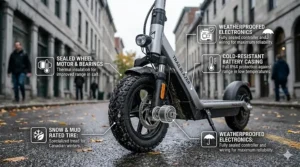
IPX5 certification means it withstands low-pressure water jets, making it more than adequate for the steady autumn rains in Victoria, the spring drizzle in Halifax, or surprise downpours in Winnipeg. NAVEE designed this model with sealed connectors and a reinforced battery casing — details that matter because the most common failure point in water-damaged scooters isn’t the main body seal but the connector ports and charging ports. The 500W motor delivers solid 25 km/h performance and manages 15% inclines adequately. At ~65 km claimed range (real-world ~50 km in 15°C conditions, ~40 km when it drops below 5°C), it handles most Canadian urban commutes confidently.
The 10-inch pneumatic tires provide noticeably better wet-traction than solid-tire budget alternatives — another detail that matters more on a rainy Vancouver Wednesday than on a dry Calgary afternoon.
Who is this for? Mid-budget Canadian commuters in wet-climate cities — Vancouver, Victoria, Halifax — who want IPX5 protection without paying the Segway Max G2 premium.
✅ IPX5 — handles sustained light-to-moderate rain
✅ Good range for price tier
✅ 10-inch tires, solid wet-road grip
❌ Less brand recognition = fewer local service options
❌ App features less polished than Segway/NIU
Value verdict: $750–$900 CAD — excellent wet-weather value.
7. Hiboy S2 Pro — Best Budget Pick with Dual-Protection (IP54)
The Hiboy S2 Pro occupies an interesting middle ground: its IP54 rating means it offers both dust protection (the “5” first digit — meaning dust is protected, not fully excluded) and water splash resistance (the “4” second digit). That makes it more versatile than a pure IPX4 model in dusty urban environments or dry suburban streets that turn to muck.
Practically, IP54 is roughly equivalent to NEMA 3 protection — adequate for wind-driven rain, splashes from any direction, and light dust. It’s not a rainy-day commuter, but it’s more well-rounded than most budget alternatives. The 350W motor covers 20 km/h speeds reliably, the 45 km range (real-world ~33–38 km in cooler weather) handles short commutes, and at 13.8 kg it’s one of the lighter options. Hiboy’s Canadian warranty and service is decent, and it ships Prime from Amazon.ca to most provinces.
Who is this for? Budget-conscious riders in dusty suburban environments (parts of Alberta, Saskatchewan) who want slightly more protection than basic IPX4 without doubling their budget.
✅ IP54 — dual solid + liquid protection
✅ Lightweight, easy to carry
✅ Prime-eligible on Amazon.ca
❌ 350W — not great on hills
❌ IP54’s water protection is still limited in real rain
Value verdict: $500–$650 CAD — smartest budget choice for mixed conditions.
What IP Rating Numbers Actually Mean: A Practical Canadian Breakdown
Understanding the electric scooter IP rating guide starts with decoding the system itself. The IP code — defined by IEC 60529 — consists of two digits. The first digit (0–6) covers protection against solid particles, ranging from no protection at all up to fully dust-tight. The second digit (0–9) covers liquids, from no protection through to high-temperature steam jets.
For electric scooters sold in Canada, you’ll almost exclusively encounter these tiers:
IPX4 / IP54 — The baseline. Protected against water splashing from any direction. IP54 adds partial dust protection. Fine for a passing drizzle but not for riding in actual rain. Most entry-level and budget scooters fall here.
IPX5 / IP55 / IP65 — A meaningful step up. These ratings confirm protection against low-pressure water jets from any direction — think a sustained shower, puddle splashes, or hosing down the scooter for cleaning. IP65 adds full dust-tight protection. Most quality commuter scooters in the $700–$1,300 CAD range should offer at least IPX5.
IPX6 / IP66 — Heavy-rain territory. Tested against powerful water jets. The “6” second digit means you can ride through a serious downpour without concern. IP66 (dust-tight + powerful jets) is the ideal target for Canadian wet-climate riders. A Vancouver rider or someone commuting in Halifax during October storm season should look here.
IPX7 and above — Temporary immersion (1 metre, 30 minutes for IPX7). Very few scooters carry this rating for the whole unit — though some, like the Segway Ninebot Max G2, rate their battery pack at IPX7 specifically.
One critical nuance most spec sheets won’t tell you: IPX7 does not automatically cover IPX6. Per IEC 60529, immersion testing and water jet testing are distinct — a scooter tested only against immersion may still fail when hit with a sustained high-pressure spray. Always check whether the rating covers jets, immersion, or both.
IPX4 vs IPX5 Electric Scooter Difference: Which Actually Handles Canadian Rain?
This is the question that generates the most confusion in Canada, and it’s worth settling clearly.
IPX4 testing uses oscillating sprinklers to spray water from multiple angles at a relatively gentle rate. Total water exposure during the test is modest. In the real world, this translates to: riding during light drizzle, handling brief splashes from passing vehicles, and surviving a damp morning commute if you’re not actively riding through puddles. The Segway E2 Plus II and Gotrax G4 live here.
IPX5 testing uses a nozzle delivering water at a rate of 12.5 litres per minute from any direction for at least 3 minutes. That’s a proper sustained spray — closer to a medium rainstorm than a sprinkle. The practical upshot: you can ride an IPX5 scooter confidently in moderate rain, ride through shallow puddles (under ~5 cm), and handle a wet commute without stopping. The Segway Ninebot Max G2 and NAVEE N65 live here.
The real-world difference between IPX4 and IPX5 is not subtle. A Vancouver rider commuting in October will feel it quickly. Here’s a practical breakdown:
| Condition | IPX4 Safe? | IPX5 Safe? |
|---|---|---|
| Light drizzle / mist | ✅ Yes | ✅ Yes |
| Steady moderate rain | ❌ Risky | ✅ Yes |
| Riding through shallow puddles | ❌ Risky | ✅ Yes |
| Hosing down scooter to clean it | ❌ No | ✅ Yes |
| Heavy sustained downpour | ❌ No | ❌ Risky (IPX6+ preferred) |
Table Analysis: For most Canadian urban commuters, IPX5 is the practical minimum for anything beyond occasional fair-weather riding. IPX4 buyers in cities like Vancouver or Halifax are playing with fire between September and April. The upgrade from IPX4 to IPX5 typically adds $200–$400 CAD to the purchase price — but costs significantly less than one controller replacement after a water-damage incident.

Can an IPX4 Scooter Ride in Heavy Rain? (The Honest Answer)
Technically, can it? Possibly — once. But should you? No, and here’s why it matters more than manufacturers let on.
The IP certification system has an important fine print most buyers never read: IP ratings are measured on factory-sealed, unmodified units under controlled laboratory conditions. Every ride your scooter takes — especially in varied Canadian temperatures — subjects the seals, gaskets, and enclosure joints to flex, vibration, and thermal expansion and contraction. T-Dot Wheels, a Canadian retailer, notes this directly: “The IPX rating of your scooter is impacted every time you go for a ride. Flex, vibration, temperature, and other external events impact this rating.”
What that means practically: an IPX4 scooter that’s survived 200 rides may have an effective rating closer to IPX2 or IPX3 by the time it meets its first heavy rainstorm. This is especially relevant in Canada where the freeze-thaw cycle stresses enclosure materials more aggressively than in temperate climates. Metal contracts in -10°C, expands in +25°C — that range is a normal Canadian year.
There’s another catch: no warranty covers water damage, even on highly rated scooters. As electricscooterguide.com explains, the warranty provider has no way of verifying whether you exceeded the IP rating or not — so virtually every manufacturer excludes water damage. This is true whether your scooter is IPX4 or IPX6.
If you live in a province with significant rainfall — British Columbia, Nova Scotia, New Brunswick, parts of Quebec — treat IPX4 as fair-weather protection, IPX5 as commuter-adequate, and IPX6 as genuine heavy-weather reliability. For the rest of Canada’s less consistently wet provinces, IPX5 is likely all you’ll ever need.
How to Choose an Electric Scooter IP Rating in Canada: 6 Key Criteria
Picking the right water protection rating for your specific situation doesn’t have to be complicated. Follow this framework:
- Assess your climate zone honestly. Are you in Vancouver (160+ rain days/year), or Calgary (relatively dry with occasional summer storms)? Coastal and Great Lakes-adjacent riders need IPX5 minimum. Interior/prairie riders can work with IPX4.
- Consider your riding frequency. A daily commuter subjects their scooter to significantly more wear-on-seals than a weekend leisure rider. Daily riders in any wet Canadian city should target IPX5 or above.
- Factor in storage conditions. If your scooter is stored outdoors even partially — in a parking garage, on a balcony, locked outside — humidity and moisture exposure accumulates even when you’re not riding. A higher IP rating offers more buffer.
- Match rating to terrain. Flat-city riders who stay on dry pavement can get by with IPX4. Anyone who regularly rides near waterfront areas, crosses wet gravel paths, or encounters spring road flooding should look at IPX5+.
- Budget for the IP upgrade. In the Canadian market, the jump from IPX4 to IPX5 typically costs $200–$400 CAD in equivalent scooters. The jump from IPX5 to IP66 can be $300–$500 more. Factor the cost of one potential controller replacement (~$150–$300 CAD at a local shop) into your decision.
- Check if IP claims are certified or claimed. There’s a meaningful difference between a scooter with third-party certified IP testing and one where the manufacturer has simply printed an IP rating on the spec sheet. Brands like Segway, Apollo, and NIU invest in independent certification. Less-known brands on Amazon.ca sometimes print optimistic IP claims without rigorous verification — check customer reviews specifically for water-related issues.
Real-World Canadian Rider Profiles: Matching IP Ratings to Your Life
Understanding which rating you need is easier when you see it through real Canadian scenarios.
Profile 1: The Toronto Condo Commuter Marcus lives in a Leslieville condo and rides 8 km each way to his office near King West. He stores his scooter inside. Toronto is in Ontario’s e-scooter pilot area (outside Toronto city proper — he commutes toward Mississauga-edge), sees 120+ rainy days per year, and rides year-round except winter. He needs at minimum IPX5. The Segway Ninebot Max G2 or NAVEE N65 are his matches — range, reliability, and water protection for a $1,000–$1,300 CAD investment that pays back quickly versus Presto card and Uber costs.
Profile 2: The Vancouver Weekend Rider Sophie lives in Kitsilano, rides to Granville Island and along the seawall on weekends when it’s not pouring. She stores her scooter in a dry indoor space. She rides maybe 30 rides per year, mostly in summer and fall. For her, IPX4 (like the Gotrax G4) is actually adequate — she’s not commuting in sustained rain. She can save $400–$500 CAD versus an IPX5 model and redirect that toward good rain gear for herself.
Profile 3: The Halifax Year-Round Commuter Darren commutes 12 km daily in Halifax, which sees maritime rainfall year-round and occasional freezing rain in late fall. He stores his scooter in a partially covered bike shelter at his apartment building. He needs IP66 — the Apollo Go. Halifax’s weather is unforgiving enough that IPX5 provides adequate but not comfortable margins. The Apollo Go’s dust-tight and powerful-jet resistance means he’s genuinely covered rather than white-knuckling it through October gales.
Long-Term Cost and Maintenance in Canadian Conditions
Choosing the right IP rating isn’t just about the initial purchase — it’s an investment in long-term cost avoidance.
Water damage repair costs in Canada (approximate CAD):
- Controller replacement: $150–$350
- Motor replacement (water-seized): $200–$400
- Battery replacement: $300–$600
- Display/electronics: $80–$200
- Total worst-case water damage: $700–$1,200+
When you frame it that way, paying an extra $300 CAD for an IPX5 or IP66 model instead of an IPX4 version is extremely rational economics — especially since no warranty covers water damage regardless of rating.
Canadian-specific maintenance tips for water-exposed scooters:
- After riding in rain, dry the charging port and all connector points immediately. Moisture trapped in charging ports is the #1 cause of damage in lightly-rated scooters.
- Road salt in winter and spring is a major corrosion accelerator. Rinse your scooter’s underside (not with high pressure on IPX4 models) after salty-road rides.
- Re-apply dielectric grease to connector points seasonally — most manufacturers won’t tell you this, but Canadian winters demand it.
- Store indoors whenever temperatures drop below 0°C. Battery capacity degrades faster and seal materials become less pliable in sustained cold.
- Inspect physical seal integrity annually. If you see cracked gaskets around the enclosure panels, address before the next rainy season.
While Canadian pricing on replacement parts is typically higher than US equivalents due to exchange rates and import logistics, keeping your scooter well-maintained dramatically reduces those costs.
Canadian Regulations, Safety Standards, and IP Ratings: What You Need to Know in 2026
Electric scooter laws in Canada sit in a fascinating regulatory patchwork in 2026 — and your IP rating choice intersects with where and how you can legally ride.
At the federal level, Transport Canada classifies many e-scooters outside the power-assisted bicycle (PAB) category, which means provincial regulations govern them primarily. Here’s the 2026 provincial snapshot:
- British Columbia: E-scooter pilot runs until April 2028. Legal in participating communities including Vancouver, Kelowna, Victoria-area, and 30+ others. Maximum 25 km/h, helmet mandatory, bike lanes where available.
- Ontario: Pilot program extended to November 27, 2029 under Regulation 389/19. Cities opt in individually — Ottawa, Mississauga, Hamilton, London, and others are in. Notably, Toronto declined in May 2024 — you can buy a scooter there but cannot legally ride it on public roads.
- Quebec: ATPM pilot runs until July 2026 with extension expected. 25 km/h limit, helmets mandatory, bike paths and roads under 50 km/h.
- Alberta: Calgary and Edmonton permit scooters on bike lanes and pathways, but provincial legislation for personal e-scooters hasn’t been enacted. Check your city bylaws.
- Nova Scotia and Maritime provinces: Among Canada’s more permissive provinces for personal e-scooter use.
Why does this matter for IP ratings? Because in wet-climate legal riding zones — BC and Nova Scotia especially — you’re almost certain to ride in rain at some point. A scooter with IPX4 in these environments is a calculated risk. Where riding is predominantly dry-season (Alberta’s summers, Saskatchewan municipal pilots), IPX4 may genuinely suffice.
Note that Canada doesn’t currently have a federal-level IP rating requirement for electric scooters, unlike some product categories covered by the Canadian Electrical Code or CSA standards. Your IP rating choice is a practical decision, not a regulatory one — but it’s one of the most consequential specs you’ll ever overlook if you skip it.
Features That Actually Matter for Canadian Wet-Weather Riding (And Those That Don’t)
What actually matters:
🛡️ IP rating (obviously) — But also verify it’s certified, not just claimed. Check customer reviews specifically for waterproofing.
🛡️ Fender coverage — Longer rear fenders dramatically reduce water spray onto the deck and rider. Short stock fenders on IPX5 scooters can be extended with aftermarket accessories available on Amazon.ca for $20–$40 CAD.
🛡️ Tire type — Pneumatic (air-filled) tires provide meaningfully better wet-road grip than solid tires. The traction difference on a rainy morning is not subtle.
🛡️ Sealed charge port — Inspect whether the charge port has a rubber cap or seal. Many budget IPX4 models overlook this seemingly minor detail — and it’s often the entry point for water damage.
🛡️ Battery management system (BMS) quality — A sophisticated BMS shuts down charging or discharging safely if moisture ingress is detected. Brands like Segway and Apollo invest in this; generic imports often don’t.
What doesn’t matter as much as marketing suggests:
💨 “Military-grade” framing — Meaningless without a specific IP number. Ignore it.
💨 Extreme maximum speed claims — Legally irrelevant in Canada (25 km/h in nearly all provincial pilot programs) and practically irrelevant on wet roads where 20 km/h is already pressing safe braking limits.
💨 Suspension quality for water protection — Suspension affects comfort and battery stress, but has no bearing on IP protection. Great suspension + IPX4 is still just IPX4 in the rain.
FAQ: Electric Scooter IP Ratings in Canada
❓ What IP rating do I need for riding an electric scooter in rain in Canada?
❓ What is the IPX4 vs IPX5 electric scooter difference in real-world terms?
❓ Can an IPX4 scooter ride in heavy rain safely?
❓ Are electric scooters legal to ride in the rain in Canada?
❓ Do electric scooters available on Amazon.ca have genuine IP certification, or is it just a marketing claim?
Conclusion: Choose Your IP Rating Like Your Ride Depends on It (Because It Does)
Here’s the honest summary of this electric scooter IP rating guide: in a country with Canada’s climate diversity, choosing the wrong IP rating isn’t a minor inconvenience — it’s potentially a $700+ CAD repair bill and a scooter that’s dead by its second autumn.
The tiers are clear. IPX4 for fair-weather riders who occasionally get caught in light drizzle. IPX5 for daily commuters in any Canadian city with a real rainy season. IP66 for anyone in coastal or maritime climates who rides year-round without compromise.
The seven scooters in this guide represent the best the Canadian Amazon.ca market has to offer in 2026 across price tiers — from the budget-smart Gotrax G4 for fair-weather riding to the Apollo Go’s exceptional IP66 dual-motor package for riders who refuse to check the weather before leaving. The Segway Ninebot Max G2 remains my top all-around recommendation for the majority of Canadian urban commuters: the combination of IPX5 whole-unit rating, IPX7 battery pack, self-sealing tires, and 70 km range is simply unmatched in its class on Amazon.ca.
Before you buy, check your province’s current e-scooter regulations — the landscape is still evolving in 2026, and a scooter that’s legal in Ottawa may not be rideable in Toronto. Then factor in your real-world riding conditions, not just your ideal-weather fantasy ones.
Whatever you choose — check the IP rating first. It’s the spec that determines whether your investment lasts one autumn or five years.
✨ Don’t Miss These Exclusive Deals!
🔍 Ready to find your perfect waterproof scooter? Click on any highlighted product name in this article to check current pricing and availability on Amazon.ca. Stock and prices change regularly — check today to avoid missing your ideal pick!
Recommended for You
- Best Water Resistant Scooter for Vancouver Rain 2026 (Top 7)
- Best All Season Electric Scooter for Commuting Canada 2026 (Top 7)
- Best Waterproof Electric Scooter IP65 in Canada 2026 (Top 7 Picks)
Disclaimer: This article contains affiliate links. As an Amazon Associate, I earn from qualifying purchases. If you purchase products through these links, we may earn a small commission at no additional cost to you.
✨ Found this helpful? Share it with your friends! 💬🤗
