
In This Article
Let’s be real — if you’re commuting in Vancouver, you’re not commuting around the rain. You’re commuting through it. Metro Vancouver averages well over 1,100 mm of precipitation a year, and the Pacific Northwest rainy season runs from October through April with impressive (and frankly relentless) consistency. A scooter that crumbles at the first drizzle isn’t a commuter tool — it’s an expensive disappointment waiting to happen.
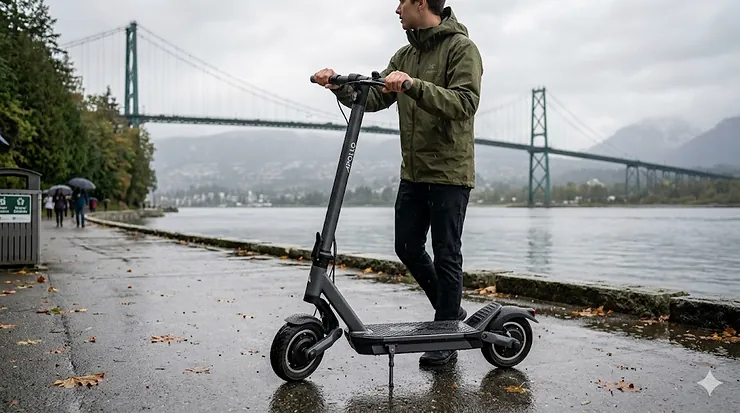
Here’s the thing most buyers don’t realize: there is no such thing as a fully waterproof electric scooter. Every manufacturer who claims otherwise is marketing, not engineering. What you can get is a solid water resistant scooter for Vancouver rain — one rated to IPX5, IPX6, or IP66 — and that distinction matters enormously when you’re threading through puddles on the Cambie Street Bridge on a Tuesday morning.
What does that mean in practice? An IPX5 rating means the scooter can withstand continuous water jets from any direction — think heavy rain, road spray, and puddle splashes — without internal damage. IPX6 handles powerful jets, equivalent to the kind of sideways rain that only Vancouver and the rest of the Pacific Northwest can conjure. IP66 adds dust protection on top of that. For most daily commuters in Vancouver, IPX5 is the minimum you should accept, and IPX6 or above is genuinely worth the upgrade.
I’ve spent time evaluating the electric scooter for rainy commute Canada market specifically, going beyond the spec sheets to understand how these machines actually hold up in wet-weather riding. In this guide, you’ll find seven real products available on Amazon.ca, a clear buyer’s framework built for Pacific Northwest conditions, honest pros and cons, and — crucially — Canadian pricing context so you know what to budget in CAD.
British Columbia’s pilot program means e-scooters are now legal in Vancouver for riders 16 and older, provided you stick to bike lanes, greenways, and roads under 50 km/h. That’s great news. What it means for this guide is that your scooter needs to be reliable in wet conditions because you’ll be using it on public roads, not just a private driveway.
Quick Comparison: Top Water Resistant Scooters for Vancouver Rain
| Model | IP Rating | Motor | Range | Best For | Price Range (CAD) |
|---|---|---|---|---|---|
| Segway Ninebot Max G2 | IPX5 | 1000W | ~70 km | Daily commuters | $900–$1,100 |
| Segway Ninebot Max G3 | IPX6 | 850W (2000W peak) | ~65 km | Upgrade seekers | $1,100–$1,400 |
| CUNFON RZ800 | IPX5 | 1200W | ~50 km | Mid-range power | $500–$700 |
| ECOROAD ES6 | IPX4+ | 1000W | ~60 km | Budget commuters | $350–$500 |
| NAVEE ST3 Pro | IPX5 | 1350W | ~75 km | Long-range riders | $700–$950 |
| Gyrocopters Flash 6.0 | IPX4 | 350W | ~30 km | Light rain/transit combo | $300–$420 |
| iSinwheel S10Max | IPX4 | 500W | ~45 km | Budget-conscious riders | $400–$550 |
The table above tells a clear story: if Vancouver rain is a daily reality for you, the Segway G2 and G3 are in a league of their own for IP-rated protection and range. Mid-range riders get solid value from the CUNFON RZ800 and NAVEE ST3 Pro, both offering IPX5 protection with meaningful motor power. Budget options like the Gyrocopters Flash 6.0 and iSinwheel S10Max are capable in light drizzle but should be approached with realistic expectations during a Pacific Northwest downpour.
💬 Just one click — help others make better buying decisions too! 😊
✨ Don’t Miss These Exclusive Deals!
🔍 Take your wet-weather commute to the next level with these carefully selected scooters. Click on any highlighted product to check current pricing and availability on Amazon.ca. These picks will help you ride confidently through Vancouver’s rainiest days!
Top 7 Water Resistant Scooters for Vancouver Rain: Expert Analysis
1. Segway Ninebot Max G2 — The Gold Standard for Wet Commuting in Canada
The Segway Ninebot Max G2 is, without exaggeration, the closest thing to a “Vancouver-ready” electric scooter you’ll find on Amazon.ca today. Its IPX5 rating isn’t just a badge — it’s backed by real-world performance that Canadian riders across Metro Vancouver and Ontario have tested through genuine rainy-season commutes.
The 1000W motor puts out up to 35 km/h and handles a 22% climb angle, which matters if your Vancouver route involves any of the city’s notorious slopes near Commercial Drive or the East Side. The 551Wh battery delivers around 70 km of range in optimal conditions — and that “optimal conditions” caveat is worth unpacking. In cooler BC weather (5°C to 10°C, which is Vancouver’s autumn reality), expect a 10–20% range reduction. You’re realistically looking at 55–62 km in typical fall commuting weather, which is still excellent for a city scooter.
What sets the G2 apart for rain riding specifically is its TCS (Traction Control System) — an industry first for kick scooters. On wet asphalt, traction control actively modulates wheel spin, giving you a far more confident feel on painted road markings and slick corners. The dual suspension (front hydraulic, rear spring) also means you’re absorbing Vancouver’s rougher pavement without losing control.
Canadian buyers consistently note the G2 holds up through extended rain exposure. The folding mechanism remains smooth even with wet hands — a practical detail that competitors often overlook.
✅ IPX5 industry-proven rating for real rain commuting
✅ TCS traction control unique in this price range
✅ 70 km range handles longer Vancouver commutes
❌ Weighs around 19 kg — not light enough to carry up apartment stairs daily
❌ Premium pricing puts it above casual use budgets
In the $900–$1,100 CAD range, the G2 is the benchmark that every other rain-ready scooter on this list is measured against.
2. Segway Ninebot Max G3 — Maximum Rain Protection for the Serious Pacific Northwest Commuter
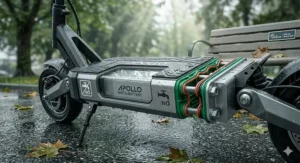
If the G2 is the benchmark, the Segway Ninebot Max G3 is what happens when Segway asked, “What would a Vancouver commuter actually need?” The answer: IPX6 water resistance — one full step above the G2 — plus bigger 11-inch tyres, dual disc brakes, and an 850W motor capable of 2000W peak boost output.
That IPX6 certification means the G3 can withstand powerful water jets from any direction. In practical terms, this is the scooter you ride confidently through the kind of sideways rain that Vancouver serves up in November. Road spray from buses, puddles concealing storm drains, the whole Pacific Northwest menu — the G3 is engineered to take it.
The 80 km maximum range (more realistically 55–65 km in BC autumn temperatures) pairs with the dual disc brakes for a wet-stopping-distance performance that inspires real confidence. Larger 11-inch tyres also improve road contact on slick surfaces compared to the 10-inch wheels on the G2.
The G3 is available through Segway Canada’s official store and select Amazon.ca listings. Check availability, as stock varies seasonally in Canada. For serious Vancouver daily commuters logging 15–25 km round trips through October to April rain, the G3’s higher IP rating justifies the price premium over the G2.
✅ IPX6 — highest readily available water resistance rating
✅ Dual disc brakes for reliable wet stopping
✅ 11-inch tyres for superior wet-road grip
❌ Price sits in the $1,100–$1,400 CAD range — a significant investment
❌ Heavier build — not ideal for multi-floor apartment storage
3. CUNFON RZ800 Electric Scooter — Underrated IPX5 Workhorse for Budget-Aware Vancouver Riders
The CUNFON RZ800 is one of the most undervalued splash proof electric scooter commuter options on Amazon.ca right now, and it’s flying under the radar of most Canadian buyers who default to Segway without exploring alternatives.
The 1200W motor delivers up to 50 km/h top speed and handles 50 km of range — that last number dips a bit in Vancouver’s cooler months, but the 10.5-inch pneumatic tyres genuinely help compensate on wet roads by providing better surface contact than 8.5-inch options. The IPX5 rating is manufacturer-certified, and the dual spring front/rear suspension handles Vancouver’s pavement gaps and speed bumps without drama.
What I find particularly practical for Vancouver use: the full lighting system is genuinely good. Vancouver requires lights for night riding under the BC pilot rules, and the RZ800’s headlight and brake light combination satisfies that requirement without needing to add aftermarket accessories.
The fingerprint unlock is a clever feature when you’re wearing rain gloves — no fumbling with app connections at 7:45 am. Canadian customer feedback on Amazon.ca highlights the build quality as punching above its price point.
✅ IPX5 certification with 1200W motor — strong combination
✅ 10.5-inch tyres improve wet-road traction
✅ Full lighting system legally compliant for Vancouver night riding
❌ Brand support network in Canada is limited compared to Segway
❌ Range drops noticeably in cool weather
At the $500–$700 CAD range, the CUNFON RZ800 is the strong mid-range pick for Vancouver riders who want real rain protection without the premium Segway price tag.
4. ECOROAD ES6 Electric Scooter — Long-Range Budget Commuter with Wet-Weather Capability
The ECOROAD ES6 occupies a smart position in the Canadian market: it doesn’t claim the highest IP rating, but what it lacks in water resistance depth it compensates for in range and value. Available on Amazon.ca and shipped by ECOROAD directly, this is a legitimate daily driver for electric scooter for rainy commute Canada riders who are price-sensitive.
The 1000W motor and 624Wh (48V, 13Ah) battery push a claimed 60+ km range. In Vancouver’s autumn weather, you’ll realistically hit 45–50 km — more than sufficient for the vast majority of daily Metro Vancouver commutes. The 10-inch pneumatic tyres and dual suspension handle BC road surfaces capably.
The dual disc brakes plus E-ABS combination is where the ES6 earns its rain-day reputation. E-ABS electronic braking works even when standard brake performance degrades in wet conditions, which is a practical safety feature that the spec sheet undersells. A mid-mounted colour display shows speed, battery level, and temperature alerts in real time — that temperature warning is genuinely useful when riding in sub-5°C conditions, as it signals when battery efficiency is declining.
One caveat worth stating clearly: the ES6’s IPX4 protection covers splashing from any direction but is not rated for continuous water jets. In a light-to-moderate Vancouver drizzle, it performs well. In a sustained downpour, exercise caution.
✅ 60+ km claimed range — strong value for budget tier
✅ E-ABS braking system for wet-condition safety
✅ Colour display with temperature alert for cold-weather riding
❌ IPX4 is minimum viable water resistance for Vancouver’s heavier rain days
❌ Service centres in Canada limited — warranty claims can take time
In the $350–$500 CAD range, the ECOROAD ES6 is excellent value with the understanding that heavy rain riding will require more caution than an IPX5+ model.
5. NAVEE ST3 Pro Electric Scooter — Long-Range All-Terrain Choice for Wet Weather Commuting Canada
NAVEE has quietly built one of the strongest lineups for Canadian wet-weather commuting, and the ST3 Pro is the crown jewel. Available on Amazon.ca, it combines IPX5 water resistance with a 1350W motor, a claimed 75 km range, and all-terrain 10-inch tyres that genuinely change how a scooter handles Vancouver’s varied road surfaces.
The motor’s 45 km/h top speed capability needs to be understood in BC context: under Vancouver’s pilot rules, you’re legally capped at 24 km/h on most bike paths and roads. What that extra power actually gives you is reserve torque on wet uphill grades — the kind of load-bearing performance that keeps you at a steady pace on Kingsway rather than slowing to a crawl when it’s raining and the road is slick.
NAVEE has specifically engineered its Canadian-market scooters to fit within BC’s pilot specifications (500W configurable, speed settings adjustable to 25 km/h), which removes the headache of compliance concerns that plague some other imported models. This is a genuine differentiator for Vancouver buyers.
Dual suspension front and rear handles the transition zones between bike lanes and road surfaces that are common throughout Metro Vancouver.
✅ IPX5 protection with 1350W torque reserve for wet uphill grades
✅ Designed to fit BC pilot program specifications — no compliance headaches
✅ 75 km range is class-leading in mid-price tier
❌ $700–$950 CAD positions it close to Segway G2 territory
❌ Heavier frame at approximately 22 kg
6. Gyrocopters Flash 6.0 (2026) — The Canadian Brand Budget Pick for Light Rain Riding
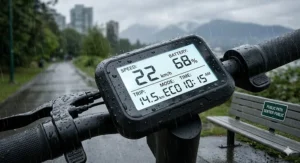
Gyrocopters is a proudly Canadian brand — designed in Canada since 2015 — and the Flash 6.0 is their most polished commuter offering for the wet weather commuting scooter category. Available on Amazon.ca in its 2026 edition with UL 2272 safety certification, it’s a lightweight option at 13 kg that integrates nicely with Vancouver’s public transit system.
The 350W brushless motor tops out at 30 km/h with a range of up to 30 km. That’s honest range for a scooter this size — and in cold BC weather, you’ll get around 22–25 km before needing to charge. The 8.5-inch burst-proof tyres and app connectivity (Tuya Bluetooth app with remote lock, headlight control, and ride history) make daily urban use straightforward.
The water resistance reality: Gyrocopters rates the Flash 6.0 for outdoor riding but doesn’t publish a formal IP rating for this model. Based on buyer feedback on Amazon.ca, it handles light to moderate rain without issues. In heavy Pacific Northwest rain, it’s less suited for extended exposure. Think of it as a reliable companion on Vancouver’s grey drizzle days, not a soaker storm warrior.
For a Vancouver condo dweller taking the SkyTrain part-way and scooting the last 3–4 km, the Flash 6.0’s lightweight and transit-friendly design is a strong practical choice.
✅ Proudly Canadian brand — strong local consumer support
✅ 13 kg lightweight — transit combo commuting made easy
✅ 2026 model with app lock security for urban theft prevention
❌ No published IP rating — treat as light-rain-only
❌ 30 km range limits longer Vancouver commute segments
In the $300–$420 CAD range, the Flash 6.0 is the most affordable Canadian-made option and earns its place for mixed transit commuters.
7. iSinwheel S10Max Electric Scooter — Entry-Level IPX4 Option for Occasional Wet Rides
The iSinwheel S10Max rounds out this list as the accessible gateway option for riders new to the electric scooter for rainy commute Canada space. Available on Amazon.ca, it offers a 500W motor, around 45 km of claimed range, and an IPX4 splash-resistant build that covers light rain exposure with reasonable confidence.
What iSinwheel gets right is the dual braking system — front disc and rear E-ABS — which performs credibly in wet conditions for a scooter at this price point. The 8.5-inch tyres are pneumatic (not solid), which is important for wet-road grip; solid tyres at this size hydroplane much more readily.
Canadian buyers should note: the S10Max doesn’t carry formal Canadian certification markings (CSA or cUL), which is worth flagging for BC residents under the pilot program requirements. Verify BC eligibility before purchasing for street use in Vancouver.
For riders who commute on dry days primarily and get caught in light rain occasionally, the S10Max works. For those who plan to ride through Vancouver’s November-to-March season regularly, budget up to the CUNFON RZ800 or ECOROAD ES6 at minimum.
✅ Accessible entry price in the $400–$550 CAD range
✅ Pneumatic tyres for better wet-road grip than solid alternatives
✅ Dual braking with E-ABS for wet-condition stopping
❌ IPX4 is inadequate for sustained Pacific Northwest rain riding
❌ Canadian certification status — verify before BC street use
How to Choose a Water Resistant Scooter for Vancouver Rain: A Practical Framework
Buying a wet weather commuting scooter in Vancouver requires thinking through a different checklist than buying one for, say, Calgary’s drier climate. Here’s the decision framework I’d use:
Step 1 — Establish your actual IP rating minimum. If you commute October through April in Vancouver, IPX5 is your floor. IPX4 is for riders who scoot primarily in dry weather and get caught in light rain occasionally. If your route involves waterfront or exposed road sections with road spray, target IPX6.
Step 2 — Calculate your real-world range need. Take your one-way commute distance, double it, and add 20% as a cold-weather buffer. If your round trip is 20 km, you need a scooter with at least 24 km of cold-weather-adjusted range (not the marketed maximum). Most listed ranges are measured at 20°C — Vancouver autumn rides at 7°C will cut that by 15–20%.
Step 3 — Check BC pilot compliance. Under BC’s electric kick scooter pilot, your scooter must not exceed 500W motor output and must be speed-configurable to under 25 km/h for designated areas. Models marketed at higher wattages may require configuration. NAVEE explicitly engineers for BC compliance; verify others before purchasing.
Step 4 — Consider the weight vs. storage equation. Vancouver’s condo reality means many riders are carrying their scooter up stairs or onto SkyTrain. Anything over 16–17 kg gets awkward fast. The Gyrocopters Flash 6.0 at 13 kg is a genuine transit combo asset; the Segway G2 at 19 kg is less transit-friendly but compensates with superior rain performance.
Step 5 — Tyre size matters in the rain. Ten-inch or larger pneumatic tyres provide meaningfully better wet-road grip than 8.5-inch options. If you’re riding slick bike lane paint in the rain, bigger tyres are not optional — they’re a safety consideration.
Step 6 — Fenders are non-negotiable. Any scooter used in Vancouver rain must have both front and rear fenders. Without them, you arrive at work looking like you swam part of the way. The Segway G2 has one of the best fender systems in the commuter scooter category.
Step 7 — Budget in CAD realistically. A genuine IPX5 rain-ready scooter in Canada starts around $500 CAD. Budget less and you’re in IPX4 territory, which is a compromise for Vancouver’s rainfall intensity. Don’t let short-term savings lead to a scooter failure mid-winter.
Real-World Canadian Rider Profiles: Which Scooter Fits You?
Profile 1: The Metro Vancouver Daily Commuter (15 km each way, rain or shine)
Sarah rides from East Vancouver to Downtown daily, rain or shine, September through May. Her route crosses two rain-exposed stretches with significant road spray from buses. Budget: around $1,100 CAD.
Best match: Segway Ninebot Max G2. The IPX5 rating, TCS traction control, and 70 km range (55 km cold-weather adjusted) cover her 30 km daily round trip with comfortable buffer. The G2’s fender system keeps spray off her while the TCS handles slick bike lane corners.
Profile 2: The UBC Student on a Budget (8 km commute, light to moderate rain)
Marcus commutes from Kitsilano to UBC via the bike path network. His scooter needs to work in light rain, fold for the bus, and not break the bank. Budget: around $400–$500 CAD.
Best match: ECOROAD ES6. The 60 km range far exceeds his 16 km daily round trip, the E-ABS braking handles wet bike paths safely, and the price point leaves room in his budget for a quality rain jacket and gloves — also essential Vancouver commuter gear.
Profile 3: The Burnaby Tech Worker (Long Weekend Warrior + Wet Commuter)
David uses his scooter twice weekly for a 12 km commute and occasionally longer weekend rides through November rains. Budget: $700–$900 CAD.
Best match: NAVEE ST3 Pro. The 75 km range accommodates both his commute and weekend exploration. BC-pilot-compliant engineering removes any compliance stress, and the IPX5 protection handles his moderate but regular wet-weather use.
Profile 4: The Transit Combo Rider (3–5 km last mile, light rain tolerance)
Li takes the Canada Line to Yaletown and scoots the last 4 km. Needs to bring the scooter on the train or up to her office on the 14th floor. Budget: under $400 CAD.
Best match: Gyrocopters Flash 6.0. At 13 kg and with a compact fold, it’s the only option on this list realistically suitable for daily elevator and SkyTrain use. For her light-rain, short-distance use case, the unrated water resistance performs adequately.

Common Mistakes Vancouver Buyers Make When Choosing a Rain-Ready Scooter
Mistake 1: Trusting “waterproof” marketing language without checking the IP rating. No electric scooter is truly waterproof. If a listing doesn’t state an IP rating — and many budget models on Amazon.ca don’t — treat it as splash-resistant at best and rain-risky at worst.
Mistake 2: Buying without verifying BC pilot compliance. Under Vancouver’s e-scooter pilot rules, scooters must meet provincial specifications. A high-powered imported model that isn’t speed-configurable could land you with a fine or an impounded scooter. Always confirm BC compliance before purchasing for street use. The City of Vancouver’s official e-scooter pilot rules are worth bookmarking.
Mistake 3: Ignoring cold-weather battery impact. Lithium batteries lose capacity in cold. Vancouver’s mild winters (average 3°C–7°C from December to February) still reduce scooter range by 10–20%. A scooter with a “25 km range” marketing claim realistically delivers 20–22 km on a December commute. Always factor in the cold-weather buffer.
Mistake 4: Choosing solid tyres to avoid flats. Solid (airless) tyres seem logical for wet Vancouver streets, but they provide significantly less grip than pneumatic options at speed on wet asphalt. The reduced traction risk outweighs the puncture-resistance benefit for most commuters. Stick with pneumatic tyres 10 inches or larger.
Mistake 5: Skipping fenders to save money on accessories. Some Amazon.ca listings sell base models without adequate fenders. Riding in Vancouver rain without fenders means road spray directly onto your shoes, pants, and the scooter’s own electronics. This is both a comfort and a longevity issue. If the model doesn’t come with front and rear fenders, add them before your first rainy commute — or choose a model that includes them as standard.
Mistake 6: Ignoring cross-border warranty complications. Several scooter brands ship from US fulfillment centres even when listed on Amazon.ca. While delivery usually works, warranty claims on scooters that aren’t officially distributed in Canada can involve cross-border shipping costs that exceed the repair value. Prefer brands with Canadian distribution or local service presence (Segway Canada, NAVEE Canada) when budget allows.
Understanding IP Ratings: What They Actually Mean for Vancouver’s Rain
The IP (Ingress Protection) rating system is governed by the IEC 60529 standard — a globally recognized benchmark for how well electronic enclosures resist solid particles and liquids. For electric scooters, the liquid protection number (the second digit) is what matters.
Here’s what each rating means when you’re deciding on a splash proof electric scooter commuter for Vancouver:
IPX4 — Protected against splashing water from any direction. Fine for light drizzle and incidental puddle spray. Not suitable for Vancouver’s sustained autumn rain or road splash from passing vehicles.
IPX5 — Protected against water jets from any direction. This is the minimum standard I’d recommend for year-round Vancouver commuting. The Segway Ninebot Max G2 and NAVEE ST3 Pro sit here. A sustained Vancouver rainstorm qualifies as IPX5-territory exposure.
IPX6 — Protected against powerful water jets. The Segway Max G3 hits this level. This is where you ride confidently through heavy Pacific Northwest rain, road puddle splash, and occasional pressure-washed garage floors without stress.
IP66 — Dust tight plus powerful water jets. Rare in the scooter category. The Apollo Phantom 2.0 reaches this standard — though it’s primarily available through Apollo Canada direct rather than Amazon.ca.
What the IP rating doesn’t tell you: the quality of sealing around the charging port, the folding joint, and the handlebar connections. These areas are common water ingress points on budget models even with an IPX5 claim. Buying from established brands with verified third-party testing (not just manufacturer claims) gives you real-world confidence that the spec sheet promises.
The British Columbia government’s Motor Vehicle Act and e-scooter pilot regulations also don’t specify IP ratings — but they do require scooters to be mechanically safe for public road use. A scooter with failed electronics from water ingress is neither safe nor legal.
Long-Term Cost and Maintenance in Vancouver’s Wet Climate
One thing Vancouver riders don’t think about enough before buying: the ongoing cost of keeping a scooter operational through multiple rainy seasons. A rainfall-ready scooter in Vancouver isn’t just a purchase — it’s a maintenance relationship.
Battery care in BC’s cool, damp climate: Lithium batteries don’t love cold storage. If you store your scooter in a cold underground parkade (common in Vancouver condos), bring the battery inside if temperatures drop below 5°C for extended periods. Cold-stored batteries lose cycle capacity faster. For a $900 CAD scooter, protecting the battery extends the usable life by two or more seasons.
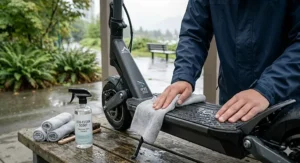
Post-rain maintenance routine: After riding in rain, don’t put your scooter away soaking wet. Stand it upright, towel dry the deck and handlebar area, and wipe down the motor cover. Pay particular attention to the charging port — even on IPX5 models, water accumulation at the port can cause corrosion over time. A silicone port cover (under $10 CAD) is cheap insurance.
Road salt awareness: Unlike Ontario or Quebec, Vancouver doesn’t heavily salt roads — de-icing is less common on cycling infrastructure. But roads closer to the waterfront and during frost events may see light salt application. Post-winter cleaning of undercarriage components is good practice regardless.
Tyre maintenance in wet weather: Pneumatic tyres on wet Vancouver bike paths need pressure checks monthly. Under-inflated tyres on wet surfaces dramatically increase sliding risk, especially on downhill sections. Keep tyres at manufacturer-recommended PSI — usually printed on the tyre sidewall.
Service centre access in Canada: Segway has Canadian-authorized service partners in Metro Vancouver, making warranty claims and repairs straightforward. NAVEE has growing Canadian support. Lesser-known brands may require shipping scooters to US service centres, which adds both cost and weeks of downtime during your prime commuting season.
In total cost of ownership terms, a $1,000 CAD IPX5 Segway G2 that lasts four Vancouver rainy seasons at $10/month in maintenance costs less per commute than a $400 CAD IPX4 scooter replaced every 18 months. Do the math before defaulting to the lowest-priced listing.

BC Regulations You Must Know Before Riding a Scooter in Vancouver Rain
Under BC’s electric kick scooter pilot project, Vancouver is a participating community — which means personal e-scooters are legal here under specific conditions. Here’s what matters for 2026:
Age and helmet requirements: Riders must be 16 or older. Helmets are mandatory in BC — this applies rain or shine, and there are no exceptions for short trips. A quality rain-compatible helmet is worth the additional investment.
Where you can ride: Approved bike lanes, greenways, shared paths, and roads with speed limits at or under 50 km/h. The Seawall and several major arterials have geofencing restrictions for rental scooters; personal scooter rules are slightly different but sidewalk riding remains illegal.
Speed and motor limits: Maximum 24 km/h on designated paths. Motor output must be at or under 500W for pilot-program classification. Scooters exceeding these specs are reclassified as limited-speed motorcycles requiring registration, insurance, and a driver’s licence — a bureaucratic headache worth avoiding.
Night riding lighting: Front white light and rear red light are required for riding after dusk. Most mid-range and premium scooters on this list include adequate lighting; the Gyrocopters Flash 6.0 and CUNFON RZ800 are particularly well-lit for night commuting.
According to CBC News reporting on Vancouver’s e-scooter pilot program, the trial has been operating for several years and transportation advocates continue to monitor safety impacts — which reinforces the importance of choosing a scooter with good braking and traction systems rather than just prioritizing range or speed.
FAQ: Water Resistant Scooters for Vancouver Rain
❓ What IP rating do I need for a scooter to ride in Vancouver rain?
❓ Are electric scooters legal in Vancouver in 2026?
❓ Does cold weather affect my scooter's range in BC?
❓ Can I get a good electric scooter on Amazon.ca that ships to all BC regions?
❓ Do I need insurance for my electric scooter in Vancouver?
Conclusion: Finding Your Perfect Rainfall-Ready Scooter for Vancouver
The Pacific Northwest doesn’t apologize for its weather, and your scooter shouldn’t either. The right water resistant scooter for Vancouver rain is one that matches your IP rating needs to your actual riding conditions, respects BC pilot program regulations, and gives you the range and reliability to commute confidently through October’s first serious storms.
For most Metro Vancouver commuters, the Segway Ninebot Max G2 remains the most trusted, best-supported, and most rain-proven option on Amazon.ca — it earns every bit of its reputation. Riders who want to step up to IPX6 protection for heavier daily rain exposure should look seriously at the Max G3. Budget buyers who commute shorter distances in moderate rain will find real value in the CUNFON RZ800 or NAVEE ST3 Pro.
Whatever you choose, remember the fundamentals: check the IP rating, verify BC compliance, budget for cold-weather range reduction, and invest in a proper helmet and rain fenders. Vancouver’s rain isn’t a problem to avoid — it’s a condition to equip yourself for.
✨ Don’t Miss These Exclusive Deals!
🔍 Click on any highlighted product to check current pricing and availability on Amazon.ca. Prices change frequently — check today for the best current deals!
Recommended for You
- Best All Season Electric Scooter for Commuting Canada 2026 (Top 7)
- Best Waterproof Electric Scooter IP65 in Canada 2026 (Top 7 Picks)
- How to Winterize Electric Scooter: 7 Essential Products for Canadian Winters (2026)
Disclaimer: This article contains affiliate links. As an Amazon Associate, I earn from qualifying purchases. If you purchase products through these links, we may earn a small commission at no additional cost to you.
✨ Found this helpful? Share it with your friends! 💬🤗
