
In This Article
A speed limited vs unrestricted electric scooter comparison comes down to one question: does the scooter hold a capped top speed set by firmware or hardware, or does it run at whatever its motors and battery can deliver? Limited models usually top out around 24-32 km/h. Unrestricted ones can pass 60 km/h.
That sounds like a spec-sheet footnote. It isn’t. In Canada, that single number decides whether your scooter fits a legal definition, whether your insurer shrugs or sues, and whether your commute feels like a bike ride or a low-flying experiment.
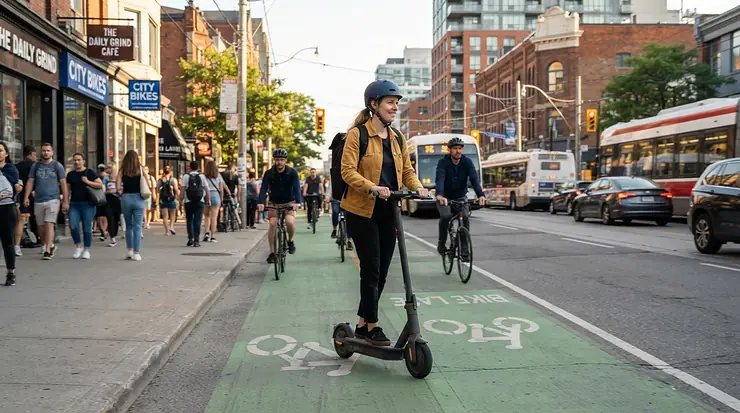
Here’s the catch most buyers miss. Canada has no federal e-scooter statute, so the rules come from provinces and cities, and they disagree with each other. Ontario’s pilot defines a legal e-scooter as one with a motor of no more than 500 W and a maximum speed of 24 km/h, as laid out on the Ontario government’s e-scooter page. Quebec says 25 km/h. Alberta still bans personal use. A scooter that’s perfectly legal in Ottawa can be a liability in Toronto.
So I’ve done the legwork. Below you’ll find seven real scooters, from a beginner-friendly capped commuter to a 100-lb off-road brute, plus the regulations, the insurance traps and a decision framework. Every spec is interpreted, because a number without meaning is just trivia.
Speed Limited vs Unrestricted Electric Scooter: Quick Comparison Table
Think of this table as the menu before the meal. It sorts the seven picks by how they handle speed, which matters more than horsepower for most Canadian riders.
| Scooter | How Speed Is Controlled | Approx. Top Speed | Price Range (CAD) | Best For |
|---|---|---|---|---|
| Hiboy S2R | Factory modes plus app settings | ~30 km/h | C$450-C$650 | Beginners, tight budgets |
| Gotrax G4 | Fixed factory ceiling | ~32 km/h | C$600-C$900 | Light, simple commuting |
| Segway Ninebot Max G2 | App-adjustable limit | ~32-35 km/h (varies by version) | C$1,000-C$1,400 | Comfort-first commuters |
| Apollo City | App-adjustable top speed | ~40-45 km/h | C$1,300-C$2,000 | App-savvy riders |
| Apollo City Pro | App plus three speed modes | ~50 km/h | C$2,000-C$2,800 | Hills, long commutes |
| Kaabo Mantis V2 | Mode buttons, no numeric cap | ~60 km/h | C$2,300-C$2,900 | Enthusiasts on private routes |
| Kaabo Wolf Warrior 11 | Effectively unrestricted | ~72 km/h | C$4,000-C$4,800 | Off-road and private land |
Read the table left to right and you’ll see a pattern. Price climbs with speed, but so does regulatory risk. The Hiboy S2R and Gotrax G4 sit closest to pilot-program territory, while the Segway Ninebot Max G2 and both Apollo models can be dialled down to fit it. The two Kaabo machines sit firmly in “check your local bylaw, then check it again” country.
All prices are ranges based on research at the time of writing. Check current prices before you buy, since retailer promotions swing wildly.
💬 Just one click — help others make better buying decisions too!😊
Top 7 Speed Limited vs Unrestricted Electric Scooters: Expert Analysis
These seven span budget, mid-range and premium, plus a few lesser-known-but-solid options. The commentary below comes from published specs and independent reviewer findings, not from personal testing, and where evidence runs thin I’ll say so.
1. Hiboy S2R — cheapest classroom for speed discipline
The Hiboy S2R is the scooter I’d steer a nervous first-timer toward, because its app and mode button let you shape how fast it goes, not just how fast it could go. A 350 W motor and a 36 V pack of roughly 270 Wh deliver a rated top speed near 30 km/h (19 mph). That’s above Ontario’s 24 km/h pilot ceiling and Quebec’s 25 km/h, so the lower modes matter. Levy Electric’s Hiboy guide lists Comfort mode at roughly 13 mph (about 21 km/h), which slides neatly under both limits.
At around 15 kg, it’s easy to carry up a walk-up’s stairs. The 8.5-inch solid tires never go flat, but they transmit every crack in the pavement to your knees. Spec databases quote ranges from 11 to 17 miles (18-27 km), so plan on the low end.
Reviewers at The Gadgeteer called it a solid all-round commuter with a rock-steady hinge. Scooter Guide noted that going without suspension is the trade-off. After roughly 16 km of mixed riding, one reviewer’s battery had dropped to about a third.
Pros:
- ✅ App and modes make speed limiting easy
- ✅ Light enough to carry upstairs
- ✅ Puncture-proof tires, no flats
Cons:
- ❌ No suspension, so rough roads hurt
- ❌ Real-world range is modest
Price: roughly C$450-C$650. For a first scooter that teaches good speed habits, the value is strong.
2. Gotrax G4 — lightest all-rounder with a fixed ceiling
The Gotrax G4 earns its spot as the fixed-speed benchmark. The G4’s top speed is around 32 km/h (20 mph), and in my research I found no source confirming a user-adjustable cap, so treat that ceiling as baked in. Its 350 W motor and roughly 374 Wh battery are modest, but 10-inch pneumatic tires smooth out pavement far better than the S2R’s solids. At about 17 kg (37 lb) it’s also easy to haul around.
Here’s the practical read. A 32 km/h ceiling exceeds Ontario’s 24 km/h pilot limit and Quebec’s 25 km/h by a clear margin. In pilot regions, a rider choosing a non-adjustable scooter at this speed is choosing a scooter that may not fit the legal definition on day one. It suits provinces or private routes with looser rules, or riders who simply never ride in a pilot zone.
Review sentiment is where honesty matters. Comparison sites generally praise its tidy design, pneumatic tires and weight, and some note a built-in USB charging port. But I couldn’t verify a deep pool of independent lab tests, and published range claims vary widely (about 23 km tested versus 40 km claimed). Weigh that uncertainty.
Pros:
- ✅ Pneumatic tires ride smoother than solids
- ✅ Light and easy to carry
- ✅ Simple, no-fuss controls
Cons:
- ❌ No verified adjustable speed cap
- ❌ No suspension, so bumps still sting
Price: roughly C$600-C$900. Good value only if the fixed speed suits your local rules.
3. Segway Ninebot Max G2 — comfort king with a tunable limit
The Segway Ninebot Max G2 is the scooter that makes the adjustable-limiter debate tangible. Canadian Tire’s listing highlights adjustable speed and acceleration through an app, and ERideHero lists speed limiting as a supported feature. Hydraulic front and rear suspension, a 450 W nominal motor (about 1,000 W peak) and a 551 Wh battery make it the plushest ride here.
ERideHero measured a top speed near 36 km/h, regular-riding range around 48 km and braking from speed in about 3.6 m. Canadian retailer listings quote 32-35 km/h depending on version, and Notebookcheck found that regional versions are capped differently. That’s the point: the same hardware can be limited by software, which makes regional versions possible but also means a cap can be changed.
The 24 kg weight is the downside. Notebookcheck’s verdict calls it very heavy, and it requires the app to unlock its full potential. If you live above a third-floor walk-up, think twice.
Based on the spec sheet, it’s ideal for riders who want one scooter that can be tuned down for pilot-zone commuting and loosened for private paths.
Pros:
- ✅ Hydraulic suspension soaks up rough pavement
- ✅ App-adjustable speed and acceleration
- ✅ Strong real-world range
Cons:
- ❌ Heavy to carry
- ❌ App needed for full functionality
Price: about C$1,000-C$1,400. Worth it for ride quality if you won’t be carrying it.
4. Apollo City — app-controlled speed for the tinkerer
The Apollo City hands the speed dial to your phone. Tom’s Guide describes a 500 W motor (other sources say up to 600 W peak), dual suspension, turn signals and a 48 V 13.5 Ah battery rated for up to about 40 km (25 mi). At roughly 19 kg it’s lighter than the Segway Ninebot Max G2, and its app lets you set an overall top speed.
That app is a double-edged sword, and Tom’s Guide’s own reviewer showed why: he promptly changed the limit to maximum. It’s a real-world demonstration that a user-adjustable cap protects you only as much as you let it. For compliance in a 24-25 km/h zone, you need discipline, not just software.
Reviewers describe it as fun, fast and well-equipped with turn signals. Complaints include a fussy folding latch and a price some find steep for the category. Another reviewer felt acceleration could be better for the money.
The price of the lighter weight is a shorter real-world range. Expect around 30 km on a mixed commute rather than the claimed 40.
Pros:
- ✅ Turn signals boost visibility
- ✅ App sets top speed precisely
- ✅ Dual suspension, lighter than rivals
Cons:
- ❌ Folding latch feels fussy
- ❌ Pricey for its power class
Price: roughly C$1,300-C$2,000. Good value for the feature set, but check current price against competitors.
5. Apollo City Pro — the capped commuter that can sprint
The Apollo City Pro is the one I’d pick for riders who want a scooter that obeys in the bike lane and bites on the highway-adjacent shoulder. Dual motors totalling about 1,000 W nominal push tested top speeds near 50 km/h. EScooterNerds lists three speed modes and a 120 kg rider limit, and Levy Electric lists an IP56 water-resistance rating and about 30 kg weight.
That’s the interesting tension. The scooter’s modes let you ride at 25 km/h on a pilot-zone commute, but its motor power doubles the 500 W ceiling of Ontario’s and Quebec’s definitions. A speed limit on a 1,000 W scooter does not change its power rating, so it still sits outside the legal definition in those provinces. That distinction is exactly the kind of detail buyers overlook.
Battery capacity appears as roughly 860-960 Wh depending on the source, and ERideHero lists a 38-mile (61 km) maximum range. Brakes are drum on some listings, which means less maintenance but less outright bite than discs.
Pros:
- ✅ Dual motors climb hills easily
- ✅ IP56 resistance suits wet Canadian springs
- ✅ Three speed modes for tuning
Cons:
- ❌ About 30 kg, tough to carry
- ❌ Motor power exceeds pilot-program definitions
Price: roughly C$2,000-C$2,800. Excellent value if your routes are private or loosely regulated.
6. Kaabo Mantis V2 — serious speed without going full monster
The Kaabo Mantis V2 is where “unrestricted” starts for real. Two 1,000 W motors, a 1,092 Wh battery and a Rider Guide tested top speed of 37.3 mph (60 km/h) put it in a different league from everything above. It carries riders up to about 120 kg (265 lb), and Rider Guide’s hill test showed a 10% grade of 60 m conquered in 8.1 seconds.
There’s no numeric speed limit to dial down. Instead you toggle eco/turbo and single/dual motor modes with buttons, which is a blunt instrument compared with an app. The Fluid Edition adds an IPX5 water-resistance rating and turn signals. At about 31 kg, you won’t be carrying this one anywhere.
Reviewers praise the acceleration and hill-climbing. Freshly Charged flags a display that’s hard to read in direct sunlight and recommends the LG-cell battery option for reliability. Rider Guide recorded 27.2 miles (about 44 km) of real range.
For Canadian riders, treat it as a private-property, trail or permitted-area machine. It almost certainly falls outside every pilot program’s limits.
Pros:
- ✅ Brutal acceleration and hill-climbing
- ✅ IPX5 water resistance on Fluid Edition
- ✅ Strong real-world range
Cons:
- ❌ Too fast and powerful for pilot zones
- ❌ Heavy, with a hard-to-read display
Price: roughly C$2,300-C$2,900. Great value for performance riders, with legal strings attached.
7. Kaabo Wolf Warrior 11 — the 100-lb off-road wrecking ball
The Kaabo Wolf Warrior 11 isn’t a commuter, it’s a statement. Dual 1,200 W motors (5,400 W peak), a claimed 80 km/h top speed and a Rider Guide tested 72.5 km/h make this the fastest scooter on the list by a mile. Add 11-inch tires, hydraulic suspension and Zoom hydraulic brakes, and you have something closer to a motorbike with handlebars than a kick scooter.
At roughly 45 kg (101 lb) it is unwieldy to carry or load. Rider Guide recorded about 48.6 km of tested range, though claims run higher. Reviewers call the acceleration brutal in full-power mode.
Be blunt with yourself about where this thing can legally go. Its power and speed sit orders of magnitude beyond any Canadian pilot definition, and legal commentary from McCarthy Tétrault notes that Criminal Code offences such as impaired and dangerous driving can apply to e-scooters generally. Think private land, closed courses and off-road parks.
Pros:
- ✅ Extreme power and off-road capability
- ✅ Hydraulic brakes with serious stopping force
- ✅ Heavy-duty suspension and large tires
Cons:
- ❌ Roughly 45 kg, nearly impossible to carry
- ❌ Not suited to any public road in Canada
Price: roughly C$4,000-C$4,800. Value depends entirely on whether you have a legitimate place to ride it.
Spec Showdown: How the Seven Stack Up
Numbers only matter when you know what they mean. Here’s the comparison that explains the whole speed limited vs unrestricted electric scooter divide in one glance.
| Scooter | Motor Power | Weight | Speed Control Type | Best For |
|---|---|---|---|---|
| Hiboy S2R | 350 W | ~15 kg | Modes plus app | First-time riders |
| Gotrax G4 | 350 W | ~17 kg | Fixed ceiling | Simple, light commuting |
| Segway Ninebot Max G2 | 450 W nominal | ~24 kg | App-adjustable | Plush commuting |
| Apollo City | ~500-600 W | ~19 kg | App-adjustable | Tinkerers |
| Apollo City Pro | ~1,000 W dual | ~30 kg | App plus modes | Hills and distance |
| Kaabo Mantis V2 | 2,000 W dual | ~31 kg | Mode buttons | Performance riders |
| Kaabo Wolf Warrior 11 | 2,400 W dual | ~45 kg | None | Off-road and private land |
Notice that motor power and weight climb together, and so does the gap between “can be capped” and “was never meant to be capped.” The two Hiboy S2R and Gotrax G4 entries sit at or under the 500 W line, but only the Segway Ninebot Max G2 and Apollo City combine that low-ish power with true app-based limiting. If you want one scooter that can behave in a pilot zone and relax elsewhere, those two are the sweet spot, while everything above 500 W is a regulatory gamble no matter what the app says.
Provincial Speed Regulations: What Canadian Riders Need to Know
Provincial speed regulations are the single biggest reason this comparison matters, so let’s lay them out plainly. This is general information, not legal advice, and rules change, so confirm with your city.
Ontario: The pilot runs January 1, 2020, to November 27, 2029. Municipalities opt in. Legal e-scooters have a motor of no more than 500 W and a maximum speed of 24 km/h. Violations of the pilot regulation carry fines from $250 to $2,500. Toronto, as of a July 2026 roundup, still said no for personal scooters.
British Columbia: A four-year pilot is underway, and the BC government’s rules page says riders must be 16 or older, wear an approved helmet and stay off roads with speed limits above 50 km/h. One legal summary lists 25 km/h as the capability limit.
Quebec: The pilot continues, with the maximum speed capped at 25 km/h and 500 W. Riders must be 14 or older and wear a helmet, and fines run to $200 per offence. A July 2026 provincial campaign hammered home that 25 km/h is the limit.
Alberta: Personal scooters remain banned for use on public roads, though cities like Calgary run rental programs at 20 km/h, dropping to 15 km/h in slow zones.
Notice a pattern. Every regulated jurisdiction defines the scooter by its capability, not just how you ride it. That’s why a scooter capped by an app you can reopen is a murkier proposition than one built with a hard ceiling.
Electric Scooter With Adjustable Speed Limit: How to Set It Up and Keep It Honest
An electric scooter with adjustable speed limit is only useful if you set it up properly. Here’s a practical routine that Amazon listings rarely spell out.
Step 1: Update the firmware first. Pair the scooter with its app and install any available firmware update before touching limits. Updates sometimes change speed-mode behaviour.
Step 2: Set your ceiling below the line, not on it. If your city follows Ontario’s 24 km/h or Quebec’s 25 km/h, set the cap a notch lower. Speedometers can read optimistically, and hills plus downhill rolls push actual speed past the setting.
Step 3: Test on flat, empty pavement. Ride a measured stretch with a second device, such as a phone GPS, to check the real speed against the display. Differences of a few km/h are common.
Step 4: Lock it. Some apps offer a PIN or lock feature. Use it so a borrowed phone or curious teenager can’t raise the limit.
Step 5: Check braking at your cap. Ontario’s pilot requires a full stop within 9 m from 24 km/h. Do a few hard stops at your set speed.
Common mistakes in the first 30 days: setting the limit once and forgetting it, letting friends borrow the app login, and assuming Eco mode equals a legal cap. Eco mode usually limits power, not guaranteed speed.
Treat the limiter as a seatbelt that you buckle on purpose, not a force field.
Adjustable vs Fixed Limiters: Which Protection Actually Holds Up?
The adjustable vs fixed limiters question is where speed limited vs unrestricted electric scooter debates get philosophical. There are really three tiers.
Tier 1: Fixed factory ceiling. The scooter simply can’t go faster without modification. The Gotrax G4 appears to be in this camp, though at a speed above most pilot limits. A fixed cap is the strongest evidence of capability, but only if the number is right for your jurisdiction.
Tier 2: Firmware modes. The Hiboy S2R uses selectable modes such as Comfort and Sport. Levy Electric describes Hiboy limiting as firmware-based rather than a physical limiter wire, and says the app doesn’t expose speed-adjustment parameters. That makes it harder to change casually than an app slider, though it’s not tamper-proof.
Tier 3: App-adjustable limit. The Segway Ninebot Max G2, Apollo City and Apollo City Pro let the owner pick the number. It’s wonderfully flexible. It’s also reversible with a few taps, as Tom’s Guide’s reviewer demonstrated.
Here’s my analytical take. A reversible cap is a rider-discipline tool. It may reduce your risk but doesn’t change what the machine is capable of, and regulators define scooters by capability. If you live somewhere strict, pair an adjustable limiter with a motor under 500 W, or accept that you’re riding in a grey area.
Liability and Insurance Factors Before You Ride
Liability and insurance factors are the least glamorous part of buying a scooter and the most expensive part of getting it wrong. Insurance rules here are genuinely unsettled, so I’m sharing what industry reporting says and recommending you call a broker.
In Ontario, the pilot regulation deems a compliant electric kick-scooter not to be a motor vehicle. The twist, laid out in a Canadian Underwriter analysis, is that once a scooter exceeds the pilot’s limits, it may be treated as a motor vehicle needing insurance. That can bring a bar on tort rights and exposure to vicarious liability. In plain English: a scooter that’s too fast or too powerful could leave you personally exposed after a crash.
Other Canadian Underwriter reporting quotes an insurance executive who believes an auto policy would not respond to a scooter claim, and that a homeowner’s policy might, depending on wording. It also warns that an injured pedestrian hit by an uninsured rider may recover little.
Injury trends add urgency. CIHI data cited by the same publication show e-scooter injuries in Canada rose 32% between 2022-2023 and 2023-2024, with Ontario hospital visits climbing from 92 to 154.
Practical steps: ask your home insurer about personal-transporter coverage, consider third-party liability, and keep records showing your scooter’s limit setting. I’m not a lawyer or insurance advisor, so treat this as a starting point.
Speed Limited Electric Scooter Review: What Reviewers Consistently Report
A speed limited electric scooter review is only as honest as the testing behind it, so here’s what independent reviewers keep finding, with no invented quotes.
Capped scooters feel calmer. Reviewers of the Hiboy S2R and similar budget models describe predictable, easy-to-control rides. Gentle top speeds make hard stops less dramatic, which fits what the numbers imply: kinetic energy rises with the square of speed, so cutting 40 km/h to 25 km/h removes well over half the crash energy.
Real range falls short of claims. ERideHero measured the Segway Ninebot Max G2 at about 48 km regular range against a much higher claimed figure. The Hiboy S2R and Gotrax G4 show similar gaps between claims and databases.
Weight is the hidden cost. Notebookcheck’s heavy-scooter warning on the Segway Ninebot Max G2 and Scooter Guide’s note about the 101-lb Kaabo Wolf Warrior 11 echo each other. Powerful and portable rarely coexist.
Unrestricted models reward skill. Rider Guide’s tests of the Kaabo Mantis V2 and Kaabo Wolf Warrior 11 describe acceleration that demands respect.
What the spec sheet won’t tell you, but user reports suggest: a scooter’s limiter matters less than its brakes, tires and your riding habits.
Speed Limited vs Unrestricted Electric Scooter: Benefits vs Traditional Alternatives
How does the speed limited vs unrestricted electric scooter choice stack up against the old standbys? Here’s the broader view.
| Factor | Speed Limited Scooter | Unrestricted Scooter | Bicycle or E-Bike |
|---|---|---|---|
| Legal clarity in pilot zones | Good if under 500 W and 24-25 km/h | Poor | Well-established rules |
| Insurance exposure | Lower, still unsettled | Higher, may be treated as a motor vehicle | Generally clearer |
| Portability | Often 15-24 kg | Often 30-45 kg | Bulky |
| Commute speed | ~24-32 km/h | 50-70+ km/h | ~20-32 km/h |
| Best For | Urban commuters in pilot zones | Private land and off-road riders | Longer trips, cargo |
The takeaway is that speed is not the only metric. A capped scooter wins on clarity, weight and risk, while an unrestricted one wins on raw performance but loses nearly everything else for city use. A bicycle still beats both on regulatory simplicity. Riders who just want a faster commute may find an e-bike with clear legal status beats a 70 km/h scooter with an unclear one.
✨ Don’t Miss These Exclusive Deals!
🔍 Take your commute to the next level with these carefully selected scooters. Click on any highlighted item to check current pricing and availability. These picks will help you ride confidently within the rules your whole neighbourhood can live with!
How to Choose Between a Speed Limited vs Unrestricted Electric Scooter
Choosing between a speed limited vs unrestricted electric scooter doesn’t have to be agonizing. Work through these steps in order.
- Check your local rules first. Find whether your city is in a pilot program and what its speed and power limits are. This eliminates half the market immediately.
- Decide where you’ll actually ride. Bike lanes and shared roads point to capped scooters. Private land and trails open the door to unrestricted ones.
- Match motor power to the legal ceiling. If your province uses 500 W, a 1,000 W scooter fails no matter how it’s capped.
- Pick the limiter type. Want flexibility? Choose app-adjustable. Want a stronger compliance argument? Prefer a fixed or firmware-set cap.
- Budget for weight. If you carry the scooter daily, anything above about 20 kg gets old fast.
- Check braking and tires. Pneumatic tires and good brakes matter more than top speed.
- Plan your insurance. Call your broker before you buy, not after.
Each step narrows the field. By step three, most buyers in pilot zones are choosing between the Hiboy S2R, Gotrax G4, Segway Ninebot Max G2 and Apollo City.
Real-World Scenarios: Three Canadian Riders, Three Different Picks
Here are three scenarios showing how the framework plays out.
The Montreal commuter. Quebec enforces 25 km/h and 500 W, and the province’s own 25 km/h reminder campaign shows enforcement attention is real. A rider with a 12 km daily trip, a C$1,500 budget and a third-floor apartment wants something compliant and light. The Apollo City, set to 25 km/h, fits the spec and weighs about 19 kg. The Hiboy S2R is the budget alternative.
The Ottawa student. A budget of C$600, a short campus route and ground-floor storage point to the Hiboy S2R in Comfort mode, keeping under Ontario’s 24 km/h.
The rural Alberta rider. With personal scooter use still restricted on public roads, a rider with acreage and trails can legitimately consider the Kaabo Mantis V2 or Kaabo Wolf Warrior 11 on private land. A budget of C$3,000-C$4,500 and a truck for hauling make weight irrelevant.
Notice that nobody in these scenarios picked on top speed alone. Budget, storage, terrain and local law decided it. That’s the whole game.
Features That Actually Matter (And Those That Don’t)
Marketing loves big numbers. Here’s what to ignore and what to prioritize.
Matters: brake quality, tire type, weight, a real-world range figure (not the claimed one), water resistance and lighting. Turn signals, like those on the Apollo City, genuinely improve safety in traffic.
Matters in Canada specifically: cold-weather battery performance, IP ratings for wet seasons and a limiter that fits your province’s rules.
Doesn’t matter as much: peak wattage claims (a 5,400 W peak on the Kaabo Wolf Warrior 11 sounds thrilling but is useless on a road where it can’t legally go), top speed beyond your local limit and flashy displays.
Often overlooked: serviceability and warranty. Retailers such as Best Buy Canada list open-box and refurbished Segway Ninebot Max G2 units with shorter warranties, which can save money but changes the risk calculation.

FAQ
❓ Can I lock the speed on an electric scooter with an adjustable limit?
❓ Do I need insurance for a speed limited electric scooter in Ontario?
❓ What's the best speed limited electric scooter for a beginner in Canada?
❓ Is it legal to buy an unrestricted electric scooter in Canada?
❓ Can I raise my scooter's speed limit after buying it?
Conclusion
The speed limited vs unrestricted electric scooter decision isn’t really about speed. It’s about fit: the fit between your machine and your city’s rules, your insurance position, your stairs and your ambitions.
If you commute in Ontario, Quebec or BC, a capped scooter under 500 W is the safest bet, and the Hiboy S2R, Segway Ninebot Max G2 and Apollo City each handle that job in their own way. If you want flexibility, an adjustable limiter lets one scooter serve two lives, as long as you stay honest about where it’s set. If your riding is off-road on private land, the Kaabo Mantis V2 and Kaabo Wolf Warrior 11 deliver thrills that capped scooters can’t touch.
Remember the three things the spec sheet won’t say. First, motor power matters as much as top speed in pilot zones. Second, a limiter you can reverse is a habit, not a guarantee. Third, insurance for e-scooters is still a grey area, so ask before you ride.
Pick the scooter that suits your real route, check current prices, and ride like the person behind you has a phone camera and a lawyer.
Recommended for You
- Speed Limited Electric Scooters Under $700 CAD: 7 Best Picks (2026)
- Electric Scooter For Teenagers: 7 Safest Picks In Canada (2026)
- Speed Limited Electric Scooter: 7 Safest Picks In Canada 2026
Disclaimer: This article contains affiliate links. As an Amazon Associate, I earn from qualifying purchases. If you purchase products through these links, we may earn a small commission at no additional cost to you.
✨ Found this helpful? Share it with your friends! 💬🤗
