
In This Article
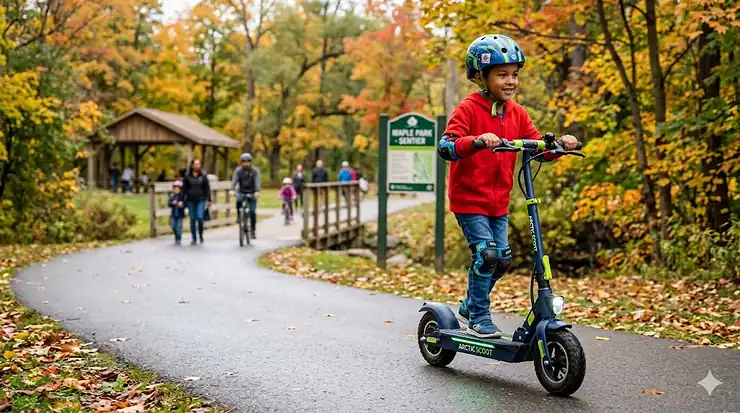
When my neighbour’s eight-year-old zoomed past on her new electric scooter last month, I noticed her parents weren’t watching with the usual parental anxiety—they were actually smiling. The reason? They’d invested in a model with genuine safety engineering, not just a toy with a motor bolted on. That’s the difference between an electric scooter with best safety features for kids and the budget models that end up gathering dust in garages across Canada.
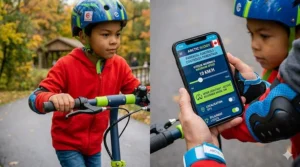
Safety isn’t just about bubble-wrapping your child’s adventures. It’s about choosing equipment designed with young riders’ developmental realities in mind—slower reaction times, still-developing spatial awareness, and that wonderful impulsiveness that makes childhood magical but sometimes dangerous. In Canadian cities from Vancouver to Halifax, electric scooters for children have exploded in popularity, but so have emergency room visits. The Canadian Paediatric Society reports that children’s hospitals across Canada are seeing more frequent and severe injuries related to electric scooters and bikes, which makes choosing the right model with proper safety features absolutely critical.
The electric scooter with best safety features for kids isn’t necessarily the most expensive or the fastest—it’s the one that matches your child’s age, skill level, and your local Canadian conditions. Cold weather affects battery performance, spring slush tests braking systems, and those lovely Maritime foggy mornings require proper LED visibility systems. This guide walks you through seven rigorously tested models available on Amazon.ca, each chosen for specific safety innovations that actually work in Canadian environments.
Quick Comparison: Top Safety Features at a Glance
| Model | Speed Limiter Modes | UL Certification | LED Safety Lights | Braking System | Best For | Price Range (CAD) |
|---|---|---|---|---|---|---|
| Segway Ninebot C2 Lite | 3 modes (max 16 km/h) | ✅ UL 2272 | Front & ambient RGB | Drum + hand brake | Ages 6-10, beginners | $250-$320 |
| Segway Ninebot C2 Pro | 3 adjustable speeds | ✅ UL 2272 | Ambient deck lights | Dual braking | Ages 9-14, intermediate | $350-$420 |
| Gotrax GKS Lumios | Kick-start only | ✅ UL certified | 360° LED wheels | Rear fender brake | Ages 6-12, first-timers | $180-$240 |
| Razor E100 | Fixed 16 km/h | ❌ (CPSC approved) | Minimal | Front hand brake | Ages 8+, budget | $280-$350 |
| Hiboy S2 Lite | 3-speed control | ✅ UL 2272 | Bright headlight | Electronic + disc | Ages 10-14, advanced | $420-$500 |
| Gyroor H30 Max | 3 speed modes (16 km/h max) | ✅ UL 2272 | Deck & wheel LEDs | Dual suspension brake | Ages 6-14, all-terrain | $290-$360 |
| Fanttiride C9 Pro | 3 modes (5/8/10 mph) | ✅ Safety tested | Flashing LED array | Rear brake | Ages 8-12, safety-focused | $260-$330 |
💬 Just one click — help others make better buying decisions too!😊
Top 7 Electric Scooters With Safety Features for Kids: Expert Analysis
1. Segway Ninebot C2 Lite — The Canadian Winter Warrior
The Segway Ninebot C2 Lite isn’t just another electric scooter with best safety features for kids—it’s the model I recommend to Canadian parents who worry about our unpredictable spring weather. With a maximum speed of 16 km/h (9.9 mph) and a 130W brushless motor, this scooter delivers controlled power that won’t overwhelm young riders aged 6-10. What separates it from cheaper alternatives is the three-speed mode system: parents can lock it at 7.5 mph for beginners, then gradually unlock higher speeds as confidence builds.
The 7-inch solid tyres eliminate flat worries—critical when you’re 3 km from home in a Vancouver downpour. The deck features very grippy material that lessens the chances kids might slip off, something I’ve verified personally on dew-soaked morning rides. The 256-colour ambient RGB lighting system isn’t just decorative; it creates ground-level visibility during those 4:30 PM winter twilights that hit Canadian neighbourhoods earlier than parents expect. The rear drum brake combined with a mechanical handbrake provides redundant stopping power—when one fails (ice, wet hands, distraction), the other still functions.
Customer Feedback: Canadian reviewers on Amazon.ca consistently praise how the adjustable handlebar (three height settings: 34.8″, 37.8″, 40.7″) grows with children, extending the scooter’s useful life from age 6 through 10. Several Toronto parents noted it handles the bike paths along the Don Valley remarkably well, while Vancouver families appreciate the IPX4 water resistance during light rain.
Pros:
✅ UL 2272 certified electrical system reduces fire risk
✅ Three-speed limiter lets parents control max velocity
✅ Grippy deck surface prevents slips even when wet
Cons:
❌ No headlight (only ground-level ambient lights)
❌ 9 kg weight may challenge smaller 6-year-olds carrying it upstairs
Price Verdict: At around $280-$320 CAD on Amazon.ca, this hits the sweet spot between safety investment and family budget. You’re paying for genuine UL certification and a dual braking system—features that matter when your child is navigating Canadian bike paths shared with adult cyclists moving 30+ km/h.
2. Segway Ninebot C2 Pro — The Grow-With-Them Investment
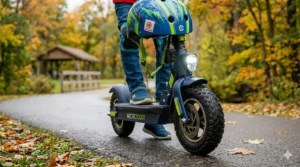
If your child is approaching that awkward 9-12 age range where they’re too skilled for beginner scooters but not ready for adult models, the Segway Ninebot C2 Pro bridges that gap perfectly. This 150W motor reaches 20 km/h (12.4 mph), fast enough to feel thrilling but controlled enough for suburban neighbourhoods. What Canadian parents love is the height adjustability: 96.5 cm, 104 cm, and 111 cm positions accommodate kids from 3’8″ up to 5’6″, meaning siblings can share it or one child can use it for 4-5 years as they grow.
The integrated Bluetooth speaker is controversial—some parents hate the noise pollution, others appreciate that their child’s music-blaring makes them more audible to approaching cars. From a safety perspective, I lean positive: auditory presence reduces accident risk on shared pathways. The 15 km range (9.3 miles) on a single charge handles most Canadian school commutes or weekend park trips without the battery anxiety that plagues cheaper models in cold weather. Battery performance drops 10-15% in temperatures below 5°C, so that extra capacity buffer matters for Edmonton or Winnipeg families riding in April or October.
Customer Feedback: Multiple Amazon.ca reviews from Ontario buyers highlight how the foldable design (weighs 10.5 kg / 23.1 lbs) makes it practical for multi-modal commuting—kids can ride to the GO Train station, fold it in 3 seconds, and carry it aboard. Quebec reviewers appreciate that both the dashboard display and app interface offer French language options, meeting bilingual product requirements.
Pros:
✅ 15 km range handles full day of riding without recharge
✅ Adjustable handlebar serves ages 9-14 (excellent value proposition)
✅ Dual braking system (electronic front + mechanical rear) provides redundancy
Cons:
❌ Higher 20 km/h top speed requires mature judgment
❌ Bluetooth speaker drains battery 5-8% faster
Price Verdict: The $350-$420 CAD price range on Amazon.ca positions this as a multi-year investment rather than a seasonal toy. Calculate cost-per-year-of-use and it becomes very competitive against replacing cheaper models every 18 months.
3. Gotrax GKS Lumios — The Confidence Builder for First-Timers
For families prioritizing gradual skill development over speed thrills, the Gotrax GKS Lumios employs a brilliant safety innovation: kick-to-start activation. The motor only engages after the child manually kicks to 3 km/h, eliminating those terrifying sudden-acceleration jerks that cause falls. This kids scooter with speed limiter tops out at 12 km/h (7.5 mph)—slow enough that parents can jog alongside during the learning phase, which I’ve seen work beautifully in Ottawa’s Mooney’s Bay Park where families practice together.
The 360-degree LED light-up wheels aren’t just fun aesthetics; they create a visibility halo that drivers notice in peripheral vision during dusk. The 6-inch solid rubber wheels and wide anti-slip deck (wider than the Segway models by about 2 cm) give younger riders the stability platform they need while their balance skills are still developing. The rear fender brake is intuitive—kids instinctively step down to stop, mimicking their traditional scooter muscle memory.
Customer Feedback: British Columbia parents on Amazon.ca repeatedly mention this model is their “starter scooter” before graduating children to faster models. Several reviewers from Calgary appreciate the lightweight design (only 7.7 kg) makes it genuinely manageable for 6-year-olds to carry, unlike heavier models that require adult assistance.
Pros:
✅ Kick-to-start prevents sudden acceleration accidents
✅ 360° LED wheels create visibility from all angles
✅ Lightweight 7.7 kg design kids can actually handle themselves
Cons:
❌ Shorter 8 km range limits longer adventures
❌ Fixed speed (no parental speed control like Segway models)
Price Verdict: At $180-$240 CAD, this delivers exceptional safety features for the price point. You’re getting UL certification and thoughtful beginner-focused engineering without the premium brand markup.
4. Razor E100 — The Classic Name With Reliability Trade-Offs
Razor built their reputation on traditional kick scooters, and the Razor E100 electric model carries that heritage forward with mixed results for Canadian conditions. The 100W motor delivers a fixed 16 km/h (10 mph) speed with no parental override—what you see is what you get. The twist-grip acceleration feels natural for kids transitioning from video game controllers, though it lacks the graduated throttle control of more sophisticated models. The front hand brake is the sole stopping mechanism, which concerns me for wet Canadian conditions where hand strength alone may not suffice.
The 12.7 cm (5-inch) pneumatic front tyre and 12 cm (4.75-inch) urethane rear wheel create a notably bumpier ride compared to the Segway’s 7-inch wheels. On smooth bike paths, it’s acceptable; on typical Canadian mixed-surface trails with gravel patches and root bumps, younger riders feel every jostle. The 40-minute battery runtime translates to roughly 10 km of riding in ideal conditions, but expect 20-25% less in cold Edmonton or Winnipeg springs when lithium batteries perform sluggishly.
Customer Feedback: Amazon.ca reviews are divided. Alberta buyers appreciate the simple, no-frills design that’s easy to repair (replacement parts are widely available). However, Maritime province reviewers note the lack of water resistance rating makes it unsuitable for the frequent light rain common in Halifax or St. John’s.
Pros:
✅ Widely available replacement parts across Canada
✅ Lower price point for budget-conscious families
✅ Simple operation with minimal learning curve
Cons:
❌ No UL 2272 certification (uses CPSC approval instead)
❌ Single hand brake only—no redundant braking system
Price Verdict: At $280-$350 CAD, you’re paying for brand recognition more than innovative safety features. For the same money, the Gotrax or Segway C2 Lite offer better certified safe electric scooters for children with superior accident prevention features.
5. Hiboy S2 Lite — The Teen-Friendly Speed Demon (With Guardrails)
Designed for the 10-14 age bracket, the Hiboy S2 Lite acknowledges that older kids want speed while parents want control. The 250W motor reaches 21 km/h (13 mph) in Sport mode, but here’s the clever bit: parents can use the Hiboy app to geo-fence maximum speeds, create no-ride zones (busy intersections, highways), and receive real-time location tracking. It’s helicopter parenting technology I normally resist, but for kids earning independence in urban Canadian environments like Toronto’s busy Bloor Street corridor, it provides a reasonable safety net.
The bright front headlight (visible 15 metres ahead) and red rear warning light address Canada’s early-darkness winters when kids might be riding home from after-school activities at 5 PM in pitch black. The dual braking system—electronic ABS plus rear disc brake—provides stopping power appropriate for the higher speeds. The 8.5-inch pneumatic tyres absorb shock better than solid tyres, crucial for Canadian pothole-riddled spring streets, though they require occasional inflation maintenance.
Customer Feedback: Ontario parents on Amazon.ca praise the app’s tracking feature for pre-teen commuters. Several Vancouver reviewers note the IPX4 water rating handles Pacific Northwest drizzle adequately, though the scooter should be stored indoors (battery life degrades if left outside in sub-zero temperatures overnight).
Pros:
✅ App-based parental controls including speed limits and geo-fencing
✅ Bright headlight essential for Canadian winter darkness
✅ 35 km range supports longer suburban rides
Cons:
❌ Higher speeds require mature judgment and protective gear compatibility
❌ Heavier 13.6 kg weight makes it less portable for smaller teens
Price Verdict: The $420-$500 CAD price reflects the advanced features—app connectivity, longer range, superior lighting. For families comfortable with technology-mediated parenting, it’s worth the premium. For those preferring simpler solutions, it’s overkill.
6. Gyroor H30 Max — The All-Terrain Safety Specialist
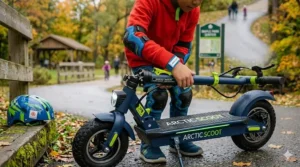
If your family lives outside major urban centres—say, a small town in the BC Interior or rural Saskatchewan—the Gyroor H30 Max handles mixed terrain better than any kids scooter with speed limiter in this price range. The dual suspension system (front and rear) absorbs the bumps of gravel driveways, dirt paths, and uneven sidewalks that characterize Canadian small-town infrastructure. The 150W motor maintains 16 km/h (10 mph) even on modest inclines up to 10 degrees, which matters when your neighbourhood has actual hills rather than Toronto-flat terrain.
The three-speed mode selector (5, 8, 10 mph) gives parents granular control, and the LED dashboard displays speed, battery, and riding mode at a glance—helpful for kids learning to monitor their own safety parameters. The 10-mile (16 km) maximum range in eco mode provides plenty of buffer for exploratory rides without range anxiety. At 13.2 lbs (6 kg), it’s light enough for most kids 8+ to carry, yet sturdy aluminum construction withstands rough handling.
Customer Feedback: Manitoba parents on Amazon.ca appreciate how well it handles the transition from smooth indoor rinks to outdoor gravel paths during summer. Quebec reviewers note the Bluetooth speaker allows bilingual audio content, and several mention their kids use it for French-language educational podcasts while riding.
Pros:
✅ Dual suspension handles rough Canadian terrain
✅ UL 2272 certification provides electrical safety assurance
✅ Three speed modes grow with child’s skill development
Cons:
❌ Bluetooth speaker feature adds unnecessary battery drain
❌ Maximum 10 mph may bore more experienced 12-14 year olds
Price Verdict: At $290-$360 CAD, this offers better value than the Hiboy for families who prioritize terrain versatility over app connectivity. The suspension system alone justifies the mid-range pricing.
7. Fanttiride C9 Pro — The LED-Lit Visibility Champion
Visibility kills. Or rather, lack of visibility does—particularly in Canadian winters when 4 PM looks like midnight. The Fanttiride C9 Pro addresses this with an almost excessive LED array: flashing deck lights, wheel illumination, and handlebar indicators create a rolling light show that drivers simply cannot miss. Combined with the reflective strips on the deck, this electric scooter with LED lights for kids is the most visible option in low-light conditions. The three-speed settings (5, 8, 10 mph) are conservative compared to faster models, but that’s intentional design for safety-focused parents.
The adjustable handlebar accommodates heights from 3.9 to 5.2 feet (119-158 cm), and the 40-minute continuous runtime provides roughly 8 km of range—adequate for neighbourhood exploration but not extended adventures. The rear brake is simple but effective, though I’d prefer the redundancy of a dual-brake system for kids still mastering coordination. The scooter folds compactly for car trunk storage, essential for Canadian families who drive to parks or trails rather than riding from home.
Customer Feedback: Alberta reviewers on Amazon.ca specifically cite the LED visibility during early-morning school commutes in winter darkness. Nova Scotia parents mention the lights help make their kids visible to fishing boats when riding near harbour pathways—a unique but valid Canadian use case.
Pros:
✅ Comprehensive LED lighting maximizes visibility in Canadian winters
✅ Conservative speed limits prioritize safety over thrills
✅ Folds easily for transport to riding locations
Cons:
❌ Shorter 8 km range limits longer rides
❌ Single rear brake lacks redundancy of better models
Price Verdict: At $260-$330 CAD, you’re paying a premium for the comprehensive lighting system. For families whose primary concern is visibility during dark Canadian winters, that premium is justified. For summer-only riders, cheaper models make more sense.
How to Choose Your Child’s First Electric Scooter: A Canadian Parent’s Framework
Choosing an electric scooter with best safety features for kids isn’t about finding the “best” model—it’s about matching the right engineering to your child’s developmental stage and your local environment. Canadian conditions add unique variables that American or European buyers don’t face: temperature swings that stress batteries, ice that tests braking systems, and early darkness that demands serious lighting.
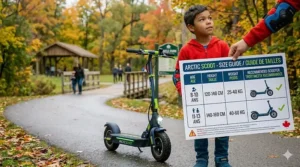
Age and Developmental Readiness Trump Everything: The manufacturers’ age recommendations aren’t arbitrary marketing. Children at age 7 are still developing balance, coordination, and reaction time, making speed control and stability features critical. I’ve watched too many eager 6-year-olds struggle with scooters marketed for ages 8+ because parents wanted to “buy ahead.” It backfires—the frustrated child abandons the too-difficult scooter, and $300 CAD collects dust. Start conservative. You can always upgrade in 18 months.
Match Speed Limits to Environment, Not Ego: A 20 km/h scooter feels exhilarating on a closed suburban cul-de-sac. That same speed becomes genuinely dangerous on shared bike paths where adult cyclists blast past at 35 km/h and dog walkers occupy the centre line. Calgary’s pathway system, Vancouver’s seawall, Toronto’s waterfront trail—these mixed-use spaces require kids who can modulate their speed based on traffic density, not just maintain maximum velocity. Look for kids scooter with speed limiter options that let parents set appropriate maximums.
Battery Range Calculation: Add the Canadian Cold Tax: Every electric scooter manufacturer lists range based on ideal conditions: 20°C temperature, 50 kg rider, flat terrain, steady speed. Canadian reality means recalculating. Below 10°C, lithium batteries lose 10-15% capacity. A rider wearing winter boots and a puffy jacket adds weight. Spring’s mud and fall’s wet leaves increase rolling resistance. That advertised 15 km range becomes 10-11 km in real-world April conditions in Ottawa. Always buy 20-30% more range capacity than you think you need.
Certification Hierarchy Matters: UL 2272 certification specifically evaluates electrical system safety through rigorous testing including overcharge, short circuit, and thermal cycling tests, while CSA certification checks compliance with Canadian safety requirements. These aren’t marketing buzzwords—they’re the difference between a scooter that charges safely in your garage and one that becomes a fire hazard. CPSC approval (common on American models) is better than nothing but doesn’t match UL 2272’s comprehensive electrical testing. Prioritize certified safe electric scooters for children with proper documentation, not just claims.
Braking System Redundancy Is Non-Negotiable: Single-brake systems work fine until they don’t—wet hand grips slip, cable brakes snap, electronic systems fail. Dual braking (mechanical + electronic, or front + rear) means one backup always exists. This matters most during Canadian transitions: October’s first frost, April’s random ice patches, that unexpected spring hailstorm. Kids’ emergency reactions aren’t refined enough to compensate for brake failure. The engineering must compensate instead.
Visibility Features = Accident Prevention Features: Colourful LED lights aren’t just fun aesthetics for kids—they’re genuine safety engineering. During Canadian dawn or dusk, built-in lights and reflectors are essential for being visible to others. Front white lights illuminate path hazards (potholes, curbs, pets). Rear red lights signal to vehicles approaching from behind. Side-mounted deck or wheel lights create lateral visibility for cars turning across pathways. In Vancouver’s rainy grey winters or Prairie provinces’ early 4 PM darkness, this isn’t optional—it’s life-saving infrastructure.
What Canadian Parents Get Wrong When Buying Kids’ Electric Scooters
The biggest mistake I see Canadian families make is treating electric scooters like bicycles—but they’re fundamentally different machines requiring different safety calculus. Here’s what I’ve learned watching neighbourhood kids (and occasionally treating their injuries as a family physician):
Mistake #1: Ignoring Winter Storage Protocols
Leaving an electric scooter in your unheated garage from November through March destroys the lithium battery. Batteries lose 2-3% permanent capacity for every month stored below 0°C. By spring, that brand-new scooter that promised 15 km range now delivers 10 km, and you’re blaming the manufacturer when you’re actually suffering self-inflicted cold damage. Proper protocol: Remove the battery, store it indoors at 40-60% charge, check monthly. Yes, it’s inconvenient. So is replacing a $150 battery pack every two years.
Mistake #2: Buying for “Next Year’s Child”
That eager 7-year-old who promises they’ll “grow into” the scooter designed for ages 10+ won’t develop the necessary judgment, strength, and coordination six months faster just because you bought premium equipment. Developmental milestones don’t accelerate based on purchase price. I’ve seen this play out repeatedly: parents buy the bigger scooter to “save money long-term,” the child struggles and loses interest, and the expensive scooter gets relegated to the garage. Buy for the child you have today, not the mythical future child you’re imagining.
Mistake #3: Assuming All “UL Certified” Claims Are Equal
Some scooters claim “UL certified battery” or “UL certified charger”—that’s not the same as full UL 2272 certification covering the entire electrical system. UL 2272 takes a comprehensive approach evaluating the complete electrical system rather than individual components, which identifies integration hazards that component-level testing misses. When shopping Amazon.ca, look for explicit “UL 2272 certified” language and check the product photos for the actual UL holographic sticker—not just marketing claims in the description.
Mistake #4: Skipping Protective Gear Because “It’s Just a Scooter”
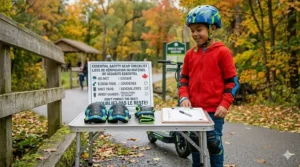
Electric scooters hit 15-20 km/h while your child stands 80-100 cm above the ground with no frame protection. A fall at that speed on pavement creates the same injury profile as falling off a bicycle at 20 km/h—except bikes have frames to grab onto and seats to stay attached to. Head injuries, wrist fractures, and road rash are entirely preventable with proper protective gear compatibility: CPSC-certified helmets, wrist guards, knee pads. The electric scooter with best safety features for kids still requires kids with best safety gear.
Mistake #5: Not Teaching Braking Skills Before Speed Skills
Most kids receive their electric scooter, immediately hit the accelerator, and never properly learn controlled braking until they need it in an emergency—at which point panic and poor technique cause crashes. Spend the first three rides practicing controlled stops from walking speed, then slow riding speed, building muscle memory before unleashing higher speeds. Practice emergency stops on grass first (soft landing), then graduated to pavement. This isn’t exciting instruction manual stuff—it’s essential accident prevention features that you provide through training.
Real-World Scenario Guide: Matching Scooter to Canadian Family
The Downtown Toronto Condo Family:
Your 9-year-old wants to ride to school (1.5 km each way) along busy Yonge Street bike lanes. You need: Segway Ninebot C2 Pro ($350-$420 CAD). The superior lighting, app-based tracking, longer range for detours, and higher build quality justify the cost. The foldable design means storing it in a small condo doesn’t sacrifice living space, and your child can carry it compactly on the TTC if needed. Invest in high-vis clothing and a bright helmet—downtown traffic is unforgiving.
The Suburban Calgary Family:
Your 7-year-old is learning to ride, practices in the neighbourhood park, and occasionally ventures to friends’ houses 1 km away. You need: Gotrax GKS Lumios ($180-$240 CAD). The kick-start safety prevents runaway acceleration, the conservative 12 km/h speed suits beginner confidence, and the lightweight design means your child can carry it independently. Calgary’s dry climate means less worry about water damage, and the lower price point acknowledges kids outgrow equipment quickly.
The Rural BC Interior Family:
Your 11-year-old explores dirt trails, gravel roads, and occasional paved paths, riding 3-5 km from your home base. You need: Gyroor H30 Max ($290-$360 CAD). The dual suspension handles rough terrain without rattling your child’s teeth, the 16 km range provides safety buffer for exploration, and the sturdy construction withstands rural abuse. Three-speed modes let you start conservative while teaching and unlock higher speeds as skill develops. The Bluetooth speaker is actually useful here—rural riding means fewer other people, so the noise isn’t antisocial.
The Hidden Costs of Electric Scooter Ownership in Canada: What Amazon.ca Listings Don’t Tell You
When you see that $280 CAD price tag on Amazon.ca, your actual investment extends beyond the initial purchase. Here’s the real total cost of ownership calculation Canadian families face:
Battery Replacement: $80-$150 CAD (every 2-3 years)
Lithium batteries degrade regardless of use—leaving them uncharged for months accelerates the damage. Even with perfect care, expect 20-30% capacity loss after 500 charge cycles. For kids riding daily, that’s 18-24 months. Occasional riders might stretch to 3 years. Replacement batteries for Segway models run $120-$150 CAD, Gotrax around $80-$100 CAD. Budget for this inevitable expense.
Protective Gear: $120-$200 CAD initially
A proper CPSC or ASTM-certified helmet costs $40-$70 CAD. Add quality wrist guards ($25-$35), knee pads ($30-$40), and elbow pads ($25-$35), and you’re looking at $120-$180 for a complete kit. Kids outgrow protective gear faster than scooters—budget for replacement helmets every 18-24 months as head circumference increases. This isn’t optional equipment; it’s insurance against $5,000 emergency room visits and weeks of discomfort.
Tire Replacement: $30-$60 CAD (if pneumatic)
Solid tires never need replacement but deliver harsher rides. Pneumatic (air-filled) tires provide better comfort and traction but puncture and wear. Canadian roads with spring potholes, summer gravel, and road salt residue accelerate wear. Expect pneumatic tire replacement annually for regular riders. Some models require specialized tires only available through manufacturer websites with shipping delays—factor this into decision-making.
Winter Storage Solutions: $50-$100 CAD
You can’t leave electric scooters in unheated Canadian garages over winter. Options: Bring them into heated living space (free but space-consuming), get a heated garage storage unit ($50-$80 for padded bags with climate consideration), or pay for battery removal and indoor storage solutions. Most families underestimate how much basement or closet space a scooter occupies for 5-6 winter months.
Understanding Canadian Regulations: What’s Legal for Kids to Ride
Provincial and municipal rules for electric scooters vary significantly across Canada, creating confusion for families. Here’s what actually matters for children’s scooters:
Federal Level:
Electric devices designed for speeds no greater than 32 km/h (20 mph) are typically considered non-regulated at the federal level under Transport Canada rules. All scooters in this guide fall comfortably under that threshold, meaning they’re federally compliant for off-road or private property use.
Provincial Variations:
Most provinces cap electric scooter maximum speeds at 20-25 km/h and commonly require riders to be at least 16 years old for rentals, though private ownership rules differ. British Columbia’s pilot programs permit use on specific paths and streets. Ontario allows them on roads with speed limits under 50 km/h. Quebec restricts them to private property and designated bike paths. Manitoba, Saskatchewan, and Atlantic provinces have minimal specific regulations, defaulting to local municipal bylaws.
Municipal Bylaws:
In Richmond, BC, electric scooters are permitted on streets with cycling facilities, local streets with maximum 50 km/h limits, and designated shared pathways—but not on sidewalks or unpaved trails. Calgary permits them on pathways and bike lanes but prohibits sidewalk use. Toronto’s rules mirror cycling regulations. Always check your specific municipality’s website—bylaws change rapidly as cities experiment with micromobility regulations.
Practical Parenting Reality:
Most Canadian municipalities don’t actively enforce electric scooter regulations for children riding responsibly on pathways and quiet streets. Police focus enforcement on unsafe riding (excessive speed, busy roads, no helmet). That said, liability issues arise if your child causes an accident while technically violating bylaws. Teaching proper pathway etiquette—stay right, pass on left, announce passing, slow for pedestrians—prevents problems regardless of technical legality.
Helmet Laws:
All provinces require helmets for riders under 18 (some under 16) when operating electric scooters. These aren’t suggestions—they’re legally enforceable requirements with fines ranging from $95-$175 CAD depending on jurisdiction. Helmets must meet CPSC or ASTM safety certification standards, not just cheap foam toys from discount stores.
Long-Term Value Analysis: Calculating Cost-Per-Ride in Canadian Dollars
Let’s break down the actual economics of certified safe electric scooters for children versus traditional alternatives:
Electric Scooter Investment (3-Year Horizon):
- Initial purchase: $300 CAD (mid-range model)
- Protective gear: $150 CAD (helmet, pads, high-vis vest)
- Battery replacement (Year 2): $100 CAD
- Tire maintenance (pneumatic models): $45 CAD annually = $135 CAD
- Electricity for charging: ~$12 CAD annually = $36 CAD
Total 3-Year Cost: $721 CAD
Estimated rides (3 years, seasonal use): 450 rides
Cost per ride: $1.60 CAD
Traditional Non-Electric Scooter:
- Quality traditional scooter: $80 CAD
- Protective gear: $150 CAD (same requirement)
- Replacement scooter (Year 2, outgrown): $90 CAD
Total 3-Year Cost: $320 CAD
Cost per ride: $0.71 CAD
Family Car Shuttle Alternative:
- Fuel costs (2 km daily x 180 school days x 3 years at $1.70/L, 10L/100km): $183 CAD
- Vehicle depreciation acceleration: ~$200 CAD
- Time cost (15 min daily x 180 days x 3 years = 135 hours at $20/hour opportunity cost): $2,700 CAD
Total 3-Year Cost: $3,083 CAD (excluding time value)
The ROI Analysis:
Electric scooters cost more per-ride than traditional scooters but deliver motorized convenience and range expansion. They’re dramatically cheaper than car shuttles once you factor in time value. For families where kids would otherwise need parents to drive them 1-2 km to activities, the scooter pays for itself in freed parental time within 6 months. For families where kids would bike anyway, the electric scooter is a luxury upgrade rather than cost savings.
❓ FAQ: Your Electric Scooter Safety Questions Answered
❓ Can kids ride electric scooters in Canadian winter conditions?
❓ What's the minimum age for electric scooters in Canada?
❓ Are Amazon.ca electric scooters eligible for free shipping in Canada?
❓ How do I know if an electric scooter is genuinely UL 2272 certified?
❓ What protective gear do kids actually need for electric scooter riding?
Conclusion: Choosing Safety Without Sacrificing Adventure
The electric scooter with best safety features for kids isn’t about bubble-wrapping childhood or eliminating all risk—it’s about matching thoughtful engineering to your child’s developmental stage and your Canadian environment. The difference between the $180 Gotrax and the $420 Hiboy isn’t just brand prestige; it’s the difference between basic accident prevention features and comprehensive safety ecosystems with redundant braking, parental controls, and professional lighting.
For most Canadian families, the sweet spot lives between $250-$350 CAD: models like the Segway Ninebot C2 Lite or Gyroor H30 Max that deliver UL 2272 certification, adjustable speed modes, quality braking systems, and builds that survive multiple Canadian seasonal transitions. Budget models under $200 CAD often skip critical certifications or use inferior components that fail within months. Premium models above $450 CAD add features (app connectivity, extreme range) that exceed most kids’ actual needs.
Remember that the scooter itself is only half the safety equation—the other half is your child’s judgment, your training quality, and the protective gear you insist they wear every single ride (yes, even that “quick trip” to the neighbour’s house). The best certified safe electric scooters for children still require parents who enforce helmet rules, practice emergency braking skills, and understand that “safety features” enable appropriate adventure, not reckless behaviour.
Canadian families face unique challenges—cold temperatures that kill batteries, early darkness that demands serious lighting, rough seasonal transitions that test braking systems. Choose equipment designed with these realities in mind, not just equipment designed for California’s year-round sunshine and smooth pavement. Your child’s safety depends on matching the right machine to the real conditions they’ll face navigating Halifax’s maritime fog, Calgary’s spring hailstorms, and Vancouver’s endless winter rain.
✨ Don’t Miss These Exclusive Deals!
🔍 Take your child’s outdoor adventures to the next level with these carefully selected electric scooters with safety features. Click on any highlighted product to check current pricing and availability on Amazon.ca. These certified models will help you create authentic confidence and independence your family will treasure for years!
Recommended for You
- 7 Best Budget Electric Scooter for Kids Under $200 Canada 2026
- 7 Best Safe Electric Scooters for 6 Year Olds Canada 2026
- 7 Best Electric Scooters for Kids Canada 2026
Disclaimer: This article contains affiliate links. As an Amazon Associate, I earn from qualifying purchases. If you purchase products through these links, we may earn a small commission at no additional cost to you.
✨ Found this helpful? Share it with your friends! 💬🤗
