
In This Article
Here’s a confession every scooter shopper eventually makes to themselves at 1 a.m., scrolling spec sheets: motor configuration sounds like a boring technicality right up until it’s the reason you’re stuck walking your scooter up a hill in the rain. The single motor vs dual motor electric scooter debate isn’t marketing fluff — it’s the single decision that shapes how your scooter accelerates, climbs, handles wet pavement, and drains its battery. A single motor electric scooter uses one motor, almost always in the rear hub, to push you forward; it’s simpler, lighter, and cheaper to build and maintain. A dual motor electric scooter splits the work across both wheels, delivering meaningfully more torque, better traction, and genuine hill-climbing confidence, usually at a higher price and a shorter per-charge range.
For Canadian riders, this isn’t a purely academic question either. Hilly cities like Halifax, Hamilton, and parts of Vancouver punish underpowered scooters, while flat-city commuters in Winnipeg or Regina might never notice the difference. Add in our patchwork of provincial and municipal rules — a topic Transport Canada addresses directly in its guidance on e-bicycles and scooter-type vehicles — and the “right” motor setup becomes a genuinely personal calculation involving your commute, your budget, and your tolerance for walking the last block.
This guide compares seven real, currently available electric scooters spanning budget, mid-range, and premium tiers, four of them dual motor and three single motor, so you can see the trade-offs in hard numbers rather than marketing copy. We’ll break down real specs, aggregate what actual owners report in reviews, and hand you a decision framework you can use in the next ten minutes — no engineering degree required.
Quick Comparison Table
| Scooter | Motor Setup | Top Speed | Range | Best For |
|---|---|---|---|---|
| Gotrax G4 | Single, 350W | 32 km/h | 40 km | Tightest budget, flat routes |
| NIU KQi3 Pro | Single, 350W | 32 km/h | 50 km | Lightweight daily commuting |
| Segway Ninebot MAX G3 | Single, 2000W peak | 45 km/h | 70–80 km | Long-range solo commuting |
| Gotrax GX Zero | Dual, 2×500W | 45 km/h | 51 km | Cheapest entry into AWD traction |
| Apollo Go | Dual, 1500W combined | 44 km/h | 45+ km | Everyday commuting with hills |
| Apollo City Pro | Dual, 2×500W (1000W peak each) | 51.5 km/h | 69 km | All-round hilly-city commuter |
| Kaabo Wolf King GT | Dual, 2×2000W | 100 km/h | 180 km | Off-road, hyperscooter performance |
Looking at this lineup, the split is obvious: every single motor electric scooter here trades outright climbing power for a lighter frame and a friendlier price tag, while every dual motor model leans into acceleration and traction at the cost of extra kilograms and battery draw. Notice, too, that range doesn’t always favour single motor scooters — the Segway Ninebot MAX G3 actually out-ranges three of the dual motor entries here, because a bigger battery can offset a single motor’s efficiency advantage. The takeaway before we go deeper: motor count is one variable among several, and pairing it with battery size and rider weight matters just as much as the “single vs dual” label alone.
💬 Just one click — help others make better buying decisions too!😊
Top 7 Electric Scooters: Single Motor vs Dual Motor, Expert Analysis
1. Segway Ninebot MAX G3 — best single motor scooter for long-range commuting
The Segway Ninebot MAX G3 proves that “single motor” doesn’t automatically mean “underpowered.” Its 2,000W peak motor is genuinely strong for a one-motor setup, and that’s before you factor in the 597Wh battery feeding it.
On paper, a rear hub motor rated for 850W nominal power (2,000W peak) getting you to 45 km/h with a 30% incline rating sounds like spec-sheet bragging, but the practical translation matters more: this scooter accelerates from 0 to 24 km/h in about 2.4 seconds, which is genuinely quick off the line for a single-motor design, and the SegRange battery management stretches real-world range toward 70–80 km under favourable conditions. Based on the spec comparison with other single motor models in this list, the Segway Ninebot MAX G3 is doing more with one motor than most competitors manage, largely because Segway paired it with a disproportionately large battery rather than skimping to hit a lower price point.
Who should care? Commuters with longer routes who don’t want the added weight, cost, and shorter range that typically come with dual motor setups. Reviewers consistently report that the dual hydraulic suspension and 11-inch self-sealing tubeless tires make this one of the smoother-riding single motor scooters on the market, and the traction control system (TCS) helps compensate for the single-wheel-drive limitation on wet pavement — though it doesn’t eliminate it entirely.
Pros:
- ✅ Genuinely long range for a single motor scooter
- ✅ Strong acceleration relative to its motor class
- ✅ Dual hydraulic suspension smooths rough pavement
Cons:
- ❌ Rear-wheel-only power still slips on wet inclines
- ❌ Heavier than most single motor competitors
Price typically falls in the C$1,400–C$1,700 range at the time of research, and given the battery-to-motor ratio, it represents strong long-term value for riders prioritizing distance over raw hill-climbing torque.
2. Gotrax G4 — best budget single motor pick for flat-city riders
The Gotrax G4 is the scooter equivalent of a reliable used sedan: nothing flashy, everything functional, and priced so you won’t lose sleep over a scratch.
Its 350W rear hub motor (peaking around 500–750W depending on the exact G4 variant) caps out at 32 km/h, and the 36V battery delivers roughly 40 km of range — numbers that sound modest until you remember this is an entry-level price point. What most buyers overlook about this model is that the 10-inch pneumatic tires do a lot of heavy lifting for ride comfort, absorbing bumps that a cheaper solid-tire scooter would transmit straight into your wrists. There’s no suspension to speak of, so the tires are carrying the whole comfort burden.
This is squarely a single motor electric scooter for commuting on flat ground — sidewalks, campus paths, short urban hops — rather than hill country. Aggregated review sentiment on the Gotrax G4 is consistently positive around value and simplicity, with recurring praise for the electric code lock as a theft deterrent, though a common complaint in user reviews is that the fixed-height, non-folding handlebar setup makes it slightly less compact for elevator commutes or transit transfers than folding-handlebar competitors.
Pros:
- ✅ Among the lowest entry prices in the category
- ✅ Pneumatic tires smooth out cracked pavement
- ✅ Built-in electric code lock deters casual theft
Cons:
- ❌ Struggles noticeably on inclines above gentle grades
- ❌ Fixed handlebar height reduces portability
Expect a price in the C$500–C$650 range, which makes this one of the most accessible entry points into e-scooter ownership in this entire lineup — an honest budget pick rather than a compromise dressed up as one.
3. NIU KQi3 Pro — lightest, most refined single motor commuter
If the Gotrax G4 is the reliable sedan, the NIU KQi3 Pro is the compact hatchback with the nicer stereo — still practical, but noticeably more polished.
The 350W rated (700W peak) rear motor is nearly identical on paper to the Gotrax G4, yet the NIU KQi3 Pro feels like a different tier of product once you look at supporting features: a 486Wh battery pushing roughly 50 km of range, dual disc brakes with regenerative braking, and NIU’s companion app for cruise control, ride stats, and smart lock functions. Here’s what the spec sheet won’t tell you outright, but reviewers note repeatedly: the regenerative braking doesn’t just save your brake pads, it meaningfully extends real-world range on routes with frequent stops, which matters more in city commuting than the headline range figure suggests.
At 20.3 kg, this is also one of the lighter scooters in this roundup, making it a strong fit for anyone climbing apartment stairs or carrying it onto a bus. Based on the spec comparison, the NIU KQi3 Pro sits in an interesting niche — more refined than budget single motor rivals, but without the extra weight and cost of the dual motor tier.
Pros:
- ✅ Noticeably lighter than most scooters in this list
- ✅ Regenerative braking stretches real-world range
- ✅ NIU app adds smart lock and cruise control
Cons:
- ❌ No front or rear suspension
- ❌ 220 lbs max load limits heavier riders
Pricing tends to swing widely with promotions, typically landing somewhere in the C$500–C$1,100 range — worth watching for a sale window given how frequently NIU discounts this model.
4. Gotrax GX Zero Dual Motor — cheapest entry into dual-motor traction
The Gotrax GX Zero Dual Motor exists to answer one specific question: what does the cheapest possible dual motor electric scooter actually feel like? The answer, based on the spec sheet, is “surprisingly credible.”
Two 500W motors (one per wheel) combine for genuinely useful torque, pushing the Gotrax GX Zero Dual Motor to a 45 km/h top speed with roughly 51 km of range and a generous 264 lb payload capacity. What most buyers overlook about entry-level dual motor scooters is that the traction benefit shows up immediately on wet or gravel-dusted pavement — power split across both wheels reduces the wheel-spin that plagues single motor scooters under hard acceleration, even at this price point. That’s the core theoretical advantage of all-wheel drive, and it holds up here in a way that a cheap single motor scooter simply can’t replicate regardless of motor wattage.
Reviewers consistently frame the Gotrax GX Zero Dual Motor as a value play rather than a performance flagship — it won’t out-torque the Kaabo Wolf King GT on a 20% grade, but for riders who want dual-motor traction without dual-motor pricing, it fills a real gap in the market.
Pros:
- ✅ Dual-motor traction at a genuinely budget price
- ✅ High payload capacity for the price tier
- ✅ Solid range for a two-motor commuter scooter
Cons:
- ❌ Build quality trails premium dual motor rivals
- ❌ Suspension and braking feel basic under hard use
At a price typically in the C$1,000–C$1,400 range, the Gotrax GX Zero Dual Motor is arguably the best value dual-motor pick for anyone who wants the traction benefit without the hyperscooter price tag.
5. Apollo Go — best dual-motor upgrade for everyday commuting
The Apollo Go is what happens when a company designs specifically for “more power than the absolute basics, less complexity than a performance scooter” — a genuinely useful middle lane that a lot of the market skips entirely.
With 1,500W of combined peak output from its dual-motor setup, the Apollo Go is rated to handle roughly a 15% grade with headroom left over for city-traffic acceleration. Here’s what the spec sheet won’t tell you: Apollo’s smart motor controller matters as much as raw wattage, smoothing throttle response so the extra power doesn’t translate into jerky, hard-to-control acceleration — a common complaint with cheaper dual motor scooters that simply bolt on a second motor without tuning the controller to match. The front spring plus rear rubber suspension setup, combined with 9-inch flatproof self-healing tires, gives this scooter noticeably more compliance over broken pavement than the Gotrax GX Zero Dual Motor, which shows in longer-term ride comfort on daily commutes.
Aggregated review sentiment on Apollo scooters generally highlights the brand’s UL2271/2272 safety certification and weather sealing as standout trust signals, particularly for Canadian riders dealing with rain and slush for a good chunk of the year.
Pros:
- ✅ Smooth, well-tuned dual-motor power delivery
- ✅ Front and rear suspension improves ride comfort
- ✅ UL-certified safety and full weather sealing
Cons:
- ❌ Costs meaningfully more than budget dual motor rivals
- ❌ Heavier than single motor commuter alternatives
Expect a price in the C$1,300–C$1,700 range, positioning the Apollo Go as a strong “everyday dual motor” pick rather than a specialist performance machine.
6. Apollo City Pro — best all-rounder dual motor commuter for hills
If you commute somewhere genuinely hilly — think Hamilton’s escarpment or the hills ringing much of Metro Vancouver — the Apollo City Pro is built with exactly that rider in mind.
Two 500W motors (1,000W peak each, for a combined output well above the standard Apollo City) push this scooter to a 51.5 km/h top speed while maintaining a substantial 69 km range from its 48V 20Ah battery. What most buyers overlook about dual-motor climbers like this one is that the benefit isn’t just top-end speed — it’s sustained torque on a long incline without the motor overheating, something a single motor scooter working alone tends to struggle with on multi-minute climbs. Reviewers consistently note the sealed dual drum brakes as a durability advantage: they don’t offer quite the outright bite of disc brakes, but they last considerably longer and shrug off Canadian winter grime far better.
Based on the spec comparison, the Apollo City Pro slots in as the most complete hill-climbing commuter in this lineup that still folds down for transit and apartment storage — a genuinely rare combination.
Pros:
- ✅ Strong sustained climbing power on long inclines
- ✅ Sealed drum brakes handle grime and winter slush well
- ✅ IP66 weather resistance rated for serious rain
Cons:
- ❌ At 29 kg, less portable than lighter single motor picks
- ❌ Higher price than either Apollo Go or Gotrax GX Zero
Typical pricing lands in the C$1,800–C$2,300 range, which reflects the jump from the standard single-motor Apollo City to this genuinely dual-motor Pro configuration.
7. Kaabo Wolf King GT — ultimate dual-motor performance and off-road capability
The Kaabo Wolf King GT isn’t really competing with the rest of this list so much as it’s answering a completely different question: what if you wanted a scooter that behaves more like a lightweight motorcycle?
Dual 2,000W motors combine for up to 7,200W peak output, launching the Kaabo Wolf King GT to a genuinely startling 100 km/h top speed with a massive 72V 35Ah battery rated for up to 180 km of range. On paper this means the Kaabo Wolf King GT isn’t just “a dual motor scooter” in the same category as the Apollo City Pro — it’s a different class entirely, built around motorcycle-grade hydraulic suspension, 11-inch off-road-capable tires, and dual hydraulic disc brakes with anti-lock functionality. What reviewers consistently flag is that this power level demands real caution: the acceleration curve is genuinely aggressive, and Kaabo itself recommends starting in a lower-power eco mode before working up to full output.
This is not a scooter for a first-time rider or a casual flat-city commuter — it’s for experienced riders who want serious performance and don’t mind the trade-offs in weight (roughly 52 kg) and portability that come with a battery and motor system this substantial.
Pros:
- ✅ Genuinely motorcycle-adjacent acceleration and top speed
- ✅ Long real-world range from its oversized battery
- ✅ Motorcycle-grade suspension handles rough terrain
Cons:
- ❌ Far too heavy and large for portable, foldable commuting
- ❌ Serious speed demands experienced riders and full gear
At roughly C$4,200–C$5,200 depending on configuration, the Kaabo Wolf King GT sits well outside typical commuter budgets — but for riders who’ve outgrown standard dual motor commuters, it’s a legitimate step up rather than a novelty.
Motor Type Electric Scooter Explained: How Single and Dual Motors Actually Work
A single motor electric scooter uses one motor, mounted in the hub of either the front or rear wheel (rear is far more common), to drive the scooter forward — all the mechanical work of turning the wheel and generating torque happens in one spot. A dual motor electric scooter mounts a motor in both wheels, splitting the workload and effectively giving the scooter all-wheel drive. That single distinction cascades into nearly every other spec you’ll compare, from acceleration curves to battery drain patterns to how the scooter behaves on a wet manhole cover.
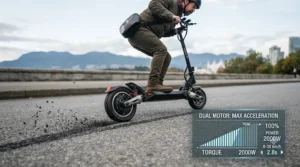
Here’s the mechanical reality reviewers and manufacturers alike keep circling back to: torque delivered through one wheel has a traction ceiling. Push a single motor too hard on loose gravel or wet pavement and the drive wheel spins before the scooter actually accelerates — energy wasted as wheelspin rather than converted into forward motion. Splitting that same power across both wheels instead gives you meaningfully better traction, stability, and control, an effect that shows up most clearly on wet roads or during sharp turns. That’s the core engineering case for dual motor designs, and it holds true regardless of brand or price tier.
| Factor | Single Motor | Dual Motor |
|---|---|---|
| Typical weight | Lighter (20–37 kg) | Heavier (29–52 kg) |
| Hill climbing | Adequate on moderate grades | Strong on steep grades |
| Wet-surface traction | Limited to one drive wheel | Power split across both wheels |
| Typical price tier | Budget to mid-range | Mid-range to premium |
| Battery efficiency | Generally more efficient per charge | Higher draw, shorter range for same battery size |
The efficiency row deserves a second look: a second motor doesn’t just add power, it adds rolling resistance and draws more current under hard acceleration. Industry analysis on EV powertrain efficiency generally points to aggressive throttle use as the single biggest factor affecting range — more than the added weight of a second motor. In practice, this means a dual motor scooter with an equivalent battery to a single motor competitor will often show a shorter real-world range unless the manufacturer compensates with a larger battery pack, exactly what we saw with the Kaabo Wolf King GT‘s oversized 72V pack offsetting its power-hungry dual-motor draw.
✨ Ready to compare real numbers side by side? Scroll back up to the comparison table before you decide.
Single Motor Electric Scooter Pros and Cons
Breaking down single motor electric scooter pros cons in isolation helps clarify exactly what you’re trading away, and what you’re gaining, before you commit to a purchase.
On the pros side: single motor scooters are simpler machines with fewer components to fail, which typically means lower repair costs and easier troubleshooting over the ownership period. They’re also lighter — the NIU KQi3 Pro at 20.3 kg versus the Kaabo Wolf King GT at 52 kg is a stark illustration of just how much weight a second motor and its supporting battery system add. That weight difference matters enormously if you’re carrying your scooter up stairs, folding it onto a bus, or storing it in a small apartment. Single motor scooters are also generally more energy-efficient per charge, since there’s only one motor drawing current rather than two.
On the cons side, the limitations show up specifically in scenarios that dual motor buyers are trying to solve: reduced traction on wet or loose surfaces, since all power routes through one wheel; weaker sustained hill-climbing torque, particularly on long or steep grades where a single motor can overheat under continuous strain; and a lower practical ceiling on acceleration and top speed compared to dual motor competitors at a similar price point. None of these are dealbreakers for the right rider — they’re simply trade-offs that matter more in some commutes than others.
Single Motor vs Dual Motor Electric Scooter: The Real-World Performance Difference
Specs on paper only tell part of the story, so let’s translate them into what actually happens during a ride.
Accelerating from a stop, a dual motor scooter with equivalent total wattage to a single motor competitor will typically feel noticeably punchier, because torque is applied simultaneously at both contact patches rather than funneled through one wheel that has to fight for grip before it can convert power into forward motion. This is most obvious in wet conditions or on loose surfaces like gravel shoulders and painted crosswalk lines — a single motor scooter’s rear wheel can chirp and slip in exactly the conditions where a dual motor scooter simply grips and goes.
Climbing hills tells a similar story but with an added wrinkle: sustained duration. A single motor working alone against a long, steep grade generates more heat concentrated in one motor housing, and thermal throttling — where the motor automatically reduces power to protect itself from overheating — becomes a real risk on climbs lasting more than a minute or two. Split that same climbing workload across two motors and each one runs cooler under the same total power demand, which is exactly why the Apollo City Pro‘s dual-motor setup handles sustained hill climbs more gracefully than the Segway Ninebot MAX G3‘s single motor, despite the Segway’s higher peak wattage rating on paper.
Braking and downhill control round out the comparison. Dual motor scooters generally offer regenerative braking from both wheels, which improves stopping consistency and reduces wear on mechanical brakes — genuinely useful during a Canadian winter when brake pad grip can already be compromised by road salt and grime.
Single Motor Electric Scooter for Commuting
For the specific use case of daily commuting — repeatable routes, predictable distances, and a strong preference for portability — a single motor electric scooter for commuting is often the smarter default rather than a compromise pick.
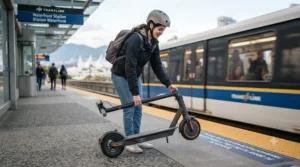
Consider the math: most Canadian urban commutes fall well under 15 km each way, a distance any of the single motor scooters in this list handle comfortably with battery to spare. The lighter weight of single motor designs pays dividends every single day you fold the scooter to carry it up an apartment stairwell, onto a GO Train, or into an office storage closet — daily friction that dual motor owners feel every time they lift a scooter that’s routinely 10–20 kg heavier. Reviewers consistently note that single motor commuter scooters like the NIU KQi3 Pro feel more nimble threading through pedestrian-heavy sidewalks and tight bike lanes, an underrated advantage in dense urban cores.
The trade-off only becomes a real problem if your commute regularly includes steep grades, unpaved shortcuts, or wet-weather riding where traction genuinely matters — situations where the extra investment in a dual motor scooter starts paying for itself.
Best Electric Scooter for Flat City Riding in Canada
If your daily riding happens somewhere genuinely flat — Winnipeg, Regina, much of Ottawa’s core, or Montreal’s flatter boroughs — the calculus shifts firmly toward single motor scooters, and specifically toward the budget end of that spectrum.
The best scooter for flat city riding in Canada doesn’t need dual-motor torque it will rarely, if ever, use. The Gotrax G4 and NIU KQi3 Pro both make strong cases here: modest hill-climbing specs simply aren’t a limiting factor when your commute never climbs more than a gentle on-ramp or overpass grade. What most buyers overlook is that paying for dual-motor hill-climbing capability you don’t need is money better spent on other priorities — a bigger battery for extended range, better tires, or simply banking the savings. Flat-city riders should prioritize range, weight, and tire comfort over motor count, since those factors will shape day-to-day satisfaction far more than a spec you’ll never test.
How to Choose a Single or Dual Motor Electric Scooter: Canada Buying Guide
Use this electric scooter buying guide Canada checklist to work through the decision systematically rather than getting swept up by whichever spec sheet looks most impressive.
- Map your actual commute terrain. Pull up your regular route and note any sustained grades over roughly 8–10%; that’s the threshold where dual motor advantages start to matter in practice.
- Weigh portability honestly. If you’re carrying the scooter up stairs, onto transit, or into a small apartment daily, every extra kilogram compounds — factor this before motor count.
- Set a realistic range buffer. Calculate your round-trip distance and double it as a safety margin, since cold Canadian temperatures can measurably reduce battery performance.
- Check provincial and municipal rules first. Legal power and speed limits vary significantly across Canada, so confirm compliance before falling in love with a high-powered model. If you’re riding in Ontario, the province’s guidance on e-bike weight, speed, and equipment rules is a useful baseline, since compliant scooter-type vehicles are often held to similar standards as power-assisted bicycles.
- Budget for total cost, not just sticker price. Dual motor scooters often mean higher tire wear (from added torque) and pricier replacement parts — factor this into your comparison.
- Prioritize weather sealing if you ride year-round. An IP66 rating matters more in a Canadian winter than an extra 5 km/h of top speed.
- Test ride if at all possible. Spec sheets can’t convey how a scooter’s throttle response or brake feel will actually suit your riding style.
When to Choose a Single Motor Scooter
Knowing exactly when to choose single motor scooter setups over dual motor alternatives comes down to matching your specific situation against a short, honest checklist.
Choose single motor if your commute is primarily flat, your budget is a genuine constraint, portability matters daily (stairs, transit, small storage spaces), and you rarely ride in challenging wet or off-road conditions. If three or more of those apply to you, a single motor scooter like the Gotrax G4 or NIU KQi3 Pro will likely serve you better than an expensive dual motor upgrade you’ll rarely push to its limits.
Choose dual motor instead if you regularly face hills, ride in wet or unpredictable weather, carry extra cargo weight, or simply want performance headroom for confidence rather than necessity. There’s no universally “correct” answer here — only a correct answer for your specific commute and priorities.
Real-World Rider Scenarios: Matching Motor Type to Your Life
Scenario one: the downtown condo commuter. She rides 6 km each way to work along mostly flat bike lanes, carries her scooter up two flights to her unit, and values portability above all else. A lightweight single motor pick like the NIU KQi3 Pro fits perfectly — she’ll rarely, if ever, need dual-motor torque, and the lighter weight saves her effort every single day.
Scenario two: the hillside suburban rider. He commutes 12 km from a hilly suburb into a downtown core with a genuinely steep grade partway through his route, sometimes in light rain. For him, the Apollo City Pro‘s dual-motor climbing power and weather sealing directly solve a daily pain point that a single motor scooter would struggle with, particularly on wet mornings.
Scenario three: the weekend performance rider. She already commutes by transit but wants a scooter for weekend trail exploring and the occasional adrenaline-fuelled ride with friends. The Kaabo Wolf King GT‘s off-road tires and serious power make sense here precisely because her use case isn’t daily portability — it’s weekend performance, where the extra weight and cost are simply part of the package she’s buying into.
Setting Up and Riding Safely: Your First 30 Days
Getting the most from any new scooter — single or dual motor — starts with a handful of habits that most first-time owners skip.
In your first week, ride in the lowest available power mode even if your scooter defaults to a faster setting; this lets you learn brake feel and throttle response before you’re committing to higher speeds. Check tire pressure weekly for the first month, since pneumatic tires lose pressure gradually and under-inflation is one of the most common causes of reduced range and sluggish handling. Charge the battery to roughly 80% for daily use rather than always topping off to 100%, a habit that meaningfully extends battery lifespan over a multi-year ownership period. A common mistake in the first 30 days is riding aggressively in rain before understanding how your specific scooter’s traction and braking behave when wet — ease into wet-weather riding gradually, starting with lower speeds on familiar routes.
For dual motor owners specifically, resist the temptation to max out power modes immediately; the extra torque available means mistakes happen faster, and building throttle familiarity in a lower mode first genuinely reduces early-ownership spills.
Common Mistakes When Buying an Electric Scooter
The single most common mistake is buying based purely on top speed, when day-to-day satisfaction actually hinges on range, weight, and ride comfort far more than a headline speed figure you’ll rarely use in city traffic. A close second: underestimating how much a scooter’s weight matters until you’re actually carrying it up stairs or through a transit turnstile every single day — a spec that looks trivial on a webpage becomes very real in practice.
Buyers also frequently skip checking local regulations before purchasing, only to discover their new scooter exceeds legal power or speed limits for their province or city — an expensive and avoidable mistake. Finally, many first-time buyers assume “dual motor” automatically means “better” across the board, without weighing whether their specific commute actually benefits from the extra torque, weight, and cost — as we’ve seen throughout this guide, that’s frequently not the case.
Long-Term Cost & Maintenance: Single vs Dual Motor
Total cost of ownership diverges meaningfully between single and dual motor scooters, and it’s worth running the numbers before assuming a cheaper upfront price is automatically the better long-term value.
| Cost Factor | Single Motor | Dual Motor |
|---|---|---|
| Typical upfront price | C$500–C$1,700 | C$1,000–C$5,200 |
| Tire wear | Lower, less torque stress | Higher, more torque stress |
| Repair complexity | Simpler, one motor to service | More complex, two motors and controllers |
| Charging cost per full charge | Lower (smaller battery draw) | Higher (larger battery, more frequent charging) |
A single motor scooter’s simplicity generally translates into lower repair bills over a multi-year ownership period, since there’s only one motor and controller that can fail rather than two. That said, a dual motor scooter’s shared workload means each motor carries a lighter individual burden, which can actually extend individual motor lifespan compared to a single motor working alone at maximum capacity daily — a nuance that partially offsets the added mechanical complexity. Charging costs, while modest for both categories, do add up: a scooter with a larger battery and higher current draw will cost noticeably more per full charge over a year of daily commuting, though the difference remains small in absolute terms compared to equivalent car or transit costs.
💬 Not sure which cost profile fits your budget? Compare the specific models above before making the call.
Electric Scooter Safety and Regulations in Canada
Canadian e-scooter regulation is a genuine patchwork, and it’s worth understanding before you buy rather than after a ticket. Transport Canada classifies electric scooters similarly to power-assisted bicycles at the federal level, but provinces and municipalities layer their own rules on top of that federal baseline, covering speed limits, age requirements, and where you’re legally permitted to ride.
Ontario runs a provincial e-scooter pilot program that individual municipalities can opt into, but Toronto has not joined the program, meaning e-scooters currently cannot be legally ridden on Toronto’s public roads, sidewalks, or bike lanes regardless of motor configuration. CBC News has reported on how neighbouring GTA cities have taken very different approaches under the same provincial pilot framework, with some embracing shared e-scooter programs while Toronto maintains its ban — a good reminder that “legal in one city” doesn’t mean “legal everywhere nearby.” Always confirm your specific municipality’s bylaws before riding, a rule that applies equally whether you’re eyeing a budget single motor scooter or a hyperscooter like the Kaabo Wolf King GT.
Beyond legality, safety fundamentals apply universally: wear a certified helmet regardless of local requirements, use front and rear lights when riding at dusk or after dark, and remember that higher-powered dual motor scooters demand more rider experience and caution given their significantly higher achievable speeds. If you’re unsure whether a specific model complies with your province’s power and speed thresholds, check the manufacturer’s specifications against your provincial highway traffic act before purchasing rather than after.

Frequently Asked Questions
❓ Is a dual motor scooter faster than a single motor scooter?
❓ Do dual motor scooters drain the battery faster?
❓ Can I ride a single motor electric scooter up steep hills?
❓ Is a dual motor electric scooter worth the extra cost for commuting?
❓ Are electric scooters legal across Canada?
Conclusion
The single motor vs dual motor electric scooter decision ultimately comes down to matching hardware to your actual commute rather than chasing whichever spec sheet looks most impressive. Flat-city riders juggling stairs and transit will likely find more day-to-day satisfaction in a lighter single motor pick like the Gotrax G4 or NIU KQi3 Pro, while hill-climbing commuters and weather-exposed riders will feel the benefit of dual-motor traction in models like the Apollo City Pro or even the performance-focused Kaabo Wolf King GT.
None of the seven scooters covered here is objectively “best” — each represents a different answer to a different commuting question, from the long-range efficiency of the Segway Ninebot MAX G3 to the budget-friendly all-wheel-drive value of the Gotrax GX Zero Dual Motor. What matters most is running your own commute, budget, and portability needs through the framework above before you decide. As Canada’s e-scooter regulatory landscape continues evolving, staying informed on your local rules will matter just as much as which motor configuration you ultimately choose.
✨ Don’t Miss These Exclusive Deals!
🔍 Take your commute to the next level with one of these carefully compared scooters. Click through on any highlighted model to check current pricing and availability, and find the ride that actually fits how — and where — you get around.
Recommended for You
- Single Motor Electric Scooter Canada: 7 Reliable 2026 Picks
- Dual Motor vs Single Motor Electric Scooter: 7 Best Picks 2026
- 2000W Electric Scooter vs Motorcycle: 7 Surprising Picks (2026)
Disclaimer: This article contains affiliate links. As an Amazon Associate, I earn from qualifying purchases. If you purchase products through these links, we may earn a small commission at no additional cost to you.
✨ Found this helpful? Share it with your friends! 💬🤗
