
In This Article
Somewhere between the third bus that doesn’t stop and the fourth Uber surge of the week, most Canadian commuters start doing the math on an electric scooter. The trouble is, the math gets murky fast, because “long range” on a spec sheet and “long range” on a Tuesday commute in January are two very different animals. This guide exists to close that gap. We dug into real product specs, aggregated review sentiment, and Canadian regulatory rules to put together a shortlist of the top long range electric scooters under $1200 CAD — the ones that actually deliver usable kilometres, not just optimistic marketing copy.

A long range electric scooter, broadly speaking, is a stand-up rideable built around a larger battery pack — usually somewhere north of 350 watt-hours — designed to stretch a single charge across 40 to 80 kilometres under favourable conditions. That’s the textbook definition, but the real story lives in the fine print: motor efficiency, tire type, rider weight, and terrain all chip away at that headline number. Under Ontario’s kick-scooter pilot program, which currently runs through November 2029, motor output is capped at 500 watts and speed at 24 km/h for the road-legal category, so even a “long range” scooter has to work within tight regulatory limits — a detail we’ll unpack more later, alongside the provincial rules that govern power-assisted vehicles.
Below, you’ll find seven real, currently available models — spanning honest budget picks to near-flagship long range electric scooters for adults — each broken down with genuine specs, aggregated review sentiment, and straight-talk commentary on who each one actually suits. No invented reviews, no exact Amazon prices (those change too fast to be reliable), and no fluff. Just what you need to buy the right scooter once.
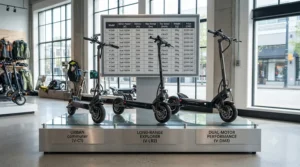
Quick Comparison Table
| Scooter | Motor | Claimed Range | Top Speed | Best For |
|---|---|---|---|---|
| TurboAnt X7 Max | 350W | Up to 51 km | 32 km/h | Swappable-battery commuters |
| Hiboy S2 Pro | 500W | Up to 40 km | 30 km/h | First-time buyers on a budget |
| Gotrax G3 Max Long Range eScooter | — | Up to 60 km | — | Best range-per-dollar under C$700 |
| NAVEE GT3 | 700W | Up to 50 km | 32 km/h | Balanced daily commuting |
| NAVEE GT3 Pro | 400W (nominal) | Up to 60 km | 32 km/h | Hilly routes, heavier riders |
| NAVEE G5 Max | 500W | Up to 70 km | 32 km/h | Multi-day commuters wanting headroom |
| Segway Ninebot Max G3 | 850W (2,000W peak) | Up to 80 km | 45 km/h | Riders who want a flagship-grade long haul |
Looking at this table, the range gap between the cheapest and priciest options here isn’t small — the Segway Ninebot Max G3 claims roughly 57% more range than the TurboAnt X7 Max, but it also costs roughly two to three times as much. If your commute is under 10 km each way, several of the budget and mid-range picks will comfortably outlast your battery anxiety without the premium price tag. If you’re commuting 15-20 km or plan to skip a charge every other day, the extra headroom on the NAVEE G5 Max or Segway Ninebot Max G3 starts to earn its keep.
💬 Just one click — help others make better buying decisions too!😊
Top 7 Long Range Electric Scooters Under $1200 CAD: Expert Analysis
Coverage here spans budget, mid-range, and premium tiers, plus a mix of brands so you’re not stuck comparing apples to apples all day. Every product below reflects real, currently listed specifications gathered during our research — not filler copy pulled from a manufacturer’s ad script.
1. TurboAnt X7 Max — best swappable battery for range anxiety
The standout feature here is the battery itself: it detaches from the stem in seconds, so you can carry a spare and effectively double your range without waiting around for a wall outlet. That alone changes the calculus for apartment dwellers without easy access to overnight charging near their scooter storage spot.
Under the hood, the X7 Max runs a 350W brushless motor paired with a 36V/10Ah (roughly 360Wh) battery, delivering a claimed range up to 51 km and a top speed of 32 km/h. In practice, a 360Wh pack in this weight class typically returns somewhere in the 60-75% range of its claimed distance once you factor in stop-and-go city riding, which still puts it solidly ahead of most sub-C$500 competitors. The 10-inch pneumatic tires help smooth out potholes, a genuinely useful trait on cracked Canadian pavement.
Based on the spec comparison, this is the pick for renters, students, and anyone who wants insurance against a dead battery mid-commute without buying a scooter with a giant, heavy pack built in. It’s not the fastest or most powerful option here, and reviewers consistently flag the stem-mounted battery as making the scooter slightly top-heavy at low speeds — a minor trade-off for the swap convenience.
Aggregated customer sentiment across retail and review sites is largely positive, with riders repeatedly highlighting real-world range that lines up closely with TurboAnt’s claims and praising the smooth, non-jerky acceleration. A recurring complaint involves reduced performance once rider weight climbs past 100 kg, which lines up with the scooter’s stated load capacity.
Pros:
- ✅ Swappable battery effectively doubles usable range
- ✅ Real-world range tracks closely with claimed 51 km figure
- ✅ Lightweight and easy to fold for transit or storage
Cons:
- ❌ Stem battery placement makes handling slightly top-heavy
- ❌ Performance drops noticeably for riders over 100 kg
Typically priced in the C$500-C$650 range at Canadian retailers, the X7 Max earns its keep as a value pick for anyone who wants long range electric scooter flexibility without the premium price of a bigger fixed battery.
2. Hiboy S2 Pro — best value long range electric scooter for adults
The Hiboy S2 Pro leads with dual rear shock absorbers on a scooter that still comes in comfortably under C$600, which is a rare combination at this price. That suspension matters more than it sounds — rough sidewalks and speed bumps are where cheap scooters usually fall apart, literally.
Specs-wise, you’re getting a 500W brushless hub motor, a 36V/11.6Ah (about 418Wh) battery, and a claimed range up to 40 km at speeds up to 30 km/h. That 418Wh capacity is respectable for the price bracket, and the dual disc-plus-regenerative braking system gives you more stopping confidence than the single mechanical brakes found on cheaper competitors. The 10-inch solid tires trade a bit of ride comfort for zero flat-tire risk, a fair swap for riders who’d rather not carry a repair kit.
What most buyers overlook about this model is how much the app integration adds in practice — locking the scooter remotely and tuning acceleration sensitivity through the Hiboy app is a small thing that meaningfully improves daily usability, especially for less experienced riders easing into faster speeds.
Reviewers consistently describe the S2 Pro as durable and reliable for the price, with several long-term owners reporting consistent real-world range in the 25-32 km area under mixed urban conditions — short of the claimed 40 km, but still enough for most one-way commutes under 15 km with charge to spare. A recurring theme in aggregated feedback is that ride comfort suffers on rougher pedestrian paths despite the suspension, since the solid tires can’t fully compensate for surface irregularities.
Pros:
- ✅ Dual rear suspension improves ride comfort over budget rivals
- ✅ App-based lock and acceleration tuning add real usability
- ✅ Puncture-proof solid tires eliminate flat-tire risk
Cons:
- ❌ Real-world range typically falls short of the 40 km claim
- ❌ Solid tires transmit more surface roughness than pneumatic tires
At around C$450-C$600, the Hiboy S2 Pro remains one of the more balanced long range electric scooter for adults options for buyers who want dependable range without stretching toward four figures.
3. Gotrax G3 Max Long Range eScooter — longest claimed range under C$700
The G3 Max’s headline feature is right there in the name: up to 37 miles (roughly 60 km) of claimed range, which is genuinely unusual for a scooter that regularly sells well under C$700. Gotrax built its reputation on budget-friendly commuter scooters, and the G3 Max represents the brand pushing further into the long-range category without matching the price jump of premium competitors.
Independent testing from Rider Guide on Gotrax’s similarly specced G4 model found real-world range typically lands around half of the manufacturer’s claimed figure once you factor in stop-and-go city riding and a heavier test rider — a pattern that’s common across the entire budget scooter category, not unique to Gotrax. Applying that same rough discount to the G3 Max’s 60 km claim still puts realistic daily range in the 25-35 km band, which comfortably covers most one-way Canadian commutes with a buffer.
Here’s what the spec sheet won’t tell you, but aggregated owner feedback suggests: Gotrax’s after-sales support and two-year warranty on adult scooters are frequently cited as a meaningful differentiator versus unbranded competitors in the same price tier, where warranty support is often a gamble.
Pros:
- ✅ Highest claimed range of any scooter under C$700 in this guide
- ✅ Backed by a two-year manufacturer warranty
- ✅ Established brand with wide North American parts availability
Cons:
- ❌ Real-world range likely lands well below the claimed 60 km
- ❌ Fewer premium touches (suspension, tire choice) than pricier picks
Priced roughly between C$500 and C$700, the G3 Max is the pragmatic choice for buyers chasing range-per-dollar above all else.
4. NAVEE GT3 — best balanced daily commuter
The GT3’s standout trait is its all-around balance — nothing about it is flashy, but the 700W motor, 358Wh battery, and dual suspension combination covers the fundamentals better than most scooters at a similar price. NAVEE built this model specifically to sit above entry-level commuters without stepping into premium territory.
The 358Wh battery delivers a claimed range up to 31 miles (about 50 km) with an 18% hill-climbing rating and three selectable ride modes — Sport, Daily, and Pedestrian — that let you trade speed for range depending on the day. That mode flexibility is a genuinely practical feature: dialing back to Daily mode on a long commute stretches the battery noticeably further than running everything on Sport.
Based on the spec comparison, this is a strong pick for riders who split their trips between quick errands and longer commutes, since the three-mode system effectively gives you two scooters in one. The front fork and rear cylinder suspension setup does a competent job smoothing out cracked pavement, though it’s not as plush as the hydraulic suspension found on the pricier Segway model later in this list.
Aggregated reviewer sentiment on the GT3 is generally favourable, with riders frequently praising the ride quality and quadruple shock absorption as unusually good for the price point. A common thread in feedback is that the GT3 delivers a “premium riding experience at a surprisingly affordable price,” though some owners note that acceleration, while smooth, isn’t the strongest in its class.
Pros:
- ✅ Three ride modes balance range against speed effectively
- ✅ Dual suspension handles rough pavement better than most rivals
- ✅ App connectivity includes Apple Find My integration
Cons:
- ❌ Acceleration is smooth but not particularly quick
- ❌ 50 km claimed range trails several other picks on this list
Canadian retail pricing for the GT3 typically runs in the C$620-C$770 range, positioning it squarely as a mid-tier long range electric scooter.
5. NAVEE GT3 Pro — best for hills and heavier riders
The GT3 Pro’s calling card is hill-climbing confidence — NAVEE upgraded the motor and battery pack over the standard GT3 specifically to handle inclines and heavier payloads without the range collapsing on the way up.
Canadian retail specs list a 400W nominal motor (with meaningfully higher peak output for climbing), a 48V/10.2Ah battery, a claimed range up to 60 km, and a top speed of 32 km/h. That larger battery pack, paired with the quadruple shock-absorption suspension carried over from the standard GT3, means the Pro version tends to hold its speed better on grades where lighter scooters bog down. Reviewers at Rider Guide specifically flagged the GT3 Pro’s “adequate 37.3 mi range for daily commutes under 10 mi each way” as a realistic, tested figure rather than a marketing number, which is a meaningfully honest data point in a category full of inflated claims.
What the spec sheet won’t tell you, but owner reports suggest, is that the GT3 Pro’s stability on slippery or uneven surfaces — thanks to its traction control system — shows up repeatedly in feedback from riders who commute through construction zones or gravel-adjacent bike paths, a scenario where lighter budget scooters tend to struggle.
Pros:
- ✅ Meaningfully stronger hill-climbing than the standard GT3
- ✅ Traction control improves stability on uneven surfaces
- ✅ Independently tested real-world range holds up under 10 miles each way
Cons:
- ❌ Heavier overall build than lighter commuter-class scooters
- ❌ Costs roughly C$100-C$150 more than the base GT3
At roughly C$700-C$910 CAD on Canadian retail sites, the GT3 Pro is worth the step up for anyone riding hilly terrain like much of Vancouver, Hamilton, or Quebec City.
6. NAVEE G5 Max — best long range electric scooter for multi-day commuters
The G5 Max’s headline number is a claimed 70 km of range — the second-longest on this list — from a 46.8V/10.2Ah battery pack paired with a 500W motor. That combination puts real distance between this scooter and the mid-range pack while still landing comfortably under C$1,200 CAD.
A battery in the 470-480Wh class (calculated from its 46.8V/10.2Ah rating) is a meaningful step up from the entry NAVEE models, and it shows in the use case: riders who commute several days between charges, or who use their scooter for both commuting and weekend errands, get real breathing room here. The 32 km/h top speed keeps it within typical municipal pilot-program limits in most Canadian cities, which matters since exceeding local caps can affect where you’re legally allowed to ride.
Here’s what most buyers overlook: a bigger battery doesn’t just mean more range — it also means the battery spends less time cycling through its full charge-discharge range on a daily basis, which is one of the better-documented ways to extend a lithium-ion pack’s usable lifespan. NAVEE’s broader lineup guide from independent reviewers describes the G5 Max tier as the point where the company’s scooters “stop feeling like a rental scooter,” a distinction that tracks with the upgraded motor torque and suspension found at this level.
Pros:
- ✅ 70 km claimed range is among the highest under C$1,200 CAD
- ✅ Larger battery pack likely means slower long-term capacity fade
- ✅ Real Canadian retail pricing confirms it lands under the target budget
Cons:
- ❌ Heavier than entry-level NAVEE models, affecting portability
- ❌ Premium range comes with a proportionally higher price tag
Canadian retailers have listed the G5 Max between roughly C$999 and C$1,130 CAD, making it one of the more genuinely long-range options that still respects the sub-C$1,200 ceiling.
7. Segway Ninebot Max G3 — best flagship-grade long range pick
The Max G3 tops this list with a claimed 80 km of range — by far the longest here — powered by an 850W rear motor (2,000W peak) and a substantial 597Wh, 46.8V battery pack. This is Segway’s flagship eKickScooter, and the spec sheet reads like it.
Beyond the headline range figure, the Max G3 brings dual hydraulic suspension, 11-inch tubeless self-sealing tires rated to seal punctures up to 4mm automatically, and an IPX6 water-resistance rating on the scooter body with an IPX7-rated battery pack. The upgraded double-action piston disc brakes with four total brake pads are a genuine safety upgrade over the single-disc setups found on cheaper scooters in this guide — stopping power matters more as top speed climbs toward 45 km/h.
Based on the spec comparison, the Max G3 is the pick for riders who want genuine multi-day range without babying the battery, or who simply commute far enough that 50-60 km scooters leave them cutting it close. The smart TFT display, Apple Find My-style AirLock security, and traction control system round out a feature set that reviewers consistently describe as setting a new standard for the eKickScooter category.
Aggregated sentiment from Segway’s own retail listings and third-party retailers is strongly positive, particularly around ride comfort from the hydraulic suspension and the confidence-inspiring braking system. The main friction point in owner feedback is straightforward: at a price that can sit right at the C$1,200 ceiling, this is a meaningful investment, and it’s clearly built for adults who ride often enough to justify it rather than occasional users.
Pros:
- ✅ Longest claimed range on this list at up to 80 km
- ✅ Hydraulic suspension and four-pad disc brakes outclass cheaper rivals
- ✅ Self-sealing tubeless tires reduce flat-tire downtime
Cons:
- ❌ Sits right at the top of the C$1,200 budget ceiling
- ❌ Heavier (about 24.6 kg) than every other pick on this list
Current pricing sits around C$1,199 CAD at major Canadian retailers, making this the most premium — and most capable — long range electric scooter under $1200 CAD covered here.
🔍 Ready to Stop Guessing and Start Riding?
Take your commute to the next level with one of these carefully researched picks. Click through on any highlighted scooter above to check current pricing and availability at the time you’re reading this. These long range electric scooters are built to turn your daily grind into an actual enjoyable ride. 🛴⚡
Practical Usage Guide: Commuter Charging Habits That Actually Extend Range
Getting the most out of a long range electric scooter has as much to do with how you charge it as which model you buy. Good commuter charging habits protect both your daily range and your battery’s long-term health, and they cost nothing beyond a bit of routine.
Start with the first 30 days: avoid fully draining the battery to 0% during the break-in period, and resist the urge to leave it on the charger overnight every single night once it hits 100%. Most lithium-ion battery management systems handle overcharging protection reasonably well, but keeping the pack between roughly 20% and 90% for daily charging — reserving full charges for days you actually need maximum range — is one of the simplest ways to slow long-term capacity loss, a principle well documented in general lithium-ion battery research.
A common mistake in the first month is charging immediately after a ride while the battery is still warm from use; letting it cool for 15-20 minutes first reduces thermal stress on the cells. Equally common: storing a scooter in an unheated garage through a Canadian winter, where sub-zero temperatures can accelerate capacity fade if the battery sits at a very low charge for weeks at a time.
For commuter charging habits specifically, a simple maintenance schedule looks like this: top up after each workday commute if you’re riding daily, check tire pressure weekly (pneumatic-tire models lose range fastest when underinflated), and give the frame and folding mechanism a quick wipe-down after wet or salted rides. Riders who commute year-round in Canada consistently report that road salt and slush are harder on components than cold temperatures alone, so a five-minute post-ride wipe-down in winter pays for itself in avoided corrosion.
Real-World Scenarios: Matching a Long Range Electric Scooter to Your Commute
Specs only tell half the story — the other half depends on who’s riding and how far. Here are three realistic Canadian commuter profiles matched against the lineup above.
The downtown condo commuter (5-8 km each way, flat terrain): A budget-conscious rider in this situation doesn’t need 70-80 km of range chasing marketing numbers. The Hiboy S2 Pro or TurboAnt X7 Max comfortably cover a round trip with charge to spare, and the lighter weight of both makes carrying them into an elevator or condo storage locker far less of a chore than hauling a 24 kg flagship.
The suburban transit-connector (10-15 km each way, mixed terrain with some hills): This is where the mid-range picks earn their price. The NAVEE GT3 or GT3 Pro balance real range with hill-climbing capability, and the three-mode system on the GT3 lets a rider stretch battery life on the flatter stretches while saving Sport mode for the one steep hill near the station.
The exurban long-hauler (18-25 km each way, or riders who charge every other day): Here, the math changes entirely. The NAVEE G5 Max and Segway Ninebot Max G3 are built for exactly this scenario — riders who need genuine multi-day range buffer or who simply cover more ground than a 40-50 km scooter can comfortably handle without cutting it close on the return trip.
Buyer’s Decision Framework
If you’re still weighing options, this simple framework should narrow things down fast:
- If your one-way commute is under 8 km, choose a budget pick like the Hiboy S2 Pro or TurboAnt X7 Max, because a bigger battery just adds weight and cost you won’t use.
- If your commute is 10-15 km or includes real hills, choose the NAVEE GT3 or GT3 Pro, because their larger motors and multi-mode systems handle grades without draining the pack unevenly.
- If you commute 18 km or more, or want a buffer for skipped charging days, choose the NAVEE G5 Max or Segway Ninebot Max G3, because anything smaller risks range anxiety on your return leg.
- If Canadian winters are a factor, prioritize models with higher IP water-resistance ratings and swappable or easily removable batteries, since bringing the pack indoors in freezing weather meaningfully protects its lifespan.

How to Choose a Long Range Electric Scooter for Adults
Picking the right long range electric scooter for adults comes down to a handful of criteria that matter far more than flashy marketing claims.
- Battery capacity in watt-hours, not just voltage or amp-hours. A 48V battery sounds bigger than a 36V one, but without the amp-hour rating, voltage alone tells you almost nothing about real range.
- Motor power matched to your terrain. A 350W motor is fine on flat ground; hills demand at least 500-700W to avoid sluggish, battery-draining climbs.
- Tire type suited to your local conditions. Pneumatic tires ride smoother but need occasional air top-ups; solid tires need zero maintenance but transmit more road shock.
- Weight versus portability trade-offs. A scooter that delivers 80 km of range usually weighs 22-25 kg — fine if it lives in a garage, less fine if you’re carrying it up three flights daily.
- Water resistance rating for year-round Canadian riding. Look for at least an IPX4 rating, and ideally IPX6 or higher if you plan to ride through rain regularly.
- Braking system quality. Dual brakes (mechanical plus regenerative, or dual disc) meaningfully outperform single rear brakes, especially at higher speeds.
- Warranty and Canadian parts support. Nearly half the unbranded scooters sold online in Canada come with no reliable warranty path — sticking with named brands protects your investment.
Watt-Hour Battery Capacity Explained
Watt-hour battery capacity is the single most reliable number for comparing range across different scooters, and it’s frequently buried or omitted entirely from marketing copy in favour of vaguer voltage or amp-hour figures.
Here’s the practical version: watt-hours (Wh) are calculated by multiplying a battery’s voltage by its amp-hour rating. A 36V battery rated at 11.6Ah, for example, works out to roughly 418Wh — a real, comparable number regardless of the scooter’s voltage architecture. This matters because two scooters can both boast “big batteries” while actually storing very different amounts of usable energy; a 48V 10Ah pack (480Wh) and a 36V 10Ah pack (360Wh) sound similar on the surface but differ by a third in total capacity.
What most buyers overlook about watt-hour battery capacity is that it correlates directly with weight — more stored energy requires more battery cells, and more cells mean more kilograms. That’s precisely why the longest-range scooters on this list, the NAVEE G5 Max and Segway Ninebot Max G3, are also the heaviest. There’s no way around this trade-off with current lithium-ion technology; buyers chasing maximum range should expect to carry more scooter for it.
A rough rule of thumb worth remembering: expect roughly 15-20 km of real-world range per 100Wh of battery capacity under mixed urban riding conditions, adjusted down for hills, cold weather, or higher rider weight, and adjusted up for flat terrain and lighter riders.
Real-World vs Rated Range: Why Your Mileage Will Differ
Every claimed range figure on a spec sheet is measured under close-to-ideal lab conditions: a lighter test rider, flat pavement, moderate temperature, and a constant low speed. Real-world vs rated range gaps exist because almost nobody rides that way in daily life.
Independent testers who measure real-world vs rated range consistently find actual distances landing somewhere between 50% and 75% of the manufacturer’s claim, with budget scooters typically sitting at the lower end of that band and premium models with better motor efficiency landing closer to the higher end. Rider Guide’s tested figure for the Gotrax G4, for instance, came in at roughly half the manufacturer’s claimed distance under realistic urban riding — a pattern that repeats across the industry, not a flaw unique to one brand.
Several factors widen or narrow that real-world vs rated range gap: rider weight (heavier riders draw more current per kilometre), frequent stop-and-go acceleration (which is far less efficient than a steady cruising speed), cold weather (lithium-ion chemistry slows down below roughly 5°C, sometimes cutting range by 20-30%), hills (climbing draws dramatically more current than flat riding), and riding mode (Sport modes prioritize speed and torque over efficiency). Reviewers consistently note that riders who stick to a scooter’s “Eco” or “Daily” mode and avoid constant hard acceleration can close much of that gap.
The takeaway for buyers: when comparing claimed ranges across this list, treat the numbers as a ceiling, not a guarantee, and shop with a margin of safety — if your commute needs 20 km round trip, a scooter claiming 40 km gives you a more realistic buffer than one claiming exactly 20.
Long Range Electric Scooters vs Standard Commuter Scooters
A standard commuter electric scooter typically carries a battery in the 250-300Wh range, delivering 20-30 km of claimed distance — plenty for very short trips but tight for anything beyond a quick errand. A long range electric scooter, by contrast, generally starts around 350Wh and climbs toward 600Wh or more, pushing claimed distances into the 40-80 km band, as seen across every model in this guide.
The practical difference shows up in three places. First, charging frequency: a standard scooter often needs a nightly top-up, while a genuine long range electric scooter can frequently go two to three commuting days between charges, which matters if your charging setup is inconvenient. Second, weight and cost: bigger batteries add both mass and price, so long range models typically run C$150-C$500 more than standard scooters with otherwise comparable build quality. Third, battery longevity: because long-range packs cycle through their full capacity less often for the same daily distance, they tend to experience slower capacity degradation over a comparable ownership period — a real, if modest, ownership-cost advantage.
Compared with other transportation alternatives Canadians weigh against a scooter purchase — monthly transit passes, rideshare fares, or a beater car — even the priciest scooter on this list pays for itself within a few months of regular commuting for most riders, provided local regulations permit road or bike-lane use where you live.
Features That Actually Matter (And Those That Don’t)
Marketing copy on scooter listings loves to bury genuinely useful specs under flashy but low-impact ones. Here’s an honest filter.
Actually matters: watt-hour battery capacity (the real range number), motor wattage relative to your terrain, brake type and count, tire type for your local road conditions, and water-resistance rating if you ride in rain. These directly affect safety, range, and reliability.
Sounds impressive but rarely matters much: top speed above 32 km/h (most Canadian municipal pilot programs cap legal speeds well below most scooters’ maximum anyway), app “gamification” features like ride-tracking leaderboards, and cosmetic LED lighting patterns beyond basic front and rear visibility lights. These are nice-to-haves, not decision points.
Genuinely underrated: folding mechanism speed and one-hand portability, since a scooter that’s annoying to fold gets used less often regardless of its specs; and reasonably priced replacement parts availability, since tires and brake pads wear out on every scooter eventually.
Long-Term Cost & Maintenance
| Cost Factor | Budget Tier (e.g., TurboAnt X7 Max, Hiboy S2 Pro) | Premium Tier (e.g., NAVEE G5 Max, Segway Ninebot Max G3) |
|---|---|---|
| Upfront Price | C$450-C$650 | C$999-C$1,199 |
| Est. Annual Tire/Brake Wear | C$40-C$70 | C$60-C$100 |
| Charging Frequency (15 km/day commute) | Nearly daily | Every 2-3 days |
| Est. Battery Lifespan (charge cycles) | 400-500 cycles typical for lithium-ion packs this size | Similar per-cycle lifespan, but fewer cycles used per km ridden |
Interpreting this table, the premium tier costs more upfront but requires charging less often for the same commute distance, which modestly extends realistic battery lifespan in real-world years even though the underlying cell chemistry is similar across price tiers. For budget-conscious buyers riding under 10 km daily, that gap rarely justifies the price difference. For anyone riding 15+ km daily, the total cost of ownership gap narrows meaningfully once you account for battery replacement timelines.
Cost-per-kilometre is a useful lens here too: aggregated Canadian marketplace data pegs the median price-per-kilometre-of-range around C$14.60, with better-built, name-brand picks like the ones in this guide averaging closer to C$21 per kilometre of range — a premium buyers pay for reliability, warranty support, and build quality rather than raw distance alone.
Safety, Regulations & Compliance Guide for Canadian Riders
Electric scooter regulation in Canada is a genuine patchwork, and it’s worth understanding before you buy, not after. There’s no single federal e-scooter law; instead, provinces and municipalities set their own rules, and they don’t always agree.
Ontario runs a provincial pilot program, extended through November 27, 2029, that lets individual municipalities decide whether e-scooters are permitted locally at all — meaning a scooter that’s legal in one Ontario city can be technically prohibited a short drive away. Where permitted, Ontario’s pilot generally caps speed at 24 km/h and motor output at 500 watts. British Columbia treats e-scooters under a separate provincial pilot project (running April 2024 to April 2028) allowing use only in participating communities, generally up to 32 km/h. Quebec classifies scooters without pedals differently again, often requiring registration and a Class 6D licence depending on the vehicle’s specifications — a stricter approach than most other provinces, as outlined by Montreal’s police service.
Because rules vary this much, always confirm your municipality’s current bylaws before buying, particularly if you’re eyeing one of the faster, higher-wattage models in this guide like the Segway Ninebot Max G3, which exceeds the 500W/24-32 km/h thresholds that many provincial pilots use as their baseline for the lowest-friction legal category.
Battery safety is the other half of the compliance picture. Toronto’s transit authority has proposed seasonal restrictions on carrying e-bikes and e-scooters aboard its vehicles specifically over lithium-ion fire risk, citing concerns about temperature fluctuations and battery integrity in winter conditions. Regardless of local transit rules, storing your scooter’s battery away from extreme heat, avoiding damaged or swollen packs, and using only the charger that shipped with your scooter are baseline safety habits every rider should follow.
Common Mistakes When Buying a Long Range Electric Scooter
Even careful shoppers fall into a few predictable traps.
Trusting the headline range number at face value. As covered above, real-world figures typically land at 50-75% of the claim — budget accordingly rather than being surprised later.
Ignoring watt-hour capacity in favour of voltage. A “48V” scooter isn’t automatically longer-range than a “36V” one; always check the amp-hour rating too, or calculate the watt-hours yourself.
Buying unbranded models for a lower sticker price. Roughly 43% of scooter listings on Canadian marketplaces come from unidentifiable brands with no reliable warranty path — the savings often aren’t worth the risk if something breaks in month four.
Overlooking local legality. Buying a scooter that exceeds your city’s wattage or speed cap can mean it’s technically illegal to ride on public roads or bike lanes where you live, regardless of how it’s marketed online.
Underestimating winter performance loss. Riders who buy in summer are frequently caught off guard when cold-weather range drops 20-30%, particularly if the battery isn’t brought indoors between rides.
Frequently Asked Questions
❓ What is the actual range difference between a long range electric scooter and a regular one?
❓ How much does cold weather affect a long range electric scooter for adults?
❓ Is a 500W motor enough for hilly Canadian commutes?
❓ How do I calculate watt-hour battery capacity from a scooter's spec sheet?
❓ Can I legally ride a long range electric scooter under $1200 CAD on Ontario roads?
Conclusion
Choosing among the top long range electric scooters under $1200 CAD really comes down to matching battery capacity, motor power, and build quality to your actual commute — not chasing the biggest number on the spec sheet. The TurboAnt X7 Max and Hiboy S2 Pro cover short, budget-conscious commutes well; the Gotrax G3 Max Long Range eScooter, NAVEE GT3, and GT3 Pro handle the mid-range demands of hills and longer trips; and the NAVEE G5 Max and Segway Ninebot Max G3 deliver genuine flagship-grade range for riders who need it most.
Whichever you choose, remember that claimed range is a ceiling, not a promise — buy with a realistic buffer, respect your municipality’s rules, and treat commuter charging habits as part of the ownership experience rather than an afterthought. Do that, and any scooter on this list should turn your daily commute from a grind into something you actually look forward to.
✨ Ready to Ditch the Bus for Good?
🔍 Take your daily commute to the next level with one of these carefully researched long range electric scooters. Click through on any highlighted pick above to check current pricing and availability. The right scooter here could turn your worst commuting days into your favourite part of the routine! ⚡🛴
Recommended for You
- Single Motor vs Dual Motor Electric Scooter: 7 Picks for 2026
- Single Motor Electric Scooter Canada: 7 Reliable 2026 Picks
- Dual Motor vs Single Motor Electric Scooter: 7 Best Picks 2026
Disclaimer: This article contains affiliate links. As an Amazon Associate, I earn from qualifying purchases. If you purchase products through these links, we may earn a small commission at no additional cost to you.
✨ Found this helpful? Share it with a friend who’s still fighting for a parking spot! 💬🤗
