

In This Article
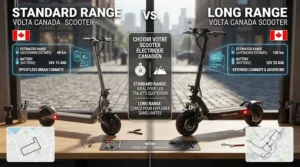
Here’s the question that trips up almost every scooter shopper in Canada: do you actually need a long range electric scooter, or is a standard range electric scooter just… fine? A long range electric scooter, generally, is any model built to travel roughly 50 km or more per charge, while a standard range electric scooter tops out somewhere between 20 and 40 km. That gap sounds academic until you’re standing in your driveway at 6:45 a.m., wondering if the battery will survive the commute home in February slush.

I’ve spent the past few weeks pulling apart spec sheets, cross-referencing manufacturer claims against real owner feedback, and mapping out exactly where the “long range vs standard range electric scooter” debate actually matters for Canadian riders — as opposed to where it’s just marketing noise stapled onto a bigger battery. Range numbers get thrown around like they’re gospel, but a 60 km rating in a lab in Shenzhen and a 60 km ride through Winnipeg headwinds are two very different animals.
This guide breaks down seven real models sold through amazon.ca, spanning budget standard-range runabouts to premium long-range commuters. You’ll get honest commentary on what each spec actually means for your ride, a full comparison of battery weight trade-offs, how your riding style quietly rewrites the manufacturer’s range claim, and — because Canadian winters are their own beast — how often you’ll realistically be charging. According to Ontario’s e-scooter pilot rules, riders also need to keep device weight and speed within provincial limits, which factors into range decisions more than most buyers expect.
Quick Comparison Table
| Scooter | Range Class | Claimed Range | Motor | Best For |
|---|---|---|---|---|
| GoTrax Apex | Standard | ~24 km | 250W | Budget flat-terrain commuting |
| Gyroor C1S | Standard | ~32 km | 550W | Comfort-first neighbourhood rides |
| Hiboy KS4 Pro | Standard/Extended | ~40 km | 500W (750W peak) | Daily mixed commutes |
| NAVEE N65 | Long | 64-72 km | 800W | Value-focused long-range buyers |
| iSinwheel S10Max | Long | 60 km | 1000W | The 60 km daily-use benchmark |
| Segway Ninebot Max G3 | Long | Up to 80 km | 2000W peak | Longest claimed range, multi-mode riding |
| Apollo City | Long | ~69 km | High-torque hub motor | Premium Canadian long-range commuting |
Looking at the spread above, there’s a clear pattern: standard-range scooters in this lineup cluster under 40 km and lean on smaller 250-550W motors, while every long-range model here pairs a bigger battery with a motor rated 800W or higher. That’s not a coincidence — pushing a heavier, higher-capacity battery pack usually calls for more torque just to keep acceleration from feeling sluggish. Budget-conscious commuters with flat, short routes can comfortably skip the extra range and save several hundred dollars; anyone doing daily round trips past 15 km, or riding through hills, should lean toward the long-range half of this table.
💬 Just one click — help others make better buying decisions too!😊
Top 7 Long Range and Standard Range Electric Scooters: Expert Analysis
1. GoTrax Apex — best budget standard-range commuter
The Apex is GoTrax’s entry point, and it wears that “budget” label honestly rather than hiding it behind marketing gloss. A 250W motor and a 36V battery deliver a manufacturer-claimed range of about 24 km (15 miles) at a top speed near 25 km/h — numbers that sound modest until you remember most Canadian commutes to a bus stop or GO station are under 5 km one-way. The 8.5-inch pneumatic tires soak up minor cracks and cobblestones reasonably well, though they trade some durability for that comfort since pneumatic tires are more puncture-prone than solid ones. Based on the spec comparison against pricier models in this list, the Apex is squarely built for flat, short-hop city riding rather than hills or longer treks — buyers wanting a beginner-friendly first scooter, or a dedicated “last kilometre” tool for transit, are the intended audience here. Reviewers consistently report that the in-deck battery placement makes the ride feel more stable than older tiller-mounted designs, though several also note the kick-to-start throttle takes a bit of getting used to. It’s UL 2272 certified for electrical safety, which matters more than people assume when a battery is going to live in a cold garage all winter.
Pros:
- ✅ Genuinely affordable entry point into daily e-scooter commuting
- ✅ In-deck battery improves stability over older top-heavy designs
- ✅ UL 2272 certified for electrical and fire safety
Cons:
- ❌ 24 km range shrinks fast on hills or in cold weather
- ❌ 250W motor struggles noticeably on steeper inclines
Priced under C$400, the GoTrax Apex earns its keep as a low-risk way to try scootering without overspending on range you may never use.
2. Gyroor C1S — comfiest ride in the standard-range class
If the Apex is the no-frills option, the Gyroor C1S is what happens when a brand decides comfort matters as much as commuting speed. Its 550W motor pushes a claimed top speed around 30 km/h with roughly 32 km of range — solidly in standard-range territory, but noticeably stronger than budget entries thanks to the bigger motor and 12-inch vacuum tires. What most buyers overlook about this model is that it’s really designed to feel like a small bike rather than a stand-up commuter: the adjustable, breathable seat fits riders from about 5’1″ to 6’1″, and the shock-absorbing setup takes real sting out of rough pavement and tree-root-buckled sidewalks. That focus on ride quality means less vibration fatigue on 20-30 minute rides, which matters more than raw range for errand-runners and neighbourhood cruisers. The heavy-duty metal frame is rated to 265 lb, giving it a bit more headroom for heavier riders than some competitors in this price bracket. Aggregated review sentiment points to cruise control being a genuine wrist-saver on longer flat stretches, though a few owners note the seated posture takes some adjustment if you’re used to standing scooters.
Pros:
- ✅ Seated design reduces fatigue on longer neighbourhood rides
- ✅ 12-inch vacuum tires handle cracked pavement smoothly
- ✅ Higher 265 lb weight capacity than most budget standard-range models
Cons:
- ❌ Bulkier to fold and store than stand-up-only designs
- ❌ Still standard range, so hilly commutes will drain it fast
In the C$400-C$500 range, the Gyroor C1S suits riders who want comfort over speed and don’t need long-range numbers.
3. Hiboy KS4 Pro — best all-rounder for daily commuting range
The Hiboy KS4 Pro sits right at the border between standard and extended range, and that middle ground is exactly why it’s one of the most popular commuter scooters sold on amazon.ca. Its 500W motor (750W peak) reaches about 30 km/h, while the 36V 11.6Ah battery is rated for up to 40 km per charge — enough for most round-trip commutes without stepping into premium pricing. Based on the spec comparison, the real differentiator here isn’t raw power, it’s the dual braking system (EABS plus a rear disc brake), which reviewers consistently report feels noticeably more controlled than the single-brake setups common on cheaper scooters. The 10-inch honeycomb tires are flat-resistant by design, a smart trade for commuters who can’t afford a surprise puncture on the way to work, though that firmness does translate to a slightly stiffer ride than pneumatic alternatives. Rear suspension takes some edge off that stiffness. The three-part lighting system (headlight, taillight, and side lighting) genuinely stands out for visibility, which matters through a Canadian fall and winter when daylight disappears by 5 p.m. It also holds an IPX4 water-resistance rating, meaning light rain and splashes are fine, but it shouldn’t be ridden through standing water or heavy downpours.
Pros:
- ✅ Dual braking system feels notably safer than single-brake budget models
- ✅ Flat-resistant honeycomb tires cut puncture risk for daily commuters
- ✅ Strong three-light visibility package for dark Canadian evenings
Cons:
- ❌ Honeycomb tires ride firmer than pneumatic alternatives
- ❌ 40 km claimed range still drops meaningfully in cold weather
Sitting in the C$450-C$550 range, the Hiboy KS4 Pro is the pick for riders who want more range than a budget scooter without paying long-range prices.
4. NAVEE N65 — best value long-range pick
Once you cross into long-range territory, the NAVEE N65 is where the value argument gets interesting. An 800W motor paired with a 48V 600Wh battery is rated for 40-45 miles (roughly 64-72 km) — a genuine jump over anything in the standard-range tier — while still landing well below flagship pricing. What the spec sheet won’t tell you, but reviewers note, is that NAVEE’s energy recovery system reportedly boosts real-world range by around 15% over models without regenerative braking tuned this aggressively, which matters a lot once winter temperatures start eating into battery capacity. The 10×3-inch pneumatic tires are wider than most commuter scooters, which helps with stability on uneven pavement and light gravel, and the dual brake system (front E-ABS, rear disc) gives confident stopping power at higher speeds. This is a scooter built for riders doing genuinely long daily distances — think 15-20 km commutes, or weekend rides that would otherwise mean multiple recharges on a standard-range unit. The foldable handle design is a nice practical touch, shrinking storage footprint by more than half compared to older non-folding-handle models in the same lineup.
Pros:
- ✅ Long-range battery covers genuinely long daily commutes
- ✅ Energy recovery system helps offset cold-weather range loss
- ✅ Wide pneumatic tires add stability on rough or gravelly pavement
Cons:
- ❌ Heavier overall package than standard-range alternatives
- ❌ IPX4 rating still means avoiding heavy rain or puddles
At roughly C$650-C$750, the NAVEE N65 delivers long-range numbers without long-range pricing, making it the value pick of this whole lineup.
5. iSinwheel S10Max — the 60 km daily-use benchmark
If you searched specifically for a 60 km range electric scooter for daily use, the iSinwheel S10Max is the model that keeps showing up for good reason. Its 1000W motor and 54.6V 15Ah battery are rated for exactly that 60 km figure, with a top speed near 45 km/h. Here’s what’s easy to miss on a spec sheet: that 60 km rating assumes a fairly light rider at moderate speed, so reviewers consistently report real-world numbers closer to 35-45 km once you factor in a heavier adult rider, hills, or faster cruising speeds — still comfortably ahead of any standard-range scooter, but worth knowing before you plan a 55 km round trip around it. The dual suspension setup (front swing-arm, rear spring) combined with 10-inch pneumatic off-road tires makes this one of the more comfortable long-range rides in this price class, and front-and-rear disc brakes give it stopping power that matches its speed. Aggregated owner sentiment repeatedly praises the acceleration and stability as “better than average” for the price, with the main recurring complaint being the 7-8 hour charge time when using the stock charger — a real consideration if you’re riding daily and need a fast turnaround.
Pros:
- ✅ Genuinely strong range performance backed by a large 15Ah battery
- ✅ Dual suspension and off-road tires smooth out rough city pavement
- ✅ Front and rear disc brakes suited to its higher top speed
Cons:
- ❌ Real-world range runs meaningfully below the 60 km claim for heavier riders
- ❌ 7-8 hour charge time is slow if you ride back-to-back days
In the C$700-C$850 range, the iSinwheel S10Max is the clearest real-world answer to “which long range electric scooter comparison actually holds up.”
6. Segway Ninebot Max G3 — longest claimed range in this lineup
The Segway Ninebot Max G3 is the flagship of this comparison, and its range numbers are, frankly, a little wild: up to 80 km in Eco mode, 64 km in Drive mode, dropping to around 40-55 km in Sport and Sport+ modes at higher speeds. That range flexibility is the real story here — this isn’t one fixed number, it’s a scooter that lets you trade speed for distance on the fly. A 2000W peak motor gets you 0-24 km/h in 2.4 seconds via Boost mode, and the 597Wh battery recharges in about 3.5 hours with the standard charger. Based on the spec comparison, the dual hydraulic suspension and 11-inch self-sealing tubeless tires are a genuine step up in ride quality over every other scooter on this list, and the IPX6 water-resistance rating is the highest of the bunch, meaning it tolerates powerful water jets rather than just light splashes. Reviewers consistently note the TFT colour display and Apple Find My integration as standout conveniences for anyone who’s ever worried about scooter theft. This is the model for riders who want maximum flexibility between commuting efficiency and weekend performance riding without switching scooters.
Pros:
- ✅ Widest range flexibility of any model here, from 40 km to 80 km
- ✅ Hydraulic suspension and self-sealing tires deliver premium ride quality
- ✅ Highest IPX6 water resistance rating in this comparison
Cons:
- ❌ Premium pricing puts it well above mid-range competitors
- ❌ Heavier build makes daily carrying up stairs less practical
Around C$1,300-C$1,600, the Segway Ninebot Max G3 is for riders who want the ceiling of long-range performance and are willing to pay for it.
7. Apollo City — premium Canadian-designed long-range commuter
Rounding out the list is the Apollo City, a scooter designed in Montreal and built specifically with North American commuting patterns in mind. It’s rated for roughly 69 km of range at speeds up to 51 km/h, with an IP66 water-resistance rating that ranks among the toughest in this comparison. Here’s what most spec sheets skip: Apollo puts every model through 10,000 km of in-house lab testing covering rain, heat, vibration, and fatigue before release, which is the kind of durability commentary that matters more in a country with actual winters than a marketing bullet point about top speed. At around 29-29.5 kg, it’s noticeably heavier than the budget and mid-range picks here, and that weight is a direct trade-off for the bigger battery pack and reinforced frame that make the long range possible in the first place. Reviewers and third-party scooter-rating sites consistently score its build quality well above category average, while flagging that comfort and portability take a modest hit compared to lighter commuter scooters. For riders who want long range from a company with a Canadian service network and local support, that trade-off is often worth it.
Pros:
- ✅ Strong 69 km range backed by extensive in-house durability testing
- ✅ IP66 water resistance among the best in this comparison
- ✅ Canadian company with local service and support network
Cons:
- ❌ Noticeably heavier than every other scooter in this lineup
- ❌ Premium C$1,499-C$2,199 price puts it out of reach for casual riders
The Apollo City is the pick for Canadian commuters who want long range plus a company that actually understands Canadian roads and winters.
Practical Usage Guide: Charging Frequency, Setup & Battery Care
Getting a new scooter home is the easy part — the first 30 days are where good habits (or bad ones) get set. Start with a full initial charge before your first ride, even if the battery arrived partially charged; lithium-ion cells settle into a more accurate charge reading after that first complete cycle. From there, charging frequency really depends on your range class: standard-range scooters like the GoTrax Apex or Gyroor C1S covering short daily hops might only need a top-up every 2-3 rides, while long-range models like the iSinwheel S10Max or Segway Ninebot Max G3 can often go several days between charges on a typical commute.
A common early mistake is leaving the scooter charging overnight, every night, out of habit. Lithium-ion batteries degrade faster when kept at 100% for extended periods, so unplugging once it hits full charge — rather than leaving it topped up for eight hours after — genuinely extends long-term battery health. In Canadian winters, store the scooter and battery indoors above 0°C whenever possible; cold cells lose usable capacity temporarily, which is exactly why every range number in this article should be read as a best-case figure. Wipe down tires and check tire pressure weekly if you’re running pneumatic tires, since underinflated tires quietly eat into your range by increasing rolling resistance. Finally, resist the urge to fully drain the battery before recharging — partial charge cycles are actually gentler on lithium-ion chemistry than repeated full discharges.
✨ Don’t Miss These Exclusive Deals!
🔍 Take your scooter shopping to the next level with these carefully selected long-range and standard-range models. Click on any highlighted item to check current pricing and availability. These picks will help you find a genuinely reliable daily commuter without the guesswork!
Real-World Scenarios: Matching Riders to the Right Range
The downtown condo commuter: A 4 km one-way ride to a subway station, flat terrain, daily use. A standard-range scooter like the GoTrax Apex or Gyroor C1S covers this easily with charge to spare, and the lighter weight makes carrying it up a condo elevator far less annoying than hauling a 29 kg long-range model.
The suburban-to-office rider: A 12-15 km one-way commute with a few hills, riding through spring and fall when temperatures swing. This is exactly the gap the Hiboy KS4 Pro or NAVEE N65 fills — enough range to handle the round trip with a safety margin, without spending flagship money on a route that doesn’t need it.
The all-season, all-distance rider: Someone doing 20+ km daily, through a full Canadian winter, who wants range flexibility rather than range anxiety. The iSinwheel S10Max, Segway Ninebot Max G3, or Apollo City all make sense here — the extra battery capacity absorbs the 15-30% range loss that cold weather typically causes, keeping the rider well within a comfortable margin even on the coldest commutes.
Buyer’s Decision Framework: Long Range vs Standard Range
If your daily round trip is under 15 km on mostly flat terrain, choose a standard-range scooter because you’ll rarely use the extra capacity anyway, and you’ll save real money plus carry less weight. If your round trip runs 15-30 km, or includes meaningful hills, choose an extended or long-range model, since standard-range batteries lose their safety margin quickly once terrain or distance pushes past their comfort zone. If you ride through a full Canadian winter and can’t always charge daily, prioritize long range regardless of distance, because cold-weather capacity loss can eat 15-30% of a rated range before you’ve even left the driveway. And if you’re simply unsure, lean toward the next range tier up from what your commute strictly requires — a scooter with range to spare is a minor inconvenience to carry; a scooter that dies four blocks from home is a much bigger one.
Long Range vs Standard Range Electric Scooter: How to Choose
- Measure your actual round-trip distance first. Not the straight-line distance — the real route, including detours around construction or hills you’ll want to avoid.
- Add a 30% buffer for Canadian winter conditions. Cold temperatures are the single biggest hidden range-killer, consistently cited across owner reviews and manufacturer test notes alike.
- Weigh portability against range. Long-range batteries are heavier, so if you’re carrying your scooter up stairs or onto transit daily, that trade-off deserves real consideration, not just a glance at the range number.
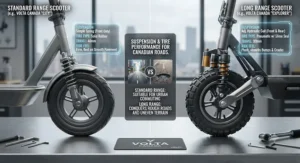
- Check the motor wattage alongside the range figure. A long-range battery paired with a weak motor still struggles on hills — pair range needs with adequate power, especially over 500W if your route includes inclines.
- Factor in charging frequency and your schedule. If you can charge nightly without fail, a standard-range scooter may be all you need; if charging access is inconsistent, long range becomes a practical necessity rather than a luxury.
- Consider tire type and suspension for your terrain. Range means little if the ride is uncomfortable enough that you stop wanting to use the scooter at all.
- Match your budget to your actual use case, not the biggest number. A 24 km scooter used daily beats an 80 km scooter that sits in the closet because it was overkill and overpriced for the commute it was bought for.
Battery Weight Trade-Offs: Why More Range Isn’t Always Better
Every extra kilometre of claimed range comes from somewhere, and that somewhere is almost always a bigger, heavier lithium-ion battery pack. Comparing the lineup above makes this obvious: the GoTrax Apex, at the standard-range end, weighs meaningfully less than the Apollo City or Segway Ninebot Max G3, and that difference is concentrated almost entirely in the battery and the beefier motor needed to move it. What most buyers overlook is that this extra weight isn’t just a carrying inconvenience — it also changes acceleration feel, braking distance, and how tiring the scooter is to fold and lift onto a bus or up a flight of stairs.
There’s also a diminishing-returns curve here that spec sheets never mention. Going from a 24 km standard-range battery to a 40 km extended-range battery adds real, usable capacity for most Canadian commutes. Going from 60 km to 80 km, by contrast, mostly adds weight and cost for range most daily riders will rarely touch, since few commutes genuinely require 80 km of buffer. The honest takeaway: match battery size to your actual worst-case commute distance plus a cold-weather buffer, not to the biggest number on the shelf.
How Riding Style Impacts Real-World Range
Manufacturer range figures are measured under close to ideal conditions — a specific rider weight, flat terrain, a moderate constant speed, and mild temperatures. Real riders rarely match all four. Riding at full throttle instead of a moderate cruising speed can cut range noticeably, since power draw increases sharply (not linearly) as speed climbs — that’s simple physics, not a manufacturing flaw. Frequent hard acceleration from stops, common in stop-and-go city riding, drains a battery faster than smooth, steady cruising at a consistent speed. Hills are an obvious range-eater, but even a heavier rider on flat ground uses more energy per kilometre than a lighter one, since the motor is doing more work against gravity and rolling resistance regardless of terrain.
This is exactly why aggregated review sentiment across every model in this comparison shows a consistent pattern: real-world range typically lands 20-40% below the manufacturer’s claimed figure. A rider who mostly does gentle, flat cruising in eco mode will land near the top of that range; someone doing aggressive stop-and-go riding at max speed through hilly streets will land near the bottom. Knowing your own riding style — and being honest about it — matters more for choosing the right scooter than any single spec on the page.
Long Range Electric Scooter Comparison: Which Model Actually Delivers
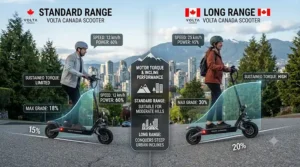
Putting the three genuine long-range models in this lineup side by side tells a more useful story than their marketing pages alone. The NAVEE N65 claims 64-72 km and leans on an efficient energy recovery system to help close the real-world gap. The iSinwheel S10Max claims a flat 60 km and backs it with a larger 15Ah battery, though real-world reports skew toward the lower end of that figure for heavier riders. The Segway Ninebot Max G3 claims up to 80 km, but that number only applies in its slowest Eco mode — switch to Sport+ for speed, and the range figure drops to roughly half that. Independent Canadian scooter research aggregating dozens of models found that claimed range figures typically run 20-40% higher than real-world results, which lines up closely with what individual owner reviews report across all three of these scooters.
The practical conclusion: don’t rank long-range scooters purely by the biggest number on the box. Instead, compare the range figure against the riding mode it was measured in, cross-reference it against real owner reports, and pick the model whose worst-case real-world range still comfortably covers your commute.
A 60 km Range Electric Scooter for Daily Use: Is It Overkill?
For a lot of Canadian commuters, 60 km sounds excessive — and for short, flat, in-city routes, it often is. But run the numbers on a realistic winter scenario: a 15 km round-trip commute, done at a brisk pace in stop-and-go traffic, in temperatures that knock 20-30% off rated capacity. That alone can turn a “40 km” standard-range scooter’s real-world number into something uncomfortably close to that 15 km requirement, with little margin for a detour or a colder-than-expected morning. A genuinely 60 km-rated scooter like the iSinwheel S10Max, even accounting for a 30-40% real-world discount, still leaves a healthy buffer.
So it’s not overkill for everyone — it’s a buffer for people whose commute, climate, or charging schedule leaves little room for error. For a short, flat, fair-weather commute, it absolutely is more range than necessary, and that money is better spent on a scooter with stronger brakes, better suspension, or simply saved.
Common Mistakes When Buying a Long Range Electric Scooter
Buyers repeatedly make a handful of avoidable errors when shopping this category. First, taking the top-line range number at face value without checking which riding mode or rider weight it assumes — that single oversight causes more post-purchase disappointment than any hardware issue. Second, ignoring motor wattage relative to hills on their actual route; a long-range battery paired with an underpowered motor still crawls uphill. Third, underestimating weight: a scooter that’s genuinely comfortable to carry up three flights of stairs matters as much as its range figure for many urban Canadian renters. Fourth, skipping tire type consideration — solid tires resist punctures but ride rougher, while pneumatic tires ride smoother but need occasional pressure checks and are more puncture-prone. Fifth, overlooking water resistance ratings entirely, which matters enormously given how often Canadian commutes include rain, slush, or wet leaves underfoot.
Long-Term Cost & Maintenance: Battery Replacement and ROI
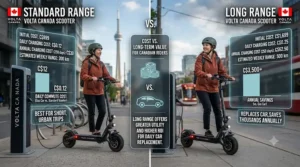
Sticker price is only part of the ownership cost. Most lithium-ion scooter batteries hold up well for roughly 500-1,000 charge cycles, translating to somewhere in the 2-4 year range depending on how hard the battery is used and how well it’s cared for. A long-range scooter used for a short commute may see fewer full-depth discharge cycles relative to its capacity, potentially extending its usable battery life compared to a standard-range scooter working closer to its limit every single day. That’s a subtle but real cost-of-ownership factor rarely mentioned alongside the sticker price.
Tires, brake pads, and occasional bearing maintenance are fairly consistent across range classes, though heavier long-range scooters do put more cumulative wear on tires and brakes over time. When a replacement battery is eventually needed, expect it to represent a meaningful fraction of the original scooter’s price — often worth weighing against simply upgrading to a newer model, especially as battery technology and range figures continue improving year over year.
Safety, Regulations & Compliance Guide for Canadian Riders
Range and speed don’t exist in a legal vacuum in Canada. Rules vary meaningfully by province and even by municipality, so checking local bylaws before riding any of these scooters on public roads is essential, not optional. Ontario, for example, runs an e-scooter pilot program that municipalities can opt into, with speed caps and age minimums set at the provincial level, while cities like Toronto have historically prohibited e-scooters on public roads entirely — a distinction that trips up a lot of new riders. As CBC reported when Ontario’s pilot program launched, riders must be at least 16 years old and scooters are generally capped at 32 km/h, rules that several models in this comparison can technically exceed in their higher-speed riding modes.
Beyond legality, look for UL 2272 certification (electrical and fire safety for the battery and motor system) on any scooter you’re considering, regardless of range class — several models in this lineup carry it, and it’s a meaningful baseline safety standard rather than a nice-to-have. Helmets are strongly recommended across the board even where not legally mandatory, and higher-range, higher-speed models in particular warrant more protective gear given their higher top speeds.
Frequently Asked Questions
❓ What's the real difference between long range and standard range electric scooters?
❓ How much range do electric scooters lose in Canadian winters?
❓ Is a 60 km range electric scooter enough for daily use?
❓ Do heavier long-range batteries slow down acceleration?
❓ How often should I charge my electric scooter battery?
Conclusion
The long range vs standard range electric scooter decision really comes down to one honest question: what does your actual commute demand, in the worst realistic conditions you’ll ride in? Budget-conscious, short-distance city riders are well served by standard-range picks like the GoTrax Apex or Gyroor C1S, while daily commuters covering longer distances, hills, or full Canadian winters get genuine value from long-range models like the NAVEE N65, iSinwheel S10Max, Segway Ninebot Max G3, or Apollo City. The Hiboy KS4 Pro sits neatly in between for riders who aren’t quite sure which camp they fall into. Whichever tier fits your ride, buy for your actual worst-case commute rather than the biggest number on the spec sheet, and the extra range — or the money saved by skipping it — will feel like the right call every single ride.
✨ Ready to Find Your Perfect Scooter?
🔍 Compare current pricing on any of these seven picks and match your daily commute to the right range class. A little research now saves a lot of range anxiety later!
Recommended for You
- 7 Best Electric Scooter for Long Commutes Picks in 2026
- Cheap Long Range Electric Scooter Picks: 7 Tested for 2026
- Top Long Range Electric Scooters Under $1200 CAD: 7 Picks for 2026
Disclaimer: This article contains affiliate links. As an Amazon Associate, I earn from qualifying purchases. If you purchase products through these links, we may earn a small commission at no additional cost to you.
✨ Found this helpful? Share it with your friends! 💬🤗
