
In This Article
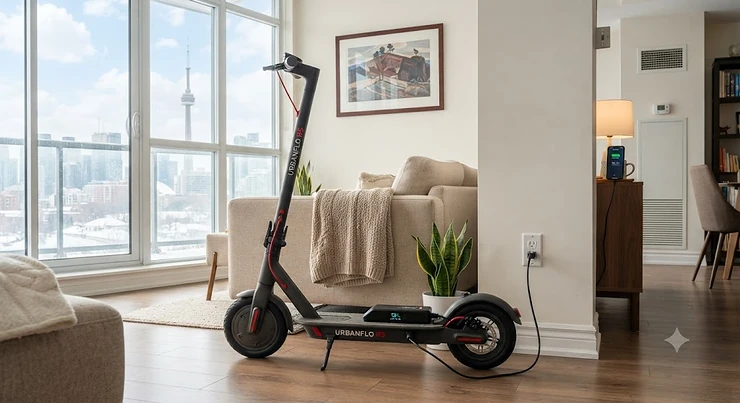
If you’ve ever dragged a 50-pound scooter up three flights of stairs just to reach the only outlet in your apartment that isn’t already claimed by a lamp, a router, and a suspiciously ambitious air fryer, you already understand the problem this article solves. An electric scooter for apartment charging isn’t really about the scooter — it’s about the battery, the building rules wrapped around it, and the six inches of hallway space you’re allowed to occupy without your neighbour giving you “the look.” Condo boards across the country have gotten twitchy about lithium-ion batteries lately, and honestly, after a recent e-scooter battery scare in a Dartmouth apartment building, a Nova Scotia fire official publicly urged residents to use quality chargers, avoid overnight charging, and never leave a device charging in a hallway or exit path — which tells you this isn’t a hypothetical concern dreamed up by anxious landlords.
So what actually makes a scooter “apartment-friendly”? In short: a battery you can pop out with one hand, carry to your unit in a tote bag, and charge on a hard surface away from your bed, paired with a scooter frame you’re not obligated to haul indoors at all. That’s the whole game. Over the next several thousand words, we’re going to dig into seven real, currently available scooters with removable or swappable batteries, break down what building charging policies actually require of you, talk honestly about battery carrying weight (because a “removable” battery that weighs 15 pounds isn’t removable, it’s a chore), and walk through fire-safety charging practices that could genuinely save your building from a very bad night. None of this is going to read like a spec sheet you copied off Amazon — every product here gets an honest, sourced take on who it’s actually for, based on real specifications and aggregated reviewer sentiment, not invented anecdotes.
What Is an Electric Scooter for Apartment Charging?
An electric scooter for apartment charging is any e-scooter built with a detachable or swappable battery pack — typically 3 to 15 pounds — that riders can remove from the deck or stem and carry indoors, eliminating the need to bring the entire frame inside or run an extension cord out to a bike rack. The defining feature isn’t range or top speed; it’s whether the power source separates cleanly from the vehicle.
Quick Comparison Table
| Scooter | Battery Weight | Removable? | Range | Best For |
|---|---|---|---|---|
| Levy Plus | 5 lbs | Yes, tool-free | Up to 20 mi/battery | Lightweight urban commuting |
| Hiboy S2R Plus | 4.8 lbs | Yes, keyed lock | Up to 22 mi | Budget-conscious first-timers |
| ANYHILL UM-2 | 5 lbs | Yes | Up to 17 mi | Ultra-light spare-battery carrying |
| TurboAnt V8 | 7.5 lbs (stem unit) | Partial (1 of 2) | Up to 50 mi combined | Long, multi-stage commutes |
| EMOVE RoadRunner V2 | 15 lbs | Yes, keyed | Up to 35 mi | Seated comfort commuting |
| Apollo Explore 2.0 | ~9 lbs (est.) | Yes, quick-swap | Up to 60 km | Canadian riders wanting UL-certified power |
| HX X6 | 6.6 lbs | Yes | Up to 13 mi | Backpack-sized micro-commutes |
Looking at this table, a clear pattern shows up fast: the lighter the removable battery, the shorter the range, and that trade-off is the single biggest decision you’ll make when shopping for an electric scooter for apartment charging. The TurboAnt V8 breaks the pattern slightly by keeping one battery fixed in the deck and only one removable in the stem, which extends range without making the whole pack unliftable. Riders prioritizing effortless daily carrying should lean toward the Hiboy S2R Plus or ANYHILL UM-2, while anyone commuting more than 15 km one-way should look at the Apollo Explore 2.0 or EMOVE RoadRunner V2 despite their heavier packs.
💬 Just one click — help others make better buying decisions too!😊
Top 7 Electric Scooters for Apartment Charging: Expert Analysis
Building charging bans and battery weight limits mean the “best” scooter for a dorm room isn’t the same as the best one for a family of four in a downtown condo. The seven picks below cover budget, mid-range, and premium tiers, and every single one was chosen specifically because its battery detaches from the frame — not because it topped a generic “best scooters” list somewhere else.
1. Levy Plus — fastest tool-free battery swap on the market
The standout here is speed: Levy’s battery pops out in under ten seconds with no tools, no keys, and no fumbling in a dim hallway. The 36V, 12.8Ah (460Wh) pack weighs just 5 pounds and rides in the scooter’s stem, while the frame itself tips the scale at 30 pounds — light enough that some renters even bring the whole scooter inside on move-in day and then never do it again. Based on the spec comparison, the Panasonic 18650 cells housed in a fireproof, waterproof metal casing are a meaningful upgrade over the generic pouch cells found in cheaper imports, and that casing matters more than most buyers realize when a building’s fire-safety policy specifically calls out battery enclosure quality. Reviewers consistently note the Levy Plus feels most at home with commuters doing 5 to 10 km daily trips who value simplicity over raw range; riders chasing 30+ km round trips tend to find the 20-mile-per-battery ceiling limiting unless they buy a second pack. Aggregated user feedback on the swap mechanism is largely positive, though a recurring theme in owner reviews is that the six-month base warranty feels short compared to competitors, making the paid warranty extension worth serious consideration.
Pros:
- ✅ Battery swaps in under 10 seconds, no tools needed
- ✅ Fireproof, waterproof metal battery casing
- ✅ Lightweight 30 lb frame for stair-carrying days
Cons:
- ❌ Base warranty is only six months
- ❌ 20-mile range per battery limits longer commutes
At around C$950-C$1,050, the Levy Plus sits in the sweet spot for renters who want a genuinely apartment-first design without stretching into premium territory — check current price before buying, as promotions shift regularly.
2. Hiboy S2R Plus — lightest removable battery under C$700
What immediately stands out is the 4.8-pound battery — light enough to toss in a tote bag alongside your groceries without a second thought. The 313Wh pack removes with a simple turn-of-key mechanism, and the 350W motor (500W peak) is rated for hills up to 15 degrees, which on paper means it’ll handle a typical parking garage ramp or a moderate street grade without stalling out. What most buyers overlook about this model is that the theft-deterrent design of the keyed battery lock does double duty: it also prevents accidental removal while riding, something cheaper toolless designs occasionally get wrong. Reviewers consistently report the 9-inch pneumatic tires provide meaningfully better shock absorption than the solid tires found on scooters at this price point, which matters if your commute includes any cobblestone, transit-grate, or pothole-riddled stretches. A common theme in aggregated feedback is that the 22-mile range comfortably covers a week of short apartment-to-transit trips before a recharge is needed, though colder Canadian winters will trim that number down noticeably. The optional spare battery, sold separately, doubles range to roughly 44 miles for riders willing to carry two light packs instead of one heavier one.
Pros:
- ✅ Battery weighs just 4.8 lbs — easiest to carry daily
- ✅ Keyed lock deters theft and accidental removal
- ✅ Pneumatic tires smooth out rough pavement
Cons:
- ❌ 22-mile range shrinks noticeably in cold weather
- ❌ 19 mph top speed feels slow on longer routes
Priced in the C$550-C$650 range at the time of research, the Hiboy S2R Plus is arguably the most apartment-practical budget option on this list — prices may vary, so check current listings.
3. ANYHILL UM-2 — lightest detachable battery in this roundup
The headline feature is weight: at roughly 5 pounds, the UM-2’s LG-cell battery is among the lightest detachable packs available on any commuter scooter, which is a genuine advantage if you’re climbing stairs daily rather than taking an elevator. The 36V lithium pack uses fast-charge technology and extends total range to about 50 miles when paired with a second battery, a smart move for anyone who wants long-range flexibility without ever lifting a heavy single unit. Here’s what to weigh: the UM-2’s base range tops out around 17 miles on a single charge, which is honest but modest, so this scooter rewards riders who buy the spare rather than those hoping one battery covers a full week. The wide deck and balanced throttle response get consistent praise in aggregated owner feedback, particularly from newer riders who found twitchier throttles on competing budget models harder to control. What the spec sheet won’t tell you, but user reports suggest, is that the battery’s IPX6 rating (more water-resistant than the scooter’s own IP54 body rating) reflects a deliberate design choice, since a battery that spends time in a bag or hallway needs better splash protection than one sealed inside a frame.
Pros:
- ✅ One of the lightest removable batteries available
- ✅ Battery rated IPX6, more water-resistant than the frame
- ✅ Spare battery option extends range to 50 miles
Cons:
- ❌ Base range of 17 miles is modest without a spare
- ❌ Limited availability through mainstream Canadian retailers
Expect to pay somewhere in the C$500-C$600 range for the ANYHILL UM-2 — availability shifts often, so confirm current stock and pricing before ordering.
4. TurboAnt V8 — dual-battery range without a single heavy lift
The clever engineering here is the split battery design: one 36V, 7.5Ah pack lives permanently in the deck, while an identical second pack detaches from the stem for independent charging, together delivering a manufacturer-claimed 50 miles of combined range. Based on the spec comparison, this hybrid approach solves a real apartment problem — you get long-range capability without needing to detach and carry a single 15-pound monster battery, since only the stem unit (roughly 7.5 pounds) needs to come inside. The 450W motor with disc and electronic braking handles Canadian city hills reasonably well, though reviewers consistently note that real-world range tends to land closer to 20-25 miles rather than the advertised 50, a gap common across the entire e-scooter category and worth mentioning honestly rather than repeating the marketing number. A recurring theme in aggregated feedback is that the 47-pound total weight makes this a poor choice for anyone without elevator access, since even with the stem battery removed, the frame itself remains a genuine two-hands-and-a-grunt carry up stairs. The included charging dock and dual adapters are a thoughtful touch, letting you charge both packs simultaneously overnight — provided your building’s fire-safety policy allows unattended overnight charging, which increasingly many do not.
Pros:
- ✅ 50-mile combined range from dual batteries
- ✅ Only the lighter stem battery needs to come inside
- ✅ Bike-lock slot deters theft while parked
Cons:
- ❌ 47 lb total weight is hard to carry up stairs
- ❌ Real-world range runs well under advertised figures
At a price range of C$750-C$950, the TurboAnt V8 appeals most to commuters with elevator buildings and genuinely long routes — check current price, as this model sees frequent seasonal discounting.
5. EMOVE RoadRunner V2 — seated comfort with a backpack-sized battery
What sets the RoadRunner V2 apart is comfort paired with portability: it’s a seated, pegged scooter (not a bicycle, despite appearances) with a 48V, 1253Wh Dynavolt battery that removes via a pull-out handle and keyed lock, and at roughly 15 pounds, it’s genuinely light enough to sling into a backpack. The dual-motor setup and 35-mile tested range mean this model outperforms most standing scooters in this article on comfort and distance simultaneously, which matters for anyone whose knees have opinions about standing for a 12 km commute. Reviewers consistently note the battery, while heavier than the sub-5-pound packs on this list, still charges from empty in a few hours and is far more manageable than hauling the full 50-pound seated frame into a unit. On paper this means renters get long-range, seated comfort while still meeting most buildings’ “no full e-vehicle indoors” charging rules, since only the battery — not the scooter — needs to come inside. A common complaint in aggregated user reviews is that the seated, pegged design confuses some condo bylaws that draw distinctions between “e-bikes” and “e-scooters,” so it’s worth checking your specific building’s language before assuming this model is covered under either category.
Pros:
- ✅ Removable 15 lb battery, light enough for a backpack
- ✅ Seated comfort over long commutes
- ✅ Dual motors handle inclines with ease
Cons:
- ❌ 15 lb battery is heavier than standing-scooter packs
- ❌ Bylaw ambiguity between “e-bike” and “e-scooter” categories
Pricing typically falls in the C$1,600-C$2,000 range for the EMOVE RoadRunner V2 — as with all premium models, confirm current pricing directly, since seated scooters see frequent bundle promotions.
6. Apollo Explore 2.0 — Canadian brand with quick-swap, UL-certified power
Apollo is a Canadian company, and the standout feature of the Explore 2.0 is a quick-swappable battery system that releases with a single push-button, paired with a 648Wh pack that Apollo states is fully certified to UL standards, giving apartment riders documented assurance rather than a vague manufacturer promise. The dual-suspension, 1650W peak motor delivers a claimed 60 km of Eco-mode range, and what most buyers overlook about Apollo specifically is the lifetime frame warranty, a rarity in a category where most competitors cap coverage at six to twelve months. Based on the spec comparison, the Explore 2.0’s self-healing tubeless tires and IP66 water resistance make it one of the more weather-ready options here, which matters through a Canadian winter more than almost any other spec on this list. Reviewer sentiment aggregated across Apollo’s own customer feedback and third-party retailers consistently highlights build quality and ride smoothness as standout strengths, though a recurring theme is that the quick-swap battery, while genuinely fast to remove, weighs more than the ultra-light packs on cheaper models — a reasonable trade-off given the higher-capacity cell count. For Canadian renters specifically, buying from a company with domestic warranty support and shipping is a practical advantage that’s easy to underrate until you actually need a replacement part shipped from overseas.
Pros:
- ✅ UL-certified 648Wh battery with quick push-button swap
- ✅ Lifetime frame warranty from a Canadian company
- ✅ IP66 rating and self-healing tires suit Canadian weather
Cons:
- ❌ Swap battery is heavier than budget-tier packs
- ❌ Premium price puts it out of reach for casual riders
The Apollo Explore 2.0 typically lands in the C$1,800-C$2,200 range — Apollo runs frequent seasonal sales, so check current pricing on their site before assuming the sticker price is final.
7. HX X6 — smallest backpack-portable scooter with removable power
The defining feature of the X6 is sheer compactness: at just 22 pounds and small enough to fit inside a standard backpack when folded, it’s built specifically for riders who combine scooting with transit rather than replacing a car entirely. The 36V, 5Ah removable battery weighs roughly 6.6 pounds and slides out for independent charging, and here’s what to weigh: the 250-350W motor and 12-13 mile range are modest by commuter standards, but that’s the honest trade-off for a scooter this small. Reviewers consistently note that the compact 5.5-inch solid tires handle smooth sidewalks and bike lanes fine but transmit far more road vibration than the 9- or 10-inch pneumatic tires found on larger models in this article, which matters if your commute includes rough pavement. A common theme in aggregated feedback is that the app-based lock and speed-limit controls are a nice added layer of security for a scooter this easy to carry and, unfortunately, this easy to have stolen if left unattended. What most buyers overlook is that the X6’s tiny footprint makes it genuinely one of the only scooters on this list that satisfies even the strictest building policies limiting “personal mobility device” size in common areas, since the folded unit barely qualifies as a device at all.
Pros:
- ✅ Folds small enough to fit in a backpack
- ✅ 6.6 lb battery is easy to carry daily
- ✅ App-based lock adds theft deterrence
Cons:
- ❌ 12-13 mile range suits only short hops
- ❌ Solid tires transmit more vibration on rough roads
Available for under C$350 at the time of research, the HX X6 is the most budget-friendly and space-conscious pick here — as always, verify current pricing before purchase.
Top 7 Products: Specs & Value Comparison
| Scooter | Motor | Battery Weight | Top Speed | Price Range (CAD) | Best For |
|---|---|---|---|---|---|
| Levy Plus | 350W | 5 lbs | 19-20 mph | C$950-C$1,050 | Simplicity & speed of swap |
| Hiboy S2R Plus | 350W (500W peak) | 4.8 lbs | 19 mph | C$550-C$650 | Budget daily riders |
| ANYHILL UM-2 | ~250-350W | 5 lbs | ~15-19 mph | C$500-C$600 | Ultra-light carrying |
| TurboAnt V8 | 450W | 7.5 lbs (partial) | 20 mph | C$750-C$950 | Long, multi-leg commutes |
| EMOVE RoadRunner V2 | Dual motor | 15 lbs | ~20 mph | C$1,600-C$2,000 | Seated comfort |
| Apollo Explore 2.0 | 1650W peak | ~9 lbs (est.) | ~40 km/h | C$1,800-C$2,200 | Canadian, weatherproofed |
| HX X6 | 250-350W | 6.6 lbs | 16 mph | Under C$350 | Backpack portability |
The value story here isn’t linear with price — the Hiboy S2R Plus and ANYHILL UM-2 deliver nearly identical apartment-charging convenience to scooters costing three times as much, while the Apollo Explore 2.0 justifies its premium mainly through UL certification and Canadian warranty support rather than raw range. If your building enforces strict weight or size limits on personal mobility devices in common areas, the HX X6 is worth serious consideration purely on footprint alone, even though its range is the weakest of the seven.
✨ Don’t Miss These Exclusive Deals!
🔍 Take your apartment commute to the next level with these carefully selected picks. Click on any highlighted scooter above to check current pricing and availability. The right removable-battery setup will save you stairs, save your building’s fire marshal a headache, and get you to work without the hallway drama! 🔋
Practical Usage Guide: Your First 30 Days of Apartment Charging
Bringing home a new electric scooter for apartment charging is exciting right up until you realize nobody handed you a manual for the social and logistical side of things. Start by identifying exactly where you’ll charge — ideally a hard, non-combustible surface like a kitchen counter or entryway tile, never a carpeted bedroom floor or anywhere near your bed. During the first week, charge in shorter bursts rather than letting the battery fully deplete every time; most lithium packs, including the ones on the Levy Plus and Hiboy S2R Plus, actually prefer staying between 20% and 80% for long-term health rather than constant full cycles.
A common first-month mistake is charging overnight while asleep, which safety officials specifically warn against because early signs of battery failure — swelling, odd smells, unusual heat — go unnoticed while you’re unconscious. Instead, charge while you’re home and awake, ideally during an evening you’re puttering around anyway. Keep the original charger; a mismatched third-party charger is one of the most common causes of overheating incidents reported by fire departments. Finally, register your scooter’s serial number with the manufacturer if the option exists — it makes recall notifications and warranty claims dramatically faster, and recalls on lower-tier battery packs happen more often than most new owners expect.
Real-World Scenarios: Matching Riders to Removable-Battery Scooters
Consider three realistic Canadian renters. First, a graduate student in a fourth-floor walk-up with no elevator, commuting 4 km to campus daily — for her, the HX X6 or Hiboy S2R Plus makes the most sense, since both keep total carrying weight low and neither battery exceeds five pounds, meaning stair climbs stay manageable even on tired mornings.
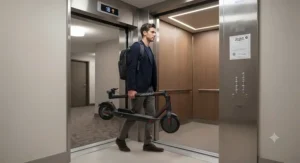
Second, a condo-dwelling professional in an elevator building commuting 12 km each way through a mixed bike-lane and road route — this rider benefits more from the TurboAnt V8 or Apollo Explore 2.0, since elevator access removes the stair-carrying concern entirely, freeing them to prioritize range and weather resistance instead. Third, imagine a rideshare-averse commuter with knee pain who needs a seated option and lives in a building with a designated ground-floor charging nook — the EMOVE RoadRunner V2 fits this scenario precisely, combining seated comfort with a battery light enough to carry to that nook without aggravating anything. In all three cases, the “best” scooter isn’t universal; it’s a function of floor number, elevator access, commute distance, and physical comfort, which is exactly why a one-size-fits-all recommendation would do these very different riders a disservice.
Problem → Solution: Common Apartment Charging Headaches
Problem: My building just banned charging in units entirely. Solution: look for buildings offering a designated, ventilated charging room — a growing number of Canadian condos are adding these specifically for e-bikes and e-scooters — or ask your property manager about installing one, since insurers increasingly favour buildings with structured charging areas over ad-hoc in-unit setups.
Problem: The battery is too heavy to carry comfortably every day. Solution: switch to a sub-6-pound pack like those on the Hiboy S2R Plus or ANYHILL UM-2, even if it means slightly shorter range, since a battery you actually carry consistently beats a heavier one you start leaving on the scooter out of fatigue (which defeats the entire point).
Problem: My scooter’s battery won’t hold a charge like it used to. Solution: this is usually normal capacity fade after 300-500 cycles, but it’s also a signal to inspect the casing for cracks or swelling before continuing to charge it — a compromised battery should be isolated, not charged “just to see.”
Problem: I don’t have anywhere to charge that isn’t near flammable furniture. Solution: a metal tray or fireproof charging bag (inexpensive and widely available) creates a buffer even in tight apartments, and it’s worth the roughly C$30-C$50 investment for genuine peace of mind.
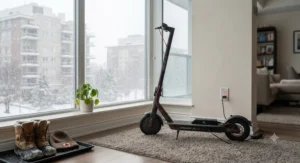
How to Choose an Electric Scooter for Apartment Charging
Choosing the right electric scooter for apartment charging comes down to seven practical criteria, each worth weighing before you buy:
- Battery weight first, range second. A battery you’ll actually carry daily matters more than one that promises extra miles you’ll rarely use.
- Check your building’s specific policy. Some buildings ban indoor charging outright; others only require UL/CSA-certified batteries.
- Confirm the removal mechanism. Toolless swaps (like the Levy Plus) beat keyed locks for daily convenience, though keyed locks add theft deterrence.
- Match range to your real commute, not the manufacturer’s best-case number, which typically overstates real-world distance by 20-40%.
- Factor in elevator access. If you’re climbing stairs daily, total scooter weight matters almost as much as battery weight.
- Look for third-party safety certification, since Canada currently lacks a mandatory federal standard for micromobility batteries.
- Budget for a spare battery if your commute exceeds the single-battery range, rather than buying an oversized primary pack you’ll struggle to carry.
Removable Battery Electric Scooter for Commuters: Why It Wins in Apartments
A removable battery electric scooter for commuters solves a problem that fixed-battery models simply can’t: it separates the part that needs charging from the part that needs storing. With a fixed-battery scooter, charging means either wheeling the entire frame indoors — often against building rules — or running an extension cord to an outdoor outlet, which most buildings also prohibit for safety and liability reasons. Removable-battery models flip that entirely; the frame can stay locked in a bike room or hallway rack (where permitted) while only the compact battery pack comes inside.
| Factor | Removable-Battery Scooter | Fixed-Battery Scooter |
|---|---|---|
| Indoor charging | Battery only, easy | Entire frame required |
| Building policy fit | Generally compliant | Often violates bylaws |
| Theft exposure while parked | Lower (battery removed) | Higher (full unit exposed) |
| Weight to carry indoors | 4-15 lbs | 25-55 lbs |
| Replacement cost if damaged | Battery only | Often entire unit |
The practical upshot is clear from the table: removable-battery models shift both convenience and risk in the renter’s favour. A fixed-battery scooter parked outside overnight is a theft target and a weatherproofing gamble, whereas a removable-battery model leaves an empty, less valuable frame outside while the expensive, fire-sensitive component comes inside under your control. The one caveat worth noting honestly is that heavier removable packs, like the 15-pound unit on the EMOVE RoadRunner V2, erode some of that convenience — a removable battery you dread lifting isn’t meaningfully better than a fixed one for daily use.
Building Charging Policies: What Condos and Property Managers Actually Require
Building charging policies have shifted dramatically over the past two years, and pretending otherwise will only get your scooter confiscated or your lease flagged. According to insurance industry reporting on Toronto’s lithium-ion battery fire trend, property managers and condo boards are now treating battery storage policy and designated charging areas as a specific loss-prevention issue rather than folding it into generic fire-safety guidance, which means the vague “no candles” rule from 2015 no longer covers what your building actually expects from you today. Across major cities including Vancouver, Toronto, Montreal, and Calgary, condo boards and property managers have been rolling out new rules around e-bike and e-scooter storage and charging: some buildings now require specific safety certifications, others restrict charging to designated areas with fire suppression equipment, and a growing number have banned indoor charging entirely.
Practically, this means you should request your building’s written policy in advance of buying anything — not after. Ask specifically whether UL 2272 or UL 2849 certification is required, whether charging is permitted in-unit at all, whether there’s a designated common-area charging station, and whether overnight charging is restricted. If your building has no formal policy yet, that’s not a green light — it often means the rules are coming, and buying a certified, removable-battery scooter now protects you from having to replace an incompatible model later. Property managers report that buildings with a dozen or more e-bikes and e-scooters concentrated in individual units create outsized fire-liability exposure, which is exactly the scenario a removable, individually-charged battery is designed to avoid.
Battery Carrying Weight: What It Means for Your Daily Commute
Battery carrying weight sounds like a minor spec until you’re doing it twice a day, every day, for years. A 5-pound battery, like those on the Hiboy S2R Plus or ANYHILL UM-2, is roughly the weight of a bag of flour — genuinely easy to sling into a tote or backpack without a second thought. A 15-pound battery, like the pack on the EMOVE RoadRunner V2, is closer to a small dumbbell, and while that’s manageable for many riders on flat ground, it becomes a real consideration on a fourth-floor walk-up climbed twice daily.
Here’s what to weigh: heavier batteries generally mean longer range, since more cells fit inside a bigger, heavier enclosure, so the trade-off between carrying comfort and distance is essentially unavoidable engineering physics, not a marketing failure. Riders with mobility considerations, small frames, or long stair climbs should prioritize sub-7-pound batteries even if it means accepting a shorter range or budgeting for a second pack. On the other hand, riders with elevator access or ground-floor units can reasonably prioritize range and accept a heavier pack, since the weight penalty only shows up occasionally rather than on every single trip. The honest bottom line: don’t buy based on range alone — carry the battery (or a similarly weighted object) around your actual building before committing, if a retailer’s showroom allows it.
Fire-Safety Charging Practices Every Apartment Rider Should Follow
Fire-safety charging practices aren’t optional guidelines for apartment dwellers — they’re the difference between a routine commute and a very bad conversation with your building’s fire marshal. The Canadian Forces Fire Marshal’s public safety guidance specifically urges people to stop using any lithium-ion device immediately if it smells strange, feels hot, swells, or makes popping or hissing sounds, and to move it away from anything flammable and call the fire department if any of those signs appear. That’s not overcautious advice; it reflects a genuine and growing incident pattern.
Certification matters more than most riders realize. Testing bodies like CSA Group evaluate the entire electrical system of e-mobility devices — battery, charger, motor, and wiring — against fire and shock hazards, and choosing a scooter with recognized certification (UL 2272 for the device, UL 2271 for the battery pack) genuinely reduces failure risk compared to uncertified imports. Beyond certification, a short list of habits covers most of the real-world risk: always use the charger that shipped with your specific scooter rather than a generic universal charger; charge on a hard, non-flammable surface, never a bed, sofa, or carpeted area; avoid charging directly beside your unit’s only exit or in a hallway that blocks egress; unplug once charging completes rather than leaving it connected indefinitely; and inspect the casing periodically for cracks, dents, or swelling, especially after the battery has been dropped or knocked. This guidance reinforces one consistent message across every Canadian fire-safety source: treat lithium-ion batteries with the same seriousness you’d give a space heater, because in energy-storage terms, that’s essentially what they are.
Long-Term Cost & Maintenance for Apartment Charging
The sticker price of a scooter is only part of the total cost of ownership, and removable-battery models change that math in a genuinely useful way. Because the battery is the component most prone to degradation, a scooter with a separately replaceable pack — like every model in this article — lets you swap in a fresh C$150-C$400 battery after 500-800 cycles rather than replacing the entire C$600-C$2,200 scooter once range noticeably drops. That’s a meaningful long-term savings compared to fixed-battery designs, where a dead battery often means the whole unit is effectively junk unless you’re comfortable with DIY cell replacement.
Maintenance costs stay modest across this category: expect to replace tires every 12-18 months of regular use (roughly C$30-C$60 per pair depending on pneumatic versus solid), brake pads occasionally, and to budget for the eventual battery swap mentioned above. Cold Canadian winters accelerate both tire wear and battery degradation, so riders in colder provinces should expect to land toward the earlier end of those replacement windows. Storing your removable battery at roughly 50% charge during extended non-use — say, if you switch to boots and transit for a snowy month — meaningfully extends its long-term lifespan compared to storing it fully charged or fully depleted.
Common Mistakes When Buying an Electric Scooter for Apartment Charging
The most frequent mistake is buying based on advertised range alone, ignoring battery weight entirely, and then discovering the “convenient” removable battery is too heavy to actually want to carry daily. A close second is skipping the building policy check until after purchase, which occasionally results in an expensive scooter that technically can’t be charged where the buyer lives. Buyers also commonly assume all “UL certified” claims are equivalent, when in fact UL 2272 (the device), UL 2271 (the battery pack), and UL 2849 (the full electrical system, more common on e-bikes) cover different scopes — a scooter listing only one of these isn’t necessarily unsafe, but it’s worth knowing which standard actually applies. Finally, many first-time buyers underestimate how much winter temperatures cut real-world range, leading to disappointment that a slightly more conservative expectation would have avoided entirely.
FAQ
❓ Can I charge an electric scooter battery in my apartment?
❓ Are removable battery scooters safer than fixed-battery models for condos?
❓ How heavy is a removable scooter battery?
❓ Do condo boards actually enforce e-scooter charging policies?
❓ What certification should I look for on a scooter battery?
Conclusion
Choosing an electric scooter for apartment charging really comes down to an honest inventory of your own building and body: how many stairs, how far you’re commuting, and how much weight you’re genuinely willing to carry every single day without quietly starting to resent it. The Hiboy S2R Plus and ANYHILL UM-2 cover the light-and-budget end beautifully, the TurboAnt V8 and EMOVE RoadRunner V2 suit longer, elevator-assisted commutes, and the Apollo Explore 2.0 rewards Canadian riders willing to pay for certified, weatherproofed performance. The Levy Plus remains the benchmark for swap speed, and the HX X6 wins on sheer, backpack-ready portability.
None of these choices matter much, though, if fire-safety charging practices get ignored — as the federal government’s own guidance puts it bluntly: charge smart, charge safe. Pair the right scooter with the right habits, confirm your building’s charging policy in writing, and you’ll spend far more time actually commuting than negotiating hallway logistics.
✨ Ready to Ditch the Stair-Carrying Struggle?
🔍 Compare the seven picks above and check current pricing before you buy. The right removable-battery scooter means less hauling, fewer building headaches, and a commute that finally works with your apartment instead of against it! 🔋
Recommended for You
- Affordable Fast Charging Electric Scooter: 7 Best 2026 Picks
- 7 Fast Charging Scooter Picks for Daily Use in Canada (2026)
- 7 Best Extended Range Scooter for Delivery Riders Picks (2026 CA)
Disclaimer: This article contains affiliate links. As an Amazon Associate, I earn from qualifying purchases. If you purchase products through these links, we may earn a small commission at no additional cost to you.
✨ Found this helpful? Share it with your friends! 💬🤗
