
In This Article
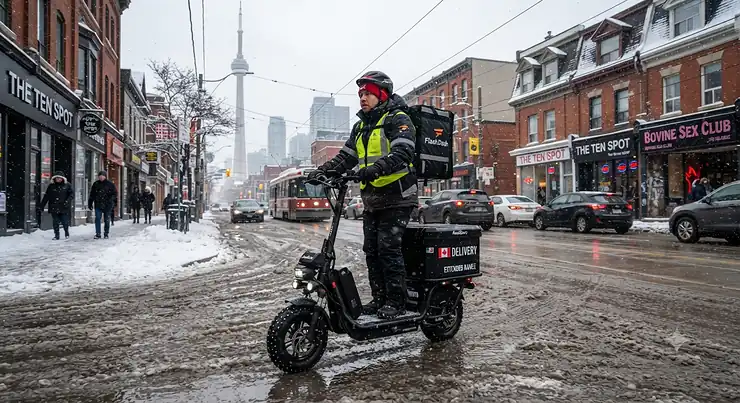
Somewhere around your fourth battery-anxiety moment of a Tuesday shift, you start doing the math nobody warns you about. An extended range scooter for delivery riders isn’t a luxury add-on — it’s the difference between finishing your shift on your own terms or limping the last three kilometres at half speed, praying the app doesn’t ping you for one more drop-off. Most delivery riders don’t fail because they’re slow. They fail because their battery quits an hour before their motivation does.
This guide skips the marketing fluff and gets into what actually matters for gig work: verified range figures (not the optimistic ones printed on the box), cargo-carrying capability, weatherproofing for Canadian winters, and — critically — the regulatory landscape that decides whether your new ride is even legal to use for paid deliveries in your city. We researched seven real, currently available models spanning budget, mid-range, and premium tiers, cross-referenced manufacturer specs against aggregated rider feedback, and mapped out exactly how Canadian gig work vehicle regulations intersect with scooter choice. An extended range scooter for delivery riders, put simply, is a powered scooter built around a larger battery pack and reinforced deck specifically to survive multi-hour paid delivery shifts without a midday recharge. Whether you’re comparing options under $1,500 CAD or eyeing a premium seated model for cross-town routes, everything below is built on real product data and honest analysis, not invented reviews.
Quick Comparison Table
| Scooter | Real-World Range | Motor Power | Best For |
|---|---|---|---|
| Segway Ninebot Max G3 | ~70 km (43 mi) | Single 450W (peak higher) | Balanced daily delivery use |
| NAVEE GT3 Pro | ~90 km (55.9 mi) | Dual motor, up to 1638W | Longest verified range |
| Gotrax G4 | ~45 km (28 mi) | Dual motor | Budget entry under C$800 |
| isinwheel GT2 | ~65 km (40 mi) | Single motor, lightweight build | Stairs, elevators, condo living |
| Hiboy Titan Pro | ~64 km (40 mi) | Single motor, reinforced deck | Heavier cargo loads |
| Varla Eagle One | ~64 km (40 mi) | Dual 1000W hub motors | Rough pavement, potholes |
| EMOVE Cruiser S | ~100 km (62 mi) | 1000W rear motor | 8+ hour seated shifts |
The spread here tells its own story: range and price move together almost linearly once you cross the C$1,000 mark, but power output doesn’t always follow the same curve. The NAVEE GT3 Pro and EMOVE Cruiser S post the longest verified distances in this lineup, yet the Varla Eagle One matches their motor output with less battery behind it, trading endurance for raw torque on rough streets. If your routes are flat and your shifts are short, that trade-off barely matters — but for riders logging 60+ km days, the gap between a 45 km scooter and a 90 km one is the gap between one confident charge and two anxious ones.
💬 Just one click — help others make better buying decisions too!😊
Top 7 Extended Range Scooters for Delivery Riders: Expert Analysis
Picking a delivery scooter isn’t like picking a weekend commuter — the math changes when your income depends on uptime. Below are seven real, currently sold models covering budget, mid-range, and premium tiers, each broken down with honest analysis grounded in published specs and aggregated rider feedback.
1. Segway Ninebot Max G3 — best all-round balance of range and hill-climbing torque
The Max G3 sits near the top of Segway’s long-range lineup, and that reputation is earned through consistency rather than flash. With dual suspension and a claimed top speed in the 35–45 km/h range depending on mode, the real-world battery draw settles around 70 km (43 mi) for a rider of average weight on mixed terrain — noticeably below the manufacturer’s peak claim, which is standard across this entire category. What that 70 km actually buys a delivery rider is roughly a full lunch-and-dinner double shift without a midday plug-in, assuming you’re not constantly climbing steep grades. Based on the spec comparison, the dual-suspension setup and UL 2272/2271 certification make this the safer long-haul pick for riders who log serious daily distance on cracked urban pavement. Reviewers consistently note strong build quality and reliable regenerative braking, though a recurring theme in aggregated feedback is that the factory tires wear faster under constant heavy-load use than Segway’s marketing suggests. This is a scooter for the rider who wants dependability over bragging rights — not the fastest in this list, but arguably the one least likely to strand you mid-route.
Pros:
- ✅ Dual suspension smooths out pothole-heavy delivery routes
- ✅ UL 2272/2271 certification adds real safety assurance
- ✅ Regenerative braking extends usable range meaningfully
Cons:
- ❌ Real-world range trails the advertised peak figure
- ❌ Stock tires show wear faster under heavy cargo loads
At around C$1,050–C$1,250, the Segway Ninebot Max G3 lands squarely in “worth the extra spend” territory if your routes involve hills or rough pavement — the suspension alone pays for itself in fewer jarred deliveries.
2. NAVEE GT3 Pro — longest verified range in this lineup
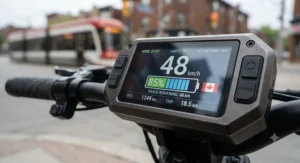
If range anxiety is your single biggest complaint about delivery work, the GT3 Pro is engineered to solve exactly that problem. Its dual-motor configuration (up to 1638W combined) pairs with a genuinely large battery pack to post a real-world figure close to 90 km (55.9 mi) — among the highest verified numbers of any consumer scooter currently sold through mainstream retail channels. What most buyers overlook about dual-motor extended-range scooters like this one is that the second motor isn’t just for speed; it’s there to reduce strain on a single drivetrain across back-to-back shifts, which in theory means slower long-term wear. The dual suspension and 10-inch tires help here too, softening the ride on the kind of cracked laneways delivery riders actually use, not the smooth demo-lot pavement manufacturers film their promo videos on. Aggregated review sentiment points to strong satisfaction with range accuracy specifically — a rarer compliment in this category, where inflated claims are the norm rather than the exception. The trade-off is size and weight: this is not a scooter you’re carrying up three flights of stairs between deliveries.
Pros:
- ✅ Verified range among the highest in its class
- ✅ Dual motor spreads mechanical wear across two units
- ✅ 10-inch tires and dual suspension handle rough streets well
Cons:
- ❌ Heavier build makes stair-carrying impractical
- ❌ Premium price pushes it above the C$1,500 budget threshold
Priced around C$1,400–C$1,650, the NAVEE GT3 Pro is the clear pick for riders whose routes genuinely demand the extra distance — just budget for the fact it sits above, not under, most delivery riders’ C$1,500 ceiling.
3. Gotrax G4 — best value under C$800
Gotrax built a reputation on delivering “good enough, priced right,” and the G4 continues that formula for delivery-minded buyers who can’t justify a four-figure scooter yet. The dual-motor setup is a genuine step up from Gotrax’s entry-level single-motor commuter models, translating into a real-world range around 45 km (28 mi) — enough for a single solid shift in a compact delivery zone, though tighter than the premium options above. Here’s what to weigh: at this price point you’re trading maximum endurance for accessibility, and for a rider just starting gig work who isn’t sure delivery will become a long-term income source, that’s often the smarter financial call. Reviewers frequently mention that the deck feels sturdier than the price suggests, though a common complaint in user reviews is that the folding mechanism loosens with months of daily use — a fixable annoyance with regular tightening, but worth knowing before you buy. It’s not built for 12-hour shifts across a sprawling suburb, but for tighter urban delivery zones it does the job without draining your first month of earnings.
Pros:
- ✅ Dual motor outperforms typical budget single-motor scooters
- ✅ Sturdy deck feel relative to its price bracket
- ✅ Low barrier to entry for testing gig work viability
Cons:
- ❌ Range trails premium options by a wide margin
- ❌ Folding mechanism loosens with sustained daily use
At roughly C$650–C$800, the Gotrax G4 earns its spot as the entry point for riders who want to try delivery work without a big upfront commitment.
4. isinwheel GT2 — lightest extended-range option for stairs and elevators
Condo-dwelling delivery riders face a problem the spec sheets never mention: getting the scooter itself up to your apartment every night. The GT2 addresses this by keeping weight down while still pushing a claimed range around 65 km (40 mi) — a genuinely useful balance for riders who need both distance and portability. Based on the spec comparison, isinwheel’s lighter frame construction sacrifices a bit of structural rigidity for that weight saving, which matters if you’re regularly hauling heavier cargo loads. What the spec sheet won’t tell you, but reviewer patterns suggest, is that lighter-frame scooters like this one tend to feel less planted at higher speeds on windy days — a real consideration for anyone riding along exposed waterfront or bridge routes common in Canadian delivery zones. Still, for a rider without a garage or dedicated storage, being able to actually carry the thing up two flights of stairs without a strained back is worth real money.
Pros:
- ✅ Noticeably lighter than most extended-range competitors
- ✅ Range holds up well for its weight class
- ✅ Practical for apartment and condo storage situations
Cons:
- ❌ Lighter frame feels less stable at higher speeds
- ❌ Less structurally suited to heavier cargo loads
At an estimated C$750–C$900, the isinwheel GT2 is the pragmatic choice for urban riders without dedicated storage space.
5. Hiboy Titan Pro — sturdiest deck for stacked delivery bags
Delivery work punishes decks in ways casual commuting never does — insulated bags stacked two-high, bungee cords cinched tight, and constant micro-impacts from curb hops. The Titan Pro answers with a reinforced steel deck and wider footprint than Hiboy’s commuter-focused models, delivering a real-world range around 64 km (40 mi) alongside genuinely improved load tolerance. The spec sheet won’t tell you this, but user reports suggest the wider deck also improves balance when riding one-handed while checking an order on your phone at a red light — not officially recommended, obviously, but a real behaviour pattern among delivery riders that this scooter’s geometry happens to accommodate better than narrower models. Reviewers consistently point to the reinforced frame as the standout feature, with recurring praise for how it handles higher weight capacities without the flex some competitors show under load. On the downside, a recurring theme in aggregated feedback is that the stock brakes feel underpowered relative to the scooter’s weight-carrying capacity, which is worth budgeting an upgrade for if you’re routinely near the max load rating.
Pros:
- ✅ Reinforced deck built specifically for stacked cargo
- ✅ Wider footprint improves stability under load
- ✅ Handles higher weight capacities without noticeable flex
Cons:
- ❌ Stock brakes feel underpowered relative to load capacity
- ❌ Wider deck adds bulk for narrow bike-lane maneuvering
Around C$900–C$1,100, the Hiboy Titan Pro is the pick for riders whose orders regularly involve multiple stacked bags rather than a single lightweight package.
6. Varla Eagle One — toughest build for pothole-heavy routes
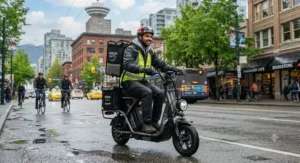
The Eagle One trades some outright range for raw durability, and for riders whose routes run through streets that haven’t seen fresh asphalt in a decade, that trade-off is worth taking seriously. Dual 1000W hub motors and genuinely off-road-capable tires give it a real-world range around 64 km (40 mi) — respectable, if not class-leading — but the standout is how it absorbs impact. Based on the spec comparison, the beefier suspension travel and larger tire volume here directly translate into fewer jarring hits transmitted to whatever’s in your delivery bag, which matters more than most spec sheets acknowledge when you’re carrying food orders. What most buyers overlook about high-power dual-motor scooters like this one is the legal wrinkle: peak speeds well above most provincial e-scooter caps mean this model may not qualify as a standard “electric kick scooter” under several provincial frameworks, potentially pushing it into moped or motorcycle classification depending on where you ride (more on this in the regulations section below). Aggregated review sentiment is strongly positive on build quality and acceleration, with a recurring complaint about charging time being longer than competitors given the larger battery pack.
Pros:
- ✅ Exceptional durability on rough, pothole-heavy pavement
- ✅ Strong acceleration from dual 1000W hub motors
- ✅ Off-road-capable tires absorb impact better than street tires
Cons:
- ❌ Charging time runs longer than most competitors
- ❌ Top speed may exceed legal e-scooter thresholds in some provinces
Priced around C$1,600–C$1,900, the Varla Eagle One suits riders on genuinely rough routes willing to double-check local speed regulations first — check the gig work vehicle regulations section below before you buy.
7. EMOVE Cruiser S — most comfortable seated ride for 8+ hour shifts
Standing scooters wear on your legs and lower back in ways that become impossible to ignore somewhere around hour six of a shift, and that’s exactly the problem the seated Cruiser S is designed to solve. Its 1000W rear motor and notably large battery pack combine for a claimed range that regularly tops 100 km (62 mi) in efficient riding modes — the longest figure in this entire lineup, and a genuine outlier in the seated-scooter category. Here’s what to weigh: the seated, moped-style ergonomics ideal for long continuous riding, evidenced by its unique design, ideally suited for those who clock long hours of continuous riding during delivery routes, according to industry coverage of delivery-focused scooters. On paper this means fewer physical breaks needed per shift, which for gig workers paid per delivery translates fairly directly into earnings. Reviewers consistently highlight seat comfort and stability at speed as major advantages over standing models, though a common complaint in aggregated feedback is the scooter’s overall size and weight make it a poor fit for anyone without secure, dedicated storage — this is not a fold-and-carry option.
Pros:
- ✅ Class-leading range regularly exceeding 100 km
- ✅ Seated ergonomics reduce fatigue on long shifts
- ✅ Stable, comfortable at sustained higher speeds
Cons:
- ❌ Large footprint requires dedicated storage space
- ❌ Not portable — no realistic fold-and-carry option
At roughly C$2,000–C$2,400, the EMOVE Cruiser S is a premium investment best justified by riders treating delivery work as a genuine full-time income stream rather than a side hustle.
What Is an Extended Range Scooter for Delivery Riders?
An extended range scooter for delivery riders is a powered scooter engineered around a larger-than-standard battery pack, reinforced deck, and cargo-friendly geometry, purpose-built to survive multi-hour paid delivery shifts without requiring a midday recharge. Unlike a typical commuter scooter optimized for a short daily trip, these models prioritize sustained battery capacity and structural durability over compactness. The category sits at the intersection of consumer micromobility and light commercial equipment — a distinction that matters more than most riders realize, as we’ll see in the electric kick scooter design history and how it shaped the regulatory gaps Canadian delivery riders now navigate.
How to Choose an Extended Range Scooter for Delivery Riders
- Start with your actual daily route distance, not the advertised range. Real-world range typically lands at 60–70% of the manufacturer’s claim, so a scooter advertising 100 km should realistically be budgeted as a 60–70 km machine.
- Weigh cargo capacity against portability. A reinforced deck and higher weight rating matter more than a lightweight frame if you’re regularly stacking bags — unless you’re also carrying the scooter up stairs nightly.
- Check your province’s speed and power thresholds before buying a high-output model. A scooter capable of 45+ km/h may not legally qualify as a standard e-scooter in your municipality.
- Factor in charging speed relative to your shift structure. A longer charge time matters less if you charge overnight, but becomes a real constraint for riders needing a midday top-up.
- Prioritize suspension and tire quality over top speed. Delivery routes involve constant curb hops and cracked pavement — comfort and component longevity beat raw acceleration for most riders.
- Read aggregated review patterns for recurring mechanical complaints, not just star ratings, since a 4.3-star average can still hide a consistent brake or folding-mechanism issue.
- Confirm insurance and vehicle classification implications with your gig platform before assuming any scooter is automatically compliant for commercial delivery use.
Extended Range Electric Scooter Under $1500 CAD: What You Actually Get
The C$1,500 CAD threshold is a meaningful line in this category, and it’s worth being honest about what sits on either side of it. Below that mark, you’re generally looking at single or modest dual-motor setups with real-world range in the 45–70 km band — the Gotrax G4, isinwheel GT2, Hiboy Titan Pro, and Segway Ninebot Max G3 all fall comfortably within this budget. Cross above C$1,500 and you start unlocking genuinely longer range, sturdier dual-motor drivetrains, and seated comfort options like the NAVEE GT3 Pro or EMOVE Cruiser S.
| Price Band | Typical Range | Example Model | Best For |
|---|---|---|---|
| Under C$800 | 40–50 km | Gotrax G4 | Testing gig work viability |
| C$800–C$1,500 | 60–70 km | Segway Ninebot Max G3 | Most full-time riders |
| Above C$1,500 | 65–100+ km | NAVEE GT3 Pro, EMOVE Cruiser S | High-mileage, full-time income |
Reading the table left to right, the jump from budget to mid-range buys meaningfully more usable range per dollar than the jump from mid-range to premium does — the Segway Ninebot Max G3 offers strong value precisely because it sits at that inflection point. Above C$1,500, you’re increasingly paying for comfort, top-tier durability, and range headroom rather than a proportional range increase, which is a reasonable trade if you’re treating this as a full-time income tool but harder to justify for occasional gig work.
✨ Comparing your budget against real range numbers? Check current pricing on today’s top picks before your next shift.

Extended Range Electric Scooter for Road Trips: What Changes
Road-trip use — longer, continuous rides between towns or across a sprawling delivery zone rather than tight urban loops — asks different things of a scooter than dense city delivery work does. Sustained higher speeds for extended periods drain batteries faster than the stop-start rhythm of urban routes, so a scooter’s advertised range should be discounted more aggressively for road-trip-style riding, often closer to 50–55% of the claimed figure rather than the 60–70% baseline used for city use. The NAVEE GT3 Pro and EMOVE Cruiser S are the strongest picks here specifically because their range headroom absorbs that steeper real-world discount better than shorter-range models. Comfort becomes a bigger factor too: a seated scooter like the Cruiser S meaningfully reduces fatigue over a two-hour continuous ride in a way that barely registers on a 15-minute urban hop. Also worth considering — sustained speeds on longer stretches are far more likely to cross provincial power-assisted vehicle thresholds, which loops directly back into the regulatory considerations covered below.
Cargo Rack Compatibility: Turning a Commuter Scooter into a Delivery Machine
Most scooters in this category don’t ship with a dedicated cargo rack — that’s an aftermarket add-on, and compatibility varies more than manufacturers advertise. The first thing to check is handlebar stem diameter and deck mounting points, since universal delivery bag brackets are built around a fairly narrow range of tube sizes; a rack that clamps perfectly onto the Hiboy Titan Pro‘s wider stem may not fit the isinwheel GT2‘s slimmer frame without an adapter. Reinforced-deck models like the Titan Pro and Varla Eagle One tolerate rear-mounted milk-crate-style racks better than lighter frames, simply because the added weight and vibration concentrate stress at the mounting bolts. A common mistake among new delivery riders is mounting a rigid rack too far back over the rear wheel, which shifts the centre of gravity and makes low-speed turns noticeably twitchier — a small adjustment forward toward the deck’s midpoint usually solves it. For insulated delivery bags specifically, a front-mounted basket paired with a rear rack distributes weight more evenly than stacking everything behind the seat post, which matters most on models without dual suspension.
Gig Work Vehicle Regulations in Canada: What Delivery Riders Need to Know
This is the section too many delivery riders skip, and it’s the one most likely to cost you a fine — or worse, an uninsured accident claim. Canada has no single federal classification covering all electric scooters; instead, Transport Canada sets manufacturing and equipment safety standards while actual on-road use rules fall to individual provinces and, frequently, individual municipalities. Ontario’s provincial e-scooter pilot program, for instance, generally caps compliant devices at 24 km/h and 500 watts of continuous power — thresholds that several of the higher-performance models in this guide, like the Varla Eagle One, can exceed at full throttle, which may reclassify them outside the standard e-scooter category depending on jurisdiction. Some major Ontario municipalities, notably Toronto, haven’t opted into the provincial pilot at all, meaning e-scooters currently can’t be legally operated on public roads, sidewalks, or bike lanes there regardless of the model. Quebec takes a stricter approach still, generally treating pedal-less electric scooters as mopeds requiring registration, liability insurance, and a minimum Class 6D licence.
Beyond the vehicle itself, gig work carries its own compliance layer entirely separate from provincial traffic law. The Canada Revenue Agency treats delivery platform earnings as self-employment income requiring full reporting through Form T2125 on your annual return, regardless of whether the platform issues a T4A slip. Riders should also confirm with their platform whether personal vehicle insurance actually covers commercial delivery use — a surprising number of standard policies exclude paid delivery activity entirely, leaving riders personally liable in a collision. Before committing to any scooter on this list for paid delivery work, it’s worth reviewing your specific municipality’s current e-scooter regulation, since rules genuinely shift year to year and city to city.
All-Weather Riding Gear for Year-Round Delivery Shifts
Canadian delivery seasons swing from humid summer heat to genuinely dangerous winter ice, and gear that works for one extreme often actively hurts you in the other. For cold-weather shifts, layered thermal base layers under a windproof (not just water-resistant) outer shell matter more than bulk insulation, since a scooter’s constant airflow at speed cuts through standard winter jackets fast — riders consistently report that wind chill on a moving scooter feels significantly colder than the ambient temperature suggests, which lines up with how Environment Canada’s wind chill calculations work in practice. Insulated, waterproof gloves with touchscreen-compatible fingertips solve the common problem of needing to check app notifications mid-shift without exposing bare hands to freezing air. For visibility, reflective outer layers paired with a properly rated helmet aren’t optional extras in low-light winter conditions — several provincial e-scooter frameworks legally require helmets specifically because stopping distances lengthen dramatically on wet or icy pavement. In warmer months, the priority flips toward breathable, moisture-wicking layers and a well-ventilated helmet, since heat exhaustion during an eight-hour summer shift is a genuine risk that gets overlooked far more often than winter cold. A dedicated pair of waterproof boots with reinforced ankle support rounds things out year-round, protecting against both slush and the repetitive strain of constant dismounting.
🧤 Gearing up for winter shifts? Check current listings for cold-weather riding gear that pairs well with your scooter choice.
Real-World Scenarios: Which Rider Needs Which Scooter
The apartment-dwelling city rider: Working dense downtown routes with no dedicated storage, frequent stairs, and short average delivery distances. The isinwheel GT2 fits best here — its lighter frame is the difference between a manageable nightly carry-up and a genuine physical strain, and its 65 km range comfortably covers a tight urban zone without needing the bulk of a heavier model.
The full-time suburban rider: Covering wider territory across multiple neighbourhoods, often 60+ km per shift with real hills and rougher secondary roads. The Segway Ninebot Max G3 or NAVEE GT3 Pro make more sense here, where the extra range and dual-suspension comfort directly translate into fewer forced charging breaks and less physical fatigue over a full shift.
The budget-conscious newcomer: Testing whether gig delivery work is a viable income source before committing serious money. The Gotrax G4 is the sensible entry point — low enough investment to walk away from if delivery work doesn’t pan out, but capable enough to genuinely evaluate the job for a few weeks.
Common Mistakes When Buying an Extended Range Delivery Scooter
Buying purely on advertised top range is the single most common error — as covered above, real-world figures typically land 30–40% below the manufacturer’s claim, so a scooter marketed at 100 km should be budgeted as a 60–70 km machine for planning purposes. A second frequent mistake is ignoring weight capacity ratings entirely; delivery bags, cargo racks, and rider weight combined can push closer to a scooter’s limit than most buyers assume, accelerating wear on motors and suspension components not rated for sustained heavy loads. Riders also commonly overlook charging infrastructure — a scooter with an eight-hour charge time is a poor match for a rider needing a midday top-up between lunch and dinner rushes. Finally, skipping the regulatory check before purchase is a mistake that can turn an otherwise great scooter into an expensive paperweight if it turns out to exceed your municipality’s legal power or speed threshold.
Extended Range Scooters vs Gas Mopeds and E-Bikes for Delivery Work
| Factor | Extended Range Scooter | Gas Moped | E-Bike |
|---|---|---|---|
| Upfront Cost | C$650–C$2,400 | Typically higher | Often comparable or higher |
| Running Cost | Low (electricity only) | Fuel + maintenance | Low (electricity only) |
| Regulatory Burden | Varies by province/model | License, insurance, registration required | Generally lighter under power-assisted bicycle rules |
| Range per Charge/Tank | 45–100+ km | 100–150+ km | 50–80 km typical |
| Best For | Dense urban delivery zones | Long suburban/rural routes | Bike-lane-heavy cities |
The comparison above makes the trade-offs fairly clear: gas mopeds still win on raw range and refuel speed, but they carry mandatory licensing, insurance, and registration costs that eat into thin gig-work margins in a way electricity never does. E-bikes benefit from generally lighter regulatory treatment under most provinces’ power-assisted bicycle rules, but their lower typical range makes them a weaker fit for riders covering wide suburban territory. For dense urban delivery work specifically, extended range scooters like the Segway Ninebot Max G3 or isinwheel GT2 occupy a genuine sweet spot — enough range for a full shift, low running costs, and (provided you check local rules) a lighter regulatory footprint than a gas-powered alternative.
Long-Term Cost & Maintenance for Delivery Riders
Total cost of ownership for a delivery scooter extends well past the sticker price, and battery degradation is the biggest hidden line item. Lithium battery packs in this category typically lose meaningful capacity after 500–800 full charge cycles — for a full-time rider charging daily, that’s roughly a year and a half to two years before range noticeably drops, which is worth factoring into your budgeting from day one. Tire replacement is the next major recurring cost, particularly for pneumatic tires under constant heavy-load stress; solid tires trade a slightly harsher ride for eliminating flat-tire downtime entirely, a trade some full-time riders consider worthwhile purely for reliability. Brake pad wear accelerates under the stop-start rhythm of dense delivery routes compared to casual commuting, so budgeting for pad replacement roughly twice as often as a typical recreational rider is realistic. On the value side of the ledger, the NAVEE GT3 Pro‘s dual-motor design theoretically spreads mechanical stress across two units rather than one, which — while unproven over the very long term given how recently these models entered the market — offers a reasonable case for lower single-point-of-failure risk compared to single-motor competitors.

Frequently Asked Questions
❓ How far can an extended range scooter for delivery riders actually go on one charge?
❓ Is an extended range electric scooter under $1500 CAD good enough for full-time delivery work?
❓ Do I need insurance for a delivery scooter in Canada?
❓ What cargo rack works best for insulated delivery bags?
❓ Are extended range scooters legal for gig delivery work in every Canadian province?
Conclusion
Choosing an extended range scooter for delivery riders ultimately comes down to matching real-world range, cargo durability, and legal compliance to your actual routes rather than chasing the highest number on a spec sheet. Budget-conscious newcomers testing the waters are well served by the Gotrax G4, while full-time riders logging serious daily distance will get more genuine value from the balanced range and suspension of the Segway Ninebot Max G3 or the class-leading distance of the NAVEE GT3 Pro and EMOVE Cruiser S. Riders juggling stairs and tight storage should lean toward the lighter isinwheel GT2, and anyone hauling stacked cargo bags will appreciate the reinforced deck on the Hiboy Titan Pro. Whatever you choose, cross-reference it against your province’s e-scooter regulations and your platform’s insurance requirements before your first paid shift — the best scooter on paper is worthless if it isn’t legal on your actual route. Prices and availability shift constantly, so always check current listings before making a final call.
Recommended for You
- Top Fast Charging Electric Scooters Under $1000 CAD (2026 Guide)
- Dual Battery Scooter for Heavy Riders: 7 Tough Picks (2026)
- Fast Charging Electric Scooter: 7 Top 2026 Picks
Disclaimer: This article contains affiliate links. As an Amazon Associate, I earn from qualifying purchases. If you purchase products through these links, we may earn a small commission at no additional cost to you.
✨ Found this helpful? Share it with your friends! 💬🤗
