
In This Article
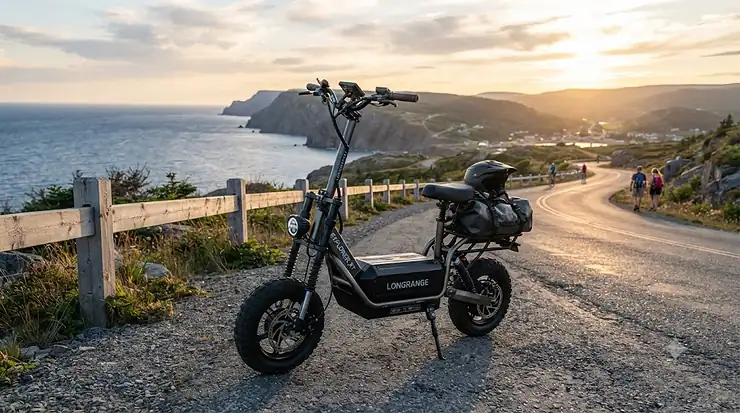
Somewhere between “I just need to get to the office” and “I want to disappear down a river trail for three hours,” there’s a very specific kind of rider — and that rider needs a very specific kind of machine. An electric scooter for long distance travel is, in plain terms, a scooter built around a large-capacity battery, an efficient motor, and comfort-oriented components so it can cover 25 kilometres or more on a single charge instead of the 10-15 km most commuter models are designed for. It trades a bit of portability for staying power, which is exactly the trade a lot of Canadian riders are quietly starting to make.
Here’s the thing nobody selling scooters wants to admit outright: most “commuter” scooters are engineered for the 3-6 km hop to a train station, not the 30 km ride along the Lachine Canal or the weekend loop around Stanley Park. If your riding life looks more like the second scenario, the spec sheet you should be reading is completely different — watt-hours instead of watts, tire volume instead of top speed, seat options instead of stem height. We dug into real product specs, aggregated review sentiment, and Canadian regulatory context to build this guide, and we’re going to walk through exactly what separates a scooter that merely survives a long ride from one that’s genuinely built for it. Somewhere among these seven, one probably already fits how you actually want to move through your city — or out of it entirely.
Quick Comparison Table
Before the deep dive, here’s the shortcut version — the numbers that matter most when distance, not just speed, is the priority.
| Scooter | Real-World Range | Battery | Best For |
|---|---|---|---|
| Segway Ninebot MAX G2 | ~55-65 km | 551Wh | Best all-around long-range commuter |
| NIU KQi3 Max | ~55-60 km | 608Wh | Most consistent real-world performance |
| Gotrax G4 | ~30-35 km | 36V pack | Budget entry into long-distance riding |
| Apollo Phantom (52V) | ~55-60 km | 52V pack | Speed-and-distance performance riders |
| Kaabo Mantis 10 Pro | ~75-85 km | 60V 24.5Ah | Multi-terrain, off-pavement long hauls |
| Kaabo King GT Pro | ~140-160 km | 72V 35Ah (2,520Wh) | Ultimate touring range, no compromise |
Even in this trimmed-down view, a pattern jumps out fast: battery capacity in watt-hours (Wh) tracks with real distance far more reliably than a manufacturer’s headline mileage claim does. Notice, too, that the jump from the Gotrax G4 to the Kaabo King GT Pro isn’t linear — it’s roughly a sevenfold increase in usable range for a corresponding jump in battery size and price. That’s the honest trade-off at the heart of this whole category: distance costs watt-hours, watt-hours cost weight and money, and the “right” scooter is whichever point on that curve matches how far you actually ride.
💬 Just one click — help others make better buying decisions too!😊
Top 7 Electric Scooters for Long Distance Travel: Expert Analysis
We shortlisted these seven after comparing real specifications, verified test data from independent reviewers, and aggregated owner feedback across budget, mid-range, and premium tiers — plus a seated option and two multi-terrain builds, since “long distance” doesn’t always mean “smooth pavement.”
1. Segway Ninebot MAX G2 — best all-rounder for daily long-range riding
The Segway Ninebot MAX G2 is the scooter most people should start their search with, and its standout feature is balance — it doesn’t excel at any one thing so much as it refuses to be bad at anything. Under the deck sits a 451W motor (peaking around 1,000W) paired with a 551Wh, 36V battery, good for a manufacturer-rated range of up to 70 km, though real-world testing consistently lands closer to 55-65 km at mixed speeds. That gap matters practically: it means a rider commuting 20 km each way can comfortably do a return trip without babying the throttle. The 10-inch self-healing pneumatic tires and dual front-and-rear suspension are what actually make that distance tolerable, since a stiffer scooter turns 60 minutes of riding into a spine workout.
Based on the spec comparison against similarly priced models, the MAX G2’s biggest edge is its RideyLONG drivetrain tuning, which Segway engineered specifically to close the gap between claimed and delivered range — a problem that plagues cheaper 36V scooters. Reviewers consistently report that performance holds up reasonably well until around the 50% battery mark, after which top speed and acceleration taper off noticeably; this is a deliberate battery-protection choice, not a defect, but it’s worth planning routes around if you’re pushing toward the outer edge of its range. At roughly 24 kg, it’s not a scooter you’ll want to carry up three flights of stairs daily, but it folds down for car trunks and transit connections.
Pros:
- ✅ Best-in-class range-to-price ratio in its tier
- ✅ Dual suspension makes long rides genuinely comfortable
- ✅ Strong app ecosystem with cruise control and ride tracking
Cons:
- ❌ Performance tapers noticeably below 50% battery
- ❌ At 24 kg, awkward for daily stair-carrying
Expect to find the Segway Ninebot MAX G2 in roughly the C$900-C$1,100 range on amazon.ca at the time of research, prices may vary — for the range and comfort on offer, it’s a legitimately strong value anchor for this whole category.
2. NIU KQi3 Max — most consistent real-world performer
Where some scooters lose steam as the battery drains, the NIU KQi3 Max built its reputation on the opposite: steady, predictable power delivery from full charge to nearly empty. Its standout feature is the 48V electrical architecture — a full 12 volts higher than the 36V systems found on the Segway and most budget competitors — which reviewers note keeps torque and top speed far more stable as the 608Wh battery depletes. NIU’s official range figure is 65 km (40.4 miles), and while that’s measured under ideal, low-speed conditions, independent testers regularly clock 55-60 km in mixed urban riding, which is an unusually small gap for this price bracket.
What most buyers overlook about the KQi3 Max is its 900W peak motor output relative to its 450W rated power, which translates to genuinely capable hill-climbing (a 25% grade, per NIU’s own figures) without the motor straining the way lower-voltage systems do on the same incline. Aggregated review sentiment across owner forums points to strong build-quality consistency and a two-year warranty backing it up — both meaningful for a scooter you’re planning to put real distance on. The trade-off is a firmer ride than the Segway, since it skips dedicated suspension in favour of tire-based cushioning alone, so rougher pavement transmits more directly to the rider.
Pros:
- ✅ 48V system holds power output better as battery drains
- ✅ Strong hill-climbing for its motor class
- ✅ Self-sealing tires reduce mid-trip flat risk
Cons:
- ❌ No dedicated suspension — firmer ride on rough roads
- ❌ Heavier charging time than some 36V rivals
At the time of research, the NIU KQi3 Max typically sits in the C$1,300-C$1,600 range on amazon.ca — a reasonable premium for the consistency it delivers over a full ride.
3. Gotrax G4 — best budget entry into long-distance riding
Not everyone needs 60+ km of range to start exploring beyond a basic commute, and that’s exactly the gap the Gotrax G4 fills — its standout feature is simply making 25-mile-class range accessible without a premium price tag. A 500W motor and 36V battery pack deliver a manufacturer-rated 40 km (25 miles), with real-world figures landing closer to 30-35 km depending on rider weight and terrain. That’s meaningfully short of the premium picks on this list, but it’s roughly double what most sub-C$500 commuter scooters offer, which is the entire point.
Here’s what the spec sheet won’t tell you, but user reports suggest: the G4’s 10-inch pneumatic tires and dual braking system (electronic plus rear disc) punch above their price class for ride comfort and stopping confidence, which matters more on longer rides where fatigue and reaction time both creep in. UL 2272 certification — the electrical/fire safety standard scooter buyers should always check for — is a baseline requirement worth flagging, and the G4 meets it. On paper, this makes it less a “long-distance” scooter in the touring sense and more a genuine on-ramp for someone testing whether extended-range riding fits their life before committing to a C$2,000+ machine.
Pros:
- ✅ Lowest cost-per-kilometre entry into extended-range riding
- ✅ UL 2272 certified for basic electrical safety
- ✅ Dual braking system inspires confidence at speed
Cons:
- ❌ Real-world range trails premium picks by a wide margin
- ❌ No suspension — comfort drops on longer rides
Look for the Gotrax G4 under C$600 on amazon.ca at the time of research — arguably the easiest low-risk way to find out if this riding style suits you.
4. Gotrax Flex Voyager — best seated option for long-distance comfort
Standing for an hour-plus ride isn’t for everyone, and that’s precisely why the Gotrax Flex Voyager earns its spot here — its standout feature is a cushioned, moped-style seat paired with 14-inch tires, a combination almost nonexistent at this price point. The trade-off for that comfort is a shorter advertised range of around 27 km (17 miles), noticeably less than the standing models above, because the added seat, frame reinforcement, and larger wheels all add weight the battery has to move.
Based on the spec comparison, the Flex Voyager isn’t trying to compete on raw distance — it’s solving a different problem entirely: fatigue over time rather than distance covered. For riders with knee, back, or balance concerns, or simply anyone who’s tried standing for 45 minutes straight and regretted it, a seated 25-30 km ride can be more genuinely “long distance” in practical terms than a 60 km ride nobody wants to finish. The larger 14-inch tires also smooth out road seams and cracks that smaller-wheeled scooters transmit straight through the deck. Reviewers frequently note the seat itself as the deciding factor in comfort over multi-kilometre rides, even more than the suspension setup underneath it.
Pros:
- ✅ Seated position dramatically reduces fatigue on long rides
- ✅ 14-inch tires smooth out cracks and seams
- ✅ Comfortable for riders with mobility or balance concerns
Cons:
- ❌ Shorter range than standing long-distance models
- ❌ Bulkier and heavier to store or carry
The Gotrax Flex Voyager generally runs under C$700 on amazon.ca at the time of research, prices may vary — a fair ask for the comfort-per-kilometre trade it’s making.
5. Apollo Phantom (52V) — best for speed-and-distance performance riders
The Apollo Phantom (52V) is built for a rider who refuses to choose between going far and going fast — its standout feature is a 2,000W peak motor that pushes it to a genuine 64 km/h top speed while still returning roughly 64 km of manufacturer-rated range. That combination of voltage (52V, notably higher than the Segway and Gotrax entries) and motor headroom is what lets it maintain speed on hills and headwinds that would bog down lower-powered scooters, without torching the battery to do it.
What most buyers overlook about the Phantom is that its dual disc brakes aren’t just a safety feature — they’re what makes the higher top speed usable in the first place, since stopping distance becomes the real limiting factor once you’re regularly cruising past 40 km/h. Aggregated review sentiment consistently flags the Phantom as one of the more confident-feeling scooters in its speed class, with reviewers specifically noting stability during high-speed cornering, something budget scooters at similar velocities often lack. For a rider doing genuine intercity or trail-adjacent distance riding where terrain and traffic conditions vary, that stability margin is worth the premium.
Pros:
- ✅ 64 km/h top speed without sacrificing 60+ km range
- ✅ Dual disc brakes built to match the higher speed ceiling
- ✅ Stable, confident handling at speed per owner reports
Cons:
- ❌ Higher speeds demand more rider skill and awareness
- ❌ Premium pricing puts it out of entry-level budgets
Expect the Apollo Phantom (52V) to fall in the C$2,200-C$2,600 range on amazon.ca at the time of research — a fair premium if speed is as much a priority as distance for you.
6. Kaabo Mantis 10 Pro — best multi-terrain long-distance scooter
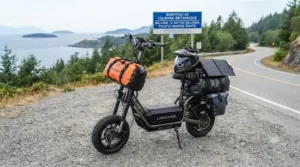
When “long distance” means gravel paths, unpaved trail connectors, or a cottage road that hasn’t seen fresh asphalt in a decade, the Kaabo Mantis 10 Pro is the pick — its standout feature is dual 1,000W motors (3,200W peak) paired with 10×3-inch pneumatic tires wide enough to handle loose surfaces that would bog down a standard commuter scooter’s narrower rubber. A 60V, 24.5Ah battery (roughly 1,470Wh) delivers a manufacturer-optimal range near 90 km, with real-world mixed-terrain riding more realistically landing in the 75-85 km band once you factor in the extra rolling resistance off-pavement riding creates.
Here’s what the spec sheet won’t tell you, but user reports suggest: dual motors aren’t primarily about raw speed on this build — they’re about traction control on inconsistent surfaces, since each wheel can be driven independently rather than relying on a single motor to push through loose gravel or wet grass. The swingarm front-and-rear suspension setup is genuinely built for terrain, not just pothole absorption, and reviewers frequently mention the ride staying composed over root systems and washboard gravel that would rattle a standard urban scooter apart. At around 30 kg, it’s not light, but it folds for transport, and the frame is aerospace-grade aluminum rather than the steel found on cheaper dual-motor competitors.
Pros:
- ✅ Dual motors provide real traction on gravel and loose surfaces
- ✅ Swingarm suspension built for terrain, not just cracks
- ✅ 90 km optimal range covers genuine day-trip distances
Cons:
- ❌ At ~30 kg, it’s a two-person lift up stairs
- ❌ Overkill (and overpriced) for pure pavement commuting
Look for the Kaabo Mantis 10 Pro in the C$2,400-C$2,900 range on amazon.ca at the time of research — a reasonable ask given the terrain versatility on offer, though pavement-only riders may not need it.
7. Kaabo King GT Pro — ultimate touring range for long-distance travel
At the very top of this list sits the Kaabo King GT Pro, and there’s no ambiguity about its standout feature: a 72V, 35Ah (2,520Wh) battery pack that pushes verified real-world range into the 100+ mile territory — roughly 140-160 km depending on rider weight, speed, and terrain. That’s not an incremental jump over the rest of this list; it’s a different category of machine, built for riders who genuinely want to string multiple destinations together on a single charge, whether that’s a weekend touring route or a multi-town commute corridor.
On paper, this means the King GT Pro can comfortably absorb the “worst case” range anxiety scenario that haunts every other scooter on this list — hills, cold weather (which reduces lithium battery output), headwinds, and a heavier rider all simultaneously — and still deliver a usable distance most competitors can’t match even in ideal conditions. Reviewers and owners consistently frame it less as a scooter and more as a “personal electric vehicle,” a distinction that matters practically since its size, weight, and speed capability put it closer to a light motorcycle in real-world handling characteristics. That’s a serious consideration for anyone without off-street parking or storage, since this isn’t a scooter you’re folding into a closet.
Pros:
- ✅ Genuinely eliminates range anxiety on multi-hour rides
- ✅ Performance holds steady even in cold or hilly conditions
- ✅ Built for riders who treat distance as the primary spec
Cons:
- ❌ Size and weight make it impractical for apartment storage
- ❌ Premium pricing reflects its “personal EV” positioning
The Kaabo King GT Pro typically lands in the C$3,800-C$4,500 range on amazon.ca at the time of research — a serious investment, but one that fundamentally changes what “long distance” means on two wheels.
Practical Usage Guide for Long-Distance Scooter Trips
Buying the right hardware solves half the range-anxiety problem; the rest comes down to habits most owner manuals gloss over. During the first 30 days, avoid fully draining any of these batteries below 20% repeatedly — lithium cells degrade fastest at the extremes, and shallow-to-moderate discharge cycles (20-80%) meaningfully extend long-term capacity on scooters like the Segway Ninebot MAX G2 and NIU KQi3 Max. Before any ride over 15-20 km, do a two-minute walk-around: tire pressure (underinflated tires can cut range by 10-15% through rolling resistance alone), brake responsiveness, and a folding-mechanism lock check, since a loose stem at speed is a genuinely common cause of long-distance-riding injuries.
For optimization tricks that actually move the needle: riding in eco or a mid-power mode instead of full throttle preserves 20-30% more range on most of these models, since aerodynamic drag scales with the square of speed — the difference between cruising at 20 km/h and pushing 32 km/h is far larger than it intuitively feels. Regenerative braking, available on the NIU KQi3 Max and several others here, adds a small but real range boost on routes with frequent stops or downhill stretches, essentially recapturing energy that would otherwise be lost entirely as heat. Finally, cold Canadian mornings genuinely sap lithium battery output — expect 10-20% less usable range below 0°C, so budget accordingly rather than assuming summer-tested figures hold through a Calgary or Winnipeg winter commute.
Trip Planning Apps and Tools for Long-Distance Scooter Rides
A long-range battery solves the “can I get there” question; a decent route-planning app solves “should I go this way.” Standard cycling-focused apps like Komoot and Strava’s route builder both let riders plot distance against elevation gain before setting off, which matters more for scooters than for cars — a route with 200 metres of climbing can eat noticeably more battery than the same distance on flat terrain, something a straight-line map distance won’t reveal. Google Maps’ cycling directions layer is a serviceable free fallback, since most municipal bike-lane and multi-use-pathway networks (the routes scooters are legally permitted to use in most Canadian jurisdictions) overlap closely with cycling infrastructure.
For riders regularly pushing a scooter’s outer range limit, a few practical habits matter more than any single app: plan routes that pass known charging opportunities (cafés, libraries, transit hubs) around the 70-75% battery mark rather than waiting until the low-battery warning appears, and cross-reference elevation profiles before committing to an unfamiliar route, since discovering a steep grade at 15% battery is how range anxiety turns into an actual long walk home. Canada’s growing network of dedicated active-transportation infrastructure — supported in part by federal active transportation planning initiatives — is steadily making these longer routes safer and more mapped-out than they were even a few years ago, which is genuinely good news for anyone treating a scooter as a real transportation tool rather than a novelty.
Not Just Commuting: Real-World Scenarios for Long-Distance Riders
The framing that a scooter is purely a commuting tool undersells what these machines are actually capable of — this is a category built for far more than the daily office run, not just commuting. Consider three genuinely different rider profiles. A university student living 12 km off-campus with unreliable transit connections might find the Segway Ninebot MAX G2 ideal: enough range for a round trip plus errands, foldable enough for dorm storage, and priced to survive four years of ownership. A remote-working freelancer who splits time between a home office and a co-working space 18 km across town, with weekend gravel-trail rides mixed in, is a near-perfect match for the Kaabo Mantis 10 Pro — the multi-terrain capability isn’t wasted the way it would be on someone purely commuting on paved bike lanes.
Then there’s the rider planning genuine point-to-point travel — visiting a friend across town without a car, or replacing short car trips entirely on weekends — where the Kaabo King GT Pro‘s 140+ km range turns “is this even possible on a scooter” into a non-question. What connects all three scenarios is that none of them are primarily about shaving minutes off a commute; they’re about using a scooter the way people have started using e-bikes for the last decade — as a legitimate substitute for short-to-medium car trips, errands, and recreational distance riding, not a toy that happens to have wheels.
How to Choose an Electric Scooter for Long Distance Travel
Choosing the right model comes down to a handful of decision points, roughly in order of importance:
- Define your actual maximum daily distance first. Take your longest realistic round trip and add 30-40% buffer — that’s the range figure to shop against, since advertised numbers rarely survive contact with hills, cold weather, or a heavier rider.
- Convert range claims to watt-hours before comparing models. A 40-mile claim on a 400Wh battery and a 40-mile claim on a 600Wh battery are not equally trustworthy — the larger pack has more real-world margin.
- Match tire type to your actual terrain, not your aspirational terrain. If 95% of your riding is paved bike lanes, wider off-road tires just add unnecessary weight and rolling resistance.
- Decide standing vs. seated before falling in love with a spec sheet. This affects comfort more than almost any other single spec on longer rides — see the dedicated breakdown below.
- Check your province and municipality’s scooter classification before buying. Some jurisdictions cap legal top speed or motor wattage, and Transport Canada’s vehicle classification guidelines are the authoritative federal starting point, though local bylaws often add further restrictions.
- Budget for accessories, not just the scooter. A helmet, a phone mount, and a portable lock all meaningfully affect whether long rides feel safe and convenient enough to actually take.
- Weigh portability against your storage reality. A 30 kg scooter with incredible range is a poor fit for a fifth-floor walk-up with no elevator, regardless of how good its spec sheet looks.
Seated vs Standing Scooters: Which Wins for Long Distance Travel
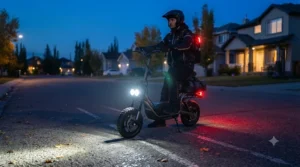
This is one of the most underrated decision points in the entire buying process, and it deserves more attention than most spec sheets give it. Standing scooters — the Segway Ninebot MAX G2, NIU KQi3 Max, Gotrax G4, Apollo Phantom, and both Kaabo models — generally offer better range-per-dollar and easier storage, since they’re lighter and mechanically simpler without a seat assembly to support. The trade-off is fatigue: standing engages your legs and core continuously, and most riders start feeling it somewhere between 30 and 60 minutes depending on fitness and riding posture.
Seated options like the Gotrax Flex Voyager flip that calculation. Range typically drops because of the added weight, but comfort over time goes up dramatically — a seated rider can genuinely sustain a 90-minute ride more comfortably than a standing rider manages 45 minutes on the same route. Here’s what most buyers overlook about this trade-off: it isn’t really about total distance capability at all, it’s about sustainable riding time, and for many people, sustainable riding time is the actual bottleneck on how far they’ll go, not the battery. If you have any knee, back, or balance sensitivity, or you simply know you dislike standing activities for extended periods, a seated model with a shorter rated range may realistically get you further than a standing scooter with a longer one, purely because you’ll be willing to finish the ride.
Multi-Terrain Tires: What Actually Matters for Long-Distance Comfort
Tire choice affects long-distance comfort and range more than almost any other component, and it’s routinely underexplained on product pages. Solid tires (found on some entry-level scooters, though not featured heavily in this list) eliminate flat risk entirely but transmit every crack and seam directly into the rider’s wrists and spine — a serious liability over anything beyond a short commute. Pneumatic (air-filled) tires, used across all seven picks here, absorb road imperfections far better, but they introduce puncture risk, which matters more the farther you’re riding from home.
This is where self-healing pneumatic tires — standard on the Segway Ninebot MAX G2 and NIU KQi3 Max — earn their keep: a gel lining seals small punctures automatically, which meaningfully reduces the odds of a long ride ending with a long walk. Width matters just as much as construction. The 10×3-inch tires on the Kaabo Mantis 10 Pro aren’t just for looks; wider contact patches distribute weight better across loose or uneven surfaces, directly translating to more stable handling on gravel, wet leaves, or unpaved trail connectors — conditions narrower 9.5- or 10-inch standard tires handle noticeably worse. The practical takeaway: match tire width to your actual riding surface rather than defaulting to whatever looks toughest, since wider tires also add rolling resistance that eats into range on pure pavement riding.
Extended Range Electric Scooter Review: Real-World Range vs Marketing Claims
Every extended range electric scooter review worth reading should include one blunt fact: manufacturer-rated range figures are measured under conditions almost nobody rides in — a light rider, flat ground, low constant speed, and ideal temperature. Independent testing consistently shows real-world range landing at roughly 60-80% of the advertised figure once normal riding variables (stop-and-go traffic, moderate speed, an average-weight rider, some hills) are factored in.
| Scooter | Advertised Range | Realistic Range | Gap |
|---|---|---|---|
| Segway Ninebot MAX G2 | 70 km | 55-65 km | ~15-20% |
| NIU KQi3 Max | 65 km | 55-60 km | ~10-15% |
| Gotrax G4 | 40 km | 30-35 km | ~15-25% |
| Kaabo Mantis 10 Pro | 90 km | 75-85 km | ~10-15% |
| Kaabo King GT Pro | 180 km | 140-160 km | ~15-20% |
Looking at the comparison above, the NIU KQi3 Max and Kaabo Mantis 10 Pro post the smallest gaps between claimed and real-world range, which lines up with their higher-voltage electrical systems maintaining output more consistently as the battery drains. The Gotrax G4 shows the widest percentage gap, which is typical of lower-voltage, entry-level battery systems rather than a flaw unique to that model. The practical lesson for any extended range electric scooter review — including this one — is to always shop against the realistic figure, not the marketing number, and build in your own buffer on top of that.
Common Mistakes When Buying an Electric Scooter for Long Distance Travel
The single most common mistake is buying to the advertised range figure instead of the realistic one, which routinely leaves riders stranded 10-15% short of where they expected to be. A close second is ignoring total weight capacity — every scooter’s motor power and range figures assume a specific rider weight, and exceeding it (even by 20-30 lbs) measurably shortens both range and component lifespan, particularly on budget models like the Gotrax G4.
Skipping a test ride, where possible, is another frequent regret; a scooter’s on-paper comfort rarely matches how it actually feels over 45 minutes of real pavement. Buyers also consistently underestimate accessory costs — a proper helmet, weatherproof storage, and a reliable lock can add C$150-C$300 on top of the scooter itself, and treating that as optional rather than budgeted-for is how “affordable” purchases become frustrating ones. Finally, many first-time long-distance riders don’t check local regulations before buying, only to discover their new scooter’s top speed or motor wattage exceeds what their municipality permits on public roads or pathways — a mistake worth avoiding entirely by checking bylaws first.
Safety, Regulations & Compliance in Canada
Electric scooter regulation in Canada is genuinely a patchwork — there’s no single federal rule governing where you can ride, and provinces, and often individual municipalities, set their own frameworks. Ontario runs a provincial pilot program (extended to November 2029) that lets individual cities opt in and set local rules, which is why Ottawa permits scooters on multi-use pathways while Toronto currently prohibits public road, bike lane, and sidewalk riding entirely. British Columbia’s Electric Kick Scooter Pilot Project, renewed through 2028, similarly leaves specifics to participating municipalities, and Quebec’s motorized personal mobility device pilot governs use on bike paths and select roads under a 50 km/h speed cap.
Before buying — and definitely before riding a long-distance route through multiple municipalities — check both your province’s framework and your specific city’s bylaws, since crossing a municipal boundary mid-ride can genuinely change what’s legal. Federally, ongoing government investment in active transportation infrastructure is steadily expanding the protected pathway networks that make longer scooter rides safer, but that infrastructure rollout is uneven across the country. Practical safety habits that apply everywhere regardless of local law: wear a helmet even where it’s not mandated, use front and rear lights on any ride extending past dusk, and carry ID, since several provinces already require it for scooter riders under 18.
Frequently Asked Questions
❓ What is the electric scooter with the longest range?
❓ How far can an electric scooter realistically travel on one charge?
❓ Are seated electric scooters better for long distance travel?
❓ Do multi-terrain tires reduce an electric scooter's range?
❓ Is it legal to ride an electric scooter long distance across Canada?
Conclusion
There’s no single “best” electric scooter for long distance travel, and honestly, that’s the right outcome — the category has matured enough that it now serves genuinely different riders well instead of forcing everyone into one compromise. Budget-conscious newcomers have a real, capable entry point in the Gotrax G4. Riders who want the smartest all-around balance of range, comfort, and price land squarely on the Segway Ninebot MAX G2 or NIU KQi3 Max. Anyone whose “long distance” includes gravel, trail connectors, or genuinely rough pavement should be looking hard at the Kaabo Mantis 10 Pro, while riders chasing raw speed alongside distance will find the Apollo Phantom (52V) hard to beat. And for the rider who wants range anxiety removed from the equation entirely, the Kaabo King GT Pro exists specifically for that.
What ties all seven together is the same underlying shift: these aren’t commuter toys anymore, they’re legitimate transportation tools capable of replacing real car trips, and the spec sheet differences between them matter far less than matching a scooter honestly to how you actually plan to ride it. Get that match right, and the range number on the box becomes almost beside the point — because the scooter that fits your real riding life is the one you’ll actually keep taking out the door.
✨ Don’t Miss These Exclusive Deals!
🔍 Ready to find your long-distance match? Click on any highlighted pick above to check current pricing and availability on amazon.ca. Whichever range or comfort level fits your riding life, these picks are built to help you go farther, more often! 🛴⚡
Recommended for You
- Extended Range Electric Scooter: 7 Top Picks That Won’t Quit (2026)
- Long Range vs Standard Range Electric Scooter: 7 Best Picks 2026
- 7 Best Electric Scooter for Long Commutes Picks in 2026
Disclaimer: This article contains affiliate links. As an Amazon Associate, I earn from qualifying purchases. If you purchase products through these links, we may earn a small commission at no additional cost to you.
✨ Found this helpful? Share it with your friends! 💬🤗
