
In This Article
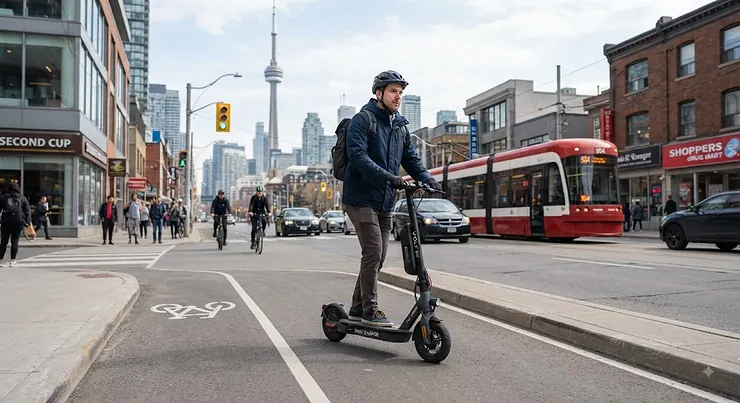
Standing over a half-charged scooter at 7:45 a.m., watching the little battery icon crawl upward while your bus pulls away outside, is its own special kind of Tuesday-morning misery. A fast charging electric scooter is built precisely to stop that from happening — a scooter whose charger and battery chemistry are matched to push more energy in over a shorter window than the six-to-nine-hour “plug it in and pray” chargers that shipped with scooters a few years ago. In practice, that usually means a charger rated at a higher amperage (often 3A to 5A instead of the old 1.5A to 2A standard), sometimes paired with a dual-charging-port design that lets you run two chargers at once.
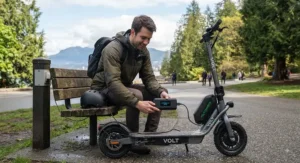
This guide is built for the Canadian rider: the person commuting through Toronto slush, dodging Vancouver rain, or riding the flat, wide streets of Calgary and Winnipeg where a scooter genuinely replaces short car trips. We’ve dug into real specifications, verified charging-time claims from manufacturers and independent testers, and pulled together honest, sourced analysis rather than a repackaged spec sheet. Health Canada and Transport Canada have issued public safety guidance on lithium-ion batteries used in e-mobility devices, so charging speed isn’t just a convenience question here — it’s a safety one too, and we’ll cover both angles honestly.
Below, you’ll find seven real scooters spanning budget, mid-range, and premium price points, a breakdown of what charger amperage actually does to your wait time, an honest look at what fast charging does to long-term battery health, and a practical answer to the overnight-versus-quick-top-up debate that most owners eventually face. Prices are shown as ranges in Canadian dollars because Amazon.ca pricing shifts constantly — always check the current listing before you commit.
Quick Comparison: Fast Charging Electric Scooters at a Glance
| Scooter | Claimed Charge Time | Battery | Price Range (CAD) | Best For |
|---|---|---|---|---|
| Segway Ninebot Max G3 | 3.5h (2.5h dual charger) | 597Wh | C$1,200–C$1,450 | Fastest full recharge with dual-charger upgrade |
| Apollo City | 4.5h (2–3h with fast charger add-on) | 960Wh (48V 20Ah) | C$1,000–C$1,250 | Canadian-designed commuter with a genuine fast-charge accessory |
| Varla Eagle One | 8–9h (4–5h dual charger) | 946Wh | C$1,650–C$1,950 | Off-road power with a real dual-port shortcut |
| NIU KQi3 Pro | Under 6h | 486Wh | C$750–C$900 | Balanced mid-range charging and range |
| Xiaomi Electric Scooter 4 Ultra | 6.5h (faster with third-party charger) | 561.5Wh | C$1,100–C$1,350 | Best range recovered per charging hour |
| GoTrax G4 | 4–5h | 374.4Wh | C$550–C$700 | Quickest charge in the budget tier |
| Hiboy S2 Pro | 4–6h | 36V 11.6Ah | C$480–C$600 | Honest budget pick without a true fast-charge system |
The pattern that jumps out immediately: charging speed doesn’t track neatly with price. Reviewers and manufacturer documentation both confirm the Segway Ninebot Max G3 posts the shortest realistic full-charge window in this lineup once you add the optional DC fast charger, while the Varla Eagle One — despite a bigger battery and a higher price tag — still needs a second charger purchased separately to get anywhere near competitive charge times. Budget buyers shouldn’t assume they’re stuck waiting longest, either; the GoTrax G4 and Hiboy S2 Pro post charge windows that are perfectly respectable for scooters at their price, even without dedicated fast-charging hardware.
💬 Just one click — help others make better buying decisions too!😊
Top 7 Fast Charging Electric Scooters: Expert Analysis
1. Segway Ninebot Max G3 — dual-charger halves the wait
The Max G3’s standout trick is its dual-input charging port, which lets you run the stock charger alongside an optional second unit to cut total charge time roughly in half. Segway’s own documentation and independent testers converge on the same numbers: about 3.5 hours with the included charger, dropping to around 2.5 hours when both chargers are running simultaneously. That’s a meaningful jump from the six-hour wait riders tolerated on the previous-generation Max G2. Powering all this is a 597Wh battery paired with a 2,000W peak-output rear hub motor, enough to hold a Class 3 top speed of roughly 45 km/h (28 mph) once unlocked through the Segway app, with a manufacturer-rated range up to 80 km (50 miles) in Eco mode.
Based on the spec comparison, this is the scooter for someone whose commute schedule genuinely can’t absorb a multi-hour wait — a rider who gets home late, needs the scooter charged by early morning, and doesn’t want to plan their evening around a six-hour charge cycle. What most buyers overlook is that the second charger isn’t included in the box, so the advertised 2.5-hour figure requires an extra purchase most first-time buyers don’t budget for. Reviewers consistently note strong build quality, dual hydraulic suspension that smooths out rough pavement, and a genuinely useful TFT display, while also flagging that the dual-charger accessory feels like it should be bundled rather than sold separately at this price tier.
Pros:
- ✅ Dual-input port cuts charge time to about 2.5 hours
- ✅ Strong 2,000W peak motor with real hill-climbing power
- ✅ UL-2272/2271 certified with dual hydraulic suspension
Cons:
- ❌ Second fast charger sold separately, not included
- ❌ Heavier build makes stair-carrying less convenient
Expect the Segway Ninebot Max G3 to sit in the C$1,200–C$1,450 range at the time of research, and given the charging flexibility and certified safety testing, it’s a fair value pick for anyone prioritizing minimal downtime over raw sticker price.
2. Apollo City — Canadian-built with true fast-charge upgrade
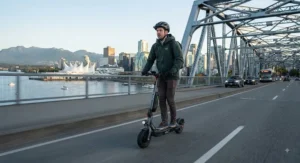
Apollo is a Vancouver-headquartered company, and the City model is engineered with Canadian commuting conditions in mind — IP66 weatherproofing, self-healing PunctureGuard tires, and a triple-spring suspension tuned for cracked pavement and pothole season. On the charging side, the standard included charger brings a full recharge in about 4.5 hours from the 48V 20Ah (960Wh) battery, but Apollo also sells a dedicated 48V fast charger as an accessory that the company states cuts charging time by roughly 50%, landing in the 2-to-3-hour range.
Here’s what to weigh: the City’s dual 500W motors (2,000W combined peak) deliver real hill-climbing performance for cities like Vancouver, Halifax, or the hillier parts of Montreal, and the regenerative braking system recovers a modest amount of charge on every stop — Apollo states its Power RBS system adds back up to 10% range through braking alone. Reviewers cited by Apollo, including Rider Guide and Electric Scooter Insider, consistently praise the ride comfort and build quality, and aggregated buyer sentiment on the company’s own listings highlights the frame’s lifetime warranty as a differentiator few competitors match. On paper this means a scooter designed to survive a Canadian winter’s worth of salt and slush better than most imports.
Pros:
- ✅ Genuine 48V fast charger accessory nearly halves charge time
- ✅ IP66 weatherproofing built for Canadian winters
- ✅ Lifetime frame warranty backed by a domestic company
Cons:
- ❌ Fast charger is an extra purchase, not standard equipment
- ❌ Heavier dual-motor build (around 29 kg) limits portability
At an estimated C$1,000–C$1,250 range, the Apollo City sits as a strong mid-to-premium value, particularly for buyers who want direct Canadian customer support rather than dealing with cross-border warranty claims.
3. Varla Eagle One — off-road power, dual-port quick charge
The Eagle One is built for riders who want a genuine off-road-capable scooter rather than a strict city commuter, and its charging story reflects that trade-off. The stock single charger needs roughly 8 to 9 hours for a full charge of the 52V 18.2Ah (946Wh) battery — long by 2026 standards — but the scooter includes two separate charging ports, so adding a second charger (sold separately) cuts that down to around 4 to 5 hours. Dual 1,000W hub motors combine for a 3,200W peak output, letting the Eagle One climb 30-degree-plus inclines and carry riders up to roughly 150 kg (330 lbs).
What the spec sheet won’t tell you, but reviewers note, is that the dual-charging setup genuinely changes the day-to-day usability of a scooter this large. Without the second charger, an overnight-only charging habit is basically mandatory; with it, the Eagle One becomes workable for riders who need a mid-day top-up between shifts or errands. Multiple independent reviewers, including Ebike Escape and Active Gear Review, describe the ride quality as excellent for a dual-motor performance scooter, citing stable handling at speed and strong suspension, while consistently flagging the 35 kg (77 lb) weight as a genuine barrier to portability — this is not a scooter you’re folding up and carrying onto a bus.
Pros:
- ✅ Dual charging ports cut time roughly in half with a second unit
- ✅ Dual 1,000W motors handle steep inclines with ease
- ✅ Long 946Wh battery supports up to 64 km (40 mi) range
Cons:
- ❌ Single-charger stock setup takes 8–9 hours
- ❌ Very heavy at roughly 35 kg, poor for stairs or transit
The Varla Eagle One typically lands around C$1,650–C$1,950, making the second charger purchase (often under C$100) one of the better value-add accessories in this whole category if fast charging matters to you.
4. NIU KQi3 Pro — steady mid-range charging efficiency
NIU’s KQi3 Pro doesn’t market itself as a dedicated “fast charging” model, but its numbers are genuinely competitive against scooters that do. The 486Wh battery reaches full charge in under 6 hours according to NIU’s own specifications, and independent testing from ERideHero confirms this is meaningfully quicker than some 350W-class competitors that stretch past 7 hours for a smaller battery. The scooter runs a 350W rated (700W peak) motor, hits a top speed around 32 km/h (19.9 mph), and carries a manufacturer-rated range of up to 50 km (31 miles).
Based on the spec comparison, the KQi3 Pro earns its spot here less through headline-grabbing charge-time claims and more through consistency — you’re not choosing between a great battery and a slow charger, or vice versa. Reviewers consistently note that real-world range lands closer to 35–38 km (22–24 miles) once you account for stop-and-go city riding rather than NIU’s ideal-condition figures, and NIU Canada operates dedicated stores in Toronto and Montreal, which matters for warranty service and parts availability that many imported budget brands simply can’t offer.
Pros:
- ✅ Sub-6-hour charge time beats several similarly priced rivals
- ✅ Dual disc brakes plus regenerative braking for range recovery
- ✅ NIU Canada storefronts in Toronto and Montreal for support
Cons:
- ❌ No true fast-charge accessory currently offered
- ❌ Real-world range runs noticeably below the rated maximum
Around C$750–C$900 at the time of research, the NIU KQi3 Pro represents one of the strongest all-around value picks in this comparison, especially for buyers who want dependable local support.
5. Xiaomi Electric Scooter 4 Ultra — best range-per-charging-hour balance
Xiaomi’s flagship scooter in this lineup takes a different approach to the fast-charging conversation: rather than shortening the wait dramatically, it maximizes what you get out of every hour plugged in. The 561.5Wh battery fully charges in about 6.5 hours using the stock 124W adapter, and that adapter delivers meaningfully more power than the chargers bundled with cheaper scooters, which is exactly why the 4 Ultra can push a rated range of up to 70 km (43 miles) despite a charge time that isn’t the shortest on this list. A 500W rated (940W peak) motor and dual suspension round out a genuinely premium feature set.
Reviewers consistently note this is one of the best distance-per-charging-hour ratios in the category — roughly 10.7 km of rated range recovered for every hour of charging, ahead of several scooters with nominally “faster” chargers but smaller batteries. What most buyers overlook is that Xiaomi doesn’t officially sell a certified fast-charging upgrade path in Canada the way Segway or Apollo do; third-party chargers exist but typically require installing a different charging port and voiding the manufacturer warranty, which is a real trade-off worth weighing before buying aftermarket hardware.
Pros:
- ✅ Best rated-range-per-charging-hour ratio in this comparison
- ✅ Self-healing DuraGel tires reduce flat-related downtime
- ✅ Dual suspension smooths rough Canadian pavement
Cons:
- ❌ No official Xiaomi fast-charging accessory sold in Canada
- ❌ 6.5-hour charge is average, not class-leading, on its own
Expect the Xiaomi Electric Scooter 4 Ultra in the C$1,100–C$1,350 range, positioning it as a premium pick for riders who value range recovered per plugged-in hour over the shortest possible total wait.
6. GoTrax G4 — quickest charge in the budget class
The G4 has become GoTrax’s flagship commuter model largely because it doesn’t force buyers to trade charge speed for range the way many entry-level scooters do. GoTrax’s own manual lists a 4.5-hour charge time for the 374.4Wh (36V 10.4Ah) battery, and TechGearLab’s hands-on testing confirmed a similar four-to-five-hour window in practice — genuinely quick for a scooter in this price bracket. A 350W motor (500W peak-rated in GoTrax marketing) delivers a top speed around 32 km/h (20 mph) and a manufacturer-rated range up to 40 km (25 miles).
The spec sheet won’t tell you this, but user reports suggest the G4’s lighter, higher-density battery pack is a meaningful part of why it charges faster than bulkier budget competitors carrying similar capacity — smaller cells generally accept charge current more efficiently than older, heavier chemistries. Reviewers consistently point to the 10-inch pneumatic tires and above-average range for the price as the G4’s biggest strengths, while flagging that the plastic components feel less premium than the aluminum-heavy builds of pricier options — a fair trade-off at this price point rather than a genuine flaw.
Pros:
- ✅ 4–5 hour charge time is genuinely quick for the price
- ✅ 10-inch pneumatic tires smooth out cracked pavement
- ✅ Above-average 40 km rated range for a budget scooter
Cons:
- ❌ No dual-charging or fast-charge accessory option
- ❌ Build materials feel noticeably less premium than pricier picks
At roughly C$550–C$700, the GoTrax G4 is arguably the best charge-time-to-price ratio of any scooter in this entire comparison.
7. Hiboy S2 Pro — honest budget pick, charging tradeoffs and all
In the interest of the honesty this guide promises, the S2 Pro doesn’t pretend to be a fast-charging scooter — and it shouldn’t be marketed as one. Hiboy’s own documentation lists a 4-to-6-hour charge window for the 36V 11.6Ah battery, which is competitive but not exceptional, and there’s no dual-charging port or fast-charge accessory available for this model. Its 500W motor and honeycomb airless tires prioritize durability and low maintenance over cutting-edge charging tech, with a rated range up to 41 km (25.6 miles) and top speed around 30 km/h (19 mph).
Here’s what to weigh: the S2 Pro earns its place on this list not because it charges fast, but because it charges reasonably well while eliminating flat-tire downtime entirely, thanks to its airless honeycomb tires — a real, if different, kind of “uptime” advantage. Reviewers at EScooterNerds, who tested the model extensively, describe it as one of the toughest scooters in its price class with a notably low defect rate, though they also note the solid tires trade some ride comfort for that puncture immunity, and the lack of any fast-charge option is the clearest limitation for buyers specifically shopping this keyword.
Pros:
- ✅ Airless honeycomb tires eliminate flat-tire downtime entirely
- ✅ Reliable 4–6 hour charge window with low reported defect rates
- ✅ Strong build quality reviewers describe as unusually tough
Cons:
- ❌ No fast-charging accessory or dual-port option exists
- ❌ Solid tires ride firmer than pneumatic alternatives
At around C$480–C$600, the Hiboy S2 Pro is best understood as the honest budget baseline in this guide — a solid scooter that simply isn’t built around fast charging, included here so shoppers can see exactly what they’re trading off at this price.
Fast Charging Electric Scooters vs Standard Charging Models
| Factor | Fast Charging Models | Standard Charging Models |
|---|---|---|
| Typical charge time | 2.5–5 hours | 6–9 hours |
| Charger amperage | 3A–5A common | 1.5A–2A common |
| Upfront cost | Often C$100–C$300 higher | Lower entry price |
| Battery heat during charge | Higher, needs good ventilation | Lower, gentler on cells |
| Best For | Riders with tight daily turnaround windows | Riders who only ever charge overnight |
The trade-off here isn’t really about which is “better” in the abstract — it’s about matching charging speed to your actual routine. Riders who can reliably plug in overnight every single night rarely notice a difference between a 4-hour and an 8-hour charger, since both finish well before morning regardless. Where fast charging earns its markup is for shift workers, delivery riders, or anyone squeezing in a midday top-up between uses, where the gap between a 2.5-hour and an 8-hour wait is the difference between riding again today or not at all.
✨ Don’t Miss These Exclusive Deals!
🔍 Take your commute to the next level with a scooter that actually fits your charging routine. Click on any highlighted pick above to check current pricing and availability on amazon.ca. The right match here saves you real time every single week!
Practical Usage Guide: How to Fast-Charge Your Electric Scooter the Right Way
Fast charging isn’t just “plug in a stronger charger and walk away” — a few habits protect both your battery and your safety. First, always charge on a hard, non-flammable surface, never on a bed, carpet, or near flammable materials; this is standard guidance echoed across fire-service advisories in Canadian cities. Second, avoid charging a scooter the moment it comes in from freezing temperatures — let the battery warm to roughly room temperature first, since charging a genuinely cold lithium-ion pack accelerates degradation and, in rare cases, raises safety risk. Third, if your scooter supports dual charging, only use the manufacturer’s matched second charger, not a generic replacement, since mismatched voltage or amperage between two simultaneous chargers can stress the battery management system.
During the first 30 days with a new fast-charging scooter, resist the urge to run the battery all the way to empty before recharging; shallow, frequent top-ups are gentler on lithium-ion chemistry than repeated deep discharges. A common early mistake is leaving a scooter on the fast charger well past 100%, which most modern battery management systems handle safely by cutting current, but unplugging promptly once charged is still the safer long-term habit. Finally, inspect the charging port and cable monthly for fraying, corrosion, or bent pins — a damaged charging connection is one of the more common triggers behind the battery fires Canadian fire departments have flagged in recent safety advisories.
Who Actually Needs Fast Charging? Real-World Scenarios
Consider a hospital nurse working rotating 12-hour shifts in Ottawa, riding her scooter from a transit hub to the hospital and back. Her window between shifts is often under four hours, which makes a standard 8-hour charger simply unworkable — for her, a scooter like the Segway Ninebot Max G3 with its dual-charger option isn’t a luxury, it’s the only setup that lets her ride every shift rather than every other one.
Now picture a university student in Kitchener-Waterloo who commutes twice daily across campus and lives in a dorm with one shared outlet. He only ever charges overnight, so the difference between a 4-hour and an 8-hour charger is functionally irrelevant to his routine — a budget pick like the GoTrax G4 or Hiboy S2 Pro saves him real money without costing him any actual convenience.
Finally, think about a courier in Calgary doing food-delivery runs across a spread-out, hilly service area, needing 60-plus kilometres of range across a workday with maybe one break to plug in. For this rider, the Varla Eagle One‘s dual-port fast-charge setup and hill-climbing dual motors solve two problems simultaneously — enough charge speed during a lunch break to add real kilometres back, and enough torque to handle Calgary’s terrain without the motor straining. Matching the scooter to the actual charging window in your day, not the one on the spec sheet, is the single biggest decision-making shortcut in this whole guide.

Fast-Charging Problems and Practical Solutions
Problem: The battery charges to 100% but drains unusually fast the next day. This is often a battery management system recalibration issue rather than true capacity loss. Letting the battery run down to around 20% before a full charge cycle, occasionally rather than every time, can help recalibrate the percentage readout.
Problem: The scooter won’t accept a fast charge in cold weather. Most lithium-ion battery management systems intentionally throttle or block charging below roughly 0°C to protect the cells. Bring the scooter indoors and let it reach a moderate temperature before plugging in — this is expected behaviour, not a defect.
Problem: A second charger for dual-port charging isn’t compatible. Always buy the manufacturer’s specific accessory charger rather than a generic aftermarket unit; mismatched voltage between chargers is a common cause of charging port damage.
Problem: Charge time seems to be getting longer after a year of use. Gradual capacity fade is normal lithium-ion aging, but a sudden, sharp increase in charge time can indicate cell degradation from consistently fast-charging a battery that’s kept at a very low or very high state of charge for long periods.
Problem: The charging port feels warm or hot during a fast charge. Mild warmth is normal given the higher current involved, but genuine heat you can’t comfortably touch warrants immediately unplugging and inspecting the port and cable for damage before charging again.
How to Choose a Fast Charging Electric Scooter
What is a fast charging electric scooter? It’s a scooter engineered with a higher-amperage charger, and often a larger onboard charging circuit, that recharges its battery meaningfully faster than the 6-to-9-hour standard — typically landing in the 2.5-to-5-hour range, sometimes through a dual-charging-port design that runs two chargers at once.
- Match charger amperage to your actual charging window. If you only ever charge overnight, a 1.5A standard charger works fine; if you need a midday top-up, look for 3A or higher.
- Check whether “fast charging” is standard or a paid accessory. Several scooters on this list, including the Apollo City and Varla Eagle One, require buying a second charger separately to hit their fastest advertised times.
- Confirm battery capacity alongside charge time. A fast charger on a small battery isn’t necessarily faster in absolute range recovered than a slower charger on a bigger one — compare range-per-hour, not just total hours.
- Look for UL 2272 or equivalent safety certification. This matters more with fast charging, since higher current puts more stress on the battery management system.
- Factor in local climate. Cold-weather Canadian cities should prioritize scooters with documented cold-charging tolerance, since charging speed often drops sharply below freezing regardless of the charger’s rating.
- Weigh warranty and local support. Canadian-based brands like Apollo and NIU Canada offer more accessible service for charger and battery issues than some import-only competitors.
- Read aggregated review sentiment on real-world charge times, not just manufacturer claims, since independent testing regularly shows longer-than-advertised charging under realistic conditions.
Understanding Charger Amperage: Why the Number on the Box Matters
Charger amperage is the single most misunderstood spec in this entire category, and it’s worth slowing down on. A charger’s total power output is roughly voltage multiplied by amperage — so a 54.6V charger rated at 2A delivers around 109W, while the same voltage at 3.9A (like Segway’s fast charger for the Max G3) delivers around 213W, nearly double. That’s the entire mechanism behind fast charging: more watts pushed into the battery per hour, which means less time waiting, all else being equal.
Here’s what most buyers overlook: charger amperage isn’t something you can simply upgrade on any scooter. The battery’s internal circuitry, specifically its battery management system, has to be rated to accept that higher current safely, which is exactly why manufacturers sell matched fast-charger accessories rather than letting owners plug in any higher-amperage charger they find online. Using a generic higher-amperage charger not explicitly rated for your specific battery is one of the more commonly cited causes of charging-related battery stress in consumer reports, and Canadian safety officials have specifically flagged mismatched or uncertified charging hardware as a fire-risk factor worth taking seriously.
Reviewers consistently note that when comparing two scooters with similar battery sizes, the one with the higher-amperage charger will almost always win on charge time — but that speed comes with a genuine trade-off in heat generation during charging, which is precisely why the safety guidance below matters just as much as the convenience angle.
Battery Health and Fast Charging: What the Research Actually Shows
This is the section most marketing pages skip entirely, so let’s be direct about it. Peer-reviewed battery research consistently finds that faster charging accelerates a specific degradation mechanism called lithium plating, where lithium ions build up on the surface of the battery’s graphite anode instead of properly absorbing into it, particularly at higher charge rates and lower temperatures. A study published in the Frontiers in Energy Research journal found that increased charge rate and lower operating temperature both independently worsen this plating effect, which is the primary early-stage driver of capacity loss in fast-charged lithium-ion cells.
That doesn’t mean fast charging is inherently dangerous or that you should avoid it — it means the trade-off is real and worth understanding rather than ignoring. Research from the U.S. National Renewable Energy Laboratory has documented that uneven lithium distribution during fast charging is a genuine technical barrier the battery industry is still actively working to solve, not a solved problem manufacturers have already fully engineered around. Based on the spec comparison across this guide’s seven scooters, the practical takeaway for everyday riders is straightforward: reserve genuine fast charging for the days you actually need a rapid top-up, and default to your scooter’s standard charger the rest of the time if your schedule allows it, since slower charging is consistently gentler on long-term battery capacity.
What the spec sheet won’t tell you, but the research suggests, is that keeping a scooter’s battery in a moderate charge range — roughly 20% to 80% — for daily use, and reserving full 100% charges for days you need maximum range, is a widely recommended practice for extending lithium-ion battery lifespan across consumer electronics generally, scooters included.
Overnight vs Quick-Top-Up Charging: Which Habit Wins?
Neither charging habit is universally “correct” — they solve different problems, and the honest answer depends entirely on your battery chemistry and your schedule. Overnight charging, typically an 6-to-9-hour standard-charger session while you sleep, is gentler on the battery precisely because it happens at a lower current over a longer window, generating less heat and less of the lithium-plating stress that faster charging introduces. If your commute pattern genuinely allows a full overnight charge every single night, this remains the lower-stress option for long-term battery health, and it’s effectively free of the trade-offs discussed in the section above.
Quick top-up charging, using a fast charger for a partial 30-to-90-minute session mid-day, solves a scheduling problem overnight charging simply can’t: getting meaningful range back when you don’t have six-plus hours available. The trade-off is that repeated fast partial charges, especially from a low state of charge, generate more heat and slightly more plating stress per kilometre of range recovered than a full, slow overnight session would. Reviewers and battery researchers alike generally agree on a practical middle path: use overnight standard charging as your default habit whenever your schedule allows it, and treat fast, quick top-ups as a genuinely useful tool reserved for the days your routine actually demands it — not as your everyday charging routine by default.
Common Mistakes When Buying a Fast Charging Electric Scooter
The most frequent mistake is assuming “fast charging” is a standard, included feature rather than checking whether it requires a separate accessory purchase — as this guide has shown, the Apollo City and Varla Eagle One both require buying a second charger to hit their fastest advertised times. A second common error is comparing charge times in isolation without checking battery capacity; a scooter that charges in 4 hours but only holds 350Wh isn’t necessarily “faster” in any meaningful sense than one that charges in 6 hours but holds 600Wh, since the second scooter is recovering more usable range per hour plugged in.
Buyers also frequently overlook cold-weather charging performance, which matters enormously for a Canadian audience specifically — a charger’s rated speed in a manufacturer’s lab conditions rarely holds up in an unheated garage in January. Finally, a subtler mistake is buying a generic, uncertified “fast charger” replacement online instead of the manufacturer’s matched accessory, chasing a lower price without realizing the safety and warranty implications; Canadian safety advisories have specifically flagged this exact category of substandard third-party charging hardware as a fire-risk concern worth taking seriously rather than dismissing as overcautious.
Features That Actually Matter (And Those That Don’t)
Charger amperage, battery capacity in Wh (not just Ah, which is meaningless without knowing the voltage), and genuine safety certification like UL 2272 are the features that actually determine your real-world charging experience, and all three deserve real scrutiny before purchase. Dual-charging-port capability matters specifically if your schedule includes a midday charging window; if you only ever charge overnight, it’s a feature you’ll likely never use regardless of how impressive it sounds on a spec sheet.
On the “doesn’t matter as much as marketing suggests” side: flashy app dashboards showing charging percentage in real time are genuinely convenient but have zero effect on actual charge speed, and marketing terms like “turbo charge” or “rapid charge” aren’t standardized industry terms — always check the actual amperage and hours claimed rather than trusting the label alone. Similarly, peak wattage figures for motors get far more marketing attention than charger wattage, even though for this specific buying decision, charger wattage is the number that actually predicts your morning wait time.
Safety, Regulations and Battery Fire Compliance in Canada
Fast charging brings genuine safety considerations that Canadian riders shouldn’t brush aside. Toronto’s fire chief has specifically called lithium-ion battery fires linked to e-bikes and e-scooters “the largest growing fire safety risk in the city,” with fire incidents tied to these batteries climbing year over year across multiple Canadian municipalities including Calgary, Ottawa, and Montreal. Transport Canada currently regulates the labelling, transport, and import of lithium batteries, while day-to-day operational rules for riding e-scooters — helmet requirements, minimum age, and where you’re permitted to ride — are set provincially and often further restricted at the municipal level, so always confirm your local rules before buying.
The clearest, most actionable safety takeaway for fast-charging specifically: always use manufacturer-certified chargers, never leave a charging scooter unattended overnight in an enclosed space without a smoke detector nearby, and never charge a battery that’s visibly swollen, damaged, or unusually hot to the touch. Health Canada’s public consultation on lithium-ion battery regulation, along with continued advisories on avoiding uncertified third-party batteries and chargers, reflects a regulatory landscape that’s actively tightening, not one that’s settled — worth keeping an eye on if you’re investing in a scooter you plan to keep for several years.
Frequently Asked Questions
❓ How fast can a fast charging electric scooter actually charge?
❓ Does fast charging damage electric scooter batteries?
❓ Can I use any charger to fast charge my scooter?
❓ Is overnight charging better than a quick top-up?
❓ What charger amperage counts as 'fast charging' for an electric scooter?
Conclusion
Choosing a fast charging electric scooter really comes down to being honest with yourself about your actual daily schedule rather than chasing the most impressive-sounding spec sheet. If your commute allows a reliable overnight charge every night, a scooter like the GoTrax G4 or Hiboy S2 Pro delivers excellent value without paying a premium for charging speed you’ll rarely use. If your day includes a genuine midday gap and you need real range back in an hour or two, the dual-charging setups on the Segway Ninebot Max G3 and Varla Eagle One — or the Canadian-built Apollo City with its dedicated fast-charge accessory — solve a problem the budget options simply can’t.
Across every price point in this guide, the underlying advice stays consistent: check whether “fast charging” is standard equipment or a separate purchase, compare charger amperage alongside battery capacity rather than either number alone, and treat manufacturer safety certifications as a genuine decision factor, not fine print to skim past. Battery health research makes clear that fast charging is a real trade-off rather than a free upgrade, so matching the charging speed to what you actually need — not the fastest number available — is the smartest way to buy in this category for 2026.
✨ Ready to stop waiting on your scooter?
Check today’s price on your top pick and get back to riding sooner!
Recommended for You
- Dual Battery Scooter for Extended Range: 7 Real 2026 Picks
- Medium Range vs Long Range Electric Scooter: 7 Best Picks (2026)
- 30-60 km Range Electric Scooter for Students: 7 Top Picks (2026)
Disclaimer: This article contains affiliate links. As an Amazon Associate, I earn from qualifying purchases. If you purchase products through these links, we may earn a small commission at no additional cost to you.
✨ Found this helpful? Share it with your friends! 💬🤗
