
In This Article
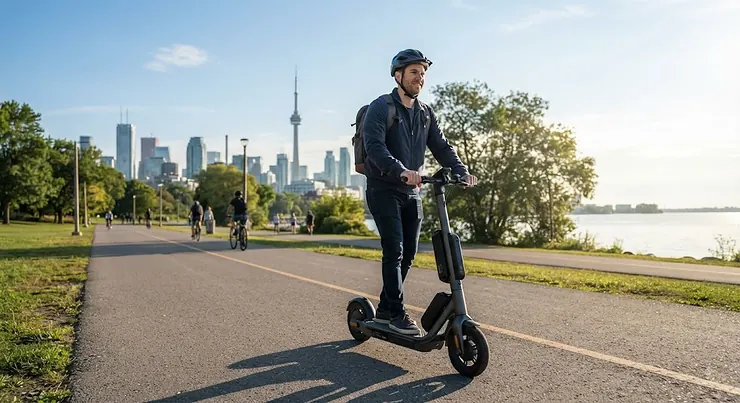
Range anxiety is a strange thing to feel on a scooter. You are not stranded on a highway shoulder, but you are absolutely stuck two kilometres from home with a dead deck and a long walk ahead of you. That is the exact problem a dual battery scooter for extended range is built to solve, and it is why the category has quietly become one of the fastest-growing corners of the personal electric vehicle market. A dual battery scooter for extended range is, in short, an electric kick scooter that draws power from two separate battery packs — either built in from the factory or added as a genuine second unit — instead of relying on one single cell block to cover the whole ride. The idea sounds simple. The engineering behind it, and the trade-offs that come with it, are not. Some manufacturers genuinely split the pack in two so you can charge or swap one half without touching the other. Others simply build one very large battery and call it “dual” because it uses two parallel cell groups internally, which is a different thing entirely and matters a lot once you are the one paying for replacement cells. Over the next several thousand words, we will walk through seven real, currently available models, dig into what “dual” actually means on each one, and cover the practical stuff — commuting range, weight distribution, battery swap convenience, and what Canadian regulations actually allow — that most spec sheets leave out entirely.
Quick Comparison Table
| Scooter | Battery Setup | Est. Range | Price Range (CAD) | Best For |
|---|---|---|---|---|
| Segway Ninebot ES4 | True dual battery (factory) | Up to 45 km (28 mi) | C$800–C$950 range | Budget commuting |
| Segway Ninebot ES2 + External Pack | Expandable to dual | Up to 45 km (28 mi) | C$650–C$850 range | Upgradeable starter |
| Ausom DT2 Pro | Single large pack, dual charge ports | Up to 114 km (71 mi) | C$1,400–C$1,700 range | Mid-range value |
| Varla Eagle One V3.0 | Single large pack, dual motor | Up to 80 km (50 mi) | C$1,650–C$1,950 range | All-terrain commuting |
| INOKIM OXO (2026 Edition) | Single large pack, dual motor | Up to 109 km (68 mi) | C$3,300–C$3,800 range | Long-distance touring |
| Kaabo Wolf Warrior 11 Plus | Single large pack, dual motor | Up to 90 km (56 mi) | C$2,600–C$3,000 range | Off-road extended range |
| Segway SuperScooter GT2 | Single large pack, dual fast-charge | Up to 90 km (56 mi) | C$3,800–C$4,300 range | Performance flagship |
Looking at the spread above, a clear pattern shows up fast: true two-pack “dual battery” architecture is mostly a budget-commuter feature, while premium extended-range machines almost always chase distance through one oversized single pack instead. That is not a flaw in either approach, it is just a different engineering bet, and which one suits you depends heavily on how you plan to charge, store, and eventually replace the battery. The Segway Ninebot ES4 wins on true battery swap convenience for a low upfront cost, while the INOKIM OXO wins on raw distance per charge if range is genuinely the only thing you care about.
💬 Just one click — help other Canadian parents make better buying decisions too!😊
Top 7 Dual Battery Scooters: Expert Analysis
1. Segway Ninebot ES4 — genuine dual-battery design at a commuter price
The Segway Ninebot ES4 is the closest thing on this list to a textbook dual battery scooter for extended range, and it earns that spot honestly rather than through marketing language. Segway built the ES4 around two physically separate battery units working together, each protected by its own battery management system, rather than one oversized cell block wearing a “dual” label. In practice this means a rated range of roughly 45 km (28 miles), a top speed near 30 km/h (18.6 mph), and a scooter that is genuinely lighter to lift onto a bus rack than most single-large-battery competitors at this price. Based on the spec comparison against its own sibling, the ES2, the added second pack is what actually delivers the ES4’s real-world range advantage rather than any motor upgrade. Reviewers consistently note that the dual-pack setup extends daily range without meaningfully hurting portability, though a few mention the battery indicator can be optimistic in cold weather, a fair warning for anyone commuting through a Canadian winter. The scooter is not swappable mid-ride in the truest sense — you cannot pull one pack out and slot in a charged spare on the sidewalk — but the redundancy still means one weak cell group is less likely to strand you entirely.
Pros:
- ✅ True dual-pack design, not marketing language
- ✅ Noticeably lighter than single big-battery rivals
- ✅ Reliable, well-documented parts and repair network
Cons:
- ❌ Packs are not user-swappable mid-ride
- ❌ Range drops more than average in cold weather
Prices for the Segway Ninebot ES4 typically sit in the C$800–C$950 range at the time of research, and for that money it remains one of the strongest value picks for anyone whose commute is genuinely a dual battery electric scooter for commuting problem rather than an off-road one.
2. Segway Ninebot ES2 + Official External Battery Pack — best upgrade path to dual battery
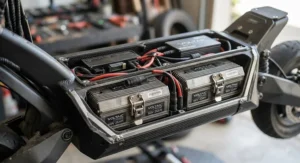
The Segway Ninebot ES2 on its own is a single-battery scooter, but Segway sells an official external battery pack that clips onto the stem and turns it into a genuine two-pack system, which is exactly why it earns a spot here as the best “grow into it” option. What most buyers overlook about this combination is that the smart-charging circuitry in the add-on pack automatically balances charge between both batteries, so you are not manually juggling two separate chargers every night. Key numbers: the base Segway Ninebot ES2 carries roughly 187 Wh internally, and the external pack nearly doubles usable capacity, pushing rated range from around 24 km (15 miles) up to roughly 45 km (28 miles) while also lifting top speed slightly. Aggregated review sentiment on this combo is largely positive, with owners praising the fact that it is a genuine factory accessory rather than a third-party workaround, though a handful of reviewers flag that the external unit adds noticeable bulk to the stem and slightly disrupts the fold. For a rider who is not sure they need extended range on day one, buying the base ES2 and adding the pack later is a financially sensible way to test the water before committing to a bigger, heavier machine.
Pros:
- ✅ Genuine factory-backed dual battery upgrade path
- ✅ Smart charging balances both packs automatically
- ✅ Lets you delay the extended-range purchase decision
Cons:
- ❌ External pack adds bulk to the folded profile
- ❌ Two components to buy instead of one
Buying the Segway Ninebot ES2 and pack together typically lands in the C$650–C$850 range, at the time of research, making it arguably the most budget-friendly true dual battery electric scooter for commuting on this entire list.
3. Ausom DT2 Pro — long single pack with genuinely useful dual charging
The Ausom DT2 Pro is not a two-battery scooter in the strict sense, but it earns its place here because its 52V 23.4Ah (1,216.8 Wh) single pack is paired with a dual charging port system that lets you plug in two chargers at once and cut recharge time roughly in half. Here’s what to weigh: that single big pack is what actually delivers the DT2 Pro’s headline 114 km (71 mile) claimed range, and the dual-port charging is a convenience feature layered on top rather than a second physical battery. The hydraulic brakes and aerospace-inspired rocker-arm suspension suggest Ausom aimed this scooter at riders who want performance-scooter comfort without performance-scooter pricing. Reviewers consistently note strong value for the spec sheet, particularly the inclusion of an NFC lock and hidden tracker slot at this price point, though the claimed 71-mile figure should be read the way any manufacturer number should — as a best-case, low-speed, flat-ground result rather than a daily guarantee. On paper this means a rider doing a genuinely hilly Canadian commute should plan for meaningfully less than the advertised distance.
Pros:
- ✅ Large single pack delivers genuinely long range
- ✅ Dual charging ports roughly halve recharge time
- ✅ Hydraulic brakes and built-in security features
Cons:
- ❌ Not a true dual-battery redundancy design
- ❌ Real-world range likely well under the claimed figure
The Ausom DT2 Pro generally sits in the C$1,400–C$1,700 range at the time of research, positioning it as a strong mid-range pick for buyers who prioritize fast recharging over true battery redundancy.
4. Varla Eagle One V3.0 — dual motor, single big battery, budget-conscious extended range
The Varla Eagle One V3.0 leans on dual 1,200W hub motors and a single 52V 26Ah LG battery pack to deliver a manufacturer-claimed range of roughly 80 km (50 miles), and it is one of the more honest examples of the “single large battery vs dual battery design” question in this whole guide. What most buyers overlook about the Eagle One line is that the dual part of its name refers entirely to the motors, not the battery, which matters if you were shopping specifically for pack redundancy. That said, the 52V architecture (versus the 36V and 48V systems common on cheaper scooters) genuinely does translate into flatter power delivery on hills and less voltage sag as the battery depletes. Aggregated customer feedback across independent scooter review sites is generally favourable, with recurring praise for the dual suspension and hill-climbing torque, and a recurring complaint about the roughly 37 kg (82 lb) curb weight making it a poor choice for anyone regularly carrying it up apartment stairs. Reviewers also note the dual charging ports, which — like the Ausom above — cut charge time without adding a second physical pack.
Pros:
- ✅ Strong hill-climbing torque from the 52V system
- ✅ Genuinely long single-charge range for the price
- ✅ Dual hydraulic suspension smooths rough pavement
Cons:
- ❌ Heavy at roughly 37 kg (82 lb)
- ❌ No true dual-battery pack redundancy
At the time of research, the Varla Eagle One V3.0 typically lists in the C$1,650–C$1,950 range, making it a reasonable middle ground between the budget Segway commuters and the premium off-road options later in this list.
5. INOKIM OXO (2026 Edition) — the single-large-battery range champion
If raw distance is genuinely the only metric that matters to you, the INOKIM OXO is difficult to beat on this list, with a 60V 25.6Ah LG battery rated for up to 109 km (68 miles) in eco mode. Based on the spec comparison against everything else here, the OXO achieves that number not through a second battery pack but through one very large, very high-voltage single cell block, reinforcing the honest reality that most flagship extended-range scooters chase distance this way rather than through true dual-pack redundancy. The patented adjustable dual suspension (OSAP) lets riders mechanically raise or lower the deck between a street mode and an off-road mode, which is a genuinely unusual feature at any price. Reviewers, including several independent testers, consistently praise the OXO’s build quality and note it earned a Red Dot design award, while also flagging a long roughly 14-hour recharge time as a real drawback of putting all that capacity into one pack instead of splitting it. The spec sheet won’t tell you this, but a battery this large also means a heavier, harder-to-repair pack if a single cell group ever fails, since there is no second half to fall back on.
Pros:
- ✅ Class-leading single-charge range near 109 km (68 mi)
- ✅ Adjustable dual suspension for street or off-road use
- ✅ Award-winning build quality and hydraulic braking
Cons:
- ❌ Roughly 14-hour recharge time on a full drain
- ❌ No second pack to fall back on if cells fail
The INOKIM OXO commands a premium price, typically in the C$3,300–C$3,800 range at the time of research, positioning it firmly as a flagship rather than a casual commuter purchase.
6. Kaabo Wolf Warrior 11 Plus — off-road extended range on a single high-capacity pack
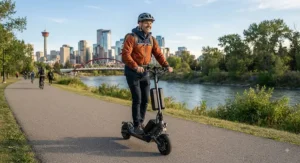
The Kaabo Wolf Warrior 11 Plus pairs dual 1,200W brushless motors with a single 60V 26Ah lithium pack rated for up to 90 km (56 miles) of optimum range, built around a frame borrowed largely from Kaabo’s premium Mantis line. What most buyers overlook about this scooter is that its fast dual-charging setup — two charging ports feeding the same single pack — is often mistaken for true battery redundancy when it is really just a faster way to refill one large battery. The upside-down front forks and rear C-spring shock absorber are genuinely built for rough terrain rather than smooth commuter paths, which explains the roughly 40 percent hill-climbing rating. Aggregated reviewer sentiment describes the Wolf Warrior 11 as excellent value against similarly powered competitors, particularly the Dualtron Thunder it borrows components from, though several riders note real-world range testing tends to land meaningfully below the manufacturer’s optimum-condition claim, a pattern worth remembering across this entire category. The spec sheet won’t tell you this, but a 60V system this large also charges noticeably faster per kilometre added than older 48V designs, which partially offsets the long full-charge time.
Pros:
- ✅ Strong off-road capability with premium suspension
- ✅ Fast dual-charging cuts refill time meaningfully
- ✅ Excellent value against similarly specced rivals
Cons:
- ❌ Real-world range typically falls short of claims
- ❌ Heavy and less practical for daily portage
The Kaabo Wolf Warrior 11 Plus typically sells in the C$2,600–C$3,000 range at the time of research, an aggressive price for the power on offer, provided you actually need off-road capability.
7. Segway SuperScooter GT2 — flagship performance with fast dual-port charging
The Segway SuperScooter GT2 sits at the top of this list on pure engineering ambition, with dual 1,500W motors (6,000W peak) drawing from a single 50.4V 30Ah (1,512 Wh) high-performance battery rated for up to 90 km (56 miles). Segway’s own testing methodology defines that range figure under specific conditions — a rider near 75 kg riding at a steady 20 km/h — and independent reviewers who pushed the GT2 harder recorded closer to 43 km in mixed use, a useful reminder that manufacturer range claims deserve healthy skepticism industry-wide. Here’s what to weigh: like several other flagships on this list, the GT2 is not a true dual-battery design, but its Heat Flux multi-layer cooling system and dual fast-charging ports mean the single pack can go from empty to full in roughly eight hours with two chargers, versus sixteen with one. Reviewers consistently highlight the double-wishbone front suspension and transparent PMOLED display as genuine standouts, while also noting the roughly 53 kg (116 lb) weight puts this firmly in “never carrying this up stairs” territory.
Pros:
- ✅ Motorcycle-adjacent acceleration and top speed
- ✅ Advanced cooling protects long-term battery health
- ✅ Dual fast-charge ports meaningfully cut downtime
Cons:
- ❌ Real-world range well under the marketed figure
- ❌ Very heavy at roughly 53 kg (116 lb)
At the time of research, the Segway SuperScooter GT2 generally lists in the C$3,800–C$4,300 range, placing it firmly as the flagship option for riders who want extended range wrapped in genuine performance hardware.
Practical Usage Guide: Getting the Most From Your Battery Setup
Whether you land on a true dual-pack machine like the Segway Ninebot ES4 or a single-large-battery flagship like the INOKIM OXO, the first 30 days matter more than most new owners realize. Start by fully charging the scooter before the first ride, even though most packs ship partially charged and technically rideable, because a full initial cycle helps the battery management system calibrate its capacity readings accurately. Avoid letting either pack drain to zero repeatedly in the first month; lithium cells generally prefer staying between roughly 20 and 80 percent for daily use, reserving full charges for days you actually need the extended range. For true dual-battery models, check whether both packs charge simultaneously or sequentially, since charging them out of sync over months can create a capacity mismatch between the two units. Store the scooter, and especially any external battery pack, at room temperature rather than in a cold garage or a hot trunk, since Canadian winters are genuinely hard on lithium-ion chemistry and can quietly shave range off every single ride. A common early mistake is ignoring firmware updates through the manufacturer’s app; several models on this list, including the Segway and Ausom units, use software to balance load between charging ports and packs, so staying current actually protects battery longevity.
Real-World Scenarios: Matching Riders to the Right Setup
The daily transit-linked commuter. Picture someone riding 6 km to a train station and back, five days a week, largely on flat urban pavement, budget capped around C$900. The Segway Ninebot ES4 fits this profile closely: its true dual-pack design covers the round trip with margin to spare, and its lighter weight makes hauling it up transit platform stairs far less punishing than a 37 kg flagship.
The suburban hill-climber. Now picture a rider covering 15–20 km through rolling suburban terrain with a couple of genuine inclines, unwilling to charge mid-day, and willing to spend closer to C$1,700. The Varla Eagle One V3.0 or Ausom DT2 Pro both suit this case well, since their higher-voltage single packs resist the voltage sag that shorter-range budget scooters suffer on hills.
The weekend long-distance rider. Finally, picture someone chasing 40+ km rides along multi-use pathways on weekends, prioritizing distance over portability, budget essentially open. The INOKIM OXO or Kaabo Wolf Warrior 11 Plus make the most sense here, trading weight and price for genuine single-charge distance most commuter scooters simply cannot match.
How to Choose a Dual Battery Scooter for Extended Range
Choosing the right dual battery scooter for extended range comes down to matching battery architecture, weight, and charging behaviour to how you actually ride, not to the biggest number on a spec sheet. Use this framework:
- Define your real daily distance first. Add 30–40 percent margin to your actual commute distance to account for cold weather, hills, and rider weight, then shop range figures against that adjusted number rather than the raw claim.
- Decide whether true redundancy matters. If getting stranded is a genuine concern — say, a commute with no transit backup — a true dual-pack design like the Segway Ninebot ES4 offers peace of mind a single big battery cannot.
- Weigh portability against capacity honestly. Every extra kilometre of range on this list correlates closely with extra kilograms; decide upfront whether you will ever actually carry the scooter upstairs.
- Check charging infrastructure at home. Dual fast-charge ports, as on the Ausom DT2 Pro or Segway SuperScooter GT2, only help if you own two chargers and have two outlets free.
- Confirm voltage, not just watt-hours. Higher-voltage packs (52V and 60V systems) generally hold power delivery better under load than lower-voltage packs of similar capacity.
- Verify the scooter is legal where you will actually ride it. Motor wattage, top speed, and weight limits vary significantly by Canadian province, so check regulations before finalizing a purchase.
- Budget for a full replacement pack, not just the scooter. Battery replacement costs are a meaningful part of total ownership cost and vary a lot between true dual-pack and single-pack designs.
Single Large Battery vs Dual Battery Design: What Actually Matters
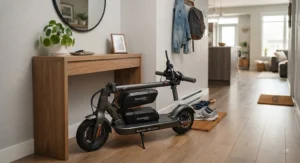
This is arguably the most misunderstood part of the entire category, and it deserves straight talk. A true dual battery design splits capacity across two physically separate packs, each with independent protection circuitry, which means a fault in one pack does not necessarily strand the whole scooter. A single large battery, by contrast, packs all of that capacity into one unit, which is mechanically simpler and often cheaper to manufacture at a given range figure, but offers no built-in redundancy if something goes wrong.
| Factor | Single Large Battery | True Dual Battery |
|---|---|---|
| Redundancy if a fault occurs | None — full range loss | Partial — other pack may still work |
| Typical weight at equal range | Lighter per Wh | Slightly heavier due to duplicate housings/BMS |
| Repair/replacement cost | One large, often pricier pack | Two smaller, sometimes cheaper packs |
| Common price tier | Mid-range to flagship | Mostly budget-to-mid commuter models |
| Charging flexibility | Fast dual-port charging common | Independent or staggered charging possible |
Reading the table above, the honest takeaway is that neither design is objectively better — a single large battery, as seen on the INOKIM OXO and Segway SuperScooter GT2, currently wins on raw maximum range per dollar, while true dual-pack machines like the Segway Ninebot ES4 win on resilience and repairability. Riders who have experienced a scooter dying mid-commute tend to weight redundancy far more heavily than riders who have not, which is a reasonable, if unscientific, way to make the call for yourself.
Weight Distribution: Why Battery Placement Changes the Ride
Weight distribution is one of the least discussed but most physically obvious differences between these designs, and it is worth understanding before you buy. On a true dual-pack scooter like the Segway Ninebot ES2 with its external battery add-on, the second pack typically mounts near the stem or handlebar area, which shifts more weight toward the front wheel and can make steering feel slightly heavier at low speed. Single large battery scooters, including the Varla Eagle One V3.0 and Kaabo Wolf Warrior 11 Plus, generally centre their pack low and near the middle of the deck, which tends to produce a more balanced, planted feel, particularly noticeable when cornering at speed or riding over uneven pavement. What most buyers overlook is that this is not just a comfort issue — a scooter with poor weight distribution can genuinely handle worse in wet or icy conditions, a real consideration through a Canadian winter. Reviewers of stem-mounted dual-pack systems consistently note a slight but noticeable change in how the front end responds once the external pack is installed, while low-centred single-battery designs rarely draw the same complaint.
Battery Swap Convenience: What “Dual Battery” Really Buys You
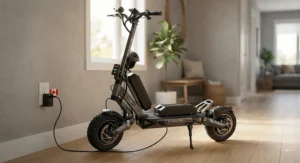
Battery swap convenience is the feature most people assume every dual battery scooter for extended range offers, and it is worth being precise here, because most do not deliver true hot-swapping the way a Gogoro moped or an industrial battery swapping forklift system does. None of the seven scooters above let you physically pull a depleted pack and slot in a charged spare mid-ride the way some larger electric vehicles do. What true dual-battery models like the Segway Ninebot ES4 actually offer is charging convenience and partial redundancy: you can, in some configurations, disconnect and charge one pack independently, and a fault in one unit does not automatically kill the whole scooter. For riders who genuinely want a swap-and-go experience, the closer real-world equivalent is simply owning a spare charged battery pack for models that support it, like the Segway Ninebot ES2‘s official external unit, and physically clipping it on before heading out. That is meaningfully different from true swap convenience but still far more practical than waiting eight to sixteen hours for a single large pack to recharge from empty.
Dual Battery Electric Scooter for Commuting: What to Expect Day to Day
A dual battery electric scooter for commuting behaves differently in daily use than a weekend performance machine, and it is worth setting expectations accordingly. Expect noticeably lighter curb weight on true dual-pack commuter models, since manufacturers building for the daily-transit crowd generally prioritize portability over maximum range, which is exactly why the Segway Ninebot ES4 and Segway Ninebot ES2 weigh a fraction of the flagship machines on this list. Expect a folding mechanism you will use twice a day, every day, which means fold reliability matters more here than raw top speed. Riders should also check municipal rules before committing to a commute route; Ontario runs a provincial pilot programme that lets individual municipalities opt in, and it is worth reading the official electric kick-style scooter rules on Ontario’s government site before assuming your city participates, since Toronto notably has not joined the pilot. British Columbia, Quebec, and several other provinces run comparable pilot programmes with their own speed and age restrictions, so a scooter that is perfectly legal in Vancouver may not be street-legal in a Toronto bike lane.
Dual Battery Electric Scooter Comparison: Feature-by-Feature
| Scooter | Top Speed | Weight | Charge Time (Full) | Suspension | Best For |
|---|---|---|---|---|---|
| Segway Ninebot ES4 | ~30 km/h | ~14 kg | ~6 hrs | Front only | Dual battery electric scooter for commuting |
| Segway Ninebot ES2 + Pack | ~30 km/h | ~13.5 kg | ~6–8 hrs | Front only | Budget upgrade path |
| Ausom DT2 Pro | ~68 km/h | ~28 kg | ~5–6 hrs (dual chargers) | Rocker-arm dual | Mid-range value |
| Varla Eagle One V3.0 | ~64 km/h | ~37 kg | ~5–10 hrs | Front & rear | All-terrain commuting |
| INOKIM OXO (2026) | ~64 km/h | ~34 kg | ~5–14 hrs | OSAP dual | Long-distance touring |
| Kaabo Wolf Warrior 11 Plus | ~80 km/h | ~40 kg | ~4.3–13 hrs | Fork & C-spring | Off-road extended range |
| Segway SuperScooter GT2 | ~70 km/h | ~53 kg | ~8–16 hrs | Double-wishbone | Performance flagship |
This dual battery electric scooter comparison makes one pattern obvious: charge time and top speed move almost in lockstep with weight and battery voltage, which means there is no free lunch anywhere on this list. Riders chasing the fastest possible recharge should prioritize dual-port charging models like the Ausom DT2 Pro, while riders who genuinely value low weight above every other spec should stay firmly in Segway’s ES-series lane rather than being tempted by a flagship’s range number.
✨ Torn between two models? Tap the one that fits your commute above and check today’s availability before it changes!
Common Mistakes When Buying a Dual Battery Scooter
The single most common mistake is assuming “dual battery” always means true swap capability, when in most cases on the market it means either two small factory packs or one large pack marketed with dual-adjacent language like dual charging or dual motors. A second frequent error is ignoring rider weight when reading range claims; nearly every manufacturer figure in this guide assumes a rider well under 75 kg riding gently, and heavier riders or aggressive throttle use can cut published range by a third or more. Buyers also regularly skip checking provincial and municipal legality before purchasing, only to discover the scooter they bought exceeds local wattage or speed limits for road use. Another overlooked mistake is buying based on maximum range alone without considering charge time; a scooter that goes farther but takes sixteen hours to refill is a poor fit for anyone charging overnight on a tight schedule. Finally, many first-time buyers underestimate curb weight until they are physically carrying a 40+ kg scooter up an apartment stairwell, which is a lesson better learned from a spec sheet than from experience.
Long-Term Cost & Maintenance
The purchase price on any of these seven scooters is only part of the real cost of ownership. Lithium-ion battery packs generally degrade to somewhere around 70–80 percent of original capacity after roughly 500–800 full charge cycles, meaning a daily commuter on a true dual-pack Segway Ninebot ES4 might expect noticeably reduced range within two to three years of consistent use, while a lower-cycle weekend rider on an INOKIM OXO could see that horizon stretch considerably further. Replacement packs for true dual-battery designs tend to be cheaper individually since each unit is smaller, though buying two eventually can approach or exceed the cost of one large single-pack replacement. Tires, brake pads, and suspension bushings represent the other recurring cost category across every model here, and off-road-oriented machines like the Kaabo Wolf Warrior 11 Plus generally chew through consumables faster than commuter-focused Segway models due to their higher torque and rougher intended use. Budgeting roughly 10–15 percent of the original purchase price annually for consumables and eventual battery replacement is a reasonable planning figure across this entire category.
Safety, Regulations & Compliance Guide for Canadian Riders
Battery safety deserves serious attention in this category, not as boilerplate caution but as a genuinely material factor in choosing a dual battery scooter for extended range. Health Canada’s own guidance notes that larger, more powerful lithium-ion battery packs — exactly the kind found in every scooter on this list — can produce more severe incidents when something goes wrong, and its official lithium-ion battery safety page recommends always using the original charger, avoiding charging in extreme cold, and never modifying a pack. This is not a theoretical risk in Canada specifically; Toronto Fire has publicly called lithium-ion batteries the city’s fastest-growing fire risk after recording a sharp rise in e-scooter and e-bike battery fires in recent years, largely tied to improper charging, damaged cells, or uncertified third-party parts. Practical steps that apply to every scooter here: charge on a hard, non-flammable surface, never charge unattended overnight next to exits, inspect the pack after any hard impact or drop, and buy only certified, UL- or CSA-marked chargers rather than cheap replacements. On the legal side, provincial rules vary sharply — most provinces cap street-legal e-scooters around 500W motor power and 24–25 km/h top speed, which means several performance models on this list, including the Kaabo Wolf Warrior 11 Plus and Segway SuperScooter GT2, may only be legal for private property or off-road use in many Canadian jurisdictions, so confirm local rules before riding on public roads.
Problem → Solution: Common Extended-Range Riding Issues
Problem: Range drops sharply in cold weather. Lithium cells lose capacity as temperature falls, and Canadian winters can cut real-world range by 20–30 percent. Solution: store the scooter indoors, warm the battery to room temperature before riding, and budget extra range margin between roughly November and March.
Problem: One battery drains faster than the other on true dual-pack systems. Uneven wear between packs is common if they are not charged together consistently. Solution: always charge both packs to full together on models like the Segway Ninebot ES4, and avoid letting one sit depleted while the other stays topped up.
Problem: Charging takes too long for a daily routine. A single large pack on models like the INOKIM OXO can take upward of 14 hours from empty. Solution: charge to 80 percent rather than 100 percent daily, which is faster and gentler on the cells, and reserve full charges for weekends when extended range is actually needed.
Problem: The scooter feels unstable at speed. This is often a weight distribution issue tied to an improperly mounted external battery pack or under-inflated tires. Solution: check tire pressure regularly and ensure any add-on battery pack is torqued down according to the manufacturer’s instructions.
✨ Ready to Ride Farther?
🔍 Take your daily commute to the next level with a dual battery scooter for extended range that actually fits your route, your budget, and your storage space. Click on any highlighted model above to check current pricing and availability on Amazon.ca. The right pick today means fewer dead-battery walks home tomorrow!
Frequently Asked Questions
❓ What is a dual battery scooter for extended range?
❓ Is a dual battery electric scooter for commuting worth the extra cost over a single-battery model?
❓ Can you charge dual battery packs separately?
❓ Are dual battery scooters legal to ride on Canadian roads?
❓ How much extra range does a second battery pack actually add?
Conclusion
There is no single correct answer to “which dual battery scooter for extended range is best,” because the honest answer depends entirely on whether you value true redundancy, raw distance, or something in between. If your priority is a light, dependable commuter with genuine two-pack resilience, the Segway Ninebot ES4 remains the clearest, most affordable choice on this list, and the Segway Ninebot ES2 with its official external pack offers an even cheaper way in. If distance is genuinely the only number that matters and you are comfortable with a heavier, single-large-battery machine, the INOKIM OXO and Kaabo Wolf Warrior 11 Plus both deliver serious range at a serious price. And if you want performance and extended range in the same package, the Segway SuperScooter GT2 and Ausom DT2 Pro both make strong, if very different, cases for themselves. Whichever direction you lean, run your real commute distance, your local province’s rules, and your storage situation through the framework above before clicking buy — a scooter that is technically the longest-range option on paper is not automatically the right one for your actual daily ride.
Recommended for You
- Medium Range vs Long Range Electric Scooter: 7 Best Picks (2026)
- 30-60 km Range Electric Scooter for Students: 7 Top Picks (2026)
- Electric Scooter For Medium Commutes: 7 Real Picks Tested (2026)
Disclaimer: This article contains affiliate links. As an Amazon Associate, I earn from qualifying purchases. If you purchase products through these links, we may earn a small commission at no additional cost to you.
✨ Found this helpful? Share it with your friends! 💬🤗
