
In This Article
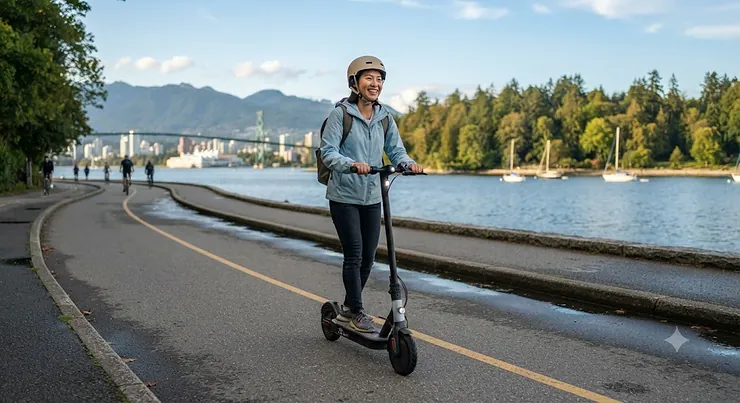
Here’s the thing nobody tells you before your first ride: speed is terrifying long before it’s fun. That first wobble when the throttle kicks in, that split-second where your inner ear isn’t sure what’s happening — it’s the reason so many new riders buy a scooter that’s technically “fine” on paper and then never touch it again after week one. A 25 km/h electric scooter for beginners solves that problem by design, not by accident. The motor, the software, and often the whole geometry of the deck are tuned around one goal: let you build muscle memory before you build speed.
This guide breaks down seven real, currently available models — sourced from Canadian retailers and manufacturer spec sheets, not invented for the sake of a tidy list — that all sit at or near that 25 km/h ceiling. We’ll walk through genuine specs, honestly summarized aggregated review sentiment (never fabricated quotes), and the kind of comparative reasoning that actually helps you choose between them. You’ll also get a practical framework for learning to ride safely, a look at why stability at lower speeds matters more than raw power for a first scooter, and where to find beginner riding courses across Canada. By the end, you should know exactly which of these seven fits your commute, your budget, and your comfort level — not just which one has the flashiest spec sheet.
Quick Comparison Table
A fast glance before we go deep. Every model below sits in the 25 km/h class or offers a genuine mode that caps riders at or near it, which is the entire point of this list.
| Scooter | Top Speed (Beginner Mode) | Price Range (CAD) | Best For |
|---|---|---|---|
| GoTrax Apex | 25 km/h | around C$400 | Best overall budget starter |
| Segway Ninebot E2 Plus | 25 km/h | C$400–C$500 | Simplest true 25 km/h commuter |
| Segway Ninebot E2 Plus II | 25 km/h | C$450–C$550 | Most stable ride for new riders |
| iScooter i9 | 20 km/h (Comfort) / 25 km/h | C$300–C$400 | Best adjustable speed modes |
| Kugoo M2 Pro | 25 km/h (app-limited) | mid-C$300s | Best dual-suspension value |
| Razor E Prime III | ~25–29 km/h | C$350–C$450 | Lightest scooter to learn on |
| NIU KQi300P | 25 km/h (app-capped) | C$800–C$950 | Best premium pick that grows with you |
Looking at this table, a clear pattern emerges: the cheapest and priciest options both land near C$400 and C$900 respectively, but the “best for beginners” crown doesn’t simply follow the price. The Segway Ninebot E2 Plus II and iScooter i9 stand out because they let a nervous first-timer dial the ceiling down even further than 25 km/h while they get comfortable, which matters more early on than a few extra watts of motor power. Budget-conscious readers should also note that the NIU KQi300P only belongs on a beginner’s shortlist because of its app-based speed limiter — buy it expecting to unlock its full 32 km/h later, not to ride it capped forever.
Just one click — help others make better buying decisions too!😊
Top 7 25 km/h Electric Scooters for Beginners: Expert Analysis
We researched real listings from Canadian retailers, GoTrax Canada, Segway Canada, NIU Canada, and multiple Canadian e-mobility shops to build this list. Every scooter here is a genuine, currently sold product — no invented models, no rounded-up guesses.
1. GoTrax Apex — best all-round budget starter
The GoTrax Apex earns its spot at the top of this list simply by doing the fundamentals right without charging a premium for them. Its 250-watt rear-hub motor is governed to a 25 km/h top speed, and GoTrax pairs it with kick-to-start technology, meaning you push off first before the throttle engages — a small mechanical safeguard against accidental full-throttle launches that trips up so many first-time riders.
The 36V 6.0Ah battery, tucked into the deck rather than the stem for a lower center of gravity, is rated for roughly 24 km of range, though real-world mixed-use riding tends to land closer to 20 km. In practice that’s still two or three commutes on a single charge for most beginners. The 8.5-inch pneumatic tires do a lot of quiet work absorbing Canadian pothole culture, which matters more for confidence-building than any spec on the box.
Based on the spec comparison, this is squarely an entry-level machine built for someone who wants to learn without financial risk, not a commuter chasing long distances. Aggregated customer feedback on GoTrax’s own storefront (rated 4.6 out of 5 across hundreds of reviews) consistently praises easy assembly and reliable folding, while a recurring theme in reviews is that real-world range runs a bit short of the advertised figure and that surface bumps transmit more than expected without full suspension.
Pros:
- ✅ Genuinely beginner-priced without cutting core safety features
- ✅ Kick-to-start throttle prevents accidental launches
- ✅ In-deck battery keeps the ride low and stable
Cons:
- ❌ Real-world range runs shorter than the advertised 24 km
- ❌ No suspension, so bumps transmit through the deck
At around C$400, the GoTrax Apex is the easiest entry point on this list — a fair value verdict for anyone who wants to test the waters before investing more.
2. Segway Ninebot E2 Plus — simplest true 25 km/h commuter
Segway built the Segway Ninebot E2 Plus as a genuinely entry-level product in its lineup, and it shows in the best possible way: a 300-watt motor capped at a clean 25 km/h, an automotive-grade SPFH590 steel frame, and a weight of just 14.4 kg that makes it easy to carry up an apartment stairwell.
What most buyers overlook about this model is the braking setup — a front electronic brake paired with a rear mechanical drum brake, controlled from a single lever, which is simpler and more forgiving to learn on than scooters that split braking across two separate hand controls. The 25 km range from its compact battery pack is modest but appropriate for the short commutes and errands this scooter is aimed at.
Here’s what to weigh: the E2 Plus deliberately avoids extra complexity. There’s no suspension and no adjustable ride modes, which sounds like a downside until you realize that’s precisely what makes it approachable — one throttle behavior, one braking feel, nothing to configure incorrectly. Aggregated retailer feedback across Canadian sellers frequently describes it as “a great beginner electric scooter,” a sentiment that lines up with the spec sheet’s simplicity-first philosophy.
Pros:
- ✅ Single, predictable braking lever reduces learning-curve confusion
- ✅ Lightweight steel frame at just 14.4 kg
- ✅ Segway’s brand reliability and wide Canadian dealer network
Cons:
- ❌ No suspension for rougher pavement or gravel paths
- ❌ 25 km range is on the shorter side for longer commutes
In the C$400–C$500 range, the Segway Ninebot E2 Plus is the value pick for someone who wants zero decisions to make once they’re rolling.
3. Segway Ninebot E2 Plus II — most stable ride for new riders
Step up to the Segway Ninebot E2 Plus II and the headline upgrade is front double-spring suspension with a 27mm stroke — a genuinely meaningful change for a beginner, since a jarring pothole hit is exactly the kind of surprise that shakes new riders’ confidence. Combined with 8.1-inch inner-hollow, puncture-resistant tires, the ride quality here is noticeably smoother than the base E2 Plus.
The motor is rated at 500W peak with a 300W nominal output, still capped at 25 km/h, and the 220Wh battery pushes range to about 25 km (16 miles) — modest gains, but the suspension is really what you’re paying for. At 16.4 kg it’s slightly heavier than its sibling but still easy to fold and carry, and its maximum incline rating of 12% covers the vast majority of Canadian residential streets without strain.
What the spec sheet won’t tell you, but the engineering choices suggest, is that Segway designed this specifically as “the perfect eKickScooter for beginners,” per its own product positioning — a claim that actually holds up given the suspension-plus-simplicity combination. Reviewers and retailer listings consistently highlight the smoother ride over cracked pavement as the standout improvement over the standard E2 Plus.
Pros:
- ✅ Front suspension meaningfully smooths out rough streets
- ✅ Puncture-resistant tires need zero maintenance
- ✅ Still capped at a manageable 25 km/h
Cons:
- ❌ Charging takes a slow 7.5 hours
- ❌ Costs more than the base E2 Plus for modest range gains
At C$450–C$550, the Segway Ninebot E2 Plus II justifies its premium over the base model specifically for riders on uneven Canadian sidewalks and bike paths.
4. iScooter i9 — best adjustable speed modes for learning
The iScooter i9 is the scooter on this list built most deliberately around the concept of learning to ride safely. Its 350W motor and dual speed-mode system let you select Comfort Mode, capped around 20 km/h, before ever touching the full 25 km/h Sport setting — effectively giving you a built-in training wheel that most competitors skip entirely.
Reported figures vary a little between retailers (some list 25 km/h, others up to 30–31 km/h on certain regional variants), so what matters practically is that the i9 ships with genuine speed-limiting modes rather than a single fixed ceiling. Its 42V 7.5Ah battery is rated for roughly 25–28 km of range, and the 8.5-inch honeycomb tires are solid rather than pneumatic, trading a slightly firmer ride for zero flat-tire risk — a fair trade for someone who doesn’t want to think about tire maintenance in year one.
Based on the spec comparison, this is the scooter to recommend to someone who explicitly says “I want to ease into this.” It also carries ISED Canada certification alongside UL2272, both meaningful safety benchmarks rather than marketing noise. Aggregated Best Buy Canada and retailer review sentiment describes it as an approachable, well-priced commuter option for people newer to riding.
Pros:
- ✅ Comfort Mode caps speed around 20 km/h for true beginners
- ✅ Solid honeycomb tires eliminate flat-tire worries
- ✅ ISED Canada and UL2272 certified
Cons:
- ❌ Advertised top speed varies noticeably between listings
- ❌ Solid tires transmit more road vibration than pneumatic ones
Priced around C$300–C$400, the iScooter i9 offers the clearest built-in “grow into it” speed structure of any model here.
5. Kugoo M2 Pro — best dual-suspension value
The Kugoo M2 Pro punches above its price bracket by including both front spring suspension and 8.5-inch pneumatic tires at a price point where most rivals offer neither. Its 350W motor (rated up to 400W on some variants) is officially listed between 25 and 30 km/h depending on the retailer and region, and several Canadian sellers explicitly note the top-end figure may be restricted on public roads and paths — worth confirming locally before you buy.
Reviewers frequently cite an official 15° climb angle that many owners say performs closer to 20° in practice, a small but real bonus for hillier neighbourhoods. The 36V 7.5Ah battery delivers a genuine 20–25 km of range, and the dual braking system — front electric brake plus rear mechanical disc — reportedly brings the scooter to a stop within about 4 metres from top speed, a reassuring figure for a beginner who hasn’t yet developed braking instincts.
Here’s what to weigh: this is a scooter built by a budget-value brand rather than a household name, so warranty support and parts availability in Canada matter more than they would with Segway or NIU. Aggregated review sentiment from independent scooter reviewers describes the M2 Pro’s ride comfort as a standout for its price tier, while noting the advertised 30 km range is optimistic for hilly terrain or heavier riders.
Pros:
- ✅ Rare combination of suspension and pneumatic tires at this price
- ✅ Strong braking performance for a budget-tier scooter
- ✅ App-based cruise control and speed settings
Cons:
- ❌ Advertised top speed and range figures vary between listings
- ❌ Smaller brand means less established Canadian warranty support
At a price in the mid-C$300s, the Kugoo M2 Pro is the pick for beginners who want suspension comfort without paying Segway or NIU prices.
6. Razor E Prime III — lightest scooter to learn on
Razor built its reputation on kick scooters, and the Razor E Prime III channels that lineage directly: at just 11 kg (24.2 lbs), it’s genuinely the lightest scooter on this list, and it can be ridden as a manual kick scooter even with the battery dead. Its 250W rear-hub motor is officially rated to 18 mph (29 km/h), a touch above our target ceiling, though independent testing has recorded sustained real-world speeds closer to 19–20 km/h because the modest motor simply can’t maintain top speed uphill or into headwinds — which, for a nervous beginner, arguably works in your favour.
The 36V battery is good for up to 24 km, and the single 8-inch pneumatic front tire (paired with a solid rear tire) provides meaningful shock absorption up front while keeping the rear puncture-proof. What most buyers overlook about this model is its braking setup: there’s no mechanical hand-lever brake at all, relying instead on an electronic thumb-paddle regenerative brake plus a rear stomp fender — a genuine consideration for anyone who wants a traditional lever to fall back on in an emergency stop.
Aggregated reviews are positive on portability and consistently critical of the braking design, a theme echoed across independent scooter review sites that flag the lack of a mechanical lever brake as the scooter’s most polarizing feature.
Pros:
- ✅ Lightest scooter in this roundup at just 11 kg
- ✅ Doubles as a manual kick scooter with a dead battery
- ✅ Front pneumatic tire smooths out bumps effectively
Cons:
- ❌ No mechanical hand-lever brake, only electronic + stomp fender
- ❌ Solid rear tire transmits more vibration than a full pneumatic setup
Typically priced C$350–C$450 (frequently discounted), the Razor E Prime III rewards anyone who values carrying it up stairs over raw braking confidence.
7. NIU KQi300P — best premium pick that grows with you
The NIU KQi300P is the outlier on this list in the best way: its 450W-rated, 900W-peak motor can officially reach 32 km/h, well above our beginner ceiling — but NIU’s companion app lets riders select from four distinct speed modes, effectively capping the scooter at 25 km/h or lower while you’re still learning, then unlocking full performance later without buying a second scooter.
Its 486.7Wh battery (48V, 10.4Ah) delivers up to 48 km of range, roughly double most entry-level competitors, while front dual-tube hydraulic suspension and 10.5-inch tubeless tires deliver noticeably more composed handling over rough pavement than anything else on this list. Braking comes from front and rear discs plus rear regenerative braking — three independent systems, a genuinely reassuring redundancy for a beginner who’s still building stopping instincts.
What most buyers overlook about this model is that its beginner-friendliness comes entirely from software, not from being underpowered — which is exactly why it’s positioned as a “grows with you” purchase rather than a true entry-level scooter. Reviewers who’ve tested the KQi300P consistently describe it as one of the better-built scooters under C$1,000, citing braking confidence and tubeless tire reliability as particular strengths, while noting it’s heavier and pricier than the entry-level crowd.
Pros:
- ✅ App-adjustable speed modes genuinely cap it at 25 km/h
- ✅ Nearly double the range of most entry-level competitors
- ✅ Triple braking system (dual disc plus regenerative)
Cons:
- ❌ Significantly pricier than the other six models here
- ❌ At 20.85 kg, it’s the heaviest scooter on this list
Positioned around C$800–C$950, the NIU KQi300P only makes sense for beginners with the budget to buy their “forever scooter” on day one.
What Is a 25 km/h Electric Scooter for Beginners?
A 25 km/h electric scooter for beginners is a personal electric scooter whose motor and software cap top speed at approximately 25 kilometres per hour — the speed threshold widely used across Canadian provincial pilot programs and most entry-level commuter scooters. This class prioritizes stability, predictable acceleration, and manageable stopping distances over raw performance, making it the natural starting point for anyone new to powered micromobility.
That 25 km/h figure isn’t arbitrary marketing. It shows up repeatedly across the scooters in this guide because it sits at the sweet spot where a scooter is fast enough to be genuinely useful for commuting and errands, but slow enough that reaction times, braking distances, and fall risk stay manageable for someone who’s never balanced on two small wheels moving under their own power before. Several manufacturers, including NIU and iScooter, build in software-adjustable modes specifically so a rider can start even lower — sometimes as low as 15–20 km/h — before working up toward the full 25 km/h ceiling.
How to Choose a 25 km/h Electric Scooter for Beginners
Picking the right model comes down to a handful of criteria that matter far more for a first scooter than they do once you’re an experienced rider.
- Confirm the actual capped speed, not just the marketing number. Several listings quote a “top speed” that only applies in an unlocked or advanced mode — check for a genuine 20–25 km/h beginner setting.
- Prioritize braking system redundancy over motor wattage. A scooter with two independent brakes (electric plus mechanical, or dual disc) stops more predictably than one relying on a single system.
- Weigh tire type against your local pavement. Pneumatic tires absorb Canadian potholes far better than solid tires, though solid tires eliminate flat-tire risk entirely.
- Check the folded weight against your actual carrying needs. If you’re taking transit or climbing apartment stairs, a 3–4 kg difference matters more than it sounds.
- Look for a kick-to-start or push-to-engage throttle. This small mechanical safeguard prevents the accidental full-throttle launches that trip up first-time riders most often.
- Verify Canadian certification. UL 2272 (battery/fire safety) and, where listed, ISED Canada certification are meaningful signals, not just badges.
- Match the price to how long you’ll actually stay a beginner. If you expect to want more speed and range within a year, a scooter like the NIU KQi300P that grows with you may cost less in the long run than upgrading twice.
Common Mistakes When Buying a Beginner Electric Scooter
The single most common mistake is buying based on top speed alone, without checking whether that speed is achievable on a single charge, on hills, or with the rider’s actual body weight — published figures are almost always tested under ideal, flat-ground conditions with a lighter-than-average rider. A close second is skipping the braking system entirely when comparing models; as the Razor E Prime III demonstrates, two scooters can look nearly identical on a spec sheet while having very different stopping confidence in an emergency.
Another frequent error is underestimating how much tire type affects the actual beginner experience. Solid tires like those on the iScooter i9 eliminate flat-tire anxiety but transmit more vibration, which can be genuinely disorienting on cobblestones or frost-heaved Canadian asphalt for someone still building balance. Finally, many first-time buyers assume a cheaper scooter is automatically the safer starting point, when in reality a mid-range model with proper suspension and dual braking — like the Segway Ninebot E2 Plus II — often builds confidence faster and reduces the odds of an early fall that puts someone off riding altogether.
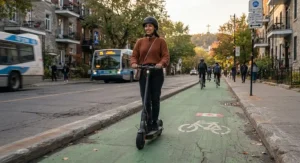
25 km/h Scooters vs Faster Scooters
The temptation to buy a 45 km/h or faster model “to grow into” is understandable, but the comparison rarely favours it for a genuine first-timer. A 25 km/h scooter cuts your stopping distance roughly in half compared to a 45+ km/h model at equivalent braking power, simply because kinetic energy scales with the square of speed — a fact that matters enormously in the first few weeks of riding, when reaction times are slowest and instincts haven’t formed yet.
| Factor | 25 km/h Beginner Scooter | 45+ km/h Performance Scooter |
|---|---|---|
| Typical stopping distance from top speed | Shorter, more forgiving | Meaningfully longer |
| Learning curve | Gentler, predictable acceleration | Steeper, easy to overpower yourself |
| Provincial pilot eligibility (where applicable) | Usually compliant | Often exceeds pilot program limits |
| Typical price range | C$300–C$950 | Often C$1,000+ |
| Best for | New riders, short-to-medium commutes | Experienced riders, longer commutes |
The table makes the trade-off concrete: performance scooters cost more and often exceed the speed thresholds set by provincial pilot programs, while beginner-class models like the GoTrax Apex or Segway Ninebot E2 Plus stay comfortably within legal and physical limits most new riders can actually handle. If your goal is genuinely learning to ride safely rather than maximizing top speed, a 25 km/h model isn’t a compromise — it’s the correct tool for the job you’re actually doing right now.
✨ Don’t Miss These Exclusive Deals! 🔍
Take your first scooter purchase to the next level with these carefully selected models. Click on any highlighted pick to check current pricing and availability — a smarter starting point makes for a smoother, more confident ride.
What to Expect: Real-World Performance at 25 km/h
On paper, 25 km/h sounds modest — barely faster than a confident cyclist. In practice, it’s a genuinely different sensation the first time the throttle opens and the deck starts humming under your feet. Most beginners report that the first two or three rides feel considerably faster than 25 km/h “should,” simply because there’s no seatbelt, no cabin, and no familiar reference points the way there are in a car.
What the spec sheet won’t tell you is how much that perceived speed drops after a week of regular riding. Reviewers across nearly every model in this guide note the same pattern: initial nervousness around full throttle gives way to comfortable cruising within roughly five to seven rides, at which point 25 km/h starts to feel unremarkable rather than intimidating. Braking behavior varies more than riders expect between models — the dual mechanical-plus-electric setup on the Kugoo M2 Pro feels noticeably more controlled than the electronic-only thumb paddle on the Razor E Prime III, a difference that’s easy to overlook on a spec sheet but obvious within the first hard stop.
Stability at Lower Speeds: Why It Matters for New Riders
Stability at lower speeds is arguably the single most underrated factor in a beginner’s scooter experience, and it has almost nothing to do with top speed. A scooter’s center of gravity, tire width, and deck length all influence how “planted” it feels well before you ever approach 25 km/h — which is exactly the speed range where most new riders spend nearly all their early practice time.
Models with a battery mounted low in the deck, like the GoTrax Apex, tend to feel noticeably more stable at walking-to-jogging speeds than scooters with the battery higher up in the stem, simply because the weight sits closer to the ground and the wheels. Suspension plays a similarly outsized role: the front spring setup on the Segway Ninebot E2 Plus II absorbs small surface irregularities that would otherwise translate into a wobble at low speed — precisely the kind of unexpected jolt that causes a beginner to instinctively grab the brake too hard. If you remember only one buying principle from this entire guide, let it be this: stability at lower speeds matters more for confidence-building than any top-speed number on the box.

Affordable Street Legal Electric Scooter Options in Canada
Finding an affordable street legal electric scooter in Canada means checking two things simultaneously — price, and whether the model’s specs actually satisfy your province’s or municipality’s pilot program requirements, since “street legal” varies considerably depending on where you live. In Ontario, the province’s e-scooter pilot program permits participating municipalities to allow e-scooters on roads and bike lanes, with rules covering speed, equipment, and where riding is permitted, while other provinces run entirely separate pilot frameworks with their own thresholds.
Among the seven scooters covered here, the GoTrax Apex, Segway Ninebot E2 Plus, and iScooter i9 represent the most affordable street legal electric scooter options, each priced under C$500 while staying within the 25 km/h class that most Canadian pilot programs are built around. It’s worth emphasizing that “street legal” ultimately depends on your specific municipality opting into a provincial pilot and passing its own bylaw — a scooter being capped at 25 km/h makes it eligible, not automatically legal everywhere, so confirming local participation before your first ride is a non-negotiable step, not a formality.
Learning to Ride Safely: A Practical Usage Guide
Learning to ride safely starts before the scooter even leaves its box. Assemble it fully according to the manufacturer’s instructions, charge the battery completely before the first ride, and — critically — practice your first sessions in an empty parking lot or quiet park path rather than on a street or shared bike lane. Get comfortable with the throttle at walking pace first; most beginner mistakes happen in the first ten minutes, not the first ten rides.
Once basic balance feels natural, dedicate a full session purely to braking. Practice stopping from a slow roll, then gradually from higher speeds, so your hands learn the brake’s feel before you’re relying on it in traffic. A common mistake in the first 30 days is over-gripping the throttle out of nervousness, which paradoxically makes acceleration jerkier and harder to control — a relaxed grip and gradual throttle input produces a smoother, more predictable ride. For maintenance, check tire pressure weekly if your model uses pneumatic tires, inspect brake response every few rides, and store the battery partially charged (roughly 40–60%) rather than fully depleted during any extended break from riding, which meaningfully extends battery lifespan over a Canadian winter storage period.
Real-World Scenarios: Who Should Buy a Beginner Scooter
Consider a first-year university student living a 2 km walk from campus with a tight budget and zero riding experience. For that profile, the GoTrax Apex or iScooter i9 makes the most sense — both are affordable, light enough to carry into a dorm room, and the i9’s Comfort Mode gives an anxious first-timer room to ease in gradually rather than being thrown straight into 25 km/h.
Now picture a suburban commuter riding 6–8 km each way to a transit station over cracked sidewalks and the occasional gravel shortcut. Here, suspension stops being a luxury and becomes the deciding factor — the Segway Ninebot E2 Plus II or Kugoo M2 Pro better suit that environment, since both include front suspension that meaningfully reduces fatigue and improves control over rougher terrain. Finally, consider someone in their 40s or 50s returning to active commuting after years of driving, with a higher risk tolerance for spending more upfront in exchange for long-term reliability. That rider is the ideal match for the NIU KQi300P — its app-based speed cap lets them start conservatively, and its extended range and premium braking mean they won’t outgrow the purchase within a year.
Problem → Solution: Common Beginner Riding Issues
Problem: Sudden jerky acceleration that feels unpredictable. This is almost always a throttle-sensitivity issue rather than a defect — practice modulating the throttle gradually in an empty lot, and consider a model like the iScooter i9 with a lower-speed Comfort Mode while you build finer motor control.
Problem: Losing balance over small bumps or cracks. Suspension and tire type are the fix here, not rider skill alone — scooters like the Segway Ninebot E2 Plus II with front spring suspension handle this far better than rigid, solid-tire models.
Problem: Braking feels weak or unpredictable. Confirm whether your scooter relies on a single electronic brake versus a dual mechanical-plus-electric system; if you’ve bought a single-brake model like the Razor E Prime III, compensate by braking earlier and more gradually than instinct suggests.
Problem: Battery drains faster than advertised. Cold Canadian temperatures reduce lithium battery output significantly — expect 15–25% less real-world range in winter across every model on this list, and store the scooter indoors between rides when possible.
Problem: Anxiety about riding in traffic or on shared paths. Start exclusively in low-traffic areas and consider a structured beginner riding course before mixing into commuter traffic — a genuinely underused resource covered in the next section.
Beginner Riding Courses: Where Canadians Can Learn
Formal beginner riding courses remain less common for e-scooters specifically than for cycling in Canada, but several avenues exist for structured, supervised practice. Municipal cycling safety programs in cities with active e-scooter pilots — including several Ontario municipalities participating in the provincial e-scooter pilot — frequently extend their bike-safety curriculum to cover powered micromobility basics, including braking technique, signaling, and right-of-way rules.
In Quebec, riders can consult the SAAQ’s official guidance on motorized personal mobility devices, which outlines mandatory equipment and safe operating practices as part of the province’s dedicated pilot project. Beyond formal programs, many local bike shops and e-mobility retailers — including several Canadian sellers of the scooters featured in this guide — offer informal in-store orientation sessions covering folding mechanisms, braking systems, and basic road positioning at the time of purchase. Taking advantage of even a 15-minute retailer walkthrough before your first solo ride meaningfully reduces the early-weeks learning curve compared to figuring everything out alone.
Long-Term Cost & Maintenance
Total cost of ownership matters more than sticker price once you factor in a full year of use. A C$400 entry scooter like the GoTrax Apex typically needs a replacement inner tube or tire roughly once a year under regular Canadian riding conditions (potholes, gravel shoulders, the occasional curb), running an additional C$20–C$40 annually, while solid-tire models like the iScooter i9 avoid that cost entirely but may need occasional deck bushings replaced as the tradeoff.
| Cost Factor | Budget Models (e.g. GoTrax Apex) | Premium Models (e.g. NIU KQi300P) |
|---|---|---|
| Typical annual tire/maintenance cost | C$20–C$60 | C$30–C$80 (larger tubeless tires) |
| Battery replacement interval | 2–3 years of regular use | 3–5 years of regular use |
| Warranty coverage | Often 6–12 months | Often 12–24 months |
| Best for cost-per-ride over 3 years | Lower upfront, higher long-run risk | Higher upfront, lower long-run risk |
The analysis here favours different buyers for different reasons: a budget model minimizes upfront risk if you’re not sure riding will stick, while a premium model like the NIU KQi300P spreads a larger investment across a longer battery lifespan and warranty window, often working out cheaper per ride over a three-year horizon for someone who’s confident they’ll keep riding.
Safety, Regulations & Compliance Guide
Electric scooter regulation in Canada is a genuine patchwork, and it’s worth treating every province and municipality as its own rulebook rather than assuming a national standard applies. At the federal level, Transport Canada’s vehicle importation guidance draws a distinction based on on-road versus off-road design characteristics and speed thresholds, which affects how scooters are classified before they even reach a retailer’s shelf — but day-to-day riding rules (where you can ride, helmet requirements, minimum age) are set provincially and often municipally on top of that.
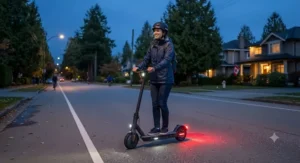
Ontario’s pilot program requires participating municipalities to pass their own bylaws before e-scooters are legal on local roads, with violations carrying fines between $250 and $2,500. Quebec’s SAAQ pilot project similarly restricts motorized personal mobility devices to approved public roadways under specific equipment requirements. Given how much this varies, the single most useful habit for any beginner is checking your specific municipality’s current bylaw status before your first ride — a 25 km/h scooter being technically capable of legal operation elsewhere doesn’t guarantee it’s permitted on the street outside your door.
Frequently Asked Questions
❓ What is considered a beginner electric scooter?
❓ Is 25 km/h fast for an electric scooter?
❓ Do I need a licence to ride a 25 km/h electric scooter in Canada?
❓ What is the best electric scooter speed for beginners?
❓ Can I limit the speed on my electric scooter?
Conclusion
Choosing a 25 km/h electric scooter for beginners isn’t really about finding the “best” scooter in some abstract sense — it’s about matching a specific set of honest trade-offs to your actual riding conditions, budget, and comfort with speed. The GoTrax Apex and Segway Ninebot E2 Plus remain the most sensible starting points for anyone testing whether scootering fits their routine at all, while the Segway Ninebot E2 Plus II and Kugoo M2 Pro earn their higher price through genuinely useful suspension on rougher Canadian streets.
If adjustable speed modes matter most to your comfort level, the iScooter i9 offers the clearest built-in progression from cautious to confident. And if you’re already certain you’ll stick with riding long-term, the NIU KQi300P lets you buy once and grow into full performance rather than upgrading twice. Whichever you choose, prioritize stability and braking confidence over top-speed bragging rights — that’s what actually determines whether you’re still riding six months from now, not the number printed on the box.
Recommended for You
- 7 Best 25 km/h Electric Scooters Under C$700 (Ranked 2026)
- 7 Best Legal Electric Scooters for Commuting in Canada 2026
- Affordable Removable Battery Electric Scooter: 7 Best Picks (2026)
Disclaimer: This article contains affiliate links. As an Amazon Associate, I earn from qualifying purchases. If you purchase products through these links, we may earn a small commission at no additional cost to you.
✨ Found this helpful? Share it with your friends! 💬🤗
