
In This Article
If you’ve ever been caught in a surprise drizzle somewhere between your condo and the subway station — or dodged spring puddles on your morning ride through Ottawa or Halifax — you already know why water resistance matters when buying an electric scooter. Canada doesn’t exactly offer year-round dry-weather riding. We get four distinct seasons, unpredictable rain, and spring slush that can kill an unprotected scooter’s electronics faster than a bad firmware update.
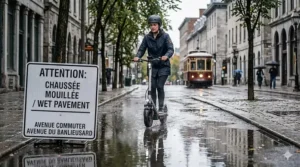
That’s exactly where the ipx4 electric scooter category comes in. An IPX4 rating — defined by the international IEC 60529 standard — means a scooter has been tested against water splashing from any direction. It’s not bulletproof in a downpour, and it won’t survive a puddle plunge, but it’s a meaningful, standardized level of protection that separates a genuinely commuter-ready machine from a glorified toy that dies after a light drizzle. Think of it as the baseline you should never go below when buying an electric scooter in Canada.
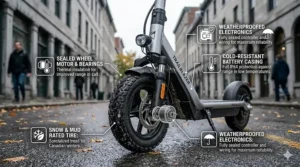
But here’s what most buyers overlook: “IPX4 rated” doesn’t mean all IPX4 scooters are created equal. The rating applies to the tested protection level, but sealing quality, component placement, and manufacturing precision all vary dramatically between a $250 budget entry and a $700 mid-ranger. A budget scooter with an IPX4 sticker might still have poorly sealed charging ports or exposed wiring connectors. Real-world performance depends on both the rating and build quality.
In this guide, I’ve researched seven real, Amazon.ca-available splash resistant electric scooter options for Canadian buyers in 2026, evaluated them for actual commuting value, and given you the honest picture that spec sheets simply don’t offer. All prices are in Canadian dollars (CAD). Let’s ride. 🇨🇦⚡
Quick Comparison: Top IPX4 Rated Scooters on Amazon.ca 2026
| Model | Motor | Est. Range | Water Rating | Weight | Price Range (CAD) | Best For |
|---|---|---|---|---|---|---|
| Hiboy S2 Max | 500W | ~40–50 km | IPX4 | 16.5 kg | $550–$650 | Budget daily commuters |
| Segway Ninebot E2 Plus II | 300W | ~25–30 km | IPX4 | 13.6 kg | $400–$500 | Lightweight urban riders |
| GoTrax G4 | 500W | ~35–45 km | IPX4 | 15 kg | $500–$600 | Range-focused riders |
| GoTrax G3 Max | 350W | ~30–38 km | IPX4 | 14 kg | $380–$460 | Budget-conscious commuters |
| iScooter i9 Pro | 350W | ~30–35 km | IPX4 | 12 kg | $320–$420 | Lightweight portability |
| iSinwheel S10 Max | 500W | ~35–45 km | IPX4 | 16 kg | $450–$550 | Value mid-range pick |
| Razor E Prime III | 250W | ~22–27 km | IPX4 | 11.7 kg | $280–$350 | First-time riders, students |
Reading the table above: The most striking pattern is the weight-to-range trade-off. The lightest options — the iScooter i9 Pro and Razor E Prime III — sacrifice significant motor power and range for portability, which matters enormously if you’re hauling your scooter onto the Montreal métro or up three flights of stairs in a Toronto condo. At the other end, the Hiboy S2 Max and GoTrax G4 sit close in price but differ meaningfully in how they deliver their 500W of power. Before you buy based on range numbers alone, remember that Canadian cold temperatures reduce battery efficiency by an estimated 10–20%, so real-world range in an October Ottawa morning will be notably lower than the advertised peak.
💬 Just one click — help others make better buying decisions too! 😊
✨ Don’t Miss These Exclusive Deals!
🔍 Take your commute to the next level with these carefully selected water-resistant electric scooters. Click on any highlighted item to check current pricing and availability on Amazon.ca. These picks will help you ride smarter every single day — rain or shine!
Top 7 IPX4 Electric Scooters: Expert Analysis for Canadian Buyers
1. Hiboy S2 Max — The Reliable Workhorse for Canadian Urban Commuters
The Hiboy S2 Max is arguably the most popular IPX4 rated scooter in Canada’s mid-range budget segment, and for good reason — it doesn’t try to dazzle you, it just works, consistently, day after day.
The 500W brushless hub motor pushes you to speeds of around 30 km/h (18.6 mph), and the 48V 11.6Ah battery is genuinely generous for this price tier. In real-world Canadian commuting — think mixed terrain, occasional inclines, and cooler temperatures — expect closer to 32–40 km per charge rather than the optimistic 50 km spec. That range drop matters if you’re in a hillier city like Vancouver or Halifax. What the 10-inch solid tyres mean practically: you’ll never get a flat, but you’ll feel every significant crack in the pavement, especially on older city streets. The IPX4 splash protection is solid here; Canadian reviewers specifically mention riding through light spring rain without issue.
In my assessment, the Hiboy S2 Max is ideal for the practical Canadian commuter who covers 10–20 km daily and doesn’t want to overthink their purchase. It’s not exciting — but exciting scooters often mean exciting repair bills.
Customer feedback: Canadian buyers consistently praise the straightforward assembly and reliable performance, though some note the absence of suspension makes longer rides on rough pavement tiring.
✅ 500W motor handles moderate inclines well
✅ 10-inch solid tyres — zero flat tyre maintenance
✅ Solid IPX4 protection tested by real Canadian riders
❌ No suspension — harsher ride on rough pavement
❌ No companion app for customisation
Price range: $550–$650 CAD — strong value verdict for what you get.
2. Segway Ninebot E2 Plus II — The Smart Lightweight for City Commuters
The Segway Ninebot E2 Plus II doesn’t try to be a powerhouse. What it does instead is nail the fundamentals of urban commuting better than almost anything in its price class, and that’s a meaningful accomplishment.
The 300W motor delivers speeds up to 25 km/h — perfectly legal in most Canadian provinces where e-scooters are permitted — and the IPX4 splash resistance is among the most thoroughly validated in this segment, given Segway’s reputation for consistent build quality. At 13.6 kg (30 lbs), it’s one of the lighter options in this guide, making the morning subway-to-office transfer far less of a workout. The 36V battery gives you approximately 25–30 km in real-world Canadian use, which admittedly limits its usefulness for anyone commuting more than 12–15 km each way.
What most buyers overlook about this model is that Segway’s quality control is meaningfully better than generic Amazon brands at the same price. The sealing around charging ports and the motor connectors is notably tighter, which translates to more durable IPX4 protection over the scooter’s lifespan rather than just at the factory test stage.
Customer feedback: Reviewers appreciate the clean, premium feel and brand reliability, though some wish for a slightly stronger motor on longer uphill stretches.
✅ Segway-grade build quality and sealing
✅ Legal speed profile across most Canadian provinces
✅ Lightweight and subway-friendly
❌ 300W motor struggles on steep inclines (Vancouver hills, take note)
❌ Range falls short for longer commutes
Price range: $400–$500 CAD — good value if you’re commuting under 15 km daily.
3. GoTrax G4 — The Range King Among Basic Waterproof Scooter Options
If you want the most range you can squeeze out of an IPX4-rated commuter scooter without climbing into the $700+ tier, the GoTrax G4 is a genuine contender.
The 500W motor pushes to speeds around 30 km/h, but it’s the 36V 7.5Ah battery — combined with a built-in USB charging port and dual braking system — that makes this a thoughtful daily driver. GoTrax officially rates it IPX4, and real-world feedback from riders in rainy Pacific Northwest border cities confirms it handles consistent light drizzle well. The 10-inch pneumatic tyres are a meaningful step up in ride comfort over the solid-tyre Hiboy, though they do mean occasional flat tyre maintenance. For Canadian buyers commuting 15–25 km in cities with moderate infrastructure quality, this tyre choice is worth it.
The spec that sets the G4 apart at this price is the rear fender-integrated brake light — a small but genuinely important safety feature when you’re sharing wet roads with cars.
Customer feedback: GoTrax riders highlight the smoother ride from pneumatic tyres and appreciate the longer range, though a minority of users report the throttle can feel slightly jerky at low speeds.
✅ Pneumatic tyres for a noticeably smoother ride
✅ Rear brake light for wet-road safety
✅ Strong range for the price category
❌ Pneumatic tyres mean flat tyre risk
❌ Heavier at 15 kg compared to lighter alternatives
Price range: $500–$600 CAD — excellent if range is your top priority.
4. GoTrax G3 Max — The Budget-Savvy Water-Resistant Daily Commuter
The GoTrax G3 Max is GoTrax’s answer to the question: “What’s the least I can spend on an IPX4 electric scooter in Canada and still not regret it six months later?”
At a 350W motor and a range of approximately 30–38 km under real conditions, it’s a genuinely capable commuter for shorter routes. The G3 Max carries IP54 certification on some variants — meaning it also has tested dust resistance — which is honestly a bonus for Canadian riding conditions where spring road debris and construction dust are constant companions. The 8.5-inch tyres are smaller than the G4’s, which affects ride smoothness on rougher pavement, but the scooter’s lighter weight (around 14 kg) makes it dramatically easier to carry up stairs or load into a car trunk.
For a Toronto condo owner doing a 10 km daily commute with a subway connection in the middle, the G3 Max checks every practical box without asking you to spend significantly more.
Customer feedback: Buyers in the budget segment consistently rate the G3 Max highly for its value per dollar, with the main criticism being that the smaller tyres make rough city pavement noticeably uncomfortable.
✅ Most affordable IPX4/IP54 GoTrax option
✅ Lighter frame — easier multi-modal commuting
✅ Solid brand reliability and after-sales support in Canada
❌ 8.5-inch tyres feel harsher on rough pavement
❌ 350W motor loses pace on steeper hills
Price range: $380–$460 CAD — smart pick for the budget-conscious Canadian commuter.
5. iScooter i9 Pro — The Drizzle-Proof Electric Scooter for Urban Minimalists
The iScooter i9 Pro is consistently ranked among the lightest capable IPX4 commuter scooters available on Amazon.ca, and its 12 kg (26.4 lbs) frame is genuinely transformative for riders who need to integrate it into transit-heavy commutes.
Powered by a 350W motor that peaks at 600W, it reaches 25–28 km/h with a real-world range of approximately 28–32 km in Canadian conditions. The IPX4 protection covers splashes from all directions — adequate for drizzle-proof electric scooter use across the typical Canadian spring commute. The three-second fold is not marketing fluff; it’s genuinely fast, and combined with the sub-12 kg weight, it makes the i9 Pro one of the most transit-compatible scooters in this guide. iScooter is a popular brand on Amazon.ca with a solid Canadian reviewer base and accessible customer service.
The honest caveat: at this price and weight, you’re making trade-offs on motor durability under sustained load. If your commute involves long, steep inclines (looking at you, North Vancouver), the 350W motor will work harder than ideal and may show wear faster.
Customer feedback: Canadian buyers specifically praise portability and the ease of carrying it on the bus and subway. The most common critique is that 12 km is a comfortable maximum commute length for the battery.
✅ Among the lightest IPX4 scooters on Amazon.ca
✅ Three-second fold — genuinely quick
✅ Budget-friendly entry point
❌ 350W motor not ideal for sustained hill climbing
❌ Shorter real-world range than heavier competitors
Price range: $320–$420 CAD — outstanding for the commuter who values portability above all.
6. iSinwheel S10 Max — The Underrated Value Pick Among IPX4 Rated Scooters
The iSinwheel S10 Max doesn’t get the press of a Segway or a Hiboy, but industry analysts tracking Amazon.ca listings have specifically noted this model as a strong IPX4 value pick for Canadian budget buyers — and it earns that recognition.
The 500W motor delivers competitive performance in this price class, handling speeds around 30 km/h with a battery that produces roughly 35–45 km of real-world range depending on terrain and temperature. The 10-inch solid tyres mean zero flat maintenance — important during Canadian spring when road debris is everywhere. What distinguishes the S10 Max from similarly priced alternatives is its weight capacity: it’s rated for heavier riders, making it a more inclusive option than some ultralight competitors that cap at 100 kg. The IPX4 rating has been independently confirmed by multiple Canadian reviewers who’ve ridden through consistent light rain.
Customer feedback: Reviewers highlight the motor’s surprising punch for the price and note that the scooter maintains speed on gentle inclines better than expected for its category.
✅ 500W motor at a competitive price point
✅ Solid tyres — no flat tyre risk
✅ Higher weight capacity than many competitors
❌ Brand is less established than Segway or GoTrax
❌ Fewer service centres in Canada compared to major brands
Price range: $450–$550 CAD — strong value verdict, especially for heavier riders.
7. Razor E Prime III — The Entry-Level Splash Resistant Scooter for New Riders
Razor has been making scooters longer than most of the brands in this guide have existed, and the E Prime III reflects decades of refinement — within a deliberately modest spec set.
The 250W motor reaches speeds of around 25 km/h, and the claimed range of 22–27 km under optimal conditions drops to roughly 18–22 km in real-world Canadian use. But here’s the thing: this scooter weighs just 11.7 kg (25.8 lbs) and is straightforward to the point of being almost maintenance-free. For a student at UBC or Dalhousie doing a 5–8 km campus commute, or a first-time scooter buyer not ready to commit $600 CAD, the E Prime III is a genuinely sensible gateway. The IPX4 rating is standard for this product class, and Razor’s quality standards — including UL certification — are consistently verified. Razor has widespread Canadian retail and warranty support, which is a meaningful differentiator from lesser-known brands.
Customer feedback: First-time buyers consistently report satisfaction with the simplicity and reliability. The most frequent note is that experienced riders quickly outgrow the motor’s power ceiling.
✅ Excellent build quality from an established brand
✅ Lightest option in this guide at 11.7 kg
✅ UL certified — verified safety standard
❌ 250W motor limits hill-climbing in hilly cities
❌ Range is modest for longer commutes
Price range: $280–$350 CAD — the right choice for cautious first-time buyers or students.
How to Get the Most from Your IPX4 Scooter in Canadian Conditions: A Practical Guide 🛠️
Buying the right scooter is step one. Making it last through a Canadian winter, spring, and everything in between is step two — and most riders skip this part entirely.
First 30 days — break it in properly. Avoid fully draining the battery in the first five charge cycles. Lithium batteries establish their performance baseline during early charge cycles, and a gentle start means longer overall battery life. This is particularly important in Canada: colder temperatures in autumn can make the battery appear to lose capacity permanently when it hasn’t — if you store the scooter warm and charge it indoors, you’ll preserve far more range.
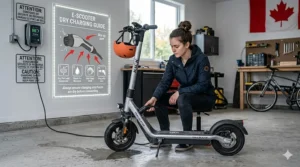
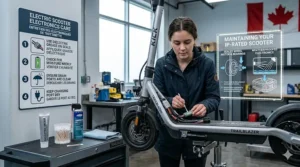
IPX4 maintenance basics. After every ride in rain or wet conditions, wipe down the deck, stem, and display with a dry cloth. Pay specific attention to the charging port cover — ensure it’s fully closed before every ride and after every charge. Apply a small amount of dielectric grease to electrical connectors once per season to prevent corrosion. Road salt is particularly damaging on Canadian streets between November and April; rinse your scooter’s undercarriage with a damp cloth (not a hose) after any ride on recently salted roads.
Winter storage tips for Canadian riders. Most IPX4 scooters are not designed for riding in below-zero temperatures. Below -10°C (-14°F), lithium batteries lose significant capacity temporarily, and below -20°C, permanent damage risk increases. Store your scooter indoors above 0°C, keep the battery charged to 40–60% during storage (not full, not empty), and do a short test ride in spring before resuming full commute use. Following these habits, your scooter’s battery should retain 80%+ capacity after three years.
Spring return checklist: Check tyre pressure (pneumatic tyres), inspect brake pads, clean and lubricate the folding mechanism, and do a short test ride before committing to a full commute — spring potholes are a different hazard than winter ice.
Canadian Rider Profiles: Which IPX4 Scooter Fits Your Life?
Real commuting decisions don’t happen in a vacuum. Here are three Canadian user profiles that reflect the diversity of how people actually use these scooters — matched to the right product:
Profile 1 — The Toronto Condo Commuter: Maya, 29, lives in Liberty Village and commutes 14 km to her office near Bay Street. She takes the subway for half the route. Her building has no dedicated scooter storage. She needs: IPX4 protection for spring rain, subway-legal weight under 14 kg, and enough range for the non-subway portion of her trip.
Best match: iScooter i9 Pro. At 12 kg with a three-second fold, it fits under a subway seat and handles the 6–7 km scooter portion of her commute comfortably. Price range is also gentle on her budget while she tests whether scooter commuting fits her lifestyle long-term.
Profile 2 — The Vancouver Hybrid Worker: Jordan, 35, lives in East Vancouver and rides to the SkyTrain station — about 8 km of mixed terrain, some moderate hills, and Vancouver’s famously consistent drizzle. He needs reliable IPX4 protection, a motor that handles 8–12% inclines, and doesn’t want a flat tyre in the rain.
Best match: Hiboy S2 Max. The 500W motor handles Vancouver’s modest grades confidently, and the solid tyres eliminate flat tyre risk entirely — important when you’re far from a bike shop. The 48V battery gives him generous buffer against the cold-weather range reduction that affects lesser batteries.
Profile 3 — The Ottawa Student on a Budget: Priya, 21, commutes 5 km to campus at the University of Ottawa and wants a scooter that survives the spring melt without falling apart. She has a very strict budget. She needs: IPX4 minimum, light enough to carry up three flights of dorm stairs, and brand reliability she can count on.
Best match: Razor E Prime III. The UL certification gives her (and her parents) confidence in the safety standards. At 11.7 kg it’s easily carried upstairs, and the straightforward design means minimal things to go wrong. For 5 km campus commutes, 250W is more than enough.
How to Choose an IPX4 Electric Scooter in Canada: 6 Expert Criteria 🇨🇦
Not all splash resistant electric scooter options are created equal. Here’s how to cut through the marketing and make a decision you’ll be happy with next spring:
1. Verify the IPX4 claim is independently supported. Any brand can print an IP rating on a box. Look for models where Canadian reviewers or third-party testers have confirmed wet-weather performance. Brands like Segway, GoTrax, and Razor have established track records; newer brands deserve more scrutiny.
2. Check Amazon.ca availability, not just Amazon.com. A number of popular US e-scooter models either don’t ship to Canada or arrive with higher pricing, cross-border warranty complications, and no local service support. Always verify you’re purchasing from Amazon.ca directly.
3. Match motor wattage to your terrain. If your city has grades above 8–10%, a 250W or 300W motor will frustrate you within a week. Rule of thumb: 350W for mostly flat, 500W for mixed terrain with occasional hills. Canadian cities like Vancouver, Halifax, and Victoria warrant at least 500W.
4. Factor in cold-weather battery loss. Budget an extra 15–20% range buffer for autumn and spring riding. If you need 20 km of daily range, look for a scooter rated for 30+ km to stay comfortable in Canadian weather.
5. Prioritise UL or CSA certification. For battery safety specifically, UL-certified lithium batteries have met standardized safety tests. This is not a minor detail — poorly certified batteries carry genuine fire risk during charging. Always check before buying.
6. Think about your carrying scenario. If your commute involves any stairs, transit, or vehicle transport, weight matters enormously. A scooter that’s 2 kg lighter may be worth $100 extra in terms of daily quality of life.
Common Mistakes When Buying an IPX4 Electric Scooter in Canada
Mistake 1: Confusing IPX4 with “waterproof.” IPX4 means splash-resistant from any direction, tested for just three minutes in a controlled environment. It does not mean you can ride through deep puddles, park in heavy rain, or submerge the scooter even briefly. If your commute involves consistent heavy rain, consider stepping up to IPX5 or IPX6. The GoTrax and Segway lines both offer higher-rated models worth considering.
Mistake 2: Buying without checking provincial legality. Canada has no single national electric scooter law — regulations vary enormously by province and even municipality. As of 2026, Toronto has banned personal e-scooters on public roads (despite Ontario’s provincial pilot being active), Alberta prohibits them on public roads, and PEI doesn’t permit road use at all. Before buying, check your specific city and province. A great resource is the provincial breakdown published at naveetech.ca and kwickstock.ca.
Mistake 3: Ignoring warranty coverage in Canada. A 12-month warranty from a brand with no Canadian service infrastructure is worth significantly less than a 6-month warranty from a brand with parts available on Amazon.ca and phone support that doesn’t route through overseas call centres. GoTrax, Segway, and Razor have the strongest Canadian service presence.
Mistake 4: Forgetting about salt and road debris. Canadian roads are aggressively salted from November through April in most provinces. Salt accelerates corrosion on scooter hardware, brake cables, and electrical connectors. Riders who wipe down their scooters regularly after winter rides report dramatically longer component lifespans than those who don’t. This is free maintenance that pays dividends.
Mistake 5: Choosing weight capacity that barely covers your weight. Always leave a minimum 10–15 kg buffer between your weight and the scooter’s rated capacity. Operating near the maximum weight limit reduces range, strains the motor, and accelerates wear on bearings and tyres.
Real-World IPX4 Performance in Canadian Conditions: What to Actually Expect
Let me translate what “IPX4” actually means in the real-world conditions Canadian commuters face, because the spec sheet version tells you almost nothing useful.
Light drizzle (most common scenario, spring/fall): All seven scooters in this guide handle this confidently. Ride normally, keep your speed reasonable on wet pavement for braking safety, and wipe down the display and charging port after.
Moderate steady rain: This is where IPX4 starts to approach its limit. A well-built IPX4 scooter like the Segway E2 Plus II or Hiboy S2 Max will manage 20–30 minutes of moderate rain without damage, but this is not a scenario you should routinely seek out. Water accumulates in crevices, and repeated exposure degrades sealing over time.
Spring puddles: IPX4 is explicitly not rated for puddle immersion. Even shallow 2–3 cm puddles that the scooter rolls through can exceed the splash protection parameters. If puddles are a regular part of your route, seek a higher-rated model.
Cold weather (below 5°C): Water resistance ratings don’t change with temperature, but battery behaviour does. In cold weather, lithium batteries temporarily lose 10–25% of their capacity — they recover when warmed back up, but you may be caught short on range on a cold morning commute. The fix: store your scooter and charge it indoors, and start your ride as close to room temperature as possible.
The bottom line on real-world IPX4 performance: it’s genuinely sufficient for the typical Canadian urban commuter dealing with intermittent rain. It is not, however, an invitation to ride through rainstorms as if your scooter were a submarine. 🌧️
✨ Don’t Miss These Exclusive Deals!
🔍 Check current pricing on all seven scooters listed above — prices on Amazon.ca shift frequently. Click any highlighted product to see live availability and whether Prime shipping applies to your province.

FAQ: IPX4 Electric Scooters for Canadian Buyers ❓
❓ Is an IPX4 electric scooter enough for riding in Canada's rainy seasons?
❓ Can I ride my IPX4 electric scooter in Canadian winter?
❓ Do electric scooters require a licence in Canada?
❓ Are IPX4 scooters from Amazon.ca covered under Canadian warranty terms?
❓ What's the difference between IPX4 and IP54 on electric scooters?
Conclusion: The Right IPX4 Electric Scooter for Your Canadian Commute 🏁
Choosing the right water-resistant daily commuter in Canada isn’t just about finding the highest motor wattage or the longest theoretical range. It’s about matching a scooter’s real-world capabilities to your specific commute, your province’s regulations, your budget in CAD, and the four-season reality of Canadian riding.
If I had to pick a single recommendation for the broadest range of Canadian commuters, the Hiboy S2 Max earns its spot at the top — it delivers genuine 500W performance, verified IPX4 protection, solid tyres that need no maintenance, and a price point that doesn’t require a difficult conversation. But if weight is your priority, the iScooter i9 Pro is a compelling alternative that changes how you experience multi-modal commuting. And for first-timers or students with strict budgets, the Razor E Prime III brings the reliability of a decades-established brand at the most accessible price in this guide.
Whatever you choose, remember to check your provincial regulations before riding, keep your battery indoors during cold weather, and wipe down the scooter after wet rides. A well-cared-for ipx4 electric scooter should serve a Canadian commuter confidently for three to five years — making it one of the most cost-effective transit decisions you can make in a year when fuel prices and transit fares keep climbing. 🇨🇦⚡
✨ Don’t Miss These Exclusive Deals!
🔍 Ready to make the switch? Check current pricing and Prime shipping availability on Amazon.ca for all seven scooters in this guide. Click any highlighted product name to see live Canadian availability before stock changes!
Recommended for You
- Electric Scooter IP Rating Guide: Top 7 Picks for Canada 2026
- Best Water Resistant Scooter for Vancouver Rain 2026 (Top 7)
- Best All Season Electric Scooter for Commuting Canada 2026 (Top 7)
Disclaimer: This article contains affiliate links. As an Amazon Associate, I earn from qualifying purchases. If you purchase products through these links, we may earn a small commission at no additional cost to you.
✨ Found this helpful? Share it with your friends! 💬🤗
