
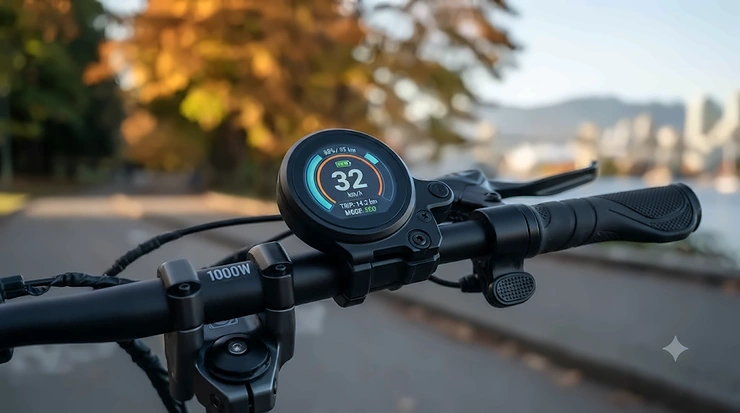
In This Article
Here’s the question that brings most people to this page, usually after they’ve already added a scooter to their cart: can you actually ride a 1000w electric scooter legal in Canada, or are you about to spend two grand on an expensive lawn ornament? The honest answer is more nuanced than either the manufacturer’s marketing copy or the angry comment section suggests. Every provincial pilot program that governs stand-up e-scooters — Ontario, British Columbia, Quebec — caps the motor at 500 watts continuous output, roughly half of what a 1000w machine puts out. That single number is the hinge this entire guide swings on.

None of that means a 1000w scooter is useless in Canada. It means the legal picture depends heavily on where you ride it, how your municipality has opted into (or out of) its province’s pilot, and whether you’re using the scooter on public infrastructure at all. Riders in Toronto face a flat ban regardless of wattage, while a compliant rider in Kelowna or Ottawa has an entirely different set of rules to navigate. This guide breaks down the wattage math, walks through seven real high-power scooters sold to Canadian buyers, and lays out exactly where a 1000w electric scooter fits — and doesn’t — into the country’s patchwork of provincial pilots. Every price mentioned below is a range in Canadian dollars, since exact figures shift by the week and Amazon.ca pricing policy prohibits quoting them anyway.
Quick Comparison: Where the 7 Picks Land
| Scooter | Motor Power | Top Speed | Best For |
|---|---|---|---|
| Hiboy Titan | 750W (1,000W peak) | 25 mph / 40 km/h | Budget entry to serious power |
| Kaabo Mantis 10 Lite | Dual 500W (1,000W combined) | 31 mph / 50 km/h | Value-focused dual-motor commuting |
| Varla Eagle One | Dual 1,000W hub | 40 mph / 64 km/h | All-terrain hybrid riding |
| Hiboy Titan Pro | Dual 750-1,000W | 31 mph / 50 km/h | Longest range, delivery-style use |
| Kaabo Mantis King GT | Dual 1,100W | 44 mph / 70 km/h | Refined suspension and braking |
Looking at this table, the spread in top speed alone — 25 mph to 44 mph — tells you these aren’t interchangeable products just because they share a wattage bracket. The Hiboy Titan sits closest to what a determined rider might argue is a grey-area commuter tool, while the Kaabo Mantis King GT is unambiguously a performance machine built for private land, sanctioned trails, or countries with more permissive road classifications. Price and power climb together here, which matters if your budget is the deciding factor rather than raw output.
💬 Just one click — help others make better buying decisions too! 😊
💬 Bookmark this comparison — you’ll want it again when you get to the pros and cons below!😊
Top 7 1000w Electric Scooters: Expert Analysis
Amazon.ca and Canadian specialty retailers carry a genuine range of high-power scooters in this bracket, from entry-level single-motor builds to dual-motor machines built for off-road use. Below, all seven are broken down with honest, spec-driven commentary — no invented test rides, no manufactured five-star anecdotes, just what the numbers mean in practice and what verifiable aggregated review sentiment says.
1. Hiboy Titan — best budget entry into serious power
The Titan opens this list because it’s the most approachable on price without dipping below true 1000w territory. Its 750W rear hub motor is rated for 1,000W at peak output, which in practice means strong takeoff from a stop but a ceiling you’ll notice on longer, steeper climbs.
The 48V 18Ah battery is paired with gel-filled, puncture-resistant 10-inch tires and dual suspension, a combination that keeps the ride composed on gravel or cracked pavement without the maintenance headache of tubed pneumatic tires. Top speed lands at 25 mph (40 km/h), with a claimed range up to 46 miles (74 km) under light-rider, flat-terrain conditions — real-world range will run noticeably lower once hills and cargo enter the picture.
This is the right call for a rider who wants meaningfully more torque than a commuter-class scooter without stepping into dual-motor pricing. Based on the spec comparison against this list’s other entries, the Titan is the only single-motor unit here, which is exactly why it’s also the lightest and easiest to store. Reviewers on the manufacturer’s own site and third-party retailers consistently note strong value for the price point, alongside recurring comments about the folding mechanism needing a firm hand to lock securely — not a dealbreaker, but worth knowing before your first fold.
Pros:
- ✅ Strong torque-to-price ratio for a single-motor build
- ✅ Gel-filled tires mean no flat-tire maintenance routine
- ✅ Lighter and more compact than every dual-motor pick here
Cons:
- ❌ Lower top speed limits highway-adjacent commuting appeal
- ❌ Single motor struggles more on sustained steep grades
The Titan typically lands in the C$900-C$1,100 range at the time of research. For a rider prioritizing value over outright performance, it’s a genuinely solid entry point into this power class.
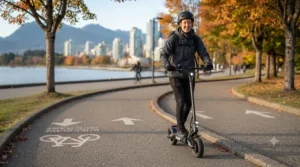
2. Kaabo Mantis 10 Lite — best value dual-motor commuter
Kaabo built its reputation on dual-motor engineering, and the Mantis 10 Lite is the brand’s answer to buyers who want that dual-motor feel without flagship pricing. Two 500W brushless motors combine for 1,000W of nominal output, switchable between single-motor eco mode and full dual-motor power through one button on the display.
What most buyers overlook about dual-motor setups like this one is traction, not just speed. On wet pavement or loose gravel, having power routed to both wheels reduces wheel-spin dramatically compared to a single rear-hub design — a real-world advantage that doesn’t show up on a spec sheet. The 48V 13Ah battery delivers a claimed 37 miles (60 km) of range, and the scooter climbs 25-degree inclines with the dual-motor mode engaged, a genuinely useful figure for hillier Canadian cities.
Aggregated review sentiment across Kaabo’s retail partners consistently praises the ride comfort from the dual spring suspension and the responsiveness of the sine-wave motor controllers, which produce smoother acceleration than the cheaper square-wave controllers found on many budget scooters. A recurring critique in the same review pool is that the NFC lock, while a nice security touch, isn’t a substitute for a proper physical lock when parking in public.
Pros:
- ✅ True dual-motor traction at a below-flagship price
- ✅ Sine-wave controllers deliver noticeably smoother acceleration
- ✅ NFC lock adds a convenient extra security layer
Cons:
- ❌ 13Ah battery trails the range of larger dual-motor rivals
- ❌ NFC lock alone isn’t sufficient theft deterrence
Expect the Mantis 10 Lite in the C$1,250-C$1,450 range. Given the dual-motor traction and Kaabo’s build reputation, it represents strong value-per-watt in this lineup.
3. Varla Eagle One — best all-round hybrid off-roader
The Eagle One is where this list starts feeling less like a commuter tool and more like a genuine performance vehicle. Dual 1,000W hub motors produce a combined peak output of 3,200W, driven by twin 25A sine-wave controllers that Varla has refined across several product generations.
Here’s what the spec sheet won’t tell you outright: that 3,200W peak figure is a burst rating, not a sustained one, so don’t expect to hold 40 mph indefinitely on a single charge. What you can expect is genuinely strong hill-climbing — a 36 Nm torque rating gets the Eagle One up 30-degree grades without the motor bogging down, a meaningful advantage over single-motor scooters in this price bracket. The 52V 18.2Ah battery (some configurations ship with 98 high-density 18650 cells) delivers up to 40 miles (64 km) of range on eco mode.
Aggregated customer sentiment on Varla’s own storefront and third-party retailers is notably durability-focused: multiple long-term owners report the scooter surviving hard crashes with only minor plastic part replacements needed, and describe the suspension and hydraulic braking as standout features relative to the price. A recurring complaint centers on charging time — the stock charger takes 13-14 hours for a full cycle, meaningfully longer than most competitors, though Varla sells a faster charger separately.
Pros:
- ✅ Genuine 30-degree hill-climbing capability from dual motors
- ✅ Reported durability after real-world crashes and hard use
- ✅ Hydraulic disc brakes provide confident, consistent stopping
Cons:
- ❌ Stock charger takes 13-14 hours for a full charge
- ❌ Heavier build than budget-tier single-motor alternatives
Pricing typically sits in the C$1,500-C$1,750 range. For riders who want off-road versatility with street-capable manners, the Eagle One earns its reputation.
4. Hiboy Titan Pro — longest range in this lineup
If range anxiety is what’s kept you from buying an electric scooter, the Titan Pro is built specifically to solve that problem. Its dual motor configuration (available in 750W and 1,000W-per-motor variants depending on the trim) is paired with a genuinely oversized 48V 36Ah battery — nearly triple the capacity of most scooters on this list.
The result is a claimed range of up to 80 miles (129 km) on a single charge, a figure that will drop under real-world conditions but still leaves this scooter in a different range class entirely from the rest of this lineup. Reviewers consistently note this is the scooter to buy if you’re doing genuine long-distance riding — a delivery rider covering a wide territory, or a commuter with an unusually long route — rather than short urban hops where a smaller battery would go unused anyway.
The trade-off for that battery size is weight: at roughly 30 kg, the Titan Pro is noticeably harder to carry up stairs or lift into a trunk than the lighter entries on this list. Dual hydraulic brakes and a dual suspension system help offset the added mass by keeping the ride controlled, and the reinforced 6061 aluminum frame is rated for off-road use with a 35% max incline.
Pros:
- ✅ Class-leading 80-mile claimed range from oversized battery
- ✅ Dual hydraulic brakes suited to the extra weight and speed
- ✅ Reinforced frame built for genuine off-road terrain
Cons:
- ❌ Roughly 30 kg makes portability a real consideration
- ❌ Real-world range will fall meaningfully short of the claim
Expect this model in the C$1,850-C$2,300 range. For riders whose priority is distance over agility, it’s hard to beat on paper.
5. Varla Eagle One Pro — fastest top speed on this list
The Eagle One Pro takes everything the standard Eagle One does and pushes it further. Dual 1,000W hub motors now produce a peak output of 3,600W, driven by upgraded 30A sine-wave controllers, and Varla rates the top speed at 45+ mph (72+ km/h) — the fastest figure in this entire lineup.
A 40 Nm torque rating allows the Eagle One Pro to climb grades up to 35 degrees, and the 60V 27Ah battery extends range to a claimed 45 miles (72 km), an improvement over the base Eagle One despite the added power draw. Reviewers consistently frame this as the scooter for genuine enthusiasts rather than casual commuters — riders who have outgrown a first scooter and specifically want more speed and range in the same trip. One recurring theme across owner feedback is the dual-shock suspension and wide, silicone-padded deck, both cited repeatedly as meaningfully improving comfort at higher speeds compared to entry-level scooters.
Because it’s built to carry heavier riders — Varla rates it for loads over 330 lb — the Eagle One Pro is also noticeably heavier than its sibling, a trade-off worth weighing if portability matters to you. As with the standard Eagle One, the extra charging port helps offset the long stock charging window, but the second charger is sold separately rather than included.
Pros:
- ✅ Fastest claimed top speed of any scooter in this guide
- ✅ 330+ lb weight rating suits larger or heavier riders
- ✅ Dual-shock suspension noticeably improves high-speed comfort
Cons:
- ❌ Heaviest build in this lineup, hurting portability
- ❌ Second charger is a separate purchase, not included
Pricing lands in the C$2,000-C$2,300 range. For enthusiasts chasing outright performance, this is the standout pick.
6. Apollo Phantom V3 — best Canadian-engineered flagship
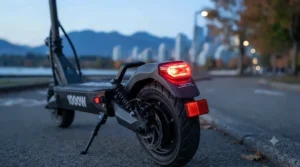
Apollo is a Canadian company, and the Phantom V3 is its flagship dual-motor scooter — a detail worth noting for buyers who’d rather support a business with a Canadian warranty and support desk than an overseas import. Dual 1,200W motors combine for roughly 2,400W nominal output and close to 3,000W at peak, delivered through a proprietary MACH1 controller running 25 amps per motor.
Independent long-term testing (six months, roughly 300 miles) has found the Phantom V3’s acceleration curve to be unusually smooth across its full speed range, a quality that matters more in daily use than a headline top-speed number. That top speed sits around 41 mph (66 km/h) on the 52V 23.4Ah battery, with real-world range closer to 32 miles despite Apollo’s conservative-conditions claim of 50 miles. Quadruple spring suspension and a regenerative brake throttle — operated by the left thumb rather than a traditional lever — give the Phantom V3 genuinely distinctive ergonomics among scooters in this price bracket.
What most buyers overlook is the app integration: real-time ride data, adjustable regenerative braking strength, and OTA firmware updates put the Phantom V3 closer to a connected vehicle than a simple kick scooter. Reviewers note the trade-off is weight — at roughly 35 kg it’s among the heaviest scooters here — and mechanical rather than hydraulic front brakes on some trims, a detail worth confirming before ordering.
Pros:
- ✅ Canadian company means domestic warranty and support
- ✅ Unusually smooth acceleration curve across the full speed range
- ✅ App-based regenerative braking and real-time ride data
Cons:
- ❌ Heaviest scooter in this list at roughly 35 kg
- ❌ Real-world range runs well below the advertised maximum
Expect the Phantom V3 in the C$2,900-C$3,300 range. For buyers who value domestic support alongside genuine performance, it’s a compelling flagship pick.
7. Kaabo Mantis King GT — most refined suspension and braking
The Mantis King GT closes this list as Kaabo’s most complete dual-motor scooter, built to bridge city commuting and legitimate off-road use in a single machine. Dual 1,100W motors combine for a peak output exceeding 4,200W, and the scooter reaches a top speed of 43-44 mph (70 km/h) — squarely in flagship territory.
The standout feature here isn’t raw power, though — it’s the fully adjustable hydraulic suspension front and rear, a feature typically reserved for far more expensive scooters. Riders can dial in preload and rebound independently, tuning the ride for a smooth city commute one day and rougher off-road terrain the next. The 60V 24Ah Samsung battery (built from 21700 cells) delivers a realistic 37 miles of range in day-to-day use, stretching to a claimed 56 miles under optimal conditions, and dual charging ports let riders use two chargers simultaneously to cut charge time to roughly 2.5 hours.
Aggregated owner sentiment consistently highlights the braking system — front and rear hydraulic discs with an optional ABS mode — as best-in-class for this power bracket, alongside praise for the folding mechanism’s speed and security latch. A recurring theme in longer-term reviews is that the aggressive top power setting (mode 5) is genuinely challenging to control from a standing start, a fair warning for less experienced riders rather than a flaw in the hardware itself.
Pros:
- ✅ Fully adjustable hydraulic suspension, front and rear
- ✅ Best-in-class braking with optional ABS assist
- ✅ Dual charging ports cut full-charge time significantly
Cons:
- ❌ Top power mode is genuinely demanding for new riders
- ❌ Among the most expensive scooters in this power class
The Mantis King GT typically runs in the C$2,900-C$3,400 range. As a flagship, it justifies the price through suspension and braking refinement most competitors simply don’t offer.
Full Spec Comparison: All 7 Scooters Side by Side
| Scooter | Combined/Peak Power | Range (claimed) | Weight Capacity | Price Range (CAD) |
|---|---|---|---|---|
| Hiboy Titan | 750W / 1,000W peak | 46 mi (74 km) | 265 lb | C$900-C$1,100 |
| Kaabo Mantis 10 Lite | 1,000W combined | 37 mi (60 km) | 264 lb | C$1,250-C$1,450 |
| Varla Eagle One | 3,200W peak | 40 mi (64 km) | 330 lb | C$1,500-C$1,750 |
| Hiboy Titan Pro | 2,000W peak | 80 mi (129 km) | 330 lb | C$1,850-C$2,300 |
| Varla Eagle One Pro | 3,600W peak | 45 mi (72 km) | 330+ lb | C$2,000-C$2,300 |
| Apollo Phantom V3 | ~3,000W peak | 50 mi (32 mi real-world) | 300 lb | C$2,900-C$3,300 |
| Kaabo Mantis King GT | 4,200W peak | 56 mi (37 mi realistic) | 265 lb | C$2,900-C$3,400 |
This table makes the value curve obvious once you line the numbers up: range and top-tier suspension climb sharply after the C$1,750 mark, while the sub-C$1,500 picks trade some of that polish for genuinely solid day-to-day performance. Notice too that claimed range and realistic range diverge more the higher you go up this list — a pattern common across the whole industry, not unique to any single brand — so treat every manufacturer figure as a ceiling rather than an expectation.
What Is a 1000w Electric Scooter, and Is It Legal in Canada?
A 1000w electric scooter is a stand-up kick-style personal electric vehicle whose motor is rated at roughly 1,000 watts of continuous or peak output, well above the maximum allowed for a street-legal e-scooter under any current Canadian provincial pilot program. In short: are electric scooters street legal Canada wide at this power level? No — not on public roads, bike lanes, or sidewalks, anywhere in the country, regardless of province.
That’s not a loophole waiting to be found; it’s a hard technical line. Ontario’s pilot regulation, British Columbia’s pilot regulation, and Quebec’s pilot both define a legal e-scooter as one with a motor output that does not exceed 500 watts. A 1000w scooter — whether that’s a true 1,000W single motor or dual motors that combine to reach that figure — simply doesn’t meet the definition, full stop, no matter how the listing markets it. This distinction runs parallel to Canada’s federal framework for power-assisted bicycles, which uses the same 500W threshold for pedal e-bikes, even though the two vehicle categories are regulated separately.
Where a 1000w scooter is genuinely usable is private property, sanctioned off-road trails that permit motorized recreational vehicles, and — depending on your municipality’s specific bylaw language — some grey-area private developments. It is not a legal substitute for a compliant e-scooter on a public street, and riding one there exposes you to the same fines, and in some provinces the same seizure risk, as any other unauthorized vehicle on the road.
Electric Scooter Speed Limit Canada: What the Numbers Actually Mean
The electric scooter speed limit Canada enforces isn’t one number — it’s a layered set of provincial and municipal caps that all sit well below what a 1000w scooter is physically capable of. Understanding the gap between “capable of” and “legally permitted to” is the single most important distinction in this entire guide.
- British Columbia caps legal e-scooters at 25 km/h (about 15.5 mph) on a clean, level surface, and requires the motor to disengage automatically at that threshold.
- Ontario sets a provincial maximum of 24 km/h (about 15 mph), though individual municipalities can set it lower — Ottawa, for example, caps its participating scooters at 20 km/h.
- Quebec allows e-scooters on roads posted at 50 km/h or under, with the device itself capped at 20 km/h under the ATPM pilot administered by the SAAQ.
On paper, this means a 1000w scooter capable of 40-plus mph is running at nearly triple the legal speed ceiling anywhere it might otherwise be ridden on public infrastructure. Reviewers and riders alike sometimes point to the “speed capability” spec as bragging rights, but in a legal context that same number is closer to a liability. It’s worth noting the federal power-assisted bicycle standard uses a related but separate figure — 32 km/h — for pedal e-bikes, which is a common source of confusion since it doesn’t apply to stand-up scooters at all.
Electric Scooter Regulations Province Canada: The Complete Guide
Electric scooter regulations province by province in Canada diverge sharply enough that a scooter perfectly legal in one city can be an impoundable offence three hours down the highway. Here’s the comparison that matters most before you buy or ride.
| Province | Legal Watt Cap | Speed Cap | Minimum Age | Helmet Required |
|---|---|---|---|---|
| Ontario | 500W | 24 km/h (varies by city) | 16 | Not universally mandated |
| British Columbia | 500W | 25 km/h | 16 | Yes |
| Quebec | Not specified by watt; speed-capped | 20 km/h | 14 (moped licence if under 18) | Yes |
| Alberta | Personal e-scooters prohibited on roads | N/A (rentals only) | 18+ (rentals) | Recommended |
| Saskatchewan | Aligns near 500W/25 km/h | 25 km/h | Varies by municipality | Recommended |
This table underlines a point that trips up a lot of buyers: Alberta doesn’t have a higher wattage allowance than Ontario or BC — it simply doesn’t permit privately owned e-scooters on public roads at all, full stop, regardless of watts. Only shared rental fleets operating under municipal exemptions are legal there. Quebec’s approach is notably different too, regulating primarily by top speed rather than a hard wattage figure, which technically leaves more room for interpretation but doesn’t change the practical outcome for a 1000w machine.
Electric Scooter Laws in Ontario Canada: Toronto, Ottawa, and the Provincial Pilot
Electric scooter laws in Ontario Canada run on a genuinely unusual structure: the province sets the technical rulebook, but each municipality decides individually whether to opt in at all. Ontario’s e-scooter pilot program has been running since January 2020 and is now proposed to extend to November 27, 2029, under Ontario Regulation 389/19.
Toronto is the headline exception every Ontario rider needs to know: city council has twice declined to join the provincial pilot, most recently in 2024, which means e-scooters — of any wattage, compliant or not — cannot legally be operated anywhere on public property in the city. Toronto Police actively enforce this, and fines apply under both the Highway Traffic Act and municipal bylaws. Ottawa took the opposite approach and opted in, but layered its own stricter rules on top of the provincial baseline: a 20 km/h cap rather than the provincial 24 km/h, no riding on NCC pathways, and sidewalk-riding fines starting at $150.
Roughly two dozen Ontario municipalities have opted into the pilot as of 2026, each with the authority to set its own local restrictions within the provincial framework. A 1000w electric scooter legal Canada wide it is not, and Ontario’s patchwork of opt-in cities makes that especially visible — the exact same scooter can be a fineable offence in one municipality and simply irrelevant (because e-scooters aren’t permitted at all) in the next.
E-Scooter Rules British Columbia Alberta: Two Very Different Approaches
E-scooter rules British Columbia Alberta riders face couldn’t be more different, and the contrast is a useful case study in how much provincial philosophy shapes what’s actually rideable.
British Columbia runs one of the country’s more structured pilots. Under the province’s electric kick scooter rules, a legal device must have a continuous motor output under 500W, weigh under 45 kg, cap out at 25 km/h, and include working lights, a horn or bell, and a compliant braking system. Participating communities — Vancouver, Victoria, Kelowna, Burnaby, and dozens more — allow use on roads posted at 50 km/h or under and in designated bike lanes, with the pilot itself extended through April 2028.
Alberta takes essentially the opposite stance. Personal e-scooters are classified as prohibited devices under the province’s Traffic Safety Act and cannot legally be ridden on roads, sidewalks, or pathways anywhere in the province — a rule that applies regardless of the scooter’s wattage, since the prohibition isn’t calibrated by power output at all. Calgary and Edmonton both run shared rental programs (Bird, Lime, Neuron) operating under specific municipal exemptions, but if you own your scooter personally, riding it in public in either city is simply not an option under current law, and local council pushes to change that haven’t yet resulted in legislation as of mid-2026.
Electric Scooter License Requirement Canada: When You Need One (and When You Don’t)
The electric scooter license requirement Canada imposes depends entirely on whether your device meets a province’s compliant e-scooter definition — and this is where a 1000w scooter’s classification gets genuinely complicated.
A compliant e-scooter, meeting the roughly 500W and 24-25 km/h thresholds most provinces converge on, requires no driver’s licence, no registration, and no insurance to operate under the applicable pilot. That’s a deliberate design choice: pilot programs exist specifically to keep low-powered personal mobility devices outside the motor-vehicle licensing system. Reviewers consistently note this as one of the main appeals of a compliant scooter over a moped or e-bike moped conversion.
A 1000w scooter breaks that exemption simply by exceeding the wattage threshold, but here’s the honest, less-discussed nuance: unlike an over-powered e-bike, which can sometimes be registered as a limited-speed motorcycle or moped if it meets separate vehicle safety standards, a non-compliant stand-up e-scooter generally has no equivalent registration pathway in most provinces. It isn’t that you need a special licence to ride one legally on the road — it’s that there typically isn’t a legal road-use category for it at all. That’s a meaningfully different problem than simply needing more paperwork, and it’s the detail most retail listings conveniently leave out.
How to Choose a 1000w Electric Scooter
Choosing the right high-power scooter comes down to matching intended use to the legal reality, not just picking the highest wattage your budget allows. Here’s the process worth following before you buy.
- Confirm your actual use case first. If you need daily public-road commuting, a 1000w scooter is the wrong category entirely — look at compliant 500W models instead.
- Check your municipality’s specific pilot status. Provincial rules only apply where your city has opted in; confirm this before assuming any legal riding path exists locally.
- Prioritize suspension and braking over top speed. On off-road terrain, adjustable suspension and hydraulic brakes matter far more to safety than an extra 5 mph of capability.
- Match battery capacity to your actual riding distance, not the manufacturer’s optimal-conditions claim, which typically overstates real-world range by 20-30%.
- Factor in weight and portability if you’ll need to carry, store, or transport the scooter regularly — the heaviest picks on this list exceed 30 kg.
- Verify the warranty and Canadian support options, since cross-border warranty claims on imported scooters can add weeks to any repair.
- Budget for protective gear and a proper lock separately, since neither is typically included and both are non-negotiable for safe, secure ownership.
1000w vs 500w Electric Scooters: Off-Road Power vs Street-Legal Compliance
The 1000w vs 500w comparison isn’t really about which scooter is “better” — it’s about which legal category you actually need, and the two aren’t interchangeable no matter how similar the shopping experience feels.
| Factor | 1000w Class | 500W Compliant Class |
|---|---|---|
| Public road legality | Not permitted under any provincial pilot | Legal in participating municipalities |
| Typical top speed | 25-45 mph (40-72 km/h) | 15-16 mph (24-25 km/h) |
| Licence/registration | No clear road-use pathway if non-compliant | None required if compliant |
| Best-suited terrain | Private land, sanctioned trails | Public roads, bike lanes, pathways |
| Typical price range | C$900-C$3,400 | C$500-C$1,800 |
Looking at the comparison above, the deciding factor really is where you plan to ride, not which scooter feels more impressive in a spec sheet. A 500W compliant scooter costs less on average and unlocks genuine, stress-free public-road use in any participating municipality, while a 1000w machine delivers real off-road capability and speed but confines you to private land or sanctioned trails for legal use. Riders who split time between both contexts sometimes end up owning one of each rather than compromising on a single scooter that does neither job particularly well.
Common Mistakes When Buying a 1000w Electric Scooter
Even experienced riders make predictable errors shopping in this power bracket, and most of them trace back to skimming the spec sheet instead of reading it carefully.
Confusing peak wattage with continuous wattage tops the list — a listing advertising “1000W peak” often means a 500-750W continuous motor with a brief power burst, which changes both the legal classification and the real-world hill-climbing performance. Buyers also frequently overlook total ride weight capacity, assuming their own body weight is the only factor, when cargo, backpacks, and winter gear all count against that limit. A third common mistake is assuming manufacturer range claims reflect real conditions; those figures are almost always measured under a light rider, flat terrain, and a constant moderate speed — conditions that rarely match daily commuting or off-road use.
Finally, plenty of buyers skip checking their specific municipality’s pilot status before purchase, assuming provincial legality automatically extends to every city — as Toronto residents who bought scooters expecting Ontario’s pilot to apply have discovered the hard way.
Practical Usage Guide: Setup, First 30 Days, and Battery Care
Getting a new 1000w scooter set up correctly in the first month meaningfully extends both its lifespan and your enjoyment of it, and most of the advice here applies regardless of which model you choose.
Unbox and inspect the frame, folding mechanism, and tires before the first ride — a loose bolt from shipping vibration is common and takes thirty seconds to tighten. Charge the battery to 100% before the very first ride to let the battery management system calibrate properly, then settle into a habit of charging after most rides rather than letting it drain fully; lithium-ion batteries in scooters this size generally last longest when kept between roughly 20% and 90% charge rather than cycled to empty. In the first 30 days, expect to re-tighten stem and folding-clamp bolts at least once as components settle — this is normal, not a defect, and most manufacturers cover it in their setup documentation.
A common first-month mistake is over-inflating pneumatic tires to the maximum pressure printed on the sidewall; a slightly softer tire actually improves shock absorption and grip on rougher terrain, which matters more for a 1000w scooter’s higher speeds than a marginal efficiency gain. If your scooter includes app connectivity, take the twenty minutes to set up custom speed profiles for different environments — a lower-power setting for tight spaces, full power reserved for open trails — rather than running max power by default.
Real-World Scenarios: Who Actually Buys a 1000w Electric Scooter in Canada
Understanding who genuinely benefits from this power class helps clarify whether it’s the right purchase for your situation specifically.
Consider a rural Alberta property owner with several acres of unpaved land: for them, a 1000w scooter like the Varla Eagle One is a legitimate, road-free transportation tool for moving between a house, barn, and workshop, with none of the public-road legality questions in play at all. Compare that to a Toronto university student hoping to commute across campus and city streets — for that use case, a 1000w scooter is flatly the wrong purchase, since Toronto doesn’t permit e-scooters on public property regardless of wattage, and a compliant 500W model (where a nearby opted-in municipality allows it) or public transit remains the only legal path. A third profile: a hunting or fishing enthusiast in British Columbia who wants a quiet, quick way to cover ground on a private lease or a designated off-highway vehicle trail — here, the Hiboy Titan Pro’s extended range genuinely earns its higher price relative to shorter-range alternatives.
Each of these riders has a completely legitimate use case for a 1000w scooter — none of them involve riding on a public road, which is precisely the distinction this entire guide keeps circling back to.
Safety, Insurance, and Injury Risk: What Riders Need to Know
The safety conversation around high-power scooters in Canada has intensified sharply over the past two years, and the data backs up the concern rather than exaggerating it. Hospitalizations linked to scooter-related injuries rose noticeably nationwide over a recent 12-month reporting period, with e-scooters specifically accounting for roughly half of those cases and climbing faster than manual-scooter injuries. According to reporting on national hospitalization data, emergency physicians describe injuries ranging from fractures to serious traumatic brain injuries, and consistently emphasize that speed is the primary factor driving injury severity — which is directly relevant to any scooter capable of 40-plus mph.
Insurance is a genuinely underexplored risk for 1000w scooter owners. Standard homeowner or tenant policies frequently exclude motorized recreational vehicles from liability coverage, meaning a collision or injury involving a non-compliant scooter could leave the rider personally exposed to the full cost of any claim. Before riding regularly, it’s worth a direct call to your insurance provider to confirm exactly what is and isn’t covered — assumptions here carry real financial risk.
On the equipment side, a certified helmet is non-negotiable regardless of provincial mandate, and reviewers across every product in this guide consistently flag that stock lighting on budget models is adequate for visibility but not for actually seeing terrain in full darkness — an upgraded headlight is a worthwhile investment for anyone riding off-road after sunset.
Long-Term Cost & Maintenance of a 1000w Electric Scooter
The sticker price is only the starting point for what a high-power scooter actually costs to own over several years, and the maintenance burden scales with the power output in ways many first-time buyers underestimate.
Battery replacement is the single largest long-term expense, and packs on 1000w-class scooters — larger and higher-voltage than compliant 500W models — typically cost more to replace when they degrade after 500-800 charge cycles, roughly two to four years of regular use. Tire wear accelerates too: pneumatic tires on dual-motor performance scooters wear faster under sustained higher speeds and torque than on lower-power commuter models, and off-road use adds puncture risk that gel-filled tires (like the Hiboy Titan’s) largely sidestep. Brake pad replacement follows a similar pattern — hydraulic systems on the higher-end picks in this guide, like the Mantis King GT, cost more per service than the mechanical or basic hydraulic setups on entry-level scooters, but also last longer and perform more consistently.
Factoring all of this in, a realistic total cost of ownership over three years for a mid-range 1000w scooter typically runs 25-40% above the initial purchase price once battery, tires, brakes, and routine tune-ups are included — a figure worth budgeting for rather than discovering after the first major repair bill.
Features That Actually Matter (and Those That Don’t)
Marketing copy in this category leans hard on headline numbers that don’t always translate to meaningful real-world differences, so it’s worth separating genuine value from spec-sheet noise.
Suspension quality and brake type matter enormously and consistently show up in aggregated owner satisfaction — the difference between a scooter with adjustable hydraulic suspension (like the Mantis King GT) and a fixed spring setup is immediately noticeable on rough terrain. Motor configuration matters too: dual-motor traction genuinely improves control in wet or loose conditions, not just acceleration. What matters far less than the marketing suggests is peak wattage alone, disconnected from continuous rating — a scooter advertising a huge peak number but a modest continuous motor won’t out-climb a well-matched dual-motor competitor with a lower headline figure. App connectivity is a nice-to-have that improves the ownership experience but shouldn’t be a deciding factor over core mechanical quality.
Frequently Asked Questions
❓ Is a 1000w electric scooter legal in Canada?
❓ What is the electric scooter speed limit in Canada?
❓ Do I need a license for an electric scooter in Canada?
❓ Are electric scooters street legal in Ontario?
❓ Can I ride a 1000w electric scooter in Alberta?
Conclusion
A 1000w electric scooter legal Canada wide simply isn’t a real category yet — every provincial pilot converges near the 500W mark, and no amount of aftermarket tinkering changes that math. What this guide hopefully makes clear is that the wattage question isn’t really the obstacle; the real question is matching the right scooter to where you’re actually going to ride it. For private land, sanctioned trails, and genuine off-road use, the seven scooters covered here — from the budget-friendly Hiboy Titan to the flagship Kaabo Mantis King GT — represent real, verifiable options with honest trade-offs in range, weight, and price.
If daily public-road commuting is the goal, a compliant 500W scooter remains the only stress-free path in any participating municipality, and it’s worth checking your specific city’s pilot status before spending a dollar either way. Whichever direction you go, verify your municipality’s current rules directly, since pilot programs continue to evolve year over year, and budget realistically for the total cost of ownership, not just the sticker price. Ride safely, wear a certified helmet, and treat the legal boundaries here as genuinely load-bearing rather than optional.
Recommended for You
- 1000W vs 1500W Electric Scooter Canada: 7 Real Picks (2026)
- 1000W Electric Scooter Canada: 7 Powerful Picks for 2026
- Best 750W Electric Scooters for Heavy Riders in Canada (2026)
Disclaimer: This article contains affiliate links. As an Amazon Associate, I earn from qualifying purchases. If you purchase products through these links, we may earn a small commission at no additional cost to you.
✨ Found this helpful? Share it with your friends! 💬🤗
