
In This Article
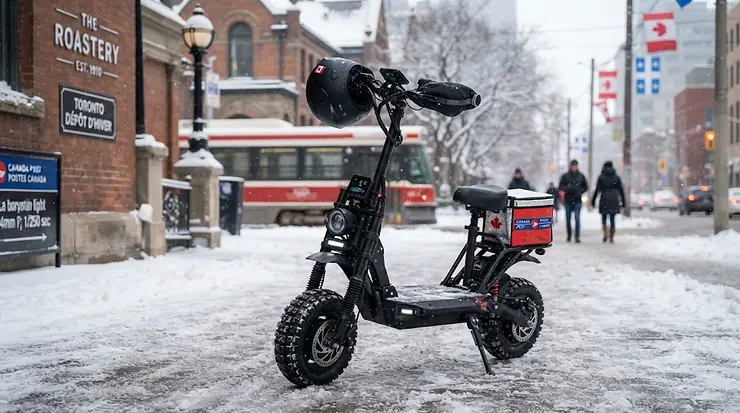
Somewhere around the third week of a Canadian January, every scooter owner asks the same question while scraping frost off their handlebars: does anything actually work out here? Fair question. Most electric scooters are engineered in California test labs at a balmy 20°C, then shipped to people who commute through Winnipeg wind chills that could stop a diesel engine. An electric scooter for winter canada 1500w setup — meaning a scooter with a motor powerful enough to fight through slush, packed snow, and the extra rolling resistance that cold rubber creates — is a different animal from the 350W campus cruiser your neighbour rides in July.
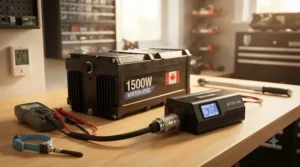
What is an electric scooter for winter canada 1500w? In short, it is a stand-up e-scooter with roughly 1500 watts of motor power (or a dual-motor system producing similar combined output), paired with cold-rated batteries, aggressive tread, and weatherproofing suited to Canadian winter roads, slush, and sub-zero temperatures. That extra wattage is not for showing off. It is torque insurance against snowbank drag, icy inclines, and the 20-30% range hit that lithium-ion batteries take once the mercury drops, a phenomenon well documented in how cold temperatures reduce lithium-ion conductivity and battery capacity.
This guide walks through seven real, currently available scooters that Canadian riders are actually buying for winter use, from budget snow-convertible builds to premium performance machines. We researched specs, aggregated review sentiment, and current market positioning so you are not left guessing. A quick heads-up before we dive in: this article contains affiliate links, and as an Amazon Associate we may earn a commission on qualifying purchases, at no extra cost to you.
Quick Comparison Table
| Scooter | Motor Power | Claimed Range | Best For |
|---|---|---|---|
| Phantomgogo Pro Level | 1500W brushless | Up to 30 mi (wheels) | Budget snow convertible |
| Apollo Go | 1500W combined (dual) | Up to 48 km | All-round Canadian commuter |
| WOW G63 Convertible | 1500W (2200W peak) | Up to 42 mi | Dedicated snow/ski riding |
| Hiboy Titan Pro | Up to 2400W peak (dual) | Up to 80 mi | Long-range winter commuting |
| Varla Eagle One V2.0 | Dual 1000W (3200W peak) | Up to 42 mi | Hill-heavy winter routes |
| Segway Ninebot MAX G3 | 2000W peak | Up to 80 km | Refined all-weather performance |
| Kaabo Mantis King GT | Dual 1100W | Up to 56 mi | Premium ice-grip performance |
Looking at the spread above, the range figures tell only half the story — every one of these numbers was measured on dry pavement at moderate temperatures, so treat them as a ceiling rather than a promise once the snow starts flying. Riders chasing pure distance for a longer winter commute should lean toward the Hiboy Titan Pro or Segway MAX G3, while anyone actually riding through fresh snow rather than just cold pavement needs the convertible track systems on the WOW G63 or Phantomgogo. Budget-conscious buyers should note that raw wattage alone does not guarantee winter performance — tire design and weatherproofing matter just as much, which is exactly what the product breakdowns below unpack.
💬 Just one click — help others make better buying decisions too! 😊
💬 Found a scooter that fits your winter commute? Save this list before you scroll — you will want to compare specs again later.
Top 7 Electric Scooter for Winter Canada 1500w Picks: Expert Analysis
Picking the right electric scooter for winter canada 1500w riding means balancing motor torque, battery chemistry, tire grip, and how much abuse the electronics can take before something shorts out in a slush puddle. We dug into real specs, verified retailer listings, and aggregated owner feedback for each of these seven. Coverage below spans budget, mid-range, and premium tiers, plus the all-important convertible snow builds that most “best winter scooter” lists skip entirely.
1. Phantomgogo Pro Level — cheapest true snow-convertible on the list
The standout here is versatility on a budget: this is one of the few sub-C$1,000 scooters that ships with an actual snow-riding configuration rather than just “aggressive tires.” The Pro Level runs a 1500W brushless motor off a 48V 20.4Ah battery, and it physically reconfigures into three modes — an 11-inch off-road wheel setup, a PA66 injection-molded snowboard version, and a tracked version using a nylon mesh rubber track. In wheel mode you get roughly 20 mph and 30 miles of range; swap to the snow configuration and top speed drops to around 14 mph with 17 miles of range, which is the honest trade-off of pushing a wide molded ski through resistance instead of rolling on a wheel. On paper, that speed drop looks like a downgrade, but reviewers of similar convertible platforms consistently note that stability in deep snow matters more than raw speed, since a scooter that can barely maintain 14 mph on packed powder beats one that spins out trying to hit 20. This model is built for the rider who wants to try snow scootering without financing a used car to do it — students, apartment dwellers without garage space for a second winter vehicle, and anyone testing whether they even enjoy riding through a Canadian winter before upgrading. Independent, verifiable long-term review volume for this exact configuration is still thin compared to mainstream commuter scooters, so treat owner reports as early and directional rather than exhaustive; what is verifiable is the spec sheet itself, which checks the boxes budget snow riders actually need. Max carrying load sits at 287 lbs, which is generous for the price bracket.
Pros:
- ✅ Three configurations for one purchase price
- ✅ Lowest entry price among true snow-convertible models
- ✅ Generous 287 lb weight capacity
Cons:
- ❌ Top speed drops sharply in snow mode
- ❌ Limited independent long-term review data
Expect this one to land in the under C$1,000 range at the time of research, making it the value pick if you want to test winter scootering before committing to a premium build. Prices change often, so always check current pricing before buying.
2. Apollo Go — best all-round Canadian winter commuter
Apollo is a Montreal-designed brand, and it shows in how deliberately this scooter was built for exactly the climate you are riding in. The Go runs a dual-motor system with 1500W of combined peak output (750W per motor), reaching 44 km/h with up to 48 km of range on a full charge. What most buyers overlook about dual-motor setups like this one is that the benefit is not really top speed — it is traction. Two independently powered wheels mean better grip when one tire is on packed snow and the other hits a patch of bare, salted asphalt, a scenario every Canadian winter commuter faces multiple times per ride. The frame carries an IP66 rating, which is a genuinely high bar for water and dust ingress protection, meaning slush spray and road salt are far less likely to creep into the electronics than on scooters rated IPX4 or IPX5. Apollo’s self-healing PunctureGuard tires also matter more in winter than people realize, since cold rubber becomes brittle and more prone to sidewall damage from the salt and grit that Canadian road crews spread liberally from November through March. Based on the spec comparison against similarly priced imports, the airflow suspension (front spring, rear polyurethane) is tuned for rougher pavement rather than off-road snow, so this is the pick for city and suburban commuters riding on cleared roads and bike lanes, not backcountry trail riders. Apollo backs the frame with a lifetime warranty, a detail that matters when winter road salt is actively working to corrode metal components over a scooter’s lifespan.
Pros:
- ✅ IP66 rating is among the highest in this category
- ✅ Dual motor improves traction on mixed snow and pavement
- ✅ Lifetime frame warranty backs winter durability concerns
Cons:
- ❌ Not designed for deep, unplowed snow
- ❌ Range drops noticeably below freezing like all lithium battery scooters
Apollo typically prices the Go in the C$1,300-C$1,600 range at the time of research, occasionally lower during seasonal promotions — always check current pricing on the retailer page before buying.
3. WOW G63 Convertible — best for actual snow and ski riding
If the Apollo Go is built for cleared city streets, the WOW G63 is built for the exact opposite: unplowed trails, backyard powder, and the kind of snow depth that would bury a standard scooter’s deck. This is a 48V 1500W brushless motor scooter (2200W peak) with a modular “Quick-Switch” system that swaps between standard wheels, off-road tracks, or a full ski-and-track snow configuration. The 21Ah UL 2272-compliant removable battery claims up to 42 miles of range, and the motor is rated for a 30-degree climbing angle, which translates to real confidence on the kind of steep, snow-covered driveways and trailheads that stop lesser scooters cold. What the spec sheet won’t tell you, but the underlying engineering suggests, is that front and rear hydraulic oil brakes plus an EABS electronic braking system are doing serious work here, because stopping distance on packed snow is dramatically longer than on dry pavement regardless of how good your brakes are — redundant braking systems are not a luxury on a snow machine, they are a requirement. This is the scooter for the rider who actually wants to carve through fresh powder on a weekend rather than simply survive a commute, and it is honestly overkill if your riding is limited to plowed sidewalks and bike lanes. As a newer convertible platform, verified independent long-term review volume remains limited compared to established commuter brands, so weigh the manufacturer specs against your own risk tolerance for buying into a less battle-tested product category.
Pros:
- ✅ True modular ski and track system for deep snow
- ✅ 30-degree climb rating handles steep winter terrain
- ✅ Dual hydraulic brakes plus EABS for icy stopping power
Cons:
- ❌ Overkill for cleared-road commuting
- ❌ Limited long-term, independently verified reviews so far
Expect this convertible system to land in the C$1,400-C$1,800 range at the time of research, with the snow kit sometimes bundled and sometimes sold separately — confirm exactly what is included before purchase.
4. Hiboy Titan Pro — best long-range pick for winter range anxiety
Range anxiety gets worse in winter, full stop. Cold weather can strip roughly 20% off a lithium battery’s usable capacity, so a scooter that claims 40 miles in summer might genuinely deliver 30 in a Canadian February. The Titan Pro sidesteps this problem by starting from an absurdly generous baseline: dual motors delivering up to 2400W combined peak power, fed by a 48V 36Ah battery rated for up to 80 miles of range in ideal conditions. Even after a realistic winter haircut, that leaves most commuters with more range than they will use in a single day, which is exactly the kind of margin you want when a dead battery in sub-zero temperatures is not just inconvenient but genuinely uncomfortable to walk home from. Reviewers consistently note that the Titan Pro feels noticeably heavier and bulkier than mid-tier commuter scooters, which tracks with a reinforced 6061 aluminum frame and a battery pack roughly double the size of competitors — that weight is the literal cost of the range you are buying. The 10-inch gel-filled tubeless tires resist the flats that studs and road debris cause more often in winter, and dual hydraulic brakes plus dual suspension keep the ride composed over the frost heaves and pothole patches that appear every spring thaw. Here’s what to weigh: this is the scooter for someone commuting a genuinely long distance, or someone who simply hates charging their scooter more than once every few days. It is not the lightest or most portable option if you need to carry it up several flights of stairs daily.
Pros:
- ✅ Class-leading range cushions winter capacity loss
- ✅ UL2272-certified 21700 cell battery for safety
- ✅ Dual hydraulic brakes and dual suspension for rough winter roads
Cons:
- ❌ Noticeably heavier than most mid-range scooters
- ❌ Bulkier footprint makes stair-carrying and transit less convenient
At the time of research, the Titan Pro has launched with promotional pricing in the low-C$1,300s and full retail closer to C$1,900-C$2,000 — prices fluctuate with sales, so check current pricing before committing.
5. Varla Eagle One V2.0 — best for hilly winter commutes
Hills and snow are a genuinely bad combination, and this is where the Eagle One V2.0 earns its keep. Dual 1000W hub motors produce a combined 3200W peak output, which the sine-wave controllers translate into smooth, non-jerky acceleration rather than the herky-jerky power delivery that makes icy hill starts dangerous on lesser scooters. Reviewers consistently report confident 30-degree incline performance with what one long-term owner described as “unnoticeable power loss,” a claim that lines up with the physics of a dual-motor system splitting torque demand across two wheels instead of overloading one. The 52V 20.8Ah battery claims up to 42 miles of range and reaches a genuinely aggressive 40 mph top speed in sport mode, though realistically most Canadian winter commuters will stay in a lower-speed setting once ice enters the equation — that top speed is a headroom number, not a recommendation for icy streets. Independent suspension front and rear smooths out the frost-heaved pavement that plagues Canadian roads every spring, and dual hydraulic disc brakes with a regenerative assist provide the stopping power that steep, snow-covered inclines demand. One honest note for Canadian buyers: Varla currently charges a flat shipping surcharge of roughly C$150 for Canadian orders on top of the scooter price, since free shipping promotions are U.S.-only — factor that into your total budget before ordering. This is the pick for anyone whose commute includes a genuine hill, since flat-ground commuters will rarely tap into this much motor.
Pros:
- ✅ Dual motors deliver strong hill-climbing torque in snow
- ✅ Regenerative hydraulic brakes aid icy-incline control
- ✅ Independent front and rear suspension smooths frost-heaved roads
Cons:
- ❌ Canadian orders incur an additional shipping surcharge
- ❌ Heavier weight makes portability harder than lighter commuters
Expect a price in the C$1,500-C$1,800 range at the time of research, plus the Canadian shipping surcharge noted above — always confirm total landed cost before ordering.

6. Segway Ninebot MAX G3 — best refined performance pick
Segway’s engineering pedigree shows up in the details here rather than in flashy marketing claims. The MAX G3 runs a 2000W peak motor to a genuinely impressive 45 km/h top speed and up to 80 km of range using Segway’s SegRange technology, backed by an IPX6 water resistance rating that beats most competitors’ IPX5 spec by a meaningful margin when it comes to shedding slush and road spray. Traction control and Segway’s proprietary SegRide stability system are doing quiet, unglamorous work on wet and cold pavement — the kind of feature you never notice until the one time it prevents a slide. On paper this means the G3 handles wet, cold asphalt with more composure than scooters relying on tire grip alone. One important honesty note, straight from Segway’s own retail guidance: the manufacturer explicitly does not recommend riding the MAX G3 in snow, ice, or heavy rain, and advises storing it indoors during winter to protect the battery. That is a meaningful distinction from the convertible snow scooters on this list — the G3 is built to handle cold, wet, salted city streets exceptionally well, not to plow through actual snowfall. For the Canadian rider whose winter reality is mostly cleared roads and slush rather than unplowed powder, that is precisely the right trade-off, and the self-sealing 11-inch tubeless tires plus double-action piston disc brakes back it up with genuinely premium stopping power.
Pros:
- ✅ IPX6 rating outperforms most competitors on slush resistance
- ✅ Traction control and SegRide stability aid cold, wet pavement grip
- ✅ Directly available through Amazon.ca with UL-2272 certification
Cons:
- ❌ Manufacturer advises against riding in actual snow or ice
- ❌ Battery needs indoor storage protection in deep winter
At the time of research, the MAX G3 typically sits in the C$1,400-C$1,700 range on Amazon.ca — prices shift with promotions, so check the current listing before buying.
7. Kaabo Mantis King GT — best premium pick with real ice-grip options
The Mantis King GT earns its spot at the top of this list for one specific reason most competitors cannot match: it supports aftermarket studded tires designed for genuine ice traction, a detail that matters enormously more than horsepower once black ice enters the picture. The stock configuration runs dual 1100W motors, a 60V 24-24.5Ah battery, and claims up to 56 miles of range under ideal conditions (with most owners reporting a more realistic 37 miles day-to-day), reaching a substantial 43 mph top speed. What most buyers overlook about premium scooters like this one is that the adjustable hydraulic suspension is not just a comfort feature — being able to dial in stiffer damping for icy, rutted winter roads versus softer settings for smooth summer pavement genuinely extends the scooter’s usable season. Reviewers consistently praise the acceleration and suspension quality, with one longtime rider noting the braking and build quality as best-in-class for the price bracket, though a few owners flagged intermittent brake noise at low speed as a minor quality-control inconsistency worth having checked under warranty. IPX5 water resistance is solid but not class-leading (the Segway above edges it out on paper), so this is a scooter best paired with fenders and the optional studded tire upgrade rather than relied upon as a stock all-weather solution. This is the buy for the rider who wants genuine performance headroom and is willing to invest in the studded tire accessory to unlock true winter capability.
Pros:
- ✅ Supports aftermarket studded tires for real ice traction
- ✅ Adjustable hydraulic suspension tunes for winter road conditions
- ✅ Strong acceleration and premium build quality reported by owners
Cons:
- ❌ IPX5 rating trails top competitors on water resistance
- ❌ Premium price puts it out of reach for budget commuters
Expect this flagship to land in the C$2,600-C$3,000 range at the time of research — a genuine investment, but one that reflects the dual-motor performance and premium componentry on offer.
Practical Winter Setup & Maintenance Guide
Buying the right electric scooter for winter canada 1500w riding solves half the problem; the other half is keeping it alive through a season that actively tries to destroy it. Start before the first snowfall: fully charge the battery and, if your scooter has a removable pack, bring it indoors overnight rather than leaving it in an unheated garage, since repeated deep cold cycling accelerates capacity loss. Check tire pressure weekly rather than monthly in winter — cold air contracts, and underinflated tires both reduce range and increase the risk of a pinch flat on a frozen pothole edge. During the first 30 days of winter ownership, the most common rookie mistake is ignoring the drivetrain after slushy rides; road salt is corrosive, and a quick wipe-down of the deck, fork, and motor housing after every wet ride prevents the kind of long-term corrosion that voids warranties and eats brake lines.
Set a maintenance rhythm: monthly checks on brake pad wear (which accelerates with grit contamination), bi-weekly tire tread inspections, and a full bolt-torque check every six weeks, since vibration on frozen, rutted pavement loosens hardware faster than smooth summer asphalt does. One optimization trick most manuals skip: preheating your battery by bringing the scooter into a heated space for 20-30 minutes before a ride in extreme cold measurably improves both range and power delivery, since lithium cells perform closer to their rated capacity above roughly 10°C. Store the scooter at room temperature between rides whenever possible rather than leaving it in a cold vestibule, and never charge a battery that is still cold from an outdoor ride — let it warm to room temperature first, since charging near-freezing lithium cells accelerates degradation and, in rare cases, poses a safety risk.
Real-World Winter Rider Scenarios
Picture three different Canadian riders and how the picks above actually map onto real life. First, the downtown condo commuter: a 28-year-old working a hybrid schedule in Toronto, riding two kilometres to the office three days a week on cleared roads and painted bike lanes, budget around C$1,500. This rider does not need a snow track system — the Apollo Go or Segway MAX G3 covers this use case perfectly, prioritizing weatherproofing and traction control over raw off-road capability, since the actual riding surface is asphalt and slush rather than powder.
Second, the suburban hill commuter: a rider in a Kitchener or Hamilton neighbourhood built on rolling terrain, where every commute includes at least one meaningful incline that turns treacherous once it ices over. This rider should prioritize the Varla Eagle One V2.0 or Hiboy Titan Pro, since dual-motor torque and confident climbing ratings matter far more here than top speed ever will — a scooter that stalls halfway up an icy hill is worse than useless, it is a hazard.
Third, the rural or acreage rider: someone living outside city limits where roads are not always plowed promptly and a chunk of the ride crosses an unplowed driveway or trail before hitting cleared pavement. This is exactly the scenario the WOW G63 or Phantomgogo Pro Level were built for, since their convertible track and ski systems handle genuine snow depth that would otherwise strand a wheel-only scooter within the first fifty metres.
Problem → Solution: Common Winter Scooter Issues
Range dropping faster than expected is problem number one, and the solution is twofold: precondition the battery indoors before riding, and budget for roughly 20-30% less real-world range than the manufacturer’s summer rating, choosing a model like the Hiboy Titan Pro with generous baseline capacity if your commute is long. Problem number two is brake fade or reduced stopping power on ice — the fix is not aggressive braking but rather earlier, gentler braking combined with a scooter running dual hydraulic disc brakes plus electronic regenerative assist, which several models on this list already include. Problem three is tire slip on packed snow or black ice, solved either by dropping tire pressure slightly for a larger contact patch, upgrading to studded tires on a scooter like the Kaabo Mantis King GT that supports them, or switching to a genuine track system like the WOW G63 for the worst conditions. Problem four is battery-related shutdowns in extreme cold, best addressed by never letting the charge drop below roughly 30% in winter, since deep discharges at low temperatures stress cells more than at room temperature. Problem five is corrosion from road salt, solved with the simple habit of wiping down the frame, motor housing, and brake components after every wet or slushy ride, particularly on scooters without a high IP rating.
How to Choose an Electric Scooter for Winter Canada 1500w
- Match motor wattage to your terrain, not your ego — a flat commute rarely needs the full 3200W peak of a dual-motor performance scooter, while genuine hills demand it.
- Prioritize IP or IPX water resistance ratings of at least IPX5, and treat IP66 as the gold standard for slush and road spray protection.
- Confirm the battery has a UL 2272 or equivalent CSA-recognized safety certification, since winter charging habits already stress cells more than summer use.
- Check whether the tires are pneumatic (better cold-weather grip and shock absorption) versus solid (lower maintenance but harsher, more slip-prone ride on ice).
- Weigh portability against range — a heavier, longer-range scooter like the Titan Pro trades stair-carrying ease for winter range security.
- Verify braking redundancy; dual hydraulic disc brakes plus an electronic assist system meaningfully shorten stopping distance on packed snow.
- Budget for the total cost of winter ownership, including any Canadian shipping surcharges, studded tire upgrades, and indoor storage solutions for the battery.
Electric Scooter Cold Weather Performance: What Really Happens
Reviewers consistently note a gap between summer-rated specs and what actually happens once temperatures drop below freezing, and the underlying chemistry explains why. Cold weather slows the electrolyte conductivity inside lithium-ion cells, which lowers both usable capacity and overall battery lifespan, typically costing riders around 20% of their normal range. In more extreme cold, the electrolyte can even begin to freeze, which in rare cases risks a short circuit — a genuinely useful reason to store your scooter’s battery indoors rather than in an unheated shed through a Prairie or Northern Ontario winter. Tire pressure compounds the problem: cold temperatures cause tire pressure to drop, which reduces grip, and combined with wet or icy surfaces this means longer stopping distances and reduced control. On paper this means every spec sheet you read for a summer test should be mentally discounted before you rely on it for a January commute. The table below breaks down what to realistically expect across common winter conditions.
| Condition | Typical Range Impact | Typical Speed Impact |
|---|---|---|
| 0°C to -5°C | 15-20% range loss | Minimal speed loss |
| -5°C to -15°C | 20-30% range loss | Slight throttle lag until warmed |
| Below -15°C | 30%+ range loss possible | Noticeable power reduction |
| Wet slush/salt spray | Accelerated corrosion risk | Reduced tire grip, longer braking |
What most buyers overlook about these numbers is that they are not a flaw in any particular scooter — they are baseline lithium-ion physics, which is exactly why choosing a model with generous baseline range, like the Hiboy Titan Pro, or aggressive weatherproofing, like the Apollo Go or Segway MAX G3, matters more in Canada than it does for a rider in Miami comparing the same spec sheets.
1500w Electric Scooter Winter Canada vs Standard 500W Commuters
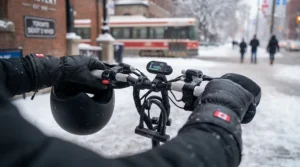
The comparison Canadians actually need to make is not between two premium scooters — it is between a proper 1500w electric scooter winter canada build and the sub-500W commuter scooters that dominate summer sales charts. A 500W scooter is legally significant in most provinces too, since Transport Canada’s federal power-assisted bicycle standard caps continuous motor output at 500W and speed at 32 km/h for vehicles that qualify as bicycles under federal law. Scooters exceeding that threshold, including every 1500W model reviewed above, generally fall outside that lighter federal category and into a patchwork of provincial rules discussed in the safety section below.
| Factor | 500W Commuter | 1500W Winter Scooter |
|---|---|---|
| Hill climbing in snow | Struggles above gentle grades | Handles 20-30° inclines confidently |
| Range in freezing temps | Often under 15 km realistic | Often 30-60+ km realistic |
| Typical price (CAD) | C$400-C$800 | C$1,300-C$3,000 |
| Best for | Flat, short summer commutes | Hilly, cold, or snow-affected routes |
The extra torque of a 1500W-class motor is not overkill for winter riding — it is the margin that keeps momentum through the extra rolling resistance snow creates, and the reserve power that prevents stalling on an icy incline a 500W motor would simply bog down on. Budget-conscious buyers should note, however, that this performance gap comes with a real price and legal-classification trade-off worth understanding before you buy.
✨ Ready to stop white-knuckling your commute every time it snows? Compare these seven picks side by side before the next storm hits.
Electric Scooter Snow Canada: Safety, Regulations & Compliance
Before buying an electric scooter snow canada riders can legally use on public roads, understand that Canadian e-scooter law is a genuine patchwork, and a 1500W scooter sits well outside the federal baseline that governs lighter e-bikes. Federally, Transport Canada’s Motor Vehicle Safety Regulations only exempt power-assisted bicycles meeting a 500W motor output and 32 km/h speed cap from licensing and insurance requirements, and standing e-scooters without pedals do not even qualify for that category in the first place. Provincial rules fill the gap, and they vary significantly. Ontario runs an e-scooter pilot program that permits municipalities to opt in, currently extended through November 2029, but the pilot’s technical rules cap permitted scooters well below 1500W and restrict where they can legally operate — meaning a scooter like several on this list may be legal to own and ride on private property or in off-road/recreational use, but not necessarily street-legal for public road use in an opted-in Ontario municipality without checking local specifics first.
Quebec takes a different approach entirely: under its motorized personal mobility device pilot project, the province limits qualifying devices to a maximum 500W motor with drive assistance ceasing at 25 km/h, meaning a 1500W scooter would not qualify for that program’s more permissive treatment and could instead be classified similarly to a moped, potentially triggering registration, licensing, and insurance requirements. The honest takeaway: before buying any electric scooter snow canada riders plan to use on public streets, check your specific province and municipality’s current rules, since a scooter perfectly legal for private trail and driveway use in one region may require a license, plates, and insurance elsewhere. Safety-wise, regardless of legal classification, CSA-recognized certifications like UL 2272 for battery and electrical systems are worth prioritizing on any winter purchase, since higher power output means a battery fire risk that is not worth cutting corners on.
Winter Commuter Scooter Canada: Matching Riders to Machines
Not every winter commuter scooter canada buyer has the same needs, and tailoring the choice to rider type avoids expensive regret. Beginners riding their first winter season should lean toward the Apollo Go or Segway MAX G3, since both prioritize predictable power delivery and strong stability systems over raw performance that a new rider might not yet know how to manage safely on ice. Experienced riders upgrading from a summer-only scooter should consider the Varla Eagle One V2.0 or Kaabo Mantis King GT, where the dual-motor torque and adjustable suspension reward riders who already understand throttle modulation on slippery surfaces. Budget-conscious students and apartment dwellers without dedicated storage are best served by the Phantomgogo Pro Level, since its lower price point and multi-configuration design let riders test winter scootering without the financial commitment of a premium build. Rural and acreage riders facing genuine unplowed snow, rather than just cold pavement, should skip wheel-only scooters entirely and go straight to the WOW G63’s convertible ski and track system, since no amount of tire pressure adjustment substitutes for an actual track when snow depth exceeds a few centimetres.
Common Mistakes When Buying a Winter Electric Scooter
The single biggest mistake is trusting summer-rated range and speed figures at face value, then being blindsided by a 20-30% real-world shortfall the first cold morning. A close second is buying based on top speed alone while ignoring braking system quality — a scooter that hits 45 km/h with a single mechanical brake is a liability on packed snow regardless of how fun that speed feels on dry pavement. Buyers also frequently skip checking their specific province and municipality’s regulations before purchasing a high-wattage scooter, only to discover afterward that it cannot legally be ridden on the road they commute along. Another common error is ignoring IP or IPX water resistance ratings entirely, treating “foldable” and “durable” marketing language as a substitute for an actual certified number. Finally, many first-time winter buyers underestimate ongoing costs — winter tires, studded tire upgrades, indoor battery storage solutions, and more frequent brake pad replacement all add up beyond the sticker price.
Long-Term Cost & Maintenance in Canadian Winters
Total cost of ownership for a winter scooter extends well past the purchase price. Brake pads wear faster with grit and salt contamination, typically needing replacement every one to two winter seasons rather than the two-to-three-year lifespan common in dry climates. Battery degradation accelerates with repeated cold-cycling, meaning a pack rated for 800 charge cycles in ideal conditions might realistically deliver closer to 500-600 meaningful cycles under harsh winter use, which is a genuine argument for investing upfront in a scooter with a larger baseline battery like the Hiboy Titan Pro, since you are effectively buying range headroom that offsets both cold-weather loss and long-term capacity fade. Tires need more frequent inspection and occasional mid-season replacement if you are riding on salted roads regularly, and any scooter without a lifetime frame warranty, like the Apollo Go offers, is a slightly bigger corrosion gamble over a five-year ownership window. Factor in roughly C$150-C$300 per winter season for maintenance consumables — brake pads, tire sealant or replacement, and battery storage accessories — when comparing the real cost between a budget and premium model. According to a Canadian Automobile Association research summary on micromobility, regulatory frameworks and safety data collection for higher-powered personal mobility devices remain limited across the country, which is one more reason to prioritize verified safety certifications over marketing claims when budgeting for a long-term winter purchase.
FAQ
❓ What wattage electric scooter is best for Canadian winters?
❓ Can a normal electric scooter handle snow in Canada?
❓ Does cold weather really reduce electric scooter range?
❓ Is it legal to ride a 1500W electric scooter on Canadian roads?
❓ How do I stop my electric scooter battery from dying in winter?
Conclusion
Winter scootering in Canada is entirely doable, but it rewards buyers who match the machine to the actual conditions they will face rather than chasing the highest top-speed number on a spec sheet. If your commute stays on cleared, salted city streets, the Apollo Go or Segway Ninebot MAX G3 deliver the weatherproofing and traction control that matter most. If hills factor into your route, the Varla Eagle One V2.0 and Hiboy Titan Pro bring the dual-motor torque and range cushion that flatland scooters simply cannot match. And if your winter reality includes genuine unplowed snow rather than just cold pavement, nothing on a wheel-only chassis competes with the convertible track systems on the WOW G63 or the budget-friendly Phantomgogo Pro Level. Whichever you choose, treat every summer-rated spec as an optimistic ceiling, budget for the real cost of cold-weather maintenance, and double-check your province’s current regulations before riding a 1500W-class scooter on public roads. Do that homework now, and you will spend the rest of the season riding through winter instead of dreading it.
🔍 Take your winter commute to the next level with one of these seven cold-weather-ready electric scooters. Click through to check current pricing and availability before the next snowfall hits your city!
Recommended for You
- 7 Best 1500w Electric Scooter Canada Picks for 2026
- 1000w Electric Scooter Legal Canada: 7 Real Picks for 2026
- 1000W vs 1500W Electric Scooter Canada: 7 Real Picks (2026)
Disclaimer: This article contains affiliate links. As an Amazon Associate, I earn from qualifying purchases. If you purchase products through these links, we may earn a small commission at no additional cost to you.
✨ Found this helpful? Share it with your friends! 💬🤗
