
In This Article
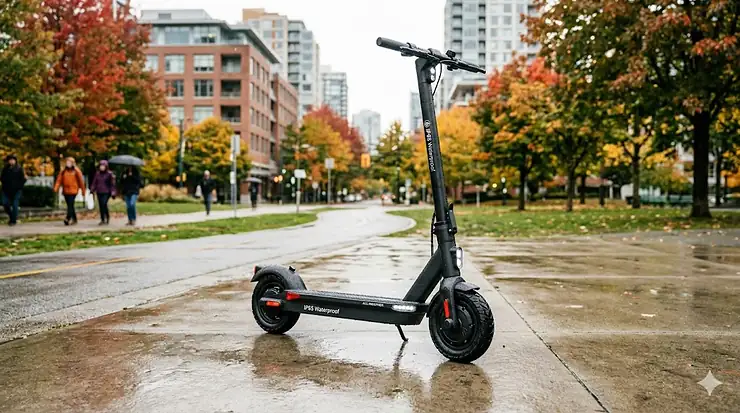
Picture this: you’re halfway through your morning commute in Vancouver when the sky opens up. Most riders scramble for cover. You? You keep rolling. That’s the quiet confidence that comes with owning a genuine waterproof electric scooter IP65 — a machine built to shrug off rain, puddles, and Canadian spring slush without flinching.
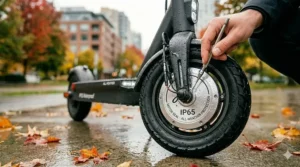
But here’s the thing Canada teaches you quickly: not every scooter that claims to handle wet weather actually does. Plenty of models on Amazon.ca carry vague “water-resistant” language, and a surprising number have no official IP rating at all. In a country where rain is a seasonal staple from Halifax to Victoria, and where spring melt turns streets into shallow rivers for weeks, that matters enormously.
A waterproof electric scooter IP65, by definition under the international IEC 60529 standard, is completely dust-tight (the “6”) and protected against powerful water jets from any direction (the “5”). That means riding through heavy downpours, puddle-splattered bike lanes, and even an accidental rinse with a garden hose won’t damage your electronics. It’s the minimum meaningful waterproofing standard for serious year-round Canadian use — and the benchmark we’ve used to vet every product in this guide.
In this article, I’ve researched seven real products available to Canadian buyers, dug into what their specs actually mean in cold, wet conditions, and matched each one to a specific type of rider. Whether you’re a condo-dwelling Toronto commuter or a weekend explorer in suburban Calgary, there’s a sealed e-scooter here that fits your life — and your budget in CAD.
Quick Comparison: Top Waterproof Electric Scooters in Canada 2026
| Model | IP Rating | Motor | Range | Weight | Best For | Price Range (CAD) |
|---|---|---|---|---|---|---|
| Segway Ninebot MAX G2 | IPX7 (battery) | 450W | ~60 km | 24.3 kg | Daily urban commuters | $700–$850 |
| FOLU J11 Plus | IP65 (certified) | 1,200W | ~60 km | 27 kg | Off-road + wet commuting | $500–$650 |
| iScooter iX3 | IP54+ | 800W | ~40 km | 18 kg | Budget performance | $400–$500 |
| Hiboy S2 Pro | IP54 | 500W | ~40 km | 16 kg | Lightweight city riding | $450–$550 |
| NIU KQi3 Max | IPX5 | 350W | ~65 km | 21 kg | Long-range commuters | $700–$800 |
| Gotrax G4 Pro | IP54 | 350W | ~40 km | 14 kg | Budget-conscious beginners | $350–$450 |
| Gyrocopters J30 | IPX4 | 350W | ~30 km | 13 kg | First-time buyers | $280–$380 |
📊 Table Analysis: What stands out here is the wide spread between IP ratings even within a similar price band. The FOLU J11 Plus delivers true IP65 certification at mid-range pricing — a rare combination. The Segway MAX G2’s IPX7 battery is technically superior in terms of submersion resistance, but the overall chassis is only IPX4. Budget buyers should note that the Gyrocopters J30’s IPX4 means splash protection only — fine for light drizzle, but risky in a proper Canadian rainstorm. If you’re riding through anything more than mist, aim for IP54 at minimum, and IP65 if you’re serious about year-round use.
💬 Just one click — help others make better buying decisions too! 😊
✨ Don’t Miss These Exclusive Deals!
🔍 Take your rainy-day commuting to the next level with these carefully selected waterproof scooters. Click on any highlighted product name to check current pricing and availability on Amazon.ca. These picks will keep you rolling through whatever Canadian weather throws your way!
Top 7 Waterproof Electric Scooters in Canada: Expert Analysis
1. Segway Ninebot MAX G2 — Best All-Round Urban Commuter
The MAX G2 is the successor to the legendary G30P, and it earns its place at the top of this list with a combination of real-world performance, intelligent engineering, and solid availability on Amazon.ca.
What the specs actually mean for you: The 450W brushless motor with 1,000W peak output handles 22% inclines smoothly — so if your commute includes hilly neighbourhoods like Montreal’s Plateau-Mont-Royal or Vancouver’s West End, you won’t be grinding to a near-halt on uphill stretches. The 551 Wh battery delivers up to 60 km of claimed range, though realistically expect 45–50 km in Canadian autumn temperatures and closer to 35–40 km when it dips below 5°C (cold weather reduces lithium battery efficiency by roughly 15–20%). The IPX7 battery rating is the headline feature: it means the battery pack itself can be submerged to 1 metre for 30 minutes — far beyond what any Canadian rainstorm demands. The 11-inch pneumatic tires absorb bumps well, which matters on the frost-heaved asphalt that plagues Canadian cities every spring.
My take: The MAX G2 is the scooter I’d recommend to anyone commuting 15–25 km daily in a major Canadian city. It’s not the cheapest option, but the combination of self-sealing tires, hydraulic front suspension, Apple Find My compatibility, and a genuinely water-resistant battery pack makes it one of the most intelligent all-weather choices on Amazon.ca. The traction control feature alone is worth the premium in wet conditions — it actively reduces wheel spin on slippery surfaces, which is something most cheaper scooters completely lack.
Customer feedback: Reviewers consistently praise the smooth ride quality and long range, with Canadian buyers specifically noting reliable performance in autumn rain. A handful of users mention the 24.3 kg (53.6 lbs) weight as a drawback for carrying up stairs in condo buildings.
✅ Dual suspension — front hydraulic, rear spring
✅ Apple Find My network tracking
✅ Self-sealing tyres for puncture resistance
❌ Heavy at 24.3 kg — not ideal for daily stair carries
❌ Higher price point among mass-market options
Price range: $700–$850 CAD — premium pricing, but justified by the feature set. Note that Canadian pricing typically runs $100–$150 CAD above US equivalents, but you avoid cross-border shipping fees, customs hassle, and warranty complications.
2. FOLU J11 Plus Electric Scooter — Best True IP65 Certified Option
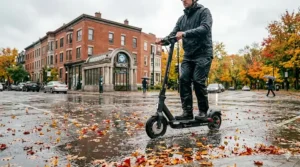
If full IP65 certification is non-negotiable for you, the FOLU J11 Plus is the most compelling option currently available on Amazon.ca. Unlike many scooters that hint at water resistance in their marketing, this model explicitly lists IP65 alongside CE, FCC, UL2722, and UL62133 certifications in its product documentation — a level of third-party validation that’s genuinely rare in this price bracket.
Spec interpretation: The 1,200W motor (with higher-wattage variants available) makes this a strong climber — it handles 15° inclines confidently, which covers most urban grades in Canadian cities. The 48V 21Ah battery offers a claimed range of approximately 60 km (37 miles), and the 11-inch off-road tires provide noticeably better traction on wet surfaces than standard 8.5-inch rubber. Six-point shock absorption means you’ll actually feel the difference on potholed side streets, which any Winnipeg or Ottawa rider will appreciate after a long winter of freeze-thaw damage.
My take: The J11 Plus occupies an interesting niche — it’s priced like a mid-range commuter but performs like a light off-road machine. What most Canadian buyers overlook about this model is the sealed deck design, which prevents water pooling on the standing platform. For riders who park outdoors during the workday and need their scooter to sit in the rain without suffering, that detail matters far more than the marketing language suggests.
Customer feedback: Users on Amazon.ca highlight the sturdy build and powerful brakes. Some note the weight (approximately 27 kg / 59.5 lbs) makes it less portable than lighter commuter-focused models.
✅ Full IP65 certification with multi-standard compliance (CE, UL, FCC)
✅ Powerful 1,200W motor handles Canadian hills well
✅ Off-road tires offer better wet-weather grip
❌ Heavy — not ideal if you need to carry it regularly
❌ Higher power may place it in a regulatory grey zone in provinces with 500W limits
Price range: $500–$650 CAD — exceptional value for a truly IP65 certified machine.
3. iScooter iX3 800W Off-Road Electric Scooter — Best Mid-Range Performance
The iScooter iX3 punches well above its price tag in terms of motor output, and it’s one of the more accessible performance-oriented options on Amazon.ca for Canadian buyers. It won’t match the Segway’s refinement, but for riders who want genuine hill-climbing ability at a mid-range price, it makes a compelling case.
Real-world spec meaning: The 800W motor delivers a top speed of approximately 40 km/h (25 mph) and handles inclines up to 30°, making it genuinely capable on routes that would leave a 350W scooter struggling. The 10-inch air-filled tires absorb road imperfections better than solid rubber alternatives — important for rider comfort on the rougher sections of Canadian bike lanes. The dual disc braking system provides confident stopping on wet surfaces, which is arguably more important than motor power when you’re dealing with slick autumn leaves and rain-slicked pavement.
My take: I’d recommend the iX3 to commuters in cities with significant elevation changes — think Halifax, Victoria, or parts of Edmonton — where motor power genuinely affects your daily experience. The IP rating isn’t officially published as IP65, but the sealed motor housing and deck design provide solid moisture resistance in practice. For a rider who wants more capability than entry-level options without the premium price of the Segway or NIU, this hits a satisfying sweet spot.
Customer feedback: Amazon.ca reviewers appreciate the motor responsiveness and build quality. A few note that the included charger is slow, and investing in a faster third-party charger is worth considering.
✅ Powerful 800W motor for hill climbing
✅ 10-inch pneumatic tires for comfort on rough surfaces
✅ Dual disc braking performs well in wet conditions
❌ IP rating not officially published — moisture resistance is good but unverified against IP65 standard
❌ Range of ~40 km (25 miles) on the shorter side for longer commutes
Price range: $400–$500 CAD — strong value for an 800W machine.
4. Hiboy S2 Pro Electric Scooter — Best for Lightweight City Riding
The Hiboy S2 Pro has been a consistent seller on Amazon.ca for good reason: it offers a genuinely balanced set of features at a price that won’t induce sticker shock. Hiboy also operates a dedicated Canadian store (hiboy.ca), which means warranty support and parts availability are meaningfully better than for grey-market alternatives.
Spec breakdown for Canadian riders: The 500W motor manages 30 km/h (19 mph) top speed and provides adequate power for flat-to-mildly-hilly urban terrain. The 36V 11.6Ah battery delivers approximately 40 km (25 miles) of range — realistic in warm weather; expect 28–32 km in cool autumn conditions. The IP54 rating (not IP65, but solid for rain protection) means it handles rain splashes and light downpours without issue. The 10-inch honeycomb tires are puncture-proof — no flats ever, which is a genuine quality-of-life advantage for daily commuters who can’t afford to be stranded.
My take: The Hiboy S2 Pro is the scooter I’d recommend to someone commuting under 20 km round-trip in a flat Canadian city — think Toronto’s east end, Mississauga, or Laval. At 16 kg (35 lbs), it’s light enough to carry up a couple of flights of stairs to your condo unit, which is a real consideration for the majority of Canadian urban renters. The Hiboy App integration lets you customize acceleration and speed limits, which is useful in provinces with 500W/32 km/h regulatory requirements.
Customer feedback: Canadian reviewers rate it highly for daily commuting, with many noting the app customization as a genuinely useful feature. Some wish the range were longer for longer commute distances.
✅ Lightweight at 16 kg — condo-friendly carry
✅ Puncture-proof honeycomb tires — no flat emergencies
✅ Hiboy Canada store means better warranty support
❌ IP54 (not IP65) — adequate for rain, but avoid heavy downpours
❌ 500W motor struggles on steep inclines
Price range: $450–$550 CAD — solid mid-range value for city commuters.
5. NIU KQi3 Max Electric Scooter — Best for Long-Range Commuting
NIU is one of the few e-scooter brands with a genuine Canadian retail presence — the company has test ride locations in Montreal, Toronto, and Vancouver, which matters enormously when you’re spending $700+ CAD on a scooter and want to feel the ride before committing. The KQi3 Max is their flagship kick scooter, and it earns the premium price with a combination of build quality and range that’s hard to match in this segment.
Unpacking the specs: The 350W motor with 700W peak output isn’t the most powerful number on paper, but the engineering behind it — NIU’s patented dual-action brake caliper and 14 layers of battery protection — demonstrates a different design philosophy: precision over brute force. The 9.5-inch self-healing pneumatic tires automatically seal small punctures, and the 65 km (40 miles) range is one of the longest in this price bracket. The IPX5 rating (not full IP65) means it handles rain and water jets from most angles, though the “5” rather than “6” in the first digit indicates it’s not fully dust-sealed — a minor distinction for most Canadian riding conditions.
My take: The KQi3 Max is the scooter for the Canadian rider who thinks in terms of weekly cost rather than sticker price. The self-healing tires alone eliminate tube replacements, the long range means fewer charging cycles, and the brand’s Canadian service network means you’re not sending your scooter across the country for warranty work. For someone commuting 20–35 km daily in a city like Ottawa or Calgary, this is the value equation that makes sense over 12–24 months of use.
Customer feedback: Users praise the range accuracy and tire durability. Canadian reviewers note the build quality feels meaningfully more premium than similarly priced Chinese-brand alternatives.
✅ Up to 65 km range — longest in this guide at this price
✅ Self-healing tires eliminate puncture worry
✅ NIU Canada retail presence for in-person support
❌ IPX5 (not full IP65) — slightly below the IP65 threshold
❌ 350W base power limited on steep hills
Price range: $700–$800 CAD — available via NIU Canada; check Amazon.ca for availability in your province.
6. Gotrax G4 Pro Electric Scooter — Best Budget Waterproof Option
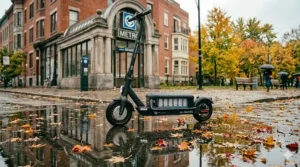
Gotrax is a brand that tends to get underestimated. The G4 Pro won’t win spec sheet comparisons against pricier models, but it delivers a remarkably complete feature set at a price point that makes e-scooters accessible to a much wider group of Canadians — students, part-time workers, and first-time buyers especially.
What the specs mean in daily life: The 350W motor provides reliable performance on flat terrain up to about 25 km/h (15.5 mph). The 10-inch pneumatic tires (rather than solid rubber) are a genuine step up from basic budget scooters, providing noticeably better shock absorption. The IP54 water resistance handles typical urban rain without concern. An integrated cable lock is a practical feature that saves you from carrying a separate lock — small detail, but genuinely useful if you’re locking up outside a coffee shop or at work.
My take: The G4 Pro is what I’d recommend to a university student in Edmonton or a part-time worker in Hamilton who wants reliable, rain-capable transportation without a significant financial commitment. It’s not a machine for long commutes or hilly terrain, but for flat urban riding in the 10–20 km range, it does the job admirably. At this price point on Amazon.ca, it also tends to qualify for Prime shipping, which means you can often have it on your doorstep in 1–2 days.
Customer feedback: Budget-conscious Canadian buyers consistently rate the value-for-money highly. A few note that the build quality feels slightly less robust than pricier alternatives, which is expected at this price point.
✅ Most affordable option with IP54 rating
✅ 10-inch pneumatic tires — better than most budget competitors
✅ Built-in cable lock included
❌ Limited range (~40 km claimed; 28–32 km realistic)
❌ 350W motor not suitable for hilly commutes
Price range: $350–$450 CAD — best entry point for budget-conscious Canadian buyers.
7. Gyrocopters J30 Electric Scooter — Best First-Time Buyer Option
The Gyrocopters J30 is made by a Canadian brand — Gyrocopters is headquartered in Canada and designs its products with Canadian riders specifically in mind. That domestic connection shows in practical ways: the included charger uses North American plugs without adapters, the manual is written in clear English (and French packaging is available for Quebec compliance), and warranty service is handled domestically.
Realistic expectations: The 350W motor maxes out at 31 km/h (19 mph) and provides 30 km (18.6 miles) of comfortable range on flat terrain. The IPX4 rating is the lowest on this list — it handles light rain and splashes adequately, but I wouldn’t recommend riding it through a heavy downpour. That said, for someone just beginning their e-scooter journey, the forgiving ride quality, simple app connectivity (anti-theft lock, customizable speed), and burst-proof 8.5-inch tires make it an excellent starting point.
My take: The J30 is the right choice for a Canadian who wants to test the e-scooter lifestyle before committing to a $700+ machine. Ride it for a season, figure out your real commuting patterns, and you’ll have a much clearer picture of which premium features actually matter for your life. The Canadian brand origin also means you’re more likely to find compatible spare parts and accessories without waiting weeks for international shipping.
Customer feedback: Canadian buyers appreciate the domestic brand origin and straightforward app. Some note they’d appreciate a higher IP rating for year-round use in rainier climates like Vancouver or Halifax.
✅ Canadian brand — domestic warranty and support
✅ Burst-proof tires eliminate flat concerns
✅ French-language packaging available (Quebec compliance)
❌ IPX4 only — not suitable for heavy rain
❌ 30 km range is limiting for longer commutes
Price range: $280–$380 CAD — lowest price point in this guide, available on Amazon.ca with Prime shipping.
How to Ride a Waterproof Scooter in Canadian Weather: A Practical Guide
Owning an IP65-rated scooter doesn’t mean treating it carelessly. Even the best moisture sealing needs some rider awareness to perform at its best over time — especially in the particularly demanding conditions that Canadian seasons throw at you.
First 30 days: After your scooter arrives, spend the first week riding in dry conditions to learn how it handles before adding wet-weather variables. Charge the battery fully before first use, and let the motor warm up for the first 5 minutes of each cold-day ride. Canadian winters are hard on lubricants — a light application of silicone spray on the folding mechanism and stem joint every two months prevents the squeak-and-bind syndrome that affects nearly every folding scooter after a winter of salt exposure.
Wet-weather riding tips: Even on an IP65-rated scooter, avoid riding through standing water deeper than about 5 cm (2 inches) — the IP65 standard covers water jets, not submersion. When stopping at lights in the rain, apply brakes slightly earlier than you would in dry conditions; disc brakes lose about 20% of their bite when wet. Clean your scooter after every wet ride with a dry cloth, paying special attention to the charging port cover and folding joint. A small piece of electrical tape over the charging port is extra insurance during multi-day rainy periods.
Cold-weather storage: When temperatures drop below -10°C, store your battery indoors if possible. Lithium batteries discharge faster in the cold and can be permanently damaged by charging at temperatures below -5°C. Many Canadian apartment dwellers bring the battery pack (or the whole scooter) inside during winter months. If you’re parking your scooter outdoors overnight in a Canadian winter, expect the first ride of the morning to feel sluggish for the first 5–10 minutes while the battery warms up.
Spring maintenance: After winter, before your first serious spring ride, inspect all cable connections for salt corrosion, check tyre pressure (cold weather deflates pneumatic tyres noticeably), and re-tighten all stem bolts. Canadian road salt is chemically aggressive — rinse the undercarriage with fresh water after any ride through treated roads.
Real Canadian Rider Profiles: Matching the Right Scooter to Your Life
Profile 1: Maya, Toronto Condo Commuter (12 km Daily) Maya lives in a 12th-floor condo in Liberty Village and commutes to an office near King Street West. She needs a scooter she can carry up one flight of stairs when the elevator is busy, and her commute involves both bike lanes and light traffic. Toronto still has patchwork regulations on scooters, so a 500W / 32 km/h-compliant model is important. Best match: Hiboy S2 Pro. At 16 kg, she can carry it without strain. The 40 km range covers her commute with comfortable buffer, the Hiboy Canada warranty means local support, and IP54 handles Toronto’s spring rain adequately.
Profile 2: Raj, Calgary Suburban Commuter (18 km Daily) Raj commutes from a house in suburban Airdrie to a transit hub and needs solid range, hill-climbing ability (his route includes a 12° grade near a river valley), and a scooter he can leave locked outdoors for 8 hours during the workday. Best match: FOLU J11 Plus. The full IP65 certification means sitting in daytime rain won’t damage it. The 1,200W motor handles his hill with ease. The heavier weight is fine since he doesn’t need to carry it indoors.
Profile 3: Sophie, Vancouver Weekend Rider + Occasional Commuter Sophie wants a premium, refined scooter for Vancouver’s year-round riding climate — light rain nearly every week, some hills in the West End, and the occasional longer weekend ride to Granville Island. Budget isn’t her primary concern; she wants something she’ll still be happy with in three years. Best match: Segway Ninebot MAX G2. The IPX7 battery, self-sealing tyres, hydraulic suspension, and traction control are all features that pay dividends on Vancouver’s wet streets. The Apple Find My integration is a nice bonus in a city where scooter theft is an occasional concern.
How to Choose a Waterproof Electric Scooter in Canada: 7 Key Criteria
1. Verify the IP rating independently. Don’t trust “waterproof” language in product titles — look for the actual IP code (IP54, IP65, IPX7, etc.) in the specifications section. The first digit (0–6) indicates dust protection; the second (0–9) indicates water protection. For Canadian riding, IP54 is the practical minimum for light rain; IP65 is the gold standard for genuine all-weather use.
2. Check provincial motor limits before buying. Most Canadian provinces cap electric scooters at 500W and 32 km/h for legal road/bike-lane use. The FOLU J11 Plus at 1,200W and the iScooter iX3 at 800W exceed this in some provincial contexts. Higher-powered scooters may technically classify as mopeds in provinces like Quebec, requiring registration, insurance, and a Class 6D licence.
3. Prioritise battery cold-weather specs. Lithium cells lose efficiency rapidly below 5°C — budget 15–20% range reduction in autumn, and up to 30% in a cold Canadian winter. Batteries with IP65 or higher ratings also resist the condensation damage that kills many lower-rated battery packs during temperature swings.
4. Consider tyre type. Pneumatic (air-filled) tires provide better shock absorption and wet-weather traction than solid rubber. Self-sealing or honeycomb alternatives eliminate flat risk. For Canadian spring conditions — frost heaves, gravel, exposed rebar — tyre quality matters more than the spec sheets typically acknowledge.
5. Think about post-purchase support in Canada. Warranty claims on scooters shipped from overseas can mean weeks without your ride. Brands with Canadian retail presence (Segway at Best Buy Canada, NIU’s Canadian stores, Hiboy’s hiboy.ca, Gyrocopters’ domestic operation) offer meaningfully faster resolution.
6. Assess weight vs. your lifestyle. If you live in a condo above the ground floor and need to carry your scooter to your unit, anything over 18 kg becomes a daily annoyance. If you park it outdoors or in a ground-floor storage room, weight matters much less.
7. Calculate total cost of ownership in CAD. A $350 scooter that needs a tyre replacement (around $40–$80 CAD), a new charger ($30–$60 CAD), and a brake adjustment ($50–$100 at a local shop) in its first year costs you more than a $550 model that comes with self-sealing tyres and a reliable build. Run the numbers over 24 months, not just at checkout.
Common Mistakes When Buying a Waterproof Scooter in Canada
Mistake 1: Confusing IPX4 with IP65. This is the single most common misunderstanding in this product category. IPX4 means “splash resistant from any direction” — adequate for light drizzle, not for riding through Vancouver rain or crossing a flooded bike lane. IP65 means “protected against water jets” — a meaningfully higher standard. Brands sometimes market IPX4 scooters using terms like “water-resistant” or “weatherproof” without specifying the exact rating. Always check the spec sheet.
Mistake 2: Ignoring provincial regulations. Buying an 800W or 1,200W scooter without checking your province’s rules can mean riding an unregistered vehicle — or, in Quebec, one that legally requires insurance and a licence. This isn’t a theoretical concern; provincial enforcement of e-scooter regulations is increasing across Canada as adoption grows.
Mistake 3: Skipping the weight check for condo living. More than half of Canadian urban residents live in multi-storey buildings. A 27 kg scooter is perfectly manageable if you park it in your building’s bike room — but an exhausting daily carry if that room is unavailable or unsafe for valuables.
Mistake 4: Buying based on claimed range. Manufacturers test range at 25°C (77°F), 70 kg rider weight, flat terrain, Eco mode. Your actual range — Canadian autumn temperatures, heavier rider weight, mixed terrain, normal riding speed — will typically be 60–75% of the claimed figure. Use 65% of any claimed range number as your realistic planning assumption.
Mistake 5: Overlooking Canadian warranty coverage. Amazon.ca’s buyer protection is robust, but manufacturer warranties often require shipping the product to a US service centre. Before buying, check whether the brand has Canadian service infrastructure or will handle cross-border warranty claims at their expense.
Waterproof Electric Scooter vs. Standard Scooter: Is IP65 Worth Paying For?
| Factor | Standard Scooter (IPX4 or no rating) | IP65 Waterproof Scooter |
|---|---|---|
| Light rain (drizzle) | Usually fine | ✅ Fully protected |
| Heavy rain (commuting) | Risk of damage | ✅ Fully protected |
| Puddles / spray | Sometimes problematic | ✅ Handles confidently |
| Winter road salt | High corrosion risk | Lower risk (sealed components) |
| Battery longevity | Moisture exposure degrades cells | Extended lifespan |
| Price premium | Baseline | ~$80–$200 CAD more |
| Peace of mind | Rider anxiety in rain | Ride without hesitation |
📊 Analysis: For Canadian riders who experience more than 100 mm of precipitation per month during riding season (which includes Toronto, Vancouver, Halifax, and most BC cities), the IP65 premium pays for itself in avoided repairs and extended component life within 12–18 months of regular use. If you’re riding only in summer in arid regions like interior BC or the Prairies, IPX4 may be adequate — but given the unpredictability of Canadian weather, I’d still recommend IP54 as a practical floor, and IP65 as the target for any serious daily commuter.
Canadian Regulations & Safety Standards for Electric Scooters
Before spending CAD on any scooter, it’s worth understanding the regulatory landscape — because “legal to buy” and “legal to ride” are very different things in Canada.
At the federal level, Transport Canada classifies power-assisted bicycles (PABs) with specific limits: motor power must not exceed 500W, and maximum speed is capped at 32 km/h. Electric kick scooters are treated similarly in most provincial frameworks.
Province-by-province highlights:
- Ontario: E-scooters are permitted under a pilot program extended to 2029. Riders must be 16+, helmets required for under-18s, roads with speed limits ≤50 km/h only, sidewalks prohibited. Toronto specifically still restricts public e-scooter use on many roads — always check your municipality’s bylaws.
- British Columbia: No driver’s licence required for standard e-scooters (≤500W, ≤24 km/h). Riders 16+, helmets mandatory, bike lanes preferred. Lights required for night riding.
- Quebec: An e-scooter without pedals is generally classified as a cyclomoteur (moped), requiring registration, liability insurance, and a Class 6D licence. The SAAQ is the authoritative source for current Quebec regulations.
- Alberta: Personal e-scooters remain in a regulatory grey zone — Calgary and Edmonton allow them on bike lanes and pathways with no licence required, but provincial traffic law hasn’t fully formalised the category.
- Saskatchewan: Municipalities decide independently whether to allow e-scooters. Check with your local city hall before riding.
For safety certification, look for UL2272 (the primary North American electrical safety standard for personal e-mobility devices), as well as CE for electrical safety. CSA certification is the Canadian domestic equivalent and is worth prioritising when available.
✨ Find Your Perfect Rain-Ready Ride Today!
🔍 Each of the waterproof electric scooters listed above is carefully selected for performance in real Canadian conditions. Click any highlighted product name to check current pricing and availability on Amazon.ca. Don’t let rain keep you off your scooter — gear up and ride smarter!
Long-Term Cost & Maintenance of a Waterproof Scooter in Canada
A $700 CAD scooter isn’t just a $700 CAD decision — it’s the beginning of an ongoing cost relationship. Here’s how the math typically works out over two years of regular Canadian commuting:
Year one costs (estimate, in CAD):
- Purchase price: $500–$850 (depending on model)
- Replacement inner tubes or tire sealant: $30–$60
- Brake pad replacement (disc brakes): $25–$50
- Charger cable replacement (if original fails): $30–$60
- Scooter lock (essential in any Canadian city): $50–$100
- Total Year 1: ~$635–$1,120 CAD
Year two costs (lower maintenance on higher-IP models):
- Tire maintenance: $20–$40
- Minor component servicing: $40–$80
- Battery health maintenance (keeping charge between 20–80%): $0 if practised
- Total Year 2: ~$60–$120 CAD
Compare to alternatives:
- Monthly transit pass in Toronto: ~$156 CAD/month = ~$1,872/year
- Monthly Uber spend for 12 km commutes: ~$250–$400/month
- Car insurance alone in Ontario: $1,500–$2,500/year
The ROI calculation for a $700 scooter that replaces even 60% of transit spending is compelling. The higher IP rating pays additional dividends in avoided repair costs — water damage to controllers, batteries, and wiring is the single most common cause of premature scooter death, and it’s not covered under most manufacturer warranties.

FAQ
❓ What does IP65 mean on a waterproof electric scooter?
❓ Are IP65 electric scooters legal to ride in Canada?
❓ Can I ride a waterproof electric scooter in Canadian winter?
❓ Which is better for Canadian rain: IP54 or IP65?
❓ Do waterproof electric scooters available on Amazon.ca ship to all provinces?
Conclusion
Finding the right waterproof electric scooter IP65 for Canadian conditions isn’t just about chasing the highest IP number — it’s about matching real waterproofing to your actual riding environment, your province’s regulatory requirements, and the genuine total cost of owning a machine that will carry you through Canadian weather for years.
The Segway Ninebot MAX G2 remains the most refined all-round choice for urban commuters who want a genuinely intelligent, all-weather ride. The FOLU J11 Plus wins on IP65 certification value. For budget-conscious riders, the Hiboy S2 Pro and Gotrax G4 Pro deliver solid IP54 rain resistance without breaking the bank in CAD.
Whatever you choose, prioritise IP rating verification, confirm your province’s motor limits, invest in a quality lock, and remember to bring your battery inside when the Canadian winter really bites. A little maintenance discipline turns a $600 scooter into a three-year commuting companion.
The rain is coming. The question is whether you’re equipped to ignore it.
✨ Ready to Ride in Any Weather? Check Out the Best Deals Today!
🔍 Browse all the waterproof electric scooters listed in this guide on Amazon.ca. Click any highlighted product to see current pricing, availability, and Prime shipping options. Your next all-weather ride is just a click away — happy rolling, Canada! 🇨🇦⚡
Recommended for You
- How to Winterize Electric Scooter: 7 Essential Products for Canadian Winters (2026)
- 7 Best Electric Scooter That Works in Snow — Canada’s Ultimate Winter Guide 2026
- 7 Best Winter Electric Scooters for -30 Degrees Celsius (2026 Canada)
Disclaimer: This article contains affiliate links. As an Amazon Associate, I earn from qualifying purchases. If you purchase products through these links, we may earn a small commission at no additional cost to you.
✨ Found this helpful? Share it with your friends! 💬🤗
