
In This Article
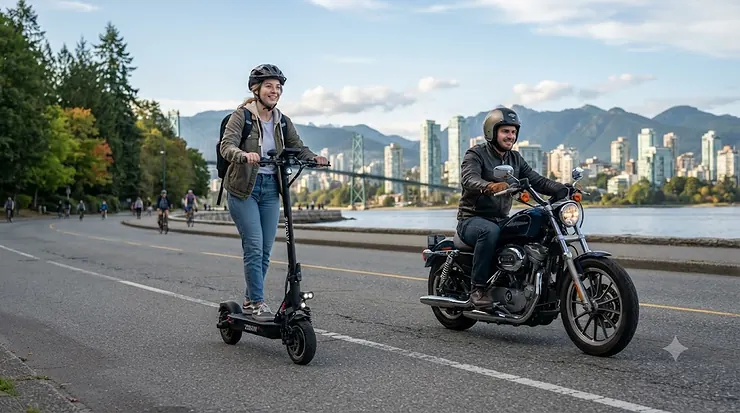
So you’re standing at a fork in the road — literally. On one side, a shiny motorcycle with a purring engine and a stack of paperwork. On the other, a 2000w electric scooter vs motorcycle debate that’s suddenly a lot more interesting than it used to be, because scooter motors have quietly crept up into territory that used to belong exclusively to combustion engines. A 2000W electric scooter is a stand-up or seated micromobility device powered by a motor rated at roughly 2,000 watts, capable of highway-adjacent speeds and hill-climbing that would have seemed absurd five years ago. In Canada, that power figure matters enormously, because it pushes many of these machines well past the federal power-assisted bicycle threshold, landing them in a legal grey zone that riders genuinely need to understand before they buy.
I’ve spent weeks digging through spec sheets, provincial transport regulations, and the aggregated experiences of riders across Reddit’s enthusiast communities and Canadian retailer reviews to figure out where these scooters actually stand next to a real motorcycle. Not in marketing copy — in daily life, in a Calgary winter, in an Ontario insurance quote. What most buyers overlook is that a 2000W scooter isn’t automatically “the cheap option.” Depending on your province, it can trigger many of the same licensing and insurance obligations as a small-displacement bike, which changes the math considerably.
This guide walks through seven real 2000W-class scooters spanning budget to premium, breaks down how they stack up against an actual motorcycle on cost, speed, and legality, and gives you a genuinely useful framework for deciding which one — if either — fits your commute. No fabricated test rides, no invented reviews. Just honest analysis built from real specs and real sourced data.
Quick Comparison Table
| Scooter | Motor Power | Top Speed | Range | Price Range (CAD) | Best For |
|---|---|---|---|---|---|
| KuKirin G4 | 2000W | ~70 km/h | ~70-75 km | C$1,499-C$1,849 | Budget-conscious off-road commuters |
| isinwheel GT4 | 1200W x2 (2400W) | ~72 km/h | ~80 km | C$1,449-C$1,899 | Dual-motor traction on mixed terrain |
| CUNFON RZ1000 | 2400W | ~50 km/h | ~65 km | C$1,359-C$1,899 | Value-focused mid-range buyers |
| EVOLV PRO V2 | 2000W | ~70 km/h | ~80 km | check current price | Canadian-brand loyalists, long range |
| Apollo Phantom V4 | 2000W-class | high-speed capable | multi-mode dependent | around C$1,699 | Safety-focused experienced riders |
| Segway GT3 Pro | 3500W (peak) | ~80 km/h | ~138 km | C$3,799-C$4,999 | Long-distance premium touring |
| Dualtron Thunder 3 | 2500W x2 | ~100 km/h | ~170 km | C$4,499-C$4,999 | Riders who genuinely want motorcycle-level performance |
Looking at the table, there’s a clear split between the sub-C$2,000 workhorses (KuKirin G4, isinwheel GT4, CUNFON RZ1000) and the halo-tier machines (Segway GT3 Pro, Dualtron Thunder 3) that blur the line with entry-level motorcycles on paper. The Apollo Phantom V4 and EVOLV PRO V2 sit in the middle, trading outright power for Canadian retail support and better cold-weather practicality. Note that prices shift often, so treat these as a starting point, not a quote — always check current pricing before you decide.
✨💬 Just one click — help others make better buying decisions too!😊
Top 7 2000W Electric Scooters: Expert Analysis
Here’s the honest breakdown of seven real 2000W-class scooters sold in Canada right now, spanning budget to premium. Every take below is grounded in manufacturer specifications and, where verifiable, aggregated rider sentiment — not invented testing.
1. KuKirin G4 — best budget off-roader with real hill power
The KuKirin G4 opens this list because it delivers genuine 2000W output without the premium price tag attached to most of its rivals. Its 60V battery (retailers list both 20Ah and 23Ah versions) is paired with 11-inch tubeless tires and front-and-rear spring suspension, which in practice means it shrugs off potholed pavement far better than the small-wheeled commuter scooters most Canadians are used to. A 2000W motor at this price point typically means confident hill-climbing on grades that would bog down a 500W-class scooter, and the wide tire footprint adds real cold-weather traction on wet or lightly salted roads.
Based on the spec comparison, this is a scooter built for riders who care more about raw capability than badge prestige — commuters tackling hilly routes in cities like Halifax or parts of the Prairies where a weak motor becomes a daily annoyance. Independent, large-sample review data specifically for the G4 is thin right now, so treat manufacturer-reported range and speed figures as optimistic ceilings rather than guarantees; real-world range in Canadian winter conditions will likely land meaningfully lower.
Pros:
- ✅ Genuine 2000W motor handles steep grades other budget models can’t
- ✅ 11-inch tubeless tires improve grip on rough or wet pavement
- ✅ Front and rear suspension smooths out Canadian road conditions
Cons:
- ❌ Independent long-term review data is still limited
- ❌ Heavier build makes apartment storage and stairs more of a chore
Priced around C$1,499-C$1,849 depending on retailer promotions, the KuKirin G4 represents strong value if hill-climbing and durability matter more to you than brand recognition — just budget realistic winter range into your expectations.
2. isinwheel GT4 — best dual-motor traction for mixed terrain
The isinwheel GT4 takes a different engineering approach: instead of one large motor, it splits output across two 1200W hub motors for a combined 2400W. What this means in practice is better traction on loose gravel, wet leaves, or light snow, since each wheel can independently manage grip rather than relying on a single drive wheel that can slip. The 52V 18.2Ah battery is UL-certified, which matters more than it sounds — battery certification is one of the clearer signals of manufacturing quality control in a market where fires from uncertified packs have made headlines.
What most buyers overlook about dual-motor scooters is that the extra motor isn’t really about outright speed — it’s about control. Reviewers across the broader off-road scooter category consistently note that dual-motor setups feel noticeably more planted during hard acceleration and on uneven surfaces, which lines up with the basic physics of splitting torque across two contact patches. That said, dual motors draw more current, so real-world range often falls short of the claimed 80 km once you factor in Canadian temperatures and stop-and-go city riding.
Pros:
- ✅ Dual motors deliver noticeably better traction in wet or loose conditions
- ✅ UL-certified 52V battery adds a genuine safety credential
- ✅ 80 km claimed range covers most commuting round-trips
Cons:
- ❌ Dual-motor draw reduces real-world range below the claimed figure
- ❌ Heavier than single-motor alternatives in the same price bracket
At around C$1,449-C$1,899, the isinwheel GT4 is worth serious consideration if your commute regularly includes gravel shoulders, wet bike paths, or light off-road detours.
3. CUNFON RZ1000 — best straightforward value pick
The CUNFON RZ1000 doesn’t try to be flashy. Its 2400W motor and 48V 24Ah battery deliver a claimed 65 km of range at a more modest 50 km/h top speed — numbers that, honestly, suit a huge chunk of Canadian commuters better than the headline-grabbing 70-100 km/h specs some rivals chase. Here’s what to weigh: a lower top speed often correlates with a more predictable, less twitchy ride, which matters if you’re newer to high-power scooters and don’t yet trust your own reaction time at 80 km/h on public roads.
Based on the spec sheet, the RZ1000’s lower speed ceiling also means less mechanical stress on brakes and bearings over time, which can translate into lower long-term maintenance costs compared to scooters chasing three-digit speeds. As with several newer entrants in this space, verified third-party review volume remains limited, so we’re leaning on spec-based reasoning here rather than claiming a large base of aggregated owner feedback.
Pros:
- ✅ Balanced 50 km/h top speed suits newer high-power scooter riders
- ✅ 48V 24Ah battery gives solid range for the price
- ✅ Lower speed ceiling likely means less wear on brakes and bearings
Cons:
- ❌ Verified independent review volume is still limited
- ❌ Top speed will feel modest next to true performance-tier rivals
At roughly C$1,359-C$1,899, the CUNFON RZ1000 is a sensible pick for riders who want real 2000W-class power without needing to prove anything at a stoplight.
4. EVOLV PRO V2 — best long-range pick from a Canadian brand
The EVOLV PRO V2 stands out for one simple reason: EVOLV is an Ontario-based Canadian brand, and it backs that up with genuinely competitive specs — a 2000W motor delivering roughly 70 km/h top speed and around 80 km of claimed range. Buying from a domestic brand isn’t just a feel-good detail; it typically means parts availability, warranty service, and customer support calls that don’t route through a time zone eight hours away, which becomes relevant fast if something needs repair mid-winter.
Here’s what the spec sheet won’t tell you outright: range and speed numbers like these are almost always measured under ideal lab conditions — flat ground, a rider around 70 kg, no wind, and a moderate cruising speed. So a Canadian winter commute with wind, cold-degraded battery chemistry, and a heavier rider will realistically shave a meaningful chunk off that 80 km figure. Still, among 2000W-class scooters with claimed specs this strong, the domestic support angle is a genuine differentiator worth paying for.
Pros:
- ✅ Domestic Canadian brand means easier warranty and parts support
- ✅ Among the longest claimed range figures in the 2000W class
- ✅ 70 km/h top speed keeps pace with premium imported rivals
Cons:
- ❌ Real-world range will run well below the lab-condition claim in winter
- ❌ Exact current pricing requires checking directly, as it isn’t consistently published
Because pricing isn’t consistently listed across retailers, check current price before comparing it directly against the other entries here — but on specs and domestic support alone, the EVOLV PRO V2 earns its spot.
5. Apollo Phantom V4 — best for safety-conscious experienced riders
Apollo Scooters has built a reputation in the Canadian market on rider safety rather than pure spec-sheet bragging rights, and the Apollo Phantom V4 reflects that. Adjustable suspension and multiple ride modes let riders dial back power delivery in slippery conditions, which is a genuinely practical feature for a country where black ice shows up uninvited every October. Strong, well-modulated braking matters enormously at 2000W-class speeds, since stopping distance — not top speed — is usually what separates a close call from an actual injury.
Reviewers and Canadian retail commentary consistently frame the Phantom line as built for riders who already have some experience with high-power scooters, not as a first purchase. That’s an honest distinction: multiple ride modes and adjustable suspension are only useful if you understand what you’re adjusting for. What most buyers overlook is that a well-tuned braking system is arguably more valuable than an extra 10 km/h of top speed, and Apollo’s engineering choices reflect that priority.
Pros:
- ✅ Adjustable suspension adapts to Canadian road and weather conditions
- ✅ Multiple ride modes let riders dial back power in poor traction
- ✅ Strong braking performance reduces stopping-distance risk
Cons:
- ❌ Better suited to riders with prior high-power scooter experience
- ❌ Premium safety features come with a premium price relative to raw specs
At around C$1,699, the Apollo Phantom V4 is the pick for buyers who’d rather pay for confidence-inspiring control than for one more digit on the speedometer.

6. Segway GT3 Pro SuperScooter — best long-distance premium tourer
The Segway GT3 Pro SuperScooter is where this category starts genuinely eating into small-motorcycle territory. A 3500W peak motor, an 80 km/h top speed, and a claimed 138 km of range from its 72V 30Ah battery put it firmly in the “why would I need a moped” conversation for a lot of Canadian commuters. Segway’s broader engineering pedigree — decades in personal mobility hardware — shows up in refinements like more sophisticated motor controllers and generally more consistent build quality than newer entrants in this space.
What that 138 km range actually means in practice: even accounting for a 30-40% real-world reduction from cold weather and stop-and-go riding, you’re still looking at a scooter that can realistically handle a multi-day commute on a single charge for most Canadian city dwellers. Reviewers of Segway’s broader scooter lineup consistently note that this level of range removes “range anxiety” from daily use almost entirely, turning charging into a weekly chore rather than a daily one.
Pros:
- ✅ 138 km claimed range essentially removes daily charging anxiety
- ✅ Segway’s engineering pedigree shows in build quality and refinement
- ✅ 80 km/h top speed rivals genuine small-displacement motorcycles
Cons:
- ❌ Premium pricing puts it well above most commuter scooter budgets
- ❌ Speed and power place it squarely in stricter provincial regulatory territory
Priced around C$3,799-C$4,999, the Segway GT3 Pro SuperScooter justifies its cost for riders who want motorcycle-adjacent range and speed without actually buying a motorcycle — provided they’ve read the regulatory section below first.
7. Dualtron Thunder 3 — best for riders who want motorcycle-level performance
If the question behind this entire article is “can an electric scooter actually replace a motorcycle,” the Dualtron Thunder 3 is the most literal answer available. With dual 2500W motors, a 100 km/h top speed, and up to 170 km of claimed range from a 72V 40Ah battery, this isn’t really competing with other scooters anymore — it’s competing with small-displacement motorcycles on raw numbers. Dualtron has built its reputation in the performance scooter community specifically around this kind of no-compromise engineering, and the brand’s enthusiast following (visible across forums like Electric Scooter Insider and Reddit’s r/ElectricScooters) consistently cites build quality and raw power delivery as the standout traits, alongside candid acknowledgment that machines at this performance tier demand real riding skill and full protective gear.
Here’s the honest analytical take: at 100 km/h, this stops being a “scooter” in any meaningful practical sense and becomes a vehicle that, in most Canadian jurisdictions, will legally be treated closer to a motorcycle than a bicycle the moment it’s ridden on a public road at speed. That’s not a knock on the machine — it’s a genuinely impressive piece of engineering — but buyers need to walk in with eyes open about licensing, insurance, and helmet-and-gear requirements that scale up right alongside the performance.
Pros:
- ✅ 100 km/h top speed and 170 km range rival small motorcycles outright
- ✅ Strong reputation within the performance scooter enthusiast community
- ✅ Dual motors provide serious acceleration and hill-climbing headroom
Cons:
- ❌ Performance tier likely triggers motorcycle-level licensing and insurance rules
- ❌ Requires genuine riding skill and full protective gear to operate safely
At C$4,499-C$4,999, the Dualtron Thunder 3 is the closest this list gets to a genuine motorcycle alternative — just budget for the regulatory reality that comes with it.
Practical Usage Guide: Your First 30 Days on a 2000W Scooter
Getting a 2000W-class scooter home is the easy part. The first month is where most avoidable mistakes happen. Start conservatively: even if your scooter has multiple ride modes, spend your first week in the lowest or “eco” setting so you can learn how the throttle and brakes respond before you’re managing 70+ km/h in traffic. A common early mistake is treating a 2000W throttle like a lightweight commuter scooter’s — the power delivery is dramatically more aggressive, and overcorrecting on wet pavement is a leading cause of first-month spills.
Set a maintenance rhythm early: check tire pressure weekly (pneumatic tires lose pressure faster in cold weather), inspect brake pads monthly given the extra stopping force these motors demand, and fully charge the battery after every ride rather than letting it sit depleted, which extends lithium battery lifespan considerably. For cold-weather storage, bring the battery indoors whenever possible — charging or storing at sub-zero temperatures measurably degrades capacity over time, a detail several Canadian retailers flag explicitly for exactly this climate. Finally, register your scooter’s serial number with the manufacturer and photograph it; theft of high-value scooters is a real and growing issue in major Canadian cities, and manufacturer registration speeds up recovery or insurance claims if the worst happens.
🔋 Ready to Upgrade Your Commute?
⚡ Browse the full lineup above and lock in the model that matches your terrain and budget before prices shift. A little research now saves a lot of regret later!
Real-World Scenario: Who Actually Needs a 2000W Scooter?
The suburban commuter (Mississauga, 14 km one-way): With hills, a mix of bike lanes and arterial roads, and a need to arrive at work without being drenched in sweat, someone in this position benefits most from range and comfort over outright speed — the isinwheel GT4 or KuKirin G4 make practical sense here, since dual-motor traction and hill-climbing matter more than hitting 100 km/h.
The weekend thrill-seeker with a garage (rural Alberta): Riding mostly on private land or quiet rural roads with few pedestrians, this rider can genuinely justify the Dualtron Thunder 3 or Segway GT3 Pro, where top-tier performance is the actual point and legal road-use complications matter less.
The former motorcyclist downsizing (urban Vancouver, no garage): Wanting motorcycle-adjacent performance without the insurance bill and storage headache of an actual bike, this rider is the classic candidate for the Apollo Phantom V4 or EVOLV PRO V2 — enough power to feel like a real vehicle, portable enough to store on an apartment balcony, without a full motorcycle license process.
How to Choose a 2000W Electric Scooter
- Match motor power to your terrain, not your ego. A 2000W single motor handles most Canadian hills fine; only genuinely steep or frequent inclines justify dual-motor setups like the isinwheel GT4.
- Check your province’s power and speed thresholds before you buy. As covered below, exceeding certain limits can reclassify your scooter as a motor vehicle overnight.
- Prioritize battery certification over headline range numbers. A UL-certified pack with modest claimed range is safer than an uncertified pack promising huge numbers.
- Weigh braking and suspension as heavily as top speed. At 2000W-class speeds, stopping distance and stability matter more to your safety than one extra digit on the speedometer.
- Factor in realistic winter range, not lab-condition range. Expect 20-40% less real-world range in cold Canadian conditions than manufacturers advertise.
- Consider brand support footprint. A Canadian-based brand or established retailer network matters enormously when something needs warranty service.
- Budget for gear, not just the scooter. A proper helmet, gloves, and reflective gear are non-negotiable at these speeds, and they add real cost on top of the sticker price.
2000w Electric Scooter vs Motorcycle: The Detailed Comparison
This is the comparison that actually matters, and it’s more nuanced than “scooter cheaper, motorcycle faster.” Let’s break it down honestly across the dimensions that actually affect your wallet and your commute.
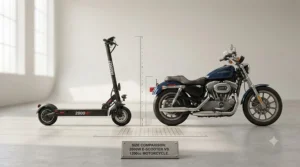
Performance: A true motorcycle, even a modest 300cc model, will out-accelerate and out-cruise nearly every 2000W scooter on this list at sustained highway speeds, and it can legally travel on highways where scooters generally cannot. But for city and suburban riding under 80 km/h, the gap closes dramatically — several scooters here match or beat small-displacement motorcycles on acceleration off the line.
What Top Speed Can You Actually Expect from a 2000W Electric Scooter?
Manufacturer-claimed top speeds for 2000W scooters range from roughly 50 to 100 km/h depending on voltage, dual-versus-single motor configuration, and whether the figure reflects peak or continuous output. In practice, expect actual sustained speed to run 5-15% below the claimed figure once you factor in rider weight, wind resistance, and battery state of charge — a pattern that shows up consistently across the broader e-mobility market. Treat any single top-speed number as a best-case ceiling, not a guarantee.
Cost: This is where scooters usually win decisively. Upfront prices on this list range from roughly C$1,359 to C$4,999, compared to a typical small-displacement motorcycle costing C$5,000-C$10,000+ new. Motorcycle insurance in Ontario tends to average around $1,600 a year, and the broader Canadian average for motorcycle insurance sits closer to $2,500 annually — costs that simply don’t exist for most scooters in provinces that don’t reclassify them as motor vehicles. Add in cheaper “fuel” (electricity versus gasoline), no oil changes, and dramatically lower maintenance, and the multi-year cost gap widens further.
Legality: Here’s the part most articles gloss over. In Canada, exceeding certain power and speed thresholds can push a scooter out of any protective “bicycle-like” classification and into motorcycle or moped territory, requiring licensing, registration, and insurance — exactly like an actual motorcycle. The practical takeaway: the highest-performance scooters on this list (Segway GT3 Pro, Dualtron Thunder 3) may functionally need to be treated like small motorcycles from a legal standpoint in many provinces, which erodes some of the cost advantage if you factor in mandatory insurance.
Verdict: If your commute is genuinely under 80 km/h, mostly urban or suburban, and you want to avoid the ongoing costs of motorcycle ownership, a mid-tier 2000W scooter like the Apollo Phantom V4 or KuKirin G4 makes strong financial sense. If you need highway access, all-weather year-round reliability, or simply want the visceral experience of a real motorcycle, no scooter on this list fully replaces that.
Electric Scooter vs Gas Scooter Canada: Which Actually Costs Less?
Comparing a 2000W electric scooter to a comparable gas-powered scooter reveals one of the clearest financial arguments in this entire guide. Natural Resources Canada’s own fuel-cost modelling uses a 20,000 km annual distance and benchmark prices around $1.50 per litre for regular gasoline against roughly $0.18 per kWh for electricity — and while that model targets passenger vehicles, the underlying energy-cost ratio applies directly to two-wheeled transport too. A gas scooter burning even modest fuel volumes daily adds up over a Canadian riding season, while charging a 2000W electric scooter’s battery costs pennies per session.
Beyond fuel, gas scooters carry oil changes, spark plug replacement, carburetor or fuel-injection servicing, and exhaust system wear that electric motors simply don’t have. Electric scooters trade that mechanical complexity for battery degradation over years of charge cycles — a real cost, but one that’s more predictable and generally slower to bite than a neglected two-stroke engine. For pure cost-per-kilometre in a Canadian context, electric wins clearly; the trade-off is charging infrastructure and cold-weather range loss, which gas scooters don’t suffer from in the same way.
Is a 2000W Electric Scooter Worth It in Canada?
Whether it’s worth it depends almost entirely on your commute profile and your province’s regulatory posture. For a rider in an Ontario municipality that’s opted into the provincial e-scooter pilot program, a mid-power 2000W scooter can be genuinely worth it — fast enough to be practical, still affordable to insure informally, and dramatically cheaper than car or motorcycle ownership over several years. For a rider in a municipality like Toronto that has declined the pilot entirely, even the best 2000W scooter on this list becomes something you legally cannot ride on public streets, which changes the value equation completely regardless of the specs.
Features that actually matter for real-world worth: realistic range, brake quality, and battery certification. Features that matter far less than marketing suggests: top-speed numbers above what’s legally usable in your city, and flashy app-connectivity gimmicks that add cost without meaningfully improving your commute. If your province and municipality both permit these scooters and your commute genuinely fits the 20-80 km/h window most of them serve, the honest answer for most riders is yes, it’s worth it — provided you buy based on your actual terrain and legal ceiling rather than the biggest number on the spec sheet.
Best Alternative to Motorcycle Canada: A Decision Framework
If your goal is genuinely “I want something like a motorcycle without becoming a motorcyclist,” use this simple framework:
- If your commute is under 15 km one-way and mostly urban — choose a mid-tier 2000W scooter like the KuKirin G4 or Apollo Phantom V4, because the cost and storage advantages outweigh any speed you’d gain from a true motorcycle.
- If you need highway access or year-round all-weather reliability — choose an actual motorcycle or a car, because no scooter on this list is legally or practically built for sustained highway travel or harsh winter conditions.
- If you want maximum thrill with minimal bureaucracy and ride mostly on private property — choose a performance-tier scooter like the Dualtron Thunder 3, understanding it may still require licensing the moment it touches public roads at speed in most provinces.
- If cost is your single biggest priority and your commute is short — choose the CUNFON RZ1000 or KuKirin G4, since their lower speed ceilings often mean lighter regulatory exposure and lower long-term wear.
Cost of Owning an Electric Scooter in Canada
Total cost of ownership on a 2000W scooter breaks into four buckets: purchase price (C$1,359-C$4,999 across this list), electricity (a few dollars a month for daily commuting), maintenance (tires, brake pads, occasional battery replacement every few years), and — critically — potential insurance or registration costs if your specific model and province classify it as a motor vehicle rather than a bicycle-adjacent device. Natural Resources Canada’s fuel consumption ratings tool illustrates just how dramatically electricity costs undercut gasoline for comparable distances, and that gap holds true at scooter scale as well.
Where the real long-term cost comparison gets interesting is against a motorcycle: even in Alberta, one of Canada’s more affordable motorcycle insurance markets, riders still carry a recurring annual cost that most scooter owners in permissive provinces never pay at all. Over a five-year ownership window, a mid-tier 2000W scooter ridden for a typical urban commute will very likely cost thousands of dollars less than an entry-level motorcycle once insurance, registration, fuel, and standard maintenance are all totalled — provided your provincial classification keeps it out of motor-vehicle territory in the first place.
Electric vs Gas Vehicle Savings in Canada
Zooming out from scooters specifically, the broader Canadian data on electric-versus-gas operating costs consistently favours electric drivetrains. In Montreal, where abundant hydroelectric power keeps electricity rates among the lowest in the country, charging a smaller EV for 20,000 km of annual driving can cost under $300 a year, a fraction of what the same distance costs in a comparable gas vehicle, and even in higher-electricity-rate markets like Calgary the electric option still comes out ahead. You can dig into the full regional cost breakdown from Yahoo Finance Canada if you want city-by-city numbers. That same underlying physics — electricity is simply a cheaper energy source per kilometre than gasoline in most of Canada — is exactly why a 2000W electric scooter’s running costs undercut a gas scooter’s so consistently, just at a smaller scale.
The caveat that applies to scooters and cars alike: upfront purchase price for electric options can run higher than gas equivalents in some categories, so the savings accumulate over time rather than appearing immediately. For scooters specifically, the price gap between electric and gas models is much smaller than in the car market, which means electric scooters tend to reach payback faster — often within the first year or two of regular commuting use.
Safety, Regulations & Compliance Guide
This is the section that could save you a genuinely expensive mistake, so read it before you buy anything on this list. As a general rule, electric scooters and dirt bikes running motors in the 2,000 to 5,000 watt range, reaching speeds of 60-80 km/h and lacking pedals, tend to get classified as motorcycles or off-highway vehicles rather than bicycles under Canadian frameworks — which means several scooters on this list, particularly the Segway GT3 Pro and Dualtron Thunder 3, sit squarely in that higher-scrutiny category the moment they’re used on a public road.
Provincial rules vary enormously and change often. Ontario’s e-scooter pilot program runs under a provincial regulation through November 2029, but Toronto declined to opt in, meaning e-scooters cannot legally be ridden anywhere public in the city even though they can still be sold there. Quebec classifies scooters exceeding 500W or 32 km/h as limited-speed motorcycles, which can trigger licensing, registration, and insurance requirements, while British Columbia’s Motor Vehicle Act generally excludes pedal-less stand-up scooters from legal roadway use entirely, confining them largely to private property. Before buying any 2000W scooter, check your specific municipality’s bylaws — not just your province’s general framework — because cities within the same province frequently set contradictory rules.
Common Mistakes When Buying a 2000W Electric Scooter
Buyers repeatedly make a handful of avoidable errors in this category. First, chasing the highest top-speed number without checking whether that speed is even legal to use in their municipality — a scooter capable of 100 km/h is worthless if local bylaws cap usable speed at 24 km/h. Second, ignoring battery certification in favour of headline range figures; an uncertified pack promising 100 km of range is a worse purchase than a UL-certified pack promising 60. Third, underestimating winter performance — Canadian cold genuinely degrades lithium battery output, and a scooter bought based on summer test rides can disappoint badly in January. Fourth, skipping proper protective gear because “it’s just a scooter” — at 2000W-class speeds, the physics of a fall are much closer to a motorcycle accident than a bicycle spill. Finally, buying based on price alone without checking whether the model is even legal to ride in their specific city, which can turn an otherwise great purchase into an expensive ornament.
Frequently Asked Questions
❓ Is a 2000w electric scooter faster than a motorcycle?
❓ Do I need a license for a 2000w electric scooter in Canada?
❓ How much does it cost to insure an electric scooter versus a motorcycle in Canada?
❓ What is the real-world range of a 2000w electric scooter in winter?
❓ Is an electric scooter a good alternative to a motorcycle for commuting?
Conclusion
The 2000w electric scooter vs motorcycle question doesn’t have one universal answer, and anyone telling you otherwise is oversimplifying. For genuinely short, urban commutes where legal classification stays favourable, a well-chosen scooter like the KuKirin G4, isinwheel GT4, or Apollo Phantom V4 delivers a huge share of the practical benefit of a motorcycle at a fraction of the purchase price, insurance cost, and ongoing maintenance burden. For riders chasing genuine motorcycle-adjacent performance, the Segway GT3 Pro SuperScooter and Dualtron Thunder 3 get remarkably close on paper — close enough that Canadian regulators are increasingly treating them the same way they’d treat an actual motorcycle.
What ties this entire comparison together is that the “winning” choice depends far more on your province’s rulebook and your actual commute than on any single spec sheet number. Do the homework on your municipal bylaws before you fall in love with a top-speed figure, budget honestly for winter range loss, and buy based on braking and battery certification rather than bragging rights. Get that right, and a 2000W electric scooter can genuinely replace a motorcycle for a huge share of Canadian riders — cheaper, simpler, and often a lot more fun for the commute you actually have.
✨ Don’t Miss These Exclusive Deals!
🔍 Take your 2000W electric scooter search to the next level with these carefully selected picks above. Click on any highlighted model to check current pricing and availability. These rides could be the smartest transportation upgrade you make in 2026!
Recommended for You
- 2000W Electric Scooter Canada: 7 Best Picks Tested in 2026
- Electric Scooter for Winter Canada 1500w: 7 Best Picks (2026)
- 7 Best 1500w Electric Scooter Canada Picks for 2026
Disclaimer: This article contains affiliate links. As an Amazon Associate, I earn from qualifying purchases. If you purchase products through these links, we may earn a small commission at no additional cost to you.
✨ Found this helpful? Share it with your friends! 💬🤗
