
In This Article
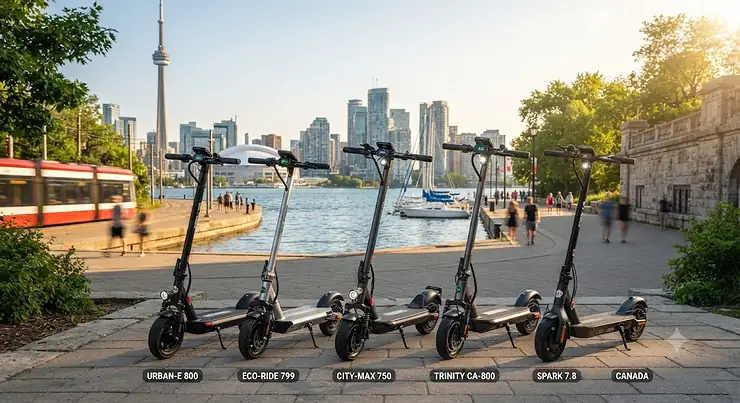
Let’s be honest about what’s happening in your garage right now: a bus pass you barely use, a bike with a flat you keep meaning to fix, and a browser tab open to yet another “best scooter” list that reads like it was copied from a spec sheet. That’s the gap this guide is built to close. If you’re hunting for the top medium range electric scooters under $800 CAD, you’re probably not chasing a toy — you’re looking for a genuine second vehicle, something that eats up the 5-to-12 km gap between “too far to walk” and “not worth calling a rideshare.”
A medium range electric scooter typically covers 30 to 60 km on a full charge, sits between 500W and 1200W of motor power, and lands squarely in that sweet spot where price, weight, and daily usability all make sense together. Recent market analysis of Canadian e-mobility listings shows the category splitting into two distinct tiers: budget and mid-range scooters under $800, and premium performance models well above $2,000. This isn’t a category of compromise so much as a category of trade-offs, and this guide is about making those trade-offs work for you instead of against you.
Electric kick scooters themselves aren’t new — the basic format has been refined for over a decade, and the underlying engineering and history of the electric kick scooter is worth a skim if you want context on how the category got here. What’s changed is the value on offer under $800 CAD: 2026’s crop of scooters in this price band pack suspension, app connectivity, and traction control that used to be premium-only features. Below, we break down seven real, currently available models — budget, mid-range, and near-premium — with honest analysis of who each one actually suits, not just what the spec sheet claims.
Quick Comparison Table
Before the deep dive, here’s the shorthand version for anyone triaging on a coffee break.
| Scooter | Motor | Claimed Range | Price Range (CAD) | Best For |
|---|---|---|---|---|
| NAVEE GT3 Pro | 1000W peak | Up to 60 km | C$600–C$750 | Hilly commutes |
| iSinwheel S10Max | 1000W | Up to 60 km | C$650–C$780 | Longest range on a budget |
| Hiboy S2 Pro | 500W | Up to 40 km | C$550–C$650 | Comfort on rough pavement |
| NIU KQi2 Pro | 300W (600W peak) | Up to 40 km | C$530–C$650 | App-tracked battery health |
| Segway Ninebot F2 Plus | 900W peak | Up to 55 km | C$700–C$799 | Wet-weather traction |
| iSinwheel S9Max | 500W | 27–35 km | C$400–C$500 | Best value under $600 CAD |
| Gotrax GXL V2 | 250W | ~15–20 km | C$350–C$450 | Lightest, easiest first scooter |
Look closer and a pattern emerges: the moment a scooter crosses into genuinely “medium range” territory (30 km or more), its price climbs into the C$550-plus zone, while anything under C$500 tends to sacrifice range first. The NAVEE GT3 Pro and iSinwheel S10Max both claim 60 km, but that number comes from ideal lab conditions — expect 60–70% of that in real Canadian commuting, especially in cold weather. If your commute is genuinely short (under 5 km each way), the Gotrax GXL V2 is honestly plenty of scooter, and paying more for range you’ll never use is money left on the table.
💬 Just one click — help others make better buying decisions too!😊
Top 7 Medium Range Electric Scooters: Expert Analysis
1. NAVEE GT3 Pro — best hill-climbing torque for the price
The GT3 Pro’s headline number is its 1000W peak motor paired with a 477Wh battery, and in practice that torque is the standout feature — this is the scooter that doesn’t wheeze on a 10% grade the way cheaper 500W units do. The 400W nominal motor with 1000W peak output means it accelerates confidently from a stop, and NAVEE’s dual suspension (front fork plus rear cylinder) takes the edge off Canadian pothole season. Based on the spec comparison, the 60 km claimed range and 32 km/h top speed put it firmly in medium range territory, with three ride modes (Pedestrian, Daily, Sport) that let new riders ease in.
Here’s what to weigh: this is a scooter for commuters who deal with actual hills — river valleys, campus slopes, or neighbourhoods built on anything but flat prairie grid. Reviewers consistently note that the TCS (traction control) genuinely reduces wheel spin on wet pavement and gravel-dusted bike lanes, which matters more in a Canadian spring than most spec sheets let on. What most buyers overlook is the Apple Find My integration — a small feature that becomes a big deal the one time your scooter goes missing from a bike rack.
Pros:
- ✅ Strong hill-climbing performance from 1000W peak motor
- ✅ Dual suspension smooths out rough city pavement
- ✅ Traction control helps in wet or gravelly conditions
Cons:
- ❌ 60 km claim is optimistic for real Canadian riding
- ❌ At 49 lbs, it’s heavier to carry up stairs than lighter rivals
At around C$600–C$750, the GT3 Pro sits near the top of this list’s price range but earns it with genuine hill performance — check current price before buying, as NAVEE runs frequent promotions.
2. iSinwheel S10Max — longest claimed range in the group
The standout here is straightforward: a 1000W motor and 45 km/h top speed paired with a claimed 60 km range, at a price that regularly undercuts similarly-specced competitors by hundreds of dollars. What most buyers overlook about this model is that its aggressive price often comes with a shorter warranty window or slower parts availability than an established brand like Segway or NIU — the spec sheet won’t tell you this, but user reports suggest after-sales support is the real trade-off, not build quality.
On paper this means you’re getting flagship-adjacent numbers at a mid-range price, and reviewers consistently report that the acceleration feels genuinely quick for the price bracket, with dual suspension keeping the ride composed. This is the pick for someone who wants maximum range and speed per dollar and is comfortable ordering from a fast-growing but less established brand. It’s not the scooter for someone who wants a decade of local dealer support.
Pros:
- ✅ Class-leading claimed range for the price point
- ✅ 1000W motor delivers strong acceleration
- ✅ Dual suspension handles rough streets well
Cons:
- ❌ Newer brand with less established Canadian service network
- ❌ Real-world range likely closer to 40–45 km than the claimed 60 km
Priced around C$650–C$780 depending on promotions, the S10Max is the value pick if range-per-dollar is your priority — always check current price, as this model fluctuates with sales.
3. Hiboy S2 Pro — smoothest ride on rough pavement
The Hiboy S2 Pro leads with comfort: dual rear shock absorbers paired with 10-inch solid honeycomb tires that never go flat, which matters enormously the first time you hit a pothole at speed. The 500W motor and 36V/11.6Ah battery combine for a claimed 40 km range and 30 km/h top speed — respectable medium range numbers without chasing an inflated headline figure the way some competitors do.
Based on the spec comparison, the solid tires are the meaningful trade-off here: no flats to worry about, but a firmer ride than air-filled tires on smooth pavement. Reviewers consistently report satisfaction with the ride quality on rough city streets specifically, with several noting the regenerative braking adds a small but real boost to daily range. What stands out in aggregated feedback is that owners describe the real-world range as slightly under the 40 km claim but “acceptable for a mid-range e-scooter” — an honest assessment that matches what you’d expect from the spec sheet.
Pros:
- ✅ Puncture-proof solid tires need zero maintenance
- ✅ Dual rear suspension smooths rough pavement
- ✅ Dual braking system with regenerative charging
Cons:
- ❌ Solid tires ride firmer than pneumatic alternatives
- ❌ Real-world range runs a bit under the 40 km claim
Expect to pay in the C$550–C$650 range for the Hiboy S2 Pro — prices shift with seasonal promotions, so check current pricing before ordering.
4. NIU KQi2 Pro — most polished app and battery health tracking
NIU built its reputation on two-wheelers before scooters, and that engineering pedigree shows up in the KQi2 Pro’s app: real-time battery health tracking, ride history, and firmware updates that actually improve performance over time. The 300W motor (600W peak) delivers a claimed 40 km range and a 15% hill-grade rating, respectable numbers backed by a 365Wh lithium battery.
Here’s what most spec sheets don’t mention: NIU’s app-based battery management is arguably the biggest long-term value driver in this whole list, because lithium batteries degrade based on how they’re charged and stored, and having visibility into that degradation lets you catch problems before a battery fails outright. Based on the spec comparison, the dual braking system (front drum, rear electric) delivers dependable stopping in wet weather, and the 10-inch tubeless tires provide solid shock absorption. This is the pick for buyers who want a scooter that feels like a maintained appliance rather than a disposable gadget.
Pros:
- ✅ Best-in-class app with battery health monitoring
- ✅ Established brand with strong parts availability
- ✅ Reliable dual braking system in wet conditions
Cons:
- ❌ 7-hour charge time is slower than some rivals
- ❌ 300W nominal motor struggles on steeper hills
The NIU KQi2 Pro typically lands in the C$530–C$650 range — watch for instant coupons, which regularly bring it toward the lower end.
5. Segway Ninebot F2 Plus — best wet-weather traction control
Segway’s F2 Plus brings genuine engineering depth to the mid-range: a 900W peak motor, Traction Control System (TCS), and a claimed 55 km range that puts it near the top of the medium range band without tipping into premium pricing. The standout feature is the combination of TCS and dual braking — this is one of the few scooters in this price bracket where wet-pavement traction genuinely feels engineered rather than an afterthought.
What most buyers overlook is that Segway backs the F2 series with built-in turn indicators and a mature companion app carried over from years of Ninebot self-balancing and scooter development — this isn’t a first-generation product from a brand finding its footing. Reviewers consistently note that the F2 Plus feels more planted at speed than lighter rivals, a direct result of its heavier build and wider stance. On paper this means a slightly heavier carry in exchange for meaningfully better stability and stopping power.
Pros:
- ✅ Traction control system genuinely improves wet-weather grip
- ✅ 55 km claimed range near the top of this list
- ✅ Mature Segway app and firmware support
Cons:
- ❌ Heavier build makes stairs and transit less convenient
- ❌ Priced near the top of the $800 CAD ceiling
The F2 Plus generally runs C$700–C$799 CAD, positioning it as the near-premium choice on this list — confirm current pricing directly with Segway’s Canadian retailers, as availability varies by region.
6. iSinwheel S9Max — best value under $600 CAD
If your budget caps out well below $800, the S9Max is the honest answer to “what’s the best medium range electric scooter under $600 CAD?” A 500W motor delivers a claimed 27–35 km range at up to 32 km/h — genuinely at the lower edge of medium range, but real medium range nonetheless, unlike scooters that inflate a 15 km reality into a “30 km” headline.
Based on the spec comparison, the S9Max trades some of the S10Max’s power and range for a meaningfully lower price, which makes sense as a first scooter or a backup for a household that already owns one premium model. What the spec sheet won’t tell you, but user reports suggest, is that build quality at this price tier is generally solid for the first year but components like bearings and brake pads may need earlier attention than pricier models — a fair trade for the savings, provided you budget for basic upkeep.
Pros:
- ✅ Genuinely reaches medium range territory under $600 CAD
- ✅ Lighter weight than the higher-powered S10Max
- ✅ Straightforward for first-time scooter owners
Cons:
- ❌ Less powerful than 1000W rivals on hills
- ❌ Components may need earlier replacement than premium models
Look for the S9Max in the C$400–C$500 CAD range, making it the clearest pick for anyone specifically shopping under $600 CAD.
7. Gotrax GXL V2 — lightest and easiest to carry
Honesty matters here: the GXL V2’s claimed range sits around 15–20 km, which is genuinely below the 30–60 km medium range band this guide focuses on. We’re including it anyway because it’s one of the most common entry points into scooter ownership in Canada, and it’s the ideal case study for entry-level scooter maintenance — simple enough that a first-time owner can learn basic upkeep without an intimidating feature list.
The 250W motor and 36V/5.2Ah battery keep things light — around 26 lbs — and the one-step folding frame is genuinely the easiest fold-and-carry mechanism in this entire list. Reviewers consistently describe it as reliable rather than exciting, which is exactly the point: it’s a starter scooter, not a commuter workhorse. What most buyers overlook is that its shorter range is actually a feature for short, flat commutes — you’re not lugging around battery weight you’ll never use.
Pros:
- ✅ Lightest scooter in this list, easiest to carry
- ✅ Simple mechanics make maintenance approachable for beginners
- ✅ Reliable, well-reviewed entry point into scooter ownership
Cons:
- ❌ Range falls short of true medium range territory
- ❌ 250W motor struggles on hills or with heavier riders
At C$350–C$450 CAD, the GXL V2 is the cheapest way to find out if scooter commuting suits your lifestyle before committing to a pricier medium range model.
Detailed Spec & Value Comparison
| Scooter | Weight | Top Speed | Suspension | Water Resistance |
|---|---|---|---|---|
| NAVEE GT3 Pro | 49 lbs | 32 km/h | Dual (front + rear) | IPX5 |
| iSinwheel S10Max | ~50 lbs | 45 km/h | Dual | IPX4 |
| Hiboy S2 Pro | ~40 lbs | 30 km/h | Rear only | IPX4 |
| NIU KQi2 Pro | ~35 lbs | 28 km/h | None (tire-based) | IPX4 |
| Segway Ninebot F2 Plus | ~46 lbs | 30 km/h | None (tire-based) | IPX4 |
| iSinwheel S9Max | ~33 lbs | 32 km/h | None | IPX4 |
| Gotrax GXL V2 | 26 lbs | 25 km/h | None | IPX4 |
Reading across this table, suspension and water resistance track closely with price: the two scooters with genuine dual suspension, NAVEE GT3 Pro and iSinwheel S10Max, also sit at the top of the price range, while lighter, cheaper models rely on tire cushioning alone. For anyone riding on genuinely rough streets — think unmaintained laneways or older neighbourhoods with frost-heaved asphalt — that suspension gap is worth the extra C$100 to C$150. If your commute runs along smooth bike paths, the weight savings on models like the NIU KQi2 Pro or Gotrax GXL V2 may matter more than suspension ever will.
Entry-Level Scooter Maintenance: Your First 30 Days
Buying the scooter is the easy part; keeping it running is where most new owners either build good habits or slowly wreck their investment. This section is built around entry-level scooter maintenance specifically, because a beginner’s first month sets the tone for the next two or three years.
Before your first ride: fully charge the battery, check tire pressure if your model uses pneumatic tires (the NAVEE GT3 Pro and iSinwheel S10Max both do), and confirm the folding mechanism locks securely — a scooter that unfolds mid-ride is a genuine safety hazard, not just an inconvenience.
Weekly habits: wipe down the deck and stem after wet rides, since road salt and slush are corrosive to exposed metal fasteners. Check that both brakes engage smoothly; a soft or delayed rear brake is the single most common early complaint across budget models like the Gotrax GXL V2 and iSinwheel S9Max.
Monthly habits: inspect for loose bolts around the folding hinge and stem clamp — vibration loosens these faster than most new riders expect. Charge the battery to roughly 80% for storage if you won’t ride for more than a week, since keeping a lithium battery at 100% charge for extended periods accelerates capacity loss.
Common first-month mistakes: charging with a third-party charger not rated for your specific battery, storing the scooter outdoors in freezing temperatures (which measurably shortens battery lifespan), and ignoring a squeaking brake until it fails entirely instead of adjusting cable tension early. None of these mistakes are expensive to avoid — they’re just easy to overlook when you’re excited about a new scooter.
Matching Weekday Commuting Patterns to the Right Scooter
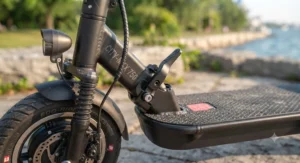
Range numbers on a spec sheet mean nothing until you map them against your actual weekday commuting patterns — the repeated, predictable trips that make up 80% of most people’s scooter use.
The 3-5 km one-way commuter: if you’re riding to a nearby GO station, campus, or office and back, five days a week, you rarely need more than 10-12 km of range per day. The Gotrax GXL V2 or iSinwheel S9Max cover this easily, and you’ll likely charge only two or three times a week rather than nightly.
The 8-10 km one-way commuter: this is where medium range actually earns its name. A round trip of 16-20 km eats a meaningful chunk of a 30 km-rated battery, especially with cold weather knocking 20-30% off claimed range. The Hiboy S2 Pro or NIU KQi2 Pro fit this pattern with a comfortable buffer, letting you skip a charge if plans change unexpectedly.
The multi-stop commuter: if your weekday routine includes a scooter-to-transit connection, a coffee stop, and an evening errand loop, you’re accumulating distance in a way flat commute numbers don’t capture. This is where the NAVEE GT3 Pro, iSinwheel S10Max, or Segway Ninebot F2 Plus justify their higher price — the extra range buffer means Tuesday’s unplanned detour doesn’t strand you three kilometres from home. A CBC News report on Ontario’s e-scooter pilot program found ridership and adoption climbing sharply among commuters and students across participating municipalities in recent years, reflecting exactly this kind of everyday, multi-stop use pattern rather than purely recreational riding.
✨ Not sure which pattern matches your week? Track your actual daily distance for five days before you buy — it’s the single best predictor of which range tier you really need.
How to Choose a Medium Range Electric Scooter
Cutting through the marketing noise, here’s the decision process that actually matters, in order:
- Measure your real round-trip distance. Add 30-40% buffer for cold weather, hills, and heavier riders — a scooter rated for 40 km rarely delivers that in a Canadian winter.
- Match motor wattage to your terrain. Flat routes are fine with 300-500W; hills or a heavier rider (over 200 lbs) need 750W or more to avoid strain and premature motor wear.
- Weigh portability against range. If you’re carrying the scooter up stairs or onto transit daily, every extra 10 lbs matters more than 10 extra kilometres of range you may not use.
- Check tire type for your commute. Solid tires mean zero flats but a firmer ride; pneumatic tires ride smoother but need occasional pressure checks and are vulnerable to punctures.
- Confirm braking redundancy. Dual braking (electronic plus mechanical) stops meaningfully faster and safer in wet conditions than a single brake system.
- Look for a genuine IP water-resistance rating, not just marketing language — IPX4 or higher is the realistic minimum for year-round Canadian riding.
- Budget for the accessories you’ll actually need: a helmet, a lock, and — since Ontario’s provincial baseline rules require riders to be 16 or older with mandatory helmets for riders under 18 — check your municipality’s specific age and equipment rules before you ride.
30-60 km Battery Sizing Explained: What Range Numbers Actually Mean
Every scooter in this guide advertises a range figure, and almost none of those figures reflect what you’ll actually get riding to work in October. Understanding 30-60 km battery sizing starts with understanding how manufacturers measure it: a single rider around 75 kg, on a flat surface, at a moderate constant speed, in mild temperatures, with no wind. Almost nobody’s actual commute matches all five conditions simultaneously.
Battery size is measured in watt-hours (Wh), calculated as voltage multiplied by amp-hours. A 48V battery rated at 10Ah delivers roughly 480Wh — and as a rough rule of thumb, expect about 15-20 Wh consumed per kilometre for a mid-weight scooter at moderate speed, meaning a 480Wh battery should theoretically deliver 24-32 km in real riding, well below many “60 km” marketing claims. Cold weather is the biggest hidden variable: lithium-ion battery chemistry loses meaningful capacity below 0°C, so a scooter claiming 60 km in July may deliver closer to 40-45 km in a Canadian January.
This is why the sizing sweet spot for most Canadian commuters is a battery rated 30-40% above your actual daily need. If your round trip is 20 km, aim for a scooter rated at least 30 km — that buffer absorbs cold weather, hills, and the gap between lab conditions and reality without forcing you to recharge mid-week out of anxiety rather than necessity.
Best Medium Range Electric Scooter Under $600 CAD
If $800 is your ceiling but $600 is your realistic target, the field narrows fast — and that’s actually good news, because it removes decision fatigue. Among this list, the iSinwheel S9Max is the clearest medium range electric scooter under $600 CAD: its 27-35 km claimed range genuinely qualifies as medium range, unlike sub-$500 scooters that top out around 15-20 km.
The trade-off compared to pricier options is straightforward: less motor power (500W versus 1000W), no dual suspension, and a lighter overall build. For a commuter riding mostly flat urban terrain under 15 km round trip, none of those trade-offs matter much in daily use. Where they matter is hills, heavier riders, or genuinely rough pavement — situations where the extra C$100-200 spent on a Hiboy S2 Pro or NIU KQi2 Pro buys real, noticeable improvement rather than marginal gains. If your budget is firm at $600 CAD, the S9Max delivers legitimate medium range performance without forcing you into the compromise-heavy sub-$400 tier.
Medium Range Electric Scooters vs Long-Range and Short-Range Models
| Category | Range | Typical Price (CAD) | Best For |
|---|---|---|---|
| Short-range | Under 25 km | C$300–C$500 | Flat, sub-5 km commutes |
| Medium range | 30–60 km | C$400–C$800 | Daily multi-km commuting |
| Long-range | 60 km+ | C$1,000+ | Long commutes, delivery, heavy use |
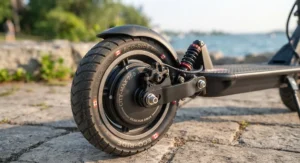
The jump from short to medium range typically costs a few hundred dollars and buys genuine everyday flexibility — enough buffer that a detour or a cold snap doesn’t leave you stranded. The jump from medium to long range costs considerably more but mostly buys peace of mind rather than proportionally more utility, since 30-60 km already covers the overwhelming majority of Canadian weekday commutes without a mid-day charge. Unless your daily round trip regularly exceeds 25 km or you’re using the scooter for gig-economy delivery work, medium range is the rational choice — long-range scooters mostly pay for battery capacity you’ll rarely draw down.
Common Mistakes When Buying a Medium Range Electric Scooter
The most common mistake is buying on top speed alone — a scooter capped at 32 km/h isn’t meaningfully faster in daily commuting than one capped at 25 km/h once you factor in intersections, pedestrians, and traffic. The second is ignoring weight entirely until the first time you have to carry the scooter up three flights of stairs; a 20-lb difference feels trivial in a spec sheet and enormous in your arms. The third is assuming all “medium range” claims are equivalent, when — as covered above — real-world range can vary by 30-40% between manufacturers’ testing methodologies. Finally, many first-time buyers skip checking their municipality’s e-scooter rules entirely, only to discover their new purchase is illegal to ride on the roads or sidewalks where they live.
What to Expect: Real-World Performance in Canadian Conditions
Spec sheets describe lab conditions; your commute involves potholes, crosswalks, drizzle, and the occasional patch of gravel a city crew left behind. In practice, expect claimed range figures to drop 20-35% in real Canadian riding, more in winter. Expect top speed to feel slower in practice than the number suggests, since most riders naturally slow for intersections, pedestrians, and rough pavement well before hitting a scooter’s rated maximum. Expect suspension-equipped models like the NAVEE GT3 Pro and iSinwheel S10Max to feel meaningfully more comfortable on frost-heaved streets than tire-only models like the NIU KQi2 Pro, even though both ride fine on freshly paved bike lanes. And expect braking distance to increase noticeably on wet leaves or light snow — this is where traction control on the Segway Ninebot F2 Plus and NAVEE GT3 Pro earns its keep.
Long-Term Cost & Maintenance: Total Cost of Ownership
The sticker price is only the opening bid. Over a two-year ownership period, budget for at minimum one replacement tire or tube (C$20-50 depending on tire type), one set of brake pads (C$10-20), and eventual battery degradation that typically reduces capacity by 15-20% after roughly 300-500 charge cycles. Solid-tire models like the Hiboy S2 Pro avoid tire replacement costs but can’t be repaired if punctured — a rare event given their design. Pneumatic-tire models like the NAVEE GT3 Pro ride smoother but need occasional pressure checks and eventual tube replacement.
Battery longevity is where genuine total cost of ownership diverges. CSA Group’s work on battery electric vehicle standards emphasizes harmonized safety guidance across Canada for charging and energy storage systems, and the same underlying lithium-ion principles apply to scooter batteries at a smaller scale: partial charges, moderate storage temperatures, and avoiding deep discharges all meaningfully extend battery life. A scooter maintained with these habits can realistically outlast one ridden hard and charged carelessly by a full year or more — turning a C$600 scooter into genuinely better value than an $800 model neglected from day one.
Features That Actually Matter (And Those That Don’t)
Traction control, dual braking, and a genuine IP water-resistance rating actually matter — they change how the scooter behaves in the wet-weather conditions Canadian riders face for a good chunk of the year. App connectivity with battery health tracking, like the NIU KQi2 Pro offers, actually matters for long-term value, since catching battery degradation early prevents a sudden mid-commute failure.
What doesn’t matter nearly as much as marketing suggests: top speed beyond about 32 km/h, since most municipal e-scooter rules cap legal speeds around 24-25 km/h anyway, making higher numbers largely irrelevant for road use. RGB ambient lighting looks fun in a product photo but does nothing for range, safety, or reliability. And headline wattage numbers, especially “peak” figures, routinely overstate real sustained performance — a motor’s continuous rated output matters far more than a brief peak burst that lasts a few seconds under hard acceleration.
Safety, Regulations & Compliance Guide for Canadian Riders
E-scooter legality in Canada varies dramatically by province and even by municipality, and this is genuinely the single most overlooked step in the buying process. In Ontario, for example, the province’s e-scooter pilot program allows municipalities to choose where and how e-scooters may be used, with the pilot running from January 1, 2020 to November 27, 2029. Some major cities, including Toronto, have opted not to participate, meaning e-scooters legally purchased and perfectly safe to ride are still prohibited on public roads and sidewalks there. Before buying, check your specific municipality’s rules directly through Ontario’s official e-scooter guidance page or your provincial equivalent, since fines for non-compliant riding can run into the hundreds of dollars.
Beyond legality, look for scooters certified to UL 2272 or ANSI/CAN/UL 2272 safety standards, which test for electrical and fire safety in the battery and motor systems — every scooter in this list meets this baseline. Wear a helmet regardless of local requirements, keep lights functional for low-visibility riding, and never modify a scooter’s motor controller to exceed its rated speed, which voids both warranty and any safety certification the unit originally carried.
Problem → Solution: Fixing the 5 Most Common Medium Range Scooter Complaints
Problem: Range drops noticeably in cold weather. Solution: store the scooter indoors overnight when possible, and avoid charging immediately after a cold ride — let the battery return to room temperature first to protect its long-term capacity.
Problem: Brakes feel spongy after a few months. Solution: check and tighten brake cable tension monthly; this is a five-minute fix on most models, including the Gotrax GXL V2 and iSinwheel S9Max, and prevents a minor issue from becoming a real stopping-distance problem.
Problem: The folding mechanism becomes loose over time. Solution: inspect the folding latch and stem clamp bolts monthly and tighten as needed — vibration from regular riding loosens these faster than most owners expect.
Problem: Solid tires feel harsh on rough streets. Solution: if comfort matters more than puncture-proofing, prioritize a pneumatic-tire model like the NAVEE GT3 Pro over a solid-tire model like the Hiboy S2 Pro from the outset — this isn’t retroactively fixable.
Problem: Battery degrades faster than expected. Solution: avoid consistently charging to 100% and letting it sit; charge to around 80% for daily use and reserve full charges for days you know you’ll need maximum range.
🔧 Want a printable maintenance checklist for your specific model? Drop a comment below and we’ll point you to the manufacturer’s exact schedule!
FAQ
❓ What is a medium range electric scooter?
❓ Is a medium range electric scooter under $800 CAD worth it compared to a cheaper model?
❓ How long does an entry-level electric scooter battery last before needing replacement?
❓ Can I ride an electric scooter under $800 CAD on Canadian roads?
❓ What's the difference between a 500W and 1000W medium range electric scooter?
Conclusion
Choosing among the top medium range electric scooters under $800 CAD really comes down to matching real numbers to your real week: measure your actual commute distance, factor in Canadian weather’s habit of shaving 20-30% off any claimed range, and prioritize the features — suspension, traction control, dual braking — that matter for your specific streets rather than the ones that photograph well. The NAVEE GT3 Pro and Segway Ninebot F2 Plus reward hillier, longer commutes with genuine performance; the iSinwheel S9Max and Gotrax GXL V2 make sense for flatter, shorter routes or first-time buyers testing the waters; and the Hiboy S2 Pro and NIU KQi2 Pro sit comfortably in between for most everyday Canadian commuters.
None of these seven scooters is a bad choice — they’re simply built for different weekday commuting patterns, budgets, and terrain. Whichever you land on, the entry-level maintenance habits and safety checks covered above will do more for your long-term satisfaction than any single spec ever could.
🔍 Ready to stop scrolling and start commuting? Check current pricing on your top pick above — availability and promotions shift often, so today’s price may not be tomorrow’s.
Recommended for You
- Top 7 Extended Range Electric Scooters Under $2000 CAD (2026)
- Electric Scooter for Long Distance Travel: 7 Best 2026 Picks
- Extended Range Electric Scooter: 7 Top Picks That Won’t Quit (2026)
Disclaimer: This article contains affiliate links. As an Amazon Associate, I earn from qualifying purchases. If you purchase products through these links, we may earn a small commission at no additional cost to you.
✨ Found this helpful? Share it with your friends! 💬🤗
