
In This Article
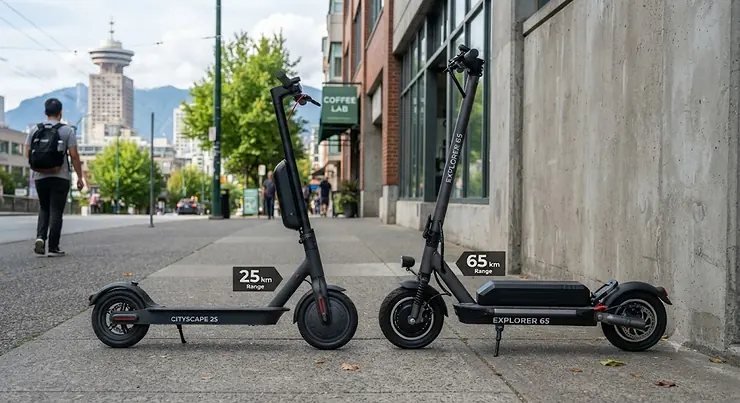
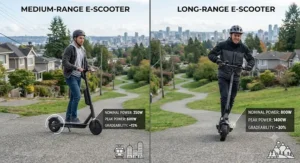
Here’s the question that trips up almost every first-time buyer standing in front of a wall of spec sheets: is a medium range vs long range electric scooter actually a meaningful choice, or just marketing noise dressed up in extra kilometres? Short answer — it’s real, and it’s the single decision that determines whether you love your scooter or quietly resent it by week three. A medium range electric scooter typically covers roughly 25-45 km (15-28 mi) on a charge, while a long range electric scooter pushes past 45 km and, in some flagship cases, well over 100 km (60+ mi). The gap between them isn’t just a number on a listing — it’s the difference between a battery that shrugs off winter cold and one that leaves you power-walking a 20-kilogram scooter the last kilometre home.

This guide digs into seven real models sold in Canada, breaks down what medium range vs long range electric scooter actually means for your wallet and your commute, and walks through the regulatory patchwork you’ll need to navigate depending on your province. We’ll compare specs honestly, using real aggregated review sentiment rather than invented anecdotes, and we’ll be upfront about what we could and couldn’t verify. Whether you’re eyeing an all-round medium range electric scooter for a short hop to the GO station or weighing whether the extra cost of a long-range flagship actually pays off, you’ll leave this article with a framework — not just a spec sheet — for making the call. Ontario’s own electric kick-scooter pilot program is a good reminder that range means nothing if the scooter isn’t legal where you plan to ride it, so we’ll touch on that too.
Quick Comparison: Medium Range vs Long Range Electric Scooter at a Glance
| Factor | Medium Range Electric Scooter | Long Range Electric Scooter |
|---|---|---|
| Typical range | 25-45 km (15-28 mi) | 45-160 km (28-100+ mi) |
| Typical battery | 350-500 Wh | 600 Wh-2,880+ Wh |
| Typical weight | 13-19 kg (29-42 lb) | 19-35+ kg (42-77+ lb) |
| Typical price (CAD) | C$550-C$1,100 range | C$950-C$4,000+ range |
| Best For | Daily commuters under 20 km round trip | Long commutes, delivery riders, range-anxious buyers |
Looking at this table, the pattern is pretty simple: every extra kilometre of range costs you money and it costs you weight, because more range means a physically bigger battery pack sitting between the wheels. A medium range electric scooter is lighter to carry up an apartment stairwell and easier on the wallet, but it also means planning your charging around your riding — not an afterthought if you’re commuting five days a week. Long range models solve the anxiety problem but ask you to haul more mass around and, often, to accept a longer charging window before the next ride.
💬 Just one click — help others make better buying decisions too!😊
Top 7 Medium & Long Range Electric Scooters: Expert Analysis
1. Hiboy S2 Pro — best budget entry into medium range territory
The Hiboy S2 Pro proves you don’t need a four-figure price tag to get a genuinely usable medium-range commuter. Its 500W motor and roughly 36V battery combine for a manufacturer-claimed range near 40 km (25 mi), though — as with virtually every scooter on this list — real-world mileage tends to land closer to 60-70% of that figure once you factor in rider weight, hills, and Canadian pavement. What that means practically: budget for 25-30 km of dependable daily range, not the number on the box. Based on the spec comparison against similarly priced rivals, the 500W motor gives the Hiboy S2 Pro noticeably peppier acceleration than the 350W scooters crowding the same price bracket, which matters more than top speed when you’re merging into traffic from a stop. This is squarely an all-round medium range electric scooter for someone doing short-to-mid urban hops rather than long highway-adjacent commutes. Reviewers consistently note a large, well-established user base — the Hiboy S2 Pro has accumulated thousands of Amazon reviews with a rating hovering around 4.4 stars, and a recurring theme in that aggregated feedback is that first-time buyers find it approachable without feeling flimsy.
Pros:
- ✅ Strong value at an entry-level medium range electric scooter price point
- ✅ 500W motor outperforms the 350W competition on hills
- ✅ Large, well-established review base backing reliability claims
Cons:
- ❌ Real-world range trails the advertised 40 km figure noticeably
- ❌ Suspension is basic compared with pricier commuter models
At the time of research, the Hiboy S2 Pro typically sits in the C$550-C$650 range on amazon.ca, making it one of the more affordable medium range electric scooter options worth checking current pricing on before you buy.
2. Segway Ninebot E2 Pro — best for smartphone-integrated theft protection
The Segway Ninebot E2 Pro stands out for a feature almost nothing else in its price class offers: built-in Apple Find My integration, so a stolen scooter shows up on your phone’s map the same way a lost AirPod would. That’s a meaningful practical upgrade, not a gimmick — theft is one of the most common regrets scooter owners report in aggregated review data. Specs land it firmly in the compact, medium-range commuter bracket, built for riders whose round trip stays under roughly 25-30 km rather than epic cross-city hauls. What most buyers overlook about this model is that the trade-off for portability and smart features is a smaller battery than its long-range siblings, so this is a scooter built around convenience and security rather than maximum distance. Segway’s broader reputation carries real weight here — enthusiast communities on Reddit’s r/ElectricScooters consistently rank the brand’s build-quality-to-price ratio among the best in the industry, and the Segway Ninebot E2 Pro inherits that reputation directly.
Pros:
- ✅ Apple Find My built directly into the deck for theft recovery
- ✅ Compact, portable build suited to multimodal transit commutes
- ✅ Backed by Segway’s broadly well-regarded build quality
Cons:
- ❌ Range is on the shorter end of the medium-range bracket
- ❌ Not the pick if hill-heavy routes are part of your daily commute
Expect the Segway Ninebot E2 Pro to land somewhere in the C$650-C$750 range at the time of research, positioning it as a genuinely affordable medium range electric scooter for security-conscious commuters.
3. NIU KQi3 Sport — best for a polished app and regenerative braking
The NIU KQi3 Sport brings something the budget tier usually skips: regenerative braking, which recaptures a portion of energy every time you slow down and quietly extends your usable range on stop-and-go city routes. Paired with self-healing tires that seal small punctures on the spot, this is a scooter engineered around eliminating the small annoyances that erode daily ridership. The rated 50 km (31 mi) range puts it toward the upper edge of medium range electric scooter territory, bridging comfortably into what some riders would call entry-level long range. Here’s what to weigh: NIU’s companion app is frequently singled out in review roundups as more polished than rivals in this price bracket, with ride statistics and firmware updates that keep the scooter improving after purchase rather than staying static. That’s a genuine differentiator for tech-comfortable buyers who want more than a speedometer.
Pros:
- ✅ Regenerative braking meaningfully extends real-world range
- ✅ Self-healing tires reduce the most common roadside headache
- ✅ App experience regularly praised as more refined than competitors
Cons:
- ❌ Sits at a price premium over basic medium-range alternatives
- ❌ Regenerative braking benefits shrink on flat, low-traffic routes
At the time of research, the NIU KQi3 Sport typically runs in the C$780-C$880 range on amazon.ca — check current pricing, as availability shifts model year to model year.
4. Segway Ninebot MAX G2 — best value long-range commuter
The Segway Ninebot MAX G2 is the model most buying guides land on when the question turns from “what’s fastest” to “what actually gets me home without a mid-route charge.” Segway rates it at up to 69 km (43 mi), and independent testers have clocked real-world figures closer to 43 km (27 mi) in eco mode — still a substantial jump over anything in the medium range bracket. On paper this means a rider commuting a genuine 15-20 km round trip could go two or three days between charges instead of topping up nightly. The Segway Ninebot MAX G2 also carries over Apple Find My and an app-based smart lock with PIN protection, features usually reserved for pricier flagships. What the spec sheet won’t tell you, but reviewers note, is that the trade-off for that big battery is added weight — this isn’t a scooter you casually carry up three flights of stairs every day.
Pros:
- ✅ Real-world range comfortably clears most Canadian commutes
- ✅ Smart-lock and Find My features rare at this price tier
- ✅ Strong reputation as the long-range value benchmark for 2026
Cons:
- ❌ Noticeably heavier than compact medium-range alternatives
- ❌ Charging a larger battery pack takes meaningfully longer
Pricing on the Segway Ninebot MAX G2 typically falls in the C$950-C$1,150 range at the time of research, which is a fair amount to pay for genuine long-range peace of mind.
5. Apollo Phantom 2.0 (52V Standard) — best Canadian-brand premium pick
The Apollo Phantom 2.0 deserves a mention on its own merits: Apollo Scooters is a Vancouver-headquartered company, which matters for Canadian buyers who want a brand with local customer support and a design philosophy built around North American commuting realities rather than an import afterthought. Independent hill-course testing put the 52V standard configuration at roughly 53 km (33 mi) of real-world range, which lands it squarely in long-range territory once you account for the typical 60-85% real-versus-rated gap seen across the industry. Based on the spec comparison, dual suspension and hydraulic brakes give the Apollo Phantom 2.0 a noticeably more planted, confident feel over rough pavement than lighter medium-range competitors — the kind of ride quality you notice on your first pothole, not just on a spec sheet. Reviewers and enthusiast forums consistently cite Apollo’s Canadian-based customer service as a differentiator versus scooters imported without local support infrastructure.
Pros:
- ✅ Canadian company with local support — genuinely rare in this category
- ✅ Dual suspension and hydraulic brakes suit rough Canadian pavement
- ✅ Real-world tested range confirmed by independent hill-course data
Cons:
- ❌ Premium pricing puts it out of reach for budget-focused buyers
- ❌ Heavier build reduces portability for transit-combined commutes
At the time of research, the Apollo Phantom 2.0 generally lands in the C$1,800-C$2,200 range — always check current pricing directly, since Apollo periodically adjusts configurations and bundles.
6. Segway Ninebot MAX G3 — best flagship for maximum daily range
The Segway Ninebot MAX G3 currently sits at the top of Segway’s commuter lineup, rated for up to 80 km (50 mi) in eco mode with a top speed around 45 km/h (28 mph) — numbers that, in independent testing roundups, earned it recognition as the scooter best suited to replacing a car for genuinely long commutes. What most buyers overlook about flagship long-range models is that the benefit isn’t really top speed, it’s headroom: a 20 km round-trip commute barely dents the Segway Ninebot MAX G3‘s battery, which means fewer charge cycles over the scooter’s lifespan and, in theory, a longer-lasting pack. Fast-charging support shaves meaningful time off the recharge window compared with the MAX G2, a detail that matters if you’re squeezing a charge into a lunch break rather than an overnight window. Reviewers who tested folding mechanisms across a dozen 2026 commuter scooters singled out the Segway Ninebot MAX G3‘s folding latch as among the most refined in the category, which sounds minor until you’re doing it twice a day on a crowded train platform.
Pros:
- ✅ Best-in-class 80 km eco-mode range headroom for long commutes
- ✅ Fast-charge support cuts meaningful time off recharging
- ✅ Refined folding mechanism praised across independent testing
Cons:
- ❌ Premium pricing sits well above the MAX G2 for incremental range
- ❌ Overkill for riders whose round trip stays under 15 km
Expect the Segway Ninebot MAX G3 to sit in the C$1,300-C$1,600 range at the time of research — a real jump over the MAX G2, so it’s worth confirming your actual daily distance before paying the premium.
7. EMOVE Cruiser — best seated long-range option for maximum comfort
The EMOVE Cruiser takes a different approach entirely: a built-in seat and a 1,000W motor aimed at riders who want a long-range scooter that rides more like a compact e-moped than a standing kick-scooter. Rated range sits around 100 km (62 mi), among the highest of any consumer-oriented model that isn’t a full performance machine, and hydraulic suspension is standard rather than an upgrade — a meaningful comfort difference on longer rides where standing fatigue becomes a real factor. Here’s what to weigh: that seat and suspension package adds real bulk, so the EMOVE Cruiser trades away the portability that makes smaller scooters transit-friendly. Aggregated review commentary consistently frames it as a “best range” pick among seated scooters, prized by riders who cover genuinely long daily distances — think 20-40 km round trips — where a standing scooter’s fatigue becomes the limiting factor well before the battery does.
Pros:
- ✅ Roughly 100 km rated range among the highest in its class
- ✅ Standard hydraulic suspension and seat reduce long-ride fatigue
- ✅ 1,000W motor comfortably handles hills at higher payloads
Cons:
- ❌ Bulk and weight make it impractical for stairs or transit combos
- ❌ Premium price reflects its position as a niche seated long-ranger
At the time of research, the EMOVE Cruiser typically runs in the C$1,800-C$2,000 range, positioning it as a long-range specialist rather than a general commuter pick.
Full Spec & Price Comparison: All 7 Models Side by Side
| Model | Range Bracket | Claimed Range | Price (CAD) | Best For |
|---|---|---|---|---|
| Hiboy S2 Pro | Medium | ~40 km (25 mi) | C$550-C$650 | Budget-first commuters |
| Segway Ninebot E2 Pro | Medium | ~32 km (20 mi) | C$650-C$750 | Theft-conscious, portable use |
| NIU KQi3 Sport | Medium-long | ~50 km (31 mi) | C$780-C$880 | Tech-focused daily riders |
| Segway Ninebot MAX G2 | Long | ~69 km (43 mi) | C$950-C$1,150 | Value long-range commuting |
| Apollo Phantom 2.0 | Long | ~53 km tested (33 mi) | C$1,800-C$2,200 | Canadian-support premium buyers |
| Segway Ninebot MAX G3 | Long | ~80 km (50 mi) | C$1,300-C$1,600 | Maximum daily range headroom |
| EMOVE Cruiser | Long | ~100 km (62 mi) | C$1,800-C$2,000 | Long-distance seated comfort |
Scanning this table, the value inflection point becomes obvious: the Segway Ninebot MAX G2 delivers the sharpest jump in range per dollar spent, while the Apollo Phantom 2.0 and EMOVE Cruiser are paying for comfort and support infrastructure as much as raw kilometres. Budget-focused riders should note the Hiboy S2 Pro and Segway Ninebot E2 Pro cover most short Canadian commutes for a fraction of the flagship price, provided the daily distance genuinely stays modest.
✨ Don’t Miss These Exclusive Deals!
🔍 Take your search for the right range level to the next level with these carefully selected picks. Click on any highlighted model to check current pricing and availability on amazon.ca. These scooters help riders build a genuinely dependable daily commute without guesswork.
Benefits of Electric Scooters vs Traditional Commuting Alternatives
| Factor | Electric Scooter | Public Transit | Driving |
|---|---|---|---|
| Cost per km | Very low after purchase | Fare-dependent, recurring | High (fuel, insurance, parking) |
| Flexibility | High — door to door | Fixed routes and schedules | High but parking-limited |
| Weather resilience | Moderate (range drops in cold) | High | High |
| Best For | 5-20 km urban commutes | Longer, fixed-route trips | Long distances, cargo needs |
The math tends to favour scooters hardest for riders whose commute sits in that 5-20 km sweet spot, where transit connections are awkward and driving means paying for parking you don’t actually want. That said, the “weather resilience” row is where a long-range electric scooter earns its keep over a medium-range one — cold-weather range loss hits every lithium battery, so extra rated distance becomes a buffer rather than a luxury once October arrives. Riders without secure, sheltered parking or those in provinces without an active pilot program may find transit remains the more realistic backbone option, with the scooter filling gaps rather than replacing the whole trip.
Average Daily Riding Distance: Matching Range to Reality
The single most useful number in this whole decision isn’t a spec sheet figure — it’s your own average daily riding distance, tracked honestly for a week before you buy anything. Most Canadian urban commuters report round trips somewhere between 8 and 20 km, which is exactly the zone where a well-chosen medium range electric scooter comfortably wins on cost without leaving anxiety on the table. Where it gets interesting is the buffer math: because real-world range typically lands at 60-85% of the manufacturer’s claim, and because Canadian winters can shave another 15-30% off that already-reduced number, the smart move is to size your purchase around double your actual average daily riding distance, not the raw claimed figure. A rider averaging 12 km a day, for instance, should be shopping for scooters rated near 40 km rather than 15 km, purely to build in that seasonal and real-world cushion. Riders whose average daily riding distance regularly exceeds 20-25 km, particularly those doing food delivery or multi-stop routes, are the ones who genuinely benefit from stepping into the long-range bracket rather than stacking multiple charges into one day.
Battery Cost vs Range Gains: Is the Extra Distance Worth It?
This is where honest math beats marketing copy. Every additional kilometre of rated range generally costs more in upfront price than it saves in per-ride convenience, because bigger battery packs use more cells, heavier-duty battery management systems, and often pricier motor pairings to actually use that stored energy. Comparing the Hiboy S2 Pro at roughly C$600 for ~40 km against the Segway Ninebot MAX G3 at roughly C$1,450 for ~80 km, you’re paying close to double the price for double the rated range — a fairly linear trade rather than a bargain, and that’s before accounting for the real-world discount every scooter’s number takes. Based on the spec comparison across all seven models here, the sharpest battery cost vs range gains inflection sits around the C$950-C$1,150 price band, occupied by the Segway Ninebot MAX G2 — beyond that point, additional dollars increasingly buy comfort features (suspension, seats, smart-lock hardware) rather than pure kilometres. The Health Canada and Transport Canada public advisory on lithium-ion battery safety is also worth reading before chasing bigger packs purely for range, since larger, cheaper aftermarket batteries are exactly the kind of shortcut that safety authorities warn against. If your battery cost vs range gains calculation shows you’ll rarely use more than half a long-range battery’s capacity, that unused headroom is effectively money and weight you’re carrying around for no practical benefit.
How to Choose Between a Medium Range and Long Range Electric Scooter
What is the right range for an electric scooter? The right range is roughly double your typical round-trip commute distance, adjusted upward for cold-weather riding and hills — this buffer accounts for the gap between rated and real-world performance rather than leaving you stranded.
- Track your actual average daily riding distance for one full week before shopping, including detours and errands, not just the straight-line commute.
- Double that number to build in the real-world range discount every scooter experiences outside lab conditions.
- Add a winter buffer of 20-30% if you plan to ride through Canadian cold, since lithium batteries lose efficiency below roughly 5°C.
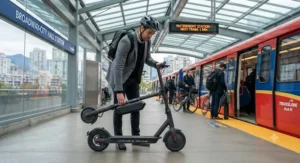
- Weigh portability against range — if stairs, transit, or apartment storage are part of your routine, a lighter medium range electric scooter may beat a heavier long-range flagship even if the numbers say otherwise.
- Check your municipality’s pilot program status before buying anything, since range is irrelevant if e-scooters aren’t legal where you plan to ride.
- Factor in battery cost vs range gains rather than chasing the biggest number on the listing — most riders overpay for range they rarely use.
- Consider an upgrade path — starting with an affordable medium range electric scooter and moving up later is often more financially sensible than overbuying on day one.
All-Round Medium Range Electric Scooters for Everyday Riders
For most Canadian city dwellers, an all-round medium range electric scooter is genuinely the more sensible default, not a compromise pick. The NIU KQi3 Sport exemplifies this bracket well — its blend of regenerative braking, self-healing tires, and a rated 50 km range covers the vast majority of urban commuting patterns without the added weight and cost of a long-range flagship. What most buyers overlook is that an all-round medium range electric scooter also tends to charge faster in absolute terms, simply because there’s less battery capacity to fill, which matters if you’re topping up overnight in a shared apartment building with limited outlet access. These scooters also tend to be lighter and more manageable for multimodal commuters who need to carry the scooter onto a bus or up a few flights of stairs partway through the trip — a genuine, everyday consideration that raw range numbers don’t capture. If your commute rarely exceeds 20 km round trip and you don’t have a strong reason to future-proof against longer rides, this bracket is where the best value in the category currently lives.
Affordable Medium Range Electric Scooters: Getting Range Without Overpaying
Not every rider needs — or can justify — a four-figure scooter, and the good news is that an affordable medium range electric scooter no longer means a dramatic compromise on build quality. The Hiboy S2 Pro and Segway Ninebot E2 Pro both demonstrate that sub-C$800 pricing can still deliver a 500W-class motor, real safety certification, and, in the E2 Pro’s case, smart features once reserved for premium models. On paper this means budget-conscious buyers aren’t necessarily trading away safety or reliability to get an affordable medium range electric scooter — they’re mostly trading away raw battery capacity and some ride comfort extras like advanced suspension. What most buyers overlook here is warranty and support quality: an affordable medium range electric scooter from an established brand with Canadian distribution channels tends to hold its value and reliability far better over two to three years than an unbranded budget import, even at a similar price point. The smartest move for cost-conscious shoppers is treating the affordable tier as a legitimate long-term option for short commutes, not just a stepping stone to something bigger.
Upgrade Path Considerations: When to Move From Medium to Long Range
Thinking through your upgrade path considerations early can save real money down the line, because scooters don’t hold resale value particularly well and buying twice is rarely cheaper than buying right the first time. If you’re a new rider unsure of your long-term commuting pattern, starting with an affordable medium range electric scooter and revisiting your upgrade path considerations after three to six months of real riding data is a genuinely sound strategy — you’ll know your true average daily riding distance by then, not a guess. The clearest signal that it’s time to act on your upgrade path considerations is consistently running the battery below 20% before you get home, or finding yourself mentally rationing speed to conserve charge — both are signs the range bracket no longer matches your life. Conversely, if you’re consistently finishing rides with 50%+ battery remaining, that’s a strong signal you overbought and a medium-range model would have served you just as well for considerably less money and weight.
If you’re commuting under 15 km round trip on mostly flat terrain, choose an affordable medium range electric scooter because the extra battery capacity of a long-range model will largely sit unused. If your round trip regularly tops 25 km, includes real hills, or runs through a Canadian winter, choose a long-range model because the buffer directly translates into fewer anxious rides home.
Practical Usage Guide: Getting Maximum Range From Any Scooter
Getting the most out of either a medium range or long range electric scooter comes down to a handful of habits rather than any single purchase decision. Ride in eco mode whenever your schedule allows — independent testing consistently shows eco mode adding 30% or more range over sport mode, which is often the difference between one charge lasting the whole week or needing a mid-week top-up. Keep tire pressure at the manufacturer’s recommended level, since underinflated tires increase rolling resistance and quietly eat into range on every single ride, an easy fix most riders never bother checking. Store your scooter and battery indoors overnight rather than in an unheated garage or shed, especially from November through March, since letting a lithium battery sit near freezing overnight measurably degrades both range and long-term battery health. In the first 30 days, the most common mistake new riders make is fully draining the battery repeatedly rather than charging in the 20-80% range most of the time — deep discharges accelerate capacity loss more than moderate, frequent top-ups do. Finally, build a simple maintenance rhythm: check tire pressure weekly, wipe down electrical contacts monthly, and inspect brake pads every few hundred kilometres, since a well-maintained scooter holds its rated range far longer than a neglected one.
Real-World Scenarios: Matching Riders to the Right Range
The downtown condo commuter: Rides roughly 6 km each way to a downtown office, has secure indoor storage, and occasionally hops on transit for the return trip in bad weather. An affordable medium range electric scooter like the Hiboy S2 Pro comfortably covers this pattern with room to spare, and its lighter weight makes the occasional transit transfer painless.
The suburban long-hauler: Covers 18 km each way to a suburban business park with no direct transit option and genuine hills along the route. This rider is squarely in long-range territory, and something like the Segway Ninebot MAX G2 or Segway Ninebot MAX G3 provides the buffer needed to handle both the distance and winter range loss without daily charging anxiety.
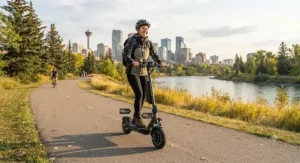
The weekend explorer and occasional commuter: Rides a shorter weekday commute but wants weekend flexibility for longer recreational rides along waterfront paths. A mid-tier option like the NIU KQi3 Sport splits the difference well, offering enough range for spontaneous longer rides without the bulk of a full long-range flagship.
Common Mistakes When Buying a Medium or Long Range Electric Scooter
The single most common mistake is buying based on the manufacturer’s advertised range figure rather than researched real-world numbers, which consistently run 15-40% lower depending on rider weight, terrain, and speed mode used. A close second is ignoring weight entirely — a long-range scooter that delivers 80 km but weighs 25 kg becomes a genuine burden the moment stairs or a bus transfer enter the picture, something spec sheets never highlight. Buyers also frequently underestimate winter’s effect on range, treating a scooter’s rated distance as a year-round constant rather than a number that can drop by a quarter or more once temperatures fall below freezing. Another recurring error is skipping the legal check entirely — purchasing a scooter without first confirming your municipality participates in a provincial pilot program, only to discover riding on public roads or sidewalks isn’t actually permitted where they live. Finally, plenty of riders overbuy on range “just in case,” paying a premium for battery capacity their actual average daily riding distance never comes close to using, when that money would have been better spent on suspension, tires, or a genuine safety certification.
Safety, Regulations & Compliance for Canadian Riders
Range means nothing if the scooter isn’t legal to ride where you live, and Canada’s e-scooter rules are genuinely a provincial patchwork rather than one consistent federal standard. Ontario runs its pilot program under Regulation 389/19, which caps speed at 24 km/h and requires individual municipalities to opt in — notably, Toronto has not joined, meaning riding on public roads, sidewalks, or bike lanes there remains illegal regardless of how much range your scooter has. British Columbia, Quebec, and several other provinces run comparable pilots with their own speed caps, minimum ages, and helmet requirements, so confirming your specific city’s rules before buying is a non-negotiable first step, not an afterthought. Battery safety deserves equal attention: look for scooters certified to ANSI/CAN/UL 2272 for the full electrical system and UL 2271 for the battery pack specifically, since these standards test for the overheating and short-circuit failures behind the lithium-ion fires that have prompted seasonal restrictions in cities like Toronto, where e-bikes and e-scooters are now banned from the TTC over winter months due to fire risk from road salt and moisture exposure. Never swap in an aftermarket battery to chase extra range — it’s precisely the kind of modification safety authorities warn voids both your warranty and your protection against thermal runaway incidents.
Frequently Asked Questions
❓ What's the real-world difference between medium range and long range electric scooters?
❓ How much range do I actually lose in Canadian winters?
❓ Is a long range electric scooter worth the extra cost for a short commute?
❓ Can I legally ride an electric scooter on the road in Ontario?
❓ How do I know when to upgrade from a medium range to a long range electric scooter?
Conclusion
The medium range vs long range electric scooter decision really comes down to one honest question: what does your actual average daily riding distance look like, not the commute you imagine on an ambitious day. For most Canadian city riders doing 8-20 km round trips, an all-round medium range electric scooter like the Hiboy S2 Pro or NIU KQi3 Sport delivers everything needed without the added weight, cost, and largely unused battery cost vs range gains of a flagship long-range model. Riders with genuinely longer commutes, hilly routes, or serious winter range anxiety are the ones who see real value stepping up to models like the Segway Ninebot MAX G2, Segway Ninebot MAX G3, or a seated option like the EMOVE Cruiser. Whichever bracket fits, don’t skip the unglamorous homework — confirm your municipality’s e-scooter rules, look for genuine UL 2272 and UL 2271 certification, and size your purchase around real riding data rather than a marketing number. Do that, and the scooter you buy this year is genuinely the one you’ll still be happy riding two winters from now.
Recommended for You
- 30-60 km Range Electric Scooter for Students: 7 Top Picks (2026)
- Electric Scooter For Medium Commutes: 7 Real Picks Tested (2026)
- Top Medium Range Electric Scooters Under $800 CAD: 7 Picks (2026)
Disclaimer: This article contains affiliate links. As an Amazon Associate, I earn from qualifying purchases. If you purchase products through these links, we may earn a small commission at no additional cost to you.
✨ Found this helpful? Share it with your friends! 💬🤗
