
In This Article
Most electric scooters are built around a 75-kilogram (165 lb) test rider, which is a polite way of saying they were never built with you in mind. If you have ever watched the range estimate on a scooter’s app plummet the second you step on, or felt a “powerful” motor wheeze on a modest hill, you already know the problem. A dual battery scooter for heavy riders solves this differently than a marketing slogan does: it pairs two power cells (or two motors drawing from a beefed-up pack) so the system isn’t gasping for amps every time you accelerate, climb, or just exist at a higher body weight. That matters because motor strain, battery voltage sag, and braking distance all scale with rider mass — ignore that, and you get a scooter that ages fast and stops slow. Below, we break down seven real, currently sold models, what “max rider weight” numbers actually mean in practice, and how to avoid overpaying — or underbuying — for the load you actually need to carry.
Quick Comparison Table
| Scooter | Max Rider Weight | Motor Setup | Price Range (CAD) | Best For |
|---|---|---|---|---|
| Hiboy S2 Max | 100 kg (220 lb) | Single 500W | Under C$750 | Lighter heavy riders, tightest budget |
| Gotrax GX Zero Dual Motor | 120 kg (264 lb) | Dual 500W | C$1,100–C$1,650 | Budget-conscious dual-motor entry |
| NAVEE GT3 Max | 120 kg (265 lb) | Single 1000W peak | C$950–C$1,150 | Value-focused commuters |
| Apollo Ghost | 136 kg (300 lb) | Dual 800W | C$2,000–C$2,300 | Canadian-brand reliability |
| EMOVE Cruiser S | 160 kg (352 lb) | Single 1000W, AWD available | C$2,300–C$2,750 | Highest weight rating, long range |
| Kaabo Wolf Warrior GT | 150 kg (330 lb) | Dual 1200W | C$3,600–C$4,100 | Serious hill-climbing, off-road |
| Kaabo Warrior 11 Max | 150 kg (330 lb) | Dual 1500W | C$4,500+ | Flagship power for the biggest riders |
Looking across the table, the spread in max rider weight — from 100 kg up to 160 kg — is the real story here, not top speed. Notice that the EMOVE Cruiser S claims the highest rating in this lineup despite running a single (very large) battery, which is a useful reminder that “dual battery” and “highest weight capacity” are related but not identical concepts. Budget buyers should also note that the jump from the Hiboy S2 Max to the Gotrax GX Zero Dual Motor roughly doubles the price but adds genuine mechanical redundancy, which matters far more once you’re above 90 kg.
💬 Just one click — help others make better buying decisions too!😊
Top 7 Dual Battery Scooters for Heavy Riders: Expert Analysis
1. Hiboy S2 Max — cheapest legitimate entry point, honest weight ceiling
The S2 Max opens the list not because it’s a dual battery unit — it isn’t — but because it’s the honest baseline every heavier rider should understand before spending more. Its 48V 11.6Ah battery and 500W motor (650W peak) push a claimed 65 km (40.4 mi) range, though that figure assumes a rider closer to 90 kg, and real-world testing from Amazon buyer Q&As suggests usable performance tapers noticeably as you approach its 100 kg (220 lb) limit. Based on the spec comparison, this is a scooter for someone at the lighter end of “heavy rider” territory, or a second scooter for a lighter household member. Reviewers consistently note that the dual braking system (front drum, rear regenerative) feels adequate at moderate speeds but that hill-climbing softens well before the rated 20% grade once rider weight climbs. What most buyers overlook is that the 10-inch pneumatic tires do a lot of the comfort work here, compensating for the absence of real suspension.
Pros:
- ✅ Lowest price point of any scooter on this list
- ✅ 10-inch pneumatic tires smooth out rough pavement
- ✅ Dual braking system for its price class
Cons:
- ❌ 100 kg weight limit rules out heavier riders
- ❌ Single battery, so no true power redundancy
At around C$550–C$750, the S2 Max is a reasonable buy only if you’re confident you sit under its stated limit — going in over-weight sacrifices exactly the range and speed that made it appealing.
2. Gotrax GX Zero Dual Motor — best all-round affordable dual battery electric scooter
This is the model that genuinely answers “affordable dual battery electric scooter” for a heavier rider on a real budget. Two 500W hub motors (one per wheel) share the load instead of forcing a single motor to do all the work, and Gotrax rates the GX Zero for 120 kg (264 lb) riders — a meaningful jump over the brand’s single-motor G-series. Here’s what to weigh: dual motors mean better traction in wet or loose conditions and noticeably steadier acceleration on inclines, since torque is split rather than concentrated at one wheel. Reviewers consistently note the ride feels planted at speed for a scooter in this price bracket, though the range (up to 51 km/32 mi claimed) drops meaningfully with a heavier rider and hillier routes. The spec sheet won’t tell you this, but user reports suggest the stock suspension is on the firmer side, so pairing it with slightly lower tire pressure helps larger riders absorb bumps.
Pros:
- ✅ True dual-motor redundancy at a genuinely accessible price
- ✅ 120 kg rating handles a wider range of heavier adults
- ✅ Noticeably better hill traction than single-motor budget rivals
Cons:
- ❌ Firm stock suspension tuning for rougher roads
- ❌ Claimed range drops fast above 100 kg rider weight
Typically priced in the C$1,100–C$1,650 range depending on promotions, the Gotrax GX Zero Dual Motor is the clearest “dual battery vs single battery electric scooter” upgrade decision on this whole list — for roughly C$400–C$600 more than the S2 Max, you get real weight headroom and motor redundancy.
3. NAVEE GT3 Max — best value for daily commuting at moderate heavy-rider weights
The GT3 Max leans on a single but large 477Wh battery paired with a peak 1000W motor, and NAVEE rates it for 120 kg (265 lb) riders — putting it in a near-tie with the GX Zero on capacity but with a noticeably different feel. Based on the spec comparison, the standout here is dual spring-and-cylinder suspension, front and rear, which most competitors at this price skip entirely. What most buyers overlook is that NAVEE’s official range and incline figures are measured at a 75 kg payload, so a heavier rider should expect the claimed 75 km (47 mi) eco-range to shrink substantially — third-party testers weighing around 100 kg have reported closer to half that on mixed terrain. Aggregated review sentiment describes the fold mechanism and deck size as comfortable for larger feet, and the tubeless tires as low-maintenance, though a few users flag charging time (roughly 8 hours) as slow for daily heavy use.
Pros:
- ✅ Genuine dual suspension for comfort at higher body weight
- ✅ 265 lb rating with tubeless, low-maintenance tires
- ✅ Strong value against its direct rivals
Cons:
- ❌ Single battery pack, not a true dual-cell system
- ❌ Real-world range for heavier riders falls well short of claims
At roughly C$950–C$1,150, the NAVEE GT3 Max rewards riders who prioritize ride comfort and daily reliability over outright weight ceiling or speed.
4. Apollo Ghost — Canadian-built dual motor, best for hill-heavy commutes
Apollo Scooters is headquartered in Vancouver, which matters here for a practical reason: their spec sheets, support, and warranty process are built around Canadian riding conditions rather than translated from an overseas listing. The Ghost pairs dual 52V 800W motors with an 18.2Ah battery pack (roughly 947Wh), rated for riders up to 136 kg (300 lb). On paper this means the Ghost sits squarely between budget dual-motor units and the true heavyweight flagships further down this list. What the spec sheet won’t tell you, but user reports suggest, is that thicker copper windings in later production runs measurably improved sustained hill performance under heavy loads compared to earlier batches — a detail that matters if you’re shopping secondhand. Reviewers consistently praise the tunable dual-spring suspension for stability over potholes, though several also flag the Ghost as one of the heavier scooters to carry at roughly 29 kg (64 lb), and the stock display can wash out in direct sunlight.
Pros:
- ✅ Genuine dual-motor power built and supported in Canada
- ✅ 300 lb rating with strong sustained hill-climbing
- ✅ Regenerative braking extends real-world range
Cons:
- ❌ Heavy at roughly 29 kg, awkward to carry upstairs
- ❌ Display can be hard to read in bright sunlight
Sitting around C$2,000–C$2,300, the Apollo Ghost is the pick for riders who want dual-motor performance backed by a Canadian company that actually understands provincial e-scooter rules.
5. EMOVE Cruiser S — highest max rider weight rating on this list
If “max rider weight ratings” is your single deciding factor, the Cruiser S leads this entire roundup with a manufacturer rating of 160 kg (352 lb) — noticeably above every other model here. It achieves this not through two separate battery packs but through one oversized 52V 30Ah (1560Wh) unit feeding a 1000W rear motor, with an all-wheel-drive dual-motor variant available for riders who want power split across both wheels. Here’s what to weigh: a single large-capacity cell can outperform two smaller batteries on raw weight tolerance and range, but it does mean less built-in redundancy if that pack ever needs service. Aggregated review sentiment consistently highlights the IPX6 water resistance and hybrid hydraulic brakes as standout safety features for heavier, faster riders, and the wide 21 cm deck earns repeat praise from larger-framed users who found narrower decks cramped. The spec sheet’s headline 100 km (62 mi) range is tested at 90 kg, so expect a real-world drop for riders near the weight ceiling.
Pros:
- ✅ 352 lb rating, the highest weight tolerance here
- ✅ Massive 1560Wh battery for genuinely long range
- ✅ IPX6 rating and hydraulic brakes suited to heavier, faster stops
Cons:
- ❌ Single-pack design lacks true dual-battery redundancy
- ❌ Long 9-12 hour charge time on the standard charger
Priced around C$2,300–C$2,750, the EMOVE Cruiser S is the strongest single pick if your primary filter is simply “who can carry me safely.”
6. Kaabo Wolf Warrior GT — best for aggressive hill-climbing and off-road heavy riders
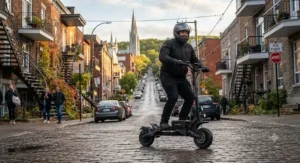
This is where “dual battery scooter for heavy riders” starts to mean something closer to a small electric motorcycle. The Wolf Warrior GT runs dual 1200W motors off a 60V 35Ah battery pack, rated for riders up to 150 kg (330 lb), with hydraulic disc brakes and an ABS system with regenerative braking on both wheels. Based on the spec comparison, the 30-degree hill-climb rating and IPX5 water resistance put this well ahead of anything in the budget or mid-range tiers on this list, which matters if your commute includes real hills rather than gentle grades. Reviewers consistently note the braking, while powerful, isn’t perfectly smooth at every speed — a fair trade-off for the stopping power such a heavy, fast machine needs. Important caveat: its rated top speed far exceeds the roughly 24-32 km/h ceiling most Canadian provinces set for legal road and bike-lane use, so this model is best suited to private land, sanctioned trails, or provinces with more permissive rules — verify locally before riding it on public infrastructure.
Pros:
- ✅ Dual 1200W motors handle steep grades with heavy riders
- ✅ Hydraulic brakes with ABS for confident stopping power
- ✅ 330 lb rating with genuine dual-battery-class performance
Cons:
- ❌ Top speed exceeds legal limits on most Canadian public roads
- ❌ Heavy at roughly 50 kg, limited portability
Expect to pay in the C$3,600–C$4,100 range for the Kaabo Wolf Warrior GT, positioning it as a genuine off-road or private-property performance machine rather than a casual commuter.
7. Kaabo Warrior 11 Max — flagship power for the biggest, toughest riders
At the top of this list sits the Warrior 11 Max, built around dual 1500W motors capable of 6720W peak output and 52 N·m of torque, still rated for the same 150 kg (330 lb) ceiling as the Wolf Warrior GT but delivering it with noticeably more headroom. What most buyers overlook is that torque, not top speed, is what actually matters for a heavy rider climbing from a dead stop — and this is where dual 1500W motors pull ahead of dual 1200W setups in daily, practical terms. The 11-inch tubeless, explosion-proof tires and dual-stem front end are engineering choices aimed squarely at stability under load rather than portability; this is not a scooter you’ll casually sling onto a bus. Aggregated review sentiment from Kaabo’s own product documentation and third-party riders emphasizes that heavier riders specifically benefit from the added torque margin, since underpowered motors under heavy load run hotter and wear faster over time. As with the Wolf Warrior GT, its performance envelope significantly outpaces standard Canadian public-road speed limits.
Pros:
- ✅ Dual 1500W motors with class-leading torque for heavy loads
- ✅ 330 lb rating with real performance margin, not just a spec-sheet number
- ✅ Dual-stem front end for stability at higher speeds
Cons:
- ❌ Very heavy and bulky, poor portability
- ❌ Premium price puts it out of reach for casual buyers
At C$4,500 and up, the Kaabo Warrior 11 Max is the clear choice only for riders who genuinely need flagship-level torque and are prepared to ride it somewhere its full speed range is actually legal.
Setting Up and Maintaining Your Dual Battery Scooter
Getting a heavy-duty scooter right starts before your first ride. Check tire pressure against the manufacturer’s upper range rather than the printed minimum — heavier riders benefit from slightly firmer tires to prevent pinch flats and rim contact. During the first 30 days, avoid fully draining either battery pack repeatedly; partial charging cycles between 20% and 90% extend lithium cell lifespan significantly more than full drain-and-charge routines, according to widely cited battery-management guidance from manufacturers like EMOVE and Kaabo. A common early mistake is over-tightening the folding mechanism’s safety latch, which can wear the locking pin prematurely; a light hand and monthly inspection go further than force. For dual-motor models specifically, check that both motors engage evenly during acceleration — a lag on one side often signals a controller sync issue worth flagging under warranty early rather than riding through it.
Monthly maintenance for any of these seven models should include a brake pad or shoe check (hydraulic systems on the Kaabo models need periodic bleed checks every few thousand kilometres), a bolt-torque pass on the stem and deck, and a visual battery housing inspection for swelling or damage. Heavier riders place more cyclical stress on suspension bushings and folding hinges than lighter riders do, so these wear points deserve extra attention every season. Store your scooter, and especially its battery, at room temperature rather than in a hot car trunk or an unheated garage through a Canadian winter, since extreme cold measurably reduces both range and battery lifespan.
Real-World Scenarios: Who Actually Needs a Dual Battery Scooter
Consider a 115 kg delivery rider in Calgary covering 25 km a day across mixed terrain and moderate hills. For this profile, the Kaabo Wolf Warrior GT or Apollo Ghost make more sense than a single-motor budget unit, since sustained heavy-load riding is exactly where a second motor prevents overheating and premature wear — though the delivery rider should confirm local speed-limit compliance for on-road use.
Now consider a 100 kg suburban commuter in Ottawa riding 8 km each way to a train station on mostly flat, paved paths. Here, the Gotrax GX Zero Dual Motor or NAVEE GT3 Max cover the actual need without overspending on torque and top speed that will rarely get used.
Finally, picture a 150 kg rider in a hillier city like Halifax who has been turned away by weight limits before. For this rider, the EMOVE Cruiser S stands out precisely because its 352 lb rating includes genuine performance margin rather than a bare-minimum tolerance — a distinction that matters enormously for safety and component longevity when you’re near the top of any scooter’s rated range.
How to Choose a Dual Battery Scooter for Heavy Riders
- Start with your actual weight, not your target weight. Choose a scooter rated at least 20-25% above your current body weight to preserve range, braking distance, and component lifespan.
- Match motor configuration to your terrain. Flat commutes rarely need dual 1200W+ motors; hilly or off-road routes benefit significantly from the added torque.
- Check real-world range at your weight class, not the marketing figure. Manufacturer ranges are typically tested at 75-90 kg riders.
- Confirm braking system quality. Hydraulic disc brakes stop heavier, faster scooters far more predictably than basic drum brakes.
- Verify provincial speed and power limits before buying a high-performance model. A 50 mph scooter may be legally restricted to private property in your province.
- Factor in portability realistically. Heavier-duty scooters often weigh 25-50 kg themselves; confirm you can actually carry, store, and transport it.
- Compare total cost, not just sticker price. Tires, brake pads, and battery replacement costs scale with a heavier-duty machine’s higher stress load.
Dual Battery vs Single Battery Electric Scooter: What Actually Changes
The core difference in a dual battery vs single battery electric scooter comparison isn’t just range — it’s how the system behaves under sustained load. A single-battery scooter pushes all current through one pack and controller, meaning voltage sag under heavy acceleration or hill climbing happens sooner and more sharply, particularly as rider weight increases. Reviewers consistently note that dual-motor or dual-cell systems (like the Gotrax GX Zero or Kaabo Warrior GT) maintain more consistent power delivery precisely because the electrical and mechanical load is split rather than concentrated.
That said, a large single battery, like the one in the EMOVE Cruiser S, can outperform a smaller dual-battery setup on raw capacity and weight tolerance — proving that “dual” isn’t automatically superior, but rather one of several engineering approaches to the same underlying problem: enough sustained power for a heavier load. What most buyers overlook is redundancy: if a single pack fails or degrades, the whole scooter is down, while genuinely dual-battery-equipped models can sometimes limp home on a single working cell. Value/ROI-wise, dual-motor systems typically cost more upfront but distribute mechanical wear across two smaller motors instead of overworking one larger motor, which can extend total drivetrain lifespan for consistently heavy riders.
Max Rider Weight Ratings: What They Really Mean
A scooter’s max rider weight rating is the manufacturer’s stated upper limit for safe, rated performance — but it is not a hard safety cliff, nor a guarantee of full advertised range and speed at that exact number. In practice, most published range, speed, and hill-climb figures are tested well below the stated maximum, often around 75-90 kg, so a rider closer to the actual ceiling should expect noticeably reduced performance across the board.
| Metric | At 75 kg (typical test weight) | Near Max Rated Weight |
|---|---|---|
| Range | Matches or exceeds spec sheet | Often 20-40% lower |
| Top speed | Matches spec sheet | Slightly reduced |
| Braking distance | Baseline | Measurably longer |
| Motor/battery heat | Low | Higher, more component stress |
| Best For | Lighter riders, spec-sheet shoppers | Heavier riders, real-world buyers |
The table makes the case plainly: buyers near a scooter’s weight ceiling should treat every published spec as an optimistic upper bound, not a guarantee. This is exactly why models like the EMOVE Cruiser S and Kaabo Warrior 11 Max, which build in genuine performance margin above the stated rating, tend to earn stronger long-term reliability sentiment from heavier riders than budget units rated right at the edge of a rider’s actual weight.
💬 Know your number before you shop — weigh yourself with a loaded backpack if you commute with gear.
Affordable Dual Battery Electric Scooter Options: Getting Real Power Without the Premium Price
Not every heavier rider needs a C$4,000 flagship, and the good news is that the affordable dual battery electric scooter segment has genuinely matured. The Gotrax GX Zero Dual Motor remains the clearest value pick here, delivering real dual-motor redundancy and a 120 kg rating for roughly a third of what the premium Kaabo models cost. What most buyers overlook is that budget dual-motor scooters often use smaller-capacity cells per motor rather than one large pack, which is why their range figures trail single-battery mid-range options like the NAVEE GT3 Max despite the mechanical advantage of two motors.
Based on the spec comparison across this list, the sweet spot for most heavier riders on a budget sits between C$1,100 and C$1,650 — enough to get genuine dual-motor traction and a meaningfully higher weight rating than entry-level single-motor scooters, without stretching into performance-scooter territory that most daily commuters will never fully use. If your commute is mostly flat, prioritize the price advantage; if hills are a regular factor, the extra investment in a model like the Apollo Ghost tends to pay for itself in reduced motor strain over time.
✨ Don’t Miss These Exclusive Deals!
🔍 Take your search for the right heavy-duty ride to the next level with these carefully selected picks. Click through to check current pricing and availability. A scooter that actually matches your weight and terrain will change how you get around your city.
Common Mistakes When Buying a Scooter for Heavy Riders
The single most common mistake is buying right at the weight limit instead of comfortably under it — a rider at 95% of a rated ceiling will feel every shortcoming the spec sheet doesn’t show. A second frequent error is ignoring tire type; solid tires are low-maintenance but transmit far more road shock to a heavier rider’s joints than pneumatic tires, which matters over a long daily commute. Buyers also commonly skip checking brake type entirely, assuming “it stops” is enough, when a heavier, faster rider genuinely needs hydraulic discs over basic drum brakes for predictable stopping distances. Another overlooked pitfall is assuming higher wattage alone solves everything, when torque, battery voltage, and controller quality all shape real-world hill performance just as much as the headline motor number. Finally, many riders skip verifying provincial speed and power regulations before buying a high-performance scooter like the Kaabo models above, only to discover it’s legally restricted to private property once it arrives.
What to Expect: Real-World Performance for Heavy Riders
Specs on a box translate differently once you’re actually riding. A scooter rated for 30 km/h will likely feel closer to 24-27 km/h for a rider near its weight ceiling, and that’s expected physics, not a defect. Hill climbing is where the gap is most noticeable: a single-motor scooter that confidently handles a 10% grade at 75 kg may bog down noticeably on the same hill at 110 kg, while dual-motor models like the Apollo Ghost or Kaabo Wolf Warrior GT hold speed far more consistently because torque is split across two wheels. Braking distance also stretches meaningfully with added weight and speed together, which is precisely why the hydraulic brake systems on the premium models in this list aren’t just a luxury feature for heavier riders — they’re a genuine safety requirement. Battery drain under heavier load is steeper too; expect your real range to land closer to the lower end of any manufacturer’s quoted window, especially in cold Canadian winters when lithium chemistry naturally loses efficiency.
Long-Term Cost & Maintenance: The True Cost of Ownership
The sticker price is only the starting point for a heavy-duty scooter’s total cost of ownership. Tires wear faster under sustained heavier loads, and pneumatic tires on models like the NAVEE GT3 Max or EMOVE Cruiser S will typically need replacement sooner than on a scooter carrying a lighter average rider — budget for this every 12-18 months of regular use. Brake pads and hydraulic fluid on the Kaabo flagship models also see more wear given both the higher speeds and heavier loads those scooters are built to handle, so factor periodic servicing into your ownership plan rather than treating it as a surprise expense. Battery replacement is the largest long-term cost across every model here, and heavier, more frequent use accelerates the natural capacity fade every lithium pack experiences over hundreds of charge cycles — a genuine dual-battery or dual-motor system can actually extend usable lifespan here, since load and heat are distributed rather than concentrated in one pack. When you compare cost-per-kilometre across the budget, mid-range, and premium tiers on this list, the mid-range models like the Apollo Ghost often deliver the strongest long-term value: enough build quality and power margin to avoid premature component failure, without the ownership costs of a full-performance flagship.
Safety, Regulations & Battery Compliance in Canada
Electric scooter regulation in Canada isn’t governed by one national rulebook. Since 2020, responsibility for defining and regulating “power-assisted” devices like e-scooters has largely shifted to the provincial and municipal level, which means the legal speed and power limits — commonly a 500W continuous motor and a roughly 24-32 km/h assisted-speed cap — vary depending on where you live and ride, and a device legal in one city may be restricted to private property just a short drive away, according to the Government of Quebec’s official guidance on motorized personal mobility devices. This is directly relevant to several scooters on this list: the flagship Kaabo models are engineered well beyond those legal thresholds, so confirm your province’s current rules, such as Ontario’s power-assisted bicycle regulation under the Highway Traffic Act, before assuming you can legally ride one on public roads or bike lanes.
Battery safety deserves equal attention, especially for heavier riders drawing more sustained current from larger packs. Canadian fire officials have flagged lithium-ion battery fires from e-scooters and e-bikes as a fast-growing risk, with Toronto’s fire chief specifically calling for stronger federal oversight of how these batteries are manufactured, sold, and charged, as reported by CBC News. Always charge on a hard, non-flammable surface, avoid unattended overnight charging, and choose scooters — like every model featured here — that carry recognized certification and a battery management system, rather than unbranded imports with no traceable safety testing.
Features That Actually Matter (And Those That Don’t)
Hydraulic brakes, genuine dual suspension, and an accurately rated weight capacity matter enormously for heavier riders — these directly affect your safety and comfort every single ride. A quality battery management system matters just as much, even though it’s invisible day-to-day, because it’s what actually protects cell health and prevents the thermal issues discussed above. On the other hand, flashy extras like ambient deck lighting or Bluetooth speaker integration, while pleasant, do nothing for load-bearing performance and shouldn’t sway a decision between two otherwise comparable scooters. Similarly, top speed numbers well above your province’s legal limit are largely marketing theatre for the average commuter — the torque and braking margin at legal speeds matters far more day-to-day than a headline number you’ll rarely, if ever, legally use.
FAQ
❓ What is the best dual battery scooter for a 300 lb rider?
❓ Are dual battery scooters actually better for heavy riders?
❓ How much does an affordable dual battery electric scooter cost in Canada?
❓ Can I legally ride a high-speed dual motor scooter on Canadian roads?
❓ How accurate are manufacturer max rider weight ratings?
Conclusion
Choosing a dual battery scooter for heavy riders really comes down to matching three numbers to your real life: your weight against the rated ceiling, your terrain against the motor and torque on offer, and your province’s legal speed limit against the machine’s actual top-end performance. Budget riders under roughly 120 kg have genuinely good options now in the Gotrax GX Zero Dual Motor and NAVEE GT3 Max, while riders closer to 300-350 lb should look seriously at the Apollo Ghost or the class-leading EMOVE Cruiser S. For riders who need serious torque for hills or off-road use, and are prepared to ride within legal limits on public roads, the Kaabo Wolf Warrior GT and Kaabo Warrior 11 Max deliver flagship-level performance margin that budget models simply can’t match. Whatever you choose, buy comfortably under a scooter’s stated weight limit rather than right at the edge of it — the difference shows up in range, braking, and how long the machine lasts.
✨ Ready to Ride?
🔍 Compare current prices on the models above and pick the one that actually matches your weight, terrain, and commute — not just the one with the flashiest spec sheet.
Recommended for You
- Fast Charging Electric Scooter: 7 Top 2026 Picks
- Dual Battery Scooter for Extended Range: 7 Real 2026 Picks
- Medium Range vs Long Range Electric Scooter: 7 Best Picks (2026)
Disclaimer: This article contains affiliate links. As an Amazon Associate, I earn from qualifying purchases. If you purchase products through these links, we may earn a small commission at no additional cost to you.
✨ Found this helpful? Share it with your friends! 💬🤗
