
In This Article
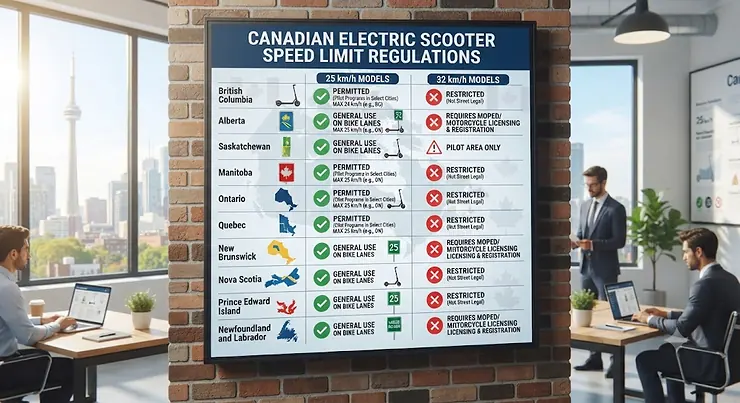
Here’s the question that trips up almost every first-time buyer: does the number on the spec sheet actually matter once you’re standing at a red light in real traffic? A 25 km/h vs 32 km/h electric scooter decision sounds like a rounding error — seven kilometres an hour, who cares — until you realize that number decides whether your scooter is legal on the street in front of your house, whether your insurance broker will even take your call, and whether you show up to work with your heart rate back to normal or spiked from weaving around a delivery van. This isn’t a spec-sheet flex. It’s a legal line drawn by your province, and depending on where you live in Canada, that line sits at a different height entirely.
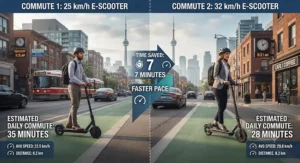
We dug through the actual provincial frameworks — Quebec’s, British Columbia’s, Nova Scotia’s, Ontario’s pilot rules, and the patchwork the rest of the country is still sorting out — and cross-referenced them against seven real scooters you can find on amazon.ca right now, from budget-friendly folders to a Montreal-engineered flagship. Some of these machines ship capped at 25 km/h out of the box. Others hit that 32 km/h ceiling by default and need a quick app adjustment depending on your postal code. We’ll walk through what each number means for your commute, your wallet, and — this part matters more than people think — your liability if something goes sideways. For the full legal picture, Québec’s official rules for motorized personal mobility devices are worth bookmarking before you buy anything.
Quick Comparison Table
| Speed Class | Typical Legal Provinces | Motor Power Needed | Best For |
|---|---|---|---|
| 25 km/h capped | Quebec, British Columbia | 350W-500W | New riders, dense urban cores, insurance-friendly builds |
| 32 km/h capped | Nova Scotia (provincial ceiling) | 500W-750W+ | Longer commutes, hillier routes, experienced riders |
| App-adjustable (25/32 km/h) | Anywhere the rider sets it correctly | 500W-2000W peak | Riders who cross provincial or municipal lines regularly |
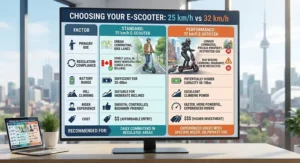
A quick scan of that table tells you most of what you need to know before you spend a cent: the “right” top speed isn’t really a performance question, it’s a postal-code question. Riders in Apollo City or Segway Ninebot Max G3 territory get the luxury of dialing the number down through an app, while a fixed-speed budget scooter locks you into whatever the manufacturer set at the factory. Nova Scotia is the outlier here, with a 32 km/h provincial ceiling that’s noticeably more generous than Quebec’s or BC’s 25 km/h cap — which is exactly why an app-adjustable scooter earns its higher price tag if you split time between provinces.
Just one click — help other Canadian parents make better buying decisions too! 😊
Top 7 Electric Scooters: Expert Analysis
1. Segway Ninebot Max G3 — app-adjustable speed for every province
The standout feature here isn’t the horsepower, it’s the flexibility: this scooter ships with region-specific speed caps, but Segway’s Mobility App lets you toggle between Eco, Standard, and Sport modes within the legal envelope your province allows. Under the hood you’re looking at an 850W nominal motor (2,000W peak) paired with a 597Wh battery, delivering a genuinely useful 60-80 km of range depending on mode — the kind of number that turns “I might run out of battery” anxiety into an afterthought. Based on the spec comparison against everything else in this roundup, the Max G3 is the only scooter here with dual hydraulic suspension front and rear, which matters enormously on Canadian streets where potholes appear seasonally like a bad houseguest.
This is the pick for someone who commutes across municipal boundaries or splits weekends between a 25 km/h city and a 32 km/h highway shoulder — the app does the compliance work so you don’t have to remember which bylaw applies where. Reviewers consistently report the ride quality as a noticeable step up from the previous-generation Max G2, particularly on rough pavement, though some note the 24.6 kg weight makes it less pocket-friendly for stairs-and-transit commuters.
Pros:
- ✅ App-adjustable speed matches provincial limits automatically
- ✅ Dual hydraulic suspension smooths out rough Canadian pavement
- ✅ Long real-world range reduces daily charging anxiety
Cons:
- ❌ Heaviest scooter in this lineup at 24.6 kg
- ❌ Premium price puts it out of reach for casual riders
At a price in the C$1,300-C$1,600 range at the time of research, the Max G3 earns its premium tag through genuine engineering rather than marketing gloss — check current price before buying, since Segway runs seasonal promotions often.
2. Apollo City — dual-motor commuter benchmark
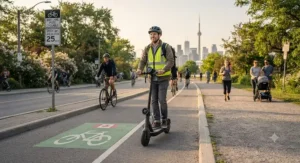
The standout here is raw redundancy: two 1,000W motors mean that even if one underperforms on a steep grade, the other picks up the slack, something single-motor scooters simply can’t offer. Montreal-designed and built for exactly the kind of freeze-thaw pavement cycles that chew through cheaper components, the City runs a 48V battery system delivering up to 69 km of range and a factory top speed well above what any Canadian province currently permits on public roads — which sounds counterintuitive until you realize the value is in the headroom, not the number itself. What most buyers overlook about dual-motor builds is that they’re not really about speed; they’re about consistent torque delivery when you’re hauling a backpack full of groceries up a hill in February.
Apollo’s own published data claims roughly six in ten riders who buy one eventually replace a car trip with it, and independent testers have clocked real-world top speeds in the low-to-mid 30 mph range unlocked — well above any legal Canadian street limit, underscoring why the app-based speed governor genuinely matters here rather than being a box-ticking formality.
Pros:
- ✅ Dual motors provide backup torque on hills and rough terrain
- ✅ IP66 water resistance built for Canadian weather swings
- ✅ Lifetime frame warranty backed by a Canadian company
Cons:
- ❌ Factory top speed far exceeds any legal Canadian road limit unlocked
- ❌ Heavier build makes it a poor fit for transit-and-carry commutes
Priced from around C$1,499 at the time of research (frequently discounted during seasonal sales), the Apollo City sits at the top of the “serious commuter” bracket — value-wise, it competes directly with the Segway Ninebot Max G3 on build quality, with the edge going to whichever brand’s app you find easier to live with.
3. Apollo Go — compact commuter with real suspension
The short version: this is the scooter for someone who wants Apollo’s build quality without Apollo’s biggest price tag. Dual 750W motors deliver genuinely surprising acceleration off the line, while a 48V battery pack provides up to 48 km of range — enough for a round-trip commute with a comfortable margin left over for detours. Here’s what the spec sheet won’t tell you, but reviewers note repeatedly: the dual spring suspension on the Go handles Canadian sidewalk seams and transit-grade pavement noticeably better than the rigid-frame budget scooters in this roundup, which matters more day-to-day than any top-speed number.
Independent reviewers testing the Go recorded real-world top speeds around 40 km/h unlocked, reinforcing that this is another scooter where the app-based speed limiter, not the hardware, is what keeps you compliant with a 25 km/h or 32 km/h provincial cap depending on where you live.
Pros:
- ✅ Dual motors give strong acceleration for a compact frame
- ✅ Spring suspension handles rough pavement better than rigid budget builds
- ✅ IP66 rating holds up through rain and slush
Cons:
- ❌ Real-world range drops noticeably in cold weather
- ❌ App speed-limiting requires manual attention when crossing provinces
At a price around the C$1,100-C$1,300 range at the time of research, the Apollo Go is the pragmatic middle option — less than the Apollo City, more capable than anything in the sub-C$1,000 bracket below.
4. NIU KQi3 Pro — best range-to-price ratio
The standout feature is efficiency: a 350W motor and 486Wh battery combine to deliver roughly 33-50 km of range depending on riding style, which on paper sounds modest next to the dual-motor entries above but in practice means fewer charging cycles per kilometre travelled than most competitors at this price. Based on the spec comparison, the KQi3 Pro’s aluminum alloy frame and 265 lb (120 kg) load capacity give it more structural headroom than most scooters in its price bracket, which matters if you’re a larger rider or occasionally carry a passenger’s backpack.
This is the pick for a budget-conscious commuter who wants dependable range over outright acceleration — someone doing a steady 6-10 km commute who values not thinking about the battery gauge more than shaving seconds off their 0-25 km/h time. A common theme in aggregated third-party testing is that the KQi3 Pro edges out the cheaper NIU KQi2 Pro largely on range and load capacity rather than top speed, and reviewers frequently flag the disc brakes as a meaningful upgrade over drum-brake competitors at a similar price.
Pros:
- ✅ Strong range-per-dollar compared to similarly priced scooters
- ✅ Higher 120 kg load capacity than most budget competitors
- ✅ Disc brakes offer more reliable stopping power than drum setups
Cons:
- ❌ Acceleration feels modest compared to dual-motor rivals
- ❌ No suspension, so rough pavement transmits more directly to the rider
Typically found in the C$950-C$1,100 range at the time of research, the NIU KQi3 Pro rewards patient commuters over speed-focused ones — a genuinely smart buy if range anxiety, not top speed, is your actual concern.
5. Apollo Air — lightest true Canadian-built option
The standout here is portability: at roughly 18.8 kg, this is the lightest scooter in the lineup by a meaningful margin, which matters enormously for anyone folding their scooter into a bus, train, or office closet daily. The 600W motor (800W peak) is modest on paper, but paired with the low overall weight, it delivers a genuinely peppy ride for daily errands and short-to-medium commutes without the bulk of the dual-motor options above. Reviewers consistently report that the Air punches above its price bracket on build quality — a reasonable expectation given Apollo’s reputation for the same aluminum-and-steel construction found across its pricier lineup.
What most buyers overlook about entry-level scooters from established brands is that the frame and brake hardware are often shared with the flagship models — you’re not getting a cut-rate chassis, just a smaller motor and battery. Independent ESG-style testing has clocked the Air’s real top speed around 33 km/h unlocked, comfortably within reach of both a 25 km/h and 32 km/h cap through the app.
Pros:
- ✅ Lightest scooter in this roundup at under 19 kg
- ✅ Shares frame quality with pricier Apollo models
- ✅ App-adjustable speed suits both 25 km/h and 32 km/h zones
Cons:
- ❌ Smaller battery means shorter range than the Go or City
- ❌ Less suspension travel than Apollo’s dual-motor models
Priced around C$800-C$950 at the time of research, the Apollo Air is the entry point into genuinely well-built Canadian engineering — ideal for anyone who values a light, foldable frame over sheer power.

6. Hiboy S2 Pro — flat-proof tires on a budget
The standout feature is maintenance-free tires: 10-inch solid honeycomb tires eliminate the flat-tire risk entirely, a detail that matters far more than most buyers realize until they’re stranded roadside with a pneumatic tire hissing air. A 500W motor and 36V 11.6Ah battery deliver a claimed range up to 25.6 miles (about 41 km), and the rear spring suspension — a genuine surprise at this price point — takes some of the edge off Canadian pothole season. Based on the spec comparison against the similarly priced Gotrax G4, the S2 Pro’s higher-wattage motor and added suspension are the two features that justify its modest price premium.
This is the pick for a rider who’s been burned by a flat tire before and wants that variable eliminated permanently, even if it means a slightly firmer ride than pneumatic tires provide. Aggregated third-party testing puts real-world top speed around 18.4-19 mph (roughly 30 km/h), which lands it squarely inside a 32 km/h provincial cap but requires attention in 25 km/h jurisdictions.
Pros:
- ✅ Solid tires eliminate flat-tire risk entirely
- ✅ Rear suspension is unusual at this price bracket
- ✅ Dual braking system adds a meaningful safety margin
Cons:
- ❌ Solid tires transmit more vibration than pneumatic alternatives
- ❌ No app-based speed governor for crossing provincial limits
Generally priced in the C$650-C$850 range at the time of research, the Hiboy S2 Pro is a smart pick for reliability-focused commuters who’ve had enough of tire repair kits.
7. Gotrax G4 — cheapest legitimate 32 km/h-capable build
The standout feature is straightforward value: a 350W-500W motor and 36V 10.4Ah battery deliver a factory top speed around 20 mph (32 km/h) at one of the lowest price points in this entire roundup, without cutting corners on the basics like dual braking and LED lighting. The 10-inch pneumatic tires provide noticeably better shock absorption than the S2 Pro’s solid rubber, a genuine trade-off worth weighing against puncture risk. Here’s what most budget-scooter shopping guides won’t tell you: the G4’s disc brake setup consistently outperforms drum-brake competitors in stopping-distance tests, which is arguably a more important safety spec than top speed for a first-time rider.
This is the pick for someone testing the waters with their first electric scooter, in a province or municipality where a 32 km/h cap (or a scooter simply ridden well under its top speed) is legal, and who wants to spend as little as possible while still getting a name-brand, warrantied product rather than an unbranded import. Aggregated review sentiment across major retailers consistently flags the G4 as “great value” and “good quality” for the price bracket, with occasional notes about minor cosmetic detail issues on individual units.
Pros:
- ✅ Lowest price point of any scooter in this roundup
- ✅ Pneumatic tires smooth out rough pavement better than solid alternatives
- ✅ Disc brakes outperform drum brakes in stopping distance
Cons:
- ❌ No suspension, so bumps still transmit to the deck
- ❌ Shorter real-world range than pricier competitors
Typically under C$700 at the time of research, often in the C$500-C$650 range during sales, the Gotrax G4 is the easiest entry point into electric scooter ownership without gambling on an unknown brand.
Practical Usage Guide: Setting Up and Riding Legally
Getting a new scooter out of the box is the easy part — getting it set up to match your province’s rules is where people trip up. Start by confirming your exact speed cap before your first ride: if you’re on a Segway Ninebot Max G3, Apollo City, Apollo Go, or Apollo Air, open the companion app immediately and set the speed limit to match your province — 25 km/h for Quebec or BC, up to 32 km/h where Nova Scotia’s provincial ceiling applies, and whatever your municipality specifies if you’re riding in an Ontario pilot city. Fixed-speed models like the Hiboy S2 Pro and Gotrax G4 don’t need this step, but you’re responsible for confirming their factory top speed doesn’t exceed your local limit regardless.
In the first 30 days, check tire pressure weekly if you’re on a pneumatic model (the Gotrax G4 or NIU KQi3 Pro), inspect brake pad wear after the first 100 km, and avoid charging the battery to 100% every single night — most manufacturers, including Segway and Apollo, recommend keeping the charge between 20% and 90% for daily use to extend battery lifespan over the long run. A common first-month mistake is leaving the scooter outside in freezing temperatures; lithium batteries lose a noticeable chunk of range in the cold, and repeated freeze-cycle exposure shortens their usable life. Bring it inside overnight whenever you can, especially through a Canadian winter.
Real-World Scenarios: Which Rider Are You?
Picture three different people staring at the same seven scooters, each with a completely different right answer. The downtown Montreal grad student riding six blocks to campus twice a day doesn’t need the Apollo City‘s dual motors — she needs the Apollo Air‘s light frame, easy fold, and a speed capped at exactly 25 km/h to match Quebec’s rider-speed rule, since going over that limit now carries the same legal weight as speeding in a car. Then there’s the Halifax nurse working rotating shifts, commuting 8 km each way on roads with real elevation change; for her, Nova Scotia’s more generous 32 km/h ceiling and the NIU KQi3 Pro‘s range-per-dollar make far more sense than paying a premium for speed she won’t fully use.
Finally, consider the Ottawa consultant who splits weeks between the city core (a 20 km/h municipal cap under the local pilot) and weekend trips to visit family in a Nova Scotia town where 32 km/h is legal — for that rider, an app-adjustable scooter like the Segway Ninebot Max G3 or Apollo Go isn’t a luxury, it’s the only option that doesn’t require owning two scooters or constantly guessing which bylaw applies. Matching the scooter to the actual commute, rather than to the biggest number on the box, is the single highest-leverage decision in this whole buying process.
What Is a 25 km/h vs 32 km/h Electric Scooter?
A 25 km/h vs 32 km/h electric scooter comparison refers to the two most common legal speed ceilings for personal e-scooters in Canada. A 25 km/h scooter is capped to match rules in Quebec and British Columbia, while a 32 km/h scooter matches Nova Scotia’s higher provincial limit; some models offer app-adjustable caps to legally match either.
That’s the textbook answer, but the practical reality has more texture. Provinces don’t just differ on the number — they differ on minimum rider age, helmet requirements, and where you’re actually allowed to ride the thing, whether that’s a bike lane, a 50 km/h-or-under road, or nowhere at all if you’re in Alberta or most of Toronto. The speed cap is really shorthand for an entire regulatory package, and buying a scooter based purely on top speed without checking the rest of that package is how well-meaning riders end up with an expensive fine or, worse, an uninsured claim after an accident.
How to Choose Between 25 km/h and 32 km/h
- Confirm your province’s actual legal ceiling first. Quebec and BC cap at 25 km/h; Nova Scotia allows up to 32 km/h; several provinces, including Alberta, don’t permit personal e-scooters on public roads at all outside rental pilots.
- Check your specific municipality, not just your province. Ottawa runs a 20 km/h city limit even though Ontario’s provincial pilot allows 24 km/h, and Toronto bans personal e-scooters entirely regardless of the provincial framework.
- Factor in your actual commute distance and terrain. A flat 3 km commute rarely needs 32 km/h capability; a hilly 10 km route benefits from the extra torque that usually comes bundled with higher-speed models.
- Decide if you’ll ever cross provincial lines with the scooter. If yes, prioritize an app-adjustable model like the Segway Ninebot Max G3 or an Apollo scooter over a fixed-speed budget option.
- Weigh insurance and liability exposure at each speed tier. Some insurers scrutinize higher-speed, higher-power scooters more closely when assessing liability claims — worth a call to your broker before you buy.
- Match the price to your actual riding frequency. A daily commuter justifies the Apollo City‘s premium price far more easily than an occasional weekend rider would.
- Test-ride if possible before committing to the higher speed tier. The jump from 25 km/h to 32 km/h feels larger in practice than the number suggests, especially for newer riders.

Provincial Speed Limits by Region: What’s Legal Where You Live
| Province/Region | Max Speed | Minimum Age | Notes |
|---|---|---|---|
| Quebec | 25 km/h (rider-capped) | 14 | Pilot extended to 2028; speed measured for the rider, not just the device |
| British Columbia | 25 km/h | 16 | Only legal in participating municipalities under the pilot |
| Nova Scotia | 32 km/h | 14 | Municipalities like Halifax can set lower local limits (25 km/h on roads) |
| Ontario | Up to 24 km/h (provincial), varies locally | 16 | Ottawa caps at 20 km/h; Toronto bans personal e-scooters entirely |
| Alberta | Not legal for personal use | N/A | Only municipally exempted rental fleets are permitted |
The pattern that jumps out immediately: Nova Scotia is the generous outlier, Quebec and BC sit at the stricter 25 km/h end, and Ontario is a genuine patchwork where your legal speed depends entirely on which city line you’re standing on. Alberta riders shouldn’t assume a personal scooter is legal on public roads at all, no matter how it’s capped — Calgary and Edmonton only permit shared rental fleets operating under specific municipal exemptions. Given how fast these rules shift year to year, cross-checking your specific municipality’s current bylaw before your first ride is genuinely worth the ten minutes it takes.
Electric Scooter for Road Use: Common Mistakes That Get Riders Ticketed
The single most common mistake is assuming a scooter’s factory top speed automatically makes it road-legal — it doesn’t. A Segway Ninebot Max G3 or Apollo City can hit speeds well beyond any Canadian provincial limit if you don’t set the app governor correctly, and riding it unlocked on a public road is treated the same as speeding in a car in most jurisdictions that regulate e-scooters at all. The second mistake is riding on sidewalks, which is banned almost everywhere in Canada regardless of your scooter’s speed cap — BC, Quebec, and most Ontario pilot municipalities all draw this line clearly, and it’s consistently one of the top reasons riders get ticketed.
A third mistake worth flagging: skipping the helmet because your scooter is “only” capped at 25 km/h. Helmet requirements in Quebec, BC, and Nova Scotia apply regardless of speed tier, and given that recent hospital data shows a significant share of severe e-scooter injuries involve riders who weren’t wearing one, it’s not a rule worth testing. CBC News reporting on rising hospitalization data found that scooter-related hospital visits climbed sharply year over year, with emergency physicians specifically warning that these aren’t the low-stakes toys many riders treat them as. The fourth mistake — riding a scooter rated above 500W on roads posted faster than 50 km/h — quietly reclassifies the device as something other than a legal e-scooter in several provinces, so check your motor’s continuous wattage against your province’s cap before assuming a road is fair game.
Insurance Considerations for Electric Scooter Owners
Here’s the uncomfortable truth most retailers won’t volunteer: in most of Canada, e-scooter riders aren’t legally required to carry insurance, but that doesn’t mean you’re automatically covered if something goes wrong. Whether your homeowner’s, condo, or renter’s policy extends liability coverage to an e-scooter accident genuinely depends on your specific policy wording and whether your scooter’s specs keep it classified as a “toy” rather than a motor vehicle under that policy’s definitions — a distinction that can hinge on details as specific as motor wattage. Industry reporting from Canadian Underwriter notes that e-scooter injuries and hospitalizations have been climbing steadily, and insurers are actively reassessing how they handle these claims as a result — this is very much a moving target, not a settled question.
What most buyers overlook about the 25 km/h vs 32 km/h distinction here is that a higher-power, higher-speed scooter is more likely to draw scrutiny in a liability claim than a lower-powered one, simply because it more closely resembles a motor vehicle in the eyes of an adjuster. Before you buy, a short call to your insurance broker to confirm what your existing policy actually covers — and whether a standalone rider or umbrella policy makes sense for your specific scooter’s power class — is worth far more than any spec sheet in this article.
Riding Experience Level: Which Speed Actually Matches You
New riders consistently underestimate how different 25 km/h feels compared to 32 km/h in actual traffic, especially in the first few weeks of ownership. If you’ve never ridden any kind of powered two-wheeled device before, starting with a 25 km/h-capped scooter like the Gotrax G4 or an app-limited Apollo Air gives you room to build reflexes — braking distance, balance on wet pavement, judging gaps in traffic — without the added margin for error that comes with an extra 7 km/h of closing speed. Reviewers and physicians alike note that inexperienced riders account for a disproportionate share of e-scooter injuries, and speed is consistently one of the compounding factors.
Experienced riders who’ve logged real hours on a bike, motorcycle, or lower-speed scooter already have the reflexes to handle 32 km/h safely, and for that group, the extra speed genuinely translates into a shorter, more practical commute rather than added risk. If you’re upgrading from an entry-level model to something like the NIU KQi3 Pro or Apollo Go, ease into the higher speed mode gradually over your first few rides rather than opening the throttle fully on day one — muscle memory from a slower scooter doesn’t transfer instantly, and that gap is exactly where avoidable spills happen.
25 km/h Electric Scooter Comparison: Head-to-Head Picks
| Scooter | Factory or App-Capped Speed | Price Range (CAD) | Best For |
|---|---|---|---|
| Gotrax G4 | ~32 km/h factory (ride under 25 km/h in QC/BC) | Under C$700 | First-time budget buyers |
| Hiboy S2 Pro | ~30 km/h factory | C$650-C$850 | Riders wanting flat-proof tires |
| Apollo Air | App-adjustable to 25 km/h | C$800-C$950 | Light, foldable daily commuting |
| NIU KQi3 Pro | Roughly 30 km/h factory | C$950-C$1,100 | Range-focused steady commuters |
For riders specifically bound by a 25 km/h electric scooter comparison — meaning Quebec or BC residents — the honest takeaway is that app-adjustable models like the Apollo Air offer genuine peace of mind over fixed-speed budget options, since you’re not relying on self-discipline alone to stay compliant. The Gotrax G4 and Hiboy S2 Pro remain excellent value, but riders in 25 km/h-capped provinces need to actively self-limit their throttle use, since neither ships with an app-based governor.
Common Mistakes When Buying: Beyond the Speed Number
Buyers fixate so hard on the top speed that they skip questions that matter just as much day to day. Battery chemistry and charge-cycle life get overlooked constantly — a scooter that hits 32 km/h but degrades noticeably after a single Canadian winter isn’t actually a better long-term buy than a slower model with a well-managed battery, like the thermally conservative charging behaviour built into the Segway Ninebot Max G3‘s battery management system. Tire choice is another blind spot: pneumatic tires like those on the Gotrax G4 and Apollo lineup ride more comfortably but carry flat risk, while solid tires like the Hiboy S2 Pro‘s eliminate that risk at the cost of a firmer ride — neither is objectively correct, but plenty of buyers don’t realize they’re making that trade-off at all.
Weight capacity is the third commonly skipped spec. A scooter rated for 100 kg genuinely won’t perform the same for a 95 kg rider as it will for a 60 kg rider — expect reduced range, slower acceleration, and more brake wear near the top of the rated capacity, regardless of whether the scooter is capped at 25 km/h or 32 km/h. The Montreal Children’s Hospital’s trauma program has also flagged rider weight and helmet fit as recurring factors in serious injury cases, a reminder that the “boring” specs deserve as much attention as top speed.
Long-Term Cost & Maintenance: 25 km/h vs 32 km/h
The upfront price gap between a 25 km/h-capped budget scooter and a 32 km/h premium model tells only part of the cost story. Higher-power motors and larger batteries, like those in the Apollo City and Segway Ninebot Max G3, generally cost more to service and replace parts for — expect battery replacement costs to scale roughly with battery capacity, and a 597Wh pack costs meaningfully more to replace than a 374Wh one. On the other hand, budget scooters like the Gotrax G4 often use more common, interchangeable parts that are cheaper and faster to source when something wears out, which can offset their shorter expected lifespan in total cost of ownership terms.
Tire replacement is a recurring cost worth budgeting for regardless of speed tier: pneumatic tires need occasional replacement or patching over a scooter’s life, while solid tires like the Hiboy S2 Pro‘s rarely need attention but transmit more vibration into other components over time, which can accelerate wear on bearings and welds. ✨ Ready to see how your commute stacks up? Compare your daily distance against each model’s real-world range before you commit. 🔋
Frequently Asked Questions
❓ Is a 32 km/h electric scooter legal in Ontario?
❓ Do I need a licence to ride a 25 km/h electric scooter in Quebec?
❓ Which is safer, a 25 km/h or 32 km/h electric scooter?
❓ Can I insure my electric scooter in Canada?
❓ How much does a good 32 km/h electric scooter cost in Canada?
Conclusion
At the end of the day, the 25 km/h vs 32 km/h electric scooter question isn’t really about which number sounds more impressive on a spec sheet — it’s about matching a legal, insurable, genuinely comfortable ride to the province and municipality you actually live in. Quebec and BC riders are locked into 25 km/h regardless of what their scooter is technically capable of, Nova Scotia riders get a bit more breathing room at 32 km/h, and everyone else needs to check their specific city’s bylaw before assuming either number applies. Among the seven scooters we covered, the Segway Ninebot Max G3 and Apollo lineup earn their higher price tags by making that compliance question a non-issue through app-based speed governors, while the Gotrax G4 and Hiboy S2 Pro remain smart, honest budget picks for riders willing to self-manage their throttle.
Whichever speed tier fits your commute, the real win is buying a scooter that matches your actual riding conditions rather than chasing the biggest number in the store. 🚴♂️ Ready to find your fit? Check current prices on today’s top picks and start commuting smarter this season! ⚡
Recommended for You
- 25 km/h Electric Scooter for Beginners: 7 Safe Picks (2026)
- 7 Best 25 km/h Electric Scooters Under C$700 (Ranked 2026)
- 7 Best Legal Electric Scooters for Commuting in Canada 2026
Disclaimer: This article contains affiliate links. As an Amazon Associate, I earn from qualifying purchases. If you purchase products through these links, we may earn a small commission at no additional cost to you.
✨ Found this helpful? Share it with your friends! 💬🤗
