
In This Article
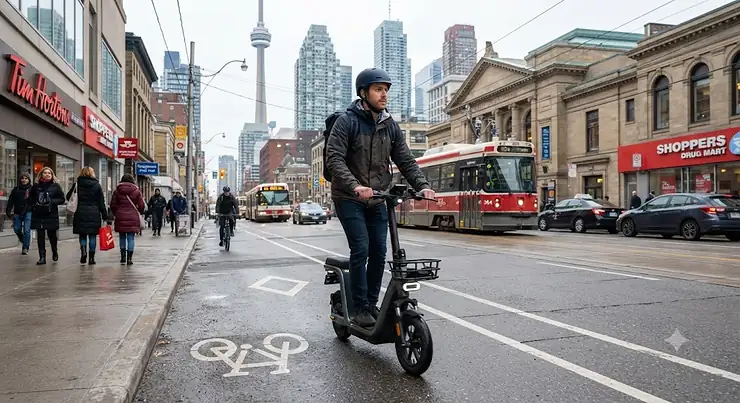
Somewhere between the wheezing folding bike you never quite maintain and the 45 km/h performance scooter that turns every ride into a legal grey area sits a genuinely useful category: the mid-speed electric scooter for commuting. It is not trying to be a motorcycle. It is not trying to be a toy, either. It exists to solve one specific problem — getting you from a transit stop, a driveway, or an apartment lobby to a desk somewhere a few kilometres away, without a car, a bus transfer, or a shower afterwards.
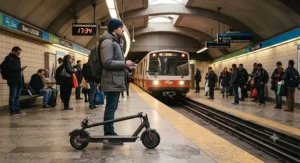
So what is a mid-speed electric scooter for commuting? It is an electric kick-scooter built around a single mid-tier motor in the 300-600W range, with a governed top speed generally around 30-32 km/h, sized and priced to serve everyday urban trips rather than off-road thrills or professional-grade top speed. That definition matters because the category directly above it — dual-motor scooters pushing 750W to 2,000W and 45-70 km/h — is engineered for an entirely different rider, and most Canadian roads and sidewalks were never going to legally accommodate that kind of speed anyway.
That last point turns out to be the whole story. A power-assisted device capable of hitting 32 km/h on a factory spec sheet is a genuinely different animal from a device you are legally allowed to ride at 32 km/h on a Canadian street, and the gap between those two facts is where most first-time buyers get tripped up. We researched seven real mid-speed electric scooters for commuting currently sold in Canada, spanning budget imports under C$650 to a Canadian-built option pushing C$900, specifically so you can match a scooter’s real motor power and governed speed to what your own province will actually let you do with it.
Quick Comparison Table
| # | Product | Motor Power | Top Speed | Range | Best For |
|---|---|---|---|---|---|
| 1 | GoTrax G4 | 500W | 32 km/h (20 mph) | Up to 40 km | Best budget overall |
| 2 | TurboAnt X7 Pro | 350W | 32 km/h (20 mph) | Up to 48 km | Longest range under C$650 |
| 3 | isinwheel S9Max | 500W | ~32-34 km/h | Up to 35 km | Smoothest ride on rough pavement |
| 4 | Segway Ninebot F40 | 350W | 30 km/h | Up to 40 km | Best brand trust for first-timers |
| 5 | Hiboy MAX3 | 350W | 30 km/h (18.6 mph) | Up to 27-40 km | Most portable fold |
| 6 | Apollo Dash | 600W | 32 km/h | Up to 40 km | Best Canadian-built option |
| 7 | NIU KQi3 Max | 450W (900W peak) | 32 km/h standard | Up to 65 km | Longest range in this lineup |
Scanning this table, the detail that jumps out isn’t brand recognition — it’s how tightly clustered these top speeds are. Every single mid-speed electric scooter for commuting on this list lands within 2-4 km/h of the others, which tells you the real differentiator in this category is motor torque, range, and build quality, not raw speed. The NIU KQi3 Max stands apart mainly on range rather than top speed, nearly doubling what the budget picks like the GoTrax G4 or isinwheel S9Max offer on a single charge, while the Apollo Dash carries noticeably more motor power (600W rated) than its 32 km/h ceiling would suggest, which shows up mostly as better hill-climbing rather than a faster cruising speed.
💬 Just one click — help other Canadian commuters make better buying decisions too!😊
Top 7 Mid-Speed Electric Scooters for Commuting: Expert Analysis
1. GoTrax G4 — best budget overall for flat commutes
The standout feature is straightforward value: a genuine 500W motor and 32 km/h top speed for less than half what several premium picks in this guide cost. The 10-inch shock-absorbing tires handle typical city bike lanes reasonably well, and the two-gear speed setting lets new riders ease into full throttle rather than being thrown straight into 20 mph the first time they twist it. Based on the spec comparison, this is the pick for a first-time buyer who mostly rides flat, paved commutes and wants to test whether scootering to work actually fits their routine before spending real money on a premium model. Aggregated reviewer sentiment from gear-testing outlets consistently frames the G4 as one of the strongest value propositions in the budget segment, praising the responsive customer support and straightforward assembly, while the recurring criticism is that the factory suspension tuning struggles once pavement quality drops.
Pros:
- ✅ Genuine 500W motor at a genuinely budget price point
- ✅ Two-gear speed setting eases new riders into full throttle
- ✅ Widely stocked with accessible replacement parts
Cons:
- ❌ Shock absorption is noticeably firm on cracked pavement
- ❌ Real-world range trails the rated figure in cold weather
Expect pricing in the C$500-C$620 range at the time of research, a reasonable entry point for testing the category.
2. TurboAnt X7 Pro — longest range under C$650
The standout feature is genuine efficiency: a 350W front hub motor paired with a battery rated for up to 48 km, the longest realistic range of any scooter under C$650 in this lineup. The dual braking system — regenerative electronic braking plus a rear disc brake — gives new commuters real stopping confidence at 32 km/h, and the fold collapses small enough to slide under most transit seating or a compact office desk. On paper, this makes the X7 Pro the pick for anyone with a longer last-mile stretch, such as riders connecting from a suburban GO Transit or SkyTrain stop rather than a downtown core address, since range is exactly where this model outperforms its price class. Aggregated reviewer sentiment, including a dedicated entry on the model’s own Wikipedia page, consistently describes the X7 Pro as one of the more balanced sub-$500 USD commuter scooters on the market, with the main recurring caveat being that its 8.5-inch tires transmit more road vibration than the 10-inch tires found on pricier rivals.
Pros:
- ✅ Longest realistic range of any pick under C$650
- ✅ Dual braking system builds real confidence at full speed
- ✅ Compact fold suits transit-connected commutes
Cons:
- ❌ Non-removable battery means charging the whole scooter in place
- ❌ Smaller 8.5-inch tires ride harsher than 10-inch alternatives
Look for it in the C$550-C$650 range — a strong value pick for range-focused commuters.
3. isinwheel S9Max — smoothest ride on rough pavement
The standout feature is genuine front-and-rear dual suspension, a feature typically reserved for pricier scooters, paired with a 500W motor that several retail listings clock at 32 km/h and others at a shade over that, depending on regional firmware. Ten-inch solid tires plus that dual suspension setup meaningfully soften the frost-heaved pavement and pothole patches that show up every spring across most Canadian cities, and an optional clip-on seat converts it into a hybrid seated commuter for longer rides. Based on the spec comparison, this is the pick for anyone whose commute route includes rougher secondary streets or poorly maintained bike paths, where suspension quality matters more than outright motor power. Aggregated reviewer sentiment across marketplace listings is generally positive on ride comfort and the companion app’s remote-lock feature, though isinwheel as a brand carries a shorter track record than legacy players like Segway or NIU, and top-speed claims vary slightly between listings of what appears to be the same core hardware.
Pros:
- ✅ Genuine front-and-rear suspension rare at this price
- ✅ Optional seat attachment for longer, hybrid-style rides
- ✅ App-based remote motor lock adds real anti-theft value
Cons:
- ❌ Shorter brand track record than legacy competitors
- ❌ Top-speed specs vary slightly by regional listing
Typical pricing lands in the C$450-C$580 range, a strong pick for comfort-focused commuters on rougher routes.
4. Segway Ninebot F40 — best brand trust for first-time buyers
The standout feature is exactly what you’d expect from the company that popularized the category: Segway-Ninebot’s global parts network and companion app, which logs ride history and pushes firmware updates most budget competitors simply don’t offer. The 350W front hub motor tops out at a governed 30 km/h with a rated range up to 40 km, though real-world testing by independent reviewers has clocked closer to 24-30 km depending on mode and temperature — an honest gap worth planning around rather than a flaw unique to this model. On paper, this makes the F40 the pick for a nervous first-time buyer who values brand longevity, resale value, and being able to find replacement tires or a battery years from now over squeezing out the absolute longest range on a spec sheet. Aggregated reviewer sentiment consistently credits the F40 with sturdy build quality and a smoother ride than many similarly priced imports, while the fair criticism across independent reviews is that its 350W motor is on the modest end of this entire lineup, so hill-heavy commutes will feel it.
Pros:
- ✅ Backed by Segway-Ninebot’s global parts and support network
- ✅ Companion app tracks ride history and firmware updates
- ✅ Sturdier ride quality than most similarly priced imports
Cons:
- ❌ Real-world range runs meaningfully below the rated spec
- ❌ Motor power is modest for hillier commute routes
Budget roughly C$550-C$700 at the time of research — a safe, well-supported choice for cautious first-time buyers.
5. Hiboy MAX3 — most portable fold for transit connections
The standout feature is genuine portability: at roughly 18.1 kg (40 lb), the MAX3 is among the lighter scooters in this guide to carry up a flight of stairs or through a subway turnstile, without sacrificing the 350W motor and 30 km/h top speed that define this category. Dual shock absorbers smooth out last-mile obstacles like curb cuts and cobblestone plazas, and Hiboy rates the range up to roughly 40 km, though independent testing has more consistently landed closer to 27 km in mixed riding conditions. Based on the spec comparison, this is the pick for commuters whose trip genuinely mixes scootering with transit or stairs — someone riding to a train platform, folding the scooter, and carrying it the rest of the way — since weight matters as much as range in that specific routine. Aggregated reviewer sentiment from dedicated e-scooter review outlets has called the MAX3 one of the better-balanced scooters in its class, while customer service experiences reported across forums are more mixed than for Segway or NIU, worth weighing if post-purchase support matters to you.
Pros:
- ✅ Among the lightest folds in this entire lineup
- ✅ Dual shock absorbers ease last-mile obstacles
- ✅ Frequently discounted well below its list price
Cons:
- ❌ Real-world range trails the rated spec more than most rivals
- ❌ Customer support reports are more mixed than legacy brands
Expect pricing in the C$480-C$600 range, a strong choice for transit-and-scooter hybrid commutes.

6. Apollo Dash — best Canadian-built option for local support
The standout feature is where this scooter comes from: Apollo Scooters is a Vancouver-founded company, and the Apollo Dash is its entry-level commuter model, carrying a 600W rated motor (1,200W peak) that gives it noticeably more torque than anything else in this guide despite sharing the same 32 km/h governed top speed. That extra torque shows up specifically on hills — a 600W motor simply doesn’t bog down on a 10% grade the way a 350W unit can — and Apollo’s Canadian presence means warranty claims and replacement parts don’t have to cross a border. On paper, this makes the Dash the pick for commuters in hillier cities like Vancouver, Hamilton, or parts of Quebec City, or anyone who has been burned before by a cross-border warranty claim on an imported scooter that took months to resolve. Aggregated reviewer sentiment around Apollo as a company consistently describes the brand as a trusted name in the Canadian e-scooter space, with the fair trade-off being that the Dash costs more than budget imports offering similar 32 km/h top speeds, and at 19.5 kg (43 lb) it’s heavier than the lightest picks here.
Pros:
- ✅ Highest-torque motor in this lineup for hilly commutes
- ✅ Canadian company means local warranty and parts support
- ✅ Backed by a company with a longer domestic track record
Cons:
- ❌ Priciest pick relative to its 32 km/h top speed
- ❌ Heavier than the lightest budget imports in this guide
Look for it in the C$800-C$900 range — a premium built specifically around Canadian ownership and support.
7. NIU KQi3 Max — longest range in this lineup
The standout feature is sheer range: NIU rates the KQi3 Max at up to 65 km on a single charge, nearly double what most budget picks in this guide offer, powered by a 450W rated motor (900W peak) that governs to 32 km/h in standard mode with a further unlockable mode reaching 38 km/h where local rules permit. A triple braking system — front disc, rear regenerative, and NIU’s e-ABS — gives this model the most reassuring stopping power in the entire lineup, which matters more at highway-adjacent bike lane speeds than most riders expect until they need it. Based on the spec comparison, this is the pick for a genuine daily commuter covering longer distances who wants to charge once every few days rather than nightly, and who values braking performance enough to pay a premium for it. Aggregated reviewer sentiment, including outlets that have specifically called the KQi3 Max the current gold standard among mid-speed commuter scooters, consistently praises the range and braking, while the honest trade-off is that at roughly 21 kg (46.3 lb) it’s the heaviest scooter here and priced well above every other pick.
Pros:
- ✅ Nearly double the range of the budget picks in this guide
- ✅ Triple braking system is the most reassuring here
- ✅ Unlockable higher-speed mode adds headroom where rules allow
Cons:
- ❌ Heaviest scooter in this entire lineup
- ❌ Highest price point of any pick here
Budget roughly C$850-C$950 at the time of research — the clear range-and-braking ceiling of this lineup.
Full Spec Comparison: All 7 Mid-Speed Electric Scooters for Commuting at a Glance
| Product | Motor Power | Top Speed | Range | Weight | Best For |
|---|---|---|---|---|---|
| GoTrax G4 | 500W | 32 km/h | Up to 40 km | 16.8 kg (37 lb) | Best budget overall |
| TurboAnt X7 Pro | 350W | 32 km/h | Up to 48 km | 15 kg (33 lb) | Longest range under C$650 |
| isinwheel S9Max | 500W | ~32-34 km/h | Up to 35 km | 15.4 kg (34 lb) | Smoothest ride on rough pavement |
| Segway Ninebot F40 | 350W | 30 km/h | Up to 40 km | 15.9 kg (35 lb) | Best brand trust |
| Hiboy MAX3 | 350W | 30 km/h | Up to 27-40 km | 18.1 kg (40 lb) | Most portable fold |
| Apollo Dash | 600W (1,200W peak) | 32 km/h | Up to 40 km | 19.5 kg (43 lb) | Best Canadian-built option |
| NIU KQi3 Max | 450W (900W peak) | 32 km/h | Up to 65 km | 21 kg (46.3 lb) | Longest range |
Weight and motor power turn out to move together more than you’d expect in this table. The three heaviest scooters — the Apollo Dash, NIU KQi3 Max, and Hiboy MAX3 relative to its weight class — also carry the strongest torque or range figures, which is simply the honest physics of bigger batteries and beefier motors adding mass. That trade-off matters most if your commute involves carrying the scooter up stairs or onto a bus rather than riding it door-to-door, in which case the lighter TurboAnt X7 Pro or isinwheel S9Max may serve you better than the spec sheet’s raw numbers suggest.
Setting Up Your Mid-Speed Electric Scooter for Daily Commuting
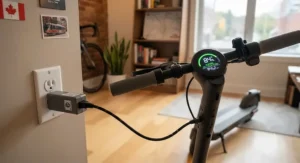
Getting real value out of a mid-speed electric scooter for commuting starts before the first ride to work. Charge the battery fully before your first outing and let it run down closer to empty on that first trip — this lets the battery management system calibrate an accurate range estimate, rather than the optimistic number most apps display out of the box. Check tire pressure weekly rather than monthly; scooters like the GoTrax G4 and isinwheel S9Max with air-filled or foam-filled tires lose noticeable ride comfort and range efficiency as pressure drops, especially once overnight temperatures start dropping below zero.
A common first-month mistake is leaving the scooter folded and locked outside overnight during a Canadian winter, which stresses battery cells that lithium-ion chemistry simply doesn’t tolerate well in deep cold. Store the scooter indoors whenever possible, and if your commute genuinely requires outdoor parking, look at models like the Apollo Dash that specifically market cold-weather-tested battery performance. Set a maintenance rhythm early: check brake pad wear monthly, tighten the folding mechanism’s locking lever every few weeks since vibration loosens it over time, and treat the deck grip tape as a wear item that eventually needs replacing rather than something built to last the scooter’s whole lifespan.
Solving Common Commuter Problems With a Mid-Speed Electric Scooter
Several recurring problems show up once people actually start commuting on a mid-speed electric scooter for commuting rather than just riding recreationally. The first is range anxiety on a return trip after a full workday — the fix is charging at your desk if an outlet is available, or simply buying one range tier above what your commute math says you need, since cold weather and headwinds routinely cut real-world range by 15-25% below the rated figure. The second is theft risk during an eight-hour workday parked outside; scooters like the isinwheel S9Max with app-based remote motor locking, or a simple secondary cable lock threaded through the frame, meaningfully reduce opportunistic theft compared with relying on the built-in key lock alone.
A third common problem is arriving at work looking like you just rode an electric scooter for commuting — sweaty, windblown, or splashed by a puddle. The honest solution is route planning around protected bike lanes rather than shoulder riding, and packing a light rain shell rather than assuming any of these scooters are genuinely waterproof beyond light drizzle. Finally, riders frequently discover mid-commute that their chosen route isn’t actually legal for a personal e-scooter in their city, which is a regulatory problem rather than a hardware one, and it’s serious enough to deserve its own section below.
Real-World Scenarios: Which Mid-Speed Electric Scooter Fits Your Commute
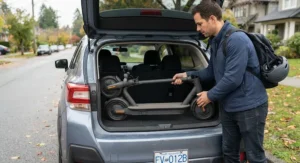
Consider three genuinely different commuters. A downtown condo resident with a flat 3 km ride to the office, budget-conscious and testing whether scootering even suits their routine, is the clearest match for the GoTrax G4 — enough motor and range to prove the concept without a four-figure commitment. A suburban commuter connecting from a GO Transit, West Coast Express, or REM station to an office a further 6-8 km away, where range and a comfortable ride matter more than raw speed, fits well with either the TurboAnt X7 Pro for value or the NIU KQi3 Max if budget allows, since both are built around covering distance rather than short hops.
And a rider in a hillier Canadian city — parts of Vancouver, Hamilton, or Quebec City’s older core — who needs real torque rather than just a top-speed number, is the realistic buyer for the Apollo Dash, whose 600W motor won’t bog down on inclines the way the 350W options in this guide can. A commuter mixing scootering with transit, folding the scooter for the second leg of the trip, should weigh the Hiboy MAX3‘s lighter carry weight against the isinwheel S9Max‘s smoother ride on rough connecting streets, depending on which part of that hybrid trip is actually harder on the body.
How to Choose a Mid-Speed Electric Scooter for Commuting
- Start with your actual commute distance, then add 30%. A mid-speed electric scooter for commuting rated for 40 km should realistically be shopped for an 8-10 km round trip once cold weather and hills are factored in.
- Match motor power to your terrain, not just your speed target. A 32 km/h top speed means little on a hill if the motor is only 300-350W; riders in hilly areas should lean toward the 500-600W end of this lineup, like the Apollo Dash or NIU KQi3 Max.
- Weigh the scooter you’ll actually carry, not the one on the spec sheet. If your commute includes stairs or a transit transfer, prioritize the Hiboy MAX3 or TurboAnt X7 Pro over heavier, longer-range options.
- Check your province’s e-scooter rules before your top speed, not after. A scooter capable of 32 km/h may still be governed down to 24-25 km/h to ride it legally, depending on where you live — more on that below.
- Prioritize dual braking systems for full-speed stopping confidence. Regenerative plus mechanical braking, found on the TurboAnt X7 Pro and NIU KQi3 Max, matters more at 30+ km/h than most first-time buyers expect.
- Treat suspension as a real feature, not a luxury add-on. Riders on rougher secondary streets should weigh the isinwheel S9Max‘s dual suspension against a firmer-riding budget pick before assuming price alone should decide.
- Factor in local parts and warranty support, not just upfront price. A scooter from a company with a Canadian presence, like Apollo, or a global brand like Segway-Ninebot or NIU, tends to be easier to service years down the road than a smaller import brand.
Provincial Speed Permissions: What Your Scooter Can Actually Do on Canadian Roads
Here is the part of buying a 32 km/h electric scooter that most product listings never mention: no major Canadian province currently permits riding a privately owned e-scooter at a full 32 km/h on public roads. Ontario’s electric kick-scooter pilot, for example, caps operation at 24 km/h and requires a maximum motor power of 500W, restricts riders to age 16 and up, and leaves the decision of where scooters can actually be ridden — roads, bike lanes, trails — up to each municipality, with controlled-access highways always off-limits. British Columbia’s pilot project runs similarly, capping speed at 25 km/h with the same 500W power ceiling, requiring a helmet at every age rather than just under 18, and restricting legal riding to participating municipalities only, which is a shorter list than most buyers assume.
Quebec follows a comparable pattern with its own numbers: a 25 km/h maximum speed, a minimum age of 14, mandatory helmets, and legal use limited to roads posted at 50 km/h or less along with adjacent bike paths, with municipalities free to post additional restrictions. Alberta sits in a genuinely different position — its provincial e-scooter framework only governs shared, operator-run fleets in Edmonton and Calgary, and personally owned e-scooters fall into more of a municipal bylaw grey zone depending on the city.
| Province | Max Speed Allowed | Minimum Age | Where You Can Ride |
|---|---|---|---|
| Ontario | 24 km/h | 16 | Set by municipality; no controlled-access highways |
| British Columbia | 25 km/h | 16 | Participating municipalities only |
| Quebec | 25 km/h | 14 | Roads ≤50 km/h and adjacent bike paths |
| Alberta | No personal e-scooter framework | Varies by city bylaw | Shared fleets only in Edmonton/Calgary |
Reading this table against the product specs above, the practical takeaway is uncomfortable but important: every mid-speed electric scooter for commuting in this guide is factory-capable of a higher top speed than any province currently permits on a public street. That doesn’t make these scooters illegal to own — most models, including every pick here, offer a lower-speed riding mode you’re expected to actually use, and several municipal bylaws are written around motor power and device class rather than a scooter’s absolute top speed. It does mean you should treat the “32 km/h” spec as a ceiling for private property or a track day, not a number to plan your commute time around, and you should check your specific municipality’s bylaw before assuming provincial speed permissions automatically apply the same way city to city.
Commuting Time Savings: How a Mid-Speed Scooter Compares to Transit and Driving
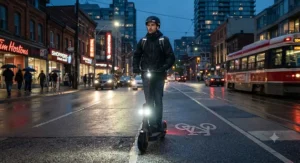
The honest case for a mid-speed electric scooter for commuting comes down to a specific number: how much of your day it gives back. Statistics Canada’s most recent commuting data puts the average one-way commute by public transit at 42.9 minutes, compared with 22.8 minutes by car and 16.5 minutes for the motorcycle, scooter, and moped category StatCan tracks as a group — a category that doesn’t isolate personal e-scooters specifically, but points in a clear direction for short-to-mid-distance urban trips. A scooter governed to a legal 24-25 km/h covering a typical 5-6 km urban commute realistically takes 15-20 minutes door-to-door once traffic lights and route choice are factored in, which lands close to that lower StatCan figure and meaningfully undercuts the 42.9-minute transit average most city commuters currently accept as normal.
Where the math gets more honest is on longer or highway-adjacent routes: a car commute genuinely covering highway distance won’t be beaten by any scooter in this guide, mid-speed or otherwise, and pretending otherwise would undercut the whole point of this article’s commitment to accuracy. The real commuting time savings shows up specifically on trips currently handled by a slow bus route with multiple transfers, or a walk-plus-wait combination to a transit stop, where a folding scooter like the TurboAnt X7 Pro or Hiboy MAX3 replaces both the walk and the wait with one continuous 15-20 minute ride. Riders should also weigh reliability into that time savings: a scooter with a dead battery costs you the whole trip, while a delayed bus at least eventually arrives, which is exactly why range planning in the earlier sections of this guide matters as much as top speed does.
Mid-Tier Motor Power vs Low-Power and High-Performance Scooters
Understanding mid-tier motor power requires seeing where it sits between two very different neighbours. Below it, low-power scooters in the 150-250W range — the kind often sold as toys or short-hop devices — top out around 15-20 km/h and struggle with any real incline, making them a poor fit for anyone commuting more than a kilometre or two on anything but dead-flat pavement. Above it, high-performance scooters running 750W to 2,000W or dual motors, such as Apollo’s own Phantom series rated up to 70 km/h, are engineered for a genuinely different rider — one prioritizing raw speed and off-road capability over legal street use, portability, or price.
| Category | Typical Motor Power | Typical Top Speed | Best For |
|---|---|---|---|
| Low-power | 150-250W | 15-20 km/h | Very short, flat hops; not true commuting |
| Mid-tier (this guide) | 300-600W | 30-32 km/h | Genuine daily commuting on legal streets |
| High-performance | 750-2,000W+ | 45-70 km/h | Off-road or private-property use only |
Looking at this comparison, mid-tier motor power is less a compromise than a deliberate fit for how Canadian e-scooter rules actually work: since every major province caps legal street speed well below 32 km/h regardless, a 300-600W motor already delivers more speed than you’re permitted to use on public roads, while staying light and affordable enough for genuine daily portability. Buyers chasing a high-performance scooter for a commute are often paying for capability they can never legally deploy outside private property, which is exactly the kind of spec-sheet trap this guide’s mid-tier picks are built to avoid.
Common Mistakes When Buying a Mid-Speed Electric Scooter for Commuting
The single most common mistake is buying based on the advertised top speed alone, without checking whether your municipality even permits a personal e-scooter on the route you’d actually ride — a mistake that turns a C$800 purchase into an expensive lawn ornament if your city hasn’t opted into a pilot program at all. A second common mistake is assuming every province’s rules match: a rider who’s read up on Quebec’s electric scooter rules and then moves to Ontario or Alberta may be surprised to find the minimum age, permitted roads, and even the legal status of personal ownership are genuinely different next door, not just a minor variation.
Buyers also frequently underestimate cold-weather range loss, expecting the rated figure on a scooter like the NIU KQi3 Max or GoTrax G4 to hold steady through a Canadian winter, when lithium-ion battery chemistry alone can cut usable range by 20% or more below freezing before headwinds and studded-tire-equivalent riding style are even factored in. Finally, a lot of first-time buyers skip trying a scooter’s braking and stability at or near its top speed in a safe, empty area before commuting on busy streets, and end up genuinely surprised by how different 30 km/h feels on two small wheels compared with a bicycle’s longer wheelbase.
Long-Term Cost & Maintenance of a Mid-Speed Commuter Scooter
The upfront price of a mid-speed electric scooter for commuting is only part of its real cost. Tires are the most common wear item — solid tires on models like the isinwheel S9Max avoid flats entirely but transmit more vibration over years of riding, while pneumatic tires on the GoTrax G4 ride smoother but eventually need replacement or occasional patching, typically every 1,500-3,000 km depending on route surface. Brake pads on mechanical disc systems, found across most of this lineup, generally last a full riding season before needing replacement, and batteries — the single most expensive component to replace — typically hold 70-80% of their original capacity after 300-500 full charge cycles, which for a daily commuter works out to roughly 1.5-2.5 years before range noticeably declines.
Comparing that against alternatives puts the numbers in perspective: even budgeting C$100-150 a year for tires, brake pads, and minor parts across a scooter like the Segway Ninebot F40 or Apollo Dash, the total multi-year cost of ownership still lands well below a monthly transit pass in most major Canadian cities, let alone the insurance, fuel, and parking costs of commuting by car. The Apollo Dash and NIU KQi3 Max‘s brand backing genuinely matters here too, since a company with a longer track record and Canadian or established international parts distribution makes a three-year-old scooter far easier to keep running than an obscure import whose warranty support has quietly disappeared.
Frequently Asked Questions
❓ What speed do mid-speed electric scooters for commuting actually reach in Canada?
❓ Is a 32 km/h electric scooter legal to ride at full speed in my province?
❓ How much money and time does a mid-speed electric scooter save on a daily commute?
❓ What's the difference between mid-tier motor power and high-performance e-scooter motors?
❓ Do I need a licence or permit to ride an electric scooter for commuting in Canada?
Conclusion
Choosing the right mid-speed electric scooter for commuting really comes down to three honest questions: how far and how hilly is your actual route, how much of that route will you need to carry the scooter rather than ride it, and — the one most buyers skip — what does your specific province and municipality actually permit once you factor in speed governing and where you’re allowed to ride at all. Budget-focused first-time buyers should look hard at the GoTrax G4 or TurboAnt X7 Pro; commuters mixing scootering with transit should weigh the Hiboy MAX3‘s light carry weight against the isinwheel S9Max‘s smoother ride; and anyone covering longer distances or hillier terrain should compare the Canadian-built Apollo Dash against the long-range NIU KQi3 Max based on which trade-off — torque or range — actually matches their commute.
None of these seven scooters exist in isolation from the rules governing where you can legally ride them. Motor power, real-world range, and your own province’s speed permissions will narrow this list faster than chasing the highest number on a spec sheet.
🔍 Ready to compare current prices and availability? Check every pick above on Amazon.ca before you commit to your next commute!
Recommended for You
- 25 km/h vs 32 km/h Electric Scooter: 7 Real Picks (2026)
- 25 km/h Electric Scooter for Beginners: 7 Safe Picks (2026)
- 7 Best 25 km/h Electric Scooters Under C$700 (Ranked 2026)
Disclaimer: This article contains affiliate links. As an Amazon Associate, I earn from qualifying purchases. If you purchase products through these links, we may earn a small commission at no additional cost to you.
✨ Found this helpful? Share it with your friends! 💬🤗
