
In This Article
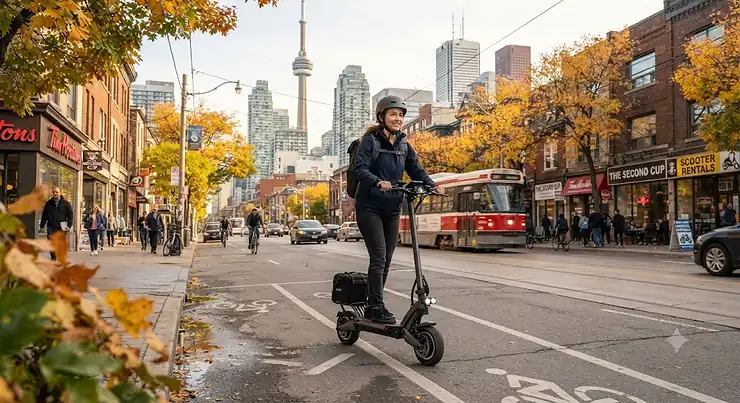
Somewhere between “I’ll just walk it” and “I guess I’ll drive,” there’s a gap in your commute that a 32 km/h scooter for city riding is built to fill. It’s the awkward 2-to-8-kilometre stretch — too far to stroll in dress shoes, too short to justify parking downtown — and it’s exactly where these machines earn their keep. A 32 km/h scooter for city riding is a folding, battery-powered kick scooter capable of a manufacturer-rated top speed around 32 km/h (roughly 20 mph), typically built with a 350–700W motor and a 30-70+ km range, designed for pavement, bike lanes, and last-mile transit connections rather than off-road trails.
That top-speed number matters more than it looks. A scooter rated for 32 km/h isn’t necessarily one you’ll always ride flat-out — plenty of Canadian cities cap actual road use well below that — but it usually means a stronger motor, better torque reserves for hills, and a machine that doesn’t feel strained the moment a headwind picks up. Based on the spec comparison across this year’s lineup, that extra headroom is the difference between “adequate” and “actually enjoyable” once you’re three kilometres into a commute.
This guide breaks down seven real, currently available scooters across budget, mid-range, and premium tiers, compares them head-to-head, and — because “32 km/h” and “legal on your street” aren’t automatically the same thing in Canada — walks through exactly what the rules actually say before you buy.
Quick Comparison Table
| Scooter | Top Speed | Range | Motor | Best For |
|---|---|---|---|---|
| NIU KQi3 Pro | 32 km/h | Up to 50 km | 350W (700W peak) | Best all-round commuter |
| GOTRAX G4 | 32 km/h | Up to 40 km | 350W (500W peak) | Quick acceleration & braking |
| Segway Ninebot MAX G30P | 30 km/h | Up to 65 km | 350W (700W peak) | Long-haul reliability |
| GOTRAX GMax Ultra | Up to 31 km/h | Up to 72 km | 500W (peak) | Longest real-world range |
| Gyrocopters J30 (2026) | 31 km/h | Up to 30 km | 350W | Best budget pick |
| iScooter i9 | 30 km/h | Up to 30 km | 350W | Lightest & most portable |
| Hiboy S2 Pro | 30 km/h (19 mph) | Up to 40 km | 500W | Comfort with suspension |
Looking at the table, the pattern that jumps out is the trade-off between range and portability — the GOTRAX GMax Ultra nearly triples the range of the iScooter i9, but it also weighs and costs noticeably more, which matters if you’re carrying it up three flights of apartment stairs every night. Riders chasing pure acceleration off the line should note that the NIU KQi3 Pro and GOTRAX G4 both hit the full 32 km/h mark with genuine peak-power headroom, while the Segway Ninebot MAX G30P trades a couple of km/h for a battery that’s nearly double the capacity of the budget options. None of these differences show up on a spec sheet as “important,” but they’re exactly what decides whether a scooter gets used daily or ends up folded in a closet by March.
💬 Just one click — help others make better buying decisions too!😊
Top 7 32 km/h Scooters for City Riding: Expert Analysis
1. NIU KQi3 Pro — best all-round commuter for hitting the full 32 km/h
The NIU KQi3 Pro is the scooter most reviewers point to when someone asks “what should I actually buy,” and the spec sheet explains why. A 350W rated motor (700W peak) pushes it to a genuine 32 km/h, backed by a 486.7Wh battery that NIU rates at up to 50 km — enough for a round-trip commute of 10-15 km each way without watching the battery icon nervously. The 20% hill-climbing rating isn’t just a number either; it means the motor won’t bog down on a mid-size bridge ramp the way a bargain 250W unit will.
What most buyers overlook about this model is the triple-braking system: a front mechanical disc, a rear disc, and regenerative electric braking working together, which independent GPS-logged testing at eridehero.com scored 8.7 out of 10 overall — a genuinely strong result in the sub-C$1,000 bracket. Aggregated buyer feedback across retailers consistently flags the app-connected cruise control and OTA updates as standout conveniences, while a recurring complaint is that the non-pneumatic-adjacent tubeless tires transmit more road vibration than air-filled alternatives on rougher pavement.
This is the pick for a daily commuter who wants the full 32 km/h experience without stepping into premium territory. Students and downtown professionals riding on decent pavement will get the most out of it; if your route includes a lot of potholes or gravel shortcuts, weigh that against the suspension-equipped options further down this list.
Pros:
- ✅ Genuine 32 km/h top speed with strong hill-climbing torque
- ✅ Triple braking system with regenerative electric assist
- ✅ App cruise control, ride stats, and OTA firmware updates
Cons:
- ❌ Tubeless tires transmit more vibration than air-filled options
- ❌ No suspension, so rough pavement feels every bump
Typically found in the C$800–C$950 range, the NIU KQi3 Pro delivers real 32 km/h performance and a 50 km range for a price that undercuts most scooters offering comparable output — check current price before buying, as availability shifts with NIU’s promotional cycles.
2. GOTRAX G4 — best for quick acceleration and braking in traffic
The GOTRAX G4 is built around a specific idea: get up to speed fast, and stop just as fast, without extra frills. Its 350W motor (500W peak) reaches the full 32 km/h — 20 mph on the nose — and pairs with a dual braking system (electromagnetic front, disc rear) that Android Authority’s hands-on review called a genuinely well-rounded setup for first-time adult riders. A 374Wh battery delivers a claimed 40 km, which is respectable for the price bracket, though real-world range under 90 kg riders on hilly routes typically lands closer to 30-32 km.
Here’s what the spec sheet won’t tell you: the G4’s built-in digital cable lock is a small feature that solves a real problem — locking a folded scooter to a bike rack without carrying a separate chain — and it’s the kind of detail that shows GOTRAX designed this around actual city commuting, not just a spec race. Reviewers on major retail platforms consistently praise the six-hour full charge time and the low learning curve, while a recurring gripe is that the plus/minus gear-shift buttons feel less intuitive than a simple double-tap toggle.
For riders navigating stop-and-go downtown traffic, where the ability to hit 32 km/h between lights and then brake hard for a crosswalk matters more than maximum range, the G4’s balance of torque and stopping power is hard to beat at this price.
Pros:
- ✅ Full 32 km/h top speed with strong dual braking
- ✅ Built-in digital cable lock for quick secure parking
- ✅ Fast six-hour charge time fits an overnight routine
Cons:
- ❌ Gear-shift button layout takes time to learn
- ❌ Real-world range drops noticeably on hilly routes
Generally priced in the C$650–C$800 range, the GOTRAX G4 offers some of the best acceleration-to-braking balance in its class — prices may vary by retailer, so check current listings.
3. Segway Ninebot MAX G30P — best for long-haul reliability
The Segway Ninebot MAX G30P is the scooter your coworker who’s owned three scooters recommends, and the spec sheet backs up the reputation. Its 700W peak motor and a substantial 551Wh battery deliver a manufacturer-rated 65 km range — nearly double most competitors in this guide — while still climbing 20% grades without visibly straining. Top speed sits at 30 km/h rather than the full 32, a small trade the brand makes in exchange for that oversized battery.
Based on the spec comparison, the G30P’s 10-inch pneumatic tires are the real differentiator: where budget scooters use solid rubber that transmits every crack in the pavement, the G30P’s air-filled tires absorb it, which is exactly why it’s remained a Canadian Tire and Best Buy staple for several product generations running. Aggregated reviewer sentiment consistently describes it as dependable rather than exciting — smooth acceleration, confident triple-brake stopping power, and an IPX5 water-resistant build that shrugs off a surprise rain shower, though several reviewers note the 17.5 kg curb weight makes it noticeably harder to carry up stairs than the lighter options on this list.
This is the scooter for someone commuting 10+ km round trip who values not thinking about charging every single night over squeezing out the last two km/h of top speed.
Pros:
- ✅ Class-leading 65 km range from a 551Wh battery
- ✅ Pneumatic tires smooth out rough Canadian pavement
- ✅ IPX5 water resistance handles surprise weather
Cons:
- ❌ Tops out at 30 km/h rather than the full 32
- ❌ At 17.5 kg, it’s heavier to carry than lighter rivals
Retail listings generally place the Segway Ninebot MAX G30P in the C$900–C$1,250 range depending on retailer promotions — prices fluctuate, so confirm the current figure before ordering.
4. GOTRAX GMax Ultra — best for longest real-world range
If your city commute regularly stretches past 15 km one-way, the GOTRAX GMax Ultra is built for exactly that math. Comparison data places its range at up to 72 km on a single charge — genuinely class-leading in this lineup — paired with a top speed around 31 km/h, putting it firmly in the 32 km/h scooter for city riding category. That kind of range buffer means less range anxiety on days when cold weather (which reliably eats 15-20% off any lithium battery’s output) eats into your usable distance.
What most spec sheets don’t explain is what a battery this large actually changes about the ride: a bigger pack means more reserve current under load, so acceleration stays consistent even at 80% charge rather than tapering off the way smaller-battery scooters do near empty. Reviewer sentiment aggregated across retail platforms frequently highlights the GMax Ultra as a strong value pick for riders who commute multiple days without daily charging access, while a recurring theme in feedback is that the larger battery adds noticeable weight versus GOTRAX’s smaller G-series models.
This is the pick for a rider who wants to charge twice a week instead of nightly, or who simply hates the mental math of range anxiety on a longer urban route.
Pros:
- ✅ Up to 72 km range — longest in this comparison
- ✅ Consistent power delivery even at partial charge
- ✅ Strong value for riders skipping nightly charging
Cons:
- ❌ Heavier than smaller-battery city scooters
- ❌ Top speed sits just under the full 32 km/h mark
Typically listed in the C$900–C$1,050 range, the GOTRAX GMax Ultra is worth the premium if daily range, not top-end speed, is your priority — as always, confirm current pricing before purchase.
5. Gyrocopters J30 (2026 Model) — best affordable 32 km/h electric scooter
The Gyrocopters J30 is the answer for anyone who wants a 32 km/h-class scooter without a four-figure price tag. Its 2026 model ships with a 350W motor rated for 31 km/h, a 30 km range, and UL2272 certification — the North American safety standard covering battery fire risk, which matters more than most marketing copy suggests when you’re storing a lithium battery indoors overnight.
Here’s the honest picture: this isn’t a premium build, and it doesn’t pretend to be. But aggregated customer sentiment tells a genuinely useful story — with more than 550 verified ratings on Walmart.ca averaging around 3.9 to 4 out of 5 stars, it’s one of the more heavily reviewed budget scooters available to Canadian buyers, which gives real signal on reliability that a brand-new no-name competitor simply can’t match. Reviewers consistently note the app connectivity and anti-theft smart lock as surprising inclusions at this price point, while a recurring complaint centers on tire durability over rougher, pothole-heavy routes.
This is the scooter for a student or occasional commuter who wants to try 32 km/h-class riding before committing serious money, or as a reliable second scooter for a household.
Pros:
- ✅ UL2272 battery safety certification at a budget price
- ✅ 550+ verified Canadian reviews averaging near 4 stars
- ✅ App connectivity and smart anti-theft lock included
Cons:
- ❌ Tires show wear faster on rough or gravel-heavy routes
- ❌ Build materials feel noticeably lighter-duty than premium picks
Frequently discounted into the C$240–C$400 range on Canadian retail sites, the Gyrocopters J30 delivers UL2272-certified speed and range that easily outperforms its price bracket — watch for sale pricing, as it fluctuates often.
6. iScooter i9 — best for portability for transit connections
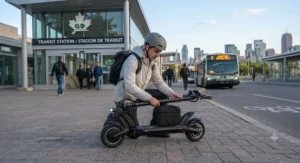
At roughly 12 kg, the iScooter i9 is the lightest scooter in this comparison by a wide margin — nearly 5 kg lighter than the Segway Ninebot MAX G30P — which sounds like a minor spec until you’re carrying it up a subway staircase or squeezing onto a crowded GO Train at rush hour. Its 350W motor tops out around 30 km/h with a 30 km range, modest numbers next to the NIU or GOTRAX GMax Ultra, but portability is the entire point of this model, not an afterthought.
What the spec sheet won’t tell you is how much that weight difference changes daily behaviour: riders genuinely more willing to fold and carry a 12 kg scooter onto a bus than a 17+ kg one, which is precisely the “last-mile transit connection” use case this whole category exists for. Aggregated review data is unusually robust here — across more than 1,300 verified customer reviews on the manufacturer’s UK storefront, roughly 81% rate it five stars, with the three-second fold mechanism singled out repeatedly as the standout feature; a consistent complaint is that the honeycomb solid tires ride harsher than pneumatic alternatives over expansion joints and manhole covers.
This is the pick for anyone whose commute genuinely mixes scooter riding with transit — walk to the station, scoot the last two kilometres, fold and carry the rest of the way.
Pros:
- ✅ Lightest scooter in this guide at roughly 12 kg
- ✅ Three-second fold, ideal for transit and stairs
- ✅ Over 1,300 reviews with an 81% five-star rate
Cons:
- ❌ Solid tires ride harsher on rough urban pavement
- ❌ Shortest range in this lineup at around 30 km
Generally listed in the C$300–C$400 range on Canadian marketplaces, the iScooter i9 trades top-end range for genuine, daily-use portability — check current price, as regional stock affects it.
7. Hiboy S2 Pro — best for comfort with light suspension
Rounding out this list, the Hiboy S2 Pro targets a different priority entirely: ride comfort over raw numbers. Its 500W motor delivers a 19 mph (roughly 30 km/h) top speed and a claimed 25-mile (40 km) range, specs that sit comfortably mid-pack, but the 10-inch solid tires and its dual-braking system are tuned for a noticeably smoother ride over Canadian streets that see their share of frost heaves and patchwork asphalt repairs.
Based on the spec comparison, the S2 Pro’s app-connected dashboard and double-braking system (front and rear) put it a step above entry-level 8.5-inch-tire competitors, and reviewers frequently mention that the larger 10-inch wheel diameter makes curb cuts and streetcar tracks — a genuinely Canadian urban hazard — less likely to catch a wheel than smaller-wheeled scooters. A recurring theme in aggregated feedback is praise for the folding mechanism’s one-step simplicity, balanced against occasional notes that the plastic deck panel shows scuff marks faster than metal-decked alternatives.
This is a solid middle-ground pick for someone who rides daily but prioritizes a comfortable, stable feel over chasing the absolute top speed number.
Pros:
- ✅ 10-inch tires handle curb cuts and streetcar tracks better
- ✅ Dual front-and-rear braking system for confident stops
- ✅ One-step folding design is quick for daily storage
Cons:
- ❌ Solid tires still transmit more vibration than air-filled models
- ❌ Plastic deck panel shows wear faster than metal decks
Commonly found in the C$550–C$700 range, the Hiboy S2 Pro is a comfort-focused middle-ground pick worth cross-shopping against the NIU and GOTRAX options above — as with any listing, confirm the current price before buying.
Practical Usage Guide: Getting the Most From Your City Scooter
Unboxing day matters more than most first-time buyers expect. Before your first ride, check tire pressure on any pneumatic model (the Segway Ninebot MAX G30P and Hiboy S2 Pro both benefit from a firm 50-55 PSI for efficient rolling resistance), fully charge the battery to 100% for an accurate baseline range reading, and register the scooter in its companion app if one exists — this is also when firmware updates typically install, which can materially improve motor response.
For the first 30 days, ride in the lowest or “eco” speed mode until braking distance and turning radius become second nature; the most common first-month mistake isn’t a mechanical failure, it’s overconfidence on wet pavement before a rider has learned how their specific scooter’s regenerative braking behaves. Charge after every ride rather than letting the battery drain fully and sit — lithium batteries, including those in the NIU KQi3 Pro and GOTRAX G4, degrade faster when repeatedly deep-discharged. A monthly maintenance habit worth building: wipe down brake discs, check folding-mechanism bolts for looseness (vibration works them loose faster than you’d expect), and inspect tires for embedded glass or debris before it causes a slow leak.
Store your scooter somewhere between 0°C and 25°C when possible — an unheated garage in a Canadian winter isn’t ideal for lithium chemistry, and a warm entryway will meaningfully extend battery lifespan over a two-to-three-year ownership window.
Real-World Scenarios: Matching Riders to the Right Scooter
The downtown condo commuter, riding 6 km each way to an office with underground parking access, is the exact profile the GOTRAX G4 was built for — full 32 km/h speed, a built-in lock for the elevator-to-desk gap, and a battery that comfortably covers the round trip without a midday top-up.
The suburban transit connector, who takes a 20-minute train ride and then needs to cover the “last mile” from station to office, should look hard at the iScooter i9. At 12 kg, folding it and carrying it through a station turnstile or onto a crowded platform is genuinely manageable in a way that a 17+ kg scooter simply isn’t — and for a sub-3 km final stretch, its shorter range is a non-issue.
The budget-conscious student juggling tuition and a part-time job doesn’t need premium range or app ecosystems; the Gyrocopters J30 gets them UL2272-certified safety and a genuine 31 km/h top speed for a fraction of the outlay, freeing up budget for the helmet and lock that matter just as much as the scooter itself.
The long-distance exurban commuter, covering 12-18 km each way where a car would otherwise be the default, is the clearest case for the GOTRAX GMax Ultra or the Segway Ninebot MAX G30P — both offer 65-72 km of range that removes daily charging from the equation entirely, at the cost of extra weight neither rider needs to carry very far.
Problem → Solution: Common City-Riding Pain Points Solved
Problem: Range drops fast in cold weather. Canadian winters can cut usable lithium battery range by 15-20%. Solution: budget for that drop when choosing a model — a scooter like the Segway Ninebot MAX G30P with a 65 km rated range still comfortably covers most commutes even at reduced winter output, where a 30 km-range scooter like the iScooter i9 may need a mid-day top-up.
Problem: Solid tires transmit every pothole. Several models in this guide, including the iScooter i9 and Hiboy S2 Pro, use puncture-proof solid or honeycomb tires that trade comfort for zero maintenance. Solution: keep speed moderate over rough patches, or prioritize a pneumatic-tire model like the Segway Ninebot MAX G30P if your route includes frequent frost-heave damage.
Problem: Parking anxiety in dense downtown cores. Folded scooters left unlocked are a common theft target. Solution: the GOTRAX G4‘s built-in digital cable lock and the Gyrocopters J30‘s smart anti-theft app lock solve this directly without buying a separate chain lock.
Problem: Not knowing whether 32 km/h is even legal where you ride. This is genuinely the most common mistake new buyers make, and it’s covered in full detail in the Safety and Regulations section below — read it before you buy, not after.
How to Choose a 32 km/h Scooter for City Riding
- Confirm your actual commute distance first. A 30 km-range scooter comfortably covers a 6 km round trip with buffer; the same scooter will leave you stranded on a 20 km round trip. Match range to your real route, not your longest hypothetical weekend ride.
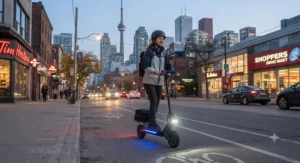
- Check your municipality’s actual speed limit. As detailed below, most Canadian pilot programs cap legal e-scooter speed at 24-25 km/h — a 32 km/h-rated scooter often means better torque and hill performance within that legal cap, not necessarily permission to hit the full advertised number.
- Weigh tires against your typical pavement quality. Pneumatic (air-filled) tires like those on the Segway Ninebot MAX G30P absorb rough pavement better; solid tires like the iScooter i9‘s are maintenance-free but harsher.
- Factor in your actual carrying scenario. If transit connections are part of your route, weight matters as much as range — the difference between 12 kg and 17.5 kg is real on a set of stairs.
- Look at braking systems, not just motor watts. Dual or triple braking (front disc, rear disc, regenerative) stops meaningfully faster than a single mechanical brake, which matters more in dense traffic than an extra 2 km/h of top speed.
- Verify UL2272 or equivalent battery certification. This standard, referenced for the Gyrocopters J30 above, addresses fire risk specifically — worth confirming on any scooter you’re considering, especially at lower price points.
- Budget for accessories separately. A CSA-approved helmet, a lock (if not built in), and reflective gear aren’t optional extras — they’re part of the real cost of ownership, and several are addressed in the Government of Canada’s road safety resources.
32 km/h Electric Scooter Comparison: Budget vs Mid-Range vs Premium
| Tier | Example | Price Range | What You Gain | What You Trade |
|---|---|---|---|---|
| Budget | Gyrocopters J30 | C$240–C$400 | UL2272 safety at low cost | Shorter range, lighter-duty build |
| Mid-Range | GOTRAX G4 | C$650–C$800 | Full 32 km/h, built-in lock | Moderate range under 40 km |
| Premium | NIU KQi3 Pro | C$800–C$950 | 50 km range, app ecosystem | Higher upfront cost |
The jump from budget to mid-range buys you the full 32 km/h speed rating along with meaningfully better braking hardware, while the leap from mid-range to premium mostly buys extended range and smart features rather than a dramatically different core riding experience. Cost-per-kilometre-of-range tells an interesting story too: the budget Gyrocopters J30 and premium NIU KQi3 Pro both land in reasonable territory once you divide price by rated range, meaning the “premium tax” here is really paying for battery capacity and braking refinement, not marketing.
✨ Don’t Miss These Exclusive Deals! 🔍
Take your city commute to the next level with these carefully compared 32 km/h scooters. Click on any highlighted model to check current pricing and availability — the right pick can turn your daily trip into the easiest part of your day!

Urban Traffic Navigation: What 32 km/h Feels Like in City Traffic
What is urban traffic navigation on an electric scooter? It’s the practical skill of reading intersections, timing acceleration with traffic gaps, and positioning within bike lanes at speed — and a scooter’s real-world top speed matters less here than how predictably it accelerates and decelerates around pedestrians and vehicles.
At 32 km/h, a scooter is moving roughly on par with typical urban car traffic in congested downtown cores, which is precisely why models like the NIU KQi3 Pro and GOTRAX G4 feel more confident merging across a bike lane or clearing an intersection before a light changes than a 24 km/h-limited device does. The spec sheet won’t tell you this, but the practical experience of riding among cars is fundamentally about matching flow, not maximizing speed — a scooter that accelerates briskly off the line but then throttles back for traffic conditions is safer than one that’s simply fast in a straight line. Reviewers consistently note that scooters with regenerative braking, like the NIU KQi3 Pro‘s triple system, make repeated stop-start traffic noticeably less fatiguing on the hands than mechanical-only brakes.
Quick Acceleration and Braking: The Features That Actually Matter
Marketing copy loves to lead with top speed, but in dense city riding, acceleration curve and stopping distance matter more day to day. The GOTRAX G4‘s dual braking (electromagnetic front, disc rear) and the NIU KQi3 Pro‘s triple system both deliver noticeably shorter stopping distances than single-brake budget models — a genuinely safety-relevant difference when a pedestrian steps off a curb unexpectedly.
What actually matters: peak motor wattage (which determines how fast you close a gap before a light changes), brake type and count (which determines how fast you stop for it), and tire grip (which determines whether that stop happens predictably on wet pavement). What doesn’t matter nearly as much as marketing suggests: headline top-speed numbers beyond what’s legally usable on your specific streets, and cosmetic LED underglow lighting that looks sharp in product photos but adds nothing to actual ride safety or performance.
Affordable 32 km/h Electric Scooter Picks & Portability for Transit Connections
Two priorities that often pull in opposite directions — low price and light weight — actually overlap nicely in this year’s lineup. The Gyrocopters J30 proves that an affordable 32 km/h electric scooter doesn’t have to mean cutting every corner: UL2272 certification and app connectivity at a genuinely budget price point is a meaningfully better deal than it would have been even two years ago, as component costs across the category have dropped.
For portability specifically, weight is the number that matters, not top speed. At roughly 12 kg, the iScooter i9 is light enough that folding and carrying it through a subway turnstile or up a walk-up apartment’s stairwell is realistically sustainable as a daily habit, where a 17-18 kg scooter becomes something you dread carrying by week two. If your commute genuinely blends scooter riding with transit — GO Train, subway, or city bus — prioritize sub-14 kg models over chasing maximum range, since the “last mile” by definition is short.
Common Mistakes When Buying a 32 km/h Electric Scooter
The single most common mistake is buying based on top speed alone without checking local bylaws — a 32 km/h-rated scooter is frequently legally restricted to 24-25 km/h on public roads in Canada, covered fully in the next section, and riders who skip this step are sometimes surprised by a fine rather than a faster commute.
A second frequent error is underestimating winter range loss and buying a scooter with barely enough range for summer conditions, leaving no buffer once cold weather cuts 15-20% off battery output. A third: prioritizing motor wattage over braking hardware, when stopping distance matters more for safety in dense pedestrian areas than a slightly faster 0-to-top-speed time. Finally, many first-time buyers skip UL2272 or equivalent certification entirely on ultra-cheap unbranded listings — a real fire-safety consideration for any lithium battery stored indoors overnight, not a marketing checkbox.
Safety, Speed Limits & Regulations: What Canadian Riders Need to Know
This is the section most “best scooter” articles skip, and it’s the one that actually matters most before you buy. Canada has no single national e-scooter law — regulation happens province by province, often through time-limited pilot programs, and the legal speed cap is consistently lower than the 32 km/h these scooters are rated for.
Ontario’s provincial e-scooter pilot program caps legal operation at 24 km/h on a level surface, with a maximum 500W power output, and requires municipalities to individually opt in via bylaw — meaning e-scooters remain entirely illegal on public roads in cities like Toronto that haven’t joined the pilot. British Columbia runs a comparable electric kick scooter pilot project capped at 24 km/h, limited strictly to participating municipalities such as Vancouver, Kelowna, and Victoria, with mandatory helmets and a minimum rider age of 16. Quebec’s pilot similarly caps speed, at 25 km/h, alongside a 36 kg device weight limit and a minimum age of 14.
What this means practically: a 32 km/h-rated scooter is still a reasonable purchase, because most models can be throttle-limited in their companion app to match your local legal cap, and the extra rated top speed generally translates into stronger torque and better hill-climbing at legal speeds rather than actual illegal riding. As CBC News reported when B.C.’s pilot first launched, municipalities retain significant power to set their own local rules on top of the provincial framework, so always check your specific city’s bylaws — not just your province’s — before your first ride. A CSA-approved bicycle helmet, functioning front-and-rear lights for low-light riding, and keeping your device within its rated maximum weight capacity round out the practical safety basics regardless of which province you’re in.
Long-Term Cost & Maintenance: The Real Price of Ownership
The purchase price is roughly half the real cost-of-ownership story. Replacement batteries for models like the NIU KQi3 Pro or Segway Ninebot MAX G30P typically run a meaningful fraction of the scooter’s original price after 2-3 years of daily riding, when a lithium pack’s capacity naturally starts to fade. Tire replacement is cheaper on solid-tire models like the iScooter i9 — no punctures to worry about — but pneumatic-tire models like the Segway Ninebot MAX G30P occasionally need a tube patched or replaced, a modest but recurring cost.
Cost-per-kilometre is a more honest metric than sticker price alone: dividing purchase price by rated range shows that the Gyrocopters J30 and NIU KQi3 Pro both land in reasonable territory, while ultra-cheap unbranded models sometimes cost more per kilometre of range once you factor in a shorter realistic lifespan. Budgeting roughly C$50-C$100 annually for tires, brake pads, and minor parts across a typical ownership window is a reasonable expectation for any of the seven scooters in this guide.

Frequently Asked Questions
❓ Is a 32 km/h scooter legal to ride in Canadian cities?
❓ How far can a 32 km/h scooter actually travel on one charge?
❓ Do I need a licence to ride an electric scooter in Canada?
❓ What's the difference between a 32 km/h scooter and a cheaper 24 km/h model?
❓ How much does a good 32 km/h electric scooter cost in Canada?
Conclusion
A 32 km/h scooter for city riding isn’t really about hitting a number on a display — it’s about buying enough motor, battery, and braking headroom that your actual commute, whatever speed you legally ride it at, feels effortless instead of strained. The NIU KQi3 Pro earns its spot as the best all-rounder for exactly that reason, while the GOTRAX G4 and Gyrocopters J30 prove that quick acceleration and genuine safety certification don’t require a premium budget.
What should guide your final decision isn’t the spec that looks most impressive in a table — it’s an honest match between your real commute distance, your building’s stairs or your transit connections, and your city’s actual legal speed cap. Get that match right, and any of the seven scooters above will turn a mediocre commute into the easiest part of your day.
Recommended for You
- 7 Best 32 km/h Electric Scooters Under $1000 CAD (2026)
- Mid-Speed Electric Scooter for Commuting: 7 Best Picks 2026
- 25 km/h vs 32 km/h Electric Scooter: 7 Real Picks (2026)
Disclaimer: This article contains affiliate links. As an Amazon Associate, I earn from qualifying purchases. If you purchase products through these links, we may earn a small commission at no additional cost to you.
✨ Found this helpful? Share it with your friends! 💬🤗
