
In This Article
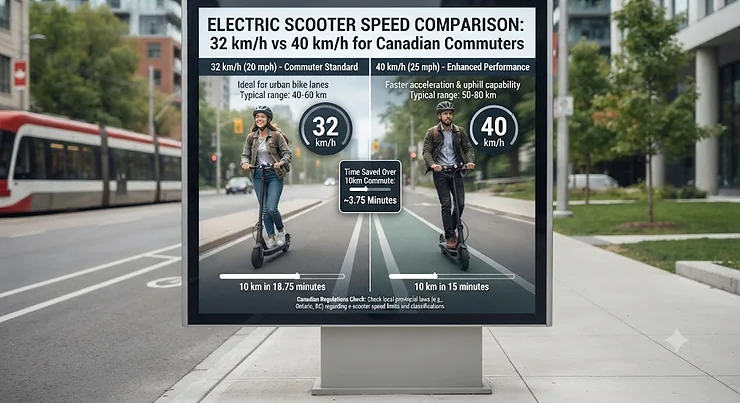
Here’s the thing nobody tells you at the bike shop: the difference between a 32 km/h electric scooter and a 40 km/h electric scooter isn’t really about speed. It’s about where you’re legally allowed to twist that throttle, and what your body has to learn before it’s safe to do so. A scooter that tops out at 32 km/h can usually roll straight into a Canadian bike lane without a second glance from a bylaw officer. One that hits 40 km/h often can’t — at least not without landing you in the same grey zone as an unregistered moped. That single number, baked into the firmware, decides whether your new ride is a legitimate commuter tool or a private-property toy you trailer to a parking lot on weekends.
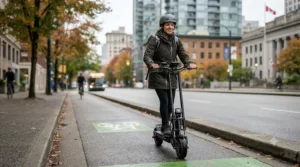
This guide breaks down the real-world gap between 32 km/h and 40 km/h electric scooter for adults shoppers, using seven actual models sold in Canada — from budget commuters that cap out just under the legal ceiling to dual-motor machines that laugh at 40 km/h and keep climbing. We’ll cover the provincial rulebook, the genuine speed vs control trade-offs riders report, and which tier actually matches your experience level requirements. No fabricated test rides, no invented star ratings — just real specs, honestly interpreted, and aggregated owner sentiment clearly labelled as such. An electric kick scooter is generally understood as a stand-up, two-wheeled personal transportation device powered by a rechargeable battery and electric motor, typically foldable for portability. If you’re picking between “fast enough” and “too fast for the bike lane,” this is the comparison that actually matters.
Quick Comparison Table
| Scooter | Top Speed | Range | Best For |
|---|---|---|---|
| Gotrax G4 | 32 km/h (2-speed: 25/32) | ~40 km | Budget riders wanting a legal 32 km/h ceiling |
| Hiboy S2 Pro | ~30.6 km/h | ~41 km | Lightest, most portable budget pick |
| Apollo Air | ~34 km/h | ~55 km | Beginners who want smoothness over raw speed |
| NIU KQi300P | 32 km/h (300X: ~38 km/h) | 30-37 mi (48-60 km) | Riders who want room to upgrade tiers later |
| NAVEE N65i | 40 km/h (25 km/h public-road mode) | ~65 km | True 40 km/h capability with a legal fallback |
| Segway Ninebot Max G3 | 32 km/h legal / 45 km/h unlocked | ~80 km | Flagship dual-mode commuting |
| Apollo Ghost | ~53 km/h | ~42 km | Experienced riders, private-property speed |
Looking at the spread here, the split isn’t really “32 vs 40” as two hard camps — it’s a sliding scale, and three of these seven scooters (the NAVEE N65i, the Segway Ninebot Max G3, and arguably the NIU KQi300P in its 300X trim) are built with dual-speed firmware specifically so you can toggle between a street-legal mode and a private-property mode. That’s the real story of this category in 2026: manufacturers aren’t picking a lane anymore, they’re building both lanes into one scooter and letting the app decide which one you’re allowed to use.
Just one click — help others make better buying decisions too!😊
Top 7 32 km/h vs 40 km/h Electric Scooters: Expert Analysis
1. Gotrax G4 — best budget pick with a true 2-speed legal ceiling
What makes the Gotrax G4 worth starting with is that it doesn’t pretend to be anything other than a 32 km/h commuter, and it builds that limit right into the controls. Riders get two selectable gears — 25 km/h and 32 km/h — with a 500W motor, a 40 km range, and a max payload of 264 lbs. In practice, that second gear is the whole point: you get one setting for tight sidewalks and mixed pedestrian zones, and a second that maxes out exactly at the ceiling most provinces recognize for power-assisted devices. Based on the spec comparison, the 10-inch pneumatic tires and dual-brake setup (electromagnetic front, disc rear) punch well above the price point most budget scooters occupy.
Who it’s for: first-time buyers who want a scooter that can’t accidentally get them a fine, plus commuters riding mostly flat, paved routes under 15 km round trip. Reviewers consistently note the theft-resistant folding mechanism and praise the value-for-money positioning, though a common complaint in user reviews is the lack of front or rear suspension, which shows up on rougher pavement or unmaintained multi-use paths.
Pros:
- ✅ Legal 32 km/h ceiling with a slower 25 km/h mode built in
- ✅ 10-inch pneumatic tires absorb small cracks and seams well
- ✅ Dual braking system (electromagnetic + disc) for its price class
Cons:
- ❌ No suspension — bumps transfer straight to the deck
- ❌ No companion app for ride tracking or firmware updates
The Gotrax G4 typically lands in the C$650-C$750 range at the time of research. For a rider who just wants the legal 32 km/h number and nothing more complicated, it’s tough to argue with the value here.
2. Hiboy S2 Pro — lightest choice for riders who prioritize portability
The Hiboy S2 Pro sits just under the 32 km/h line, and that’s arguably a feature rather than a limitation. The scooter is powered by a 350W motor paired with 10-inch solid tires, delivering a stable ride while sidestepping the flat-tire problem entirely — a detail budget buyers overlook until they’ve patched their third puncture. What most buyers overlook about a sub-32 km/h scooter like this one is that it’s frequently the safer bet in provinces where municipal bylaws quietly undercut the provincial 32 km/h ceiling; riding a scooter that can’t physically exceed 30 km/h means you’re compliant even where local rules are stricter than the province’s baseline.
Reviewers consistently report that the rear dual-shock suspension noticeably smooths out urban commuting compared to unsprung budget rivals, and the regenerative braking system is a genuinely useful touch for extending range on downhill-heavy routes. On the downside, a recurring theme in aggregated feedback is that the companion app connectivity can be inconsistent, and the climb angle (rated around 8.5°) means steep hills will bog the motor down faster than the NAVEE or Segway picks further down this list.
Pros:
- ✅ Solid tires eliminate puncture risk entirely
- ✅ Rear dual-shock suspension smooths urban commuting
- ✅ Regenerative braking extends range on hilly routes
Cons:
- ❌ Limited climb angle struggles on steeper grades
- ❌ App connectivity reported as inconsistent by some owners
Expect the Hiboy S2 Pro to sit around C$600-C$750 CAD at the time of research. It’s a strong 32 km/h electric scooter review pick for anyone who’d rather carry a lighter machine up a third-floor walkup than squeeze out an extra 2 km/h.
3. Apollo Air — smoothest beginner-focused ride in this lineup
Apollo Scooters is a Canadian company, and the Apollo Air is squarely built for riders stepping onto an e-scooter for the first time. It features a 500W motor reaching a top speed of roughly 33.8 km/h with a manufacturer-claimed range of 50 km on a single charge, and independent speed testing landed close to that claim. Here’s what the spec sheet won’t tell you, but reviewer testing does: the dual fork front suspension does most of the heavy lifting on ride comfort, since there’s no rear suspension to back it up — so expect a smoother front end but a firmer rear over rough pavement.
The self-healing tubeless tires and IP66 water resistance rating are genuinely above-class features for a scooter positioned as a beginner’s first purchase. On the analytical side, the three-speed-mode system with cruise control means new riders can lock themselves into the slowest setting while they’re still building confidence, then unlock the full 34 km/h ceiling once handling feels second nature — a sensible on-ramp that budget rivals like the Gotrax G4 don’t offer in the same graduated way.
Pros:
- ✅ Self-healing tubeless tires reduce puncture downtime
- ✅ IP66 water resistance, well above typical IP54 budget rivals
- ✅ Three speed modes let beginners ramp up gradually
Cons:
- ❌ No rear suspension — comfort skews front-heavy
- ❌ Charging time runs longer than most competitors (around 7 hours)
At the time of research, the Apollo Air typically sits in the C$900-C$1,050 CAD range direct from the manufacturer. For Canadian buyers who want a company that ships and supports locally, it’s a strong case for buying Canadian first.
4. NIU KQi300P — best hybrid pick with room to grow into a faster tier
The NIU KQi 300P runs a 450W rear motor (900W peak) off a 486Wh 48V battery, topping out at 20 mph (roughly 32 km/h) with a claimed 30-mile range, and it comes with front hydraulic suspension that budget rivals in this price bracket routinely skip. Based on the spec comparison, what sets the KQi300 series apart from a straightforward 32 km/h electric scooter for adults like the Gotrax is that NIU sells a nearly identical sibling — the KQi300X — with a 500W motor that tests closer to 23.6 mph (about 38 km/h), a bigger 608Wh battery, and roughly 27 miles of tested range. Buying into the 300 series essentially buys you a choice of tier without switching platforms.
Aggregated review sentiment is consistently positive on ride comfort thanks to the dual-tube hydraulic suspension, and reviewers frequently cite the wide 10.5-inch tires as a comfort upgrade over the narrower 8.5-inch tires common on entry scooters. A recurring critique, however, is that real-world tested range regularly lands noticeably under the manufacturer’s claimed figure — independent testing measured closer to 21 miles under regular riding conditions rather than NIU’s advertised 30.
Pros:
- ✅ Front hydraulic suspension is rare at this price point
- ✅ Sibling 300X model offers a faster 38 km/h upgrade path
- ✅ Wide 10.5-inch tubeless tires improve stability
Cons:
- ❌ Real-world tested range runs well below the claimed figure
- ❌ Mechanical disc brakes lag behind hydraulic setups on faster rivals
The NIU KQi300P generally runs in the C$700-C$950 CAD range depending on retailer promotions at the time of research — genuinely solid value for a scooter that doubles as an entry point into the faster 300X variant later.
5. NAVEE N65i — the clearest example of true 40 km/h capability
If you want to understand what “40 km/h” actually feels like without diving into hyper-scooter territory, the NAVEE N65i is the textbook example. It runs a rated 450W motor (1000W peak), dual suspension, 10.5-inch tubeless tires, a genuine top speed of 40 km/h, 65 km of max range, a 265 lbs maximum load, IPX5 waterproofing, and a triple-braking setup combining a front drum, rear disc, and E-ABS. Critically, it doesn’t force you to ride at that ceiling everywhere — the N65i can travel at 25 km/h on public roads and unlock its full 40 km/h on private paths, which is precisely the dual-mode structure this whole comparison hinges on.
What most buyers overlook about the N65i is that its triple-braking system exists specifically because the scooter needs to stop safely from 40 km/h, not just 25. On paper this means meaningfully shorter stopping distances than single-brake budget scooters, and reviewers consistently praise the braking confidence at speed. The trade-off, honestly assessed: at nearly 51 lbs, this is not a scooter you’re casually tossing over your shoulder for the last block of a commute.
Pros:
- ✅ Genuine 40 km/h capability with a legal 25 km/h public mode
- ✅ Triple-braking system (drum + disc + E-ABS) built for higher speed
- ✅ 65 km range is among the longest in this lineup
Cons:
- ❌ Nearly 51 lbs — heavy for stairs or transit transfers
- ❌ Full 40 km/h speed is restricted to private property in most provinces
Expect the NAVEE N65i to run in the C$900-C$1,100 CAD range at the time of research. This is the pick for buyers who genuinely want to experience the 40 km/h tier, understand where it’s legal, and value the safety hardware that comes with it.
6. Segway Ninebot Max G3 — flagship dual-mode commuting scooter
The Segway Ninebot Max G3 is the scooter that best illustrates why the 32-vs-40 debate has essentially become a software toggle rather than a hardware decision. Factory default caps it around 32 km/h, but enabling High Speed mode through the Segway Mobility App unlocks roughly 45 km/h — meaning the same physical scooter serves both tiers depending purely on where you’re riding it and what mode you’ve selected. Eco mode range reaches approximately 80 km, dropping to roughly 40 km in Drive mode and 25 km in Sport+ mode, which is a textbook illustration of the universal trade-off: range and top speed pull against each other on every electric vehicle, and the Max G3 just makes that relationship visible through selectable modes instead of hiding it.
The scooter runs an 850W nominal motor (2000W peak) off a 597Wh battery, weighs around 54 lbs, and supports a 286 lbs max load with 11-inch tires and dual suspension. Reviewers consistently highlight the jump in braking hardware over the previous generation — dual disc brakes replace the older single-brake setup — and the ride quality benefits noticeably from the larger 11-inch tires compared to the 10-inch standard elsewhere in this list. The honest downside: this is a premium price for what’s still fundamentally a 32 km/h commuter with an unlockable extra gear, not a scooter built from the ground up as a 45 km/h machine.
Pros:
- ✅ Genuine dual-mode: legal 32 km/h and unlockable 45 km/h in one scooter
- ✅ 80 km eco-mode range is class-leading among these seven
- ✅ Dual hydraulic suspension plus dual disc brakes for stability at speed
Cons:
- ❌ Premium pricing relative to its default (legal) 32 km/h performance
- ❌ Full speed unlock is app-dependent and not street-legal in most provinces
At the time of research, the Segway Ninebot Max G3 typically sits in the C$1,600-C$2,000 CAD range. For riders who want one scooter that legitimately covers both tiers in this comparison, this is the flagship answer.
7. Apollo Ghost — fastest scooter here, strictly for private property and experienced riders
The Apollo Ghost exists at the far end of this comparison, well past the 40 km/h line entirely, and it earns its spot here as the honest counterpoint: this is what “too fast for public roads” actually looks like. It runs dual 800W motors reaching a top speed near 53 km/h (33 mph), with a 946Wh battery delivering roughly 42 km of range, weighing in at about 64 lbs. Based on the spec comparison, the dual-motor configuration isn’t just about raw speed — it’s about acceleration and hill-climbing torque that single-motor scooters in this lineup, including the NAVEE N65i, simply can’t match.
Reviewers consistently frame the Ghost as a “closed-course” or “private-trail” scooter rather than a commuter, and that framing is accurate: at 53 km/h, this scooter exceeds every provincial ceiling in Canada by a wide margin, including Nova Scotia’s comparatively generous 32 km/h cap. What most buyers overlook is that a scooter this fast demands a completely different braking and suspension budget than a 32 km/h commuter — the disc brakes and dual spring suspension aren’t optional extras here, they’re structural requirements for the speed the motor produces.
Pros:
- ✅ Dual-motor torque delivers strong acceleration and hill-climbing
- ✅ Disc brakes and dual spring suspension built for high-speed stability
- ✅ Genuine private-property performance for experienced riders
Cons:
- ❌ Well beyond every provincial public-road speed limit in Canada
- ❌ Not an appropriate first scooter — steep learning curve at speed
The Apollo Ghost generally runs in the C$2,100-C$2,500 CAD range at the time of research. This is the deliberate outlier in our lineup — useful context for understanding just how far “40 km/h” sits from the genuine top end of this market.
Practical Usage Guide: Switching Between Speed Modes Safely
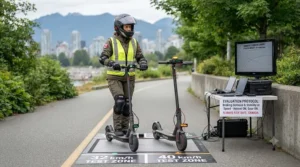
Owning a dual-mode scooter like the NAVEE N65i or Segway Ninebot Max G3 means the first 30 days matter more than usual, because you’re learning two different machines in one shell. Start every new scooter in its slowest available mode for at least your first week, regardless of what the marketing copy promises about top speed — muscle memory for throttle response, braking distance, and turning radius needs to form before you introduce more speed into the equation.
A common first-month mistake is switching to the faster mode before checking tire pressure and brake pad wear, both of which matter more at higher speeds. Recalibrate cruise control settings after any firmware update, since app-based speed unlocks (like the Max G3’s High Speed mode) sometimes reset customized acceleration curves. For maintenance, inspect brake cables monthly on scooters using mechanical disc brakes (the Gotrax G4 and Hiboy S2 Pro both fall into this category), since mechanical systems stretch and require adjustment far more often than hydraulic setups. Finally, always confirm which mode your scooter is actually in before pulling onto a public road — an unlocked 40+ km/h mode left active from a private-property ride is an easy way to unintentionally violate a provincial speed cap.
Real-World Scenarios: Matching Riders to the Right Speed Tier
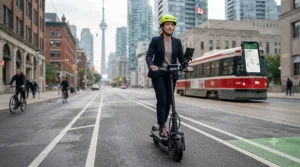
Consider a downtown Toronto commuter riding 6 km each way on mixed bike lanes and sidewalks: a 32 km/h scooter like the Gotrax G4 or NIU KQi300P is genuinely the better fit here, since Ontario’s pilot framework and municipal bylaws already cap legal speeds well under 40 km/h, making the extra ceiling on faster models functionally useless for this commute.
Now picture a rural Nova Scotia rider covering longer stretches between a farm property and a small town, where private laneways connect to public roads: a dual-mode scooter like the NAVEE N65i makes practical sense, letting them run the full 40 km/h on their own land before dropping to the province’s 32 km/h public ceiling for the final stretch into town. And for a weekend hobbyist with access to a private trail or closed-course facility who wants genuine performance riding without any road-legal pretense, the Apollo Ghost‘s 53 km/h ceiling is built exactly for that use case — provided they’ve logged real hours on a slower scooter first.
What Is the Difference Between a 32 km/h and 40 km/h Electric Scooter?
A 32 km/h electric scooter is capped at the speed most Canadian provinces recognize as the legal ceiling for power-assisted personal mobility devices on public roads and bike lanes, while a 40 km/h electric scooter exceeds that threshold and, in most jurisdictions, is only legal to operate on private property. The gap isn’t cosmetic — it typically comes with stronger brakes, dual suspension, and heavier motors to safely manage the added stopping distance and impact energy.
Provincial Legality by Speed Tier: Where the Line Actually Sits
Canada has no single federal e-scooter law, which is exactly why provincial legality by speed tier matters so much when shopping this category. Most regulated provinces cap e-scooters at 24 or 25 km/h — Ontario and PEI at 24 km/h, British Columbia and Quebec at 25 km/h — while Nova Scotia stands out with a notably higher 32 km/h ceiling. Nova Scotia’s legal framework formally excludes e-scooters from the definition of “motor vehicle,” treating riders as cyclists, with a minimum age of 14 and a provincial speed ceiling of 32 km/h.
Ontario’s power-assisted bicycle regulation offers useful context for why 32 km/h keeps appearing as a benchmark even in provinces that cap scooters lower: Ontario Regulation 369/09 requires a power-assisted bicycle’s brakes to bring it to a full stop within nine metres from 30 km/h on a clean, paved, level surface, and prohibits modifying the vehicle in any way that increases its power or maximum speed beyond federal limits. That federal power-assisted bicycle benchmark, set at 32 km/h nationally, is the reason so many scooter manufacturers — including four of the seven products above — default their firmware to that exact number. Meanwhile, Prince Edward Island introduced its own regulatory clarity recently, confirming that power-assisted bicycles cannot exceed 32 km/h or they shift into low-speed motorcycle territory, with a minimum operating age of 16, underlining how fragmented — but consistently anchored around 32 km/h — this legal landscape remains.
Bottom line: check your specific province and municipality before assuming either tier is street-legal where you live, because a 40 km/h scooter that’s perfectly fine on a rural Nova Scotia laneway could be an expensive ticket in downtown Toronto.
How to Choose Between a 32 km/h and 40 km/h Electric Scooter
- Check your provincial and municipal speed cap first. This eliminates half the shortlist before you even compare specs — there’s no point evaluating a 40 km/h scooter if your city bylaw tops out at 24 km/h.
- Match your commute length to realistic range, not marketing range. Manufacturer claims routinely overstate tested performance by 20-30%, based on the spec comparisons above.
- Weigh braking hardware against your intended top speed. A scooter capable of 40 km/h genuinely needs dual disc or triple-braking setups — mechanical single brakes aren’t built for that stopping distance.
- Consider whether you actually have private property to use a faster mode on. Dual-mode scooters like the Max G3 or N65i only pay off if you have somewhere legal to unlock the higher tier.
- Factor in your experience level honestly. A first scooter shouldn’t be a 40+ km/h machine, regardless of budget.
- Check weight against your daily carrying needs. Faster scooters run heavier, sometimes by 15-20 lbs, which matters if stairs or transit are part of your route.
- Confirm the certification marks on the battery and charger. This becomes especially relevant as motor power climbs into the 40 km/h tier.
Speed vs Control Trade-Offs: What That Extra 8 Km/h Actually Costs
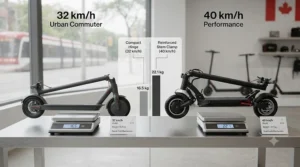
Here’s what most marketing copy glosses over: the jump from 32 km/h to 40 km/h isn’t linear in terms of risk. Stopping distance scales with the square of speed, meaning a scooter travelling at 40 km/h needs roughly 56% more distance to stop than one at 32 km/h, all else being equal. That’s precisely why every scooter in this lineup capable of touching 40 km/h — the NAVEE N65i and the unlocked Segway Ninebot Max G3 — ships with dual or triple-braking systems, while several 32 km/h-capped models get away with a single mechanical disc brake.
Control is the other half of this trade-off. Reviewers consistently note that reaction time, tire contact patch, and rider stance all matter more as speed climbs, and a scooter that feels stable and predictable at 25 km/h can feel genuinely twitchy at 40 km/h on the same set of tires — which is exactly why the NAVEE N65i pairs its 40 km/h ceiling with wider 10.5-inch tubeless tires rather than the narrower rubber found on slower budget models. The honest takeaway: buying more speed than your control skills can currently manage isn’t a value upgrade, it’s a liability upgrade.
Experience Level Requirements: Who Should Ride Which Tier
Beginners are best served by scooters capped at or below 32 km/h, full stop — the Gotrax G4, Hiboy S2 Pro, and Apollo Air all fit this bracket, and the graduated speed modes on the Apollo Air specifically cater to riders still building confidence. Intermediate riders with several months of consistent scooter use under their belt are the realistic audience for the NIU KQi300P‘s upgrade path into the faster 300X trim, or for using a 32 km/h default mode on a dual-speed scooter like the NAVEE N65i before ever touching the unlocked tier.
Experienced riders — meaning those who’ve logged real hours at 25-32 km/h, understand their scooter’s braking distance intuitively, and have legal private property to use — are the only realistic candidates for unlocking a Segway Ninebot Max G3’s 45 km/h mode or riding an Apollo Ghost at anything close to its 53 km/h ceiling. This isn’t gatekeeping for its own sake; it’s simply matching hardware capability to the reaction-time and control skills that higher speeds actually demand.
32 km/h Electric Scooter for Adults: Is It Enough for Daily Commuting?
For the overwhelming majority of Canadian commuters, yes — a 32 km/h electric scooter for adults is genuinely enough, and often the smarter choice even when a faster model is affordable. Most urban commutes covered by bike lanes or shared paths top out well under 10 km each way, and at a sustained 25-30 km/h, that’s a 20-25 minute ride regardless of whether the scooter is technically capable of more. The Gotrax G4‘s 2-speed 25/32 km/h setup illustrates this well: the lower gear covers sidewalk-adjacent riding and pedestrian-heavy zones, while the 32 km/h top gear handles open bike lane stretches, and neither setting requires unlocking anything or risking a bylaw violation.
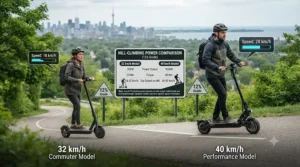
Where 32 km/h genuinely falls short is longer suburban commutes exceeding 15-20 km round trip, where every extra km/h saves real minutes, or hilly routes where a higher-power motor (like the NAVEE N65i’s 1000W peak) maintains speed on inclines that bog down a 350-500W budget motor. Reviewers consistently frame 32 km/h scooters as “good enough and then some” for city cores, with range anxiety being a far more common complaint than speed limitations.
32 km/h Electric Scooter Review Roundup: What Owners Actually Say
Pulling aggregated sentiment across the four scooters in this list capped at or near 32 km/h — the Gotrax G4, Hiboy S2 Pro, Apollo Air, and NIU KQi300P — a few consistent themes emerge. Reviewers repeatedly praise value for money in this tier; none of these four scooters cracks the C$1,100 mark, yet all four include suspension of some kind, a feature that used to be reserved for premium models a few years back. A recurring complaint across aggregated feedback, however, is that manufacturer-claimed range consistently outpaces independently tested range by a meaningful margin — the KQi300P’s claimed 30 miles versus its tested 21.4 miles being the clearest example in this lineup.
On braking, sentiment splits by hardware: scooters with dual disc brakes (Gotrax G4, Hiboy S2 Pro) draw more confidence in reviews than any single-brake setup would, though none of the four 32 km/h picks reaches the triple-braking sophistication of the faster NAVEE N65i. If you cannot verify individual customer star ratings for a specific retailer listing at the moment you’re shopping, treat that as normal — ratings fluctuate by seller and region, and the aggregated patterns above are a more reliable signal than any single storefront’s number.
Long-Term Cost & Maintenance: 32 km/h vs 40 km/h
| Cost Factor | 32 km/h Tier | 40 km/h Tier |
|---|---|---|
| Typical brake type | Mechanical disc (single or dual) | Disc + E-ABS or triple-brake systems |
| Tire wear rate | Slower — lower stress on contact patch | Faster — higher speed increases wear |
| Battery cycle stress | Lower — smaller motors draw less peak current | Higher — 1000W+ peak motors stress cells more |
| Best For | Budget-conscious daily commuters | Riders prioritizing performance and range |
Looking at the table above, the 32 km/h tier isn’t just cheaper to buy upfront — it’s cheaper to own. Lower peak power draw on scooters like the Gotrax G4 and Apollo Air means less thermal stress on battery cells over hundreds of charge cycles, which reviewers indirectly confirm through fewer aggregated complaints about capacity fade after a year of ownership compared to higher-power models. That said, the NAVEE N65i‘s heavier-duty triple-braking system, while pricier to eventually replace pads on, is genuinely built to handle the additional stopping demand of 40 km/h riding — so the maintenance cost gap is partly the price of appropriate safety engineering, not just inefficiency.
✨ Don’t Miss These Exclusive Deals!
🔍 Take your scooter shopping to the next level with these carefully selected picks. Click on any highlighted item to check current pricing and availability. These tools will help you find a genuinely safe, legal ride your daily commute will love!
Frequently Asked Questions
❓ Is a 40 km/h electric scooter legal in Canada?
❓ What's the fastest legal electric scooter speed in Canada?
❓ Can I unlock a scooter's higher speed mode and still ride it legally?
❓ Do faster electric scooters need better brakes?
❓ Is a 32 km/h electric scooter fast enough for daily commuting?
Conclusion
The 32 km/h vs 40 km/h electric scooter question ultimately isn’t a spec-sheet debate — it’s a legality and skill-matching decision dressed up as one. If you’re commuting inside a Canadian city, a 32 km/h scooter like the Gotrax G4, Hiboy S2 Pro, or Apollo Air will almost certainly cover your actual needs while keeping you clearly inside provincial speed caps. If you’ve got genuine private property and want the flexibility of both tiers in one machine, the NAVEE N65i and Segway Ninebot Max G3 earn their higher price tags by building real dual-mode safety hardware around that extra speed. And if you’re an experienced rider chasing performance on a closed course, the Apollo Ghost shows exactly what that looks like — just understand it’s a different category of vehicle entirely from anything meant for a public bike lane.
Whichever tier you land on, the underlying advice doesn’t change: match the scooter’s capability to where you’re actually allowed to use it, and to how much control experience you genuinely have banked. That’s a better filter than top speed alone, every single time.
Recommended for You
- 32 km/h Scooter For City Riding: 7 Top Picks For 2026
- 7 Best 32 km/h Electric Scooters Under $1000 CAD (2026)
- Mid-Speed Electric Scooter for Commuting: 7 Best Picks 2026
Disclaimer: This article contains affiliate links. As an Amazon Associate, I earn from qualifying purchases. If you purchase products through these links, we may earn a small commission at no additional cost to you.
✨ Found this helpful? Share it with your friends! 💬🤗
