
In This Article
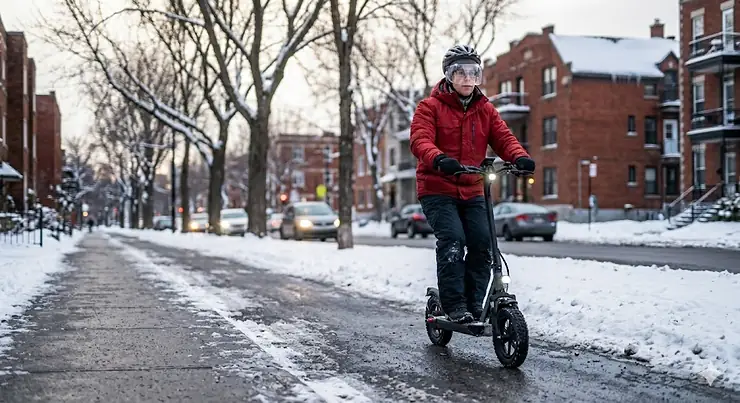
Canada does not mess around when it comes to winter. One week you’re gliding through October sunshine in Vancouver, and four weeks later a Winnipeg cold snap has turned everything into a salt-crusted ice rink at -25°C. If you own an electric scooter and you haven’t thought about winterization, your lithium battery is already drafting its resignation letter.
Knowing how to winterize electric scooter properly is the single most important thing a Canadian rider can do before the first hard frost hits. We’re not talking about a quick wipe-down and chucking it in the garage. We’re talking about a systematic, deliberate process that protects your battery chemistry, seals out road salt, preserves your tyres, and keeps your electrical connections from corroding through a five-month Canadian winter. Done right, a properly winterized scooter comes out in April exactly as you left it in November. Done wrong, you’re looking at a swollen battery pack, rust-seized folding mechanism, and a repair bill that stings more than the cold.
This guide gives you the complete 2026 playbook — the exact process, the seven best products available on Amazon.ca CAD, and the practical Canadian context you won’t find in any manufacturer’s manual. Whether you’re storing a Segway Ninebot in a Toronto condo closet or parking a NIU KQi3 in an Edmonton garage that drops to -30°C, this is the winterization guide you’ve been looking for.
Quick Comparison: Top 7 Winterization Products at a Glance
| Product | Best For | Key Feature | Price Range (CAD) | Amazon.ca |
|---|---|---|---|---|
| VVHOOY 210D Oxford Scooter Cover | Full outdoor & indoor protection | Wind-resistant elastic hem + tie ropes | $25–$40 | ✅ Prime eligible |
| NOCO GENIUS2 Smart Battery Charger | Lithium & lead-acid battery maintenance | 2-amp multi-stage charging | $50–$70 | ✅ Prime eligible |
| WD-40 Specialist Corrosion Inhibitor | Anti-rust pre-storage treatment | Up to 1 year outdoor protection | $15–$25 | ✅ Prime eligible |
| Permatex 22058 Dielectric Tune-Up Grease | Sealing electrical connectors | Prevents moisture intrusion | $8–$15 | ✅ Available |
| AstroAI Digital Tyre Inflator & Pressure Gauge | Tyre pressure management | ±1% accuracy, backlit LCD | $20–$35 | ✅ Prime eligible |
| Hiboy 4L Hardshell Handlebar Storage Bag | Accessories & charger storage | Waterproof EVA shell, universal fit | $25–$40 | ✅ Prime eligible |
| Master Lock 8143D Python Cable Lock | Security during storage | 1.8 m braided steel cable | $25–$40 | ✅ Available |
All prices in CAD. Prices may vary — always check current pricing on Amazon.ca.
The products above span every stage of the winterization process, from sealing out moisture before storage to keeping your battery trickle-charged through February. Budget riders can prioritize the corrosion spray, cover, and tyre gauge (under $80 CAD total) and still protect 80% of their scooter’s value. If you have a premium scooter worth $1,200 CAD or more, the smart charger alone pays for itself the first time it prevents a dead battery pack.
💬 Just one click — help others make better buying decisions too! 😊
Top 7 Winterization Products: Expert Analysis
1. VVHOOY Upgraded 210D Oxford Fabric Scooter Storage Cover
The VVHOOY cover is the unsung hero of the Canadian winter scooter arsenal, and frankly the first thing you should buy before you touch anything else. Made from 210D Oxford fabric with a silver-plated undercoating, it’s legitimately weatherproof — not just “water-resistant until the first downpour” waterproof. The double-stitched seams and elastic hem mean it won’t billow off during a March windstorm in Ottawa.
What makes this cover particularly useful in Canadian conditions is the four tie-rope system at the base. If your scooter lives in a garage with gust gaps or an outdoor storage locker (common in Toronto condo buildings), those ropes mean the cover stays on and the wind stays out. The 67″ × 24″ × 46″ dimensions fit most mid-size kick scooters including the Segway Ninebot ES series and NIU KQi models. It protects against UV degradation in summer storage, too — so it earns its keep year-round.
Canadian buyers should note: one Amazon.ca reviewer from Calgary specifically mentioned using this cover in unheated garage conditions through winter, reporting zero moisture or frost damage to the scooter underneath. That’s exactly the real-world confirmation you want.
✅ 210D Oxford weatherproof fabric
✅ Elastic hem + 4 tie ropes for wind resistance
✅ Universal fit up to 67″ × 24″ × 46″ (170 × 61 × 117 cm)
❌ Sizing can be snug for larger dual-motor scooters
❌ No ventilation panel — not ideal for prolonged damp indoor environments
Price range: $25–$40 CAD. Outstanding value for full-season protection.
2. NOCO GENIUS2 2-Amp Smart Battery Charger and Maintainer
Here’s the honest truth about storing an electric scooter battery through a Canadian winter: if you just unplug it and leave it at whatever charge it happened to be at in November, you are actively destroying it. Lithium-ion cells self-discharge over time, and a cell that hits zero volts during a cold spell can suffer permanent capacity loss or, in worst cases, become unsafe to charge. The NOCO GENIUS2 solves this elegantly.
The GENIUS2 is a smart, multi-stage charger that automatically detects your battery’s state and applies exactly the current it needs — no more, no less. At 2 amps, it’s gentle enough for the smaller lithium packs in entry-level scooters (10–13 Ah) while still being capable enough to recover a deeply discharged battery. It handles both 6V and 12V systems and is compatible with lithium, AGM, and lead-acid chemistries, which means it works regardless of what generation scooter you own.
The practical Canadian implication: plug this in once a month during storage, let it run until the indicator goes green, unplug. That’s genuinely all there is to it. Compared to the $200–$400 CAD cost of a replacement lithium pack, this charger is one of the best insurance purchases on Amazon.ca.
✅ 2-amp multi-stage smart charging
✅ Compatible with lithium and lead-acid batteries
✅ Error detection and spark-proof connection
❌ Requires the correct connector adapter for some scooter-specific charge ports
❌ Cord length is modest — extension cord may be needed in larger storage areas
Price range: $50–$70 CAD. A no-brainer investment for any scooter worth over $500.
3. WD-40 Specialist Long-Term Corrosion Inhibitor Spray
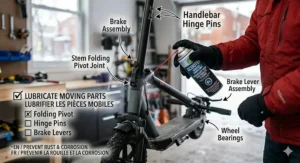
Road salt is the silent killer of Canadian electric scooters. Most riders worry about the obvious stuff — battery and tyres — while salt silently works its way into folding hinges, brake cable housing, and stem clamps throughout the autumn riding season. By the time spring arrives, those mechanisms can be partially seized or visibly rusting. The WD-40 Specialist Corrosion Inhibitor, available widely on Amazon.ca, is specifically engineered to prevent this.
Unlike the standard blue-can WD-40 (which is primarily a moisture displacer, not a long-term rust preventer), the Specialist Corrosion Inhibitor contains metal-seeking Vapour Corrosion Inhibitors (VCIs) that seal into the microscopic pores of metal surfaces. Applied before winter storage, it provides up to 1 year of outdoor corrosion protection and 2 years indoors. For a scooter going into a heated condo storage room, a single pre-storage treatment is all you need.
What most Canadian buyers overlook is where to apply it: don’t just spray the obvious metal parts. Focus on the folding latch mechanism, the brake lever pivot points, stem clamp bolts, and the underside of the deck. These are the areas where road salt accumulates and lingers. Five minutes of careful application in November can save you a seized fold mechanism in April.
✅ Up to 1-year outdoor corrosion protection
✅ Non-drying — stays in place, doesn’t run off
✅ Effective in cold and humid Canadian conditions per WD-40 Canada specifications
❌ Aerosol — keep away from brake pads and tyre sidewalls
❌ Strong solvent smell — use in ventilated space
Price range: $15–$25 CAD. Possibly the best bang-for-dollar purchase on this entire list.
4. Permatex 22058 Dielectric Tune-Up Grease
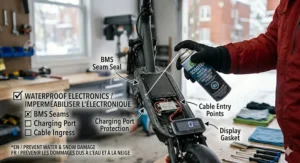
This one is the product that most riders skip and then regret deeply. Electrical connectors on electric scooters — the charge port, the battery connector, any auxiliary LED or display plugs — are exposed to moisture during riding season. Moisture + metal connectors + freeze-thaw cycling = oxidised, high-resistance connections. The result is intermittent throttle response, charging errors, and in some cases, controller damage.
Permatex Dielectric Grease is a pure silicone compound that seals electrical connectors against moisture ingress without conducting electricity. You apply a tiny amount to the inside of connector housings before unplugging and storing for winter. When you reconnect in spring, the contacts are pristine. The 28.4g tube on Amazon.ca is small enough to fit in your tool kit and contains enough product for several seasons of maintenance.
For Canadian riders, this is especially important if you store your scooter in a garage or storage locker that experiences temperature swings — say, from -15°C on a January night to +5°C on a February afternoon. That cycling creates condensation inside connector housings, and dielectric grease is the only reliable barrier against it.
✅ Prevents moisture oxidation on electrical connectors
✅ Temperature-stable from -54°C to 204°C
✅ Will not damage rubber seals or plastic connector housings
❌ Not for use on sliding metal contacts (brake levers, etc.) — use lubricant grease there instead
❌ Easy to over-apply — a thin film is all you need
Price range: $8–$15 CAD. A single tube lasts years.
5. AstroAI Digital Tyre Inflator and Pressure Gauge
Cold air is denser, and denser air exerts less pressure on tyre walls — which is the long way of saying that your scooter tyres lose pressure every time the temperature drops. A tyre that was perfectly inflated at 40 PSI in September could easily read 32–34 PSI by December, even without a puncture. At that pressure, you get degraded handling, increased rolling resistance, and accelerated tyre sidewall wear when you pull the scooter out in spring.
The AstroAI Digital Tyre Inflator is a dual-function tool: it both measures pressure (to ±1% accuracy) and inflates via a standard Schrader valve connection. The backlit LCD display is genuinely useful in the dim conditions of a Canadian garage or storage locker in winter. It fits the standard valve stems on 8.5″, 10″, and 12″ scooter tyres that cover most popular models in Canada.
The real value here is pre-storage and post-storage tyre management. Check pressure, inflate to the manufacturer’s recommended PSI (usually 40–50 PSI for most adult kick scooters), then check again in February. This also helps you spot a slow leak before it becomes a flat that you discover on your first spring ride.
✅ ±1% accuracy digital readout
✅ Backlit display for use in dim storage areas
✅ Compact — fits in the Hiboy handlebar bag
❌ Requires a power source (USB-rechargeable or car accessory port)
❌ Not a standalone pump — you’ll need a pump for major inflation
Price range: $20–$35 CAD. A must-have for any tyre-care routine.
6. Hiboy 4L Waterproof Hardshell Handlebar Storage Bag
When you’re preparing your scooter for winter storage, there’s always a collection of small items that need a home: the original charger, a small hex wrench set, valve stem caps, the dielectric grease tube, registration documents if applicable. The Hiboy 4L EVA hardshell bag solves this neatly by keeping all your maintenance essentials in one weather-sealed pouch that mounts directly to the scooter’s handlebar.
The hardshell EVA construction is genuinely impact-resistant — not just a cloth bag with a zipper. The two-way sealed zipper keeps moisture out even if the storage space gets humid. Universal strap mounting means it fits most kick scooter handlebar diameters including Segway Ninebot, NIU KQi, Apollo, and Kaabo models.
What I particularly like about keeping this bag mounted during storage is organisational continuity: when spring arrives, your tools and documentation are exactly where you left them. No hunting around a garage shelf for a valve cap or trying to remember where you put the original charging cable.
✅ 4L capacity — fits charger, tools, documents
✅ Waterproof EVA hardshell construction
✅ Universal fit with adjustable strap mount
❌ Adds visual bulk to the scooter — some riders prefer detachment during storage
❌ Listed as compatible with Hiboy-branded models — verify handlebar diameter for third-party scooters
Price range: $25–$40 CAD. Ships to Canada with Amazon.ca Prime.
7. Master Lock 8143D Python Cable Lock (1.8 m)
Storing a scooter through winter doesn’t mean your security obligations go on vacation. Indoor storage lockers in Toronto condos and Vancouver apartment buildings are not immune to theft — and a folded scooter that looks abandoned for five months is a prime target. The Master Lock Python is a 1.8 m (6 ft) braided steel cable with a 4-digit resettable combination, available on Amazon.ca in the $25–$40 CAD range.
This is not a high-security lock for outdoor public use (for that, you’d want a heavy Kryptonite U-lock). The Python is specifically suited to the threat model of indoor storage: it deters opportunistic theft by physically anchoring your scooter to a pipe, wall bracket, or bike rack in a shared storage room. The 11 mm braided cable is significantly more resistant to casual cutting than the woven cable locks you’ll find for $10 at dollar stores.
For Canadian riders using condo or building storage through winter, this lock represents a $30 CAD insurance policy against a $1,000+ loss. That’s an easy value calculation.
✅ 1.8 m length fits most indoor anchoring configurations
✅ 4-digit resettable combination — no key to lose
✅ Braided steel resists casual cable cutters
❌ Not suitable as a primary outdoor lock on public streets
❌ Combination resets require careful attention to instructions
Price range: $25–$40 CAD. Available on Amazon.ca.
✨ Don’t Miss These Exclusive Deals!
🔍 Take your scooter winterization to the next level with these carefully selected products. Click on any highlighted item to check current pricing and availability on Amazon.ca. These tools will help you protect your investment and ride confidently every spring!
Step-by-Step Winterization Guide for Canadian Riders
Think of winterizing your scooter as a fifteen-minute ritual, not a big project. Do it once, do it right, and your scooter will reward you with a flawless spring startup.
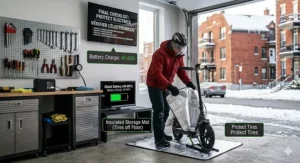
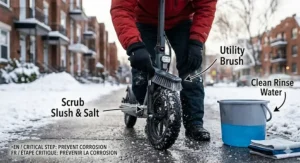
Step 1 — Final Autumn Clean (30 minutes before storage) Wipe the entire scooter down with a damp cloth, paying special attention to the underside of the deck, the wheel wells, and the folding mechanism. Road salt is invisible but corrosive — remove it now. Never use a pressure washer; the jets will force water past IP ratings into the controller enclosure.
Step 2 — Apply Corrosion Inhibitor Spray WD-40 Specialist Corrosion Inhibitor onto all exposed metal: hinges, bolts, brake cable housing, stem clamp. Let it penetrate for 10 minutes, then wipe off the excess. The VCI chemistry keeps working invisibly for months.
Step 3 — Seal Electrical Connectors Apply a thin bead of Permatex Dielectric Grease inside the charge port housing and any exposed auxiliary connector. This takes two minutes and is the single most overlooked step in Canadian scooter storage.
Step 4 — Set Battery to Storage Charge Level Charge your battery to between 50% and 80% — not 100%, not empty. A fully charged lithium cell stored long-term degrades faster than one kept at mid-range. This is particularly important in Canadian cold, where battery chemistry is already under stress.
Step 5 — Check and Inflate Tyres Inflate to manufacturer’s recommended pressure or slightly above (the cold will drop it back down within weeks). Log the date and current PSI.
Step 6 — Cover and Secure Fit the VVHOOY cover, secure the tie ropes, and anchor the Python cable lock to your storage anchor point.
Step 7 — Monthly Battery Check Once per month, bring the scooter to room temperature, connect the NOCO GENIUS2, let it complete a maintenance cycle. This takes 20–60 minutes and adds years to your battery’s service life.
Canadian Rider Profiles: Who Needs What
The Toronto Condo Commuter
Profile: Daily 8 km commute, stores scooter in a shared building locker, budget around $700 CAD for a mid-range NIU KQi3.
This rider’s biggest threat isn’t the cold — it’s the building’s storage locker, which cycles between -5°C and +15°C all winter due to its proximity to the heated parkade. The freeze-thaw cycling is brutal on battery connectors and tyre pressure. Priority products: Dielectric grease, NOCO GENIUS2, and the Python cable lock. This rider should also check the City of Toronto’s e-scooter by-laws, as Toronto has specifically opted out of Ontario’s provincial pilot program — meaning any riding in public spaces is currently not permitted, which affects whether winterization means “storage” or “riding prep.”
The Vancouver Weekend Rider
Profile: Recreational weekend use, mild winters, stores in a covered carport, budget $1,000–$1,500 CAD for an Apollo Air.
Vancouver winters are wet, not arctic — but wet is its own flavour of destructive. This rider’s enemy is sustained moisture and road salt from November rain, not battery freeze. Priority products: VVHOOY cover, WD-40 Corrosion Inhibitor, and the Hiboy storage bag for keeping tools dry. The BC e-scooter pilot allows riding in participating communities through April 2028, so this rider may actually ride through mild spells — which means the scooter needs to be ride-ready, not in deep hibernation.
The Calgary Daily Driver
Profile: Year-round rider where possible, storing a Kaabo Mantis through the deep freeze months (November–February), garage temperature drops to -20°C.
This is the hardest use case in Canada. At -20°C, a lithium battery left unplugged will not only self-discharge — it can refuse to start at all. Priority products: All seven on this list, with particular emphasis on the NOCO GENIUS2 (run monthly maintenance cycles without fail) and moving the battery indoors if physically removable. At these temperatures, battery range can drop by 30–50% even when the scooter is in good condition — a range reduction riders in Edmonton and Calgary commonly report during cold snaps.
How to Choose Winterization Products in Canada
Not every scooter needs every product on this list. Here’s how to prioritise:
- Start with protection against your dominant threat. Salt and moisture? Corrosion inhibitor and cover first. Extreme cold? Battery maintainer is your #1 purchase.
- Match product specs to your scooter’s voltage system. The NOCO GENIUS2 handles 6V and 12V systems — but verify your scooter’s battery configuration before purchasing any charger.
- Consider your storage environment. Heated indoor storage is forgiving — a simple cover and monthly charge check may be sufficient. Unheated garage or outdoor storage locker? Add the corrosion inhibitor and dielectric grease without question.
- Check Amazon.ca Prime eligibility. Many of these products qualify for free shipping on orders over $35 CAD or with an Amazon Prime membership. Bundling the corrosion inhibitor, dielectric grease, and tyre gauge in one order typically clears the free shipping threshold.
- Factor in product availability in your province. Most products here ship across Canada, but remote locations in northern Ontario, BC interior, or the territories may see 7–14 day delivery windows. Order before the first hard frost — typically late October in most of Canada.
Common Winterization Mistakes Canadian Riders Make
Mistake 1: Storing the battery at full charge. This is counterintuitive but well-established in lithium battery chemistry. A fully charged cell stored at 100% experiences higher internal stress, particularly when combined with cold temperatures. Store at 50–80% and you’ll lose less capacity over time.
Mistake 2: Charging immediately after riding in the cold. Bring your scooter indoors and let it warm to room temperature for at least 30 minutes before plugging in. Charging a cold lithium battery accelerates degradation and, in extreme cases, can cause thermal runaway. This is a fundamental rule of Canadian winter battery maintenance that even experienced riders routinely ignore.
Mistake 3: Skipping the electrical connector step. The charge port is the most moisture-exposed electrical connection on your entire scooter. One tube of dielectric grease costs under $15 CAD. A damaged charge port controller repair costs $80–$200 CAD. The math is obvious.
Mistake 4: Leaving the scooter unwashed before storage. Autumn road salt dries into a white crystalline crust and keeps corroding metal all winter, even without moisture contact. Always clean before storing.
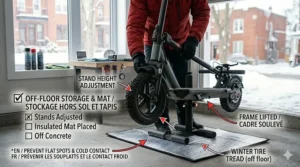
Mistake 5: Ignoring tyre pressure over the storage period. Even without a puncture, pneumatic tyres can lose 5–10 PSI over a cold winter. A tyre sitting at low pressure for five months can develop flat spots or sidewall creasing that persists into riding season. Check monthly.
Battery Management in Canadian Cold: What the Spec Sheet Won’t Tell You
The cold truth — quite literally — is that lithium-ion batteries are not fans of Canadian winters. The electrochemical processes inside a lithium cell slow significantly as temperatures drop, increasing internal resistance and reducing available voltage. Below 0°C, riders commonly experience 15–25% range reduction. Below -10°C, that can climb to 35–50%. And at -20°C or below — which is a routine January reality in Alberta, Saskatchewan, and Manitoba — some batteries will refuse to discharge at all until warmed up.
What the manufacturer’s specification sheet absolutely will not tell you is that this degradation is cumulative. A battery that’s been cold-cycled without proper storage care for two winters will permanently hold less charge than one that was properly maintained. The capacity loss is real and irreversible. This is not scare-mongering; it’s electrochemistry.
The practical solutions for Canadian riders are straightforward:
- Remove the battery if possible and store it indoors at room temperature. Many scooters (particularly modular designs like the NIU KQi3 Pro) have accessible battery packs. Take it inside.
- If the battery is non-removable, store the entire scooter in the warmest available location and run a monthly maintenance charge with a smart charger like the NOCO GENIUS2.
- Never charge below 0°C. This is the cardinal rule. Charging a sub-zero lithium cell causes lithium plating on the anode, which permanently reduces capacity and can create internal short-circuit risks.
- Warm up before riding in deep cold. If you must ride in temperatures below -10°C, run the scooter at low speed for the first 5 minutes to gently warm the battery before drawing full current.
Canadian Regulations & Safety Standards for Winter Riding
Before you decide whether you’re “storing for winter” or “riding through winter,” a quick reality check on where the regulations stand in 2026 is essential. The legal landscape for e-scooters in Canada is genuinely complex — there’s no single national rule, and the patchwork of provincial and municipal regulations varies dramatically.
British Columbia’s e-scooter pilot runs until April 2028 and allows riding in participating communities (Vancouver, Victoria, Kelowna, and 30+ others) — but only under conditions where roads are safe, which practically means cleared pavement. Ontario’s pilot extends to November 2029 with municipal opt-in, but Toronto has specifically declined, meaning public riding in Toronto is not currently permitted. Quebec’s ATPM pilot runs until July 2026 with extension expected; Alberta’s cities allow riding on bike lanes without a licence, but only for cleared surfaces.
The practical winter implication: in most Canadian provinces, riding on uncleared snow, ice, or frost-covered paths is both unsafe and — in many jurisdictions — illegal. Even where e-scooters are technically permitted year-round, the sensible guidance is to store from first snowfall until spring thaw. The Transport Canada classification framework for personal mobility devices focuses primarily on road-safe design and speed limits; winter-specific riding standards are left to provincial discretion.
For winter riders who do choose to ride through milder spells: ensure your front and rear lights are operational, wear reflective outerwear, and reduce your riding speed significantly. Braking distances on damp pavement are 40–60% longer than on dry surfaces, and e-scooter brakes (whether disc or drum) perform noticeably worse when wet and cold.
Long-Term Cost & Maintenance in Canada
Let’s talk honestly about the economics. A mid-range electric scooter in Canada — say, an Apollo Air or NIU KQi3 — runs $900–$1,400 CAD. The dominant maintenance cost isn’t the tyres or brake pads. It’s battery replacement, which for most quality scooters costs $200–$500 CAD and requires professional installation on non-modular models.
Proper winterization directly extends battery lifespan. A lithium pack that’s properly maintained through storage — charged to 60%, kept at room temperature, run through monthly maintenance cycles — can reasonably last 4–6 seasons. A battery that’s been cold-stored at full charge, never maintained during winter, and repeatedly deep-discharged might start showing significant capacity loss after 2 seasons.
The seven products in this guide total $168–$265 CAD in the mid-range of their respective price brackets. Compare that to one premature battery replacement at $300+ CAD, and the ROI is immediate. For a $1,200 CAD scooter, spending $200 CAD on proper winterization gear to protect the investment across a 5-year ownership period is simply rational financial planning.
Additionally, don’t overlook the spring inspection step. Before your first ride each season: check all bolts for tightness, inspect tyre sidewalls for cracking, squeeze both brakes to verify pad-to-rotor contact, and do a full-charge test to assess actual battery capacity. Catching a problem in the garage is always cheaper than dealing with it 10 km from home in April.
✨ Don’t Miss These Exclusive Deals!
🔍 Ready to protect your scooter investment this winter? Click on any highlighted product to check current pricing and availability on Amazon.ca. A small investment now saves you from costly repairs come spring!
FAQ: How to Winterize Electric Scooter in Canada
❓ How do I store an electric scooter for the winter in Canada?
❓ Will cold weather permanently damage my electric scooter battery in Canada?
❓ Can I ride my electric scooter in Canadian winter conditions?
❓ How often should I charge my stored scooter during a Canadian winter?
❓ Do I need to remove the battery from my scooter for winter storage in Canada?
Conclusion: Five Months of Winter, One Afternoon of Preparation
Here’s the reality of owning an electric scooter in Canada: the riding season is glorious, and the off-season is just an extended maintenance window. Knowing how to winterize electric scooter is not optional knowledge — it’s the difference between a scooter that lasts 5 seasons and one that surprises you with a dead battery in year two.
The seven products in this guide cover every angle of the winterization process, from moisture sealing to battery chemistry to physical security. None of them are expensive. All of them are available on Amazon.ca. Together, they represent the kind of preventive care that keeps a $1,200 CAD machine performing like new when April finally rolls around.
Do the fifteen-minute winterization ritual this November. Your spring self will be extremely grateful.
✨ Don’t Miss These Exclusive Deals!
🔍 Start your winterization today with these carefully selected products on Amazon.ca. Click any highlighted item above to check current Canadian pricing and Prime shipping eligibility. Protect your ride before the first frost hits!
Recommended for You
- 7 Best Electric Scooter That Works in Snow — Canada’s Ultimate Winter Guide 2026
- 7 Best Winter Electric Scooters for -30 Degrees Celsius (2026 Canada)
- 7 Best Cold Weather Electric Scooters Under $1000 Canada 2026
Disclaimer: This article contains affiliate links. As an Amazon Associate, I earn from qualifying purchases. If you purchase products through these links, we may earn a small commission at no additional cost to you.
✨ Found this helpful? Share it with your friends! 💬🤗
