
In This Article
If you’ve ever stood on a Toronto subway platform at rush hour, squeezed between strangers and wondering if there’s a better way — there absolutely is. Choosing the right electric scooter by Canadian city is one of the smartest commuting decisions you can make in 2026, and this guide is going to show you exactly how to do it without wasting a single dollar (CAD, naturally).
Here’s the thing most buyers get wrong: they shop for an e-scooter like it’s a universal gadget. It isn’t. A scooter that thrives on Vancouver’s rainy seawall paths will struggle on Calgary’s icy February sidewalks. The model that a Montreal student loves for 8 km café-to-campus runs isn’t the same one an Ottawa government worker needs for a 15 km round-trip with a helmet law in full effect. Canada’s cities are wildly different — in climate, terrain, and regulation — and the best electric scooter by Canadian city takes all of that into account.
To make this guide worth your time (and your money, which is in short supply after Canadian inflation), I analysed the real Amazon.ca listings, dug into customer reviews from Canadian buyers specifically, and cross-referenced current provincial pilot programs and municipal bylaws as of June 2026. I also factored in what cold weather actually does to lithium batteries — spoiler: it’s not pretty if you ignore it. You’ll find city-specific advice for Calgary, Ottawa, Edmonton, Vancouver, Toronto, and Montreal woven throughout.
All prices are in CAD, and I never list exact figures because Amazon.ca pricing shifts constantly. What you’ll get instead are honest price ranges that reflect what you should budget.
Let’s find your perfect ride. 🇨🇦⚡
Quick Comparison: Top 7 Electric Scooters on Amazon.ca (2026)
| Model | Motor | Range | Weight | Best City Match | Price Range (CAD) |
|---|---|---|---|---|---|
| Gyrocopters J30 2026 | 350W | ~30 km | ~12 kg | Ottawa, Halifax | Under $300 |
| iScooter i9 Max | 350W | ~35 km | ~13 kg | Montreal, Victoria | $250–$350 |
| NAVEE V25 | 600W peak | ~25 km | ~15 kg | Vancouver, Toronto | $350–$450 |
| Gotrax GXL V2 w/ Seat | 500W peak | ~31–40 km | ~16 kg | Edmonton, Winnipeg | $400–$500 |
| Hiboy S2 Pro | 500W | ~45 km | ~16.5 kg | Calgary, Ottawa | $450–$600 |
| AONIU M4 | 1000W peak | ~50 km | ~22 kg | Edmonton, suburbs | $550–$700 |
| NAVEE ST3 Series | 1000–1350W | 60–75 km | ~23 kg | Toronto, Vancouver | $650–$850 |
Reading the table: The sub-$300 models are perfectly adequate for short flat commutes in cities with dedicated bike lanes like Ottawa’s multi-use pathways. Where the table gets interesting is in the $450–$700 range — that sweet spot where range, motor power, and build quality converge for Canadian conditions. The NAVEE ST3’s 75 km claimed range sounds excessive until you remember that cold temperatures can slash battery output by 20–40%, turning a “75 km scooter” into a 45 km scooter on a -10°C Edmonton morning.
💬 Just one click — help others make better buying decisions too! 😊
✨ Don’t Miss These Exclusive Deals!
🔍 Take your urban commute to the next level with these carefully selected scooters. Click on any highlighted product name to check current pricing and availability on Amazon.ca. These picks will help you commute smarter, greener, and faster — whatever Canadian city you call home!
Top 7 Electric Scooters by Canadian City: Expert Analysis 🛴
1. Gyrocopters J30 2026 — Best Budget Pick for Ottawa & Halifax
The Gyrocopters J30 2026 is a Canadian-market favourite that earns its place as the entry-level champion, particularly for riders in flat, lane-rich cities. This model runs on a 350W brushless motor reaching speeds up to 31 km/h with a range of roughly 30 km — good for a 15 km one-way commute in Ottawa, where the e-scooter pilot program currently caps speeds at 20 km/h on most pathways anyway.
The burst-proof 8.5″ tires are genuinely useful: they won’t go flat mid-ride on the pothole-laden spring roads that follow Ottawa’s freeze-thaw cycles. What most buyers overlook, however, is the integrated smart anti-theft lock and Bluetooth app control — features that used to cost twice as much just two years ago. For a condo dweller who parks indoors and commutes on relatively flat terrain, this is the scooter.
Canadian reviews consistently praise the J30 for its folding mechanism and portability — at roughly 12 kg (26.5 lbs), it’s one of the lightest models on Amazon.ca. Note that Halifax riders benefit from relatively mild Atlantic winters compared to Alberta, making shoulder-season riding much more viable here.
✅ Lightweight and very easy to carry onto transit or up condo stairs
✅ App connectivity and anti-theft lock at this price point is impressive
✅ Burst-proof tires reduce maintenance anxiety
30 km range shrinks noticeably below 5°C — not ideal for Prairie winters
❌ Motor struggles on inclines above 10° — hilly Halifax neighbourhoods near Citadel Hill will be a challenge
Price range: under $300 CAD — outstanding value for flat urban commuting.
2. iScooter i9 Max — Best for Montreal & Victoria
The iScooter i9 Max threads the needle perfectly for riders who need a bit more range than the J30 but aren’t ready to move into the $400+ tier. It carries a 350W motor, 8.5″ pneumatic tires, and a claimed range of 35 km — realistic enough for a Montreal Plateau–to–downtown commute of 10–12 km round-trip, even accounting for the hills on Avenue du Parc.
What stands out practically is the dual braking system combining an electronic regenerative front brake with a rear disc brake. In Montreal, where cobblestone streets in Old Port can catch you off guard, having reliable stopping power on a budget scooter matters. The LED display is crisp and readable in Quebec’s bright winter sunlight, and the folded dimensions make it compatible with the STM bus bike racks.
Victoria riders will appreciate its IPX4 water resistance rating — basic, but enough to handle West Coast drizzle during morning commutes. Canadian reviewers note that the assembly is straightforward, which matters since iScooter has limited service centres in Canada. Keep that in mind: you’re largely on your own for repairs, so stick to the maintenance schedule and treat it gently.
✅ Dual braking system significantly improves confidence on wet roads
✅ Compact folded size suits transit + scooter hybrid commuting
✅ Strong value for the $250–$350 CAD range
❌ IPX4 rating means it can handle light rain, not downpours — not ideal for Vancouver
❌ Manufacturer support in Canada is limited compared to Apollo or NAVEE
Price range: $250–$350 CAD — a smart step up from the absolute budget tier.
3. NAVEE V25 — Best Urban Commuter for Vancouver & Toronto
The NAVEE V25 is where commuter scooters start getting serious. It’s powered by a 600W peak motor (running on a 36V 5.2Ah battery), reaches 30 km/h, and claims up to 25 km of range — modest but honest. NAVEE is refreshingly transparent: they know battery range varies, and they build in a smart LED display showing real-time battery percentage so you’re never caught guessing.
What justifies the V25 over cheaper options is the UL2272 safety certification and integrated BMS (Battery Management System). In Vancouver, where the Electric Kick Scooter Pilot Programme requires compliance with provincial safety standards, having a properly certified scooter keeps you legal and your battery healthier in the damp Pacific climate. The sealed motor housing performs well in rain.
Toronto riders should note: Toronto has not opted into Ontario’s e-scooter pilot as of 2026, meaning you technically can’t ride a personal e-scooter on public roads in the city. However, many Torontonians use their scooters on private property, in parks (check bylaws), or in the suburbs like Mississauga and Brampton where the pilot IS active. The V25’s fold-and-carry design makes it great for mixed transit use.
✅ UL2272 certified — meets Canadian safety standards for pilot programme cities EABS + rear disc brake is premium for this price range
✅ NAVEE has solid Canadian support through naveetech.ca
❌ 25 km range is on the conservative side — plan your route carefully
❌ Not the best choice if you ride in temperatures regularly below -10°C
Price range: $350–$450 CAD — the best-supported mid-range option on Amazon.ca.
4. Gotrax GXL V2 with Seat — Best for Edmonton & Winnipeg
If you’re commuting in Edmonton or Winnipeg — cities where wind chills can hit -35°C and every extra 5 minutes on a scooter feels like a personal vendetta from the weather — comfort becomes a survival feature, not a luxury. The Gotrax GXL V2 with Seat adds exactly that: a wide, adjustable seat with rear carry basket, turning your scooter into something closer to a practical urban runabout.
The 500W peak motor powers 14″ pneumatic tires that eat up cracked pavement and spring frost heaves far better than the 8.5″ tires on most budget models. Dual shock absorption front and rear makes a tangible difference over the broken roads of Edmonton’s older residential areas. The claimed 31–40 km range is achievable in fair weather; in Prairie winters, assume 20–25 km as a realistic cold-weather baseline.
Canadian buyers in Edmonton specifically note this model’s practicality for grocery runs and errand trips — the rear basket holds a reasonable load. It’s not the sleekest-looking scooter on the block, but Canadians generally appreciate function over flash. Gotrax has a dedicated Canadian store (gotrax.ca) with parts availability, which matters enormously if you’re dealing with warranty issues in Winnipeg rather than Vancouver.
✅ Seat + basket combo makes it a genuine car replacement for short trips
✅ 14″ tires handle rough Edmonton road surfaces exceptionally well
✅ Gotrax Canada provides local warranty support
❌ Heavier than most (~16 kg / 35 lbs) — not ideal for transit stair-carrying
❌ Seat isn’t suitable for riding in heavy snow without winter-specific modifications
Price range: $400–$500 CAD — best value for comfort-focused Prairie commuters.
5. Hiboy S2 Pro — Best All-Rounder for Calgary & Ottawa
The Hiboy S2 Pro is the scooter I’d recommend to a friend without hesitation if they said “I live in Calgary, I commute 12 km daily, and I want something that lasts more than one winter.” It delivers 500W continuous motor output, 10″ solid tires (no flats, ever), a 45 km claimed range, and a folded weight of roughly 16.5 kg (36 lbs) — all for a price that stays under $600 CAD.
Here’s what the spec sheet won’t tell you: the Hiboy S2 Pro’s rear spring suspension, while minimal compared to dual-suspension premium models, makes a noticeable difference on Calgary’s ubiquitous concrete seams and utility cover bumps. The 10″ solid tires sacrifice a small amount of vibration absorption compared to pneumatic tires, but eliminate any possibility of a flat — a genuine risk in a city with frequent road construction debris.
Ottawa riders benefit from the S2 Pro’s 45 km range for longer multi-use pathway routes. At Ottawa’s enforced 20 km/h speed limit on most pathways, the motor loafs along effortlessly, preserving battery life. Canadian reviewers consistently cite the app connectivity and bright LED headlight as standout features, particularly for the 5:00 PM rides home in January when it’s pitch-dark by 4:30.
✅ Solid tires eliminate flat-tire risk entirely — underrated for Canadian roads
✅ 45 km range handles most Canadian urban commutes with buffer to spare
✅ Strong community of Canadian Hiboy users = easier to find repair tips
❌ Solid tires are less comfortable at speed on very rough road surfaces
❌ Not ideal for trails or gravel paths
Price range: $450–$600 CAD — the best overall value pick on Amazon.ca for serious daily commuters.
6. AONIU M4 — Best Heavy-Duty Option for Edmonton Suburbs & Calgary
The AONIU M4 is for riders who are tired of being told “but you’re too heavy” by sub-150 kg weight limit scooters. With a 150 kg (330 lb) payload capacity, 1000W peak motor, and 50 km range, it occupies a performance niche that few Amazon.ca models can match at this price.
The 10″ off-road pneumatic tires aren’t marketing fluff: they absorb Calgary’s brutal spring potholes and Edmonton’s frost-heaved suburban roads with genuine competence. The 40–45 km/h top speed technically exceeds the legal limits in most Canadian provincial pilot programmes (generally capped at 25–32 km/h), but built-in speed limiters let you configure it to comply with local regulations — crucial in Alberta, where city bylaws vary significantly between Calgary and Edmonton.
Canadian buyers note the M4 is best suited for riders in less dense urban environments — suburban Calgary, St. Albert, or Sherwood Park — where longer distances between transit stops make a 50 km range genuinely useful. In city centres where you’re covering 5–8 km, it’s overkill. The heavier build at ~22 kg (48.5 lbs) makes transit stair-carrying impractical.
✅ 150 kg capacity is among the highest in its price range on Amazon.ca
✅ Configurable speed settings for Canadian pilot programme compliance
✅ 50 km range gives meaningful cold-weather buffer in prairie conditions
❌ At ~22 kg, it’s not a transit-carry scooter — best for point-to-point riding
❌ Higher price point vs comparable competitors — verify Amazon.ca current pricing
Price range: $550–$700 CAD — a serious tool for riders who’ve outgrown lightweight commuter models.
7. NAVEE ST3 Series — Best Premium Pick for Toronto & Vancouver
The NAVEE ST3 is where commuting becomes genuinely enjoyable rather than merely practical. Available in 1000W and 1350W motor variants with a claimed range of 60–75 km, dual suspension, and 10″ all-terrain pneumatic tires, it’s built for riders who treat their scooter as a primary vehicle — not a backup option.
NAVEE’s dual suspension system on the ST3 deserves particular praise for Canadian road conditions. Vancouver’s roads, worn by constant rain and salt air, can be surprisingly rough despite the mild climate. Toronto’s Don Valley Parkway area bike paths transition between smooth tarmac and cracked concrete within metres. The front and rear suspension absorbs both environments with composure, making a meaningful difference on rides exceeding 20 km.
The UL2272 certification on the ST3 means it qualifies under BC’s Electric Kick Scooter Pilot and Ontario’s provincial framework for participating municipalities. NAVEE’s Canadian website (naveetech.ca) offers direct support, warranty processing, and spare parts — a massive advantage over no-name brands where you’re waiting 6–8 weeks for a charging port from overseas. For Vancouver and Toronto riders who depend on this machine daily, that local support network is worth the premium alone.
✅ 60–75 km range handles even the coldest Canadian mornings with battery buffer
✅ Dual suspension genuinely transforms ride quality on urban Canadian roads
✅ NAVEE Canada provides local warranty and parts support
✅ UL2272 certified for pilot programme compliance across multiple provinces
❌ ~23 kg (50.7 lbs) — commit to this and commit to not carrying it upstairs
❌ Premium price point may be harder to justify for casual weekend riders
Price range: $650–$850 CAD — premium investment with genuine long-term value.
How to Choose an Electric Scooter by Canadian City: A Practical Framework 🏙️
Choosing by city isn’t just smart — in Canada, it’s almost mandatory. Here’s how to match your model to your municipality:
1. Check your city’s current pilot programme status first. Ottawa, Vancouver, Mississauga, and many others have active programmes with specific speed caps and weight limits. Toronto’s ban on public riding makes any scooter purchase an entirely different proposition. Confirm your city’s rules at apolloscooters.ca’s provincial law guide or NAVEE’s 2026 province-by-province breakdown before spending a dollar.
2. Calculate your actual commute — then double it for cold weather. A 20 km daily round-trip means you need at least 30–35 km of real-world range in summer. In Calgary or Edmonton below -5°C, lithium battery efficiency drops 20–40%, turning that 35 km range into 21–28 km. Build in a buffer or you’ll be pushing.
3. Prioritise tyre type for your terrain. Pneumatic (air-filled) tyres ride better on rough roads but can go flat. Solid tyres never puncture but transmit more vibration. For cities with smooth bike infrastructure (Vancouver seawall, Ottawa riverside pathways), pneumatic tyres win. For Edmonton or Calgary’s patchy roads, solid tyres eliminate a headache.
4. Look for Canadian certifications, not American ones. UL2272 applies here, and CSA marks matter under the Canadian Electrical Code. A product with neither certification is a liability question, especially for battery fires.
5. Consider total cost of ownership in CAD. A $250 scooter with no Canadian service support that needs $80 in parts shipped from overseas every 4 months isn’t cheaper than a $600 scooter with a local warranty. Do the 2-year math.
6. Weight matters more than you think. If your commute involves stairs, a subway, or a bus, anything over 17 kg becomes a genuine daily annoyance. Be honest about your route.
7. Buy from sellers with Canadian return policies. Amazon.ca Prime sellers generally offer straightforward returns. Third-party sellers without Canadian warehouses can turn a simple warranty claim into a 3-month ordeal.
Canadian City Profiles: Which Scooter for Which Rider? 🗺️
Let me paint three realistic Canadian commuter portraits and match each to the right machine.
Profile 1 — The Ottawa Government Worker. Anya commutes 6 km each way from Centretown to a federal building near Tunney’s Pasture. She rides Ottawa’s multi-use pathways, respects the enforced 20 km/h limit, and parks indoors at her office building. She rides from May to October and stores her scooter inside all winter. For Anya, the Hiboy S2 Pro is perfect: the 45 km range is overkill for her route (meaning she charges every 3–4 days), the solid tyres mean zero flat-tyre stress, and the bright LED headlight handles Ottawa’s overcast autumn mornings. Budget: around $550 CAD. Done.
Profile 2 — The Calgary Weekend Warrior & Occasional Commuter. Devon lives in Beltline, occasionally scooters to his office near 17th Avenue SW, but more often uses the scooter for weekend errands and Elbow River pathway rides. Calgary doesn’t have a formal citywide pilot programme — bylaws are managed locally — so Devon stays on multi-use pathways and private paths. He wants something that survives Calgary’s late-April snow surprise (it happens every year without fail). For Devon, the NAVEE ST3 delivers: the dual suspension handles pathway transitions, the 60+ km range gives him all-day weekend range, and he can store it indoors at his parkade. Budget: around $750 CAD. Smart investment.
Profile 3 — The Montreal Student. Camille lives on Plateau-Mont-Royal and commutes 9 km to her university on Sherbrooke. She’s on a tight budget, uses the STM bus two days a week, and needs something she can fold and carry onto a bus on rainy days. She rides 9 months a year — Montreal’s winter is too icy for safe e-scooter riding. For Camille, the iScooter i9 Max at $250–$350 CAD hits the sweet spot: light enough to carry, solid enough for Montreal’s cobblestone quirks in Old Port when she visits friends, and cheap enough that she won’t lie awake worrying about theft.
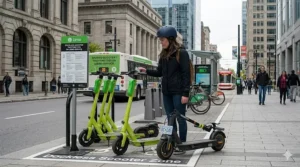
Cold-Weather Guide: How to Survive a Canadian Winter on Two Wheels ❄️🔋
Most e-scooter guides written for global audiences treat winter as an afterthought. In Canada, it’s a 4–6 month reality for 90% of the population. Here’s what you actually need to know:
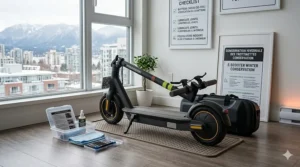
Battery Care Is Everything. Lithium-ion batteries operate optimally around 20–25°C. As temperatures drop toward 0°C, capacity can fall by 15–20%. Below -10°C (a normal Calgary or Edmonton January), you may see 30–40% range reduction. The solution: store your scooter indoors whenever possible, bring the battery inside separately if your building rules allow it, and never charge a battery that’s still cold from outdoor exposure — let it warm to room temperature first. EZbike Canada recommends keeping charge levels between 30–80% during cold months to reduce stress on cells.
Road Salt Is Your Scooter’s Enemy. Canadian cities pour extraordinary amounts of road salt between November and March. Salt accelerates corrosion on metal frames, eats away at brake cables, and can penetrate inadequately sealed motor housing. After every winter ride, wipe down the frame and undercarriage with a dry cloth, and never use high-pressure water to clean your scooter — you’ll force moisture into seals. A light application of silicone spray on metal joints in late October goes a long way.
Tyre Pressure Drops in Cold Air. For pneumatic-tyre scooters, check pressure weekly in autumn and winter. Cold air contracts, dropping pressure by 1–2 PSI per 10°C of temperature change. Underinflated tyres at 0°C on a wet road is a slide-and-fall scenario that emergency rooms in Ottawa and Edmonton see more often than you’d think.
Know When to Park It. If there’s ice on the road, park the scooter. No scooter tyre — not even the widest fat-tyre models — provides reliable traction on glare ice. This isn’t a personal failing; it’s physics. Most experienced Canadian e-scooter riders define their season as May through October in prairie cities, and March through November on the West Coast.
Seasonal Storage. If you’re putting the scooter away for winter, store the battery at around 50–60% charge in a climate-controlled space (not your unheated garage at -25°C). Recharge to 50–60% once a month if storing for longer than 30 days.
Electric Scooter vs Transit: The Real Cost Comparison in Canada 💰
“Is an electric scooter worth it in Canada?” It’s a fair question, and the answer depends heavily on your city’s transit pricing.
Consider Ottawa: a monthly OC Transpo pass costs around $125 CAD in 2026. Over a year, that’s $1,500. A Hiboy S2 Pro at $550 CAD, with roughly $30/year in electricity costs and $50/year in minor maintenance, pays for itself in under 5 months and saves you $870 in year one alone. By year three, you’ve saved over $2,700 — more than enough to cover the scooter and any replacement battery.
In Vancouver, TransLink monthly passes run higher, making the ROI calculation even more compelling. The NAVEE ST3 at $750 CAD still achieves payback in under 6 months against transit costs, and Vancouver’s relatively long riding season (10+ months) maximises that saving.
The comparison shifts in cities like Edmonton and Winnipeg, where brutal winters genuinely restrict riding to 5–7 months per year. Here the financial case is still valid but less dramatic — you’ll likely combine an annual transit pass for winter months with scooter commuting for the warm season. A budget model like the Gyrocopters J30 at under $300 CAD makes the hybrid approach extremely affordable.
One more Canadian-specific cost consideration: while Canadian prices on Amazon.ca typically run 10–20% higher than equivalent US prices due to exchange rates and import duties, you avoid customs headaches, cross-border warranty complications, and the risk of buying a scooter incompatible with Canada’s provincial pilot programme specifications. Buying Canadian (or from Amazon.ca) is almost always the smarter long-term play.
Canadian Safety Standards & Regulations Every Rider Must Know ⚖️🇨🇦
Canada’s e-scooter legal landscape in 2026 is a genuine patchwork — and ignoring it can cost you your scooter and your wallet. Here’s the practical overview, and I’d strongly encourage you to read the full NAVEE province-by-province legal guide before riding anywhere new.
The Federal Baseline. Transport Canada recognises “power-assisted bicycles” (PABs) as a distinct category capped at 500W and 32 km/h. Above those thresholds, a scooter becomes a motor vehicle requiring registration, insurance, and a driver’s licence — in every province. This is why the AONIU M4 and NAVEE ST3’s configurable speed settings matter so much.
Ontario. A pilot programme (Reg. 389/19) runs until November 2029. Cities opted in include Ottawa, Mississauga, Brampton, Hamilton, and many others. Toronto famously declined the pilot in May 2024. Speed cap: 24 km/h (Ottawa enforces 20 km/h). No licence or registration needed in compliant cities.
British Columbia. The Electric Kick Scooter Pilot runs until April 2028, with 30+ participating communities including Vancouver, Kelowna, Victoria, and Nanaimo. Max speed 24 km/h. Helmets required.
Alberta. No uniform provincial law exists. Calgary and Edmonton manage e-scooters through individual municipal bylaws — check your specific city’s current rules before riding.
Quebec. The SAAQ-administered ATPM pilot runs to July 2026 with extension expected. Montreal rules include a 20 km/h speed cap and a minimum rider age of 14.
Saskatchewan & Manitoba. Personal e-scooters remain in a grey zone in most jurisdictions. Check your municipality carefully before purchasing.
Helmets are mandatory under almost every active Canadian pilot programme. Riding on sidewalks is banned in all provinces with active rules. And critically — no riding after consuming alcohol. Province-level impaired operation charges apply to e-scooter riders exactly as they do to motorists.
Common Mistakes Canadian Buyers Make (And How to Avoid Them) 🚫
Mistake 1: Buying based on claimed range without applying a cold-weather discount. A scooter marketed as “45 km range” in a Chinese test environment at 20°C delivers meaningfully less in Calgary at 2°C. Apply a 25–35% reduction for any ride below 5°C and plan accordingly.
Mistake 2: Ignoring Amazon.ca vs Amazon.com availability. Some models reviewed on American websites simply aren’t listed on Amazon.ca, or are sold by grey-market sellers without Canadian warranty coverage. Always search Amazon.ca directly, and check whether the seller is “Amazon.ca” or a third-party with a Canadian address.
Mistake 3: Skipping the pilot programme check. Buying a $600 scooter only to discover your city hasn’t opted into Ontario’s pilot (looking at you, Toronto) is an expensive lesson. Thirty minutes of research before purchasing can save you months of frustration.
Mistake 4: Underestimating weight. Many buyers don’t test-lift a 20 kg scooter before purchasing. If your daily route involves a staircase, a bus, or a crowded subway car, that weight is a daily quality-of-life issue. Visit a local shop to hold a similarly-weighted demo before ordering online.
Mistake 5: Ignoring water resistance ratings. IPX4 (splash-resistant) is adequate for Vancouver’s light rain. It is not adequate for riding through puddles or being caught in a genuine Canadian thunderstorm in Toronto in July. If you’re a year-round West Coast rider, look for IPX5 or better.
FAQ ❓
❓ Can I ride an electric scooter in winter in Canada?
❓ What is the best electric scooter for Ottawa in 2026?
❓ Are electric scooters legal in Calgary and Edmonton, Alberta?
❓ Do electric scooters on Amazon.ca come with Canadian warranties?
❓ How much does it cost to charge an electric scooter in Canada?
Conclusion: Your City, Your Scooter 🏁
Choosing the right electric scooter by Canadian city comes down to honest self-assessment: How far are you riding? What’s your local climate like in March and October — the shoulder months that separate serious year-round commuters from fair-weather riders? Does your municipality have an active pilot programme? And can you physically manage the weight of the scooter in your daily life?
For most Canadian urban commuters, the Hiboy S2 Pro in the $450–$600 CAD range hits the optimal balance of range, reliability, and real-world usability. Budget-focused riders will be genuinely well-served by the Gyrocopters J30 2026 under $300 CAD. And if you ride more than 15 km one-way, depend on your scooter daily, or live somewhere with genuinely rough roads, the NAVEE ST3 justifies its premium with performance that holds up through Canadian reality — not just ideal test conditions.
One last thought: whatever model you choose, treat the battery with respect. Store it indoors, don’t let it freeze, and don’t charge it cold. Your battery is 60% of the scooter’s value, and Canadian winters will test it. Respect that relationship and your scooter will carry you reliably for three to five years.
✨ Don’t Miss These Exclusive Deals!
🔍 Ready to upgrade your commute? Click on any highlighted product name in this article to check real-time pricing and availability on Amazon.ca. Whether you’re riding Ottawa’s pathways or Edmonton’s suburban streets, there’s a scooter here with your name on it!
Recommended for You 📚
- 7 Canadian Climate Electric Scooters That Survive Winter (2026)
- Best Heat-Resistant Electric Scooters for Summer 2026 (Canada)
- Extend Range Electric Scooter Winter: 7 Best Picks for Canada 2026
Disclaimer: This article contains affiliate links. As an Amazon Associate, I earn from qualifying purchases. If you purchase products through these links, we may earn a small commission at no additional cost to you. All prices listed are approximate CAD ranges — always check Amazon.ca for current pricing before purchasing.
✨ Found this helpful? Share it with your friends! 💬🤗
