
In This Article
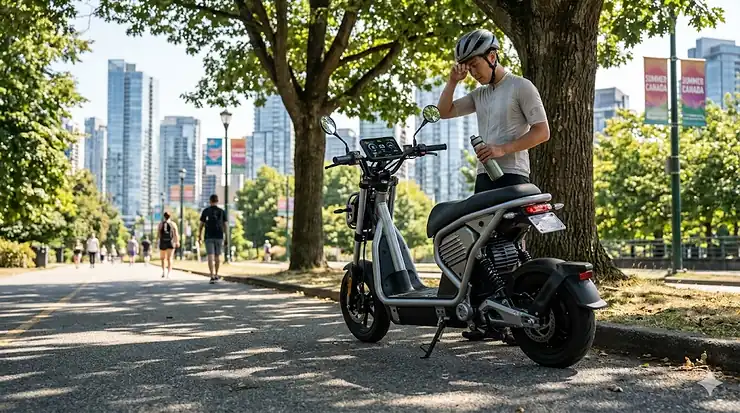
A heat-resistant electric scooter summer setup is really about one thing: keeping the battery management system (BMS) and motor controller from throttling your ride on the hottest days. Lithium-ion cells, the controller, and even your tires all respond to heat — and a scooter built with better thermal protection, light-coloured components, and a properly rated BMS will simply hold up better than a bargain-bin model once the pavement starts radiating 40°C+ heat back at you.
In Canada, summer riding comes with its own wrinkle: short seasons, big temperature swings between provinces, and a patchwork of e-scooter laws that vary from Vancouver to Montreal to Toronto. Below, I’ve pulled together seven real, currently available scooters — a mix of budget, mid-range, and premium options — along with the practical side of summer ownership: battery care, what “IP66” actually means for your ride, and which Canadian cities even let you use one on public roads.
A quick note on accuracy: prices shift constantly, so every figure below is a CAD range based on research at time of writing, not a locked-in price. Always confirm current pricing and availability directly on Amazon.ca or the manufacturer’s Canadian site before buying.
What Actually Happens to a Scooter Battery in Hot Weather
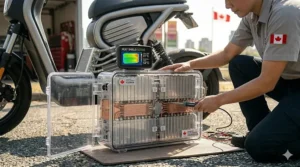
Short answer for anyone skimming: heat doesn’t usually cause a dramatic breakdown — it causes a quiet performance penalty. Riders commonly report range drops of roughly 10–15% on the hottest days as the BMS throttles output to protect the cells, and prolonged storage above 30°C accelerates long-term battery degradation. In rare cases involving damaged, overcharged, or poor-quality batteries, excess heat can trigger thermal runaway, which is why a functioning BMS and sensible charging habits matter more in July than in January.
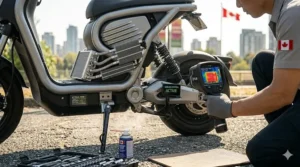
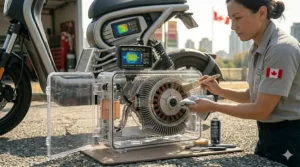
The motor controller is the other heat-sensitive component. Most decent scooters include thermal protection that automatically reduces power or shuts down temporarily if the controller overheats — annoying mid-ride, but far safer than letting it run hot. Tires and rubber seals soften in extreme heat too, which is part of why tire choice gets a callout in the comparison table below.
Quick Comparison Table
| Scooter | Motor | Battery / Range | Weather Rating | Best For | Price Range (CAD) |
|---|---|---|---|---|---|
| Apollo Dash | 600W (1,200W peak) | 48V, ~50 km | IP66 | Best value with real power | Under $600 |
| Hiboy S2 Max | 500W | 48V 11.6Ah | IPX4 | Budget Amazon.ca pick | $500–$700 |
| GoTrax G3 Plus | 250–300W | 36V, ~24 km | Splash-resistant | Entry-level commuting | $350–$450 |
| Segway E2 Pro/Ninebot | 300W | 36V, flat-free tires | Splash-resistant | Light campus/city use | $450–$600 |
| NIU KQi3 Max | 350W | ~65 km range | IPX5 | Long-range value | Under $900 |
| Apollo Go | Dual motor | 48V | IP66 | Hilly cities, daily commuting | $970–$1,500 |
| EMOVE Cruiser V2 | Dual motor | ~100 km range | IPX6 | All-season, heat + storm protection | $2,499–$3,199 |
Looking at the spread, the gap between the Hiboy and GoTrax entries versus the Apollo and EMOVE models isn’t really about top speed — it’s about what’s protecting the electronics. IP66 and IPX6 ratings mean dust- and water-jet protection that also happens to correlate with better-sealed, better-cooled controllers, which matters more on a 35°C asphalt commute than most spec sheets let on. Budget buyers should note that the lower-rated models aren’t unsafe, just more sensitive to direct sun exposure and need more deliberate shade-parking habits, covered further down.
💬 Just one click — help others make better buying decisions too! 😊
✨ Check Current Deals
Click through to Amazon.ca for any of the models below to see current pricing, Prime eligibility, and verified buyer ratings before you commit.
Top 7 Picks: Expert Analysis
1. Apollo Dash
The Dash runs a 48V architecture instead of the 36V setup common at this price point, which means less current draw for the same power output — translating to less heat buildup in the controller and steadier speed as the battery drains, a detail that matters more on a hot afternoon commute than the spec sheet implies. Add a 9.5-inch pneumatic tire and IP66 sealing, and this is a rare case of a sub-$600 CAD scooter with genuinely commute-grade thermal and weather protection.
Apollo is a Montreal-based company, so Canadian buyers get local warranty support and dozens of service points rather than relying on cross-border shipping for parts. Best for: budget-conscious commuters in cities like Halifax or Winnipeg who still want hill-climbing power. Pros: strong power-to-price ratio, good thermal margin, local Canadian support. Cons: heavier than ultralight commuter models, regen braking takes adjustment.
2. Hiboy S2 Max
Hiboy is one of the most widely stocked scooter brands on Amazon.ca, and the S2 Max’s 48V 11.6Ah battery and 10-inch solid tires are a clear step up from entry Hiboy models. The honest read: it’s competent rather than exciting — a 500W motor handles flats and gentle grades fine, but the IPX4 rating means it’s splash-resistant, not heat-and-storm proof, so shade parking matters more here than on the Apollo or EMOVE picks.
Best for: first-time riders in Ontario or BC pilot cities who want a known brand without paying for features they won’t use. Pros: widely available with parts support, solid tires need no maintenance, large community of reviews to reference. Cons: no suspension, braking feel is functional but unremarkable.
3. GoTrax G3 Plus
This is the true entry point of the lineup, and it’s honest about it — a smaller 36V battery and modest motor mean real-world range in the 15–24 km zone, plenty for short downtown hops but not for cross-city Calgary or Edmonton commutes. Lower voltage architecture does mean it runs hotter under sustained load than the 48V models above, so it’s best suited to shorter rides with breaks rather than back-to-back deliveries on a 35°C day.
Best for: students or occasional riders who want low upfront cost in CAD and don’t need long range. Pros: lowest price tier, light and easy to carry, decent warranty support. Cons: more noticeable heat-related power dips on long hills, splash-resistant only.
4. Segway E2 Pro
Segway built its reputation on dependable, low-maintenance builds, and the E2 Pro’s flat-free tires remove one common summer failure point — overheated, softened rubber on cheap pneumatic tires that go flat on hot pavement. The tradeoff is a stiffer ride on rough roads, which becomes more noticeable on Montreal’s older cobblestone streets than on smooth Vancouver bike paths.
Best for: light campus or short-commute riders who want near-zero maintenance. Pros: dependable build quality, no tire maintenance ever, easy to fold and carry. Cons: limited range for longer Canadian commutes, ride comfort is average on rough pavement.
5. NIU KQi3 Max
NIU brings electric-motorcycle engineering experience to this model, and it shows in the value math: roughly 65 km of range for under $900 CAD is a strong price-per-kilometre figure, especially with reduced range factored in for hot-weather BMS throttling. NIU maintains a Toronto showroom and Montreal warehouse, so Canadian buyers can test-ride before purchasing rather than buying blind.
Best for: commuters in sprawling cities (Calgary, Ottawa) who need range more than raw power. Pros: excellent range-per-dollar, Canadian showroom support, IPX5 splash protection. Cons: heavier than ultraportable models, motor power is modest for steep hills.
6. Apollo Go
The Go’s dual-motor setup means real hill-climbing torque, which matters in cities like Vancouver or Halifax where flat commutes are the exception, not the rule. Combined with IP66 sealing, this is one of the better mid-range options for riders who park outdoors and can’t always find shade — the sealed electronics handle both summer dust and sudden downpours without the controller running as hot as splash-resistant alternatives.
Best for: daily commuters in hilly Canadian cities who ride year-round, not just in summer. Pros: dual-motor hill performance, IP66 sealing, real-time controller temperature monitoring through the Apollo app. Cons: pricier than single-motor competitors, heavier to carry up stairs.
7. EMOVE Cruiser V2
This is the heat-and-weather-resistance ceiling of the list. An IPX6 rating and roughly 100 km of range give it the best margin against both downpours and the kind of all-day, full-sun riding that would throttle lighter scooters by mid-afternoon. It’s genuinely overkill for someone riding three flat kilometres to a downtown office, but for riders who commute year-round through Vancouver rain, Ottawa spring slush, and full Prairie summer sun on the same machine, the weather sealing pays for itself in fewer service visits.
Best for: year-round, all-weather commuters who view the scooter as a car replacement rather than a fair-weather toy. Pros: best-in-class weather sealing, long range reduces charge-cycle heat stress, swappable battery options. Cons: premium price tier, heavier and bulkier than commuter-class models.
Benefits vs. Traditional Gas Scooters/Mopeds in Hot Weather
| Factor | Electric Scooter | Gas Scooter/Moped | Best For |
|---|---|---|---|
| Heat-related breakdown risk | Temporary power throttling, rarely stranding | Vapor lock, overheating engine, can fully stall | Electric — safer failure mode |
| Running cost in summer (CAD) | Cents per charge | Fuel-price dependent, rises with demand | Electric |
| Maintenance in heat | Battery/controller checks | Oil, coolant, belt wear accelerated by heat | Electric |
| Range on hottest days | Drops ~10–15% | Less affected by ambient heat | Gas — for raw range only |
The table makes the core tradeoff clear: electric scooters fail “soft” in heat (reduced power) while gas engines can fail “hard” (stalling, vapor lock), which is a meaningful safety difference if you’re riding in mid-summer traffic. Where gas still wins is raw range unaffected by temperature, but for the typical Canadian urban commute under 25 km, that advantage rarely matters in practice.
How to Choose a Heat-Resistant Electric Scooter in Canada
- Check the IP rating first, not the top speed. IP66 or higher means real dust and water-jet sealing, which generally correlates with better-protected, better-cooled electronics.
- Favour 48V architecture over 36V at a given power level. Higher voltage means less current for the same wattage, which means less heat generated in the controller.
- Confirm the BMS has overheat protection explicitly listed. Most reputable brands state this; if a listing doesn’t mention it at all, ask before buying.
- Match motor power to your terrain, not your ego. A 250W motor working overtime on Calgary hills runs hotter than a 500W motor doing the same job comfortably.
- Verify it’s legal where you’ll actually ride. Provincial e-scooter rules vary enormously — Toronto bans personal e-scooters outright while Ottawa caps speed at 20 km/h under Ontario’s pilot, so check before buying based on speed alone.
- Look at tire type for hot-pavement durability. Solid or flat-free tires resist the softening and wear that hot asphalt accelerates on cheaper pneumatic tires.
- Budget for shade, not just the scooter. A breathable cover or simply parking in shade does more for summer battery health than almost any spec on the page.
Practical Summer Battery Care Guide
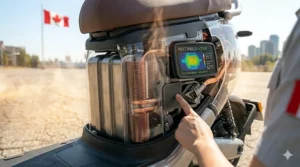
A few habits make a measurable difference to battery longevity in Canadian summers. Let the battery cool to room temperature before charging after a hot ride — charging a warm battery stresses the cells and can trigger the BMS to delay charging anyway. Park in shade whenever possible; direct sun on asphalt can push surface temperatures well past 50°C even when the air feels comfortable. Keep the scooter clean, since accumulated grime traps heat and slows how efficiently the frame and components dissipate it. And if you’re storing the scooter outdoors for extended periods, consider removing the battery and keeping it indoors at room temperature rather than leaving it baking in a hot garage or shed.
✨ Don’t Miss Current Deals
These models move in and out of stock quickly during peak summer demand — check Amazon.ca for live pricing and Prime shipping eligibility before the season’s best deals disappear.
Real-World Canadian Scenarios
A Toronto condo dweller commuting 8 km to a downtown office would be better served checking local bylaws first — Toronto declined Ontario’s e-scooter pilot, so personal scooters aren’t legal on Toronto’s public roads, making this a case where the GoTrax or Hiboy might be more useful for private trails or future relocation than for the actual commute.
A Vancouver rider doing 15 km daily through BC’s participating pilot communities benefits most from the Apollo Go or EMOVE Cruiser V2’s IP66/IPX6 ratings, given the Pacific Northwest’s combination of summer heat waves and sudden rain.
An Ottawa family considering a scooter for weekend rides under the city’s 20 km/h pilot cap would likely overspend on the EMOVE Cruiser’s long-range dual motor; the NIU KQi3 Max or Apollo Dash better match the speed cap and casual use case.
Common Mistakes When Buying a Summer Electric Scooter
Buying purely on top speed while ignoring IP rating is one of the most frequent mistakes — a fast scooter with poor sealing will throttle itself on a hot day regardless of its on-paper speed. Skipping the provincial legality check is another: some of the highest-rated scooters on Amazon.ca simply can’t be legally ridden on public roads in cities like Toronto or most of Saskatchewan. Charging the battery immediately after a hot ride, rather than letting it cool first, quietly shortens battery lifespan over a season. And underestimating how much range drops in heat — typically 10–15% — leads to range anxiety on what should have been a comfortable commute.
Canadian Regulations and Safety Standards
E-scooter law in Canada is split between federal equipment standards and provincial/municipal use rules, and the patchwork is real: BC’s pilot program (renewed through 2024–2028) allows standing e-scooters only in participating municipalities, Ontario runs its own provincial pilot with municipal opt-in (Ottawa included, Toronto excluded), and Quebec permits kick-style scooters on bike paths under its own pilot framework. Helmets are mandatory in several provinces and strongly recommended everywhere else. Because rules change and vary by city, always verify current requirements directly with your provincial transportation authority before riding — British Columbia’s official electric kick scooter rules page and Ontario’s e-scooter pilot page are good starting points.
FAQ
❓ Can electric scooters overheat in Canadian summer heat?
❓ Is it legal to ride a personal electric scooter in Toronto?
❓ What IP rating should I look for in a hot-weather electric scooter?
❓ Does heat reduce electric scooter battery lifespan permanently?
❓ Should I charge my scooter right after a hot summer ride?
Conclusion
The right heat-resistant electric scooter for a Canadian summer comes down to matching IP rating and battery voltage to how and where you actually ride — a sealed, 48V commuter like the Apollo Dash or Hiboy S2 Max covers most city riders, while the EMOVE Cruiser V2 makes sense for genuine year-round, all-weather use. Whatever you choose, the legality check matters as much as the spec sheet: confirm your city’s e-scooter rules before you buy, since even the best-built scooter is no good if you can’t legally ride it where you live.
Recommended for You
- Extend Range Electric Scooter Winter: 7 Best Picks for Canada 2026
- Best Cold Weather Battery Scooter in Canada 2026: 7 Picks
- 7 Best IPX5 Rated Electric Scooters for Rainy Canadian Commutes (2026)
Disclaimer: This article contains affiliate links. As an Amazon Associate, I earn from qualifying purchases. If you purchase products through these links, we may earn a small commission at no additional cost to you.
✨ Found this helpful? Share it with your friends! 💬🤗
