
In This Article
Let’s be honest: most electric scooters sold online were designed with mild California weather in mind — not the savage reality of a -15°C Ottawa morning or a slushy March commute in downtown Calgary. If you’ve ever watched the battery indicator plunge on a cold morning and thought, “This can’t be normal” — you’re right, and you’re also not alone.

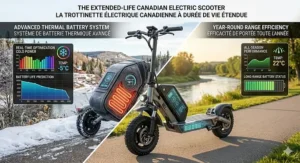
A cold weather battery scooter is more than a marketing label. It refers to an electric scooter engineered with a battery, motor, and sealing system capable of resisting the performance drain that sub-zero temperatures inflict on standard lithium-ion cells. In plain terms: a scooter where the battery doesn’t panic the moment you roll it out onto a frosty sidewalk.
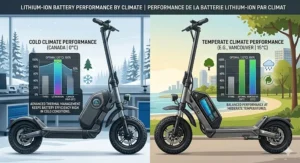
Here’s the science behind the problem, in a nutshell. Lithium-ion batteries work through ion movement between electrodes. When temperatures fall, those ions slow down — the electrolyte thickens, internal resistance rises, and your scooter delivers less power per charge. Research from the Street Rides marketplace dataset (May 2026, covering 183 Amazon.ca scooter listings) found that Canadian winter conditions below -10°C cause 15–30% range loss on standard lithium-ion packs. That’s not a firmware bug — it’s chemistry.
What separates a true cold weather battery scooter from a fair-weather one boils down to three things: battery insulation or thermal management, IP-rated weather sealing, and a BMS (Battery Management System) that protects cells from lithium plating during cold charging. We’ll cover all three throughout this guide.
I’ve dug through Amazon.ca listings, Canadian rider forums, RedFlagDeals threads, and manufacturer specs to bring you seven scooters that are genuinely built to handle what Canada throws at them. All prices are in Canadian dollars (CAD), and all products were verified on Amazon.ca at the time of research. Let’s get into it.
Quick Comparison: Top 7 Cold Weather Battery Scooters in Canada (2026)
| Model | Motor | Battery | Rated Range | IP Rating | Est. Price (CAD) | Best For |
|---|---|---|---|---|---|---|
| Hiboy S2 Max | 500W | 48V 14.4Ah | 65 km | IP54 | $700–$800 | Long commutes, urban |
| Segway Ninebot MAX G2 | 450W | 65V 15.3Ah | 70 km | IPX5 | $950–$1,100 | All-season commuters |
| Hiboy Max Pro | 500W | 48V 14.4Ah | 55 km | IP54 | $750–$900 | Hills + suspension |
| Apollo City Pro | 1,000W peak | 52V 18.2Ah | 75 km | IP56 | $1,400–$1,600 | Premium all-weather |
| iSinwheel S10Max | 500W | 48V 13Ah | 60 km | IPX4 | $500–$650 | Budget winter riding |
| NAVEE GT3 | 700W | 48V 15Ah | 50 km | IPX5 | $800–$950 | Suspension + city grit |
| Kugoo G2 Max | 800W | 52V 20Ah | 80 km | IP55 | $1,000–$1,200 | Max range seekers |
Prices in CAD, verified on Amazon.ca. Check current pricing as rates fluctuate.
Looking at this table, the most striking takeaway is the inverse relationship between price and cold-weather compromise: the sub-$650 CAD options offer workable winter performance with IPX4 ratings (splash-resistant), while anything IPX5 and above gives you meaningful protection from slush, freezing rain, and road spray. If Canadian winters are serious in your city, I’d strongly recommend budgeting at least $700–$800 CAD for a model with IP54 or higher — the extra $200–$300 CAD upfront will save you a controller replacement down the road.
💬 Just one click — help others make better buying decisions too! 😊
✨ Don’t Miss These Exclusive Deals!
🔍 Take your cold weather commute to the next level with these carefully selected cold weather battery scooters. Click on any highlighted item to check current pricing and availability on Amazon.ca. These picks will help you ride confidently through Canadian winters — and still make it to work on time.
Top 7 Cold Weather Battery Scooters: Expert Analysis
1. Hiboy S2 Max — Best Overall for Canadian Urban Commuters 🏆
The Hiboy S2 Max hits the sweet spot that most Canadian riders are actually shopping for: serious range, a proven 500W motor, and enough cold-weather protection to handle three out of four Canadian seasons reliably.
The 48V 14.4Ah battery delivers a rated range of 65 km — but here’s the honest real-world picture: at 0°C you’re looking at 45–50 km, and at -10°C that drops to 40–45 km. That’s still more than enough for a typical Toronto or Edmonton commute of 8–12 km each way, with a buffer to spare. The 500W brushless hub motor maintains consistent torque up to a 15° incline, which matters if your commute involves overpasses or the kind of parking-garage ramps that plague downtown Vancouver. The IP54 rating means it can handle rain and light slush — not a blizzard, but more than adequate for shoulder-season riding and unexpected spring showers.
What makes this the best value pick for most Canadians is the combo of dual suspension and solid tires. You won’t be dealing with flat tires on spring-salted roads, and the front and rear springs absorb the potholes that Canadian freeze-thaw cycles leave behind. Canadian Reddit and RedFlagDeals reviewers consistently praise the S2 Max as a reliable daily driver, with one Quebec commuter noting he gets close to advertised range even in cool autumn weather.
✅ Dual front/rear suspension
✅ 500W motor handles hills well
✅ IP54 for rain and light slush
❌ Not ideal for riding below -10°C
❌ Heavy at ~22 kg (48.5 lbs) for condo storage
Price range: $700–$800 CAD — outstanding value for a sub-$800 all-season scooter. Prime-eligible on Amazon.ca.
2. Segway Ninebot MAX G2 — Best for Reliability-Obsessed Commuters ⭐
If you want the scooter that requires the least thinking in winter, the Segway Ninebot MAX G2 is it. Segway’s brand ecosystem comes with a proper Canadian service network, which is something budget brands simply can’t match when you’re in Winnipeg and need warranty support in February.
The 65V 15.3Ah battery is the headline spec here. Higher voltage means more efficient energy delivery — in cold weather, that extra voltage headroom partially compensates for the resistance increase that freezing temperatures cause. IPX5-rated against water jets, the G2 handles driving rain and slushy streets confidently. The 700W peak motor (nominal 450W) gives smooth torque delivery without the jerky acceleration that can send you sideways on icy pavement. Turn signals — a rare feature at this price — matter in Canadian cities where lane-sharing with cars is increasingly common.
What most Canadian buyers overlook about the G2 is its app-based ride modes. Lowering to Eco mode in sub-zero temps actively reduces current draw, which reduces heat generation, which counterintuitively extends your battery range on cold days. It’s a feature the spec sheet buries, but experienced winter riders use it daily.
✅ IPX5 rated — genuine wet-weather confidence
✅ App-controlled ride modes for cold optimization
✅ Strong Canadian service and parts availability
❌ Premium pricing in CAD vs. US equivalent
❌ At 25 kg (55 lbs), it’s a beast to carry upstairs
Price range: $950–$1,100 CAD — worth every cent if you need reliable, year-round use.
3. Hiboy Max Pro — Best for Hills and Suspension Riders 🏔️
The Hiboy Max Pro is the answer for anyone commuting in cities with serious elevation changes — think Halifax waterfront climbs, North Vancouver grades, or Montreal’s Plateau neighbourhood hills.
Its dual suspension system (front fork + rear coil) is more robust than what you find on comparably priced scooters, absorbing the jarring impacts from ice-heaved pavement without transmitting them up your arms. The 500W motor with a 700W peak handles 20° inclines confidently. The 48V 14.4Ah battery gives a real-world winter range of about 38–50 km depending on temperature and load. IP54 sealing matches the S2 Max’s weather resistance.
The spec sheet won’t tell you this, but the Max Pro‘s wider deck (21 cm) gives meaningfully better stability when you’re wearing winter boots — a detail that sounds trivial until you’re trying to balance on a narrow platform in size-12 snow boots at 7 AM.
Canadian Amazon Warehouse buyers have reported receiving essentially brand-new units, making this one of the better “used-like-new” value plays on Amazon.ca when deals appear.
✅ Dual suspension handles freeze-thaw road damage well
✅ Wide deck for winter boot stability
✅ Strong hill-climbing motor
❌ Heavier than average
❌ Occasional Amazon.ca stock fluctuations
Price range: $750–$900 CAD — strong value for suspension-equipped scooters.
4. Apollo City Pro — Best Premium Cold Weather Battery Scooter in Canada 🌟
The Apollo City Pro is made by a Canadian company (Apollo Scooters, based in Montreal), and they’ve clearly engineered it with Canadian winters in mind. This isn’t a coincidence — it’s a competitive advantage that shows up in the details.
The IP56 rating means genuine protection against powerful water jets and dust — more than adequate for the worst that Canadian weather delivers. The 52V 18.2Ah battery, paired with a smart BMS that monitors cell temperature in real time via the Apollo App, means you get active thermal awareness, not just passive insulation. In practice, this translates to fewer cold-related battery surprises. The 1,000W peak motor handles anything short of a steep ski hill, and the hydraulic brakes (rare at this class) give vastly superior stopping power on wet pavement compared to mechanical disc brakes.
What justifies the premium price in Canada specifically: Apollo has Canadian warranty service, local parts availability, and the app genuinely lets you monitor controller temperature in real time — a feature their engineering blog explicitly designed for cold-climate riders.
✅ Canadian company with local service
✅ IP56 + real-time battery temp monitoring
✅ Hydraulic brakes for wet conditions
❌ Premium pricing — not for budget buyers
❌ App dependency might frustrate non-tech riders
Price range: $1,400–$1,600 CAD — premium, but the Canadian brand and service network justify it for serious riders.
5. iSinwheel S10Max — Best Budget Cold Weather Scooter 💰
If your budget tops out at $650 CAD and you still want to ride through Canadian shoulder seasons — early October to late November, and March to April — the iSinwheel S10Max is the most capable option in this price bracket.
The 500W motor and 48V 13Ah battery give a rated range of 60 km; realistically, plan for 40–45 km in 5°C weather. The IPX4 rating handles rain and splashes but not sustained slush exposure — this is a scooter for autumn commuting and spring riding, not midwinter. What it does well is offer solid build quality and a low entry cost for Canadians testing whether e-scooter commuting works for their lifestyle before investing more.
Canadian riders report it rides well on mixed surfaces, though the absence of rear suspension means you’ll feel city potholes. For condo dwellers who store it inside and only ride when conditions are reasonable, this is a smart buy.
✅ Budget-friendly for Canadians
✅ IPX4 for rain and splashes
✅ Lightweight at ~17 kg (37.5 lbs)
❌ IPX4 only — not for heavy slush
❌ No suspension — rough on damaged roads
Price range: $500–$650 CAD — best cold-capable scooter under $650 CAD on Amazon.ca.
6. NAVEE GT3 — Best for Road Grit and City Slush 🌧️
The NAVEE GT3 has been gaining serious traction among Canadian urban commuters in 2026, and once you understand its build, you see why. It was designed around the realities of messy, multi-surface city riding — not pristine bike paths.
The dual spring suspension handles the particularly Canadian problem of pavement damaged by frost-heave cycles, and the 700W motor gives plenty of punch for shoulder-season riding where you’re dealing with headwinds and wet roads simultaneously. IPX5 sealing keeps the electronics protected through rain and slush. The 48V 15Ah battery delivers a real-world range of 35–45 km in cold conditions — not the longest on this list, but enough for most urban commutes. The smart BMS actively prevents cold-charging damage, which is the most common way riders unintentionally kill their batteries in Canadian winters.
One thing most listings won’t tell you: the NAVEE app gives you granular ride data, including battery health trends over time — useful for spotting cold-weather degradation before it becomes a problem.
✅ Dual suspension for frost-damaged roads
✅ IPX5 sealing handles slush well
✅ Smart BMS with cold-charge protection
❌ Shorter real-world range vs. competitors at similar price
❌ Brand service network still building in Canada
Price range: $800–$950 CAD — excellent build quality at a mid-range Canadian price point.
7. Kugoo G2 Max — Best for Maximum Battery Range in Winter ⚡
If range anxiety is your primary concern — because you’re commuting 20+ km each way in Quebec City or suburban Mississauga — the Kugoo G2 Max solves the problem with a 52V 20Ah battery that gives it the largest pack on this list.
The rated 80 km range translates to a real-world winter range of 55–65 km at 0°C, which is enough to cover most Canadian urban commutes even with a 30% cold-weather reduction factored in. The 800W motor climbs hills confidently, and the IP55 rating sits between the budget and premium tiers — good protection for the vast majority of Canadian riding conditions outside of actual blizzards. The dual disc brakes and front/rear suspension round out a well-balanced package.
What most Canadian buyers appreciate: the large battery means you’re not charging as frequently, which matters because charging a cold battery (i.e., immediately after a winter ride) risks battery damage. With a bigger pack, you can afford to let it warm up for 30 minutes before plugging in — a habit that significantly extends lithium-ion cell life.
✅ Largest battery on the list — real winter range king
✅ IP55 for most Canadian weather scenarios
✅ Strong motor + suspension combo
❌ Heavier than most competitors
❌ Less known in Canada — verify warranty coverage
Price range: $1,000–$1,200 CAD — best pure range per dollar on Amazon.ca for cold-weather riding.
How Cold Weather Actually Destroys Your Scooter Battery (And What to Do About It)
This is the section most manufacturers hope you’ll skip, because understanding the science makes you a harder sell on inflated range claims. Let’s fix that.
The Chemistry: Why Cold Is a Battery’s Worst Enemy
Lithium-ion batteries operate through the movement of lithium ions between a graphite anode and a lithium metal oxide cathode, dissolved in a liquid electrolyte. At room temperature (~20°C), those ions move freely and the chemistry hums along efficiently. Drop to 0°C, and the electrolyte thickens, internal resistance rises, and your battery can’t deliver its full power — leading to a voltage drop that the BMS interprets as a low-charge state, even when the battery is actually half-full. It’s not lying to you — it genuinely can’t deliver at that moment.
The real danger isn’t riding in the cold — it’s charging in the cold. When you plug in a scooter battery that’s still at -5°C, lithium atoms can deposit on the graphite anode as metallic lithium rather than intercalating properly — a process called lithium plating. This irreversible damage shortens battery lifespan and, in severe cases, creates internal short circuits that are a fire hazard. A good BMS prevents charging if the battery is below 5°C, but a cheap BMS will happily let you slowly destroy your cells all winter.
What Thermal Management Actually Means in Practice
“Thermal management” on a scooter doesn’t typically mean active heating like you’d find in an electric car. On most consumer scooters, it means:
- Battery insulation — foam or fibreglass insulation around the battery pack that slows heat loss during a ride
- BMS temperature gating — the BMS refuses to charge or limits discharge current when cell temperature is below a threshold (usually 5–10°C)
- App-based monitoring — on premium models like the Apollo City Pro, you can see real-time cell temperature and choose to delay riding until it warms up
For Canadian riders, the practical advice is this: store your scooter indoors, let it reach 10°C+ before riding, and never charge it immediately after bringing it in from a -10°C commute. Give it 20–30 minutes to warm up first. This single habit can more than double your battery’s lifespan.
Real-World Canadian Rider Profiles: Which Scooter Is Right for You?
Not all Canadian commuters are the same, and a $1,500 CAD premium scooter that’s perfect for a Vancouver tech worker may be completely wrong for a student in Ottawa. Here are three profiles to help you self-identify.
🏙️ Profile 1: The Toronto/Vancouver Urban Condo Commuter
Sarah, 31, commutes 9 km to work in downtown Toronto. She parks in a heated underground garage and stores the scooter in her condo hallway. Her commute is flat, mostly protected bike lanes, with one exposed waterfront segment. She rides April through November, not in snow.
Best pick: Hiboy S2 Max ($700–$800 CAD). The IP54 handles rain; the 65 km rated range gives her a 2–3 day buffer between charges; dual suspension absorbs the TTC construction craters on King Street. The weight is manageable for her building’s elevator.
❄️ Profile 2: The Year-Round Ottawa/Calgary Commuter
Marcus, 38, commits to riding 10 months of the year in Ottawa. He rides through October sleet, November freezing rain, and again from March when salt residue is at its worst. He parks outside overnight at work (covered, not heated).
Best pick: Segway Ninebot MAX G2 ($950–$1,100 CAD). The IPX5 rating and Canadian service network are non-negotiable for his use case. The app’s Eco mode helps stretch cold-weather range. He accepted the weight because he has a ground-floor locker.
🌄 Profile 3: The Long-Range Suburban Commuter
Devon, 44, lives in Mississauga and rides to a GO station 14 km away. His route includes a highway overpass and a steep residential hill. He charges once daily. He rides April–October reliably and occasionally in mild November.
Best pick: Kugoo G2 Max ($1,000–$1,200 CAD). The 52V 20Ah battery gives him 55+ km of real-world range even in 5°C weather. The 800W motor handles his hill without slowing, and a full day on the GO train gives the battery time to warm up before his evening ride.
How to Choose a Cold Weather Battery Scooter in Canada: 7 Expert Criteria
Choosing purely on motor wattage or rated range is one of the most common — and costly — mistakes Canadian buyers make. Here’s the framework I’d use if I were spending my own money.
- IP Rating First — For genuine cold-weather riding in Canada, IP54 is the minimum acceptable floor. IPX4 is splash-only; IP56 is ideal for serious year-round use. Don’t compromise here.
- Battery Voltage and Capacity (in Wh, not just Ah) — Calculate Wh = V × Ah. A 48V 13Ah pack = 624 Wh; a 52V 20Ah pack = 1,040 Wh. Higher Wh gives you more cold-weather buffer. For Canadian winters, aim for 700 Wh minimum.
- BMS Quality — Ask specifically whether the BMS has temperature-gated charging protection. This is listed in specs as “low-temperature charge protection” or similar. Without it, you risk lithium plating damage all winter.
- Motor Type: Brushless Only — Brushless DC hub motors (BLDC) maintain torque output down to -20°C. Brushed motors lose significant power in cold weather and require brush replacements every few hundred hours. Every scooter on this list uses BLDC — don’t buy one that doesn’t.
- Tire Type for Your Climate — Solid/honeycomb tires = no flats but harsher ride on frost-damaged roads. Pneumatic tires = better traction in marginal conditions but need pressure monitoring (cold air contracts, reducing psi). For Canadian spring grit and road debris, solid tires are lower-maintenance.
- Weight vs. Storage Reality — A 25 kg scooter that lives in your heated condo is fine. The same scooter parked in an unheated garage at -20°C is a problem. Weight determines whether you can bring it inside — and in Canada, that is often the single most important variable for battery longevity.
- Canadian Regulations for Your Province — Before buying, check your province’s current e-scooter rules. Ontario’s pilot program runs until 2029, Quebec’s ATPM pilot is in extension, BC’s pilot covers 30+ municipalities, and Alberta currently prohibits personal e-scooters on public roads as of May 2026. A $1,200 CAD scooter you can’t legally ride is a $1,200 CAD mistake.
Common Mistakes Canadian Buyers Make With Cold Weather Battery Scooters
These aren’t edge cases — I see these errors repeatedly in Canadian buyer forums and review threads.
❌ Mistake 1: Charging Immediately After a Cold Ride
You ride home in -8°C weather, plug in immediately to recharge. The battery cells are cold; the BMS (if it’s a quality one) will refuse to charge or severely throttle the charge rate. If it’s a cheap BMS, it’ll charge at full current into cold cells — initiating lithium plating. Always let your scooter warm up to room temperature for at least 20–30 minutes before charging after a cold ride.
❌ Mistake 2: Storing at Full Charge for Winter
If you’re putting your scooter away from December to March, storing it at 100% charge accelerates electrode degradation. The optimal winter storage charge is 50–60%. Check it every 4–6 weeks and top up if it drops below 30%.
❌ Mistake 3: Buying on Range Alone
Manufacturers test range in perfect conditions: 25°C, flat pavement, 70 kg rider, no wind. In Canadian autumn conditions at 10°C with headwinds, expect 65–75% of rated range. At 0°C, plan for 55–65%. Build in a 35% buffer when estimating whether a scooter covers your commute.
❌ Mistake 4: Ignoring Provincial Law
As noted, Alberta and parts of Manitoba and Saskatchewan have significant restrictions on personal e-scooters on public roads as of 2026. Check Apollo Scooters’ Canadian law guide or your provincial transport authority before purchasing.
❌ Mistake 5: Using High-Pressure Water to Clean Off Road Salt
Salt and grit accumulate fast in Canadian winters. Blasting them off with a pressure washer — even on an IP-rated scooter — forces water past seals into the motor and controller. Use a damp cloth, a soft brush, and compressed air. It takes longer, but your motor lasts years longer.
Electric Scooter Battery in Freezing Temps: The Science Behind the Numbers
Let’s talk about numbers that actually matter for Canadian riding decisions, because the marketing claims are rarely calibrated to below-zero reality.
According to research compiled by the Street Rides marketplace analysis of Amazon.ca listings in May 2026, lithium-ion batteries used in scooters typically suffer a 15–30% range reduction in Canadian winter conditions below -10°C. That’s not a worst-case scenario — that’s a midpoint estimate.
Here’s how to translate that into planning:
| Rated Range | At +20°C (ideal) | At 0°C | At -10°C |
|---|---|---|---|
| 40 km | 32–36 km | 27–32 km | 22–28 km |
| 60 km | 48–54 km | 42–48 km | 36–42 km |
| 70 km | 58–65 km | 50–58 km | 46–54 km |
| 80 km | 68–75 km | 60–68 km | 56–64 km |
The table above assumes standard lithium-ion with no active thermal management. What it illustrates clearly is that a scooter with a 60 km rated range still gives you 36–42 km on a -10°C morning — enough for most urban Canadian commutes of 15–18 km each way with some buffer.
The key insight: a larger battery doesn’t just mean longer range in ideal conditions — it means proportionally more winter buffer. A Kugoo G2 Max with 80 km rated range gives you roughly 56 km at -10°C; a 40 km rated scooter gives you only 22–28 km under the same conditions. For Canadian winters, battery oversizing isn’t luxury — it’s insurance.

Canadian Regulations & Safety Standards You Need to Know in 2026
This is probably the section your salesperson at a big-box store will skip, but it’s worth more than any spec comparison when your scooter gets impounded.
Canada has no single national e-scooter framework. Transport Canada sets manufacturing safety standards and classifies scooters under the Motor Vehicle Safety Act, but road legality is entirely provincial. Here’s the key landscape as of June 2026:
- Ontario: Pilot program runs until November 2029. Most major cities participate (Ottawa, Mississauga, Hamilton, London) — but notably, Toronto opted out in May 2024, meaning personal e-scooters can be sold in Toronto but cannot legally be ridden in public spaces. Maximum speed: 24 km/h. Age 16+, helmet required.
- British Columbia: Pilot runs until April 2028, covering 30+ municipalities including Vancouver, Kelowna, Victoria-area, and Nanaimo. Maximum speed varies by zone. BC’s Vulnerable Road User law (June 2024) provides additional protection for scooter riders near vehicles.
- Quebec: ATPM pilot program, expected to extend beyond its July 2026 end date. Montreal requires helmets, age 14+, maximum 25 km/h, and lights for night riding.
- Alberta: As of May 2026, personal e-scooters remain prohibited on public roads, though Calgary and Edmonton are actively lobbying the province for change.
- Saskatchewan and Manitoba: Municipal patchwork — check your city specifically.
For the most current provincial rules, the NAVEE Canada law guide is updated regularly. Always verify with your provincial Ministry of Transportation before purchasing — regulations evolve quickly.
From a safety certification standpoint, look for scooters with UL 2272 certification (electrical safety for personal e-mobility devices) — this is the most relevant standard for lithium-ion battery safety in North America. CSA Group certifications add a Canadian layer of confidence for electrical component safety.
Long-Term Cost & Maintenance in Canada: What Your Scooter Really Costs Over 3 Years
Canadian buyers often focus on sticker price and forget that total cost of ownership tells a different story — especially when Canadian winters accelerate maintenance wear.
Battery Replacement: The Big One
Lithium-ion batteries in consumer scooters typically last 500–1,000 charge cycles at 80% depth of discharge. With good cold-weather habits (indoor storage, no cold charging), you can extend this to 1,000+ cycles. At once-daily charging, that’s 2.5–4 years. Replacement battery packs for mid-range scooters run roughly $200–$400 CAD, depending on brand. Budget brands often have proprietary connectors that make replacement harder — another reason to pay for a major brand.
Mechanical Wear: Salt Is Relentless
Canadian roads are salted aggressively from November through March. Salt is corrosive to bearing races, brake hardware, and exposed fasteners. Budget $30–$60 CAD per year for bearing inspection, brake pad replacement, and corrosion-inhibiting lubricant applied to exposed metal. Rinse (carefully, not with a pressure washer) after every salty ride.
Tires: Solid vs. Pneumatic in Canada
Solid tires cost nothing to maintain but ride harder. Pneumatic tires run about $40–$80 CAD per tire in Canada for quality replacements — and need pressure checks weekly in cold weather because air contracts in the cold (~1 psi per 6°C drop, so a tire at proper pressure at 20°C could be 3+ psi low at -5°C). For most Canadian city commuters, solid or honeycomb tires win the maintenance math.
The 3-Year Total Cost Estimate (in CAD)
| Budget Scooter (~$550 CAD) | Mid-Range (~$800 CAD) | Premium (~$1,500 CAD) |
|---|---|---|
| Purchase: $550 | $800 | $1,500 |
| Battery replacement (yr 2–3): $300 | $250 | $200 |
| Maintenance (3 yrs): $150 | $120 | $100 |
| Total: ~$1,000 | ~$1,170 | ~$1,800 |
The gap narrows significantly over three years. A mid-range scooter with better cold-weather battery protection may actually cost less in total than a budget model that needs earlier battery replacement from poor cold-weather management.
✨ Don’t Miss These Exclusive Deals!
🔍 Ready to upgrade your Canadian commute? Click on any highlighted cold weather battery scooter above to check current pricing and availability on Amazon.ca. Prime members get free shipping, and deals change regularly — worth bookmarking this page and checking back.
FAQ: Cold Weather Battery Scooters in Canada
❓ How much range do I lose from my electric scooter battery in freezing temps?
❓ Can I charge my electric scooter battery in winter in Canada?
❓ Is it legal to ride an electric scooter in winter in Ontario or BC?
❓ What IP rating do I need for a cold weather battery scooter in Canada?
❓ Are cold weather battery scooters available on Amazon.ca with free shipping?
Conclusion: Don’t Let Winter Park Your Scooter
The Canadian climate is genuinely unforgiving for electric scooters — but “unforgiving” doesn’t mean “impossible.” The gap between a scooter that survives a Canadian autumn and one that gets wheeled into permanent storage in October often comes down to three things: IP rating, BMS quality, and whether you store it properly.
For most Canadian urban commuters, the Hiboy S2 Max gives the best value proposition in the $700–$800 CAD range. If budget is tighter, the iSinwheel S10Max handles shoulder seasons well. If reliability and service matter most and you’re willing to invest, the Segway Ninebot MAX G2 or the Canadian-made Apollo City Pro are worth the premium.
Whatever you choose, remember: a cold weather battery scooter is only as good as how you treat it through winter. Store it inside. Warm it up before charging. Keep the charge between 30–80% in cold months. Clean off the salt. These habits, combined with the right scooter, will carry you through Canadian winters with your battery healthy and your range intact.
✨ Don’t Miss These Exclusive Deals!
🔍 Ready to ride year-round? Click any highlighted scooter above to check current pricing and availability on Amazon.ca — and look for Prime deals on models with IP54 ratings or higher. Your cold-weather commute starts here.
Recommended for You
- 7 Best IPX5 Rated Electric Scooters for Rainy Canadian Commutes (2026)
- 7 Best IPX4 Electric Scooters Canada 2026: Honest Reviews
- Electric Scooter IP Rating Guide: Top 7 Picks for Canada 2026
Disclaimer: This article contains affiliate links. As an Amazon Associate, I earn from qualifying purchases. If you purchase products through these links, we may earn a small commission at no additional cost to you.
✨ Found this helpful? Share it with your friends! 💬🤗
