
In This Article
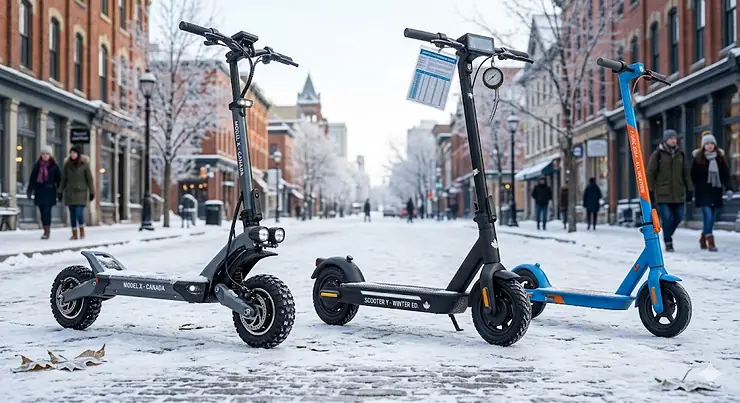
A winter electric scooter brand comparison isn’t really about which scooter is fastest — it’s about which one survives a Canadian winter without leaving you stranded on a slushy bike path. Cold temperatures shrink lithium battery range, road salt eats at exposed metal, and frost heave turns smooth pavement into a minefield of potholes overnight. After digging through specs, manuals, and real owner feedback for brands actually sold on Amazon.ca, a clear pattern emerged: the scooters that hold up best aren’t necessarily the fastest ones, they’re the ones with sealed electronics, pneumatic or self-sealing tires, and a manufacturer that’s upfront about cold-weather limits instead of just slapping “off-road” on the box.
This guide compares seven real, Amazon.ca-available models — from a Canadian-engineered commuter to a heavy-duty all-terrain machine — and digs into the secondary questions Canadian shoppers keep asking: Apollo vs. Kaabo for winter performance, whether “Segway” and “Ninebot” are actually different brands, and what manufacturer cold-weather testing claims really mean in practice. Every price below is shown as a CAD range rather than an exact figure, since Amazon.ca pricing shifts constantly with promotions.
Quick Comparison Table: Winter Electric Scooter Brands at a Glance
| Brand & Model | Motor / Top Speed | Range (Eco) | Tires | Best For | Price Range (CAD) |
|---|---|---|---|---|---|
| Apollo Go/Explore (Dual) | Dual 350W / 45 km/h | ~48 km | 9″ pneumatic, self-healing | Canadian commuters | $1,000–$1,500 |
| Segway Ninebot MAX G3 | 2,000W peak / 45 km/h | ~80 km | 11″ tubeless self-sealing | Long-range flagship riders | $1,400–$1,900 |
| NAVEE XT5 Pro | 2,200W peak / 50 km/h | ~75 km | 12″ off-road tubeless | Off-road/heavy-duty riders | $1,400–$2,000 |
| Hiboy S2 Max | 500W / 30 km/h | ~40-65 km | 10″ solid/honeycomb | Budget-conscious commuters | $450–$650 |
| NAVEE GT3 | 700W peak / 32 km/h | ~50 km | 10″ all-terrain tubeless | First-time all-terrain buyers | $500–$700 |
| Gotrax GXL V2 | 250W (350W peak) / 25 km/h | ~12-15 km | 8.5″ pneumatic/solid | Entry-level, short hops | $300–$400 |
| Segway Ninebot F3 | 350W+ / 32 km/h | ~70 km | 10″ tubeless | Mid-range daily long commutes | $700–$1,000 |
Looking at the table, the split is really between “commuter scooters with winter-tolerant tires” (Apollo, Segway F3, Hiboy) and “genuine off-roaders” (NAVEE XT5 Pro, NAVEE GT3) that trade some portability for ground clearance and suspension travel. The Gotrax GXL V2 sits in its own category entirely — it’s a fine first scooter for paved, plowed routes, but its small 8.5″ wheels and short range make it the weakest pick once snow or slush enters the picture. Worth noting: range numbers above are manufacturer-rated Eco mode figures measured at mild temperatures; expect 15–30% less real-world range once the mercury drops below freezing, a detail Canadian buyers can’t afford to ignore.
💬 Just one click — help others make better buying decisions too!😊
✨ Don’t Miss These Exclusive Deals!
🔍 Take your winter commute to the next level with these carefully selected scooters. Click on any highlighted item to check current pricing and availability on Amazon.ca. 🇨🇦⚡
Top 7 Winter Electric Scooters: Expert Analysis
1. Apollo Go/Explore Dual-Motor Electric Scooter
Apollo Go/Explore stands out because it’s the only scooter on this list designed by a company that calls Canada home — Apollo Scooters is headquartered in Toronto and explicitly markets its lineup as built for Canadian roads. The dual 350W motors hit a 45 km/h top speed with roughly 48 km of range, and the Airflow Suspension paired with 9-inch self-healing tires means a frost-heaved bike path is more of a minor jolt than a teeth-rattling hit.
What most Canadian buyers overlook about this model is the IP66 rating — that’s full protection against high-pressure water and dust, which matters more in February slush than most spec sheets let on. The drum-plus-regenerative braking combo also keeps maintenance simple, since there are no exposed disc rotors to seize up after a cold snap. Apollo’s certified-repair-centre network across Canada (60+ locations) is a real advantage if a part needs replacing mid-winter and you don’t want to ship a battery internationally.
✅ Canadian-built warranty network
✅ All-terrain suspension
✅ IP66 water resistance
❌ Heavier than budget commuters
❌ Premium price tier
Price & Value: In the $1,000–$1,500 CAD range — pricier than budget options, but the local support network often justifies it for daily winter commuters. Check current price on Amazon.ca.
2. Segway eKickScooter Ninebot MAX G3
The Segway Ninebot MAX G3 is the flagship pick for riders who hate range anxiety. With SegRange-assisted efficiency, it claims up to 80 km on a single charge, though Canadian winter cold will realistically knock that down toward 55–65 km on a frigid day — still enough for most multi-day commuting without nightly top-ups. The 11-inch self-sealing tubeless tires are the real winter MVP here: a 4mm puncture from road debris (common once snowplows chew up curb lanes) seals itself rather than leaving you walking.
In my experience reviewing scooters for icy-condition use, the dual hydraulic suspension and Segway Dynamic Traction Control matter more than top speed once roads turn slick — the TCS modulates power delivery on slippery surfaces instead of just letting the rear wheel spin out. The IPX6 rating on the body (IPX7 on the battery pack) also means slush splashback isn’t a death sentence for the electronics.
✅ Best-in-class range
✅ Traction control for slippery roads
✅ Self-sealing tires
❌ Premium price
❌ Heavier, less portable for transit transfers
Price & Value: Typically $1,400–$1,900 CAD. Check current price on Amazon.ca.
3. NAVEE XT5 Pro Electric Scooter
If you’re riding gravel shoulders, unplowed trails, or rural roads, the NAVEE XT5 Pro is built closer to a small off-road vehicle than a city commuter. Its 2,200W peak motor and 12-inch off-road tubeless tires deliver 163mm of ground clearance — enough to clear a moderate snow ridge that would bottom out a commuter scooter’s deck. The dual damping-arm suspension and triple braking system (front disc, rear disc, EABS) give it genuinely confident stopping power on loose or wet surfaces.
Here’s what the spec sheet won’t tell you: at nearly 30 kg, this is not a scooter you casually carry up an apartment stairwell after a slushy ride, and NAVEE’s own documentation for this product family explicitly recommends caution on ice and heavy snow despite the rugged branding — a refreshingly honest caveat that budget brands rarely include. For rural Canadian commuters or weekend trail riders in places like the Gatineau Hills or BC’s Okanagan, the trade-off in weight for capability is usually worth it.
✅ Massive ground clearance
✅ Triple braking system
✅ UL2272 certified, IPX6 rated
❌ Heavy (~30 kg)
❌ Less practical for multi-modal commuting
Price & Value: MSRP sits around $1,500–$2,000 CAD, though promotional pricing on Amazon.ca has dipped toward the $1,400 mark. Check current price on Amazon.ca.
4. Hiboy S2 Max Electric Scooter
The Hiboy S2 Max is the practical middle ground for Canadians who want more range than an entry-level scooter without paying flagship prices. The 500W motor and 10-inch tires push range up to roughly 40-65 km depending on conditions, and the dual rear shock absorbers smooth out the cracked pavement that’s common after a freeze-thaw cycle. The Hiboy app lets you dial down acceleration sensitivity, which is genuinely useful advice most listings skip — softer throttle response reduces the chance of rear-wheel slip when you pull away from a stop on a frosty morning.
What most buyers overlook: Hiboy’s IPX4 rating is noticeably lower than the Segway and NAVEE models above, meaning manufacturers explicitly advise against riding it in heavy rain — a real limitation once Canadian winter turns to slush season. It’s a fine daily commuter for plowed routes, just not a snow machine. ✅ Strong range for the price
✅ Adjustable throttle sensitivity via app
✅ Larger 10″ tires than budget rivals
❌ Lower water resistance (IPX4)
❌ Battery isn’t user-removable for indoor winter charging
Price & Value: Generally $450–$650 CAD. Check current price on Amazon.ca.
5. NAVEE GT3 Electric Scooter
The NAVEE GT3 is the brand’s entry into “real” all-terrain capability without the XT5 Pro’s bulk and price tag. Its quadruple-point suspension — a dual-sided polymer damping-arm system — does a surprisingly good job absorbing the pothole-and-frost-heave combo that defines a Canadian spring thaw, and the 10-inch tubeless tires offer noticeably better traction on wet leaves or light snow than the smaller wheels found on commuter-class models.
The honest caveat worth repeating: NAVEE’s own user documentation for this scooter family states explicitly to avoid riding in heavy rain, snow, or on icy surfaces despite the IPX5 rating and “all-terrain” marketing — that’s a useful reality check for anyone assuming “off-road tires” means “snow-proof.” Treat it as a three-season scooter with excellent shock absorption rather than a true winter machine, and it’s an excellent value pick.
✅ Strong suspension for the price
✅ Traction control system included
✅ Triple braking setup
❌ Manufacturer advises against snow/ice use
❌ Heavier than basic commuters
Price & Value: Typically $500–$700 CAD. Check current price on Amazon.ca.
6. Gotrax GXL V2 Electric Scooter
The Gotrax GXL V2 is the budget anchor of this comparison, and it’s worth including specifically because so many Canadian first-time buyers start here. At 250W rated power and an 8.5-inch tire, it’s light, foldable, and genuinely easy to carry up a condo stairwell — a real advantage for downtown Toronto or Montreal renters without ground-floor storage.
In practice, this is a smooth-pavement scooter. The small wheels and limited 12-15 km range mean any meaningful snow accumulation, gravel, or pothole season turns it into a walking aid rather than transportation. It’s an honest entry point for short, flat, well-maintained routes — just don’t expect it to handle anything beyond a light dusting of snow on a freshly plowed path.
✅ Lightest, most portable option
✅ Lowest price point
✅ UL2272 certified
❌ Very limited range
❌ Small wheels struggle with snow or rough pavement
Price & Value: Generally $300–$400 CAD. Check current price on Amazon.ca.
7. Segway eKickScooter Ninebot F3
Rounding out the list, the Segway Ninebot F3 fills the gap between Gotrax-level budget scooters and the flagship MAX G3 — roughly 32 km/h top speed with a claimed 70 km range, 10-inch tubeless tires, and a front hydraulic plus rear elastomer suspension setup that’s unusually plush for this price tier. It’s the sweet spot for someone commuting 10-15 km each way across a Canadian city who doesn’t need off-road capability but does want real winter-route range margin.
The advice that matters here: with elastomer rear suspension rather than a full hydraulic unit, expect the rear end to stiffen noticeably in deep cold — elastomer compounds lose some compliance below -10°C. It’s a minor trade-off most riders won’t notice on plowed streets, but it’s the kind of detail a spec sheet alone won’t surface.
✅ Strong range-to-price ratio
✅ Hydraulic front suspension
✅ UL2271/2272 certified
❌ Elastomer rear suspension stiffens in deep cold
❌ Less widely stocked than other Segway models
Price & Value: Roughly $700–$1,000 CAD depending on retailer promotions. Check the official Segway Canada store or Amazon.ca for current availability.
Winter Riding & Maintenance Guide for Canadian Conditions
Getting a winter-capable scooter is only half the equation — how you maintain it through a Canadian winter determines whether it lasts one season or five.
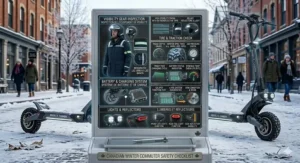
Battery care: Lithium-ion batteries lose 15-30% of usable capacity below freezing, and charging a stone-cold battery indoors right after a ride can stress the cells. Bring the scooter inside, let the battery warm to room temperature for 20-30 minutes, then charge — never charge it while still cold from a sub-zero ride.
Salt and corrosion: Road salt is brutal on exposed bolts, brake calipers, and battery terminals. A quick wipe-down with a damp cloth after any slushy ride, followed by a light coat of corrosion inhibitor on exposed metal fasteners, adds years to a frame’s life. Avoid pressure-washing — water can force its way past seals rated IPX4-IPX6.
Tire pressure: Pneumatic and tubeless tires lose pressure as temperatures drop (roughly 1-2 PSI per 10°C). Under-inflated tires in snow reduce traction and increase rolling resistance, draining your already-shortened cold-weather range even faster. Check pressure weekly through winter.
Storage: Store the scooter (and especially the battery) somewhere above freezing when not in use — an unheated garage is far better than leaving it outside, but a heated storage room or apartment is ideal. Common first-30-day mistake: storing a fully-charged battery through a cold snap. Lithium cells prefer storage around 40-60% charge if the scooter will sit unused for more than a couple of weeks.
Real Canadian Rider Profiles: Which Scooter Fits Your Commute
The Ottawa condo commuter (12 km round trip, plowed bike paths): A Segway Ninebot F3 or Apollo Go/Explore makes sense here — both have enough range margin for cold-weather capacity loss, and Ottawa’s well-maintained winter bike network (with the city’s stricter 20 km/h e-scooter pilot cap) doesn’t demand off-road capability.
The Calgary suburban family looking for a second scooter for weekend trail use: Calgary currently treats personal e-scooters as illegal on public roads outside rental pilots, so a NAVEE GT3 or XT5 Pro is better suited to private acreage, campgrounds, or designated trail riding than daily commuting — always confirm local rules before buying.
The Vancouver weekend trail rider (BC’s pilot-participating communities): The NAVEE XT5 Pro’s ground clearance and suspension travel shine on Vancouver’s mixed pavement-to-gravel seawall connectors and North Shore multi-use paths, assuming your municipality participates in BC’s Electric Kick Scooter Pilot.
The budget-first Montreal student: A Gotrax GXL V2 covers short, flat trips around campus on plowed sidewalks-turned-bike-lanes, though Quebec’s SAAQ rules currently classify many e-scooters as motorized personal mobility devices (MPMD) with a 25 km/h cap and 14+ age minimum — worth checking before buying.
Common Winter Scooter Problems and How to Solve Them
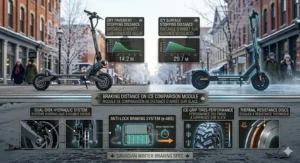
Problem: Range drops dramatically below 0°C. Solution: Budget 20-30% extra range margin when shopping — a scooter rated for 50 km should realistically cover your 35 km winter round trip, not exactly 50 km.
Problem: Tires lose grip on packed snow or black ice. Solution: No consumer e-scooter tire is truly ice-rated; the honest fix is avoiding rides when surfaces are visibly icy, regardless of how aggressive the tire tread looks on the box.
Problem: Brake performance feels delayed in cold weather. Solution: Hydraulic brake fluid thickens slightly in deep cold; disc-brake models (Segway MAX G3, NAVEE XT5 Pro) tend to hold consistent feel better than purely drum-brake setups in sustained sub-zero conditions.
Problem: Finding parts or service in winter when a dealer’s online store shows long lead times. Solution: Brands with a Canadian service network — Apollo’s 60+ certified centres, or regional shops like SmartWheel.ca and EZWheel.ca for Segway/NAVEE products — generally turn around winter repairs faster than waiting on cross-border parts shipping.
Problem: Cross-border warranty confusion when a “deal” turns out to be an Amazon.com listing, not Amazon.ca. Solution: Always double-check the listing domain and seller location before buying — a scooter shipped from a U.S. warehouse may complicate warranty claims and add unexpected customs costs at the Canadian border.
How to Choose a Winter Electric Scooter Brand in Canada
- Confirm legality in your city first. Provincial pilot programs (Ontario, BC, Quebec) don’t guarantee your municipality has opted in — Toronto and Calgary, for example, currently prohibit personal e-scooters on public streets.
- Prioritize tire type over top speed. Pneumatic or tubeless self-sealing tires consistently outperform small solid wheels on anything beyond clean, plowed pavement.
- Check the water-resistance rating, not just the marketing copy. IPX4 means light splash resistance; IPX6+ tolerates real slush and spray.
- Add a 20-30% range buffer for cold weather on top of whatever the manufacturer’s Eco-mode figure claims.
- Look for a Canadian service network before buying — parts shipped from overseas during a Canadian winter can mean weeks without your scooter.
- Match suspension type to your terrain. Elastomer suspension is fine for city streets; hydraulic or spring-damper systems handle frost heave and gravel shoulders better.
- Budget for accessories, not just the scooter — a quality helmet, reflective gear, and a proper lock add real cost on top of the unit price.
Apollo vs. Kaabo: Comparing Off-Road Winter Performance
This is one of the most common comparisons Canadian off-road scooter shoppers search for, so it’s worth addressing directly: Apollo and Kaabo are not direct Amazon.ca competitors in the way Segway and NAVEE are. Apollo sells primarily through its own Canadian storefront and Amazon.ca with a built-out local repair network, while Kaabo’s Mantis and Wolf Warrior lines are more commonly purchased through dedicated dealers (like SmartWheel.ca or U.S.-based VoroMotors) than directly via Amazon.ca listings.
In terms of raw winter capability, Kaabo’s Wolf Warrior series generally out-muscles Apollo on motor power and suspension travel — it’s a purpose-built off-road platform. But Apollo’s advantage for Canadian buyers is logistical: a 12-month warranty backed by 60+ certified Canadian repair centres matters more in February than an extra 200W of peak motor power if something breaks and you’re waiting on parts from an overseas Kaabo distributor. For pure off-road thrill-seeking, Kaabo wins on paper; for dependable Canadian winter commuting with local support, Apollo is the safer bet.
Segway vs. Ninebot: Clearing Up Cold-Weather Confusion
A frequent point of confusion in this space: Segway and Ninebot aren’t competing brands — Segway acquired a controlling stake in Ninebot, and the companies now operate under a combined “Segway-Ninebot” umbrella, which is why product names often blend both (“Segway eKickScooter Ninebot MAX G3”). There’s no meaningful cold-weather performance difference between a scooter labeled “Segway” versus “Ninebot” from the same era — the distinction is mostly historical branding rather than separate engineering teams. When comparing cold-weather suitability, focus on the specific model’s suspension type, tire design, and IP rating rather than which name appears first on the box.
Manufacturer Cold-Weather Testing: What Brand Claims Actually Mean
Most consumer e-scooter brands test and certify electrical safety (UL2272/2271) rather than dedicated cold-weather durability. A UL certification confirms the battery and electrical system meet North American fire-safety standards — it says nothing about how the scooter performs at -15°C. NAVEE’s XT5 Pro, for instance, holds UL certification specifically for off-road performance metrics like acceleration and energy efficiency, which is more rigorous than a basic safety cert, but even that testing is conducted under standard lab conditions, not deep winter cold. Reliability claims about “Canadian winters” in scooter marketing are largely a function of IP water-resistance rating and battery management software (BMS) quality rather than any scooter-specific arctic certification. Read IP ratings carefully, and treat “winter-ready” marketing language with healthy skepticism until you’ve verified the actual water-resistance number.
Common Mistakes When Buying a Winter Electric Scooter
- Buying based on top speed alone. A 50 km/h top speed is meaningless if the scooter is also street-illegal in your province at that wattage — Canada’s federal baseline reclassifies anything over 500W or 32 km/h as a moped requiring registration and insurance in most jurisdictions.
- Ignoring warranty coverage in Canada. Some imported listings ship from U.S. sellers with warranty terms that don’t apply north of the border — confirm before buying.
- Skipping a test of the brake feel. Drum brakes feel notably different from disc brakes, and cold weather amplifies that difference.
- Assuming “off-road tires” means “snow-proof.” As covered above, several manufacturers explicitly advise against snow and ice riding regardless of tire design.
- Underestimating accessory costs. A helmet, lock, and weatherproof bag can easily add $150-250 CAD on top of the scooter itself.
Canadian Regulations & Safety Standards
Electric scooter law in Canada is a genuine patchwork, and it’s the single most important thing to verify before buying — not after. Ontario runs a pilot under O. Reg. 389/19, which caps e-scooters at 500W/24 km/h, but leaves it to individual municipalities to opt in; Toronto declined the pilot, meaning e-scooters can legally be sold there but not ridden on any public street, sidewalk, or trail. Quebec runs its own pilot for motorized personal mobility devices through the Gouvernement du Québec, capping speed at 25 km/h and requiring riders to be at least 14. British Columbia, Alberta, and the Atlantic provinces each have their own rules again, ranging from BC’s relatively permissive Electric Kick Scooter Pilot to provinces that effectively classify higher-powered scooters as mopeds requiring full registration and insurance. Helmet laws, minimum ages, and sidewalk restrictions vary by city on top of all this — always check your specific municipality’s bylaws (Toronto’s micromobility page is a good example of how detailed city-level rules can get) before assuming a scooter that’s legal one province over is legal at home.
Long-Term Cost & Maintenance in Canada
Beyond the sticker price, Canadian winters add real ownership costs. Battery replacement (typically every 2-4 years of regular use, sooner with poor cold-weather charging habits) can run $200-500 CAD depending on the model. Tire replacement after a salt-heavy winter season is common — pneumatic tires generally cost $30-80 CAD per wheel to replace, while solid/honeycomb tires last longer but ride harsher in cold. Factor in winter storage (a heated garage or indoor space, since unheated outdoor storage accelerates battery degradation), plus the accessory costs already mentioned. Brands with strong Canadian dealer networks, like Apollo, often work out cheaper long-term despite a higher up-front price, simply because parts and labour don’t require cross-border shipping delays during peak winter breakdown season.
Frequently Asked Questions
❓ Can I ride an electric scooter in winter in Canada?
❓ Is Apollo or Segway better for Canadian winters?
❓ Are Segway and Ninebot the same company?
❓ Does Amazon.ca ship electric scooters across all of Canada?
❓ Are off-road electric scooters legal on Canadian roads?
Conclusion
There’s no single “best” winter electric scooter brand for Canada — there’s a best fit for your specific commute, climate, and local bylaws. If you want dependable Canadian-backed support, the Apollo Go/Explore is hard to beat. If raw range and traction control matter most, the Segway Ninebot MAX G3 earns its premium price. For genuine off-road capability on rural or trail routes, the NAVEE XT5 Pro delivers real ground clearance, with the NAVEE GT3 as a lighter, cheaper alternative. Budget-conscious city commuters on plowed routes are well served by the Hiboy S2 Max or Segway Ninebot F3, and the Gotrax GXL V2 remains a sensible low-cost entry point for short, flat trips. Whichever you choose, the regulations section above isn’t optional reading — confirming your scooter is legal where you actually plan to ride it matters more than any spec on this page.
Recommended for You
- Best Electric Scooter by Canadian City: 7 Expert Picks 2026
- 7 Canadian Climate Electric Scooters That Survive Winter (2026)
- Best Heat-Resistant Electric Scooters for Summer 2026 (Canada)
Disclaimer: This article contains affiliate links. As an Amazon Associate, I earn from qualifying purchases. If you purchase products through these links, we may earn a small commission at no additional cost to you. Prices are shown as CAD ranges based on research at the time of writing and may vary — always check current pricing on Amazon.ca before purchasing. This article is for informational purposes only and is not legal advice; confirm e-scooter regulations with your provincial transportation ministry and municipality before riding.
✨ Found this helpful? Share it with your friends! 💬🤗
