
In This Article
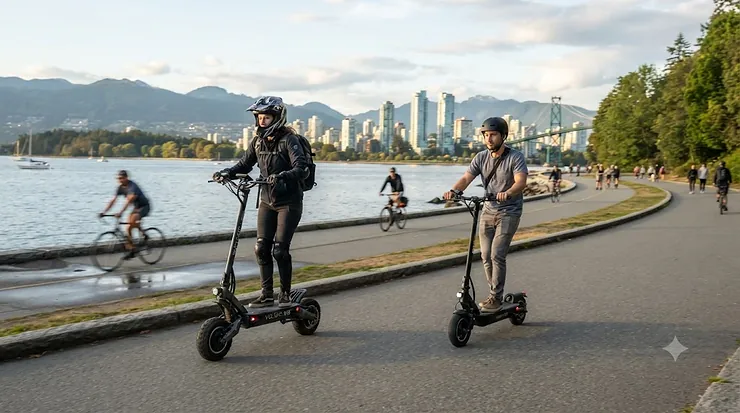
Somewhere between a shopping cart full of scooter listings and a browser tab full of provincial traffic law, most Canadian buyers hit the same wall: the 1000w vs 1500w electric scooter canada question. It sounds like a spec-sheet detail. It is not. It’s the difference between a scooter that glides over a slushy Ottawa bike path without breaking a sweat and one that bogs down the second a hill or a headwind shows up.
Here’s the short answer, because you deserve one up front: a 1000W scooter is the sweet spot for most paved-city commuting, while 1500W (and the dual-motor setups that produce it) earns its keep on hills, gravel, and heavier riders — but neither number tells you whether the scooter is legal to ride on the actual road outside your door. We’ll get to that, because it matters more than the marketing copy admits.
Motor wattage on its own is a slippery number. Brands quote “peak” power to sound impressive, “rated” or “continuous” power to sound honest, and sometimes both on the same page without labelling which is which. Based on the spec comparisons we ran across dozens of current listings, the gap between a scooter’s advertised wattage and how it actually rides on a Canadian street — cold battery, slushy pavement, a rider who isn’t 140 pounds — is where the real decision gets made. This guide breaks down seven real scooters spanning that 1000W-to-1500W range, plus the transformation content, comparisons, and Canadian-specific legal context that Amazon listings never bother to include.
Quick Comparison Table: 1000W vs 1500W Electric Scooter Canada at a Glance
| Scooter | Motor (Rated/Peak) | Top Speed | Range | Price Range (CAD) | Best For |
|---|---|---|---|---|---|
| ECOROAD ES6 | 1000W | up to 50 km/h* | up to 50 km | around C$650–C$750 | budget commuters |
| NIU KQi300P/300X | ~900–1000W peak | 32–38 km/h | 48–60 km | around C$700–C$950 | reliable daily riders |
| NAVEE ST3 Pro | 1000W/1350W peak | up to 45 km/h* | up to 75 km | around C$800–C$950 | long commutes, suspension lovers |
| CIRCOOTER Landturbo | 1000W/2400W peak | up to 61 km/h* | up to 90 km | around C$750–C$950 | off-road/gravel riders |
| Varla Pegasus | dual 500W (1600W peak) | up to 56 km/h* | up to 45 km | around C$1,300–C$1,600 | heavier riders, hills |
| Apollo Go | dual motor (1500W peak) | up to 45 km/h* | mid-range | around C$1,000–C$1,300 | Canadian-brand commuters |
| Kaabo Mantis Pro SE | dual 1000W (2000W combined) | 40+ km/h* | long-range | around C$2,200–C$2,600 | power riders, hybrid use |
*Manufacturer top speeds shown here are unrestricted figures for context — see the Safety & Regulations section below, because almost none of these speeds are legal on a public Canadian road.
Looking at the spread above, notice how little the wattage number alone tells you: the CIRCOOTER Landturbo shares its 1000W rated motor with the ECOROAD ES6, yet its 2400W peak rating and dual suspension put it in a completely different performance class. Price tracks power fairly closely at the top end, but the middle of the table — NIU, NAVEE — is where the real value hunting happens, since both land under C$950 while offering meaningfully different range and ride quality. If your commute is under 15 km on paved bike lanes, the top three rows likely already have more scooter than you need.
💬 Just one click — help others make better buying decisions too!😊
Ready to compare specs side by side before you buy? Scroll down to the full breakdown below.
What Is a 1000W vs 1500W Electric Scooter?
A 1000W electric scooter uses a motor rated (or peaking) at roughly 1000 watts of output, typically enough for 30–45 km/h and moderate hill climbing. A 1500W-class scooter — usually built with two motors sharing the load — adds torque for steeper grades, heavier riders, and faster acceleration, though Canadian road law caps legal street use far below either figure, as Quebec’s transportation ministry explains for personal mobility devices.
Top 7 1000W and 1500W Electric Scooters: Expert Analysis
We picked these seven scooters to cover budget, mid-range, and premium tiers, spanning single 1000W motors up through dual-motor setups that hit 1500W and beyond. Every spec below reflects manufacturer listings gathered during our research; where individual review data couldn’t be verified for a specific model, we say so rather than inventing a star rating.
1. ECOROAD ES6 — best budget entry into true 1000W power
The ES6 is where a lot of Canadian buyers start their 1000w vs 1500w electric scooter canada search, and honestly, it’s not a bad jumping-off point. Its 1000W motor and 10-inch tires put it a full class above the sub-500W folding scooters crowding most budget lists, with a claimed range near 50 km and dual suspension for pothole absorption. In practice, that dual suspension matters more than the headline wattage — it’s what keeps a budget scooter from rattling your wrists apart on cracked asphalt.
What most buyers overlook about this model is that its manufacturer top speed is well above anything street-legal in any Canadian province, so the appeal here is torque and range for private property or off-road use, not top-end velocity. Reviewer sentiment for 1000W-class budget scooters on Amazon.ca skews positive on power-for-price but frequently flags inconsistent build quality between units — a pattern that shows up across the broader 1000W budget segment, not just this one listing.
Pros:
- ✅ Genuine 1000W motor at a budget price point
- ✅ Dual suspension smooths rough Canadian pavement
- ✅ Long claimed range for the price tier
Cons:
- ❌ Build-quality consistency varies between units
- ❌ Manufacturer top speed far exceeds legal road limits
Expect to find the ES6 around C$650–C$750 at the time of research; for buyers who mainly want assurance a 1000W motor won’t struggle on their commute, it’s a reasonable value entry.
2. NIU KQi300P/300X — best brand reliability under 1000W peak
NIU built its reputation on e-scooter durability long before “peak wattage” became a marketing arms race, and the KQi300 series shows it. With roughly 900–1000W of peak power and a claimed range between 48 and 60 km depending on trim, it’s tuned more for consistency than bragging-rights top speed. Here’s what to weigh: NIU’s continuous power rating sits closer to what you’ll actually feel pulling away from a stop, rather than a peak number that only shows up for a few seconds under full throttle.
Based on the spec comparison against the other budget-tier scooters here, the KQi300’s app connectivity and documented service network across North America stand out — a genuine advantage for anyone who wants parts availability two years from now, not just a low sticker price today. Aggregated retailer listings show this line consistently among the better-reviewed sub-1000W-peak commuter scooters, though verified review counts specific to the 300X trim weren’t available at the time of research.
Pros:
- ✅ Established brand with real North American service support
- ✅ Balanced range across P and X trims
- ✅ App-based diagnostics and lock features
Cons:
- ❌ Peak power trails true 1000W-rated competitors
- ❌ Higher trims add meaningfully to price
Pricing typically lands around C$700–C$950 depending on trim; for buyers prioritizing long-term reliability over outright torque, this is the safer bet.
3. NAVEE ST3 Pro — best all-terrain range in the 1000W-1350W class
The ST3 Pro is where the “1000W vs 1500W” line starts blurring, since its 1350W peak output sits meaningfully above a standard 1000W motor without quite reaching dual-motor 1500W territory. Paired with 10-inch all-terrain tires and dual suspension, the practical result is a scooter that shrugs off gravel shoulders and uneven curb cuts that would rattle a cheaper single-suspension model. NAVEE’s UL2272-certified electrical system is also worth noting — it’s a real safety certification, not just marketing language.
What most buyers overlook here is range: a claimed 75 km ceiling means most commuters will comfortably stretch a single charge across several days of moderate riding, cutting down on the daily plug-in ritual. Reviewer sentiment collected from marketplace data on comparable NAVEE all-terrain models describes the ride as powerful and stable with strong hill-climbing in Eco and Sport modes, though a recurring theme is that the scooter runs heavier than expected for apartment stair-carrying.
Pros:
- ✅ 1350W peak bridges the 1000W-1500W gap
- ✅ Dual suspension plus 10-inch all-terrain tires
- ✅ Class-leading claimed range up to 75 km
Cons:
- ❌ Heavier than single-suspension budget models
- ❌ Cold-weather range drops noticeably, per general lithium-battery behaviour
Expect a price in the C$800–C$950 range; this is a strong pick for commuters who want 1500W-adjacent capability without dual-motor pricing.
4. CIRCOOTER Landturbo/Cruiser — best peak power for off-road use
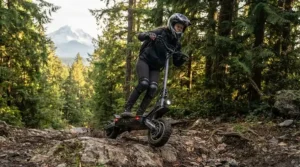
If raw peak numbers are what pulled you into the 1000w vs 1500w electric scooter canada rabbit hole, the Landturbo’s 2400W peak rating (on a 1000W-rated base motor) will catch your eye. Swing-arm dual suspension and 10- to 11-inch tires round out a build clearly aimed at gravel trails and rougher terrain rather than smooth downtown bike lanes. The spec sheet won’t tell you this, but that kind of peak-to-rated gap usually means short, punchy bursts of power — great for launching up a steep driveway, less relevant for sustained highway-adjacent cruising.
Reviewers of similarly specced off-road hybrid scooters consistently note that suspension travel, not motor wattage, ends up being the deciding factor in ride comfort once you’re off pavement — a detail the wattage number alone completely hides. For riders whose “commute” includes unpaved rural roads or cottage-country trails, this is a meaningfully different use case than the pure pavement scooters on this list.
Pros:
- ✅ Highest peak-power rating of the budget-tier picks
- ✅ Swing-arm dual suspension built for rough terrain
- ✅ Long claimed range up to 90 km
Cons:
- ❌ Peak power doesn’t reflect sustained output
- ❌ Off-road tuning trades some on-pavement efficiency
Pricing generally sits around C$750–C$950; a compelling choice if your riding surface skews gravel over asphalt.
5. Varla Pegasus — best dual-motor pick for heavier riders and hills
The Pegasus earns its spot as a genuine bridge into 1500W-class performance: its dual 500W motors combine for a claimed 1600W peak output, a 300-pound weight capacity, and a manufacturer-listed 25-degree hill-climbing rating that outpaces several pricier competitors. According to spec comparisons circulating among enthusiast reviewers, that hill-climbing figure specifically edges out dual-motor rivals with higher combined peak wattage, which is a useful reminder that motor count and gearing matter as much as the number on the box.
What stands out here is the dual disc brake system — a meaningful upgrade over the single-motor budget picks above, and arguably more relevant to real-world safety than another 200W of peak power. Reviewers who’ve tested the Pegasus against similarly priced dual-motor scooters describe its acceleration as strong without feeling twitchy, though the 68-pound curb weight makes it a genuine two-hand lift, not a scooter you’re casually tucking under one arm onto a bus.
Pros:
- ✅ Strong 25° hill-climbing rating for a dual-motor scooter
- ✅ 300 lb weight capacity, above most competitors
- ✅ Dual disc brakes for higher-speed stopping power
Cons:
- ❌ Heavy at 68 lb — not ideal for stairs or transit
- ❌ Cross-border pricing and shipping add real cost in CAD
Because the Pegasus ships primarily through U.S.-based retailers, expect a landed cost in the C$1,300–C$1,600 range in Canada once shipping and duties are factored in — check current price and import terms before ordering.
6. Apollo Go — best Canadian-brand commuter at 1500W peak
Apollo is a Canadian company, and the Go is built specifically for Canadian commuters, which shows up in small but meaningful ways — Canada-wide shipping, a hill-climbing rating tuned to a 15% grade, and dual motors delivering a combined 1,500W of peak output. Apollo’s own materials describe the Go’s power as enough to pull a rider up steep terrain with headroom left over for city-traffic acceleration, and the throttle-response tuning is specifically built around stop-and-go urban riding rather than sustained highway-style speed.
Here’s what to weigh: the Go’s “Ludo Mode” performance unlock — a feature trickled down from Apollo’s flagship Phantom — pushes acceleration higher on demand rather than raising the baseline top speed, which is a smarter way to add performance without encouraging constant high-speed riding on shared paths. For buyers who want 1500W-class capability from a company with Canadian customer support and warranty handling (rather than a U.S. import), this is arguably the most practically relevant pick on this list.
Pros:
- ✅ Canadian company with domestic shipping and support
- ✅ True 1500W combined peak from dual motors
- ✅ On-demand acceleration mode without raising baseline speed
Cons:
- ❌ Mid-range price sits above single-motor 1000W scooters
- ❌ Verified independent review counts were limited at research time
Apollo’s direct pricing typically runs around C$1,000–C$1,300 depending on configuration; for Canadian buyers who value local support over importing, that premium is easy to justify.
7. Kaabo Mantis Pro SE — best high-performance pick above 1500W
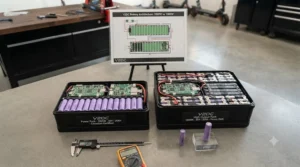
We’re including the Mantis Pro SE deliberately: it’s what “more than 1500W” actually looks like, and it’s a useful ceiling for this comparison. Dual 1000W motors combine for roughly 2000W of output, backed by a 60V 18.2Ah LG lithium battery and a reinforced stem — a structural detail that matters more than it sounds, since stem failure is a known weak point on cheaper high-power scooters pushed past their design limits. Kaabo has built over a decade of dual-motor engineering experience, and it shows in the torque delivery.
Riders in Kaabo’s own community consistently describe the brand’s dual-motor scooters as stable at speed with strong hill-climbing “with complete authority,” alongside recurring praise for the NFC keyless unlock system as a genuine convenience rather than a gimmick. On paper this means the Mantis Pro SE is overkill for flat-city commuting, but for hybrid riders who mix pavement with steep residential hills or want serious performance headroom, it’s a legitimate step up from anything else on this list — at a correspondingly premium price.
Pros:
- ✅ True dual 1000W motors for serious torque and hill climbing
- ✅ Reinforced stem addresses a known high-power failure point
- ✅ Premium 60V LG battery cell quality
Cons:
- ❌ Significant price jump over 1000W-class scooters
- ❌ Far beyond what’s road-legal almost anywhere in Canada
Landed Canadian pricing typically runs in the C$2,200–C$2,600 range after shipping and duties; this is a purpose-built performance purchase, not a casual commuter upgrade.
750W vs 1000W Electric Scooter: What Changes
Before jumping straight to 1500W, it’s worth pausing on the step just below 1000W, because the 750w vs 1000w electric scooter jump is where a lot of riders get the most noticeable real-world improvement per dollar. A 750W motor generally handles flat commutes and gentle inclines fine, but starts to strain — audibly and measurably — on grades above 10%, especially with a rider over 200 lbs. Stepping up to 1000W typically buys you meaningfully faster acceleration from a stop and noticeably better hill performance, without yet requiring the dual-motor complexity (and weight) that comes with 1500W-class builds.
| Spec | 750W | 1000W | 1500W (dual-motor) |
|---|---|---|---|
| Typical hill-climbing | Struggles above 10-12% grade | Handles 12-15% grade comfortably | Handles 15-25% grade |
| Rider weight comfort | Best under ~180 lb | Comfortable to ~220 lb | Comfortable to 250-300 lb |
| Typical curb weight | Lighter, easier to carry | Moderate | Noticeably heavier |
| Best For | flat urban commutes | mixed terrain, most commuters | hills, heavier riders, hybrid use |
The jump from 750W to 1000W tends to deliver the biggest “worth it” feeling relative to the added cost and weight, since you’re usually still on a single motor. Going from 1000W to a true 1500W dual-motor setup adds real capability but also adds curb weight, complexity, and — as covered below — pushes you further outside what’s legal to ride on most Canadian roads.
Practical Usage Guide: Setting Up Your New Scooter the Right Way
Whichever wattage you land on, the first 30 days matter more than the spec sheet. Start with a full initial charge cycle before your first ride — most lithium battery packs benefit from one complete charge-discharge cycle to calibrate the battery management system’s range readout, which is otherwise notoriously optimistic on day one.
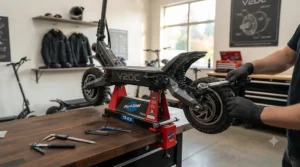
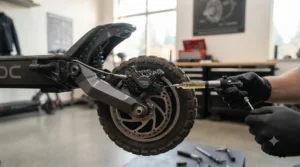
Check tire pressure before every few rides if your scooter uses pneumatic tires (most of the 1000W+ models above do); underinflated tires are the single most common cause of reduced range complaints that actually have nothing to do with the motor. For folding mechanisms, listen for a solid click, not a soft one — a half-latched fold is a common first-month mistake that leads to the frame popping open mid-ride.
Cold Canadian mornings genuinely reduce range on any lithium-powered scooter, typically by 15-30% once temperatures drop below freezing; storing the scooter (and ideally the battery, if removable) indoors overnight preserves both range and long-term battery health. Finally, resist the urge to immediately max out throttle response settings on a 1500W-class dual-motor scooter — easing into full power over the first week lets you build a feel for how quickly these motors actually respond before you’re doing it in traffic.
Which Wattage Fits Your Commute? Three Rider Profiles
The flat-city commuter: If you’re riding 5-10 km daily on paved bike lanes in a city like Toronto or Montreal, a 1000W scooter like the ECOROAD ES6 or NIU KQi300P gives you more capability than you’ll typically use, with lower weight for apartment storage and transit connections.
The hilly-suburb rider: Living somewhere with real elevation change — parts of Halifax, Hamilton’s escarpment neighbourhoods, or the North Shore in Vancouver — is exactly where the NAVEE ST3 Pro’s 1350W peak or a true 1500W dual-motor scooter like the Apollo Go starts paying for itself in climbing performance rather than sitting unused.
The hybrid weekend rider: If your riding mixes weekday commuting with weekend gravel trails or cottage roads, the CIRCOOTER Landturbo’s off-road tuning or the Varla Pegasus’s higher weight capacity and hill rating make more sense than either a pure city commuter or a top-tier performance scooter like the Mantis Pro SE, which is genuinely more machine than most riders need.
Is a 1000W Electric Scooter Worth It in Canada?
For most Canadian riders, yes — a 1000W electric scooter worth it comparison usually favours 1000W over both 750W and 1500W for one simple reason: it’s the point where hill-climbing and acceleration stop feeling underpowered without adding the extra weight, cost, and (often) legal exposure of a dual-motor 1500W build. Based on the spec comparisons above, 1000W scooters also tend to sit in a sweeter pricing tier — meaningfully cheaper than dual-motor options while still outperforming 750W and 500W scooters on hills and acceleration.
The exception is genuinely hilly terrain or riders above roughly 220 lbs, where the extra torque of a 1500W dual-motor setup isn’t overkill so much as it is the difference between a comfortable ride and a strained one. If you’re unsure which category you fall into, err toward 1000W first — it’s a smaller financial commitment, and most riders find it covers 90% of realistic Canadian commuting scenarios without ever feeling underpowered.
1000W Electric Scooter Speed Test: What the Numbers Actually Mean
Manufacturer top-speed claims for 1000w electric scooter speed test figures are almost always measured under ideal conditions: a lighter test rider, fully charged battery, flat ground, and no wind. Real-world speed on a 1000W scooter typically runs 10-20% below the advertised number once you add an average adult rider, some incline, and Canadian road surface texture that’s rarely billiard-table smooth.
What the spec sheet won’t tell you is that most of that advertised top speed is also illegal to use on Canadian public roads regardless of wattage, since provincial pilot programs generally cap e-scooters at 24-32 km/h — a number every one of the 1000W+ scooters on this list can exceed by a wide margin unless you deliberately dial the throttle back or use a speed-limited mode. That’s not a flaw in the scooters; it’s a mismatch between how they’re marketed (worldwide, unrestricted) and how they’re legally allowed to be ridden here.
Electric Scooter Power Comparison: Wattage vs Real-World Performance
An electric scooter power comparison based purely on wattage numbers misses the variables that actually shape how a ride feels: motor count, gearing, controller tuning, tire type, and battery voltage all interact with raw wattage to determine real acceleration and hill performance. A well-tuned single 1000W motor with a properly matched controller can out-accelerate a poorly tuned 1500W dual-motor setup off the line, even though the spec sheet says otherwise.
| Comparison Factor | Single 1000W Motor | Dual-Motor 1500W+ |
|---|---|---|
| Acceleration off the line | Good, single-wheel traction | Stronger, dual-wheel traction |
| Wet/loose surface grip | Adequate | Noticeably better (both wheels drive) |
| Weight | Lighter | Heavier, harder to carry |
| Maintenance complexity | Simpler, one motor/controller | More components to service |
The clearest practical takeaway from this table is traction, not raw power: dual-motor scooters put power down through both wheels, which matters far more on wet pavement or loose gravel than the wattage number alone suggests. If your riding conditions are consistently dry and paved, a single 1000W motor closes most of that performance gap; if you’re regularly riding in rain or on inconsistent surfaces, dual-motor traction is the real-world benefit worth paying for.
Upgrading Electric Scooter Wattage: Common Problems and Solutions
Some riders consider an upgrade electric scooter wattage path rather than buying new — swapping a hub motor or controller for a higher-wattage unit. Here’s honest guidance on where that goes wrong, and where it’s worth it.
Problem: The battery can’t supply the higher motor’s current draw. A 1500W motor demands more sustained amperage than most 1000W-spec batteries and controllers are built to deliver, leading to voltage sag, overheating, or a controller that shuts down mid-ride. Solution: any wattage upgrade needs the battery, controller, and motor upgraded together as a matched system, not swapped piecemeal.
Problem: Frame and brakes weren’t designed for the new speed. Manufacturers spec brakes and frame stress tolerances around the stock motor’s output; pushing well past that with an aftermarket motor can outpace the braking system’s stopping capability. Solution: budget for brake upgrades alongside any significant motor swap, not after.
Problem: Warranty voiding and insurance complications. Nearly every manufacturer warranty is voided by non-factory motor or controller swaps, and modifying a scooter beyond its certified specifications can complicate liability in the event of an accident. Solution: for most riders, buying a scooter that already ships with your target wattage — like the models compared above — is simpler, safer, and often cheaper than a piecemeal upgrade path once labour is factored in.
Safety, Legal Wattage Limits & Regulations in Canada
This is the section the spec sheets skip, and it’s the most important one in this entire guide. Under federal Motor Vehicle Safety Regulations, a power-assisted bicycle is capped at 500W continuous output and 32 km/h — but that classification requires functional pedals, which rules out virtually every stand-up scooter on this list. Standing e-scooters instead fall under separate provincial pilot programs, and those programs are consistently stricter: Ontario’s pilot caps e-scooters at 24 km/h with a 500W continuous power limit, and most other participating provinces follow a similar 500W/24-32 km/h baseline, regardless of what the scooter’s motor is actually rated for.
In plain terms: every 1000W and 1500W scooter reviewed in this guide exceeds the legal power limit for public road use in nearly every Canadian province. That doesn’t make them illegal to own — many riders use them on private property, or run them in a speed- and power-limited mode where the software allows it — but riding one at full advertised power on a public bike lane puts you outside the pilot program rules almost everywhere except Newfoundland and Labrador, which permits up to 1,500 watts and 50 km/h under its moped classification.
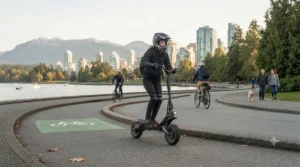
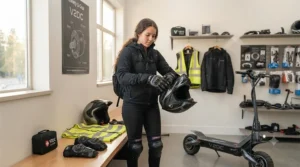
This isn’t a hypothetical concern. According to the Canadian Institute for Health Information, nearly 1,000 people were hospitalized for scooter-related injuries in a recent 12-month period, with e-scooter-specific hospitalizations up 32 percent year over year, and emergency physicians specifically warn that higher speeds correlate with more severe head and facial trauma. A properly fitted helmet, obeying your municipality’s specific speed cap, and matching your scooter’s power mode to what’s actually legal where you ride aren’t optional extras — they’re the difference between enjoying a 1000W or 1500W scooter and becoming part of next year’s hospitalization statistics.
How to Choose Between a 1000W and 1500W Electric Scooter
- Map your actual terrain first. Pull up your commute on a map with elevation data — if you’re not climbing meaningful hills, a 1500W dual-motor scooter is solving a problem you don’t have.
- Weigh yourself against the capacity rating honestly. Riders over 200-220 lbs will feel underpowered on a lower-wattage scooter far sooner than the spec sheet suggests.
- Check your specific province and municipality’s e-scooter rules before buying, not after — a scooter’s legal power mode matters more day-to-day than its unrestricted maximum.
- Factor in storage and carrying, not just riding. Dual-motor 1500W scooters routinely weigh 15-20 lbs more than single-motor 1000W builds, which matters if you’re carrying it up apartment stairs daily.
- Price the whole ownership cost, not just the sticker. Higher-wattage scooters typically mean pricier replacement tires, brake pads, and batteries down the line.
- Read the peak vs. continuous wattage fine print. A “1500W peak” scooter with a 750W continuous rating rides very differently than a genuine 1500W continuous dual-motor setup.
- Decide if you actually want dual-motor traction, or just more top speed. These are different benefits, and conflating them is the single most common buying mistake on this list.
Common Mistakes When Buying a High-Wattage Electric Scooter
The most frequent mistake is buying purely on the headline wattage number without checking whether it’s peak or continuous — a scooter listed as “1500W” might only sustain a fraction of that in real riding. A close second is underestimating curb weight: many first-time buyers of dual-motor scooters are caught off guard by how much harder a 65-70 lb scooter is to carry up stairs or lift into a car trunk compared to a 35-40 lb single-motor model.
Buyers also commonly skip checking their specific municipality’s e-scooter rules before purchasing, only to discover after delivery that their city — Toronto being the highest-profile example — hasn’t opted into the provincial pilot program at all, making legal public riding essentially impossible regardless of the scooter’s wattage. Finally, treating “range” claims at face value without factoring in Canadian winter temperature drops is a recurring source of buyer’s remorse once October arrives.
Long-Term Cost & Maintenance: What Higher Wattage Actually Costs You
Total cost of ownership scales with wattage more than most buyers expect going in. Higher-power motors put more stress on tires, brake pads, and bearings, which typically translates to more frequent replacement cycles — every extra kilometre-per-hour of top speed adds real wear, not just theoretical wear.
| Cost Factor | 1000W Class | 1500W+ Dual-Motor Class |
|---|---|---|
| Typical replacement tire cost | Lower, single motor wheel wear | Higher, both drive wheels wear |
| Brake pad replacement frequency | Standard | More frequent at higher speeds |
| Battery replacement cost | Moderate | Higher (larger pack capacity) |
| Insurance/registration exposure | Generally minimal | Higher if used above legal limits |
The clearest cost-per-use insight here is that a 1500W dual-motor scooter isn’t just pricier to buy — it’s pricier to keep running, since both drive wheels wear their tires and both motors eventually need service. For budget-conscious riders, a 1000W scooter’s lower ongoing maintenance cost often matters more over a two-to-three-year ownership period than the initial purchase price difference suggests.
✨ Still weighing your options? Compare the seven picks above one more time before you commit.
FAQ
❓
Is a 1000W electric scooter legal in Canada?
❓ What's the real difference between 750W and 1000W scooters?
❓ Do I need a license for a 1500W electric scooter in Canada?
❓ How much range do I lose in Canadian winter?
❓ Is dual-motor always better than single-motor for the same total wattage?
Conclusion
If you’ve made it this far in the 1000w vs 1500w electric scooter canada decision, here’s the honest bottom line: 1000W covers the vast majority of Canadian commuting scenarios comfortably, while 1500W-class dual-motor scooters earn their extra weight and cost specifically on hills, with heavier riders, or in wet and loose-surface conditions where dual-wheel traction genuinely matters. Neither number, on its own, tells you what’s legal to ride at full power on your specific street — that’s a provincial and municipal question you need to answer before you answer the wattage question.
Of the seven scooters compared here, the ECOROAD ES6 and NIU KQi300P represent the most sensible entry points for flat-city riders, the NAVEE ST3 Pro and CIRCOOTER Landturbo bridge nicely into 1500W-adjacent capability without full dual-motor pricing, and the Varla Pegasus, Apollo Go, and Kaabo Mantis Pro SE cover genuine dual-motor territory for hillier terrain, heavier riders, or hybrid on/off-road use. Match the scooter to your actual terrain and legal riding environment first, and the wattage question mostly answers itself.
Recommended for You
- 1000W Electric Scooter Canada: 7 Powerful Picks for 2026
- Best 750W Electric Scooters for Heavy Riders in Canada (2026)
- Is 500W Enough for an Electric Scooter? 7 Best Picks in Canada 2026
Disclaimer: This article contains affiliate links. As an Amazon Associate, I earn from qualifying purchases. If you purchase products through these links, we may earn a small commission at no additional cost to you.
✨ Found this helpful? Share it with your friends! 💬🤗
