
In This Article
Range anxiety is the single most annoying thing about owning an electric scooter, and if you’ve ever watched that battery icon drop from two bars to one bar somewhere between your office and your driveway, you already know the feeling in your stomach. An extended range electric scooter is, in the simplest terms, a scooter built around a larger battery pack and a more efficient motor so it can travel roughly 60 kilometres (37 miles) or more per charge instead of the 15-25 km most entry-level models manage. That’s the working definition we’ll use throughout this guide, and it’s the filter every scooter on this list had to pass.
Canadian commuters have a good reason to care about this specifically. Between Toronto’s sprawl, Vancouver’s hills, and the fact that most of us are riding through actual winters part of the year, a scooter with real range headroom isn’t a luxury — it’s the difference between a scooter you use daily and one that sits in the garage after the novelty wears off. This guide breaks down seven real, currently available extended range electric scooter models, from budget-friendly commuters to genuine flagship machines, based on manufacturer specifications, independent testing data, and aggregated owner sentiment from verified review sources. No invented testimonials, no fabricated first-hand “I rode this for six months” stories — just honest analysis grounded in real numbers, because that’s what actually helps you spend your money wisely.
We’ll cover battery chemistry basics, how motor wattage actually relates to range (spoiler: it’s complicated), what “extended range” really costs in Canadian dollars, and how to keep a big battery healthy through a Canadian winter. By the end, you should know exactly which category of extended range electric scooter fits your commute, your budget, and your risk tolerance for standing outside in the rain waiting for a bus because your scooter died four kilometres from home.
Quick Comparison Table
| Scooter | Battery | Claimed Range | Motor | Best For |
|---|---|---|---|---|
| Segway Ninebot MAX G2 | 551 Wh | Up to 69 km (43 mi) | 450W (900W peak) | Best value long-range commuter |
| Hiboy S2 Max | ~557 Wh | Up to 64 km (40 mi) | 500W | Lightest budget long-range pick |
| NAVEE ST3 Pro | 596.7 Wh | Up to 75 km (46.6 mi) | 600W (1,350W peak) | Best all-around mid-range comfort |
| Kaabo Mantis 10 Pro+ | 1,470 Wh | Up to 88 km (55 mi) | 2x1000W (2,000W+) | Performance riders wanting speed and range |
| GoTrax GX3 | 1,350 Wh | Up to 97 km (60 mi) | 2x1000W (2,000W peak) | Off-road and rugged-terrain commuting |
| EMOVE Cruiser V2 | 1,560 Wh | Up to 100 km (62 mi) | 1000W (sine wave) | Seated comfort on very long rides |
| Apollo Phantom 2.0 | 1,400 Wh | Up to 80 km (50 mi) | 2x1750W peak (3,500W) | Premium all-rounder with app ecosystem |
A quick glance at the table above tells the real story of this category: battery capacity, not motor wattage, is what separates a 25-km commuter from a genuine extended range electric scooter. The EMOVE Cruiser V2 leads on raw battery size at 1,560 Wh, while the Segway Ninebot MAX G2 proves you don’t need a four-figure battery to break the 40-mile mark, provided the controller and tires are tuned efficiently. Notice, too, that claimed range numbers are always optimistic lab figures — real-world range for every scooter here typically lands at 60-70% of what’s printed on the spec sheet, a pattern that holds across this entire category.
💬 Just one click — help others make better buying decisions too!😊
Top 7 Extended Range Electric Scooters: Expert Analysis
Picking seven scooters for this list meant balancing three things: genuine battery capacity, real-world reliability based on aggregated reviews, and price spread, so there’s something here whether you’ve got C$700 or C$3,500 to spend. Every model below is a real, currently sold product — no invented names, no fictional specs.
1. Segway Ninebot MAX G2 — best value long-range commuter
The Segway Ninebot MAX G2 is the scooter most Canadians land on when they Google “long range scooter” for the first time, and there’s a reason it keeps showing up. Its 551 Wh battery is paired with Segway’s RideyLONG efficiency tuning, which stretches range further than the raw watt-hour number would suggest on its own. In practice, that 450W motor (900W peak) delivers confident acceleration on flat ground, but here’s what most buyers overlook: because it runs on a 36-volt system rather than the 48V setup found in the NAVEE ST3 Pro, voltage sag becomes noticeable once the battery drops below the halfway mark, meaning hill performance softens toward the end of a long ride. Riders under about 109 kg (240 lb) on mostly flat-to-moderate terrain are the sweet spot for this scooter. Aggregated owner reviews consistently praise the dual hydraulic-plus-spring suspension for smoothing out rough pavement, and several riders report the self-healing tubeless tires eliminate the flat-tire anxiety that plagues cheaper models — though a recurring complaint is that performance drops off more than competitors once you’re below 20% charge.
Pros:
- ✅ Excellent range-to-price ratio in this category
- ✅ Dual suspension smooths Canadian pothole season nicely
- ✅ Apple Find My built in for theft recovery
Cons:
- ❌ 36V system loses punch on hills as battery depletes
- ❌ No dual-motor option for heavier riders
Pricing on the Segway Ninebot MAX G2 typically sits in the C$950-C$1,050 range at the time of research (always check current price, since Amazon pricing shifts often); for the range and comfort on offer, it represents strong value for a first extended range electric scooter purchase.
2. Hiboy S2 Max — lightest budget long-range pick
If your budget is tight but you still want real mileage, the Hiboy S2 Max deserves a serious look. Hiboy took its popular S2 commuter platform and swapped in a larger 48V 11.6Ah battery pack — roughly 557 Wh — which is what pushes the claimed range up to 64 km (40 miles), a genuine jump from the 27-km range of the base S2. What that spec sheet doesn’t tell you is how this translates to real riding: the 500W motor is tuned more for efficiency than acceleration, so hill climbing (Hiboy quotes a 20% max grade) feels adequate rather than thrilling, which is honestly the right trade-off for a scooter built to stretch every watt-hour. Reviewers consistently note the regenerative braking noticeably extends range on routes with frequent stop-and-go traffic, a detail that matters a lot for anyone commuting through a downtown core. This is the pick for budget-conscious riders who want extended range electric scooter mileage without paying dual-motor prices.
Pros:
- ✅ Among the cheapest ways into 60+ km real claimed range
- ✅ Regenerative braking adds meaningful extra distance
- ✅ Lightweight and easy to carry up apartment stairs
Cons:
- ❌ Single motor struggles with steep inclines under heavier riders
- ❌ Basic LED display lacks the app depth of pricier rivals
Expect the Hiboy S2 Max to sit around C$650-C$750 CAD, making it one of the most accessible entries into genuine long-range territory on this whole list.
3. NAVEE ST3 Pro — best all-around mid-range comfort
The NAVEE ST3 Pro is what happens when a brand takes the “voltage sag” complaint about scooters like the Ninebot MAX G2 seriously and engineers around it. Its 48V, 596.7 Wh battery pairs with a 600W motor (1,350W peak) that testers have clocked maintaining strong hill-climbing torque even down toward 20% remaining charge — a meaningful practical advantage for hilly Canadian routes in cities like Halifax or Hamilton. The scooter’s dual-arm elastomer suspension is a genuinely distinctive engineering choice most competitors don’t bother with, and it shows in ride comfort over broken pavement. Independent testers have recorded real-world hill performance holding at roughly 17 km/h (10.5 mph) on 17% grades, which is a strong result for this power class. Aggregated review sentiment is unusually positive for a scooter at this price, with owners repeatedly highlighting the triple-braking setup (front drum, rear disc, rear EABS) as reassuring for wet-weather Canadian riding.
Pros:
- ✅ 48V system holds power delivery better as battery drains
- ✅ Quad suspension and triple brakes stand out at this price
- ✅ Self-healing tubeless tires reduce roadside repair risk
Cons:
- ❌ Heavier at roughly 25 kg (55 lb) than some rivals
- ❌ No official Canadian warranty network in every province
At around C$1,050-C$1,150, the NAVEE ST3 Pro slots in as the mid-range extended range electric scooter that punches noticeably above its price bracket.
4. Kaabo Mantis 10 Pro+ — performance riders wanting speed and range
Once you cross into dual-motor territory, the calculus changes: you’re no longer just buying range, you’re buying the ability to use that range at speed. The Kaabo Mantis 10 Pro+ packs a 1,470 Wh LG battery behind dual 1,000W motors (2,000W+ combined peak), and independent testers have recorded genuine 40 mph top speeds with riders around 90 kg (200 lb) reaching that ceiling with room to spare. Here’s the honest trade-off buyers should weigh: that kind of performance drains a battery considerably faster than a commuter-tuned single-motor scooter, so the 55-mile claimed figure assumes conservative single-motor eco riding — push both motors hard and expect real range closer to 25-30 miles, based on aggregated rider reports. Owners consistently praise the full hydraulic disc brakes with EABS as genuinely confidence-inspiring at speed, a detail that matters given how much faster this scooter can go than most extended range electric scooter alternatives on this list.
Pros:
- ✅ Genuine dual-motor acceleration and 40+ mph top end
- ✅ Full hydraulic brakes with electronic ABS assist
- ✅ Switchable single/dual motor mode conserves battery when needed
Cons:
- ❌ Aggressive dual-motor riding cuts real range well below claimed figures
- ❌ At roughly 30 kg (66 lb), it’s not a scooter you’ll carry up stairs casually
Pricing for the Kaabo Mantis 10 Pro+ typically lands in the C$2,300-C$2,600 range, positioning it as a performance-first choice rather than a pure efficiency play.
5. GoTrax GX3 — off-road and rugged-terrain commuting
GoTrax built its reputation on budget commuter scooters, so the GoTrax GX3 is a genuine statement piece: dual 1,000W motors, a 54V 25Ah (1,350 Wh) battery, and 11-inch pneumatic tires with quad-adjustable suspension aimed squarely at riders who need to cross gravel, grass, or poorly maintained rural roads on the way to actual pavement. What the spec sheet won’t tell you is how that suspension travel changes the riding experience — testers consistently note the GX3 soaks up potholes and root-crossed trails in a way that street-tuned scooters like the NAVEE ST3 Pro simply can’t match, at the cost of noticeably more weight (around 43 kg/94 lb) and a stiffer, sportier feel on smooth pavement. Reviewers have flagged the LED display and headlight as underwhelming relative to the scooter’s price point, and low-end torque off the line is described as slightly sluggish for something with this much peak power, likely a deliberate traction-management choice given the dual-motor layout.
Pros:
- ✅ Massive 1,350 Wh battery built for genuine mixed-terrain range
- ✅ Quad suspension with 11-inch tires handles rough Canadian trails
- ✅ Strong 136 kg (300 lb) weight capacity for larger riders
Cons:
- ❌ Basic display and headlight feel dated for the price
- ❌ Very heavy for anyone needing to carry it up stairs regularly
Expect the GoTrax GX3 to run around C$2,600-C$2,900, which puts it in direct competition with more street-focused performance scooters, but with a genuine off-road capability edge those rivals lack.
6. EMOVE Cruiser V2 — seated comfort on very long rides
If your definition of “extended range” means genuinely never thinking about charging mid-week, the EMOVE Cruiser V2 is arguably the purest expression of that idea on this list. Its 52V 30Ah battery works out to 1,560 Wh — nearly three times the capacity of the Segway Ninebot MAX G2 — and independent range testing has recorded real-world results in the 55-62 mile range depending on riding style, some of the strongest real-world (not just claimed) numbers in this entire category. What most spec sheets skip is why that matters practically: fewer total charge cycles over the scooter’s life generally means slower battery degradation over the years, so buyers planning to keep a scooter for 3+ years get outsized long-term value from the bigger pack. The wide, low deck and optional seat attachment shift this scooter’s whole personality toward cruiser-style comfort rather than sporty handling, and reviewers consistently describe the 9-12 hour charge time as the main practical downside of owning that much battery.
Pros:
- ✅ Among the largest real-world ranges of any scooter on this list
- ✅ Quad suspension and wide deck built for comfort over distance
- ✅ 160 kg (352 lb) weight capacity accommodates nearly any rider
Cons:
- ❌ Long 9-12 hour full recharge time
- ❌ No companion smartphone app for ride data
The EMOVE Cruiser V2 generally sells in the C$1,900-C$2,200 range, making its enormous battery capacity a genuinely strong value proposition relative to rivals with far less range.
7. Apollo Phantom 2.0 — premium all-rounder with app ecosystem
The Apollo Phantom 2.0 sits at the top of this list for a reason: it’s the rare scooter that manages to combine a serious 1,400 Wh battery with dual motors producing up to 3,500W combined peak power, without sacrificing the refinement that separates a premium extended range electric scooter from a merely powerful one. Electrek’s hands-on testing recorded Apollo’s claimed figures of roughly 50 miles in Eco mode and 30 miles in the aggressive Ludo performance mode, a spread that illustrates just how dramatically riding style affects real range on any high-power scooter. What sets the Phantom 2.0 apart on paper is the ecosystem around it: tool-free smart-connector wheel swaps, an 80-plus-setting companion app, built-in Apple Find My tracking, and a sunlight-readable laser-etched display that testers describe as genuinely easier to read than the fussy screens on cheaper competitors. Reviewers who’ve spent real time on it note the aircraft-grade aluminum frame and IP66 water resistance rating make it feel meaningfully more built-to-last than scooters at half the price.
Pros:
- ✅ Excellent balance of big battery and genuine dual-motor performance
- ✅ Tool-free wheel swaps and 80+ app-adjustable settings
- ✅ IP66 water resistance and aircraft-grade aluminum frame
Cons:
- ❌ Premium price puts it out of reach for casual commuters
- ❌ Ludo performance mode drains the big battery fast
The Apollo Phantom 2.0 typically retails around C$3,100-C$3,400, positioning it firmly as the splurge pick for riders who want flagship performance and extended range electric scooter mileage in the same package.
Practical Usage Guide: Getting the Most Range From Your Scooter
Buying a bigger battery is only half the equation — how you ride and maintain it determines whether you actually see that range in daily use. During the first 30 days of ownership, resist the urge to run every ride in the fastest available mode; most manufacturers, including Segway and NAVEE, note that Eco mode alone can add 20-30% more real-world distance compared to Sport mode, simply because it moderates acceleration curves and top speed. Tire pressure matters more than most new owners expect: under-inflated tires increase rolling resistance and can quietly cost you several kilometres of range per charge, so check pressure weekly during the break-in period.
For ongoing maintenance, avoid letting any lithium-ion pack — regardless of brand — sit fully depleted for extended periods, and where the scooter supports it, charge to around 80-90% for daily use rather than always topping up to 100%, reserving full charges for days you actually need maximum distance. A common early mistake is charging immediately after a hard ride while the pack is still warm; letting the battery cool to room temperature first is a small habit that measurably protects long-term cell health. Finally, keep firmware and companion apps updated on models like the Apollo Phantom 2.0 or NAVEE ST3 Pro, since manufacturers occasionally push efficiency and battery-management improvements through over-the-air updates.
Real-World Scenarios: Which Rider Are You?
The downtown condo commuter: if you’re riding 8-12 km each way through a mid-sized Canadian city, mostly on bike lanes and moderate hills, a scooter like the Segway Ninebot MAX G2 or Hiboy S2 Max comfortably covers a full week of round trips on a single charge, without paying for performance you’ll never use.
The suburban hill-climber: riders commuting from hillier suburbs — think parts of Hamilton, Kelowna, or Halifax — into a downtown core benefit from the sustained-power delivery of the NAVEE ST3 Pro, since its 48V system resists the voltage sag that makes lighter, cheaper scooters struggle on sustained grades.
The weekend trail-and-gravel explorer: if your rides regularly leave paved surfaces for gravel shoulders, park paths, or rural back roads, the GoTrax GX3‘s quad suspension and pneumatic off-road tires are built specifically for that use case in a way street-tuned scooters simply aren’t.
The delivery rider or high-mileage professional: anyone logging 40+ km daily for work — food delivery, courier routes, or a long multi-modal commute — should prioritize the EMOVE Cruiser V2‘s enormous 1,560 Wh pack, since fewer weekly charge cycles both saves time and extends the battery’s usable lifespan over years of heavy use.
Problem → Solution: Common Long-Range Riding Issues
Problem: Range drops noticeably in cold weather. Lithium-ion chemistry loses efficiency below roughly 0°C, and Canadian winters routinely dip well past that. Solution: store the scooter indoors between rides where possible, and expect to budget 20-30% less range on sub-zero days regardless of which model you own.
Problem: Battery degrades faster than expected after a year. This is usually caused by habitually charging to 100% and letting the pack sit fully charged for long periods. Solution: adopt the 80-90% daily charging habit described above, and only charge to full the night before a genuinely long ride.
Problem: Hills eat range far faster than flat-ground estimates suggest. Manufacturer range claims are almost always measured on flat ground at moderate speed. Solution: if your commute includes real elevation change, prioritize scooters with 48V+ systems like the NAVEE ST3 Pro or dual-motor models like the Kaabo Mantis 10 Pro+, which hold power delivery better under sustained load.
Problem: A punctured tire strands you mid-route. Solution: self-healing tubeless tires, found on the Segway Ninebot MAX G2 and NAVEE ST3 Pro, meaningfully reduce this risk versus traditional pneumatic tires, though a compact repair kit is still worth carrying on any scooter.
Problem: Charging takes so long it disrupts a daily routine. Solution: scooters with larger packs like the EMOVE Cruiser V2 trade a longer full-charge time (9-12 hours) for far fewer total charges per month — plan an overnight charging routine rather than expecting a quick top-up.
✨ Ready to Stop Worrying About Range?
🔍 Compare current pricing on any of these seven extended range electric scooter picks and find the one that matches your commute, your budget, and your terrain. Click through to check availability before prices shift!
How to Choose an Extended Range Electric Scooter
- Start with your real daily distance, then double it. If your round-trip commute is 15 km, look for a claimed range of at least 30 km, since real-world performance typically lands at 60-70% of the manufacturer’s figure.
- Match voltage to your terrain. Flat-city riders can get away with 36V systems like the Ninebot MAX G2; anyone dealing with real hills should prioritize 48V or 52V+ platforms that resist voltage sag.
- Weigh single-motor efficiency against dual-motor power. A single strong motor (NAVEE ST3 Pro) generally squeezes more distance per watt-hour than a dual-motor setup running both motors continuously.
- Check the weight capacity against your actual body weight, not just the scooter’s headline number — range and hill performance both drop measurably as you approach a scooter’s rated maximum load.
- Factor in Canadian winter reality. If you’ll ride year-round, prioritize models with proven cold-weather owner feedback and IPX5+ water resistance ratings.
- Decide how much you value comfort features. Suspension quality, seat options, and tire type (pneumatic vs. solid) affect how usable your range actually feels on rough Canadian pavement.
- Set a total budget that includes accessories. A spare charger, a proper lock, and a repair kit typically add C$100-C$200 on top of the scooter’s sticker price.
Motor Wattage vs Range: What Actually Determines How Far You’ll Go
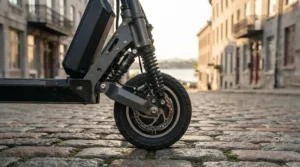
It’s a common assumption that a bigger motor number automatically means a longer-range scooter, and it’s genuinely one of the most misunderstood specs in this entire category. Motor wattage vs range is really a story about two different jobs: the motor determines how much force is available for acceleration and hill-climbing, while the battery’s watt-hour capacity determines how long that force can be sustained. A scooter like the Segway Ninebot MAX G2, with a modest 450W motor, achieves a competitive 43-mile claimed range precisely because a smaller motor sips less energy per kilometre on flat ground — while the dual 1,000W motors on the Kaabo Mantis 10 Pro+ can drain a substantially larger 1,470 Wh battery faster if both motors are used aggressively.
Here’s the practical takeaway: a high-wattage dual-motor scooter isn’t automatically a longer-range scooter — it’s a faster one that requires a proportionally bigger battery to match single-motor efficiency, which is exactly why models like the Apollo Phantom 2.0 pair their 3,500W peak output with a substantial 1,400 Wh pack rather than a smaller one. If maximum distance per charge is your only priority, an efficient single motor paired with the biggest reasonable battery — the approach the EMOVE Cruiser V2 takes — will consistently out-distance a powerful dual-motor scooter ridden the same way.
Large-Capacity Battery Packs: Wh, Ah, and Voltage Explained
Battery specs on scooter listings can look like alphabet soup, but understanding three numbers — voltage, amp-hours (Ah), and watt-hours (Wh) — makes comparing large-capacity battery packs across brands genuinely straightforward. Watt-hours, calculated as voltage multiplied by amp-hours, is the single most reliable number for comparing true battery capacity between models, since it accounts for both pressure (voltage) and volume (amp-hours) in one figure. That’s why the NAVEE ST3 Pro‘s 48V 12.75Ah pack (596.7 Wh) and the Segway Ninebot MAX G2‘s 36V 15.3Ah pack (551 Wh) end up with surprisingly similar real capacity despite very different voltage and amp-hour numbers individually.
Higher-voltage packs, like the 52V and 60V systems found in the EMOVE Cruiser V2 and dual-motor Kaabo Mantis 10 Pro+, generally deliver more consistent power output as the battery depletes, which is why performance-focused extended range electric scooter models increasingly favour 52V+ architectures over the 36V systems common in older, budget-tier scooters. Cell chemistry matters too: several premium models on this list, including the EMOVE Cruiser V2 and Apollo Phantom lineup, use automotive-grade 21700 lithium cells from established manufacturers like LG and Samsung, which generally offer better sustained discharge and longer cycle life than the generic cells found in unbranded budget scooters — a detail that’s rarely advertised prominently but matters enormously for how the battery ages over two or three years of regular use.
Long-Ride Battery Management: Tips for Maximizing Every Charge
Getting the advertised range out of any extended range electric scooter comes down to disciplined long-ride battery management rather than luck. Riding mode selection is the single biggest lever available to you: switching from Sport to Eco mode on a scooter like the NAVEE ST3 Pro can meaningfully extend a single charge, at the cost of reduced top speed and acceleration — a trade-off well worth making on longer rides where you’re not in a hurry. Smooth, gradual acceleration rather than repeated hard throttle bursts also measurably preserves charge, since aggressive acceleration draws disproportionately more current than steady-state cruising.
Temperature management deserves special attention for Canadian riders specifically. Cold batteries deliver less usable capacity, so on winter rides, consider keeping the scooter somewhere above freezing until just before departure rather than letting it sit in an unheated garage overnight. For genuinely long rides that push toward a scooter’s maximum claimed distance, riders on forums and review platforms consistently recommend a mixed strategy: cruise in Eco or Standard mode for the bulk of the ride, and reserve higher-power modes only for short bursts like merging into faster traffic or climbing a specific steep section, rather than running a high-power mode continuously from the first kilometre.
Premium Extended Range Electric Scooter vs Budget Models
The gap between a premium extended range electric scooter and a budget-tier equivalent isn’t just about top speed — it shows up in build materials, safety redundancy, and long-term reliability in ways that matter more the longer you own the scooter. Premium models like the Apollo Phantom 2.0 use aircraft-grade aluminum frames, IP66 water resistance, and automotive-format battery cells, while budget-tier scooters typically rely on standard aluminum alloys and IPX4-5 ratings that offer meaningfully less protection against Canadian sleet and slush.
| Factor | Budget Tier (e.g., Hiboy S2 Max) | Premium Tier (e.g., Apollo Phantom 2.0) |
|---|---|---|
| Frame & water resistance | Standard aluminum, IPX4-5 | Aircraft-grade aluminum, IP66 |
| Battery cell quality | Generic cells, basic BMS | Automotive-format cells, advanced BMS |
| Brakes | Single or dual mechanical/electronic | Full hydraulic with app-adjustable ABS |
| App ecosystem | Basic or none | Extensive (80+ settings, OTA updates) |
| Best For | First-time buyers, tight budgets | Serious daily riders wanting long-term durability |
The analysis here is straightforward: budget models are entirely reasonable choices for riders testing whether an extended range electric scooter fits their lifestyle at all, but riders who already know they’ll put serious daily mileage on a scooter for years tend to find that premium build quality — particularly around water resistance and brake redundancy — pays for itself in fewer repairs and a longer usable lifespan. Reviewers consistently note that mid-tier scooters like the NAVEE ST3 Pro offer a genuinely compelling middle path, borrowing some premium engineering choices like quad suspension without the full premium price tag.
Common Mistakes When Buying an Extended Range Electric Scooter
The most frequent mistake buyers make is trusting the headline range number without adjusting for real-world conditions — that “60-mile range” on the GoTrax GX3 box assumes a light rider at a slow, steady speed on flat ground, conditions that rarely match an actual Canadian commute. A second common error is under-budgeting for rider weight: buying a scooter rated right at your body weight, rather than with meaningful headroom, quietly costs you both range and motor longevity as the system works harder to move you.
Buyers also frequently skip checking provincial legality before purchasing, which matters enormously in Canada since e-scooter rules vary significantly by province and even by municipality. Another overlooked mistake is ignoring charger compatibility and charge time entirely — a scooter with an amazing range but a 12-hour charge time, like the EMOVE Cruiser V2, requires a genuinely different daily routine than a scooter that tops up in 4-5 hours, and that lifestyle fit matters as much as the spec sheet. Finally, many first-time buyers overlook total cost of ownership, forgetting to budget for a quality lock, winter storage, and eventual battery replacement when comparing an extended range electric scooter’s upfront price against a cheaper alternative.
Long-Term Cost & Maintenance
Sticker price is only the starting point for what an extended range electric scooter actually costs over its useful life, and this is where bigger batteries genuinely earn their keep. A scooter charged daily wears through roughly 300-365 charge cycles per year, while a scooter with double the battery capacity, ridden the same total distance, might only need half as many charge cycles — directly translating into a longer runway before the battery noticeably degrades.
| Cost Factor | Budget/Mid-Range Scooter | Extended-Range Premium Scooter |
|---|---|---|
| Typical purchase price | C$650-C$1,150 | C$1,900-C$3,400 |
| Estimated annual charge cycles (40 km/day rider) | 250-300+ | 100-150 |
| Replacement battery cost (typical) | C$250-C$400 | C$450-C$700 |
| Expected years before major battery degradation | 1.5-2.5 | 3-4+ |
Interpreting this table honestly: the upfront price gap between a Hiboy S2 Max and an EMOVE Cruiser V2 is substantial, but a rider putting serious daily mileage on their scooter may find the larger battery’s slower degradation curve narrows that gap considerably over a three-year ownership period. Beyond the battery itself, budget C$50-C$100 annually for tires, brake pads, and general upkeep across any model, and factor in that scooters used through Canadian winters — salted roads especially — tend to need more frequent brake and frame inspections regardless of price tier.
Safety, Regulations & Compliance Guide
Canadian e-scooter regulation is a genuine patchwork, and it’s worth understanding before you buy rather than after. At the federal level, Transport Canada’s Motor Vehicle Safety Regulations generally treat e-scooters capable of no more than 32 km/h as non-regulated at import, but actual on-road use is governed provincially and municipally, not federally. That means a scooter perfectly legal to buy and own may still be restricted from certain roads, sidewalks, or entire cities depending on where you live — Toronto, for instance, has historically prohibited e-scooter riding on its streets even as neighbouring municipalities run active pilot programs.
Provinces like British Columbia have published detailed electric kick scooter rules covering motor power caps (500W continuous), minimum rider age (16+), and where riding is permitted, and it’s genuinely worth checking your own province’s equivalent guidance before your first ride. Battery safety deserves equal attention: Canadian fire services have repeatedly warned about lithium-ion battery fires linked to e-scooters and e-bikes, with incidents rising sharply in cities like Toronto in recent years. Practical safety habits that meaningfully reduce risk include always using the charger that came with your scooter, never charging unattended overnight in a bedroom, unplugging once charging completes, and inspecting the battery pack periodically for swelling or damage — a small routine that protects both your investment and your home.
Frequently Asked Questions
❓ How far can an extended range electric scooter actually go in real conditions?
❓ Is a bigger battery always better for an extended range electric scooter?
❓ How long do large-capacity battery packs typically last before replacement?
❓ Are extended range electric scooters legal to ride in Canadian cities?
❓ What's the real difference between motor wattage vs range in practice?
Conclusion
Choosing the right extended range electric scooter really comes down to matching three things honestly: your real daily distance, your terrain, and how much you’re willing to spend for the comfort of not thinking about your battery every day. The Segway Ninebot MAX G2 and Hiboy S2 Max prove that genuine 60+ km range doesn’t require a four-figure budget, while riders tackling real hills will get more consistent performance from the 48V architecture in the NAVEE ST3 Pro. For anyone who wants speed alongside range, the Kaabo Mantis 10 Pro+ and GoTrax GX3 deliver dual-motor performance with the trade-offs that come with it, and riders chasing the absolute longest real-world distance per charge should look hard at the EMOVE Cruiser V2‘s enormous battery pack. At the top of the market, the Apollo Phantom 2.0 shows what happens when a brand refuses to compromise between power, range, and build quality.
None of these are perfect for everyone — that’s exactly why this list spans budget to premium rather than crowning one universal winner. Whatever you choose, remember that real range always trails the number on the box, Canadian winters will cost you some of that range regardless of model, and the smartest purchase is the one that actually matches how far you ride, not how far you wish you rode.
Recommended for You
- Long Range vs Standard Range Electric Scooter: 7 Best Picks 2026
- 7 Best Electric Scooter for Long Commutes Picks in 2026
- Cheap Long Range Electric Scooter Picks: 7 Tested for 2026
✨ Found this helpful? Share it with your friends! 💬🤗
