
In This Article
Nobody buys a top fast charging electric scooters under $1000 CAD to spend half their evening staring at a blinking charge light. If you commute, run errands, or just want your scooter ready to roll again before your coffee’s gone cold, charge time matters as much as top speed or range. A scooter that needs eight or nine hours to top up isn’t going to help you much if you only have a two-hour window between your commute home and your evening plans.
What is a fast charging electric scooter? In practical terms, it’s a scooter whose included charger can take the battery from empty to full in roughly four to six hours, rather than the seven-to-twelve-hour range common on budget models with underpowered chargers. The difference usually comes down to charger wattage, battery chemistry, and whether the manufacturer prioritized quick turnarounds over raw battery capacity…
We dug through spec sheets, Canadian retailer listings, and aggregated owner feedback to pull together seven real electric scooters that combine genuinely quick charge times with prices that stay under (or close to) that $1,000 CAD ceiling. Every pick below includes honest analysis of who each scooter suits, what the charging math actually means for your daily routine, and where the trade-offs hide. Nothing here is a rewritten spec sheet — it’s the reasoning you’d want from a knowledgeable friend before you hand over your credit card.
Quick Comparison Table
| Scooter | Charge Time | Battery | Price Range (CAD) | Best For |
|---|---|---|---|---|
| NIU KQi3 Pro | ~6 hours | 486Wh | around C$650-C$750 | Best all-round fast charger |
| Segway Ninebot MAX G2 | ~5 hours (built-in fast charger) | 551Wh | C$800-C$1,200 (sales dip lower) | Best long-range pick |
| Navee N65 | ~6 hours | 600Wh | C$650-C$800 | Best range-to-charge-time balance |
| TurboAnt X7 Max | ~5-6 hours (or instant with spare battery) | ~375Wh | C$650-C$700 | Best for apartment charging |
| NIU KQi3 Sport | under 5 hours | 365Wh | C$400-C$500 | Best budget fast charger |
| Hiboy S2 Pro | 4-6 hours | 410Wh | C$450-C$550 | Best entry-level commuter |
| Gotrax G4 | 4-5 hours | 374Wh | C$400-C$450 | Fastest charge among true budget picks |
Looking at the numbers, the fastest recharges tend to come from scooters with smaller battery packs — the Gotrax G4 and NIU KQi3 Sport both clear a full charge in under five hours simply because they’re not asking a home outlet to refill a huge pack. The Segway Ninebot MAX G2 is the outlier: its 551Wh battery is nearly 50% bigger than the NIU KQi3 Pro‘s, yet it charges just as fast thanks to a beefier built-in 3A charger. That’s the real lesson of this table — charge speed isn’t just about battery size, it’s about how much power the charger can push into that battery per hour.
💬 Just one click — help others make better buying decisions too!😊
Top 7 Fast Charging Electric Scooters Under $1000 CAD: Expert Analysis
1. NIU KQi3 Pro — 6-hour full charge with app-tracked battery stats
The standout here is simple: a 486Wh battery that tops up from empty in about six hours using the included charger, which is genuinely quick for a pack this size. The 350W-rated (700W peak) motor pairs with a 48V 10.1Ah battery to deliver a claimed 50 km range and a 32 km/h top speed, and NIU’s own spec sheet confirms the sub-6-hour charge window under normal conditions. Hill climbing tops out around 20%, which handles most urban inclines without the motor bogging down.
Based on the spec comparison against similarly priced commuters, what most buyers overlook about the KQi3 Pro is the regenerative braking system feeding a small amount of charge back into the battery every time you slow down — it won’t replace a wall charge, but it stretches your range on stop-and-go city routes. This scooter is for commuters who want a proven, well-supported brand without stepping into premium territory; NIU’s Toronto and Montreal service centres are a real advantage if something needs attention. Reviewers consistently note the tubeless 9.5-inch tires ride smoother than the solid tires on cheaper competitors, though a few mention the lack of front suspension on rougher pavement.
Pros:
- ✅ Genuinely 6-hour charge for a mid-size 486Wh battery
- ✅ NIU app tracks charge stats, speed modes and ride history
- ✅ Canadian service centres in Toronto and Montreal
Cons:
- ❌ No front suspension, so cracked pavement transmits through
- ❌ IP54 rating means light rain only, not downpours
Typically listed in the C$650-C$750 range at Canadian retailers, the KQi3 Pro earns its price with charge speed and brand support most budget alternatives can’t match.
2. Segway Ninebot MAX G2 — built-in 3A fast charger cuts a big battery down to 5 hours
The MAX G2’s standout is that its 551Wh battery — one of the largest in this roundup — still charges in roughly five hours thanks to a built-in 3A fast-charging circuit rather than the anemic 1.5-2A chargers bundled with cheaper scooters. That combination of 900-1000W peak motor output, dual front-and-rear suspension, and a manufacturer-rated 70 km range makes this the scooter to reach for if your commute is long and your patience for slow charging is short.
Here’s what to weigh: the MAX G2 frequently lists above C$1,000 at full retail, occasionally climbing past C$1,200, but it also shows up on sale at Canadian retailers dropping as low as the C$600-C$800 range during promotional periods — so this is the one pick on our list worth watching for a deal rather than assuming it always fits the budget. What the spec sheet won’t tell you, but reviewers note, is that the traction control system genuinely helps on wet pavement, a detail that matters more in a Canadian climate than most spec sheets bother to mention. Riders who’ve logged real mileage report the dual suspension smooths out expansion joints and gravel far better than single-suspension budget models.
Pros:
- ✅ 551Wh battery charges in ~5 hours via built-in fast charger
- ✅ Dual suspension handles rough pavement and gravel well
- ✅ Traction control noticeably improves grip in wet conditions
Cons:
- ❌ Regular price often exceeds C$1,000 outside of sales
- ❌ At roughly 24 kg, it’s heavier to carry up stairs
If you catch it in the C$700-C$900 window during a sale, the value proposition shifts dramatically in this scooter’s favour.
3. Navee N65 — 65 km of range with a straightforward 6-hour recharge
What stands out about the N65 is that Navee didn’t chase the smallest possible charge window at the expense of range — instead it balances a 600Wh (48V 12.5Ah) battery against a consistent 6-hour charge time across multiple retailer listings. The 500W motor (peaking near 900W) delivers a 32 km/h top speed and a 25% hill-climbing rating, numbers that hold up reasonably well against scooters costing considerably more.
On paper this means a rider doing 15-20 km of daily commuting could go three or four days between charges, which matters if your building’s shared charging outlet is inconveniently located. Based on the spec comparison with the NIU KQi3 Pro, the N65 trades some of NIU’s app polish for meaningfully more range per charge cycle — a fair trade for anyone whose priority is fewer plug-in sessions rather than bells and whistles. Aggregated owner feedback across retailer listings consistently flags the dual-rotation folding mechanism as a genuine convenience for elevator-and-hallway commutes, though the IPX4 water resistance rating means this isn’t a scooter for riding through standing puddles.
Pros:
- ✅ 600Wh battery still charges fully in about 6 hours
- ✅ 65 km claimed range reduces how often you need to plug in
- ✅ Dual-rotation fold is compact for elevators and hallways
Cons:
- ❌ IPX4 rating limits it to light rain, not heavy wet conditions
- ❌ App and connectivity features trail NIU’s ecosystem
Expect to pay roughly C$650-C$800 depending on retailer and promotions, positioning the N65 as one of the stronger range-per-charge-hour values on this list.
4. TurboAnt X7 Max — a swappable battery skips the charging wait entirely
The X7 Max’s standout feature isn’t actually its charge time on paper — it’s the detachable battery pack that lets you charge indoors, at a desk, or in a locker while the scooter itself stays parked wherever you left it. For apartment dwellers without an accessible outdoor outlet, that flexibility often matters more than shaving an hour off a stated charge time. The 350W-rated motor (700W peak) and roughly 375Wh battery deliver a claimed 25-32 mile range depending on riding mode.
Here’s what most buyers overlook about the swappable design: a second battery pack (sold separately) effectively eliminates downtime, since you can charge one indoors while riding on the other — a genuinely useful workaround for anyone in a high-rise without garage access. Reviewers consistently mention the aircraft-grade aluminum frame and 5.3-inch deck clearance make for a comfortable ride at this price point, though several owners note the suspension could use more refinement on rougher streets. This is the pick for renters, condo dwellers, and anyone who’s ever had to explain to a landlord why there’s an extension cord running out a window.
Pros:
- ✅ Detachable battery charges indoors without moving the scooter
- ✅ Optional spare battery effectively removes charging downtime
- ✅ Sturdy aluminum frame with a comfortable 275 lb load capacity
Cons:
- ❌ A spare battery is an extra cost, not included standard
- ❌ Suspension feels underbuilt compared to full front-and-rear setups
Typically found in the C$650-C$700 range in Canada, the X7 Max earns its spot on apartment-charging convenience alone.
5. NIU KQi3 Sport — sub-5-hour charge on the smallest budget in this lineup
The standout is straightforward: a smaller 365Wh (48V 7.6Ah) battery charges in under five hours, making the KQi3 Sport the quickest full charge of any scooter on this list. The trade-off is a more modest 300W-rated (600W peak) motor, a 40 km claimed range, and a 28 km/h top speed — numbers that make sense once you understand this is NIU’s entry point rather than its flagship.
Based on the spec comparison with its sibling, the KQi3 Pro, the Sport sacrifices roughly 20% of battery capacity to shave close to an hour off charge time and meaningfully lower the price. What most buyers overlook is that a 15% hill-climbing rating is genuinely fine for flat-to-moderate city terrain but will feel underpowered on steep residential streets — something worth testing in your own neighbourhood before committing. Reviewers consistently frame this as the scooter for shorter commutes (under 15 km round trip) rather than cross-city hauls, and NIU’s price-match policy and 2-year warranty carry over from the rest of the lineup, which is a real advantage over unbranded budget alternatives.
Pros:
- ✅ Under 5 hours for a full charge — the quickest here
- ✅ NIU’s 2-year warranty and Canadian support carry over
- ✅ Wider deck and handlebars than most budget competitors
Cons:
- ❌ 15% hill-climbing rating struggles on steep streets
- ❌ 40 km claimed range is modest for longer commutes
Frequently discounted, this scooter often lands in the C$400-C$500 range in Canada, making it one of the more accessible fast chargers on this list.
6. Hiboy S2 Pro — a 4-to-6-hour charge for under C$550
The Hiboy S2 Pro’s 36V 11.6Ah (410Wh) battery charges in a documented 4-to-6-hour window across multiple retailer listings, which is quick for a scooter that regularly sells for less than half the price of premium options on this list. A 500W motor (600W peak) delivers a claimed 40 km range and roughly 30 km/h top speed, respectable numbers for the price bracket.
What the spec sheet won’t tell you, but aggregated reviews suggest, is that the 10-inch honeycomb (airless) tires trade a slightly firmer ride for the total elimination of flat-tire risk — a fair swap for commuters who don’t want to think about tire pressure. Based on the spec comparison against pneumatic-tire competitors like the Gotrax G4, the S2 Pro’s dual rear suspension partially compensates for the firmer tires, though riders crossing frequent expansion joints or potholes will still feel more than they would on air-filled tires. This is the scooter for budget-conscious commuters who want dependable performance without fussing over tire maintenance.
Pros:
- ✅ 4-6 hour charge time for a sub-C$550 scooter
- ✅ Airless honeycomb tires mean no flat-tire risk
- ✅ Regenerative braking recharges slightly on downhill stretches
Cons:
- ❌ Honeycomb tires ride firmer than pneumatic alternatives
- ❌ 15° hill-climbing rating is modest for hilly routes
Canadian pricing typically runs C$450-C$550, making the S2 Pro one of the more approachable entry points into fast charging.
7. Gotrax G4 — the fastest charge among true budget picks
The G4’s standout is its charge window: 4 to 5 hours for a 374Wh (36V 10.4Ah) battery, according to Gotrax’s own charger documentation — genuinely fast for a scooter that routinely sells in the C$400-C$450 range. The 350W-rated (500W peak) rear-wheel motor produces a 20 mph top speed and a claimed 25-mile range, though real-world testing from independent reviewers puts practical range closer to 22 miles under mixed conditions.
Reviewers consistently note the G4 punches above its price point on hill-climbing thanks to the rear-wheel-drive layout, which puts more weight over the motor than front-wheel-drive budget alternatives. Based on the spec comparison with the NIU KQi3 Sport, the G4 charges at a comparable speed for roughly C$50-C$100 less, though it lacks NIU’s app ecosystem and Canadian service network. What most buyers overlook is the integrated tiller lock and digital code — a small but genuinely useful anti-theft feature rarely found on scooters this affordable.
Pros:
- ✅ 4-5 hour charge time on a genuinely budget scooter
- ✅ Rear-wheel drive handles hills better than similarly priced rivals
- ✅ Built-in tiller lock and digital code deter opportunistic theft
Cons:
- ❌ No mobile app or ride-tracking features
- ❌ 10-inch air-filled tires need occasional pressure checks
At roughly C$400-C$450, the G4 is the entry point for riders who want fast charging without stretching their budget at all.
Practical Usage Guide: Getting the Fastest, Safest Charge Every Time
Buying a fast charging scooter is only half the equation — how you charge it determines whether you actually see those quoted numbers. During the first 30 days, resist the urge to run the battery all the way to zero before every charge; lithium-ion batteries generally last longer when kept between roughly 20% and 90%, and topping up more frequently in smaller increments doesn’t meaningfully slow down a fast charger’s per-session speed.
Always use the charger that came in the box, or a manufacturer-approved replacement — mismatched voltage or amperage is one of the most common causes of both slow charging and, more seriously, battery damage. According to Health Canada’s review of lithium-ion battery safety requirements, improperly charged or mismatched-charger batteries are a recurring factor in overheating incidents, which is exactly why every scooter on this list ships with a charger matched to its specific voltage and amp rating.
A common first-month mistake is charging on a soft surface like a carpet or bed, which traps heat around the charger and battery. Charge on a hard, flat, ventilated surface, ideally somewhere you’d notice if something went wrong — not tucked in a closet overnight. Optimization-wise, charging in a room around 15-25°C keeps both charge speed and battery health closer to the manufacturer’s stated numbers; Canadian winters can meaningfully slow charging if the scooter is charged straight after coming in from the cold, so let it warm to room temperature first.
Apartment Charging Convenience: Solving the No-Garage, No-Outlet Problem
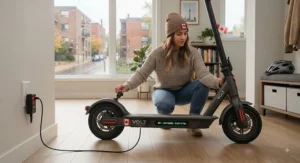
If you live in a condo or walk-up without a garage, “just plug it in overnight” isn’t always simple. Building policies increasingly restrict where lithium-ion devices can charge, hallway outlets are often locked or nonexistent, and hauling a 20+ kg scooter to a shared charging station gets old fast. This is precisely the scenario where charge speed and charging flexibility matter more than almost any other spec.
The practical fix comes in three forms. First, a swappable-battery scooter like the TurboAnt X7 Max lets you bring just the battery pack indoors — a few pounds instead of the whole frame — and charge it at a desk or by the door. Second, for scooters with fixed batteries, prioritize genuinely fast chargers (the NIU KQi3 Sport, Gotrax G4, and Hiboy S2 Pro all clear a full charge in well under six hours) so a single evening plug-in comfortably covers a morning commute. Third, check your building’s fire safety policy before you buy; several Canadian municipalities have issued specific guidance in response to rising incident numbers, and the Calgary Fire Department’s warning on lithium-ion charging practices is a useful, city-agnostic reference on using the correct charger and avoiding overnight charging unattended near exits.
For renters specifically: a fast charger paired with a compact folding scooter (most on this list fold to roughly 46 inches by 20 inches) means charging can happen entirely indoors, out of hallways and stairwells, without violating most standard lease terms around fire egress.
Real-World Scenarios: Who Actually Needs Fast Charging?
Picture a nursing student living in a fourth-floor walk-up near her downtown campus, riding roughly 12 km round trip between clinical placements. For her, a scooter like the NIU KQi3 Sport or Gotrax G4 makes sense — the under-5-hour charge fits neatly into an evening between shifts, and she doesn’t need 65 km of range she’ll never use.
Now picture a food delivery rider covering 40-50 km across a shift, with maybe a 90-minute break at most. The Segway Ninebot MAX G2‘s combination of a large 551Wh battery and a fast 5-hour built-in charger is the better fit here — enough range to finish a shift, and a charge window short enough to top up during a longer break without losing working hours.
And picture a condo dweller in a building with no accessible outdoor outlet, commuting to a suburban office rail station 8 km away. The TurboAnt X7 Max‘s swappable battery solves the access problem directly, letting the battery — not the whole scooter — travel indoors for charging, while the Navee N65 offers a fixed-battery alternative if the building does have an accessible plug and the priority is stretching days between charges rather than solving an access problem.
How to Choose a Fast Charging Electric Scooter Under $1000 CAD
- Match battery size to your actual commute, not your longest hypothetical ride. A 400Wh battery charging in 5 hours often beats a 600Wh battery charging in 9, unless you genuinely need the extra range every day.
- Check the charger’s amperage, not just watts advertised on the box. A 3A charger will typically outperform a 1.5A charger on an identically sized battery, even if the wattage numbers look similar on paper.
- Confirm the charge-time claim comes from the manufacturer’s own spec sheet, not a third-party estimate. Aggregated reviewer times are usually close but can run 30-60 minutes longer in real-world Canadian conditions, especially in winter.
- Weigh portability against battery size. Larger fast-charging batteries (like the Ninebot MAX G2’s 551Wh pack) add real weight, which matters if you’re carrying the scooter up stairs daily.
- Look for swappable-battery designs if you lack reliable outdoor charging access. This single feature solves more real-world charging headaches than any charge-time spec.
- Factor in Canadian winter charging behaviour. Cold batteries charge more slowly and lose some capacity; a scooter with headroom above your daily distance needs matters more once temperatures drop.
- Verify the included charger, not an optional fast-charger accessory, actually delivers the advertised time. Some brands sell separate fast chargers that cut time by roughly half — worth knowing before you assume the base charger hits the fastest number.
Fast Charging vs Standard Charging Electric Scooter: What’s the Real Difference?
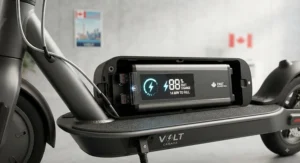
A fast charging electric scooter typically uses a charger delivering 2A to 3A or more, paired with battery management that can safely accept that current, resulting in a 4-to-6-hour full charge for most mid-size packs. A standard charging setup usually caps out around 1.5A to 2A, stretching that same battery to 7-12 hours — sometimes longer for larger packs, as seen with scooters that quote charge windows approaching 10-11 hours on their standard charger.
| Factor | Fast Charging | Standard Charging |
|---|---|---|
| Typical charger output | 2A-3A+ | 1.5A-2A |
| Full charge time (mid-size battery) | 4-6 hours | 7-12 hours |
| Best For | Renters, shift workers, tight schedules | Overnight-only charging, no time pressure |
| Trade-off | Slightly more heat generated during charge | Gentler on battery cells long-term |
The trade-off worth understanding: DC fast chargers push more energy into the battery per hour, which does generate more heat during charging, while standard AC chargers are gentler on the cells over hundreds of charge cycles. In practice, reputable manufacturers build in battery management systems specifically to handle this, so the difference in long-term battery health between a well-engineered fast charger and a standard one is smaller than the marketing gap suggests — but it’s still worth avoiding third-party “universal” fast chargers not rated for your specific scooter.
Charge Time Comparisons: Battery Size, Charger Output and Real-World Hours
| Scooter | Battery (Wh) | Charger Output | Manufacturer Charge Time |
|---|---|---|---|
| NIU KQi3 Sport | 365Wh | Standard | Under 5 hours |
| Gotrax G4 | 374Wh | Standard | 4-5 hours |
| Hiboy S2 Pro | 410Wh | Standard | 4-6 hours |
| TurboAnt X7 Max | ~375Wh | Standard / swappable | ~5-6 hours |
| NIU KQi3 Pro | 486Wh | Standard | ~6 hours |
| Navee N65 | 600Wh | Standard | ~6 hours |
| Segway Ninebot MAX G2 | 551Wh | Built-in 3A fast | ~5 hours |
Reading across this table, the Segway Ninebot MAX G2 stands out as the clearest proof that charger quality matters more than battery size alone — its 551Wh pack, larger than everything but the Navee N65, still charges faster than the smaller-battery NIU KQi3 Pro because of its built-in 3A charging circuit. For anyone comparing scooters purely by charge-time-per-watt-hour, the NIU KQi3 Sport and Gotrax G4 post the best ratios in this lineup, which explains why they’re the picks for riders prioritizing quick turnarounds above all else.
Included Charger Specs: What Ships in the Box
Every scooter on this list ships with a charger matched to its battery’s voltage — typically 42V for 36V battery systems or 54.6V-58.8V for 48V systems — and mismatching these is a real safety issue, not just a performance one. The included charger’s amperage is the number that actually predicts your charge time: a 42V/2A charger on a 10.4Ah battery produces a meaningfully different result than the same battery paired with a 1.5A charger, even though both are “included.”
What most buyers overlook when comparing spec sheets is that some brands, including Apollo, sell separate fast-charger accessories that cut charge time by roughly 50% compared to the standard included unit — meaning the box charger and the fastest possible charger for that scooter aren’t always the same thing. Reviewers consistently recommend checking whether a listed charge time refers to the included charger or an optional upgrade before comparing two scooters side by side, since a manufacturer quoting its fastest possible time (with an accessory charger) against a competitor’s baseline number isn’t really an apples-to-apples comparison.
Common Mistakes When Buying a Fast Charging Electric Scooter
The most common mistake is comparing charge times across listings without checking whether they’re measured from the same starting point — some brands quote 0-80%, which is meaningfully shorter than a true 0-100% figure used elsewhere. A second mistake is assuming a smaller battery is automatically the “fast charging” option; as the comparison table above shows, a well-engineered charger on a larger battery can outpace a weak charger on a smaller one.
Buyers also frequently overlook charging cost and cadence when budgeting — while the electricity itself costs only a few cents per charge, a scooter that needs charging every single day versus every third day changes how much that charger’s speed actually matters day to day. Finally, a subtle but costly mistake is buying a generic “universal” replacement charger to save money; using a charger not rated for your specific battery’s voltage and chemistry is one of the more preventable causes of the lithium-ion battery incidents Canadian fire departments have increasingly flagged in recent years.
What to Expect: Real-World Performance in Canadian Winters
Spec sheets are measured under ideal lab conditions — room temperature, a fresh battery, and a full-power outlet — none of which perfectly describes a Canadian winter. Cold temperatures slow the chemical reactions inside a lithium-ion cell, which can add 30 minutes to over an hour onto even a genuinely fast charger’s stated time, and charging a battery that just came in from -15°C weather is both slower and harder on long-term battery health.
The practical fix reviewers consistently recommend is letting the scooter acclimate to room temperature for 20-30 minutes before plugging in, rather than charging immediately after a cold ride. Range also drops in cold weather — often 10-20% below the manufacturer’s claimed figures — which means the “fast charging” advantage matters even more in winter, since you’ll likely be charging more frequently to compensate for the shorter range per charge.
Long-Term Cost & Maintenance: Battery Health and Charger Care
A lithium-ion battery’s usable lifespan is generally measured in charge cycles rather than years — most quality e-scooter batteries are rated for 500-800 full cycles before capacity noticeably declines, which for a daily commuter works out to roughly 1.5-2.5 years of regular use before you’ll notice reduced range. Fast charging doesn’t inherently shorten this window if the manufacturer’s battery management system is well-engineered, but consistently draining to 0% and immediately fast-charging to 100% every single day is harder on cell longevity than keeping charges in the 20-90% range most of the time.
Replacement batteries for scooters in this price range typically run C$150-C$300 depending on brand and capacity — a cost worth factoring into your total ownership math, especially for scooters like the TurboAnt X7 Max where a second battery is a genuine upgrade rather than just a replacement part. Chargers themselves are inexpensive to replace (usually C$30-C$60) if lost or damaged, but always source a manufacturer-approved replacement rather than a generic unit to avoid voltage mismatches.

Electric Scooter Charging Safety & Regulations in Canada
Transport Canada regulates how lithium batteries are labelled, packaged, and transported, while Health Canada oversees consumer product safety for the batteries themselves — and both agencies have flagged rising concerns as micromobility battery incidents climb across major Canadian cities. Practically, this means charging your scooter away from exit doors, never leaving it charging unattended overnight in a space you can’t monitor, and always using the manufacturer’s original charger rather than an off-brand replacement.
Provincial e-scooter regulations vary meaningfully across Canada — most provinces cap speeds around 24-32 km/h and require riders to be at least 16, though local municipalities can further restrict where scooters are legally ridden, so check your city’s specific rules before your first ride, separate from the charging safety guidance above. For a broader overview of how kick-style electric scooters are classified and regulated internationally, the Wikipedia entry on electric kick scooters is a useful starting reference, though Canadian riders should always defer to their specific province’s current rules over any general summary.
✨ Don’t Miss These Exclusive Deals!
🔍 Take your commute to the next level with these carefully selected fast charging electric scooters. Click on any highlighted pick to check current pricing and availability. These scooters will help you get where you’re going without the long wait on the charger! ⚡
Frequently Asked Questions
❓ How fast can a fast charging electric scooter actually charge in Canada?
❓ Is fast charging bad for an electric scooter's battery?
❓ What's the cheapest fast charging electric scooter under $1000 CAD?
❓ Can I charge an electric scooter in an apartment without a garage?
❓ Do included chargers differ in charging speed between brands?
Conclusion
Charge time isn’t the flashiest spec on an electric scooter’s listing, but it’s one of the specs that shapes your actual day-to-day relationship with the thing. A scooter with a big battery and a slow charger can leave you stranded on a night you needed a quick top-up, while a smaller, genuinely fast-charging pack might suit a short commute better than a bigger scooter ever could.
Across this list, the NIU KQi3 Pro stands out as the most balanced pick for most Canadian commuters, the Segway Ninebot MAX G2 rewards patience for a sale price if long range matters most, and the Gotrax G4 and NIU KQi3 Sport prove that fast charging doesn’t require a big budget. Whichever you choose, match the battery size and charge window to your actual commute rather than the biggest number on the spec sheet — that’s where the real value in a fast charging electric scooter under $1000 CAD shows up.
✨ Ready to stop waiting around for a charge?
🔍 Browse today’s prices on these fast charging electric scooters and find the one that fits your commute and your budget. Availability and pricing change often, so check current listings before you decide! ⚡🛴
Recommended for You
- Dual Battery Scooter for Heavy Riders: 7 Tough Picks (2026)
- Fast Charging Electric Scooter: 7 Top 2026 Picks
- Dual Battery Scooter for Extended Range: 7 Real 2026 Picks
Disclaimer: This article contains affiliate links. As an Amazon Associate, I earn from qualifying purchases. If you purchase products through these links, we may earn a small commission at no additional cost to you.
✨ Found this helpful? Share it with your friends! 💬🤗
