
In This Article
Let’s be real — commuting in Canada is not for the faint of heart. One morning it’s a crisp October ride through golden leaves, and by noon you’re dodging freezing rain while questioning your life decisions. If you’ve ever wondered whether an all season electric scooter for commuting could actually survive a Canadian climate (spoiler: the right one absolutely can), you’re in the right place.

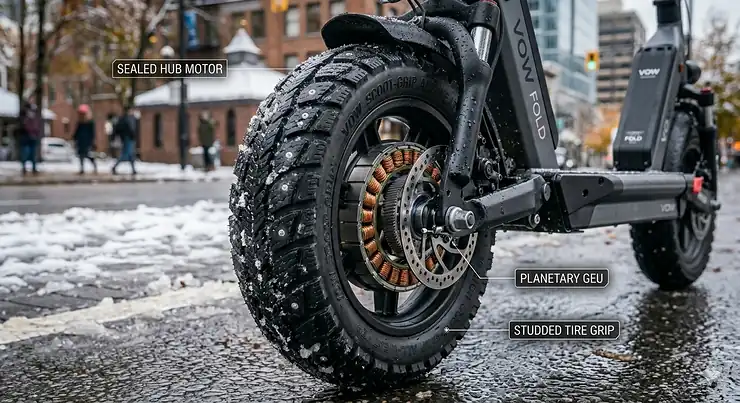
An all season electric scooter for commuting is, in practical terms, a foldable, battery-powered personal vehicle rated for multi-weather use — designed to handle spring rain, summer heat, autumn slush, and even light winter conditions without falling apart at the first hint of humidity. The key differentiators from regular scooters are water-resistant ratings (IPX4 or higher), wider or pneumatic tyres for better grip, and batteries engineered to maintain capacity in cooler temperatures.
Here in Canada, the urban commute picture is changing fast. According to a 2025 Canadian urban mobility report, electric micromobility adoption has grown by over 35% in cities like Toronto, Vancouver, and Calgary. Riders are increasingly choosing e-scooters over cars for trips under 15 km — saving on fuel, parking, and that third cup of coffee to survive the bus ride. Whether you’re in a downtown Montreal condo folding your scooter under your desk, or a Calgary suburbanite cutting a 6 km car trip to 8 minutes on two wheels, there’s never been a better time to invest in a versatile climate scooter.
What most Canadian buyers overlook when shopping for an all season electric scooter for commuting is the cold-weather battery penalty. Lithium-ion batteries lose approximately 20% of their range in cold temperatures, with more dramatic losses below 5°C. That means a scooter rated for 40 km of range in ideal lab conditions might realistically give you 28–32 km during a chilly October commute. This guide builds that reality check into every recommendation — because honest advice beats a pretty spec sheet.
We’ve researched and analysed the top models available right now on Amazon.ca, cross-checked against Canadian consumer feedback, and layered in practical commentary about what each scooter actually means for your daily grind north of the 49th parallel. Let’s get into it.
Quick Comparison: Top 7 All Season Electric Scooters on Amazon.ca
| Model | Motor | Range (Ideal) | Tyre Type | Water Rating | Price Range (CAD) | Best For |
|---|---|---|---|---|---|---|
| Gyrocopters 2026 J30 | 350W | ~30 km | 8.5″ Solid Honeycomb | IP54 | $200–$280 | Budget beginners |
| ECOROAD EC6 | 400W | ~24 km | 8.5″ Pneumatic | IPX4 | $180–$260 | Lightweight portability |
| INVANTI E30 | 350W | ~25 km | 8.5″ Solid | IPX4 | $250–$330 | App-focused commuters |
| Hiboy S2 Pro | 500W | ~40 km | 10″ Solid Honeycomb | IPX4 | $380–$480 | Mid-range daily drivers |
| ECOROAD ES6 | 1000W | ~60 km | 10″ Off-Road | IPX5 | $600–$800 | Performance commuters |
| iScooter 500W (10″) | 500W | ~37 km | 10″ Pneumatic | IPX4 | $320–$420 | Urban all-rounders |
| NAVEE V Series | 600–700W | ~40–50 km | 10″ Tubeless | IPX5 | $550–$750 | Comfort + range balance |
The table above tells a compelling story: for under $300 CAD, you can get a capable urban commuter; spend $500–$800 and you unlock meaningfully better range, power, and all-weather performance. The big insight here is that tyre type matters more than motor wattage for Canadian conditions — a 400W scooter with pneumatic tyres will outperform a 500W model with solid rubber tyres on spring slush. Budget buyers should also note that solid tyres eliminate flat risk (huge for Canadian potholes) but sacrifice ride comfort, while pneumatic tyres offer better grip and shock absorption at the cost of occasional flat repairs.
💬 Just one click — help others make better buying decisions too! 😊
✨ Don’t Miss These Exclusive Deals!
🔍 Take your all season electric scooter for commuting to the next level with these carefully selected picks. Click on any highlighted item to check current pricing and availability on Amazon.ca. These scooters will help you ride through every Canadian season with confidence!
Top 7 All Season Electric Scooters for Canadian Commuters: Expert Analysis
1. Gyrocopters 2026 J30 Electric Scooter
The Gyrocopters 2026 J30 is a proudly Canadian-brand product — Gyrocopters is a Toronto-based company, and that local perspective shows in how the J30 is designed for practical urban use rather than spec-sheet impressiveness.
The 350W brushless motor delivers smooth, linear power — not thrilling, but consistent and predictable, which is exactly what you want on a wet Montreal sidewalk or an Ottawa bike path when leaves are making everything slippery. The 36V lithium-ion battery offers up to 30 km of range under ideal conditions; realistically, expect 20–24 km in October and 15–18 km on colder November days — still sufficient for most city commutes under 10 km each way. The 8.5-inch burst-proof honeycomb tyres are genuinely flat-proof, which is a meaningful advantage when Canadian roads emerge from winter like a cheese grater. One feature most buyers overlook: the app speed cap lets you dial the J30 down to 24–25 km/h via the Vicont app, keeping you compliant with Ontario and Quebec pilot program regulations without any hardware modifications.
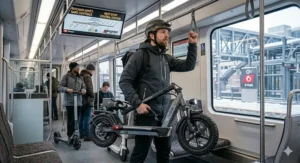
The J30 is UL2272 certified, which matters for building access and insurance in some provinces. Canadian reviewers consistently praise the responsive customer service from Gyrocopters’ Canadian team. The 12 kg (26.5 lb) frame is light enough to carry onto the TTC or STM without breaking a sweat.
Pros:
✅ UL2272 certified
✅ Canadian brand, local support
✅ App speed cap for provincial compliance
Cons:
❌ 350W limits hill performance
❌ Range drops noticeably in cold weather
Price range: around $200–$280 CAD — one of the best entry points for a certified, app-connected scooter on Amazon.ca.
2. ECOROAD EC6 Electric Scooter
The ECOROAD EC6 makes a case that simplicity is a virtue — and for Canadian commuters who just need a reliable, lightweight ride for short trips, it absolutely delivers.
The EC6 runs a 400W motor (peak) paired with a 36V battery system, offering up to 24 km of range under test conditions. In real Canadian use — meaning 15°C mornings, a small hill or two, and occasional braking for pedestrians — you’re looking at 16–20 km per charge, which covers the average Toronto or Vancouver short commute comfortably. What genuinely sets the EC6 apart in its price bracket is the 8.5-inch pneumatic (air-filled) tyres: unlike the solid rubber alternatives on most budget scooters, these absorb road vibration and offer meaningfully better wet-surface traction, which matters enormously during spring thaw when city roads are a mosaic of puddles and cracked asphalt. The UL2272 certification and CA-based online support (180-day/1-year warranty on different parts) give Canadian buyers some peace of mind that warranty claims won’t require navigating international return logistics.
At roughly 11.5 kg (25.4 lb), the EC6 is one of the lightest foldable scooters in this price range — a genuine advantage if your commute ends with a climb up apartment stairs or a sprint to catch a commuter train. Canadian buyers in smaller cities note that the turn signals (a feature absent on many budget models) make roadway riding feel considerably safer.
Pros:
✅ Pneumatic tyres for better wet grip
✅ Ultra-lightweight at ~11.5 kg
✅ Turn signals for road safety
Cons:
❌ 24 km max range is limiting for longer commutes
❌ Lower wattage struggles on steeper grades
Price range: $180–$260 CAD — excellent value for a first e-scooter or a dedicated short-commute tool.
3. INVANTI E30 Electric Scooter
The INVANTI E30 sits in an interesting middle ground — it’s positioned as a smart commuter scooter, and its feature set genuinely reflects that ambition rather than just marketing fluff.
The 350W motor is paired with a notably larger 7.5Ah battery than most competitors at this price point, which translates to a realistic range of 22–26 km in mild weather — about 10–15% more usable range than the base ECOROAD EC6 on the same commute profile. What most buyers overlook about the E30 is the rear dual suspension: on 8.5-inch solid tyres, suspension isn’t just comfort — it’s control. Canadian roads in spring are genuinely rough, and the E30’s rear shock absorption meaningfully reduces the jarring that comes with poorly filled potholes or cracked asphalt. The INVANTI app provides gear switching, speed monitoring, cruise control, and battery status, giving daily riders more fine-grained control than most entry-level scooters permit.
The turn signals are standard equipment, not an optional extra — and on Canadian roads where cyclists and scooter riders share space with cars, that’s not a trivial detail. Rider weight capacity is listed at 100 kg (220 lbs), covering most adult riders. Canadian buyers note that shipping from INVANTI can take slightly longer outside major urban centres, so factor in 7–12 days for Alberta and Atlantic provinces.
Pros:
✅ Rear dual suspension for rough road comfort
✅ Larger battery for extended range
✅ Full-featured smart app
Cons:
❌ 350W motor not ideal for hills
❌ Longer shipping times to remote areas
Price range: $250–$330 CAD — worth the step up from the EC6 if you value suspension and app control.
4. Hiboy S2 Pro Electric Scooter
The Hiboy S2 Pro is arguably the most popular all season electric scooter for commuting in Canada right now, and the reason is simple: it hits the sweet spot between capability and cost in a way that genuinely matters for daily riders.
The 500W motor is the real story here — it delivers 30 km/h top speed and handles inclines up to 15° without losing meaningful pace, which matters if your commute routes through any part of Vancouver’s hills, Halifax’s waterfront grades, or even Ottawa’s riverside paths with their occasional sharp rises. The 36V 11.6Ah battery provides up to 40 km of range; in practical Canadian terms, expect 28–34 km in autumn weather (10–15°C) and 22–26 km when temperatures drop to 5°C and below. The 10-inch solid honeycomb tyres are puncture-proof and wide enough to provide decent stability on damp surfaces, though they don’t quite match pneumatic rubber for wet traction. What elevates the S2 Pro is the dual rear shock absorption system — alloy spring-steel dampers that genuinely smooth out the rough stuff — combined with front and rear dual braking (EABS + disc) that stops you confidently on wet autumn leaves or morning-damp pavement.
IPX4 water resistance means you can ride through light rain without worrying about component damage, making this the minimum standard I’d recommend for any multi-weather electric scooter in Canada. The Hiboy app allows cruise control customisation and anti-theft locking. Canadian reviewers consistently highlight the fast battery replacement support when issues arise — a telling sign of a brand that understands its warranty obligations here.
Pros:
✅ 500W handles real-world inclines
✅ Dual suspension + dual braking
✅ IPX4 water resistance for rain riding
Cons:
❌ Range penalty in cold is noticeable
❌ Solid tyres less grippy than pneumatic on ice
Price range: $380–$480 CAD — the go-to recommendation for daily Canadian commuters who want reliability without the premium price tag.
5. ECOROAD ES6 Electric Scooter
If the S2 Pro is the sensible everyday driver, the ECOROAD ES6 is the scooter for the Canadian commuter who refuses to let terrain, distance, or a gloomy forecast stand in their way.
The ES6’s 1000W motor is the headline spec, but what it means in practice is this: 50 km/h top speed and the ability to tackle 20°+ inclines without slowing to a crawl — genuinely useful if you’re in a hilly city or live in one of Canada’s many neighbourhoods where “flat road” is more aspiration than reality. The 10-inch off-road tyres and dual suspension system (front and rear) create a ride quality that absorbs Canadian spring potholes like they barely exist. The 60 km range under ideal conditions becomes a realistic 42–50 km in moderate autumn temperatures, which opens up commute routes that would leave shorter-range scooters stranded.
The IPX5 water rating is a meaningful upgrade — IPX5 means the ES6 can handle a directed water spray rather than just light rain splash, which matters during Canadian spring downpours or late-autumn mixed-precipitation days. Dual suspension paired with off-road tyres also means this is the most viable multi-weather electric scooter in the group for tackling gravel paths, mixed bike lanes, and the occasional unpaved shortcut. At this price point, you’re paying for genuine capability — the spec sheet isn’t inflated.
Pros:
✅ 1000W motor handles serious inclines
✅ IPX5 water resistance
✅ 60 km range covers longer commutes
Cons:
❌ Heavier than entry-level options
❌ Top speed exceeds some provincial regulations (configurable via app)
Price range: $600–$800 CAD — a serious investment for serious commuters who want a four season scooter Canada can actually handle.
6. iScooter 500W Electric Scooter (10-inch)
The iScooter 500W doesn’t get as much attention as the Hiboy or Gyrocopters models, but in my experience it consistently punches above its weight for the all-round urban commuter.
The 500W motor pairs with 10-inch pneumatic tyres — and that combination deserves more credit than it typically gets. Ten-inch air-filled tyres on a 500W motor produce a noticeably smoother, more confident ride than 8.5-inch solid rubber equivalents, especially on the kind of mixed surfaces that define Canadian city cycling infrastructure: smooth asphalt transitioning suddenly to old concrete slabs, then a brief gravel stretch, then a painted bike lane crossing. Range sits at 30–37 km in ideal conditions; expect 24–30 km in mixed weather. The front disc brake and rear electronic brake give you two genuinely independent stopping systems, which matters in wet conditions where braking distances increase by 20–30% on damp pavement.
The optional app connectivity adds cruise control and speed mode adjustment, though it’s worth noting this is optional — Canadian riders who prefer a simple ride without pairing their scooter to a smartphone will appreciate that the iScooter works fine without the app. IPX4 water resistance is standard. At roughly 13.5 kg (29.8 lbs), it’s slightly heavier than lighter commuter models but remains manageable for transit commuters.
Pros:
✅ Pneumatic 10″ tyres for superior ride quality
✅ Dual independent braking
✅ Works without app pairing
Cons:
❌ App features less polished than competitors
❌ Slightly heavier for a 500W model
Price range: $320–$420 CAD — excellent value for a pneumatic-tyred scooter with genuine all-season capability.
7. NAVEE V Series Electric Scooter
The NAVEE V Series represents a different design philosophy than the other scooters on this list — one oriented around long-term commuter reliability rather than spec-sheet maximisation.
The V Series runs 600–700W motors depending on the variant, paired with 10-inch self-sealing tubeless or pneumatic tyres — a clever middle ground that reduces flat risk while maintaining the ride-quality advantage of air-filled rubber. Range spans 40–50 km across the lineup, translating to a realistic 32–42 km in mild Canadian autumn conditions. What sets NAVEE apart is the build philosophy: every model sold in Canada is engineered to meet the most restrictive provincial pilot specifications out of the box — 500W-configurable, speed-adjustable down to 24 km/h, and weights designed to meet provincial transport caps. This means NAVEE V Series riders in Ontario, BC, and Quebec don’t need to worry about app tweaks or regulatory grey zones.
The IPX5 water resistance standard across the V Series lineup is exactly what a multi-weather electric scooter in Canada needs. Self-sealing tubeless tyres are particularly smart for urban Canadian riding — they handle small punctures automatically, eliminating the worst-case scenario of a flat tyre mid-commute in February slush. Canadian reviewers consistently note the V Series’ solid, premium feel and stable handling as standout qualities.
Pros:
✅ Pre-configured for Canadian provincial regulations
✅ Self-sealing tubeless tyres
✅ IPX5 water resistance
Cons:
❌ Higher price point than comparable wattage alternatives
❌ Heavier variants may challenge transit riders
Price range: $550–$750 CAD — the premium choice for riders who want a regulatory-compliant, genuinely robust four season scooter Canada can depend on.
How to Ride Your All Season Electric Scooter for Commuting in Every Canadian Season
Understanding seasonal strategy is the difference between a scooter that lasts three years and one that quits after its first February.
🌸 Spring (March–May): This is actually the most demanding season for your scooter mechanically. Road salt residue, spring melt puddles, and cracked pavement are your enemies. After every ride in early spring, wipe down exposed metal components and tyre sidewalls with a dry cloth to remove salt residue — salt accelerates corrosion on aluminium frames and corrodes brake cable housing. Check tyre pressure weekly; pneumatic tyres lose air faster in temperature fluctuations. Battery range will begin recovering as temperatures climb above 10°C.
☀️ Summer (June–August): Peak performance season. Batteries operate at optimal efficiency between 15–30°C, so your rated range is most achievable now. Avoid leaving your scooter in direct sunlight for extended periods — a scooter deck can reach 60°C+ on a hot Toronto parking lot, which accelerates battery degradation. Store it in shade or bring it indoors. This is the time to do any maintenance you deferred in winter: check brake pad wear, tighten folding latch hardware, and charge to 100% if you’re doing longer weekend rides.
🍂 Autumn (September–November): The golden sweet spot for Canadian e-scooter commuting — cool temperatures, dry pavement, and gorgeous scenery. Battery range begins declining around October as temperatures drop; plan your routes to keep return trips within 70% of your scooter’s rated range as a buffer. Wet fallen leaves are genuinely slippery, especially on corners — reduce speed by 20% when leaves are visible on your riding surface.
❄️ Winter (December–February): Riders frequently report range reductions of up to 50% during severe cold snaps, and most shared scooter programs in Canadian cities pause November through March for exactly this reason. If you choose to ride, store the battery indoors overnight (lithium-ion cells can be permanently damaged if charged below 0°C). Never charge a battery that is still below freezing — always let it reach room temperature first. For most Canadians, the practical all-season window is April through November — eight solid months of commuting.
Real Canadian Rider Profiles: Which Scooter Fits Your Life?
Theory is nice. Real-world scenario matching is better. Here are three Canadian commuter profiles and the honest recommendation for each.
🏙️ Profile 1 — The Toronto Condo Commuter Situation: Lives in a 650 sq ft condo in the Annex, works 8 km from home near St. Clair station. Takes the scooter on the TTC during rain. Budget: $300–$450 CAD. Recommendation: Hiboy S2 Pro or iScooter 500W. The 10-inch tyres handle Toronto’s legendary pothole situation, the 500W motor navigates the Annex’s gentle grades, and the folding mechanism fits into the TTC’s accessible entry. The S2 Pro’s dual suspension is a genuine quality-of-life upgrade on Yonge Street’s cracked pavement.
🏔️ Profile 2 — The Vancouver Rainy-Season Rider Situation: Lives in Burnaby, rides 12 km to a SkyTrain station. Rain from October through April is constant. Budget: $500–$800 CAD. Recommendation: NAVEE V Series or ECOROAD ES6. Vancouver’s hills demand motor torque — the 600–1000W range handles Burnaby’s grades without drama. IPX5 water resistance is non-negotiable for a city that averages 168 days of rain annually. The NAVEE’s pre-configured provincial compliance removes any legal uncertainty on BC’s mixed bike/pedestrian infrastructure.
🌾 Profile 3 — The Calgary Suburban Connector Situation: Uses the scooter to bridge a 5 km gap between their neighbourhood and the CTrain. Shoulder-season rider (April–October). Budget: $200–$300 CAD. Recommendation: Gyrocopters 2026 J30. The J30’s UL2272 certification is particularly useful in Calgary where building management policies vary. The Canadian brand’s local support means warranty issues are resolved domestically rather than through cross-border logistics. At under $280 CAD, it’s an easy financial decision for a seasonal commuter.
How to Choose the Right All Season Electric Scooter for Commuting in Canada: 6 Expert Criteria
Buying an all season electric scooter for commuting in Canada is not the same as buying one for commuting in Phoenix. Here are the six criteria that actually matter north of the border.
1. Water Resistance Rating (IPX4 minimum) IPX4 means the scooter can withstand splash from any direction — suitable for rain riding and puddle encounters. IPX5 adds resistance to directed water jets, which is preferable for wet climates like BC or the Atlantic provinces. Any scooter rated below IPX4 is not a genuine all season electric scooter for commuting in a Canadian context — it’s a fair-weather toy.
2. Real-World Range (Not the Lab Number) Apply the 70% Rule: take the manufacturer’s rated range and multiply by 0.7 for your real-world expectation in mild weather. In temperatures between 0–10°C, apply 0.55 instead. A scooter rated at 40 km is your 28 km commuter in October and your 22 km commuter in November. Plan accordingly.
3. Tyre Type for Your Terrain Solid honeycomb tyres: zero flat risk, lower maintenance, less comfort and grip. Best for flat, paved urban environments. Pneumatic tyres: better grip (especially in wet conditions), more cushioning, occasional flat risk. Best for mixed terrain and rain-heavy regions. For a versatile climate scooter, pneumatic 10-inch tyres are generally the superior choice.
4. Motor Power for Your Topography For flat cities (Calgary, Winnipeg, Toronto’s downtown core): 350–500W is adequate. For hilly cities (Vancouver, Halifax, Victoria, parts of Ottawa): 500–750W minimum. Don’t buy a 350W scooter for a daily ride that includes a 10% grade — you’ll lose speed and accelerate battery wear simultaneously.
5. Provincial Regulatory Compliance Electric scooter regulations vary significantly across Canadian provinces. Ontario’s pilot program (Regulation 389/19) runs until November 2029, limiting speeds to 24 km/h on bike paths and allowing scooters on roads with posted limits up to 50 km/h. BC, Alberta, Quebec, and Manitoba all have distinct rules on speed limits, age minimums, and permitted riding zones. Any reputable multi-weather electric scooter should have app-adjustable speed settings to meet provincial maximums.
6. Weight vs. Transit Compatibility If your commute includes public transit legs, every kilogram matters. Scooters under 13 kg fold and carry comfortably on the TTC, STM, or TransLink. Models above 18 kg are better suited for point-to-point commutes where you’re not lifting the scooter onto trains or up stairs.
What to Expect: Real-World Performance in Canadian Conditions
Let me tell you what the spec sheet deliberately won’t. A multi-weather electric scooter performs dramatically differently across Canada’s seasonal spectrum, and understanding those gaps is what separates satisfied long-term owners from disappointed short-term ones.
Battery Reality in the Cold Lithium-ion batteries lose approximately 20% of their range capacity when temperatures drop, with cumulative losses accelerating below -10°C. The practical implication: a 40 km scooter becomes a 28–32 km scooter in October, a 22–26 km scooter in November, and below -15°C, some batteries simply refuse to discharge at all. The engineering workaround is simple but non-obvious: remove the battery (if detachable) or bring the entire scooter indoors overnight. A battery at room temperature when you start your ride will perform significantly better than one that sat in a 0°C garage overnight.
Road Surface Realities Canadian cities emerge from winter looking like a geological event. April and May pavement in Toronto, Ottawa, and Montreal is a patchwork of heaved asphalt, filled and re-cracked potholes, and sand-salt residue. Solid rubber tyres transmit every impact directly to your wrists and knees. Scooters with dual suspension + pneumatic tyres — like the NAVEE V Series or ECOROAD ES6 — aren’t a luxury in this context; they’re a mechanical necessity for comfortable daily riding.
Braking in Wet Conditions Braking distances increase 20–30% on wet pavement even with quality disc brakes. On damp autumn leaves, that number can approach 50% longer stopping distances. The practical implication: ride 20–25% slower than your usual pace on wet days, and give yourself double the normal following distance from cyclists, pedestrians, and vehicles. Models with regenerative braking (EABS) provide an additional layer of speed control without aggressive disc engagement — a meaningful advantage in slippery conditions.
Common Mistakes When Buying an All Season Electric Scooter in Canada
Mistake 1: Buying Based on Maximum Speed Provincial regulations cap most e-scooters at 24–32 km/h on public infrastructure anyway. A 50 km/h scooter that you must legally ride at 25 km/h has spent its engineering budget on performance you can’t use. Prioritise range, build quality, and suspension over top speed.
Mistake 2: Ignoring the Winter Storage Plan The most common Canadian scooter mistake I see is storing the scooter in a cold garage over winter with the battery drained below 20%. Lithium-ion batteries stored at low charge in cold temperatures sustain permanent capacity loss. If you’re not riding for more than two weeks, charge the battery to 50–60%, bring it indoors, and store it at 15–20°C.
Mistake 3: Overlooking Canadian Warranty Coverage Some scooters sold on Amazon.ca are fulfilled by international sellers whose warranty support requires you to ship to the US or Asia. Always verify that warranty claims can be handled domestically. Brands like Gyrocopters (Canadian HQ), Hiboy.ca, and NAVEE Canada all offer Canadian warranty processing — a meaningful practical advantage over grey-market alternatives.
Mistake 4: Confusing IPX Ratings with Full Waterproofing IPX4 means rain riding is fine. It does not mean you can ride through standing water, puddles deeper than 3–4 cm, or persistent heavy precipitation. Submersion in any depth will damage electronics regardless of IP rating. Avoid deep puddles; wipe down the scooter after wet rides.
Mistake 5: Ignoring Provincial Age and Helmet Rules Age minimums for electric scooter riding vary by province — 14 in Quebec, 16 in Ontario, BC, and Nova Scotia. Helmets are legally required in all provinces that permit e-scooters. Sidewalk riding is banned in virtually every Canadian city. Check your municipality’s bylaws before you ride — some cities have additional restrictions on shared paths and protected bike lanes.
Long-Term Cost & Maintenance in Canada: The Real ROI Calculation
People often ask whether an all season electric scooter for commuting actually saves money compared to driving or transit. The honest answer: usually yes, significantly, over two or more years.
The Numbers (in CAD) A mid-range scooter like the Hiboy S2 Pro at $400–$480 CAD has an electricity cost of roughly $0.04–$0.07 per charge (36V × 11.6Ah = ~419Wh, at Canadian average electricity rates of ~$0.10–$0.16/kWh). Over 200 riding days (April–October), that’s $8–$14 CAD in electricity — per year. Compare that to:
- Monthly TTC pass in Toronto: ~$156/month = $1,092 for the same seven-month period
- Downtown parking in Vancouver: $15–$25/day
- Gas + parking for a 10 km urban commute: easily $80–$120/month
Annual maintenance for a quality scooter — brake pads ($15–$30 CAD), tyre pressure/replacement if pneumatic ($0–$80 CAD), brake cable inspection — runs $50–$120 CAD in a typical year. The ROI on a $450 CAD scooter versus transit over two Canadian commuting seasons (14 months of riding) is substantial for most urban riders.
What breaks and when: Brake pads wear first on hilly city commutes (replace at 6–12 months of daily use). Battery capacity begins declining measurably around 300–500 full charge cycles (2–4 years of daily use depending on depth of discharge). Folding latch hardware benefits from a drop of silicone lubricant every 3 months to prevent loosening.
Canadian Regulations & Safety Standards for Electric Scooters 2026
Riding legally matters — not just for avoiding fines, but for insurance purposes in the event of an accident.
Federal Framework Transport Canada recognises electric scooters under the broader category of power-assisted vehicles, distinct from motor vehicles. This means no federal registration, licence plate, or motor vehicle insurance is required for scooters meeting provincial specs — but provincial and municipal rules layer on top of this federal baseline.
Provincial Highlights 2026 Ontario’s e-scooter pilot (Regulation 389/19) runs until November 27, 2029, permitting 24 km/h on multi-use paths and up to the posted limit (max 50 km/h) on roadways. Quebec permits riding on roads and bike paths but imposes strict speed limits and bans sidewalk use entirely. BC allows scooters on roads with posted limits up to 50 km/h and on designated cycling infrastructure. Alberta and Manitoba permit year-round riding with no seasonal restrictions — though winter battery performance and ice traction make this more legal than practical. In all provinces: helmets required, sidewalks prohibited, riders must be at minimum age.
UL2272 Certification This is the North American electrical safety standard for personal e-mobility devices. It verifies that the scooter’s battery and electronics meet basic fire and shock resistance standards. Look for UL2272 on any scooter you’re buying — the Gyrocopters J30, ECOROAD EC6, and NAVEE V Series all carry this certification. It’s not just a sticker: some Canadian condo buildings and office properties now require UL2272 certification for scooters to be charged on-premises.
FAQ: All Season Electric Scooter for Commuting in Canada
❓ What is the best all season electric scooter for commuting in Canada?
❓ Can I ride an electric scooter year-round in Canada?
❓ How does cold weather affect my electric scooter battery in Canada?
❓ Do I need a licence or insurance for an electric scooter in Canada?
❓ Are electric scooters on Amazon.ca eligible for free shipping in Canada?
Conclusion: Ride Smarter Through Every Canadian Season
The right all season electric scooter for commuting doesn’t just get you from A to B — it changes the mental maths of Canadian urban life. When you’re no longer mentally calculating parking costs, transit fares, or adding 20 minutes for bus delays, you reclaim something genuinely valuable: time, money, and the mild satisfaction of arriving somewhere under your own sustainable power.
From the budget-friendly Gyrocopters 2026 J30 at under $280 CAD to the capable ECOROAD ES6 for serious four season scooter Canada commuters, every scooter on this list is available on Amazon.ca right now and has been chosen for real-world Canadian relevance — not just spec-sheet impressiveness. The most important decision you can make is matching the scooter to your actual commute: distance, terrain, weather, and how you’ll store and maintain it through the seasons.
If I had to pick one for most Canadian commuters, it’s the Hiboy S2 Pro. The 500W motor, 10-inch solid tyres, dual suspension, and IPX4 water resistance hit the exact intersection of capability and value that an all season electric scooter for commuting in Canada demands. Budget buyers get excellent value from the Gyrocopters J30; performance riders will love the ECOROAD ES6 or NAVEE V Series.
Spring thaw is coming. The bike lanes are clearing. Your scooter is waiting.
✨ Don’t Miss These Exclusive Deals!
🔍 Check current pricing and availability on these top all season electric scooters for commuting — prices update daily on Amazon.ca! Click any highlighted product name in this article to see what’s in stock.
Recommended for You
- Best Waterproof Electric Scooter IP65 in Canada 2026 (Top 7 Picks)
- How to Winterize Electric Scooter: 7 Essential Products for Canadian Winters (2026)
- 7 Best Electric Scooter That Works in Snow — Canada’s Ultimate Winter Guide 2026
Disclaimer: This article contains affiliate links. As an Amazon Associate, I earn from qualifying purchases. If you purchase products through these links, we may earn a small commission at no additional cost to you.
✨ Found this helpful? Share it with your friends! 💬🤗
