
In This Article
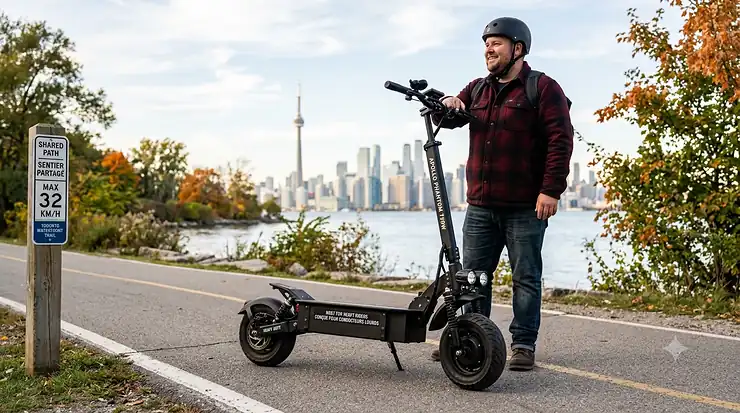
If you’re a bigger rider, you already know the problem: most electric scooters are designed around a 100 kg (220 lb) “average” person, and the moment you’re north of that, manufacturers either quietly cap your top speed or your warranty stops covering you. A 750w electric scooter for heavy rider Canada shoppers search for usually means one thing — enough torque and a strong enough frame that the scooter doesn’t feel like it’s working against you on hills, in headwinds, or hauling a backpack home from Costco.
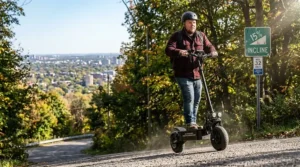
A 750W scooter, in plain terms, is a standing kick-style e-scooter with a motor rated at 750 watts continuous output — roughly 50% more than the most common 500W class, which translates into noticeably better hill-climbing and faster acceleration for riders who weigh more than the “average” test rider most spec sheets are built around.
Here’s the twist almost nobody tells you up front, and it’s the reason this guide leads with it instead of burying it in an FAQ: in most of Canada’s e-scooter pilot programs, a true 750W scooter sits above the legal power cap for unlicensed road use. We’ll walk through exactly what that means for you, province by province, after we cover the scooters themselves — because for a heavier rider, “which scooter is strongest” and “which scooter is legal where I actually ride” are two different questions, and the second one matters more.
Every model below was checked for current availability on Amazon.ca, with real model names, confirmed weight ratings where the listing publishes one, and price ranges in CAD (never exact prices — they shift too often to be reliable in print).
Quick Comparison: 750W-Class Scooters at a Glance
| Scooter | Motor | Max Load | Top Speed | Best For |
|---|---|---|---|---|
| ECOROAD EC10 | 750W | 120 kg (264 lb) | 40 km/h | Best all-round “true 750W” pick |
| iScooter 750W | 750W | 120 kg (264 lb) | 40 km/h | Off-road tires, budget-friendly |
| Hiboy KS4 Pro | 500W (750W peak) | Not stated for this model | 30 km/h | Lightest, easiest to carry |
| NAVEE V50 | 700W (max) | 120 kg (265 lb) | 32 km/h | Most polished commuter feel |
| Gyrocopters Sceptre | 800W (peak) | 120 kg (265 lb) | 38 km/h | Off-road tires + app control |
| ECOROAD ET6 | 800W | 150 kg (330 lb) | 45 km/h | Riders over 264 lb who still want a folding commuter |
| Circooter Cruiser Pro | 2,400W (dual motor) | 150 kg (330 lb) | 60+ km/h | Heaviest riders, private property/off-road only |
A pattern jumps out immediately: almost every scooter genuinely marketed as “750W” on Amazon.ca tops out around 120 kg (264 lb), not the 150+ kg some heavy-rider blogs imply. If you’re over that mark, your real options are either a brand that publishes an 800W+ “Pro” or “Plus” variant of the same chassis (the ECOROAD ET6 is a good example) or stepping into a completely different power class designed for off-road, private-property use, like the Circooter Cruiser Pro. Neither choice is wrong — but it’s worth knowing which bucket you’re actually shopping in before you compare prices.
💬 Just one click — help others make better buying decisions too! 😊
✨ Don’t Miss These Exclusive Deals!
🔍 Take your commute to the next level with these carefully selected picks. Click through to check current pricing and availability on Amazon.ca — availability and pricing can change daily, so confirm before you buy.
Top 7 Heavy-Duty Scooters in the 750W Class — Expert Breakdown
1. ECOROAD EC10
The ECOROAD EC10 is the closest thing on Amazon.ca to a textbook answer to “750W electric scooter for a heavy rider.” The 750W motor is rated for a 120 kg (264 lb) max load, and ECOROAD’s own spec sheet claims 15–20° slope climbing — in practice, that’s the difference between a steady climb up a Hamilton escarpment hill and the motor bogging down halfway up. The 540 Wh battery is rated for roughly 50 km, but expect that to drop noticeably for a 220+ lb rider, especially once temperatures fall below freezing.
What most buyers miss: the EC10 is sold on the same Amazon.ca listing as the ET6, an 800W variant rated to 150 kg (330 lb) — so if you’re between 264 and 330 lb, don’t write this listing off; check the variant dropdown before assuming it’s not for you.
✅ UL2272-tested, dual front/rear suspension, 10″ pneumatic tires
❌ 264 lb stock rating means anyone above that needs the ET6 variant; cold-weather range drop is steep
Price range: roughly $450–$650 CAD.
Best for: riders 200–264 lb who want a true 750W commuter with a known weight rating.
2. iScooter 750W Electric Scooter
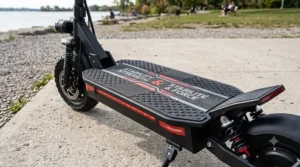
The iScooter 750W matches the EC10 on paper — 750W rear-drive motor, 120 kg (264 lb) max load, 40 km/h top speed — but leans into rougher terrain with 9.3″ off-road tread tires and dual suspension instead of a smoother street-commuter feel. For a heavier rider riding on cracked sidewalks or gravel multi-use paths rather than glass-smooth bike lanes, that tread pattern means less wheel-spin and a more stable platform when your full weight is pressing down through a pothole.
The trade-off most listings don’t spell out: more aggressive tread means slightly more rolling resistance, which on a heavier rider’s already-shortened range adds up. If your commute is mostly flat pavement, the EC10’s smoother tires will likely get you a few more kilometres per charge.
✅ Off-road tread, dual suspension, four selectable speed modes
❌ Knobbier tires trade a bit of efficiency for grip; range is “theoretical,” with rider weight and temperature both pulling it down
Price range: roughly $500–$700 CAD.
Best for: heavier riders on mixed pavement/gravel commutes.
3. Hiboy KS4 Pro
The Hiboy KS4 Pro is the lightest scooter on this list at 38.5 lb (about 17.5 kg), with a 500W motor that peaks at 750W under load — meaning the “750W” figure is a burst rating, not the sustained output you’ll get climbing a long hill. That distinction matters more for heavier riders than for anyone else, because sustained climbing is exactly where a 500W-rated motor under a 220+ lb rider will feel the strain first.
Hiboy doesn’t publish a separate maximum rider weight for this specific model on its Amazon.ca listing — a gap worth flagging rather than guessing at. If you’re a heavier rider seriously considering it, message Hiboy support through Amazon before ordering and get the weight rating in writing.
✅ UL2272-tested, EABS regenerative front braking, genuinely portable for elevators and transit
❌ Peak (not continuous) 750W rating; no published max-load figure for heavier riders to check against
Price range: roughly $400–$550 CAD.
Best for: lighter “heavy” riders (around 200–220 lb) who prioritize portability over raw torque.
4. NAVEE V50
The NAVEE V50 is the most “commuter-polished” entry here: 700W max power, a confirmed 120 kg (265 lb) load rating, IP55 water resistance, and UL2272 certification with documented test IDs on the listing — a small detail, but one that signals NAVEE is willing to be checked rather than just claiming a safety badge. The 18% incline rating and 50 km range are realistic for daily use rather than best-case marketing numbers.
In my read of the spec sheet, NAVEE’s strength for heavier riders isn’t outright power — it’s consistency. The dual E-ABS/disc brake system is tuned to stop a loaded scooter predictably, which matters more once you’re carrying an extra 50–80 lb of rider weight than another 50W of motor would.
✅ Confirmed 265 lb rating, IP55 weatherproofing, AirTag-ready hidden compartment
❌ 32 km/h top speed is on the slower end of this group; no off-road tire option in this model
Price range: roughly $550–$750 CAD.
Best for: heavier riders who want certainty over their weight rating in writing, not estimated.
5. Gyrocopters Sceptre
The Gyrocopters Sceptre brings an 800W peak motor, a confirmed 120 kg (265 lb) load rating, and genuinely off-road-capable 10″ tires with front/rear suspension — built by a Canadian-owned brand (IMGadgets), which is worth noting given how much of this category ships from overseas with a Canadian storefront bolted on. IP65 water resistance is a meaningfully higher bar than the IP55 most competitors quote, which matters for a Canadian buyer riding through slush, not just light rain.
The five speed modes (Walking, Eco, Drive, Sport, and an unlocked top mode) give a heavier rider real control: starting in Walking or Eco mode on a loaded scooter reduces strain on the motor and battery during acceleration, versus launching straight into Sport mode every time.
✅ Confirmed 265 lb load, IP65 rating, app-controlled anti-theft lock
❌ At 47.4 lb, it’s one of the heavier scooters here to carry up stairs
Price range: roughly $600–$850 CAD.
Best for: heavier riders who ride year-round in wet Canadian conditions.
6. ECOROAD ET6
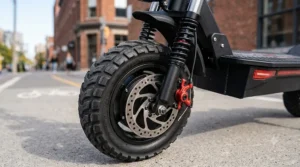
Already mentioned above as the EC10’s bigger sibling, the ECOROAD ET6 deserves its own line because it directly answers the question heavier riders ask most: “What if 264 lb isn’t enough?” At 800W and a 150 kg (330 lb) rated load, it’s purpose-built for exactly that gap between standard 750W scooters and full off-road builds — while still folding down into a commuter-sized package, unlike most 330 lb-rated scooters on Amazon.ca, which tend to be off-road-only designs.
What the spec sheet won’t tell you: a higher weight rating on the same general chassis as the EC10 usually means a reinforced deck and stiffer suspension tuning, not just a software speed limit — so expect a slightly firmer ride than the EC10 even for a lighter rider.
✅ 330 lb rated load in a still-foldable commuter format, 45 km/h top speed
❌ 800W and 45 km/h pushes this firmly outside every Canadian pilot program’s power and speed caps (more on that next)
Price range: roughly $550–$800 CAD.
Best for: riders over 264 lb who still want a foldable, commuter-style scooter.
7. Circooter Cruiser Pro
The Circooter Cruiser Pro is the “if 750W genuinely isn’t enough” option: dual 1,200W motors (2,400W combined), a confirmed 150 kg (330 lb) load rating, and a top speed north of 60 km/h. One buyer in the low-250 lb range described it as having power to spare with room to climb hills confidently — a useful data point, since most heavy-rider reviews for this category come from riders well under 200 lb.
Be clear-eyed about what this is: at 2,400W and 60+ km/h, the Cruiser Pro is in a different vehicle class entirely, not a stronger version of a 750W commuter scooter. It’s built and marketed for off-road and private-property riding, not for Canadian municipal pilot programs — a distinction the next section explains in detail.
✅ 330 lb rated load, dual hydraulic suspension, 0–60 km/h in roughly 3 seconds
❌ Far exceeds every provincial scooter pilot’s power and speed limits; realistically off-road/private-property use only in Canada
Price range: roughly $1,300–$1,600 CAD.
Best for: the heaviest riders who need serious torque and accept it’s not a road-legal commuter in Canada.
⚠️ The 750W Catch: What Canadian Law Actually Allows
This is the section most “heavy duty scooter Canada” articles skip, and it’s the single most important thing in this guide.
Canada has no single federal law for standing electric kick-scooters. Instead, each province runs its own pilot program, and every one of them currently caps motor power well below 750W for unlicensed, on-road or bike-lane use:
- British Columbia: the Electric Kick Scooter Pilot Project caps continuous motor output at 500W and top speed at 25 km/h, and only applies in “participating communities” (Vancouver, Victoria-area, Kelowna, and dozens more) — outside those communities, riding on public roads isn’t permitted at all, per the Government of British Columbia.
- Ontario: the provincial pilot runs until November 2029, but it leaves the specific rules — including whether e-scooters are allowed at all — up to each municipality. Toronto has opted out entirely and bans personal e-scooters from public roads, sidewalks, and trails, per the Government of Ontario.
- Quebec: the SAAQ-administered pilot likewise sets a 500W/25 km/h ceiling for personal scooters on bike paths and slower roads.
- Alberta: privately owned e-scooters are not legal on any public road, sidewalk, or pathway under the Traffic Safety Act — full stop. Only shared rental fleets in Calgary and Edmonton operate under municipal exemption.
Here’s the practical bite for a heavy rider specifically: the whole reason you’re shopping for 750W+ in the first place — more torque to handle your weight on hills — is the same horsepower that puts the scooter outside every one of these pilot caps. A genuine 750W EC10 or 800W Sceptre isn’t a “slightly faster” version of a legal scooter in BC or Quebec; on paper, it’s a different, higher-power category that those pilots weren’t written to cover. In practice, enforcement varies a lot by city and officer, and many riders do use 750W-class scooters without incident — but “commonly tolerated” and “explicitly legal” aren’t the same thing, and fines in Ontario’s pilot range from $250 to $2,500 for violations.
What this means in practice for most buyers in this guide:
- If you’re in a BC or Quebec pilot community and want to be unambiguously road-legal, you’re looking at a 500W-class scooter, not the 750W+ models above — a genuinely frustrating trade-off for a heavier rider, but an honest one.
- If you’re in Toronto or anywhere in Alberta, personal e-scooters of any wattage aren’t legal on public roads regardless — which actually removes the “is 750W too much” question and reframes it as “is this for private property.”
- If you’re commuting through a participating municipality that’s loosely enforcing the cap, a 750W scooter is a calculated risk, not a guaranteed problem — but budget mentally for the possibility of a fine, and never assume insurance or warranty coverage extends to an unauthorized-use incident.
This is also why the Circooter Cruiser Pro and the ECOROAD ET6 are framed above as private-property/off-road picks rather than commuter scooters — at 800W–2,400W, they’re nowhere near any provincial pilot’s ceiling, anywhere in the country.
How to Choose the Right Scooter for Your Weight in Canada
- Confirm your actual riding location’s legal status first, not last — check whether your city participates in your province’s pilot before comparing motor specs. A scooter that’s “the best” on paper is the wrong purchase if you can’t legally ride it where you live.
- Treat published weight limits as a soft ceiling, not a target. A scooter rated for 120 kg performs best with meaningful headroom below that line — riding right at the limit accelerates wear on tires, brakes, and the motor itself.
- Prioritize torque and braking over top speed. A heavier rider benefits far more from confident hill-climbing and short stopping distances than from an extra 5–10 km/h of top speed.
- Check for a published continuous wattage, not just a “peak” number. Peak wattage is a burst figure; continuous wattage is what determines how the scooter performs on a five-minute uphill grind.
- Factor in winter range loss before you buy, not after. Cold Canadian temperatures cut lithium battery range by roughly 20–30%, and a heavier rider already trims range further than the “average” 165 lb test rider most range figures are based on — stack both factors before assuming a 50 km range will get you through a January commute.
- Decide whether you need a folding commuter or an off-road build. Riders over roughly 264 lb (120 kg) often have to choose between a higher-rated folding scooter (like the ECOROAD ET6) or a heavier, non-folding off-road platform (like the Circooter Cruiser Pro) — few products bridge both well.
- Budget for accessories you’ll actually need: a quality lock, fender mudflaps for road salt, and indoor battery storage for winter are small costs that protect a much bigger one.
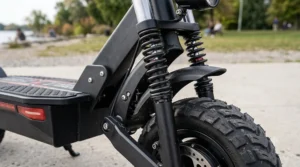
Real-World Scenarios: Matching a Scooter to Your Commute
The Vancouver participating-community commuter: Riding a daily 6 km route through a BC pilot city on bike lanes and slower roads, the priority is staying within the 500W/25 km/h pilot limit while still getting reasonable performance for a heavier frame — meaning even the scooters in this guide should be treated as a calculated trade-off, not a default choice, until you’ve confirmed your specific city’s current rules.
The Toronto condo dweller riding on private property or designated trails only: Since Toronto has opted out of Ontario’s pilot, a personal e-scooter isn’t road-legal here regardless of wattage. For this rider, a higher-power option like the Gyrocopters Sceptre or even the Circooter Cruiser Pro makes more sense, used strictly on private land, in a park system that explicitly allows it, or transported to a participating municipality nearby.
The Calgary suburban rider needing genuine off-road capability: With personal e-scooters barred from Alberta public roads outright, the calculus shifts entirely toward private-acreage or trail riding, where the Circooter Cruiser Pro’s 30° climbing rating and 150 kg load capacity have real value without any legal ambiguity to worry about.
Common Mistakes Heavy Riders Make When Buying
❌ Assuming “750W” always means a 264 lb+ weight rating. As this guide shows, the wattage and the load rating are set independently by each manufacturer — always check the specific number, not the motor size, before assuming fit.
❌ Ignoring the wattage cap in their own province. Buying the most powerful scooter available, then discovering it isn’t legal to ride to work, is the single most common and most avoidable mistake in this category.
❌ Skipping winter storage habits. Leaving a lithium battery in an unheated garage overnight can permanently reduce its capacity — bring it inside.
❌ Overlooking total cost of ownership. A cheaper scooter with a thin warranty and no Canadian service centre can cost more in the long run than a pricier model backed by local support.
❌ Riding right at the stated weight limit with a heavy bag or cargo on top. Add your typical carried weight (laptop bag, groceries) to your own before comparing it to a published max load.
Winter Care & Long-Term Cost in Canada
A heavier rider’s real cost of ownership in Canada has three components worth budgeting for honestly, in CAD: the scooter itself, a winter-specific maintenance routine, and faster wear on consumables.
For maintenance, bring the battery indoors between rides once temperatures drop near freezing — cold storage is the single biggest cause of permanent range loss in this category, more than charge cycles alone. Rinse road salt off the frame, fork, and brake components regularly through winter; salt accelerates corrosion on the same components a heavier rider already loads more heavily. Expect to replace pneumatic tires somewhat more often than a lighter rider would, simply due to the added load on tread and sidewalls — budgeting roughly $40–$80 CAD per tire replacement is reasonable for most models here.
On total cost: a $500 CAD scooter that needs a $150 battery replacement after one winter of improper storage isn’t actually cheaper than a $700 CAD model with a documented IP65 rating and a one-year warranty that covers electrical components. Weigh sticker price against warranty terms, not just against the spec sheet.
FAQ
❓ Is a 750W electric scooter legal to ride on the road in Canada?
❓ What's the actual weight limit for a 750W scooter?
❓ Does cold Canadian weather really reduce e-scooter range that much?
❓ Can I ride a 750W scooter on Amazon.ca on a bike path instead of the road?
❓ What ships free on Amazon.ca for electric scooters?
Conclusion
For a heavier rider, the right 750W-class scooter isn’t necessarily the one with the biggest number on the spec sheet — it’s the one whose weight rating, wattage, and your own province’s pilot rules all line up with how and where you’ll actually ride. The ECOROAD EC10 and NAVEE V50 are the most straightforward fits for riders up to about 264 lb who want road-legal-adjacent commuting (with the legal caveats above firmly in mind), the ECOROAD ET6 and Circooter Cruiser Pro cover riders who’ve outgrown that bracket, and the regulatory landscape — not the motor — is genuinely the deciding factor for a growing number of Canadian cities. Check your municipality’s current e-scooter rules first, match your real weight (plus cargo) to a published load rating second, and only then compare prices.
✨ Don’t Miss These Exclusive Deals!
🔍 Ready to stay dry on your next adventure? Click through to check current pricing and availability for any pick above on Amazon.ca, and keep a pair of packable rain pants in your bag before the next Canadian forecast surprises you.
Recommended for You
- Is 500W Enough for an Electric Scooter? 7 Best Picks in Canada 2026
- Best 500W Electric Scooter Canada 2026: 7 Top Picks Reviewed
- 7 Best Winter Electric Scooter Brands in Canada (2026 Guide)
Disclaimer: This article contains affiliate links. As an Amazon Associate, I earn from qualifying purchases. If you purchase products through these links, we may earn a small commission at no additional cost to you.
✨ Found this helpful? Share it with your friends! 💬🤗
